
 |
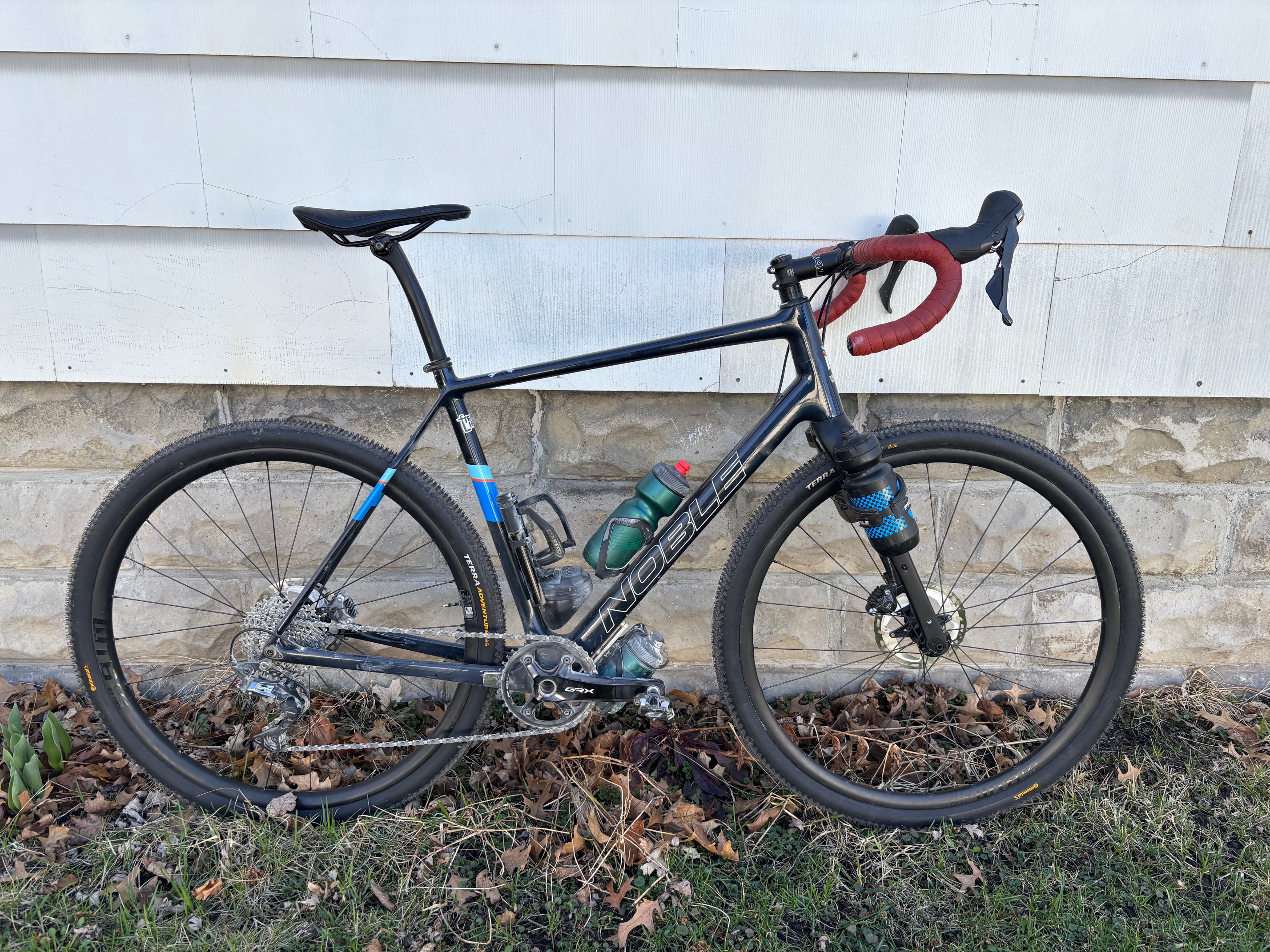
| The bike I used for testing: Noble GX5 |
Now, let's dive into this subject again by taking a look at whether you can do a wider tire to your current bike, what you can do to gain some advantages via modification, and how this may affect geometry on your bike.
You may not realize this, but any bicycle you purchase through a major brand has probably been made to comply with several European standards so they can be sold in Europe. Typically those standards which must be met are more stringent than Consumer Product Safety Commission (CPSC) standards which hold sway in the US. Specifically to tire clearance, the CPSC standard is 1.6mm clearance from the tire to a fork or frame member. (According to a Google search) I was told several years ago by a product manager for a mid-tier brand in the US that the Euro regs. were 5mm clearance. So, your bicycle may be equipped with tires which are not really the "maximum" size that you could use. Of course, what I am about to share here is all what I have done. I do not recommend that you do this, and if you push tire clearances, that's on you. You are responsible for any choices you make here.
Do You Need A New Bike?
Many newer gravel bikes are turnkey wide tire capable rigs. However; you may not "need" to go out and grab one of these bikes, and this may be determined by a few options you have available to you. First, as stated above, it is highly likely that your current bike can be fitted with a wider tire. I'll tell you about my bicycle, but as for you, you are on your own!

I discovered that the Noble GX5 can easily handle 45mm tires. That is already a pretty significant difference, but then I decided to push the limits and I found I could squeeze in a 47mm tire with about a millimeter of clearance at the chain stays.
So, in dry conditions, not anything wet, I can run a 47mm tire without any issues for myself. I understand the risks of doing this and I can sleep at night with this knowledge. Now....if it were wet? Yeah, I am running a different, narrower tire, but so do the Pros! Dylan Johnson isn't going to run a beefy 29"er tire at Unbound if it is wet. (I've heard him say this exact thing on a YouTube video)
So, think about this. It might be an option for you. In all likelihood your stock tires were very conservative spec and you probably can use a wider tire on your current bike. Especially in the fork, since forks have very little technical hurdles to allowing for clearance. Maybe you can use a LOT wider tire up front, and for some folks, this may be all you need. Wide front/narrow rear tire setups were very commonplace in the 1990's for XC MTB usage, so this idea has merit for gravel bikes as well.
 |
| 29" x 2.3" front, 700 x 47mm rear in a bike spec'ed as a 40mm tire bike. |
I tried this on my Noble Bike GX5. I should also mention I changed out the front fork for a State Bicycle Co Monster Gravel Fork V2. This allowed for a ridiculously sized, (for a gravel bike) 29"er tire to be installed. My stock fork would have easily taken a 50mm tire though.
So, what is this like? Well, there are a few things to consider if you want to use the bicycle you have and go with a fatter tire up front. First off, the geometry is going to be affected a little bit. In my case, I went from a 70° head angle with the Monster Fork installed fitted with a 700 X 45mm tire front/rear to a 69° front end with the 29" X 2.3|/700 X 47mm set up. I also raised my bottom bracket slightly, and I found my saddle was tilted up a tiny bit as well due to the change. So, keep in mind that a bigger tire up front can affect more than you might think.
In terms of handling, I got a tiny bit of "wander" while riding really slow, so this is when your handle bars want to fall to the right or left a bit. Technically it is called "wheel flop", but I wouldn't be put off by this in my case. Once up to riding speeds I could not detect this at all. Obviously, a slightly slacker head angle will stabilize the bike, with no other geometry changes, so I did gain a tiny fraction of stability here as well as getting a poofier front tire with more comfort and traction.
Next: What alternative bikes do similar things, why these are great choices, and why you may not want wider tires in the first place.


