Thursday, March 25, 2021

People Will Forget Until You Remind Them

In response to how folks perceived MTB's when they came out.
I read this bit of wisdom from an old dirt car racer on Twitter one day. He said: "People will forget until you remind them", and he'd proceed to talk about some accomplishment in racing he or his family achieved. It sounds like bragging when you read it the first time, but he's right, you know. People forget their history- or never knew it to begin with - and spout off some pronouncement that they probably wouldn't have with some perspective and knowledge of history. Such was the case earlier this week when Russ from the "Path Less Pedaled" was musing on why folks "hate on" gravel bikes. 

Generally speaking from my experience over the past fifteen years of talking about bikes for the purposes of riding on gravel, dirt roads, and bad pavement, I can say that most people's responses to the term and the existence of 'gravel bikes' lack a knowledge of history and a perspective on the subject. Sometimes the responses are near the mark, sure, but most times they lack any consideration of, or knowledge of, what has gone on before all this modern day 'gravel bike' nonsense. 

Now, you longtime blog readers all know this, more than likely, but my take on an all-terrain road bike is one drawn from history. Use bigger tires, like they used to, use slacker geometry, like they used to, and a lower bottom bracket with moderate length chain stays, just like they used to, only do it all up with modern materials technology. This was, and is, to my way of thinking, the any-man's road bike, with the 'man' part referring to humans as a species, okay? 

So, this all came up when it was pushed out on Monday on social media that certain groups of people were 'angered', (bent out of shape?), by the term 'gravel bike' and the question above was posted which you can see my answer to. Historically, no one I ever read, spoke to, or knew of thought that MTB's were just "road bikes with fat tires". In fact, if you thought that then, you'd likely not find many folks to ride with either in the roadie camp or the MTB camp. The gulf between the two was real, as crazy as it may seem today. 

Of course, this went further on in discussion until the term 'gravel grinder' came up, which is the other thing that seems to tweak some people off. But as I pointed out in that thread, and have pointed out numerous times here, that is not a construct of modern day gravel marketing. It existed as a 'thing' long before the popularity of 'gravel events' took off in the mid-00's. 

Courtesy of Richard Masoner's Tweet
I've often told the story here that Iowa and other Mid-Western roadies would often use rural roads to train on for late spring criterium racing. They referred to these early season training rides on crushed rock roads as 'gravel grinds', and going out for a 'gravel grinder' was understood to mean that you were going to go on a training ride on gravel roads for their higher resistance and more hilly terrain. 

This term was adopted by early race promoters who put on mountain bike races on gravel roads. Then, it became the obvious term to borrow for races and events put on gravel for any type of bicycle you wanted to haul out. It was a natural progression, and as such, was never meant to be a marketing term. It was adopted by the followers in the gravel event promoting ranks and then went on to represent the segment of racing and riding that was on gravel. This also probably explains why marketers adopted 'gravel' for the components and bicycles used at such events. I cannot say for certain, but that's a logical assumption on my part. Your mileage may vary. 

And as you can see, I'm not the only one that thinks this way about where that term came from. I know some folks might think we 'made that up', but we didn't. It was a term we borrowed that made sense to us in the mid-2000's. So, whether or not that 'irritates' you, the term has a history and means something that maybe you may not have considered. That may not make you feel any better about that term, but it isn't going away and for good reason. 

It reminds me of how 'mountain bikes' came about as a descriptive term for those types of off-road, fat tire bikes. That term- Mountain Bikes -was actually a brand name at first. It was what Gray Fisher and Charlie Kelly called their fledgling all terrain bicycle company. But the popularity of the name ended up becoming the term for the whole genre of off-road bicycles. Think about how dumb that is. I mean, you don't have to have mountains to ride those bikes, right? Surely "All-Terrain" should have won out. But, as we all know, it did not. 

So, there is a precedent for how a silly name becomes a term for a whole category of bicycles. I'm no fan of 'gravel bike', and you long time readers all know that. But I've been over-ruled and the market has spoken, so gravel bikes it is. 

And as far as 'gravel grinders' go, well, you can call your rides whatever you want to, but where I'm from, these crushed rock road rambles have been called that since long before I was big enough to ride gravel roads. So, it is a tradition we carry on with here. I see no harm in that term. I also don't see that term, as annoying as some think it is, going away either. Convince me otherwise....

People Will Forget Until You Remind Them

In response to how folks perceived MTB's when they came out.
I read this bit of wisdom from an old dirt car racer on Twitter one day. He said: "People will forget until you remind them", and he'd proceed to talk about some accomplishment in racing he or his family achieved. It sounds like bragging when you read it the first time, but he's right, you know. People forget their history- or never knew it to begin with - and spout off some pronouncement that they probably wouldn't have with some perspective and knowledge of history. Such was the case earlier this week when Russ from the "Path Less Pedaled" was musing on why folks "hate on" gravel bikes. 

Generally speaking from my experience over the past fifteen years of talking about bikes for the purposes of riding on gravel, dirt roads, and bad pavement, I can say that most people's responses to the term and the existence of 'gravel bikes' lack a knowledge of history and a perspective on the subject. Sometimes the responses are near the mark, sure, but most times they lack any consideration of, or knowledge of, what has gone on before all this modern day 'gravel bike' nonsense. 

Now, you longtime blog readers all know this, more than likely, but my take on an all-terrain road bike is one drawn from history. Use bigger tires, like they used to, use slacker geometry, like they used to, and a lower bottom bracket with moderate length chain stays, just like they used to, only do it all up with modern materials technology. This was, and is, to my way of thinking, the any-man's road bike, with the 'man' part referring to humans as a species, okay? 

So, this all came up when it was pushed out on Monday on social media that certain groups of people were 'angered', (bent out of shape?), by the term 'gravel bike' and the question above was posted which you can see my answer to. Historically, no one I ever read, spoke to, or knew of thought that MTB's were just "road bikes with fat tires". In fact, if you thought that then, you'd likely not find many folks to ride with either in the roadie camp or the MTB camp. The gulf between the two was real, as crazy as it may seem today. 

Of course, this went further on in discussion until the term 'gravel grinder' came up, which is the other thing that seems to tweak some people off. But as I pointed out in that thread, and have pointed out numerous times here, that is not a construct of modern day gravel marketing. It existed as a 'thing' long before the popularity of 'gravel events' took off in the mid-00's. 

Courtesy of Richard Masoner's Tweet
I've often told the story here that Iowa and other Mid-Western roadies would often use rural roads to train on for late spring criterium racing. They referred to these early season training rides on crushed rock roads as 'gravel grinds', and going out for a 'gravel grinder' was understood to mean that you were going to go on a training ride on gravel roads for their higher resistance and more hilly terrain. 

This term was adopted by early race promoters who put on mountain bike races on gravel roads. Then, it became the obvious term to borrow for races and events put on gravel for any type of bicycle you wanted to haul out. It was a natural progression, and as such, was never meant to be a marketing term. It was adopted by the followers in the gravel event promoting ranks and then went on to represent the segment of racing and riding that was on gravel. This also probably explains why marketers adopted 'gravel' for the components and bicycles used at such events. I cannot say for certain, but that's a logical assumption on my part. Your mileage may vary. 

And as you can see, I'm not the only one that thinks this way about where that term came from. I know some folks might think we 'made that up', but we didn't. It was a term we borrowed that made sense to us in the mid-2000's. So, whether or not that 'irritates' you, the term has a history and means something that maybe you may not have considered. That may not make you feel any better about that term, but it isn't going away and for good reason. 

It reminds me of how 'mountain bikes' came about as a descriptive term for those types of off-road, fat tire bikes. That term- Mountain Bikes -was actually a brand name at first. It was what Gray Fisher and Charlie Kelly called their fledgling all terrain bicycle company. But the popularity of the name ended up becoming the term for the whole genre of off-road bicycles. Think about how dumb that is. I mean, you don't have to have mountains to ride those bikes, right? Surely "All-Terrain" should have won out. But, as we all know, it did not. 

So, there is a precedent for how a silly name becomes a term for a whole category of bicycles. I'm no fan of 'gravel bike', and you long time readers all know that. But I've been over-ruled and the market has spoken, so gravel bikes it is. 

And as far as 'gravel grinders' go, well, you can call your rides whatever you want to, but where I'm from, these crushed rock road rambles have been called that since long before I was big enough to ride gravel roads. So, it is a tradition we carry on with here. I see no harm in that term. I also don't see that term, as annoying as some think it is, going away either. Convince me otherwise....

Wednesday, March 24, 2021

B.O.G. Series: How To Be Self-Supported And Why

 Welcome to the Basics of Gravel Series (B.O.G.)! In this series I will attempt to bring a very foundational knowledge of gravel and back road riding to anyone reading that may be curious or a beginner in riding off-pavement, but not wanting to be mountain biking. There will be a new entry every Wednesday until the series is complete. To see the schedule, click this LINK. Thanks! 

The 'modern gravel riding scene' was based around self-reliance to a large degree. That has morphed along with the passage of time, but self-reliance, or as we are calling it here- self-supported riding- is a good practice to engage in and will make your riding less stressful, more fun, and in the end, it will provide you with more success and adventure. This post will help to show you what areas to focus on and why these self-supported ideas can make your gravel rides better. 

First, you should develop an idea on what sort of ride time you typically want to take on and the area you'll be riding in or through, as the case may be. Much of your decision making will pivot off of where you ride and for how long. For example- If your adventure is near, or even within an urban area, where you have access to retail stores, your kit and what you need to know will be different than the person who is riding in a remote area in the foothills, and both of those will have different decisions to make from the person who is riding a 100 miles through small villages in a rural agricultural area. So, how can you make any sense out of this? 

  • Time: Your needs will be dictated by time of ride. Longer rides require more thought to nutritional needs, access to drinking water, clothing choices, and repair kits may be the largest for the ultra-distances. But for beginners, we are thinking what? Maybe an hour or two? Let's start there! 

So, working with the thought that we are dealing with just getting started on gravel riding, and maybe this ride will last up to two hours, we're likely talking something in the 20-25 mile range- or less. That's a decent pace, but not racing speeds. So that's our first parameter here. 

  • Location: Where the ride happens is the next bit. Let's assume a 'worst case scenario' here and think about an up to two hour, 20-25 mile distance ride where you are not going to have any access to a town, convenience store, or water stops. Okay? Let's also add here that this is actual rural road- gravel or dirt or both- and we'll go from there. Keep in mind that if your riding time or place of ride is less demanding that you can adjust accordingly. 

There are two things you need to think about when thinking 'self-supported riding' after time and location. That is "How will I maintain my own self to make it through the ride?" and "How do I make sure my bicycle makes it through the ride?' Let's think about the rider first. 

My bike here has multiple mounts for water, as you can see.
When you ride an hour or longer, it is conventional wisdom that you, as a human, will need to re-hydrate and you will need to replenish your energy. Drinking and eating for riding are subjects that are so deep, wide, and long I cannot possibly get a good overview in the space of one article. So, suffice it to say that water and something you like to have as a snack will have to do to get you started. Water is typically carried in a bicycle water bottle and that goes into a 'cage' which mounts to your bike. One bottle is usually enough for one hour of riding. Not consumed all at once either! No, sip on it occasionally. That's best. This is the conventional way to do the hydration thing, but there are several options. Just make sure you have enough water. Then, make sure you are constantly drinking small amounts. 

Eating is similar. I once heard a successful long-distance gravel rider say that riding longer rides was really not just riding- it is an eating contest! Well, to the degree that you should be eating regularly, yes- but this doesn't mean a vast quantity of food is necessary. I'll get into the questions of what to eat and drink next week.

You probably should eat if you've been out over an hour on a ride, but you don't have to- it isn't a hard and fast rule for everyone. So, play it by ear, but eating something is better than not, most times. Just as with drinking, moderation is key. The best bet here is to experiment with options that can be transported in your bags or backpack without having them get destroyed or ruined by heat. Carrying those items in bags, as mentioned, is generally what most do, and bags for bicycles are varied and many in size, shape, and form. If this is too bewildering, hard to deal with, or impossible to get for you, a simple rucksack will do. (Book bag, backpack, etc) I even used a messenger bag for several years to transport clothing, water, and food for rides. I even did a Winter race with a messenger bag! So, be creative. It doesn't have to be a 'bicycle specific thing'. Baskets are another option too. Milk crates on a rack will work. You get the idea..... Just make sure it is a system that is safe and doesn't destroy your food, or your ride.

Veterans of gravel riding know that you need to be properly equipped with tools and know-how. 
Now, what about your bike? Well, we've already discussed how it needs to be ready to go- No ifs, ands, or buts, so I assume you are undertaking the ride with a bike that has been signed off as workable and safe. What we are concerned with here is doing what it takes to get home in case of a 'breakdown', which 90% of the time will be a flat tire. So, disregarding tubeless here, because most beginners will be on tubed tires, you should know how to change a flat tire out and have the tools to do that. This is the number one killer of rides. 

So, seeing as how flat repair is its own subject, and seeing as how this has been covered to death already in many ways better than I can write it out, I suggest taking the time to read through and practice flat repairing by checking out this article from REI here. I'm not an REI guy, nor am I getting anything for pointing you their direction, its just a good, comprehensive look at the subject. There are tons of good flat repair tutorials out there, so feel free to search and check out the one that speaks to you. Bottom line? You NEED to learn this skill and own the proper tools to accomplish the task. 

It is very important that you take care of yourself, first, and secondly, that you know how to repair a flat tire and have the tools and proper bits to accomplish the job. If you are separated from a group, or riding alone, you will definitely feel more secure and empowered if you have the skills and knowledge necessary to do both types of self-support- Rider and bike self-support. 

I'll get around to how you can carry all this stuff around in a couple weeks here, so don't worry about that just yet. Just keep in mind that you are covering the bare necessities here of self-support. There is a LOT more you can learn here, but for getting out there to ride, these basics should prove to be good to get you started. Now, of course, there are other eventualities that can occur which can cause a ride to end prematurely. So, since we live in the times we live in, a smart phone is a good thing to have at hand. Letting people that care about you know your ride plan is another thing, and of course, riding with other seasoned riders is always a good thing as long as they are sensitive to beginner cyclists or rookies to gravel riding. 

Next week: What To Eat And Drink

B.O.G. Series: How To Be Self-Supported And Why

 Welcome to the Basics of Gravel Series (B.O.G.)! In this series I will attempt to bring a very foundational knowledge of gravel and back road riding to anyone reading that may be curious or a beginner in riding off-pavement, but not wanting to be mountain biking. There will be a new entry every Wednesday until the series is complete. To see the schedule, click this LINK. Thanks! 

The 'modern gravel riding scene' was based around self-reliance to a large degree. That has morphed along with the passage of time, but self-reliance, or as we are calling it here- self-supported riding- is a good practice to engage in and will make your riding less stressful, more fun, and in the end, it will provide you with more success and adventure. This post will help to show you what areas to focus on and why these self-supported ideas can make your gravel rides better. 

First, you should develop an idea on what sort of ride time you typically want to take on and the area you'll be riding in or through, as the case may be. Much of your decision making will pivot off of where you ride and for how long. For example- If your adventure is near, or even within an urban area, where you have access to retail stores, your kit and what you need to know will be different than the person who is riding in a remote area in the foothills, and both of those will have different decisions to make from the person who is riding a 100 miles through small villages in a rural agricultural area. So, how can you make any sense out of this? 

  • Time: Your needs will be dictated by time of ride. Longer rides require more thought to nutritional needs, access to drinking water, clothing choices, and repair kits may be the largest for the ultra-distances. But for beginners, we are thinking what? Maybe an hour or two? Let's start there! 

So, working with the thought that we are dealing with just getting started on gravel riding, and maybe this ride will last up to two hours, we're likely talking something in the 20-25 mile range- or less. That's a decent pace, but not racing speeds. So that's our first parameter here. 

  • Location: Where the ride happens is the next bit. Let's assume a 'worst case scenario' here and think about an up to two hour, 20-25 mile distance ride where you are not going to have any access to a town, convenience store, or water stops. Okay? Let's also add here that this is actual rural road- gravel or dirt or both- and we'll go from there. Keep in mind that if your riding time or place of ride is less demanding that you can adjust accordingly. 

There are two things you need to think about when thinking 'self-supported riding' after time and location. That is "How will I maintain my own self to make it through the ride?" and "How do I make sure my bicycle makes it through the ride?' Let's think about the rider first. 

My bike here has multiple mounts for water, as you can see.
When you ride an hour or longer, it is conventional wisdom that you, as a human, will need to re-hydrate and you will need to replenish your energy. Drinking and eating for riding are subjects that are so deep, wide, and long I cannot possibly get a good overview in the space of one article. So, suffice it to say that water and something you like to have as a snack will have to do to get you started. Water is typically carried in a bicycle water bottle and that goes into a 'cage' which mounts to your bike. One bottle is usually enough for one hour of riding. Not consumed all at once either! No, sip on it occasionally. That's best. This is the conventional way to do the hydration thing, but there are several options. Just make sure you have enough water. Then, make sure you are constantly drinking small amounts. 

Eating is similar. I once heard a successful long-distance gravel rider say that riding longer rides was really not just riding- it is an eating contest! Well, to the degree that you should be eating regularly, yes- but this doesn't mean a vast quantity of food is necessary. I'll get into the questions of what to eat and drink next week.

You probably should eat if you've been out over an hour on a ride, but you don't have to- it isn't a hard and fast rule for everyone. So, play it by ear, but eating something is better than not, most times. Just as with drinking, moderation is key. The best bet here is to experiment with options that can be transported in your bags or backpack without having them get destroyed or ruined by heat. Carrying those items in bags, as mentioned, is generally what most do, and bags for bicycles are varied and many in size, shape, and form. If this is too bewildering, hard to deal with, or impossible to get for you, a simple rucksack will do. (Book bag, backpack, etc) I even used a messenger bag for several years to transport clothing, water, and food for rides. I even did a Winter race with a messenger bag! So, be creative. It doesn't have to be a 'bicycle specific thing'. Baskets are another option too. Milk crates on a rack will work. You get the idea..... Just make sure it is a system that is safe and doesn't destroy your food, or your ride.

Veterans of gravel riding know that you need to be properly equipped with tools and know-how. 
Now, what about your bike? Well, we've already discussed how it needs to be ready to go- No ifs, ands, or buts, so I assume you are undertaking the ride with a bike that has been signed off as workable and safe. What we are concerned with here is doing what it takes to get home in case of a 'breakdown', which 90% of the time will be a flat tire. So, disregarding tubeless here, because most beginners will be on tubed tires, you should know how to change a flat tire out and have the tools to do that. This is the number one killer of rides. 

So, seeing as how flat repair is its own subject, and seeing as how this has been covered to death already in many ways better than I can write it out, I suggest taking the time to read through and practice flat repairing by checking out this article from REI here. I'm not an REI guy, nor am I getting anything for pointing you their direction, its just a good, comprehensive look at the subject. There are tons of good flat repair tutorials out there, so feel free to search and check out the one that speaks to you. Bottom line? You NEED to learn this skill and own the proper tools to accomplish the task. 

It is very important that you take care of yourself, first, and secondly, that you know how to repair a flat tire and have the tools and proper bits to accomplish the job. If you are separated from a group, or riding alone, you will definitely feel more secure and empowered if you have the skills and knowledge necessary to do both types of self-support- Rider and bike self-support. 

I'll get around to how you can carry all this stuff around in a couple weeks here, so don't worry about that just yet. Just keep in mind that you are covering the bare necessities here of self-support. There is a LOT more you can learn here, but for getting out there to ride, these basics should prove to be good to get you started. Now, of course, there are other eventualities that can occur which can cause a ride to end prematurely. So, since we live in the times we live in, a smart phone is a good thing to have at hand. Letting people that care about you know your ride plan is another thing, and of course, riding with other seasoned riders is always a good thing as long as they are sensitive to beginner cyclists or rookies to gravel riding. 

Next week: What To Eat And Drink

Tuesday, March 23, 2021

I Missed The Mud.......A Little!

Wet, soft roads, like these in Spring of 2018, were absent this year.
Well, it would seem that we went from Winter straight into Spring with barely any transition at all. The roads all around Iowa are seemingly coming out of Winter with flying colors and in a rather unprecedented state, they are even getting fresh gravel already. That's usually something that waits until April sometime. 

And here I was, thinking we'd have a typical transition from Winter to Spring with at least two weeks of "slop season" riding. I tacked on fenders and clip-on mudguards all to no avail. They simply were not needed this year at all. In fact, I stripped two bikes of their fenders already, and may succumb to taking them off my Black Mountain Cycles Monster Cross rig. I have not ridden that bike without fenders for over five years. 

So, big deal, right? That's a good thing. Well......maybe, except we need the moisture and it is super dry out there now, even with this rain we are getting. I am just kind of shocked we haven't seen any moisture in the roads. It is a pain to deal with when you want to bicycle, but not having any? That's not good for anyone. So, I kind of missed the mud, to be honest, and I hope that it doesn't continue to be overly dry out there. 

The other side note to all of this is that I am supposed to be reviewing this rain jacket and, well..... Hopefully I can get out in this and put an end to this review I'm doing. It has rained before this, of course, but it was freezing cold and coming down in the form of 'soft snow'. Like big flakes of snow that had just been melted enough that you could call it rain. Not anything I'd want to ride in.

I'm not sure why, but my iPhone camera just cannot replicate the color of this bike correctly.

Sunday I rode the Standard Rando v2 around the neighborhood to get my daily exercise in. No big deal. Just enough to spin out the legs and to stress the knee I tweaked Saturday a bit so it wouldn't get stiff. That all worked out, but as I was riding it I kept debating in my mind whether or not I am going to keep riding the Winston Bar on there. Unfortunately, no decision was made. 

I guess I'll just keep riding it the way it is for the time being until I get inspired to do something different. I'm not necessarily missing a drop bar, but I'm not sure the Winston Bar is 100% right for this bike. It's really good, so don't get me wrong. It is probably just a case of over-thinking things. I guess I should forget about missing 'slop-season' and the Winston Bar and shut up and ride.

I Missed The Mud.......A Little!

Wet, soft roads, like these in Spring of 2018, were absent this year.
Well, it would seem that we went from Winter straight into Spring with barely any transition at all. The roads all around Iowa are seemingly coming out of Winter with flying colors and in a rather unprecedented state, they are even getting fresh gravel already. That's usually something that waits until April sometime. 

And here I was, thinking we'd have a typical transition from Winter to Spring with at least two weeks of "slop season" riding. I tacked on fenders and clip-on mudguards all to no avail. They simply were not needed this year at all. In fact, I stripped two bikes of their fenders already, and may succumb to taking them off my Black Mountain Cycles Monster Cross rig. I have not ridden that bike without fenders for over five years. 

So, big deal, right? That's a good thing. Well......maybe, except we need the moisture and it is super dry out there now, even with this rain we are getting. I am just kind of shocked we haven't seen any moisture in the roads. It is a pain to deal with when you want to bicycle, but not having any? That's not good for anyone. So, I kind of missed the mud, to be honest, and I hope that it doesn't continue to be overly dry out there. 

The other side note to all of this is that I am supposed to be reviewing this rain jacket and, well..... Hopefully I can get out in this and put an end to this review I'm doing. It has rained before this, of course, but it was freezing cold and coming down in the form of 'soft snow'. Like big flakes of snow that had just been melted enough that you could call it rain. Not anything I'd want to ride in.

I'm not sure why, but my iPhone camera just cannot replicate the color of this bike correctly.

Sunday I rode the Standard Rando v2 around the neighborhood to get my daily exercise in. No big deal. Just enough to spin out the legs and to stress the knee I tweaked Saturday a bit so it wouldn't get stiff. That all worked out, but as I was riding it I kept debating in my mind whether or not I am going to keep riding the Winston Bar on there. Unfortunately, no decision was made. 

I guess I'll just keep riding it the way it is for the time being until I get inspired to do something different. I'm not necessarily missing a drop bar, but I'm not sure the Winston Bar is 100% right for this bike. It's really good, so don't get me wrong. It is probably just a case of over-thinking things. I guess I should forget about missing 'slop-season' and the Winston Bar and shut up and ride.

Monday, March 22, 2021

Country Views: Spring Blows Into Town

Escape Route: Hess Road
 Another Saturday, another beautiful day on tap. This time it was the first day of Spring as far as the marking of the Spring Equinox goes. I always figured it was acting like Spring most years long before that, and apparently the weather people think so as well. Now there is this "meteorological Spring' which they say starts March 1st. Well,, maybe that's too early, and I figure it is somewhere in between there, but they never asked for my opinion, so it is whatever it is. 

 At any rate, it was supposed to be near 60° and Sunny, so I was game for a ride. I went back and forth on what I wanted to do all day Friday and into Saturday morning, and in the end, an early start to Friday (4:00am) and a week's worth of bicycle wrenching had me pretty pooped out. So, I slept in instead of trying to get out before the Sun came up. That turned out okay anyway since it was about 31° in the morning and then it was supposed to zoom up about 15 degrees in the first hours of Sunlight. That's always a recipe for 'tough-to-dress-for' rides. So, I was okay to wait until the temperature stabilized. 

When I looked at the possible conditions for Saturday on Friday, the forecast was for around a 20mph wind out of the Southeast. Okay, so the route plan was South then, and I didn't dial it in until I left, and that's when I decided I'd ride from Prairie Grove Park to Hickory Hills via gravel and back. Only there was one thing I didn't know....

I decided to use the Black Mountain Cycles MCD with those Kitchen Sink bars on it. Since it was pretty warm, I dressed in a long sleeved wool jersey and a vest, 3/4's pants, and long wool socks with some pretty warm (for me) standard MTB shoes for footwear. No gloves. At first, I thought it might be a mistake as the wind was stiff and that made it feel colder, but after about three miles I was fine. 

The appearance of 'cover crops' (usually rye grass), makes for quite the contrast with what snow is left.

Some roads were still in 'hero gravel' status.....

I got out on Hess Road and turned East on Orange Road only to find that the wind wasn't 20-ish miles an hour. It was definitely stronger than that. But it is Spring now, whatever way you look at it, and that means wind. It wasn't worse than I would have thought for this time of year, so I plugged along. 

.....and others were full-on deep in gravel.

Most of the time it was in between rough and smooth.

I soon decided that this wind had revealed that I wasn't in as good of shape physically as I thought I was. I was struggling up minor grades and my speed was low. Hmmm... Oh well! That means I just had to work at this and continue to get better. It is only just starting out in Spring here. I have time, I thought, to make gains. 

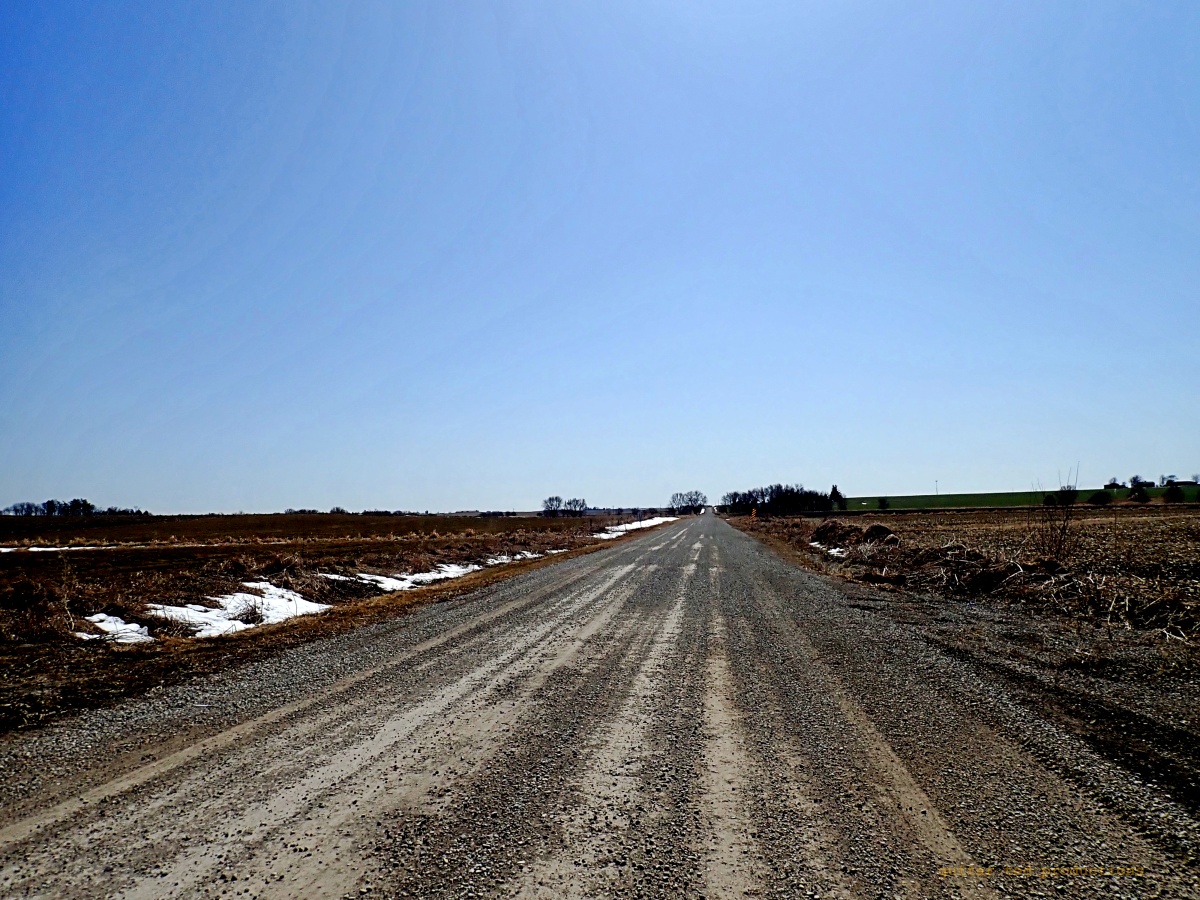
The roads were getting new gravel on them. Now, I don't know how the County decides to go about this job, because you'd hit patches of deep, loose gravel for a stretch then you'd run out on a short stretch of about 50 yards of hero gravel, then back to deep gravel, then a mile of hero gravel, then on and on.... Switching back and forth so you had variable conditions. From time to time, it even looked like 'normal' out there, as in my image above. Transition time in the country.......

I had to stop for a minute and noted that this water bottle cage (the upper one) had come loose.

Then I started up a grade and the wind roared. I shifted down two gears, spun the best I could, and hunkered down. This wind.......it wasn't just a little over 20mph! I was working way harder than I should be. Hmm.....this was more than a fitness issue! Then it became a physical issue. Yep! I felt it as a twinge of pain in my right knee. 

I was at the point I was going to turn East and make my way to Hickory Hills, but instead I stopped. My knee wasn't going to work itself out, it was only going to get worse pushing into.....hey! I have a phone with me! I decided to dig it out and see just what the heck was going on here. And when I pulled up my weather app, I was finally seeing the light. "Winds at 22mph with gust of 33mph." 

Aha! 

Made sense immediately, and in my estimation, the "gusts" part was more consistent than not. Flags were standing straight out. And as we all know, being out in the open always adds a bit to whatever the weather apps are saying. So the decision to head back was made there. 

The last snow banks are quickly disappearing, so I decided to get one last pic for the album.

The maintainer had been up Beck Road. You can see my tracks here, and maybe one other faint set.

Coming back in was brilliant! With that big wind at my back I was simply flying along and on downhills I think I was right around 30mph pretty easily. I counted one section of a mile where I pedaled maybe 20 feet of the mile. It was nuts!

I also saw some other tracks in the freshly graded surface of Beck Road, which if I had to guess, I would say it was Tom. He lives nearer to the Southern gravel in Black Hawk County, so I know he's out there a lot. But it could have been someone else. You never know.....

That white dot at the end of the road? That's the socked-in B Level Maintenance section of Petrie Road.

As I have stated here recently, it is so dry out there in the country that it is incredible for early in the year. The roads are sooooo dusty! I feared earlier that it was so bad that the road beds would start breaking down into moon dust, and on my ride Saturday I saw evidence of that happening. Now the County is laying down new gravel, but without some rain soon we will be in trouble. 

Fortunately those rains are forecast for today and tomorrow. Hopefully that pans out and we'll be getting some support from moisture to keep the roads together for a bit. Of course, Spring plants and animals will be needing that moisture as well. I really hope that they get it too. 

Greening up is happening. Soon the countryside will be festooned in green everywhere and farmers will start tilling fields. Another season of growth is kicking into gear......

Country Views: Spring Blows Into Town

Escape Route: Hess Road
 Another Saturday, another beautiful day on tap. This time it was the first day of Spring as far as the marking of the Spring Equinox goes. I always figured it was acting like Spring most years long before that, and apparently the weather people think so as well. Now there is this "meteorological Spring' which they say starts March 1st. Well,, maybe that's too early, and I figure it is somewhere in between there, but they never asked for my opinion, so it is whatever it is. 

 At any rate, it was supposed to be near 60° and Sunny, so I was game for a ride. I went back and forth on what I wanted to do all day Friday and into Saturday morning, and in the end, an early start to Friday (4:00am) and a week's worth of bicycle wrenching had me pretty pooped out. So, I slept in instead of trying to get out before the Sun came up. That turned out okay anyway since it was about 31° in the morning and then it was supposed to zoom up about 15 degrees in the first hours of Sunlight. That's always a recipe for 'tough-to-dress-for' rides. So, I was okay to wait until the temperature stabilized. 

When I looked at the possible conditions for Saturday on Friday, the forecast was for around a 20mph wind out of the Southeast. Okay, so the route plan was South then, and I didn't dial it in until I left, and that's when I decided I'd ride from Prairie Grove Park to Hickory Hills via gravel and back. Only there was one thing I didn't know....

I decided to use the Black Mountain Cycles MCD with those Kitchen Sink bars on it. Since it was pretty warm, I dressed in a long sleeved wool jersey and a vest, 3/4's pants, and long wool socks with some pretty warm (for me) standard MTB shoes for footwear. No gloves. At first, I thought it might be a mistake as the wind was stiff and that made it feel colder, but after about three miles I was fine. 

The appearance of 'cover crops' (usually rye grass), makes for quite the contrast with what snow is left.

Some roads were still in 'hero gravel' status.....

I got out on Hess Road and turned East on Orange Road only to find that the wind wasn't 20-ish miles an hour. It was definitely stronger than that. But it is Spring now, whatever way you look at it, and that means wind. It wasn't worse than I would have thought for this time of year, so I plugged along. 

.....and others were full-on deep in gravel.

Most of the time it was in between rough and smooth.

I soon decided that this wind had revealed that I wasn't in as good of shape physically as I thought I was. I was struggling up minor grades and my speed was low. Hmmm... Oh well! That means I just had to work at this and continue to get better. It is only just starting out in Spring here. I have time, I thought, to make gains. 

The roads were getting new gravel on them. Now, I don't know how the County decides to go about this job, because you'd hit patches of deep, loose gravel for a stretch then you'd run out on a short stretch of about 50 yards of hero gravel, then back to deep gravel, then a mile of hero gravel, then on and on.... Switching back and forth so you had variable conditions. From time to time, it even looked like 'normal' out there, as in my image above. Transition time in the country.......

I had to stop for a minute and noted that this water bottle cage (the upper one) had come loose.

Then I started up a grade and the wind roared. I shifted down two gears, spun the best I could, and hunkered down. This wind.......it wasn't just a little over 20mph! I was working way harder than I should be. Hmm.....this was more than a fitness issue! Then it became a physical issue. Yep! I felt it as a twinge of pain in my right knee. 

I was at the point I was going to turn East and make my way to Hickory Hills, but instead I stopped. My knee wasn't going to work itself out, it was only going to get worse pushing into.....hey! I have a phone with me! I decided to dig it out and see just what the heck was going on here. And when I pulled up my weather app, I was finally seeing the light. "Winds at 22mph with gust of 33mph." 

Aha! 

Made sense immediately, and in my estimation, the "gusts" part was more consistent than not. Flags were standing straight out. And as we all know, being out in the open always adds a bit to whatever the weather apps are saying. So the decision to head back was made there. 

The last snow banks are quickly disappearing, so I decided to get one last pic for the album.

The maintainer had been up Beck Road. You can see my tracks here, and maybe one other faint set.

Coming back in was brilliant! With that big wind at my back I was simply flying along and on downhills I think I was right around 30mph pretty easily. I counted one section of a mile where I pedaled maybe 20 feet of the mile. It was nuts!

I also saw some other tracks in the freshly graded surface of Beck Road, which if I had to guess, I would say it was Tom. He lives nearer to the Southern gravel in Black Hawk County, so I know he's out there a lot. But it could have been someone else. You never know.....

That white dot at the end of the road? That's the socked-in B Level Maintenance section of Petrie Road.

As I have stated here recently, it is so dry out there in the country that it is incredible for early in the year. The roads are sooooo dusty! I feared earlier that it was so bad that the road beds would start breaking down into moon dust, and on my ride Saturday I saw evidence of that happening. Now the County is laying down new gravel, but without some rain soon we will be in trouble. 

Fortunately those rains are forecast for today and tomorrow. Hopefully that pans out and we'll be getting some support from moisture to keep the roads together for a bit. Of course, Spring plants and animals will be needing that moisture as well. I really hope that they get it too. 

Greening up is happening. Soon the countryside will be festooned in green everywhere and farmers will start tilling fields. Another season of growth is kicking into gear......

Sunday, March 21, 2021

Trans Iowa Stories: A Face In A Window

Greg Gleason at Checkpoint #1 during T.I.v11 Image by Wally Kilburg

 "Trans Iowa Stories" is an every Sunday post which helps tell the stories behind the event. You can check out other posts about this subject  by clicking on the "Trans Iowa Stories" link under the blog header. Thanks and enjoy!

 Greg Gleason sped away from Checkpoint #1, raised his fist in the air, and disappeared. then everyone looked around. The faces of the volunteers were aghast. Was this it? Now what happens?

Gleason was at the checkpoint long enough that by the time he left it was over. No one else was going to make the time cut. We were preparing for the arrival of some riders, but how many would actually push on to the checkpoint? Surely most of them knew that they were done. 

About ten minutes later, a water-logged Bruce Gustafson rolled in alone. Then a few more minutes went by and a foursome rolled up including former Trans Iowa winners John Gorilla and Eric Brunt. John told me then that they purposefully waited a mile or so out to make sure they missed the cutoff! It was that miserable out there! But upon further reflection on this, I think John was cagey and wise enough to understand that a Trans Iowa course was going to have enough difficulties that pushing onward at the edge of the time cut-off for CP#1 was a recipe for failure further down the road anyway. Why incur further potential damage? While I don't know for sure that this was his thinking, I am sure that he was aware of that and possibly based his decision to purposefully make sure that he missed the cut-off due to those thoughts. 

After those four rolled in and were accounted for, riders started trickling in. Some alone, others in pairs. Soon we had a shelter house full of shivering, rain soaked, and muddy racers waiting for rescue by their support people. Phones were pulled out and several conversations were going on at the same time. It was becoming a bit of a chaotic scene. Steve Fuller manned the roster sheet and I ended up being the phone contact relaying information to him. We saw about a 50/50 split between riders that showed up and those that either turned back or were getting picked up out in the country between Guernsey and Grinnell to the West. 

Things were hectic for a bit there. While Wally and Jason seemingly disappeared, I had the forethought to document the scene as it unfolded. 

John Gorilla leads in three other late-comers to the checkpoint shelter.

Mark Johnson, a strong single speeder from Illinois, smiles after arriving at CP#1.

The chaos increased as vehicles piled into the checkpoint, riders were carted away, and volunteers tried to make sense of who was accounted for and who we still needed to find. The phone was going nuts as I was taking calls from riders and now from worried support people trying to navigate the sodden gravel roads around Guernsey, Iowa in search of abandoning riders. 

My two stalwart volunteers, Tony McGrane and Mike Johnson were cruising the course in search of anyone in need of assistance or directions. Tony related to me how at one point he was trying to help a rider short-cut their way to the small village where he was to be picked up, but that he was so out of sorts that he couldn't follow Tony's instructions. Eventually this rider was picked up safely. 

A rider at CP#1 with a thousand yard stare induced by the brutal conditions of that morning.

It was not uncommon for reports of riders on the verge of hypothermia and disorientation to come in to me that day. We also were watching riders waiting for rides that were 100% spent. Exhausted by their efforts to reach the checkpoint in time. Shivering, staring blankly, and incoherent, they were all eventually plucked from this normally quiet Iowa village and brought to a safe, warm place to gather themselves back up again. In fact, later on Wally reported to me that a few Guernsey residents ventured out and were bold enough to ask him a few questions. When they were appraised of the situation, they were seemingly chuffed that such heroics were being played out in their otherwise forgotten corner of Iowa. 

Occasionally I still get stories brought up about this Trans Iowa. Recently Warren Weibe, a veteran of eight Trans Iowas, reminded me of the story he had about v11. He was walking the heinous, muddy Level B before the checkpoint like everyone else. When he exited the road and reached gravel again, his spirits lifted briefly as he attempted to mount his bike. Now he could make some progress and ride! 

As he went to clip into his pedals, he realized one of his shoes was missing! How long he had walked without it on, he did not know. But he did know he'd have to go find that shoe, which could be anywhere in that mile of muck. Fortunately for Warren, he found it rather easily, since, as he put it, "It was sticking up out of the mud like a half buried car at the Cadillac Ranch".

Back at the shelter house in Guernsey, it was a busy scene until about 10:00am, a full hour and a half after the checkpoint closed. Then things started to wind down. MG called me and said he was feeling much better. He decided to come out and meet me at the checkpoint and then we'd go out in search of the last rider. Meanwhile, vehicles full of wet, muddy riders were pulling away. One, a pearl white Escalade, was packed full, and as I watched it slowly start its journey back to Grinnell, I saw a familiar face peering out. It was Tim Ek. He was a figure that was prominent in many of my Trans Iowa experiences, both during the events and in between them. We had several great email exchanges, and he was a very encouraging, supportive person during Trans Iowa's formative middle years. 

He waved at me from that foggy window as the Escalade rolled away. It was the last time I ever saw him as a Trans Iowa rider. 

Next: The Last Rider

Trans Iowa Stories: A Face In A Window

Greg Gleason at Checkpoint #1 during T.I.v11 Image by Wally Kilburg

 "Trans Iowa Stories" is an every Sunday post which helps tell the stories behind the event. You can check out other posts about this subject  by clicking on the "Trans Iowa Stories" link under the blog header. Thanks and enjoy!

 Greg Gleason sped away from Checkpoint #1, raised his fist in the air, and disappeared. then everyone looked around. The faces of the volunteers were aghast. Was this it? Now what happens?

Gleason was at the checkpoint long enough that by the time he left it was over. No one else was going to make the time cut. We were preparing for the arrival of some riders, but how many would actually push on to the checkpoint? Surely most of them knew that they were done. 

About ten minutes later, a water-logged Bruce Gustafson rolled in alone. Then a few more minutes went by and a foursome rolled up including former Trans Iowa winners John Gorilla and Eric Brunt. John told me then that they purposefully waited a mile or so out to make sure they missed the cutoff! It was that miserable out there! But upon further reflection on this, I think John was cagey and wise enough to understand that a Trans Iowa course was going to have enough difficulties that pushing onward at the edge of the time cut-off for CP#1 was a recipe for failure further down the road anyway. Why incur further potential damage? While I don't know for sure that this was his thinking, I am sure that he was aware of that and possibly based his decision to purposefully make sure that he missed the cut-off due to those thoughts. 

After those four rolled in and were accounted for, riders started trickling in. Some alone, others in pairs. Soon we had a shelter house full of shivering, rain soaked, and muddy racers waiting for rescue by their support people. Phones were pulled out and several conversations were going on at the same time. It was becoming a bit of a chaotic scene. Steve Fuller manned the roster sheet and I ended up being the phone contact relaying information to him. We saw about a 50/50 split between riders that showed up and those that either turned back or were getting picked up out in the country between Guernsey and Grinnell to the West. 

Things were hectic for a bit there. While Wally and Jason seemingly disappeared, I had the forethought to document the scene as it unfolded. 

John Gorilla leads in three other late-comers to the checkpoint shelter.

Mark Johnson, a strong single speeder from Illinois, smiles after arriving at CP#1.

The chaos increased as vehicles piled into the checkpoint, riders were carted away, and volunteers tried to make sense of who was accounted for and who we still needed to find. The phone was going nuts as I was taking calls from riders and now from worried support people trying to navigate the sodden gravel roads around Guernsey, Iowa in search of abandoning riders. 

My two stalwart volunteers, Tony McGrane and Mike Johnson were cruising the course in search of anyone in need of assistance or directions. Tony related to me how at one point he was trying to help a rider short-cut their way to the small village where he was to be picked up, but that he was so out of sorts that he couldn't follow Tony's instructions. Eventually this rider was picked up safely. 

A rider at CP#1 with a thousand yard stare induced by the brutal conditions of that morning.

It was not uncommon for reports of riders on the verge of hypothermia and disorientation to come in to me that day. We also were watching riders waiting for rides that were 100% spent. Exhausted by their efforts to reach the checkpoint in time. Shivering, staring blankly, and incoherent, they were all eventually plucked from this normally quiet Iowa village and brought to a safe, warm place to gather themselves back up again. In fact, later on Wally reported to me that a few Guernsey residents ventured out and were bold enough to ask him a few questions. When they were appraised of the situation, they were seemingly chuffed that such heroics were being played out in their otherwise forgotten corner of Iowa. 

Occasionally I still get stories brought up about this Trans Iowa. Recently Warren Weibe, a veteran of eight Trans Iowas, reminded me of the story he had about v11. He was walking the heinous, muddy Level B before the checkpoint like everyone else. When he exited the road and reached gravel again, his spirits lifted briefly as he attempted to mount his bike. Now he could make some progress and ride! 

As he went to clip into his pedals, he realized one of his shoes was missing! How long he had walked without it on, he did not know. But he did know he'd have to go find that shoe, which could be anywhere in that mile of muck. Fortunately for Warren, he found it rather easily, since, as he put it, "It was sticking up out of the mud like a half buried car at the Cadillac Ranch".

Back at the shelter house in Guernsey, it was a busy scene until about 10:00am, a full hour and a half after the checkpoint closed. Then things started to wind down. MG called me and said he was feeling much better. He decided to come out and meet me at the checkpoint and then we'd go out in search of the last rider. Meanwhile, vehicles full of wet, muddy riders were pulling away. One, a pearl white Escalade, was packed full, and as I watched it slowly start its journey back to Grinnell, I saw a familiar face peering out. It was Tim Ek. He was a figure that was prominent in many of my Trans Iowa experiences, both during the events and in between them. We had several great email exchanges, and he was a very encouraging, supportive person during Trans Iowa's formative middle years. 

He waved at me from that foggy window as the Escalade rolled away. It was the last time I ever saw him as a Trans Iowa rider. 

Next: The Last Rider

Saturday, March 20, 2021

Little Did I Know

From the 2019 Guitar Ted Death Ride Invitational
A comment on yesterday's post got me to thinking. It was made by Tom in reference to his having been in the 2019 C.O.G 100 event. He posted, "I’m very thankful I caught the tail end of your event days." 

First off- "Thank you, Tom!"

Secondly, I immediately thought afterward, "Was that my last cycling event I put on?" And the answer is, no- No it wasn't. The last one was a "Guitar Ted Death Ride Invitational". That occurred in July of 2019. Little did I know then that this would be my last event production. I didn't go into that event with the thought that I was going to stop with the work and promotions of events at all. That wasn't even on my radar then. 

Of course, I had retired Trans Iowa as an event. That was completely different, in my view. My intentions past Trans Iowa were to do the 2020 C.O.G. 100, another GTDRI, and maybe even a "Geezer Ride" again. Yep! I had no idea that the 2019 GTDRI was the last event I'd put on, maybe ever. (Because hey! You never know, right?) <===That said, don't get any ideas! I'm pretty content with my resume' and my legacy in events as it is now. 

Plus, I ain't gettin' any younger! I want to do some riding without the baggage of event production, and all that entails, hanging over me. It's a burden, quite honestly, and if you have produced an event, you know what I mean. It's an intangible 'weight' that is hard to describe, but once you've been unyoked from it, the feeling of freedom is strong. I doubt I'll be willing to put that yoke back on my shoulders again, but like I said, you never know. Never say "never", never say "always". 

While I'm thinking about the GTDRI, I will remind you that after the "Trans Iowa Stories" series is over, I am motivated to write up another series on the GTDRI's fourteen year run. Then I'll probably tag on my other various event productions along with that at the end of that series. That should be a whopping amount of writing to do in the future. So, if you were wondering what the heck Guitar Ted was going to do once he finished the T.I. stories, well, now you have that road map. 

That is, assuming I am around to write that stuff. You never know......

Little Did I Know

From the 2019 Guitar Ted Death Ride Invitational
A comment on yesterday's post got me to thinking. It was made by Tom in reference to his having been in the 2019 C.O.G 100 event. He posted, "I’m very thankful I caught the tail end of your event days." 

First off- "Thank you, Tom!"

Secondly, I immediately thought afterward, "Was that my last cycling event I put on?" And the answer is, no- No it wasn't. The last one was a "Guitar Ted Death Ride Invitational". That occurred in July of 2019. Little did I know then that this would be my last event production. I didn't go into that event with the thought that I was going to stop with the work and promotions of events at all. That wasn't even on my radar then. 

Of course, I had retired Trans Iowa as an event. That was completely different, in my view. My intentions past Trans Iowa were to do the 2020 C.O.G. 100, another GTDRI, and maybe even a "Geezer Ride" again. Yep! I had no idea that the 2019 GTDRI was the last event I'd put on, maybe ever. (Because hey! You never know, right?) <===That said, don't get any ideas! I'm pretty content with my resume' and my legacy in events as it is now. 

Plus, I ain't gettin' any younger! I want to do some riding without the baggage of event production, and all that entails, hanging over me. It's a burden, quite honestly, and if you have produced an event, you know what I mean. It's an intangible 'weight' that is hard to describe, but once you've been unyoked from it, the feeling of freedom is strong. I doubt I'll be willing to put that yoke back on my shoulders again, but like I said, you never know. Never say "never", never say "always". 

While I'm thinking about the GTDRI, I will remind you that after the "Trans Iowa Stories" series is over, I am motivated to write up another series on the GTDRI's fourteen year run. Then I'll probably tag on my other various event productions along with that at the end of that series. That should be a whopping amount of writing to do in the future. So, if you were wondering what the heck Guitar Ted was going to do once he finished the T.I. stories, well, now you have that road map. 

That is, assuming I am around to write that stuff. You never know......