Showing posts with label Dirty Kanza 200. Show all posts

Sunday, April 12, 2026

Gravel History With Guitar Ted: Changing Times

About this time ten years ago...
A story I told in the latest episode of the Guitar Ted Podcast had to do with this image. The image is of myself out North and East of Waterloo at about this time of year in 2016. It is a trading card, one of a set, which was handed out at the tenth anniversary of the Dirty Kanza 200 event in Emporia, Kansas. You know.....the event known as Unbound now? Yeah, that gravel race

I remember when the DK folks reached out to me and asked me to send them an image. They wanted something of me recent on a bike. Well.......there are not a lot of images of myself riding a bicycle, so this was a bit of an issue for myself. 

I thought it was a bit of an odd request anyway. I mean....who cares about Guitar Ted riding bikes? Especially racers. I never amounted to much when it comes to bicycle racing. As far as my event went, Trans Iowa was weird and being eclipsed by several other events by that time in gravel. Essentially, the gravel world had grown and passed myself and Trans Iowa by. 

Sure, there was the influence, the history, which Trans Iowa and myself represented. But even by 2016 most gravel folk had no idea concerning any of that. None. Zero

This is why I find it ironic when today I see stories written on major online cycling media sites stating how gravel didn't really see growth until 2018, or 2019, and some punters place the "explosion of gravel" after the pandemic. 

They don't know what they are talking about.

I used to compile a calendar of gravel events every year from 2008 until 2020. Gravel events increased in number from 2010 to 2019 by a factor of over six times. Talk about "an explosion of gravel events" But no one cares to research anything in their stories, I guess. That's why I write this stuff down. 

Anyway, back to the trading cards. I eventually settled on taking a quick selfie out on a ride and I sent it off for the DK200 folks to look at. I promptly forgot all about the promotion as I was deep in the throes of organizing the next Trans Iowa event. 

Then it came time for the DK200. I went down with Tony, a friend of mine, and I was there mostly as support for Tony. But I also was there to attend this goofy, (my opinion) autograph session for people who wanted autographed trading cards. The rest of that story is on the podcast, so I'll save you from reading it here. 

The whole deal was pretty much a flop, as I recall. I did get a complete set of cards for being there.  I went home, and probably like most everyone else, I tossed these cards in a "junk drawer" to eventually get thrown out at some point in the future. 

Then one day, well over a year later, I received an odd little package in the mail. It was a playing card box full of my trading cards. I think I have around 30+ of my card in that box yet. I have no idea why I got them afterward or what I will ever do with them in the future. 

Probably throw them out in some fit of cleaning someday.....

Sunday, March 08, 2026

The Path To Discovering Gravel Grinding: Part 2

This is Part 2 of a mini-series of posts telling the story of what it was like to attend events in the early days of the Modern Gravel Era. This story will focus on the part the Dirty Kanza 200 played in those days from my perspective. Please read Part 1 also to help with the context of this post. 

Researching on the internet concerning an unknown entity (gravel racing) in a fairly desolate part of the USA (Flint Hills) was not very rewarding. Most of what was on the internet in 2005/2006 centered around cattle grazing, the National Grasslands, and the Native American ancestors who once lived there. 

Bicycles? There was precious little information regarding riding a bicycle in the Flint Hills of Kansas. Even the event's predecessor, the Flint Hills Death Ride, was barely mentioned and it was, at that time, considered a mountain bike event. 

So, I had to guess the best that I could. Weather was a wildcard. What hills would be included, and how often, and how many, were all mysteries. The event organizers had one checkpoint where riders could have a drop bag sent and waiting for them. There were very few towns and villages. Getting resupplied was supposed to be done at convenience stores, but there were only three for the entire 200 miles. Council Grove, Cottonwood Falls, and then a long haul down to Eureka, and then back to Emporia. 

I decided on a single speed. Less stuff to go wrong in the middle of nowhere. Plus, I was going with zero support. If things went upside down, well..... If I could still walk, I was going to have to do that. Cell coverage was iffy to nonexistent. I had no idea if there were farms, like we had in Iowa, or just vast, empty spaces. 

The 2005 On One Inbred single speed 29"er as I rode it at the inaugural Dirty Kanza 200.

I decided to run a hydration pack, mostly because this was the only way to hope to have enough water for the long stretches between resupplies. Things like fork mounted bottles, "feed bags", or other commonly seen accessories for endurance gravel/road riding today weren't available yet in the mid-2000's. 

Nutrition was another reason to haul a rucksack with you. Your jersey pockets would also provide some space to carry food, but not enough for 200 miles. Plus, you needed repair items, just in case, as well. Those had to go somewhere. I think I settled on a Topeak seat bag, as I recall, for the spares. 

And navigation. Ha ha! People would throw a fit today if they were sent out on a forlorn, desolate route with just a map with a highlighted route on it. This is what we were led to believe we'd have to navigate by previous to the event. In the end, Joel and Jim marked the entire 200 mile course so well a map was barely a necessity, unless you made a wrong turn somewhere. 

So, a wired or wireless computer was a necessity. GPS? Yeah...... Think again. This was 2006. Such devices were not quite a thing yet in those days. Calibration of your computer was a fine art. Then you also had to account for how you wanted to carry your maps. Early gravel events had cues or maps and there was no agreed upon standard sizing for such things. So sometimes this was a late decision based upon whatever the event directors landed on for sheet size. Zip-loc food bags were your best bet along with a clip to hold all the sheets together. 

Decisions, decisions! Then added in was whatever you thought you'd need for clothing going into a night time finish. It was pretty crazy trying to navigate all the unknowns then! But this is what made these events so fun and memorable. 

Next: Learning lessons as a rider and event director.  

Thursday, June 05, 2025

Where We Came From: "I Guess You Had To Be There"

The underground legends made the sport special. Image courtesy of David Story

 This article is another in the "Where We Came From" series which is a series that attempts to describe early gravel events, people, and culture.  

"Well, I guess you had to be there!

How many times have you heard this when either someone is trying to justify why they think something is funny or when someone is trying to describe an experience that is difficult to describe in words? You've probably heard the former more than the latter, but it is the latter form of this turn of phrase which I want to discuss today.

There was a comment left on Monday's post which I am going to share here. It was left anonymously, so I cannot credit the person, nor do I know who this is. But it is interesting from a very different perspective, and it really said a lot which hit home with me.  I have had difficulty expressing this in the past, but this comment illuminated much of how I feel. 

I'll cut to the meat of what it is I want to get to here by posting the comment, in its entirety, from the "Two Things" post from Monday. The comment is in reference to what Unbound has become. After the comment I will give my thoughts. Now for the comment: 

"I have not ridden the race under either banner, (Dirty Kanza/Unbound) but I do miss following it in the early days. It had so much romance surrounding it. As a Kansan it felt like we had something special that the rest of the world didn't know about. All the locals, as well as the other midwesterners (seemingly centered around Lincoln), became underground legends for many of us in Kansas. I liked that it existed in a world separate from both the European road scene and the more traditional American cycling scene. It felt fresh, and a bit counter-culture. I always wanted to ride it, but I moved away from Kansas for a number of years, and by the time I got back I lacked the fitness and any interest in the new "product." I'm aware that many people scoff at this sort of nostalgia, and the young kids would call me Boomer or Unc, but certain periods are special for a reason. DK was special in a way that Unbound could never be."

First, I think the context of where these thoughts are coming from is important to note. The person did not participate in the earlier or the later versions of DK/Unbound. So the perspective here is not colored by having been inside either way the event has been produced. I think because of this, we get a more unvarnished look at both things- The early gravel scene and what it has become now.

Rider: Greg Gleason leaving Checkpoint 1 during Trans Iowa v11 Image by Jason Boucher

Something Special:

The sentiment expressed about how the early gravel scene was unique is very true. It did not belong to The World, and was neither roadie or MTB in its feel and culture. Certainly there were elements of both types of cycling incorporated into the gravel scene in those times. But it was a mix which had a unique flavor which neither road racing nor mountain biking could lay claim to.

There were "heroes" which were relatable to the common cyclist. One could go to an event and see these folks, talk to them, and if you were fast enough, ride with them for a while. This has obviously changed with Unbound to be the opposite extreme. Now, if there are any "heroes" of gravel, they are observed from afar, and you won't be riding with them in an event.  

Setting up for the Cherry Grove Checkpoint at the Almanzo.
Counterculture:

The comment mentions the feeling the early gravel days had was "a bit counter-culture".

This is also true. Gravel came out from the MTB/ultra-MTB scene and had an unkempt, rougher edge about it to begin with. This evolved into a feeling which was irreverent, snubbing "The Rules" (it's a roadie thing). The gravel culture generally looked down upon anything smacking of "governing bodies" and all the over-reaching edicts the sanctioning bodies had.

Whether you thought what was going on in early gravel was "unprofessional" or "fun", the fact is the participants brought in a looser, less structured feel. "Fun" and experiences were prioritized over all-out competitiveness. It is a nuanced discussion here. There were very disciplined athletes in early gravel racing, but there was also this other side to it which was accepted and not looked down upon as being "unprofessional" because there was no real money in gravel events.

Money was also kind of a cloud hanging over what gravel started out as being. This and governing/sanctioning organizations were - I don't want to say "feared" - but something which was kept as a "villain" of sorts to be fought against. Only no one fought against it. They ended up mostly complaining and accepting it begrudgingly as being inevitable.

It's Just Not The Same:

The comment closes out with how Unbound just cannot ever be what it used to be like. I would say this is a rather obvious statement on the surface of it, but it speaks to something deeper when looked at in context to the rest of the comment.

I would ask anyone curious about this to go look at the finish line shots from 2025 and compare them to anything from the DK200 era. I think you will find a completely different vibe in the images.

Look at any DK200 start, and you'll see the differences there as well. Obviously, those older events had far less people involved than they do now at Unbound with their estimated 5,000 individuals across all events. But if you are citing this as a reason the event has to be different, you are forgetting what else more people do to an event. Think of it in terms of experience for the individual.

In a collegiate setting, a huge lecture hall with a large number of students is less enjoyable than a smaller, more intimate classroom setting where it is possible to engage with the professor and the professor can engage with all the students. Sure, you can get a degree doing it in both settings, but which, ultimately, would you want to experience?

Okay, let's say the experience part is not all that important to you. So if it isn't about experience for the individual and the promoter(s), then what is it about? Media coverage? Pro/Elite standing in the racing community? Making money for the corporation? I would submit to you where Unbound is now is more about the questions I asked than it is about the individual racer experience, the vibe for the amateurs, and yes, even the community. By cordoning off the finish line chute area to be safe for all the Elites, they have, perhaps unintentionally, also cut off easy access by Emporians to see this spectacle which visits their city once a year. Eventually, by segregating the event in this manner, it will affect how residents see this intrusion into their daily lives.

This is in stark contrast to the festival-like feel of earlier DK200 events in the late twenty-teens. Yes, there were less people, and way less Pro/Elites demanding concessions. But when you "go big" you have compromises. Are the compromises worth the alienation of residents and segregation of the amateurs from Elites? I don't have those answers, but if the comment left on my blog Monday is any indication, and if what I saw being posted online Friday is any indication, I would say there is a growing distaste for where Unbound has gone. 


 So, What Can You Do About It Anyway?

The difficult part about anything one experiences in Life is this: At some point it ends. Life's experiences are constantly in flux, and so are the events we cherish. (Or events we don't like!) We are fortunate to have been through the events we were blessed to be a part of in their time. We should not try to elevate them beyond what they were or let anyone else denigrate or disparage them afterward. They are what they were as soon as they happened- Memories. Experiences. The Past. 

As the commenter said, " ...certain periods are special for a reason. DK was special in a way that Unbound could never be." Maybe that is hard to understand. 

Yeah,. Well, I guess you had to be there.  

Saturday, May 31, 2025

10th Anniversary Of "The Mud Year".

L-R: GT, Matt Gersib, Andrea Cohen at the DK200 Expo in 2015.
 

Applying Lessons And Support From Friends To Gain Something I Never Imagined -

Ten years ago at the Dirty Kanza 200 it was wet, muddy, and pretty darn extreme. I know folks think the 2023 year was the mud year, but their perspective is probably skewed a bit towards recent events and does not take into consideration the awesomeness that was The Mud Year at this Emporia gravel event.

2015 was a very different time at Emporia than it is now days. Now the event is called "Unbound Gravel". It is owned by Life Time Events, and not run by its founders. It also is an event which has grown exponentially since those days. Now Unbound binds up the entire city. Extending to every nook and cranny, the city cannot escape the effects of the event these days. This simply was not the case ten years ago.

Then it was more of a slight inconvenience, and most Emporia folks were just beginning to notice this gravel cycling thing, which at that point had already been happening there for ten years! A decade of DK200's was a big deal to us who had been there over the years, but what is ironic now is that these days are largely forgotten by Unbound riders of 2025. They have little to no connection to the past gravel days.

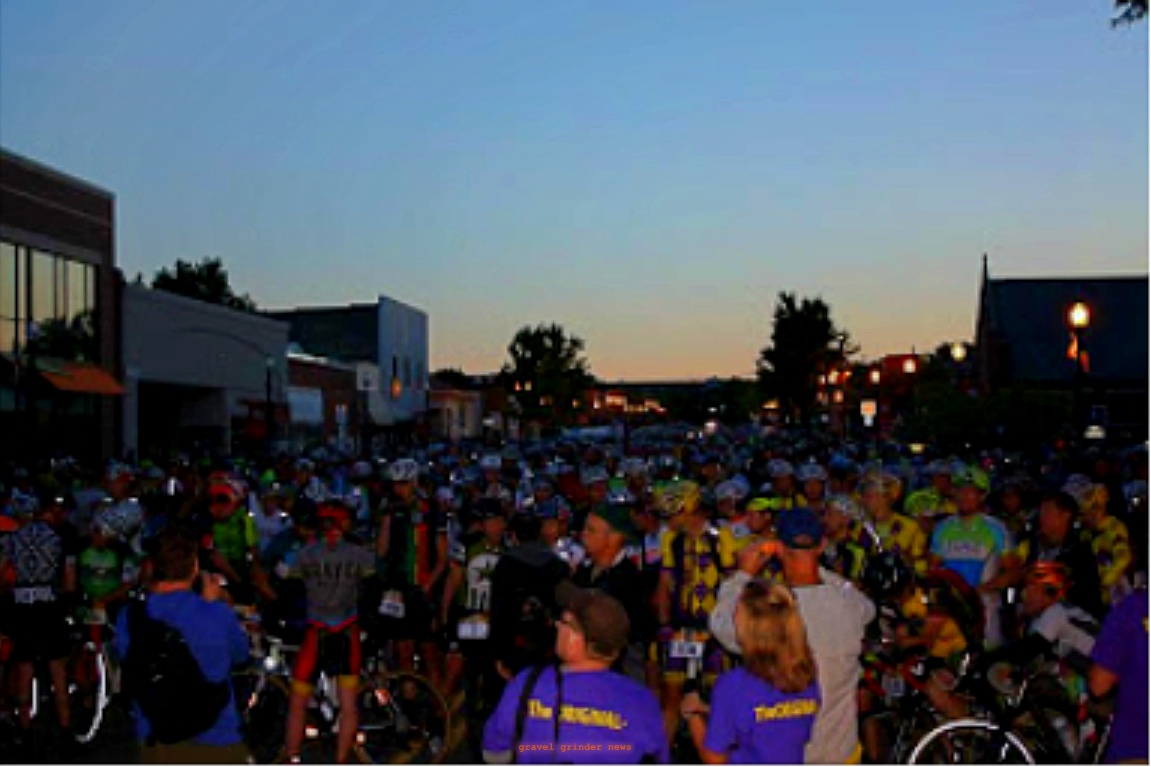
If they only knew what was awaiting them.... The start scene. Note the "16" card on the left designating the start area if you felt it would take you 16 hours to finish.

  "The Mud Year" was a turning point in this event's history. It was a spectacle which probably will never be repeated again. It was the day I might have ridden my second longest ride in one sitting I've ever done. (There is debate whether it may have been my longest ride, but this is another tale for another day) You might be surprised to learn I'd ridden in events with worse conditions. This was pretty rough, but if I am honest, wet, cool days are when I ride at my best.

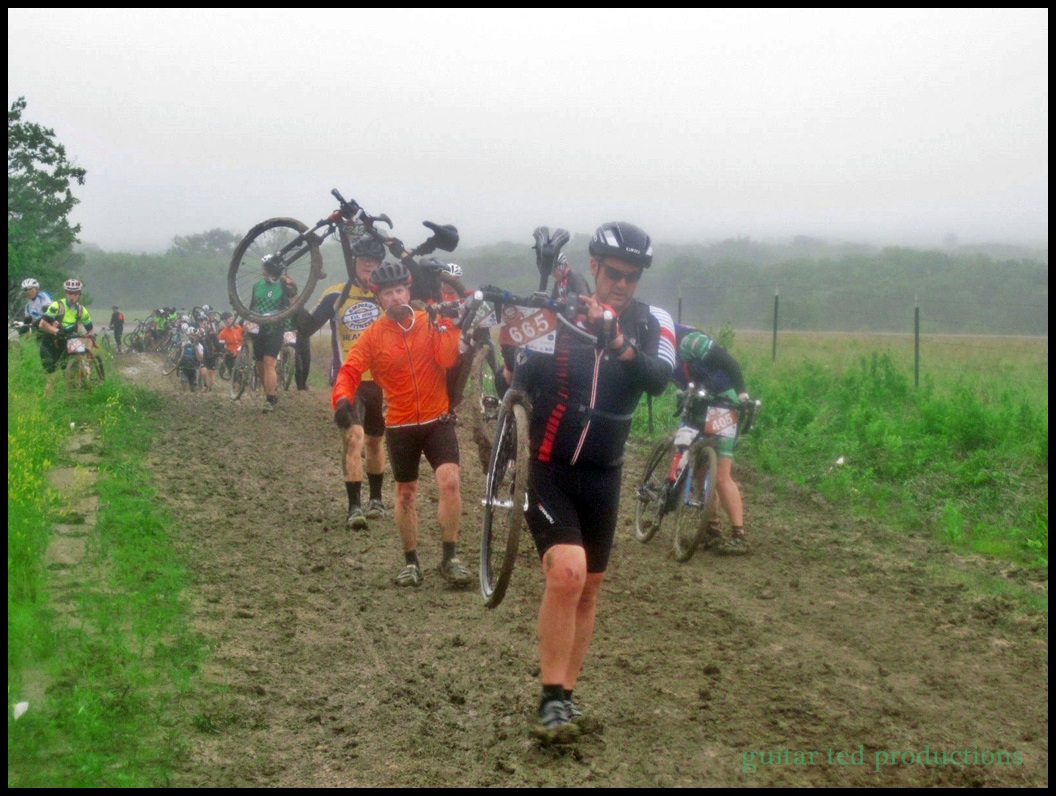
However; I think there are things I saw on that chilly, wet, misty morning which I do not think I'll ever see again. A marching line of humanity with bicycles so long you could not see the beginning or the end of the throng of people,. There were broken bikes with riders nursing their broken dreams trudging through the mire. I saw dozens of derailleurs, in one area the size of ten square yards, smashed into the mud by humans trampling them down as they marched by.  Expensive Di2 derailleurs left in the clay of Chase County. You'd have thought folks would want to salvage them. Actually, Ari Andonopoulos and I had that very thought as we rode by the scene.

Dreams being shattered here.... (Image by Ari Andonopoulos.

 Ari was my riding companion for the first third of the event. He coached me, encouraged me (and others), and he even carried my heavy Fargo while I carried his much lighter Black Mountain Cycles Monstercross bike along those three-plus miles of mud. Ari helped me tremendously in the opening stages of the 2015 DK200, and I will always be in his debt for doing so.

This is what is good about events like this with great adversity. You can forge bonds with people sharing the same or similar experiences. Sure, you may have an attitude which causes you to be very negative about finding yourself in a pickle such as we found ourselves in during the 2015 DK200. This would be totally understandable by most people looking at things from a selfish, monetary-driven, self-imposed results driven viewpoint. But sometimes it might be best to take the "K.C. Franks approach" instead.

That's me on the lower left. Image courtesy of Ari Andonopoulos.

 This approach was something I learned from an art class teacher in Junior College at North Iowa Area Community College. K.C. Franks was an older professor at the time, and he once shared a tenet of his which has been useful throughout my life. He stated the following, and I am paraphrasing for a more broad appeal here:  'When you have a plan, and the plan seems to be going sideways, don't "throw it in the trash". Run with it instead. Go where it seems to be taking you. Find a way to finish it, and you will end up with something remarkable which you never dreamed of in the first place'.

Had these folks who were disgusted with the mud, the "trashing of their plan", and who had a negative attitude about the day taken a different approach, such as the one K.C. Franks suggested? Who knows how the day may have turned for them. One such individual who could have just walked away and left was my brother Matt Gersib. His day ended on the bike early, due to mechanical failure, which was inoperable out in the field. But instead of going back to Joe's house and just wallowing in negativity, he rebooted, made a new plan, and became my de-facto ride support. Matt met me at the first checkpoint, got me things to eat, lubed my chain, and encouraged me. He was there at the last checkpoint to give me support too. He took what the day gave him and ran with it. It wasn't what he expected to have happen that wet morning, but it was awesome all the same. Ari and I were also more in the K.C. Franks camp, and I think this served me well on this day.

(L-R) Ari's friend Phil Ellsworth, who we caught up with going to Checkpoint #1. Guitar Ted feeding his face. Image by Ari Andonopoulos.

 Unfortunately after the first 'optional water stop' at the top of Texaco Hill, Ari and I parted ways. I left on my own, and it was a harder road for me because of this. However; I stuck to a steady pace, a plan of nutrition, and I steeled myself against the elements, the course, and the distance left to go. I was, and still am, pretty proud of how I rode that day.

However; there are those things beyond one's control which, again, can cause you to wad up your plan and toss it in the trash, or you can reconfigure the plan, regroup, and do the best you can with what you've been handed. Such was the case later on as I hit the "optional water stop" two thirds of the way into the course. This wasn't really an option, from a rider's standpoint, as there was no way to resupply on water for many miles until riders would eventually reach the Cottonwood Falls final checkpoint.

So, I waited for water, because the tanks were dry when I got there and a line was already forming to get the precious liquid which was promised "at any time now". Unfortunately for me, it wasn't until 20 plus minutes later that I was back rolling again with a full compliment of water onboard my Fargo.

Only about five miles from Cottonwood Falls I mistakenly thought I was out of time.

 
Matt Gersib putting my bike up on the rack at 3:00am in the morning in Cottonwood Falls. Image by Ryan Dudley.
I missed the checkpoint two cutoff by two minutes. I could have been really angry. I was delayed at the "optional water stop" too long. I maybe could have ridden faster. I spent too much time fiddling with my lights when it got dark out. But no..... This was not the way.

 I think the final stint was something like 44 miles, so I had already ridden a long way.  I had ridden for nearly 20 hours or so. I had done everything I could do to be successful. I put in a great effort and I was pleased with what I left out there on those wet Kansas Flint Hills roads. I'm not a great athlete, nor would I ever be considered "one of the fast guys", but this wasn't about those things. I was competing against myself, and in my way of looking at this, I had "won".

This was the last time I rode in this event. I've no reason to go back to compete in it again, and there are a ton of reasons I would not consider Unbound a good fit for me. Instead of doing the DK200/Unbound again, I went down with my friend, Tony McGrane, for the next few years and did my own rides. These ended up becoming some of my favorite experiences in the Flint Hills.

But I do not discount my 2015 experience at all, make no mistake. I learned a lot on the trip, and I met a lot of great folks. I got to ride with Ari, and experience an unbelievable day on the bike. I spent a lot of time with my brother from another mother, Matt Gersib. I got to stay at Joe's home, a then new acquaintance. It's hard to believe it has been ten years ago, and in a way it seems like it was 100 years ago. So much has changed since then, it is crazy.

I am glad I was able to experience those days, and I am happy I was able to persevere through much adversity to accomplish what I did. Thanks to K.C. Franks, the support of Matt Gersib,  and my friend Ari for making a mental and philosophical difference which made that day, and many since then, more than I could have ever imagined them to be.  

Saturday, May 24, 2025

Two Things

 Figuring It Out:

I am doing this "Where We Came From" series on The Guitar Ted Podcast and it has been a lot of fun hearing stories from people that were there back in
the earlier days of gravel racing.

I think the best part has been learning what the backgrounds of these people are. You maybe get a preconceived notion about someone, you know. Like, Mike Marchand, for instance, who I always assumed had been a top-tier racer all his life, when in fact that is not the case at all.

On Thursday I was able to chat with Greg Gleason, who won Trans Iowa twice and legitimately could have won twice more. He came onto the scene, seemingly out of nowhere, to take the top spot in Trans Iowa v10. He dominated the event with his presence at the front for four more years.

Of course, Greg did not "come out of nowhere" and we found this out during the latest Guitar Ted Podcast, which you can listen to HERE. It's a long episode, so this might be a good one for your next trip to a gravel event.

Now, we also spoke about current events, and Greg's opinion was decidedly on not supporting the "big-time" events. It's interesting to hear a strong opinion about this and why that is. In my opinion, Greg's proclivity for a certain kind of event speaks to his personality and his desire to have relational experiences versus purely competitive ones. But do listen to the episode and decide for yourself

From the 2010 Dirty Kanza 200 event. (Image by Guitar Ted)

There's A Hole In The Hall:

This coming Wednesday a small group of cyclists are going to be honored as the newest inductees into the Gravel Cycling Hall of Fame. An institution I am honored to be included in.

There was some chit-chat going around in 2021, when the hall was announced, which communicated an idea. An idea which stated the new hall of fame would not be "legit" unless I was a part of the first class of inductees.

I don't know about that, but one thing I do know is if the GCHoF wasn't going to be legit without my inclusion, then it certainly is not legit without the inclusion of Jim Cummings

Jim made a social media post concerning something not at all having to do with cycling, and was 'cancelled' for it. Now, the point he made is debatable, and most people probably have no idea whatsoever what it was he was talking about. (If you find yourself reading this and wondering "what did he say"? you fall into this category.)

I'm not saying what he posted was right or wrong, and to my mind, it has zero - nothing at all to do with gravel cycling. It is a point of no debate that without Jim Cummings and Joel Dyke, (who, by the way, is in the GCHoF), gravel cycling would not be what it is today. Gravel cycling was HUGELY influenced by what Jim and Joel did, along with their team and participants, which include several other GCHoF members, at one point or another.  It is as obvious as the nose on your face that Jim should be in the GCHoF. He's been nominated several times, yet..... Crickets. No reason given as to why he is being systemically excluded. 

So, when you see the start to finish coverage of Unbound this coming weekend, and when you hear the names of the latest GCHoFer's, just remember who is not being recognized, and should be. There is a gaping hole in that Hall of Fame that should be filled. All these people at Unbound are standing on the shoulders of a man they are not recognizing, and this just should not be the case.

Wednesday, January 15, 2025

Gravel History With Guitar Ted: "Answering The Call..."

 Gravel Grinder History With Guitar Ted is a series of posts covering the early days of gravel grinding, racing, and tech which helped build and make gravel riding the hottest form of cycling in the 2020's. Many of these articles were first published on my "Gravel Grinder News" blog which started in late 2008. 

In today's post you will read a race report by Matt "MG" Gersib who wrote "Answering The Call..." for Gravel Grinder News in 2013. This is a race report for the event then called the Dirty Kanza 200. (Now Unbound Gravel) In it you will learn much about how gravel events once were run. Pay specific attention to details like navigation, the names of people Matt thought were at the top of the heap in gravel racing, and to what some of the fears of gravel racers were concerning growth. 

I've lightly edited this post (removing dead links mostly, spiffing up the images) and I have added a few notes to clarify things for today's readers, but otherwise this is how this post appeared on June 11th, 2013. Enjoy!

Answering the Call…

by Matt Gersib

 Images by Cornbread, Kyle Thompson, Dave Mable, and MG

 Gravel grinding is getting pretty big in the Midwest, as evidenced by the nearly 1,000 combined entrants in the 2013 Dirty Kanza 200, “Half-Pint” 100-miler, and 20- or 50-mile “DK-Lite” fun rides. Held at the doorstep of the Kansas Flint Hills in the college town of Emporia, Kansas, the Dirty Kanza was first run in 2006. Since then, the event has grown from just a few dozen participants that first year to become one of, if not the, largest gravel grinder in North America.

Since 2010, the Dirty Kanza 200 has started and finished in-front of the historic Granada Theater in downtown Emporia. Photo: Cornbread (Cory Godfrey)
In many ways, the 2013 Dirty Kanza 200 was a test – a test to see how much was too much. I can’t count how many times I was asked “is it going to be too much to have 750 people on-course at the same time?” prior to the event. Some folks had serious doubts as to how it’d be possible to avoid pile-ups, traffic jams and other calamities caused by too many riders on the same gravel roads.

I wasn’t one of the doubters, however, and whenever asked, I told them that I thought 200 miles was a lot of space, and that there would be plenty of room for everyone to ride. I even suggested there would be times when we’d feel really alone out there, even with all the people we knew were on-course with us. 

Riders assemble prior to the 6:00a.m. start. Photo: Cornbread (Corey Godfrey)

Fast forward to race day and while the start line was an awesome spectacle, it was really the only time (on the bike) that I felt like it was any different than the Dirty Kanza 200s that had come before. Perhaps the overall level of the field was a bit higher overall due to the increased numbers, but the quality riders only enhanced the quality of the event. I mean, who doesn’t want to go to a race and meet Tour Divide champion, Jay Petervary, the “Queen of Pain”, Rebecca Rusch, and a number of other cycling legends?

I knew that bettering, or even matching my personal best DK200 placing (fifth overall in 2008) would be extremely tough as I surveyed the riders on the start line. And with my recent failure at Trans Iowa fresh in the back of my mind, I wasn’t willing to risk going too hard in the front 100-miles of the race in a vain attempt to stay near the front.

Racers roll-out onto the course just after the start of the 2013 Dirty Kanza 200. Photo: Kyle Thompson


 At one point during the first leg, I even thought I might have been going too easy, but I stopped thinking that after stopping to help Specialized rider, Garth Prosser (eventual 7th place overall finisher) with a flat rear tire. Garth offered to pull me into checkpoint one in return for stopping to help, but was clearly riding much stronger than I. It was a struggle simply to hold his wheel, so I let him go.

His strength gave me a glimpse into my own mortality if I chose to play with fire, so it was a good exercise, but it reminded me that I needed to pay attention to my game plan. I backed off and resumed a comfortable, but reasonably fast pace.

Checkpoint one came at about mile 50, and my wife Laura was amazing at taking care of everything I needed, often before I knew I needed it.

You aren’t drinking enough,” she said to me as she topped my bottles off.

It’s OK sweetheart,” I replied. “It’s not hot and I’ll be drinking a lot more on this leg, so you won’t be telling me that when I see you in 50-miles.

We both laughed as I finished the smoothie I was drinking. It was just a couple more minutes and I was back out on the course, on the second 50-mile segment. As I rode away from the checkpoint, I thought to myself, “this is where the fun starts!”

I was thinking sarcastically, of course, as I knew that there would be a lot of head wind in the next 100-miles. Unfortunately for all of us on this day, the head wind was significant. Combine that with the fact that I was once again experiencing pain in my right knee (similar to what I experienced at Trans Iowa), and it made for some times of fairly slow going.

And then I missed a turn and rode a total of six miles off-course…

I realized the error in my ways when I saw corner markers set into a corner, only they were 180-degrees opposite from their standard orientation… “What is this?” I thought to myself. (Editor's Note: The DK200 used "flags" to mark corners in the early years of the event. If you saw a flag (just a surveyor's pole with a Hi-Viz ribbon flying from it like a streamer), on your right, you then looked down the intersection each way to see where another flag like it was. If it was seen on the right side of the road in any direction from the intersection, it indicated which way to turn. In this instance Matt noted the flags were on the left side of the road, indicating he had come up on another portion of the course from the wrong direction.)

It was an earlier section of the course (ahead of checkpoint 1) that, after missing the corner I was supposed to take, I’d ridden up to. As I perused my course map in an attempt to locate myself, two riders approached from the opposite direction and asked if I needed help. I politely declined and wished them good luck on their ride.

Surveying the map, I deduced that while I wasn’t exactly sure of my location (the location wasn’t marked on the map I was reading – for segment two), turning around was my best option and hope for getting back on-course as quickly as possible. As it turns out, I rode for three miles before I came upon the turn I’d missed, which was right before a water crossing in the road (located after the corner). I’d gotten so focused on the water crossing that I didn’t even see the turn markers (or the road itself, for that matter). I was super focused-in on figuring out if the water could be ridden, and if so, which line I needed to take.

Since the water crossing was about 50 yards long (my guess, no ruler in-hand), it required considerable concentration. Oh, and yes, I was riding alone. So much for the theory that it’d be “too crowded” out on the road! HA!

The head wind turned oppressive around mile 75, and I went into energy conservation mode. That said, the gnarly Flint Hills terrain combined with the wind to take it out of me from mile 75 to 100. I came into the second checkpoint eager to tear into the Valentino’s pizza we’d brought from Lincoln in the cooler. It actually made me go faster coming into the checkpoint, but coming into the Salsa tent to receive my new map and check-in, the ladies excitedly exclaimed as I rode up:

 “Number 59… There he is. Are you Matthew?

Ummm. I think so,” I think I uttered.

Laura’s car broke down on the highway…

(Thinking to myself “Holy Shiiiii”)

“…but she did send this Monster and water for you, and we have some food we’d be happy to give you.

Ummmmmmm…..”

Cue the appearance of Joe Reed, the checkpoint coordinator and my host for the weekend. “Matt, why don’t you sit down here and we’ll just take care of you,” he said. “No problem.

Joe and I sat down and chatted while one of the checkpoint angels, Ingrid, offered up some of the summer sausage and Colby Jack cheese she had in her cooler. Meat and cheese during a bike race? I’m from Nebraska – bring it on! Thank you Ingrid – you single handedly saved my 2013 Dirty Kanza. For while that might not have been the pizza I was expecting, it was exactly what I needed.

Thank you to everyone at checkpoint two – Amanda, Amanda, Jen, Ingrid, Joe and everyone else involved with the stop. Without your generous support, I wouldn’t have been able to continue, but after leaving the checkpoint, I had no choice but to finish. You all were key to my finish. Thank you doesn’t seem like enough.

Still smiling in the first 100 miles of the event. Photo: Eric Benjamin
As I left checkpoint two with a belly fully of meat and cheese and questions swirling in my head about the status of my wife, our dog and our car, I pedaled out onto the course. We had 13 miles of a crossing tailwind before turning into a constant headwind for the remaining 37 miles of the leg into checkpoint three at Cottonwood Falls. Though the crossing tailwind was pushing me along, I was careful to meter my effort, as I knew what we were about to face.

About four miles into the leg, three riders pulled up on me – Salsa’s Tim Ek, and the Cycle Works/Moose’s Tooth duo of Scott Bigelow and James Blake. All were looking strong and for a minute I upped my tempo to ride with them. It was at about this time that the Salsa-sponsored film crew pulled up in a Jeep and, almost as if on cue, Eki raised the pace about five miles per hour. All of the sudden we were doing 23 mph…

Homie wasn’t playin’ that, so I dialed it back to a more reasonable pace for my legs and watched Eki quickly gain a hill on me as he picked off rider-after-rider for the camera. Meanwhile, I tore into a package of Honey Stinger drops with the abandon of a raging hyena. That cherry cola flavor is to die for and I hadn’t gotten many carbs during my stop at checkpoint two, so I had a bit of a hankerin’.

 So, here’s where the DK200 gets a little bleak, as the turn northward into the wind was a doozy. As we rode among the nodding donkeys in the oil fields of the Flint Hills, the sparse terrain provided little respite from the sustained 20+ mph northwest winds. The same winds we’d flown on in the earlier stages of the event were the same ones that now forced my speed below ten miles per hour regularly.

Each ten miles of the leg seemed magnified by the wind-fueled slowness. It didn’t help that my knee was giving me consistent shooting pains, which concerned me, but I decided were something I just had to live with. “Grin and bear it,” I thought to myself as I pedaled through the veil of pain.

Image: Cornbread (Corey Godfrey)

MG at Checkpoint #3

I rode into the third checkpoint with a gentleman from Washington – near Olympia. Since my parents and sister’s family live in Oly, we quickly struck up some good conversation that at some point turned to the calamity with our car. He quickly offered to let me sag out of his support car, driven by his wife. But as we rode into the checkpoint and received our new maps, who was the first person I saw? It was my beautiful wife, Laura. She’d gotten the Subaru towed to Emporia, rented a car and was back out to support me. What an awesome wife and an incredible person!

  I was so overjoyed to see Laura that I immediately and completely forgot my earlier plans, and immediately left for the rental car (and our cooler with the pizza) with Laura. Ironically, after the stop, I saw the same rider back out on-course and he said “I never saw you after we got our maps,” so I apologetically told him about finding Laura at the checkpoint and how overcome I was with joy in seeing her. About then, my knee started locking up and I had to stop to stretch it for a bit.

As I rejoined the race, two riders approached – singlespeed rider, PA single speeder, Mark Elsasser and Kansas cycling icon, Keith Walberg. It was great to ride with these two guys, if for too short a time, as after ten or so more miles I again had to stop and stretch my tightening IT band. In retrospect, when I stopped, I should have tried raising my saddle 3-4 millimeters, as that may have helped the situation, but I didn’t have the presence of mind at that point in the event to think of it. Hindsight is 20-20 however, so I’ll save that one for future reference.

The final 20 miles of the race were largely with the wind, as we rode familiar roads through the small town of Americus and into Emporia. The sun set as I rolled through Americus, dashing my hopes of scoring one of the limited edition prints that were being given to those who finished before sunset, but I decided it didn’t matter and pushed to the finish with a steeled resolve to catch as many racers in-front of me as possible before the line.

Thumbs-up at the finish. Photo: Eric Benjamin

I ended up finishing 86th overall (32nd veteran), with a course time of 15 hours and 25 minutes. It wasn’t my fastest Dirty Kanza 200, but given the challenges we had during the race, I was happy with the result and feel like it’s due to the work of a lot of folks, some of whom I’ll never be able to thank. But I’ll try, and the first person I’d like to thank is my incredible wife, Laura. I don’t know who had it harder on race day, but she came through it and was the rock I needed when I needed her. Thank You! And to everyone involved with the Dirty Kanza 200 – Jim, Kristi, Tim, and everyone at the checkpoints – Thank You all! And thanks to our host for the weekend, Joe Reed – an awesome person and good friend. And finally, thanks to Marty Larson and Sam Alison at Singular Cycles, and Rob Versteegh at Oakley for their support in 2013!

See you down the road!

What a great race report! Thanks again, Matt. This was an excellent look at what events were like a mere decade and a little more ago. There were a lot of things yet to be figured out then. Most riders were on cyclo - cross, mountain bikes, or some cobbled together rig. Most were not running tubeless yet. There were no GPS computers to use for turn prompts or massive roadside hand-ups for the fast guys. 

But you can also see the beginnings of what the Dirty Kanza event brought to gravel. The fancy finish line chute, proper timing, and promoting the event th4rough the invitation to elite athletes (Jay Petervary, Rebecca Rusch). The popularity of this event skyrocketed after 2013.

I hope you enjoyed this fascinating look back at gravel racing. 

Friday, May 28, 2021

Friday News And Views

 Nathan's Miles: Vinton's Glow-In-The-Dark Trail (From Baker Ent. Facebook page)
 The U.S.A's Longest Glow-In-The-Dark Trail:

A bicycle trail that glows in the dark? Yes, and it is located just South of where I live about 38 miles away. The trail, claimed to be the longest of its type in the U.S., has aggregate embedded in it which glows in the dark when exposed to sunlight.

Apparently it only needs 15 minutes of direct sunlight to glow for 15 hours!  This trail should get a lot of attention here in Iowa over the next several years. It has a glowing section of approximately two miles in length, (the trail is three miles overall), and it passes by a couple of Vinton's schools which were attended by a former resident and Vinton city employee, Nathan Hesson, who first dreamed of this trail. He died, unfortunately, before this trail could be realized, and it is dedicated in his memory. Called "Nathan's Miles" trail, the City of Vinton dedicated and opened the trail just this past Tuesday.  

I'll have to scoot down there again someday to check this out. I was last through Vinton on my aborted century ride last Summer but I did not see anything of this new trail at that time. Maybe I can even time it right to go through in the dark and see what this trail can do.

First Annual "UG" To Occur This Weekend:

You know, this event is big, and it is following the coat tails of one of the original gravel grinders of the modern era, the Dirty Kanza 200. (That was its name, whatever your politics/thoughts are on that.) This 'new' event happens for the first time this  next weekend. (Thanks to "RonDog" for catching my mistake!)

Here are my thoughts concerning this. I'm probably the only person that thinks this way, so never mind me, but here we go....

The whole kerfuffle with the DK name and the ouster of its former original co-director, (the other co-director, Joel Dyke, voluntarily left DK around 2011), was driven by social justice issues and with an aim to remake the old event into something which would not resemble much of the heritage of the past DK event- Things which were deemed to be offensive. Okay, that is a valid and understandable action which leaves us with a new name and new race directors, none of which are related to the old DK event with the exception of Kristi Mohn. 

Okay, so now you have an odd situation. The former name and former race director, Jim Cummings, were largely responsible for the event's effects on the community of Emporia, Kansas, which were deemed to be positive. These gains in tourism, economic impact, and let's not forget prestige in the international racing community, were things which the new owner of the event, Life Time Fitness, and the community business folks did not want to have 'go away'. 

How do you separate the one from the other? On the one hand, you have a 'turning of the page', a new event, for all intents and purposes, and on the other, you have people and business entities wanting to hold on to the money, (let's be honest here, that's the bottom line), which has great potential to benefit said entities and concerned people. Things which that old name and the old race director brought to the area. Actually, you can do this. But Unbound Gravel seems to be wanting to walk the fence on it. 

On the one hand, they haven't said that this event is a new beginning and that any and all ties to that past event which shall not be named are now cut. They could do it like this: "That part is over. The Past. We now, for the first time, begin a new event with better ideals and with the same focus on challenge, etc....." But no, we get uncomfortable references to the DK200, and in some situations, it is painfully obvious that there really is no 'cutting of the ties' to the Dirty Kanza 200. Especially when 'the continuance' of certain ideals are being carried over in terms of things the old DK200 did for rider recognition, the references to this being whatever year it is of the event, and so on. 

I just find that all totally unnecessary. Just stop it. Make a full cut from the old and start again with this being 'Year One' and make your own heritage. But no, the uncomfortable truth of the matter is that fear of losing economic impact and prestige makes for words and actions that say one thing but hold the hand behind the back for the cash on the other. 

And that's just my take. Like I said, I may be the only person on Earth that sees things that way, and I am fine with being told I'm crazy and wrong if that's the case, but that's how I see it. 

UPDATE on the Wesley Martin YouTube Channel: I was made aware on Wednesday that the link in my story called "Just Passing Through" about Wesley Martin for his You Tube channel was not working. I fixed it, but here it is again in case you tried and missed last Wednesday. I apologize for the inconvenience. But go check it out, like, and subscribe to his channel. It's a great little look at everything he is seeing on his 3000 mile bicycle trip which will eventually take him and a friend to California. 

Just as a sample, he rode a mystery trail before meeting his traveling companion and it is a hilarious episode. I won't say more, but do go check out his channel. 

WARNING: Self-Plug Coming! If you listen to his Day 15 entry you'll hear Wesley heaping praise on Andy's Bike Shop. I guess he was pretty impressed by us and said as much in that entry. It is nice to hear it, honestly. After years of pretty much no feedback on my work at the old job I was pleased to get some positive commentary and it made me feel pretty good. Also, Andy gave him one of the shop shirts and he was wearing it for the next two days! Pretty cool all in all.

So, Wesley, I doubt you'll ever read this, but if you do- "Thank you!" And also- Here's to a safe, adventurous, memorable trip for you and your traveling companion. I'll be following along on the You Tube channel to see what happens.

The WAR brand is part of the new Ross Bicycles.
Ross Bicycles Returns, Has Gravel Bike, (Of Course!) :

Rumors and bits of news had been coming for a few years in the trade papers that Ross Bicycles was coming back. You may remember the brand for their chromed out early 80's mountain bikes. By the late 80's/early 90's Ross Bicycles seemingly faded away, never to be heard from again.

Well, now they are back and they do (or will) have mountain bikes again. However; as you are all probably well aware by now, Gravel® is what you HAVE to be selling, so Ross Bicycles has a gravel model dubbed the Evader GSR under the W.A.R brand of their company.

Comments: It looks to be a consumer direct brand and the prices are okay looking, nothing spectacular here for an aluminum frame/carbon fork and SRAM Rival bits. The frame looks a LOT like the Viathon from Walmart, what with the big dropped drive side chain stay and lowered seat stay design. The geometry is what I would expect- not very inspiring, to me at least, and so this isn't anything that trips my trigger. It is just interesting that Ross Bicycles is behind this and that the brand is making a comeback.  

Okay, that's a wrap. This is a BIG weekend in the U.S.A. Stay safe, have a great holiday, and roll some wheels somewhere! Thank you for reading!

Friday News And Views

 Nathan's Miles: Vinton's Glow-In-The-Dark Trail (From Baker Ent. Facebook page)
 The U.S.A's Longest Glow-In-The-Dark Trail:

A bicycle trail that glows in the dark? Yes, and it is located just South of where I live about 38 miles away. The trail, claimed to be the longest of its type in the U.S., has aggregate embedded in it which glows in the dark when exposed to sunlight.

Apparently it only needs 15 minutes of direct sunlight to glow for 15 hours!  This trail should get a lot of attention here in Iowa over the next several years. It has a glowing section of approximately two miles in length, (the trail is three miles overall), and it passes by a couple of Vinton's schools which were attended by a former resident and Vinton city employee, Nathan Hesson, who first dreamed of this trail. He died, unfortunately, before this trail could be realized, and it is dedicated in his memory. Called "Nathan's Miles" trail, the City of Vinton dedicated and opened the trail just this past Tuesday.  

I'll have to scoot down there again someday to check this out. I was last through Vinton on my aborted century ride last Summer but I did not see anything of this new trail at that time. Maybe I can even time it right to go through in the dark and see what this trail can do.

First Annual "UG" To Occur This Weekend:

You know, this event is big, and it is following the coat tails of one of the original gravel grinders of the modern era, the Dirty Kanza 200. (That was its name, whatever your politics/thoughts are on that.) This 'new' event happens for the first time this  next weekend. (Thanks to "RonDog" for catching my mistake!)

Here are my thoughts concerning this. I'm probably the only person that thinks this way, so never mind me, but here we go....

The whole kerfuffle with the DK name and the ouster of its former original co-director, (the other co-director, Joel Dyke, voluntarily left DK around 2011), was driven by social justice issues and with an aim to remake the old event into something which would not resemble much of the heritage of the past DK event- Things which were deemed to be offensive. Okay, that is a valid and understandable action which leaves us with a new name and new race directors, none of which are related to the old DK event with the exception of Kristi Mohn. 

Okay, so now you have an odd situation. The former name and former race director, Jim Cummings, were largely responsible for the event's effects on the community of Emporia, Kansas, which were deemed to be positive. These gains in tourism, economic impact, and let's not forget prestige in the international racing community, were things which the new owner of the event, Life Time Fitness, and the community business folks did not want to have 'go away'. 

How do you separate the one from the other? On the one hand, you have a 'turning of the page', a new event, for all intents and purposes, and on the other, you have people and business entities wanting to hold on to the money, (let's be honest here, that's the bottom line), which has great potential to benefit said entities and concerned people. Things which that old name and the old race director brought to the area. Actually, you can do this. But Unbound Gravel seems to be wanting to walk the fence on it. 

On the one hand, they haven't said that this event is a new beginning and that any and all ties to that past event which shall not be named are now cut. They could do it like this: "That part is over. The Past. We now, for the first time, begin a new event with better ideals and with the same focus on challenge, etc....." But no, we get uncomfortable references to the DK200, and in some situations, it is painfully obvious that there really is no 'cutting of the ties' to the Dirty Kanza 200. Especially when 'the continuance' of certain ideals are being carried over in terms of things the old DK200 did for rider recognition, the references to this being whatever year it is of the event, and so on. 

I just find that all totally unnecessary. Just stop it. Make a full cut from the old and start again with this being 'Year One' and make your own heritage. But no, the uncomfortable truth of the matter is that fear of losing economic impact and prestige makes for words and actions that say one thing but hold the hand behind the back for the cash on the other. 

And that's just my take. Like I said, I may be the only person on Earth that sees things that way, and I am fine with being told I'm crazy and wrong if that's the case, but that's how I see it. 

UPDATE on the Wesley Martin YouTube Channel: I was made aware on Wednesday that the link in my story called "Just Passing Through" about Wesley Martin for his You Tube channel was not working. I fixed it, but here it is again in case you tried and missed last Wednesday. I apologize for the inconvenience. But go check it out, like, and subscribe to his channel. It's a great little look at everything he is seeing on his 3000 mile bicycle trip which will eventually take him and a friend to California. 

Just as a sample, he rode a mystery trail before meeting his traveling companion and it is a hilarious episode. I won't say more, but do go check out his channel. 

WARNING: Self-Plug Coming! If you listen to his Day 15 entry you'll hear Wesley heaping praise on Andy's Bike Shop. I guess he was pretty impressed by us and said as much in that entry. It is nice to hear it, honestly. After years of pretty much no feedback on my work at the old job I was pleased to get some positive commentary and it made me feel pretty good. Also, Andy gave him one of the shop shirts and he was wearing it for the next two days! Pretty cool all in all.

So, Wesley, I doubt you'll ever read this, but if you do- "Thank you!" And also- Here's to a safe, adventurous, memorable trip for you and your traveling companion. I'll be following along on the You Tube channel to see what happens.

The WAR brand is part of the new Ross Bicycles.
Ross Bicycles Returns, Has Gravel Bike, (Of Course!) :

Rumors and bits of news had been coming for a few years in the trade papers that Ross Bicycles was coming back. You may remember the brand for their chromed out early 80's mountain bikes. By the late 80's/early 90's Ross Bicycles seemingly faded away, never to be heard from again.

Well, now they are back and they do (or will) have mountain bikes again. However; as you are all probably well aware by now, Gravel® is what you HAVE to be selling, so Ross Bicycles has a gravel model dubbed the Evader GSR under the W.A.R brand of their company.

Comments: It looks to be a consumer direct brand and the prices are okay looking, nothing spectacular here for an aluminum frame/carbon fork and SRAM Rival bits. The frame looks a LOT like the Viathon from Walmart, what with the big dropped drive side chain stay and lowered seat stay design. The geometry is what I would expect- not very inspiring, to me at least, and so this isn't anything that trips my trigger. It is just interesting that Ross Bicycles is behind this and that the brand is making a comeback.  

Okay, that's a wrap. This is a BIG weekend in the U.S.A. Stay safe, have a great holiday, and roll some wheels somewhere! Thank you for reading!

Saturday, January 30, 2021

Feedback

 Recently I got a nice email from an old friend of Trans Iowa who had listened to the "Riding Gravel Radio Ranch" podcast recently. He was remarking about a way that Andy and I were describing 'winning' in terms of how that worked out for the early grassroots gravel scene. 

I've written a lot about the differences between what has happened with the big, corporate backed gravel events, the media narratives, and the perceptions that gravel races = Pro roadie-like events versus challenges, democratic experiences, and rider engagement both socially and with the events. There is some overlap, to be sure, between these things, but what we discussed on the podcast really distills this down to a finer point. 

Basically, it boils down to a choice: Do we want singular "Winners" or do we want everyone to feel like a winner. This can be a fine balance, and even some events you'd throw under the bus, maybe, are actually pretty good at doing the right things. Or they were. Here I will bring up that event formerly held in Emporia Kansas, the Dirty Kanza 200. I know.....we aren't supposed to 'name the name', but that's what it was called. The name doesn't matter in this discussion. What matters is that Jim Cummings and his crew made everyone that they could feel like a winner. Yeah, a big hoopla, fancy-pants finish line experience may not be your cuppa, but ya gotta admit, a LOT of people responded to that treatment in a very positive way. There was a big winner overall, but that wasn't THAT big of a deal, until near the end, where I feel like things got tilted too far in the direction of catering to the Pro/Media/Corporate side. 

There are other events which feature challenges, where if you can manage to get through to the end, you are celebrated, and maybe even if you don't make it, you still feel like a winner. It was upon THAT foundation that "The Gravel Scene" was founded. This happened without any sense of organized racing, without much of any help from the cycling press, and without any support from the cycling industry early on. It didn't need those things to become wildly popular. Why? Because of what I described above- everyone was welcomed, everyone was made to feel important. Winners all. 

But now I am hearing about events being put on with big prize money to five places down, or a big purse for Pro class riders, or events with nine million age divisions, (I jest, but you know what I mean), and lotteries to even get a chance to get in some of these events, like those are good things for everybody? 

Are not these the very reasons many people grew tired of criterium racing, road course racing, XC MTB, and other highly categorized, winner take all, cut throat mentality events? I would say, YES! And yet we want to start going down that road with gravel events, eh? Good luck with that.....

We know the end of that road, and it has a "Dead End" sign on it.

Feedback

 Recently I got a nice email from an old friend of Trans Iowa who had listened to the "Riding Gravel Radio Ranch" podcast recently. He was remarking about a way that Andy and I were describing 'winning' in terms of how that worked out for the early grassroots gravel scene. 

I've written a lot about the differences between what has happened with the big, corporate backed gravel events, the media narratives, and the perceptions that gravel races = Pro roadie-like events versus challenges, democratic experiences, and rider engagement both socially and with the events. There is some overlap, to be sure, between these things, but what we discussed on the podcast really distills this down to a finer point. 

Basically, it boils down to a choice: Do we want singular "Winners" or do we want everyone to feel like a winner. This can be a fine balance, and even some events you'd throw under the bus, maybe, are actually pretty good at doing the right things. Or they were. Here I will bring up that event formerly held in Emporia Kansas, the Dirty Kanza 200. I know.....we aren't supposed to 'name the name', but that's what it was called. The name doesn't matter in this discussion. What matters is that Jim Cummings and his crew made everyone that they could feel like a winner. Yeah, a big hoopla, fancy-pants finish line experience may not be your cuppa, but ya gotta admit, a LOT of people responded to that treatment in a very positive way. There was a big winner overall, but that wasn't THAT big of a deal, until near the end, where I feel like things got tilted too far in the direction of catering to the Pro/Media/Corporate side. 

There are other events which feature challenges, where if you can manage to get through to the end, you are celebrated, and maybe even if you don't make it, you still feel like a winner. It was upon THAT foundation that "The Gravel Scene" was founded. This happened without any sense of organized racing, without much of any help from the cycling press, and without any support from the cycling industry early on. It didn't need those things to become wildly popular. Why? Because of what I described above- everyone was welcomed, everyone was made to feel important. Winners all. 

But now I am hearing about events being put on with big prize money to five places down, or a big purse for Pro class riders, or events with nine million age divisions, (I jest, but you know what I mean), and lotteries to even get a chance to get in some of these events, like those are good things for everybody? 

Are not these the very reasons many people grew tired of criterium racing, road course racing, XC MTB, and other highly categorized, winner take all, cut throat mentality events? I would say, YES! And yet we want to start going down that road with gravel events, eh? Good luck with that.....

We know the end of that road, and it has a "Dead End" sign on it.