Thursday, September 07, 2006

Raleigh XXIX Arrives!


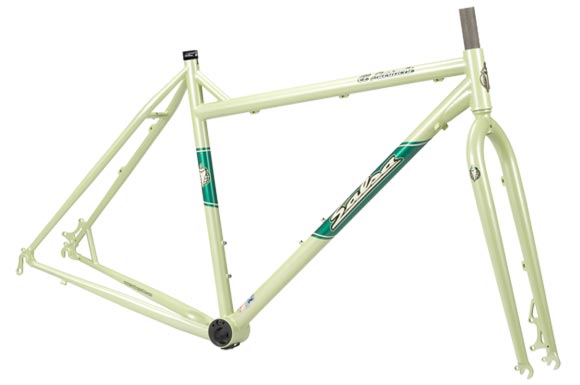
Thanks to some extra effort on the part of our shop's Raliegh rep, it showed up yesterday. That would be the XXIX. Here we see the placement of the downtube decal, which I think is pretty cool. The paint job is called "Dirty Red", which is an earthy toned red. A bit of a brownish tint to it, I'd say, which is complimented by the black with gold outlined decals. The fork is a straight legged affair that is disc specific. (Sorry you retro-grouches out there; no canti studs!)


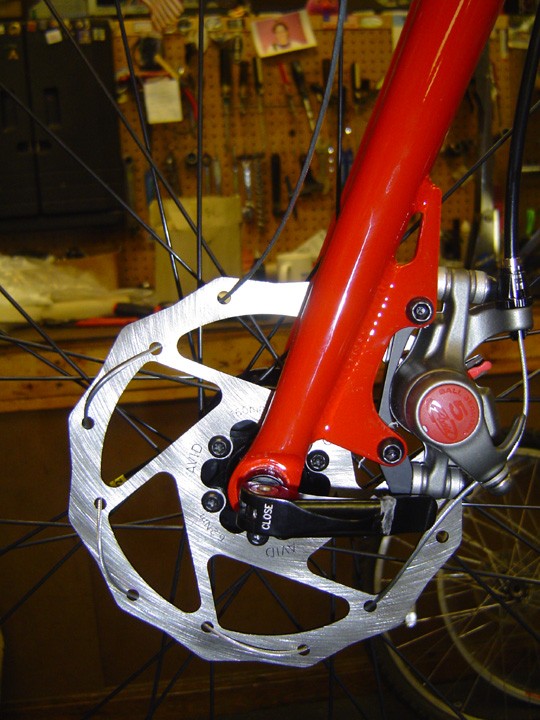
Here we see how not to run your excess cable from your Avid BB-5 disc brakes! (Thanks to Carlos the Jackal for that display of weaving ability) I had an issue with the forks drop out spacing, which is somewhat wider than 100mm and requires alot of extra effort to secure the wheel in the drop outs safely. I'll have to see about cold setting that fork, or go to a bolt on skewer to get it secured to my liking. You may want to check on this if you get an XXIX.


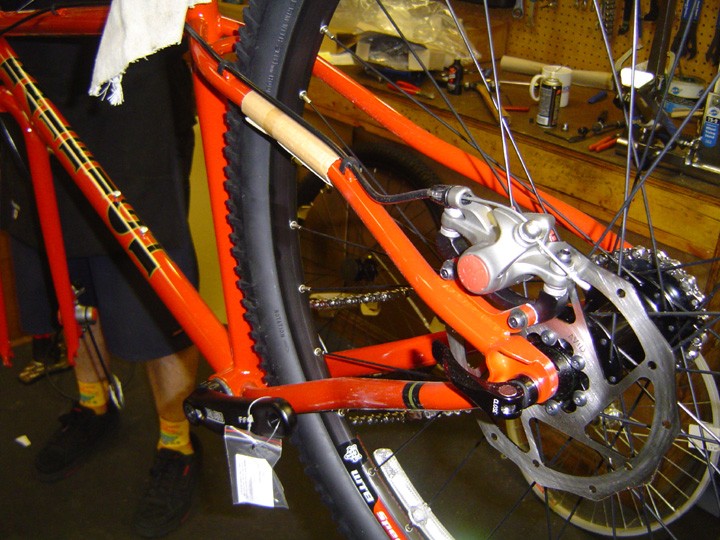
Here's a veiw of the "S" bend seat stays and the cassette rear single speed hub. The cog that comes with the XXIX is a 20T steel cog. The cassette hub along with the front hub both roll on sealed bearings and look to be pretty decent quality.

Other component highlights include a Truvativ Firex single speed crank with a 32 tooth gear and a chainguard. The wheels have WTB rims and tires, along with a WTB saddle on top of an Easton seat post. Also from Easton are the 31.8mm stem and handlebar that are mounted up with Avid levers and Raleigh's grips. All in all, a pretty decent spec for a $750.00 bike.

The frame features a double butted ChroMo tube set with an eccentric bottom bracket secured by set screws. The frame, like the fork, is disc specific. The welds looked nice and tidy and the finish was pretty nice for a production bike.

I'm going to suffer from the trend towards super sloping top tubes on this one because I need a longer seatpost to accomodate my saddle height. The 350mm Easton post won't cut it. Other than that, the frame fits nicely. The reach to the handle bars was spot on, and I'll be able to dial this bike in pretty quickly once I get the proper seat post.

Look for a detailed ride report at a later date. I can say that during my quick test ride that the bike handles slow speed cornering rather well. No "wheel flop" or strange tendencies jumped out at me, but remember, I was weaving in and out around the display islands in the shop! Not a real good test, but hey.........this is a first impressions post, okay?


Raleigh XXIX Arrives!


Thanks to some extra effort on the part of our shop's Raliegh rep, it showed up yesterday. That would be the XXIX. Here we see the placement of the downtube decal, which I think is pretty cool. The paint job is called "Dirty Red", which is an earthy toned red. A bit of a brownish tint to it, I'd say, which is complimented by the black with gold outlined decals. The fork is a straight legged affair that is disc specific. (Sorry you retro-grouches out there; no canti studs!)


Here we see how not to run your excess cable from your Avid BB-5 disc brakes! (Thanks to Carlos the Jackal for that display of weaving ability) I had an issue with the forks drop out spacing, which is somewhat wider than 100mm and requires alot of extra effort to secure the wheel in the drop outs safely. I'll have to see about cold setting that fork, or go to a bolt on skewer to get it secured to my liking. You may want to check on this if you get an XXIX.


Here's a veiw of the "S" bend seat stays and the cassette rear single speed hub. The cog that comes with the XXIX is a 20T steel cog. The cassette hub along with the front hub both roll on sealed bearings and look to be pretty decent quality.

Other component highlights include a Truvativ Firex single speed crank with a 32 tooth gear and a chainguard. The wheels have WTB rims and tires, along with a WTB saddle on top of an Easton seat post. Also from Easton are the 31.8mm stem and handlebar that are mounted up with Avid levers and Raleigh's grips. All in all, a pretty decent spec for a $750.00 bike.

The frame features a double butted ChroMo tube set with an eccentric bottom bracket secured by set screws. The frame, like the fork, is disc specific. The welds looked nice and tidy and the finish was pretty nice for a production bike.

I'm going to suffer from the trend towards super sloping top tubes on this one because I need a longer seatpost to accomodate my saddle height. The 350mm Easton post won't cut it. Other than that, the frame fits nicely. The reach to the handle bars was spot on, and I'll be able to dial this bike in pretty quickly once I get the proper seat post.

Look for a detailed ride report at a later date. I can say that during my quick test ride that the bike handles slow speed cornering rather well. No "wheel flop" or strange tendencies jumped out at me, but remember, I was weaving in and out around the display islands in the shop! Not a real good test, but hey.........this is a first impressions post, okay?


Wednesday, September 06, 2006

Bottom Bracket Standard to Change?

There have been many changes to the bicycles core component "standards" over the years. Most obvious is the headset size which has been all over the place in the last twenty years but seems to be settling on 1 1/8th for most all applications. (Again, can it really be a "standard" if not everyone is using the size in question?) Handle bar/ stem interfaces seem to be the most recent "standard" under attack. However; there has been another quietly brewing revolution at hand that is starting to get noticed more and more. This battle is beginning to rage over bottom bracket size.

To be fair, the "bottom bracket wars" have been going on now for a number of years in the world of BMX. The American sized "standard" has been assailed by the European bottom bracket, the "Spanish" bottom bracket, and something called the "mid-sized" bottom bracket, which was a new one on me just about a month ago. (Admittedly, I don't pay a whole lot of attention to BMX proclivities)

Now this "BB brouhaha" is about to come to your favorite bike brands. Cannondale, which has employed it's own in house bottom bracket size since about 2000, has introduced the "standard" to use by the rest of the industry. The SI Bottom Bracket uses an oversized shell and spindle to gain stifness, greater bearing contact surface area, and lighter weight. All good things in a bottom bracket, no doubt. The company has made it's own cranksets in the past to accomodate the larger spindle size and recently has been integrating SRM power meters into these cranks and has even gotten component maker FSA to design a crankset around this "standard" The latest company to adopt this oversized BB is Specailized who are using it in their 2007 FACT model with the oversized crankset spindle and bottom bracket.

Is this a good idea? Well, I think it's an innovation that technically makes sense. However; you will hear alot of "kicking and whining" from some folks who will cry "foul" because their old bike has now become "obsolete". I say you have more to worry about with the demise of the availability of seven speed shifters and cassettes than you do about this new "standard".

Think about it. You can still buy new square taper cranks and bottom brackets. That's not going away any time soon. While Cannondale may seem like they are "imposing their will" on the unsuspecting populace, I say it's about time that some of this stuff has gotten a freshening up. Bottom bracket size could stand a little scrutiny, and the Cannondale, ( and Pinarello idea called MOst, for that matter) is a step in the right direction. While I'm not yet sold on the attachment of the crankarms yet, (splined systems in use today haven't shown a reliability above that of square taper in my opinion) I can see that there is alot of potential here to improve upon the lowly bottom bracket.

But please! Don't call it a standard..........not yet anyway!

Bottom Bracket Standard to Change?

There have been many changes to the bicycles core component "standards" over the years. Most obvious is the headset size which has been all over the place in the last twenty years but seems to be settling on 1 1/8th for most all applications. (Again, can it really be a "standard" if not everyone is using the size in question?) Handle bar/ stem interfaces seem to be the most recent "standard" under attack. However; there has been another quietly brewing revolution at hand that is starting to get noticed more and more. This battle is beginning to rage over bottom bracket size.

To be fair, the "bottom bracket wars" have been going on now for a number of years in the world of BMX. The American sized "standard" has been assailed by the European bottom bracket, the "Spanish" bottom bracket, and something called the "mid-sized" bottom bracket, which was a new one on me just about a month ago. (Admittedly, I don't pay a whole lot of attention to BMX proclivities)

Now this "BB brouhaha" is about to come to your favorite bike brands. Cannondale, which has employed it's own in house bottom bracket size since about 2000, has introduced the "standard" to use by the rest of the industry. The SI Bottom Bracket uses an oversized shell and spindle to gain stifness, greater bearing contact surface area, and lighter weight. All good things in a bottom bracket, no doubt. The company has made it's own cranksets in the past to accomodate the larger spindle size and recently has been integrating SRM power meters into these cranks and has even gotten component maker FSA to design a crankset around this "standard" The latest company to adopt this oversized BB is Specailized who are using it in their 2007 FACT model with the oversized crankset spindle and bottom bracket.

Is this a good idea? Well, I think it's an innovation that technically makes sense. However; you will hear alot of "kicking and whining" from some folks who will cry "foul" because their old bike has now become "obsolete". I say you have more to worry about with the demise of the availability of seven speed shifters and cassettes than you do about this new "standard".

Think about it. You can still buy new square taper cranks and bottom brackets. That's not going away any time soon. While Cannondale may seem like they are "imposing their will" on the unsuspecting populace, I say it's about time that some of this stuff has gotten a freshening up. Bottom bracket size could stand a little scrutiny, and the Cannondale, ( and Pinarello idea called MOst, for that matter) is a step in the right direction. While I'm not yet sold on the attachment of the crankarms yet, (splined systems in use today haven't shown a reliability above that of square taper in my opinion) I can see that there is alot of potential here to improve upon the lowly bottom bracket.

But please! Don't call it a standard..........not yet anyway!

Tuesday, September 05, 2006

Tips On Mechanical Disc Brake Set Up


I have run across this question on how to best set up a mechanical disc brake for a bicycle enough that I thought a post on it was in order.

There are several choices for mechanical disc brakes out there, but the most common to the serious off roader is going to be the Avid BB-7, which is pictured here. That being the case, I will say that my specific tips will benefit any user of any type of mechanical disc brake.

First of all, it's not so much how you set up the caliper, although that is critical, of course. However; you can have a perfectly installed caliper, rotor, and brake lever and still have a crappy brake that's not much better than a linear pull brake and it'll be a heck of alot heavier than a linear pull brake to boot.

The trick to getting the most out of your mechanical disc brake is in the cable, housing for that cable, and your choice of brake lever. Without careful consideration for each of these component choices, you are going to have a sub-standard set up on your brakes.

Brake Lever: While it's true that any linear pull compatible brake lever will work with mechanical disc brakes, not all levers are created equal. Many linear pull levers are sloppy, flexy, and do not pull as much cable as some other higher end levers. If you are using a lever that isn't solid and flex free, you are losing braking power! I recommend using a quality linear pull lever like an Avid SD-1 or better. Paul Love Levers are also really good. A flex free lever with little to no pivot slop is imperative for getting the most out of a mechanical disc brake.

Cable: Ahh! The lowly mountain bike brake cable. What possibly could you want better than that? Well, another thing that kills mechanical disc brake power and especially feel is a dry, dirty, or rusted cable. One of the best things you can do to improve your existing mechanical disc brake is to get that plain old cable out and replace it with a Teflon coated type cable. These are available from several manufacturers. They are more slippery in the housing, they resist corrosion, and are relatively cheap.

Cable Housing: Here's the big one. If you do not do anything else, do this! First, go out and squeeze the brake lever of a linear brake equipped bike. Watch the cable housing. (This works best if you squeeze the front brake lever on a linear brake equpped bike) With pressure applied you can see the housing moving. Big deal, you say? Well, that's brake power that you are loosing, my friend. That's especially bad on a mechanical disc brake system. You can get rid of this by using a compressionless cable housing like my Nokon system in the picture above. (Look for the silver/blue/silver housing) Compressionless housings resist or eliminate flex which in turn makes your mechanical disc brake much more powerfull. This is an expensive upgrade, but well worth the effort if you desire to have the best mechanical brake set up possible, and it's still cheaper than alot of mid to high end hydro brake set ups, even if you include the costs of all of your bits and pieces.

So, that's it. You can have a mechanical brake set up that rivals any hydro brake and have yours be leak free, field serviceable, and never have to bleed the system. Joy! And, if you use a sealed cable system like Nokon's, you won't even have dirt or lube problems to deal with. If you have a mechanical disc brake set, and you haven't tried any of these things, you haven't reached the potential of your brakes yet. Not even close!

Tips On Mechanical Disc Brake Set Up


I have run across this question on how to best set up a mechanical disc brake for a bicycle enough that I thought a post on it was in order.

There are several choices for mechanical disc brakes out there, but the most common to the serious off roader is going to be the Avid BB-7, which is pictured here. That being the case, I will say that my specific tips will benefit any user of any type of mechanical disc brake.

First of all, it's not so much how you set up the caliper, although that is critical, of course. However; you can have a perfectly installed caliper, rotor, and brake lever and still have a crappy brake that's not much better than a linear pull brake and it'll be a heck of alot heavier than a linear pull brake to boot.

The trick to getting the most out of your mechanical disc brake is in the cable, housing for that cable, and your choice of brake lever. Without careful consideration for each of these component choices, you are going to have a sub-standard set up on your brakes.

Brake Lever: While it's true that any linear pull compatible brake lever will work with mechanical disc brakes, not all levers are created equal. Many linear pull levers are sloppy, flexy, and do not pull as much cable as some other higher end levers. If you are using a lever that isn't solid and flex free, you are losing braking power! I recommend using a quality linear pull lever like an Avid SD-1 or better. Paul Love Levers are also really good. A flex free lever with little to no pivot slop is imperative for getting the most out of a mechanical disc brake.

Cable: Ahh! The lowly mountain bike brake cable. What possibly could you want better than that? Well, another thing that kills mechanical disc brake power and especially feel is a dry, dirty, or rusted cable. One of the best things you can do to improve your existing mechanical disc brake is to get that plain old cable out and replace it with a Teflon coated type cable. These are available from several manufacturers. They are more slippery in the housing, they resist corrosion, and are relatively cheap.

Cable Housing: Here's the big one. If you do not do anything else, do this! First, go out and squeeze the brake lever of a linear brake equipped bike. Watch the cable housing. (This works best if you squeeze the front brake lever on a linear brake equpped bike) With pressure applied you can see the housing moving. Big deal, you say? Well, that's brake power that you are loosing, my friend. That's especially bad on a mechanical disc brake system. You can get rid of this by using a compressionless cable housing like my Nokon system in the picture above. (Look for the silver/blue/silver housing) Compressionless housings resist or eliminate flex which in turn makes your mechanical disc brake much more powerfull. This is an expensive upgrade, but well worth the effort if you desire to have the best mechanical brake set up possible, and it's still cheaper than alot of mid to high end hydro brake set ups, even if you include the costs of all of your bits and pieces.

So, that's it. You can have a mechanical brake set up that rivals any hydro brake and have yours be leak free, field serviceable, and never have to bleed the system. Joy! And, if you use a sealed cable system like Nokon's, you won't even have dirt or lube problems to deal with. If you have a mechanical disc brake set, and you haven't tried any of these things, you haven't reached the potential of your brakes yet. Not even close!

Saturday, September 02, 2006

Bonus Post and Introductions

A little introduction or two is in order here. I decided to sit down today and to rearrange a few of the links and to add a few things. So, without further verbiage, here is what's up:

Happy Mutant Multisport: Here's a new forum site that is based out of the mid-west right now, but plans are to go nationwide at some point. ( I think!) Anyway, if you are a runner, swimmer, cyclist, canoe dude, kayaker, duathelete, triathelete, enduro-freak-job, or otherwise, this place is a clearing house of info and support that is just getting off the ground now. Feel free to check it out anytime from my linkage, or go for it now.

Ridemonkey: Another cycling based forum community that might be a tad less hair trigger and more laid back than mtbr.com. At least that's been my experience on their 29"er forum. Check that out for a change of pace.

Crooked Cog Podcast: If you know The Blue Collar Mountain Bike site, or Twenty Nine Inches, then you know Tim Grahl. He is the web master mind behind the Crooked Cog Podcast, which is into it's fourth episode now and has featured Marla Streb, Nick Sandy of Surly Bikes, and Mr. 24 himself. I'll clue ya'all in when new episodes are available, but the link will be over there when ya need it.

Niner Bikes: In the "I shoulda done this ages ago" category is Niner Bikes, who are a 29"er only manufacturer of bikes. Check out the big wheeled goodness from these committed guys.

On One Cycles: Again, too long for these guys not to be linked here. Check out the outside of the box thinking behind some of the coolest handle bars around, and oh yeah! They've got a pretty decent 29"er or two, as well!

Twin Six Cycling Apparel: These guys from Minneapolis, Minnesota have got it going on with the jerseys and cycling related t-shirts, and other goodness. That's not all, but ya'all will have to wait to see what these innovative cycling nuts have up their sleeves till Interbike. Don't worry, it'll get reported on here too, so you won't miss it. In the meantime, check out this up and coming company!

Dave Nice: aka "Cellar Rat" aka "Slower Than Snot": Dave was the guy, you might remember, that got his rig stolen on the GDR this past summer. Anyway, he is a Trans Iowa veteran, a fixie off roader, and a whiskey distiller,and all around great guy, so he's on board in the linkage for you to check out his blog.

Okay, that's all new stuff in the linkage area, so keep that in mind when you visit here. I also rearranged a few things, so it might look like all the links are new, but they are not. Just jumbled up in a new way to freshen things up a bit. I really like all these companies and bloggers, so I guess you could say that I endorse them, but then again, what's that worth? I'm just going to say that I like them and they are great companies and bloggers in my opinion. If you feel the same, then support 'em! If not, that's okay too. Just my opinion, you gotta make up yer own mind.

Lastly, I wanted to mention that Chris King is making the pink ano components available year round, instead of just a few months. The breast cancer support is still there, so that's all good. I own a pink headset, and I support what they are doing. Maybe since I rode with Matt Wills on the Guitar Ted Death Ride Invitational I have a curious desire for a pink single speed disc Chris King rear hub. Hmm............could that be it?

Happy Labor Day Weekend to all you U.S. citizens out there. To everyone: Go ride yer bike!

Bonus Post and Introductions

A little introduction or two is in order here. I decided to sit down today and to rearrange a few of the links and to add a few things. So, without further verbiage, here is what's up:

Happy Mutant Multisport: Here's a new forum site that is based out of the mid-west right now, but plans are to go nationwide at some point. ( I think!) Anyway, if you are a runner, swimmer, cyclist, canoe dude, kayaker, duathelete, triathelete, enduro-freak-job, or otherwise, this place is a clearing house of info and support that is just getting off the ground now. Feel free to check it out anytime from my linkage, or go for it now.

Ridemonkey: Another cycling based forum community that might be a tad less hair trigger and more laid back than mtbr.com. At least that's been my experience on their 29"er forum. Check that out for a change of pace.

Crooked Cog Podcast: If you know The Blue Collar Mountain Bike site, or Twenty Nine Inches, then you know Tim Grahl. He is the web master mind behind the Crooked Cog Podcast, which is into it's fourth episode now and has featured Marla Streb, Nick Sandy of Surly Bikes, and Mr. 24 himself. I'll clue ya'all in when new episodes are available, but the link will be over there when ya need it.

Niner Bikes: In the "I shoulda done this ages ago" category is Niner Bikes, who are a 29"er only manufacturer of bikes. Check out the big wheeled goodness from these committed guys.

On One Cycles: Again, too long for these guys not to be linked here. Check out the outside of the box thinking behind some of the coolest handle bars around, and oh yeah! They've got a pretty decent 29"er or two, as well!

Twin Six Cycling Apparel: These guys from Minneapolis, Minnesota have got it going on with the jerseys and cycling related t-shirts, and other goodness. That's not all, but ya'all will have to wait to see what these innovative cycling nuts have up their sleeves till Interbike. Don't worry, it'll get reported on here too, so you won't miss it. In the meantime, check out this up and coming company!

Dave Nice: aka "Cellar Rat" aka "Slower Than Snot": Dave was the guy, you might remember, that got his rig stolen on the GDR this past summer. Anyway, he is a Trans Iowa veteran, a fixie off roader, and a whiskey distiller,and all around great guy, so he's on board in the linkage for you to check out his blog.

Okay, that's all new stuff in the linkage area, so keep that in mind when you visit here. I also rearranged a few things, so it might look like all the links are new, but they are not. Just jumbled up in a new way to freshen things up a bit. I really like all these companies and bloggers, so I guess you could say that I endorse them, but then again, what's that worth? I'm just going to say that I like them and they are great companies and bloggers in my opinion. If you feel the same, then support 'em! If not, that's okay too. Just my opinion, you gotta make up yer own mind.

Lastly, I wanted to mention that Chris King is making the pink ano components available year round, instead of just a few months. The breast cancer support is still there, so that's all good. I own a pink headset, and I support what they are doing. Maybe since I rode with Matt Wills on the Guitar Ted Death Ride Invitational I have a curious desire for a pink single speed disc Chris King rear hub. Hmm............could that be it?

Happy Labor Day Weekend to all you U.S. citizens out there. To everyone: Go ride yer bike!

Eurobike '07: The Tip of the 29"er Iceberg!

The reports are coming in from this years first major bicycle show of import: Eurobike in Germany. This is the first show of the "show season" where new '07 products are revealed for the first time. Of course, Trek/ Gary Fisher/ LeMond has there shindig in Madison, Wisconsin that took place just a couple of weeks ago, and some other pre-show season leakage has been seen, but this is the first big salvo.

I've predicted that Interbike will be "The Year of the 29"er" as far as a show by-line is concerned and Eurobike is showing me that I might just be right about that. Take into consideration that there is almost no 29 inch market share in Europe right now and you might see that the amount of 29 inch product shown there as an indication of big things to come. Here are some of the show highlights and my thoughts on them.

Tire choices multiply: The disadvantages of going to a 29"er are being swept away. One of those disadvantages was tire choice. Not anymore! Panaracer showed the much anticipated and previously heralded Rampage, which is a fully knobbed out fatty that should please those all-mountain and tech addicted riders of 29"er wheels. Other "big" tire news was WTB's new Weirwolf 2.55" Low Tread tire. This looks like a winner for rigid fork riders. The really big surprise was Geax which made it's intro into the 29"er marketplace with it's Saguaro tread pattern in a big, wide looking 2.5" casing. This tire looks really interesting!

Add these to the Bontrager Dry X race oriented tire and the Tubeless Ready System that Bontrager is bringing to market and it's starting to look like almost all the bases are covered in 29" tires. I expect Maxxis to show a CrossMark tread at Interbike for 29" and who knows what else will come up for rubber goodness there! Intense is expected to have 29" tires soon, so maybe they will have some show samples readied.

Other 29"er Goodness: In relation to tires in the news is Salsa's newest version of the Delgado Disc 29"er rim which was shown at Eurobike. Called the "Delgado Disc Race", the new rim will be made available in polished and black ano with a target weight of around 450 grams! That's pretty amazing for a 29 millimeter wide rim! Salsa says to expect the rims to be available sometime in February of '07.

Pace, a European fork manufacturer, has already been selling a rigid carbon fork for 29"ers which has been a good seller for them. They are now going to release a suspended fork for 29"ers that promises to be a high end, reasonably light fork. The show sample looked good.

Finally, Salsa showed a new color for the Dos Niner that is orange and tangerine with some cool pinstipe/ flamey graphics. It's going to join the already available green Dos Niner for '07. The biggest news here is not just the color, but that the orange flavor will be disc only! I suspect that more and more mountain bikes will be disc only as we progress into the future. Are linear pull brakes going to be the next "retro trend"? I'm betting they will be someday.

So, judging from these highlights shown in a market that is said to have no interest in 29"ers, I'd have to say that Interbike will be quite interesting. It just so happens that there is a 29"er market place for 29"ers here, so the release of 29"er info would logically be held off until the show in Vegas. Salsa personnel have said they are holding back some stuff for Vegas, and they already have shown some great stuff. I can't wait!

For pictures and more check out this.

Eurobike '07: The Tip of the 29"er Iceberg!

The reports are coming in from this years first major bicycle show of import: Eurobike in Germany. This is the first show of the "show season" where new '07 products are revealed for the first time. Of course, Trek/ Gary Fisher/ LeMond has there shindig in Madison, Wisconsin that took place just a couple of weeks ago, and some other pre-show season leakage has been seen, but this is the first big salvo.

I've predicted that Interbike will be "The Year of the 29"er" as far as a show by-line is concerned and Eurobike is showing me that I might just be right about that. Take into consideration that there is almost no 29 inch market share in Europe right now and you might see that the amount of 29 inch product shown there as an indication of big things to come. Here are some of the show highlights and my thoughts on them.

Tire choices multiply: The disadvantages of going to a 29"er are being swept away. One of those disadvantages was tire choice. Not anymore! Panaracer showed the much anticipated and previously heralded Rampage, which is a fully knobbed out fatty that should please those all-mountain and tech addicted riders of 29"er wheels. Other "big" tire news was WTB's new Weirwolf 2.55" Low Tread tire. This looks like a winner for rigid fork riders. The really big surprise was Geax which made it's intro into the 29"er marketplace with it's Saguaro tread pattern in a big, wide looking 2.5" casing. This tire looks really interesting!

Add these to the Bontrager Dry X race oriented tire and the Tubeless Ready System that Bontrager is bringing to market and it's starting to look like almost all the bases are covered in 29" tires. I expect Maxxis to show a CrossMark tread at Interbike for 29" and who knows what else will come up for rubber goodness there! Intense is expected to have 29" tires soon, so maybe they will have some show samples readied.

Other 29"er Goodness: In relation to tires in the news is Salsa's newest version of the Delgado Disc 29"er rim which was shown at Eurobike. Called the "Delgado Disc Race", the new rim will be made available in polished and black ano with a target weight of around 450 grams! That's pretty amazing for a 29 millimeter wide rim! Salsa says to expect the rims to be available sometime in February of '07.

Pace, a European fork manufacturer, has already been selling a rigid carbon fork for 29"ers which has been a good seller for them. They are now going to release a suspended fork for 29"ers that promises to be a high end, reasonably light fork. The show sample looked good.

Finally, Salsa showed a new color for the Dos Niner that is orange and tangerine with some cool pinstipe/ flamey graphics. It's going to join the already available green Dos Niner for '07. The biggest news here is not just the color, but that the orange flavor will be disc only! I suspect that more and more mountain bikes will be disc only as we progress into the future. Are linear pull brakes going to be the next "retro trend"? I'm betting they will be someday.

So, judging from these highlights shown in a market that is said to have no interest in 29"ers, I'd have to say that Interbike will be quite interesting. It just so happens that there is a 29"er market place for 29"ers here, so the release of 29"er info would logically be held off until the show in Vegas. Salsa personnel have said they are holding back some stuff for Vegas, and they already have shown some great stuff. I can't wait!

For pictures and more check out this.

Thursday, August 31, 2006

Materials of Choice: Carbon Fiber


Welcome to the fifth and last post on Materials of Choice, which have covered materials commonly used to make bicycle frames and forks. Of all the materials covered, this one: carbon fiber, is the only non-metallic substance that is used in the industry on a wide basis to make bicycles from.

There are all sorts of uses for carbon fiber and it is an amazing material. So, just what exactly is it? Well, carbon fiber is a pretty descriptive clue in and of itself. Basically, something has been carbonized, (burned would be a very crude way to describe it) and the resulting residue, usually in the form of fillaments, ( but not necessarily that) is either woven, wound, or chopped up. That then is introduced to a resin, or in other words, an agent that bonds the fibers together, to be cured under intense pressure and heat. Usually done in some sort of mold, the resulting object is then finished and ready for use. Want to know more? Check out this translated Japanese paper on the definition, and types of carbon fiber. Follow the prompts at the top or bottom of the page to continue reading. It's not bad....only five pages! Come on!

As I have already indicated, carbon fiber has many uses, and it's even used for more things in the industry than bicycle frames forks, and parts. It's even in some of the clothes we wear! Since this is about frames and forks, we'll try to keep it on that. Carbon fiber was toyed around with for use on bicycles and even mountain bikes way back ( I know- everything is relative!) in the 80's with notable off road examples by Kestrel and Trimble. The cautious nature of mountain bikers comes out when you say "carbon fiber", because of some of the early examples that suffered failures at the hands of the rough and tumble terrain that the bikes were subjected to. This has permeated the psyche of riders up to this very day. However; Trek and several other top tier bicycle companies have persevered in bringing more and better examples of carbon fiber frame mountain bikes to the point now where reliability in the feild is as good if not better than it's metallic brethren.

So, what's the dealio with carbon fiber anyway? To weak to handle off roading? Nope, not anymore than any other popular material today. Too spendy? Well, yeah! Believe me, cheap carbon fiber is out there, but that's the stuff you don't want to ride! Hard to produce in different sizes? Uh-huh. But mostly because you have to have a mold to make the parts, and each different frame size has different angles, so you guessed it, it has different molds! That drives up costs. Plus, to do carbon fiber properly and safely, you have to have the correct environment to work in, again more expensive. Is it light? Crazy light! Is it strong? Yep! It's very strong, but it has to be properly designed and manufactured, which adds expense. What if I scratch it, is it toast? Mmm.......tooooaaast! ( sorry! I'm hungry!) Well, unless you compromise the integrity of the fibers, you are okay. Generally carbon fiber is protected by a hard, clear outer layer of resin. This is usually what gets scratched. However; if you see dust, fraying, or fuzz.....STOP USING THE BIKE! It's compromised structurally and may need replacement!

So, is carbon fiber for you? Yes: if you are a weight weenie, like techy stuff, or are financially well endowed. Will it hold up? Yeah, probably. If you race it and use it hard, that's okay if that's what it's designed for, but ya gotta use your noggin' and check out the frame, fork, or carbon bits if you crash! Replace when necessary! Carbon fiber is strong, but it'll break, and when it does, it usually is catastrophic. Be aware! That said, Mr. 24 himself has flogged carbon fiber frames from here to Japan without incident.

Well, that wraps up another Guitar Ted series! I hope you found it informative. I know I sure learned alot! Next up is some opinions on the newest 29"er bits and pieces being shown right now at Eurobike in Germany. There are some pretty tasty tidbits, so tune in tomorrow to get my take on it all. Late!

Materials of Choice: Carbon Fiber


Welcome to the fifth and last post on Materials of Choice, which have covered materials commonly used to make bicycle frames and forks. Of all the materials covered, this one: carbon fiber, is the only non-metallic substance that is used in the industry on a wide basis to make bicycles from.

There are all sorts of uses for carbon fiber and it is an amazing material. So, just what exactly is it? Well, carbon fiber is a pretty descriptive clue in and of itself. Basically, something has been carbonized, (burned would be a very crude way to describe it) and the resulting residue, usually in the form of fillaments, ( but not necessarily that) is either woven, wound, or chopped up. That then is introduced to a resin, or in other words, an agent that bonds the fibers together, to be cured under intense pressure and heat. Usually done in some sort of mold, the resulting object is then finished and ready for use. Want to know more? Check out this translated Japanese paper on the definition, and types of carbon fiber. Follow the prompts at the top or bottom of the page to continue reading. It's not bad....only five pages! Come on!

As I have already indicated, carbon fiber has many uses, and it's even used for more things in the industry than bicycle frames forks, and parts. It's even in some of the clothes we wear! Since this is about frames and forks, we'll try to keep it on that. Carbon fiber was toyed around with for use on bicycles and even mountain bikes way back ( I know- everything is relative!) in the 80's with notable off road examples by Kestrel and Trimble. The cautious nature of mountain bikers comes out when you say "carbon fiber", because of some of the early examples that suffered failures at the hands of the rough and tumble terrain that the bikes were subjected to. This has permeated the psyche of riders up to this very day. However; Trek and several other top tier bicycle companies have persevered in bringing more and better examples of carbon fiber frame mountain bikes to the point now where reliability in the feild is as good if not better than it's metallic brethren.

So, what's the dealio with carbon fiber anyway? To weak to handle off roading? Nope, not anymore than any other popular material today. Too spendy? Well, yeah! Believe me, cheap carbon fiber is out there, but that's the stuff you don't want to ride! Hard to produce in different sizes? Uh-huh. But mostly because you have to have a mold to make the parts, and each different frame size has different angles, so you guessed it, it has different molds! That drives up costs. Plus, to do carbon fiber properly and safely, you have to have the correct environment to work in, again more expensive. Is it light? Crazy light! Is it strong? Yep! It's very strong, but it has to be properly designed and manufactured, which adds expense. What if I scratch it, is it toast? Mmm.......tooooaaast! ( sorry! I'm hungry!) Well, unless you compromise the integrity of the fibers, you are okay. Generally carbon fiber is protected by a hard, clear outer layer of resin. This is usually what gets scratched. However; if you see dust, fraying, or fuzz.....STOP USING THE BIKE! It's compromised structurally and may need replacement!

So, is carbon fiber for you? Yes: if you are a weight weenie, like techy stuff, or are financially well endowed. Will it hold up? Yeah, probably. If you race it and use it hard, that's okay if that's what it's designed for, but ya gotta use your noggin' and check out the frame, fork, or carbon bits if you crash! Replace when necessary! Carbon fiber is strong, but it'll break, and when it does, it usually is catastrophic. Be aware! That said, Mr. 24 himself has flogged carbon fiber frames from here to Japan without incident.

Well, that wraps up another Guitar Ted series! I hope you found it informative. I know I sure learned alot! Next up is some opinions on the newest 29"er bits and pieces being shown right now at Eurobike in Germany. There are some pretty tasty tidbits, so tune in tomorrow to get my take on it all. Late!

Wednesday, August 30, 2006

Materials of Choice: Titanium


If Aluminum is the flavor of the day for bike frames, and steel was the former champion, then titanium has to be the modern "wonder metal" that garners "oohs" and "aahhs" whenever we see a frame made of the silvery-grey stuff. Titanium hasn't been used in bicycle frame construction on a wide scale until recently. In fact, mountain bikes made of the stuff didn't arrive on the scene until steel and aluminum frames were rather common place. There are some rather odd details to the story of titanium, so let's take a closer look.


Pictured: A classic titanium mountain bike frame; the Moots YBB

If you think that I might have some homework for you to read, you're right! Take a look at this short article on titanium and it's alloys. You might be surprised to know that there is more titanium alloys than you thought! As with aluminum and steel, titanium gains desirable qualities if it's alloyed out with the correct materials for bicycle frames. "Commercially Pure" titanium, or "CP" as it's more commonly known, is a little too boingy for most folks taste. So to stiffen things up a bit, and to keep the frame tubing stronger, a little bit of aluminum and vanadium is thrown into the mix. (Read the article for a better explanation) At any rate, most titanium frames that you see today are made from this alloy of titanium: 3 Al- 2.5V, which describes the "recipe" for the alloy.

Titanium hasn't been used for bicycle frames for a few reasons until recently. Number one probably has to be because of it's high demand in the aero-space industry and in particular, the defense industry. The silvery-grey stuff is light and strong so it's a no brainer for applications in that field. Add to it the high resistence to corrosion and you have a highly coveted metal. The crazy thing is, titanium as an element is not rare! It's the ninth most common element on earth. So what's the dealio? Why is titanium so hard to get and so pricey? Well, that's a whole 'nuther story there, mate! To keep this post in check, you should read this. The short answer is, it's dang tough to get it out of it's natural mixed-up-with-other-substances state. You see, there are not any naturally occuring pure titanium deposits. So, it's a tough, expensive, time consuming process to get the titanium extracted. That's why it's been awhile since the metal was considered for anything other than aero-space/ defense use.

Titanium: Spendy, flexy, and not designer friendly. Lasts forever. Rides like nothing else and is lighter than anything. These are the things commonly heard about the wonder metal. True or false? Let's look!

Spendy: Yep! Confirmed. Yet, as the second linked article indicates, it might not always be the case.

Flexy: Uh-huh. Yeah, but it can be made to be somewhat less whippy and flexy with very careful design and use of it's sister alloy 6Al- 4V, which is pretty stout but harder than heck to work with. Regardless: big fellows and mashers take note, if ya likes yer frames stout and stiff, ya might steer clear of this grey matter!

Not designer friendly: No. Period. It's hard to work with, it's expensive to purchase, and their are only straight guage and one butted tube choice for builders to choose from. Tuning the ride is far more difficult to do. Most of the time, it's simply compromised for the cool factor.

Resists corrosion: Yep! Rides like nothing else: Yep again, but that's not always a good thing! Light: Yes again, but not the lightest. Care must be taken with Ti to keep the stiffness, so making it light, while entirely possible, is usually counter productive. You end up with a light bike, but it's a flexy P.O.S. !

So, is titanium for you? Maybe. If you ride smoothly, are medium to small in stature, have a healthy bank account, and don't mind a bit of flex in your steed, then go right ahead. Maybe you have fallen under the siren song of the mysterious grey metal. Whatever it is, titanium seems to have a strong following and always gets the stares. Modern technology may prove to be a boon to titanium in the recovery of the ore and also in it's use in bicycles. Carbon fiber, when mated to this wonder metal, can be used to tune the ride. Some interesting work is being done by Titus and others in this vein.

Next: Carbon Fiber

Materials of Choice: Titanium


If Aluminum is the flavor of the day for bike frames, and steel was the former champion, then titanium has to be the modern "wonder metal" that garners "oohs" and "aahhs" whenever we see a frame made of the silvery-grey stuff. Titanium hasn't been used in bicycle frame construction on a wide scale until recently. In fact, mountain bikes made of the stuff didn't arrive on the scene until steel and aluminum frames were rather common place. There are some rather odd details to the story of titanium, so let's take a closer look.


Pictured: A classic titanium mountain bike frame; the Moots YBB

If you think that I might have some homework for you to read, you're right! Take a look at this short article on titanium and it's alloys. You might be surprised to know that there is more titanium alloys than you thought! As with aluminum and steel, titanium gains desirable qualities if it's alloyed out with the correct materials for bicycle frames. "Commercially Pure" titanium, or "CP" as it's more commonly known, is a little too boingy for most folks taste. So to stiffen things up a bit, and to keep the frame tubing stronger, a little bit of aluminum and vanadium is thrown into the mix. (Read the article for a better explanation) At any rate, most titanium frames that you see today are made from this alloy of titanium: 3 Al- 2.5V, which describes the "recipe" for the alloy.

Titanium hasn't been used for bicycle frames for a few reasons until recently. Number one probably has to be because of it's high demand in the aero-space industry and in particular, the defense industry. The silvery-grey stuff is light and strong so it's a no brainer for applications in that field. Add to it the high resistence to corrosion and you have a highly coveted metal. The crazy thing is, titanium as an element is not rare! It's the ninth most common element on earth. So what's the dealio? Why is titanium so hard to get and so pricey? Well, that's a whole 'nuther story there, mate! To keep this post in check, you should read this. The short answer is, it's dang tough to get it out of it's natural mixed-up-with-other-substances state. You see, there are not any naturally occuring pure titanium deposits. So, it's a tough, expensive, time consuming process to get the titanium extracted. That's why it's been awhile since the metal was considered for anything other than aero-space/ defense use.

Titanium: Spendy, flexy, and not designer friendly. Lasts forever. Rides like nothing else and is lighter than anything. These are the things commonly heard about the wonder metal. True or false? Let's look!

Spendy: Yep! Confirmed. Yet, as the second linked article indicates, it might not always be the case.

Flexy: Uh-huh. Yeah, but it can be made to be somewhat less whippy and flexy with very careful design and use of it's sister alloy 6Al- 4V, which is pretty stout but harder than heck to work with. Regardless: big fellows and mashers take note, if ya likes yer frames stout and stiff, ya might steer clear of this grey matter!

Not designer friendly: No. Period. It's hard to work with, it's expensive to purchase, and their are only straight guage and one butted tube choice for builders to choose from. Tuning the ride is far more difficult to do. Most of the time, it's simply compromised for the cool factor.

Resists corrosion: Yep! Rides like nothing else: Yep again, but that's not always a good thing! Light: Yes again, but not the lightest. Care must be taken with Ti to keep the stiffness, so making it light, while entirely possible, is usually counter productive. You end up with a light bike, but it's a flexy P.O.S. !

So, is titanium for you? Maybe. If you ride smoothly, are medium to small in stature, have a healthy bank account, and don't mind a bit of flex in your steed, then go right ahead. Maybe you have fallen under the siren song of the mysterious grey metal. Whatever it is, titanium seems to have a strong following and always gets the stares. Modern technology may prove to be a boon to titanium in the recovery of the ore and also in it's use in bicycles. Carbon fiber, when mated to this wonder metal, can be used to tune the ride. Some interesting work is being done by Titus and others in this vein.

Next: Carbon Fiber

Tuesday, August 29, 2006

Materials of Choice: Steel

Just as aluminum is now the material du jour of the average bicycle in America, steel was in the past. Really, it wasn't that long ago either. Steel was the only real choice for practical bicycles for decades. Most every design that you have ever seen executed for use on your off road bicycle was first done on a steel framed bicycle and often in steel itself. The modern bicycle owes everything to this noble material and the multitude of ways that it can be used. Of course, most of Western Culture was built on the back of steel, so it should come as no surprise that bicycles flourished because of it. ( pictured is a Salsa "El Mariachi" 29"er frameset made from True Temper OX Platinum steel alloy tubing)

Again, there is alot more going on here than meets the eye. It's an understatement to say that we take steel for granted. I found out alot of stuff about steel from an article posted originally on Pirate 4X4.com . If you thought that the link on the Aluminum post was total pocket protector, geek material, than you ain't seen nuttin' yet! ( appologies to B.T.O.) This steel and iron stuff is amazing! Once again, we aren't really understanding what we're talking about as bike geeks when we say "CroMo" or "4130". Read the info, and you will see what I mean! I'll forewarn you though. You're going to need a pot of black goodness to get ya through it all!

Now that you've been pointed in the right direction, and have hopefully read and understood the pertinent info, we can move on. Let's see about today's current state of affairs in the world of steel bicycles.

It certainly isn't easy to walk into just any bike shop and see a nicely executed steel frame and fork these days, unless it's an oldie in the repair department. Most steel frame and forks that are of higher quality are coming out of small custom builders shops. That isn't to say that you can't get a decent frame and fork from your local shop. (The "El Mariachi" above being a perfect example) , it's just not a common thing these days. Sure, there are some companies that have held onto their steel roots, but not many. Why is this the case? Well, some of it has to do with fashion, and alot of it has to do with money. It's just plain easier for a big Far East company to churn out hundreds of "cookie cutter" aluminum frames than it is to make steel ones and besides, aluminum frames just look more "burly" and are percieved to be "lighter" by the general public. Steel lost it's cache' with the average cyclist due to hype and marketing. Steel wasn't cool anymore!

To be sure, military research and developement was focused more on aluminum products than it was steel, so the influx of technology into the bicycle business in the late 80's and early 90's at the end of the Cold War favored aluminum and it's alloys. Soon, just about every kid had heard about "M2" and other "metal matrix" aluminum alloys and steel was just well..........boring! It hasn't been until recently that steel alloys have appeared that rival the weights of aluminum frames and the steel "feel" has been missed by alot of riders. Ya know, steel is real, and all of that!

Steel is heavy, it rusts too easily, and it's just old skool hype. That's what the naysayers talk about. Let's take a look at that!

Heavy? Not anymore, at least not at the highest levels. New steel alloys are being introduced that rival titanium weights, (S-3 True Temper) and have strength of frames weighing more. But by and large you are going to find that, yes steel typically adds weight over other frame material choices. Why use it? Because it has that certain feel, that forgiving nature, that...........okay, I'm going to cut the crap! Steel flexes! Yep! Get over it you stiffness freaks, steel doesn't beat you up and it "works with you" if it's designed correctly. You can ride it all day long and get up the next day for more. Flex is good, if it's used properly and steel can give you that. Okay, I just covered the "old skool hype" comment here too. It's not hype, it's reality, thus the "steel is real" credo that you hear all the time. That's what they are talking about.

Now on to the rusting issue. Steel in it's rawest form can rust, but it resists rusting when alloyed out in other metals. CrMo, ( see the link to find out what that really is) is one of those rust resistant alloys. While it's true that it will eventually rust through if neglected, typically a painted steel bicycle frame can last a lifetime if properly cared for. And that doesn't take a whole lot of effort to do.

Steel is also one of the most thoroughly understood materials that bicycles are made from. It is a highly formable material, so all sorts of butted profiles exist in steel tubing that allows for almost infinite ride tuning by a custom builder. Steel is relatively inexpensive when compared to other materials and is usually the predominately used material for custom frame builders. You can find frame builders using steel all over the place, so getting a fine, high quality steel framest shouldn't be an issue. Picking your builder will be an issue though! Steel also lends itself to fancy joinery methods that other materials are not typically joined with or cannot be joined with. Lugs and fillet ( say "fill-it") brazing are a couple of the most notable methods that come to mind here.

Steel is also a budget bikes best friend when it comes to reasonable light weight and ride quality. Take the Karate Monkey steel 29"er from Surly as an example. I own one, and while it's not splendiferously exciting in ride quality, it's decent and it doesn't beat you up. Not bad for a $470.00 or so frame set. Plus, it's tough as nails, so I don't have to worry if I happen to park it poorly and it falls over. No sweat! Can it break? Sure! But I'd be more worried about my well being if I did break it, or not- steel usually survives bad crashes with a possibility of bending or denting. When it does fail, it's usually not catastrophic, so that's not a worry.

Is steel for you? It could be if you appreciate the springy flex and classic good looks that steel can offer you. It's also high tech enough to run with the big dogs, if you get the right design. It's available from budget all the way up to stratospheric ranges in price and can be custom tuned to ride and perform almost anyway you can imagine. Steel for bicycles has been around a long time now, and I'm willing to bet it'll be around for a long time to come!
A fine example of fillet brazed joinery courtesy of Rob Pennell at Badger Cycles

Next: Titanium

Materials of Choice: Steel

Just as aluminum is now the material du jour of the average bicycle in America, steel was in the past. Really, it wasn't that long ago either. Steel was the only real choice for practical bicycles for decades. Most every design that you have ever seen executed for use on your off road bicycle was first done on a steel framed bicycle and often in steel itself. The modern bicycle owes everything to this noble material and the multitude of ways that it can be used. Of course, most of Western Culture was built on the back of steel, so it should come as no surprise that bicycles flourished because of it. ( pictured is a Salsa "El Mariachi" 29"er frameset made from True Temper OX Platinum steel alloy tubing)

Again, there is alot more going on here than meets the eye. It's an understatement to say that we take steel for granted. I found out alot of stuff about steel from an article posted originally on Pirate 4X4.com . If you thought that the link on the Aluminum post was total pocket protector, geek material, than you ain't seen nuttin' yet! ( appologies to B.T.O.) This steel and iron stuff is amazing! Once again, we aren't really understanding what we're talking about as bike geeks when we say "CroMo" or "4130". Read the info, and you will see what I mean! I'll forewarn you though. You're going to need a pot of black goodness to get ya through it all!

Now that you've been pointed in the right direction, and have hopefully read and understood the pertinent info, we can move on. Let's see about today's current state of affairs in the world of steel bicycles.

It certainly isn't easy to walk into just any bike shop and see a nicely executed steel frame and fork these days, unless it's an oldie in the repair department. Most steel frame and forks that are of higher quality are coming out of small custom builders shops. That isn't to say that you can't get a decent frame and fork from your local shop. (The "El Mariachi" above being a perfect example) , it's just not a common thing these days. Sure, there are some companies that have held onto their steel roots, but not many. Why is this the case? Well, some of it has to do with fashion, and alot of it has to do with money. It's just plain easier for a big Far East company to churn out hundreds of "cookie cutter" aluminum frames than it is to make steel ones and besides, aluminum frames just look more "burly" and are percieved to be "lighter" by the general public. Steel lost it's cache' with the average cyclist due to hype and marketing. Steel wasn't cool anymore!

To be sure, military research and developement was focused more on aluminum products than it was steel, so the influx of technology into the bicycle business in the late 80's and early 90's at the end of the Cold War favored aluminum and it's alloys. Soon, just about every kid had heard about "M2" and other "metal matrix" aluminum alloys and steel was just well..........boring! It hasn't been until recently that steel alloys have appeared that rival the weights of aluminum frames and the steel "feel" has been missed by alot of riders. Ya know, steel is real, and all of that!

Steel is heavy, it rusts too easily, and it's just old skool hype. That's what the naysayers talk about. Let's take a look at that!

Heavy? Not anymore, at least not at the highest levels. New steel alloys are being introduced that rival titanium weights, (S-3 True Temper) and have strength of frames weighing more. But by and large you are going to find that, yes steel typically adds weight over other frame material choices. Why use it? Because it has that certain feel, that forgiving nature, that...........okay, I'm going to cut the crap! Steel flexes! Yep! Get over it you stiffness freaks, steel doesn't beat you up and it "works with you" if it's designed correctly. You can ride it all day long and get up the next day for more. Flex is good, if it's used properly and steel can give you that. Okay, I just covered the "old skool hype" comment here too. It's not hype, it's reality, thus the "steel is real" credo that you hear all the time. That's what they are talking about.

Now on to the rusting issue. Steel in it's rawest form can rust, but it resists rusting when alloyed out in other metals. CrMo, ( see the link to find out what that really is) is one of those rust resistant alloys. While it's true that it will eventually rust through if neglected, typically a painted steel bicycle frame can last a lifetime if properly cared for. And that doesn't take a whole lot of effort to do.

Steel is also one of the most thoroughly understood materials that bicycles are made from. It is a highly formable material, so all sorts of butted profiles exist in steel tubing that allows for almost infinite ride tuning by a custom builder. Steel is relatively inexpensive when compared to other materials and is usually the predominately used material for custom frame builders. You can find frame builders using steel all over the place, so getting a fine, high quality steel framest shouldn't be an issue. Picking your builder will be an issue though! Steel also lends itself to fancy joinery methods that other materials are not typically joined with or cannot be joined with. Lugs and fillet ( say "fill-it") brazing are a couple of the most notable methods that come to mind here.

Steel is also a budget bikes best friend when it comes to reasonable light weight and ride quality. Take the Karate Monkey steel 29"er from Surly as an example. I own one, and while it's not splendiferously exciting in ride quality, it's decent and it doesn't beat you up. Not bad for a $470.00 or so frame set. Plus, it's tough as nails, so I don't have to worry if I happen to park it poorly and it falls over. No sweat! Can it break? Sure! But I'd be more worried about my well being if I did break it, or not- steel usually survives bad crashes with a possibility of bending or denting. When it does fail, it's usually not catastrophic, so that's not a worry.

Is steel for you? It could be if you appreciate the springy flex and classic good looks that steel can offer you. It's also high tech enough to run with the big dogs, if you get the right design. It's available from budget all the way up to stratospheric ranges in price and can be custom tuned to ride and perform almost anyway you can imagine. Steel for bicycles has been around a long time now, and I'm willing to bet it'll be around for a long time to come!
A fine example of fillet brazed joinery courtesy of Rob Pennell at Badger Cycles

Next: Titanium

Monday, August 28, 2006

Materials of Choice: Aluminum

Todays subject on materials for bicycle frames is aluminum. It's probably one of the most widely used materials for frame building by mass manufacturers of bicycles. Step into your local "mart" store and check out the......ahem!, "bicycles" there or walk into most any independant bike shop and you will see a predominantly aluminum landscape. This wasn't always the case, and actually, it's quite a recent developement considering the history of the "safety" style of bicycle that we ride today.

Before I get any further into this, let's just clear up a few misconceptions out there. First, it's not just aluminum that's in that thar bicycle frame. It's an alloy of aluminum and other metals that make the combination something more than just plain, straight up aluminum. You may have seen or heard about certain four digit numbers that are bandied about by knaves and peasants in the bike shops or internet forums. Such numbers as 6061 T-6, 7000 series, or 2014 series. This one is that and such and such. You know...........poindexter stuff! It'd take a week of posts just to wade through it all, but if you've got the time, read this. I did, and it made alot of sense to me. Aluminum fabrication, welding, and processing is rather complex. It's easy to see why the bicycle industry didn't adopt the material for widespread use until recently. It's also readily apparent why the industry did adopt aluminum, as well. Read the paper in the link, and you'll understand more.

Now, let's get to the bicycle stuff! As I stated in my previous post, any frame material can be used poorly or brilliantly. Aluminum has become the meal ticket for most of your low end and entry level performance bicycle frames. These are the frames that are not anything to write home about, and in some cases, they may not get you home! Although that is, thankfully, becoming more and more rare. Suffice it to say that these frames are heavy, overbuilt, and display the worst traits in as far as riding quality is concerned. I'm not going to speak much on these types of frames, since they are not really indicative of what a good aluminum frame can be.

Getting to the good qualities that aluminum has to offer, we see light weight, stiffness, ( depending on the alloy used) and corrosion resistance, (again- dependant upon the alloy used). Usually, a highly manipulated, well thought out aluminum frame structure can rival the lightest of bike frames and ride rather well. Aluminum frame tubing can be butted, and formed into complex shapes. The typical rap on aluminum is that it rides too stiff, or in an unforgiving nature, that it's "dead" feeling, and that it "fails with out warning".

As with any "conventional wisdom" there are grains of truth and chaff of falsehood in each of the above statements. Let's take a look at each of the "raps against", shall we?

Rides too stiff: Well, again....not to sound like a broken record, but this is all dependant upon the specific alloy of aluminum chosen and the design that's used to build the frame. You can build an ungodly stiff, brutal machine, (Klein Attitude, circa 1992) or a really sweet handling, all day in the saddle kind of bike. (Cannondale Synapse in the aluminum flavor) You can even build an aluminum bike that is whippy and too compliant! Since aluminum can be tuned in several ways by shaping and butting, you can acheive most any desired ride qualities. Usually, folks that are talking this way, ( too stiff) are referring to the early 90's aluminum bicycles that rode like hay racks. To make this statement today about high end aluminum is just not fair or smart. Sometimes stiff is a good thing though, and aluminum is a great candidate for full suspension designs for this reason.

It rides "dead": Again, usually in referance to early examples of mass produced road bikes or mountain bikes in aluminum. Not necesarily the case today. One thing that has helped in this area is the use of front shocks on mountain bikes and carbon forks on road bikes. Road feel or trail feel is definitely different on aluminum, but not bad, and not extremely bad, as it was years ago. Does it ride like steel or titanium? No, but that doesn't mean it's worse......just different.

Aluminum "fails without warning": While aluminum can and does fail in a catastrophic manner, the instances of this occuring have been less and less over the years. Better understanding of the specific stresses imposed by bicycles on the design and construction of aluminum frame structures has helped manage the material better. As an example, do you remember when everybody was in an uproar over off road aluminum handle bars and how we should change them every three years? Well, while we probably should still do that, who really does? Have you heard that about handle bars recently? I remember when you couldn't open up a magazine without reading an article on that! It seems that aluminum technology for bicycles has come a long way since the early 90's.

This is not to say that aluminum is without it's faults, but usually that's dependant more on the design, how it's used, or misused, and other outside influences- not the material itself. Aluminum is generally regarded as a safe material, and it works quite well in the bicycle world. Is it for you? Possibly. If you are buying mass produced or small manufacturers bikes, you can't go wrong with aluminum. If it's a specific, custom design, it may prove a bit more problematic. While there are full on custom design aluminum bicycle frame builders out there, they are fewer in number than, say steel or titanium frame builders. So getting what you want might be a bit more of a hassle, but still do-able.

Finally, let me comment on a recent "fad" most commonly seen in road bikes, but also in off road machines. That being carbon fiber rear seat stays or complete rear triangles made out of the stuff and bonded to an aluminum front end. While I'm not ready to expound on the carbon fiber part of the equation, I just want to say that alot of designs utilizing this fashionable trend are nothing but, well........fashionable! It plays upon the consumers pre-conceptions that "aluminum is harsh- carbon fiber is good". Beware of poser designs! Nuff said!

Tomorrow: Steel

Materials of Choice: Aluminum

Todays subject on materials for bicycle frames is aluminum. It's probably one of the most widely used materials for frame building by mass manufacturers of bicycles. Step into your local "mart" store and check out the......ahem!, "bicycles" there or walk into most any independant bike shop and you will see a predominantly aluminum landscape. This wasn't always the case, and actually, it's quite a recent developement considering the history of the "safety" style of bicycle that we ride today.

Before I get any further into this, let's just clear up a few misconceptions out there. First, it's not just aluminum that's in that thar bicycle frame. It's an alloy of aluminum and other metals that make the combination something more than just plain, straight up aluminum. You may have seen or heard about certain four digit numbers that are bandied about by knaves and peasants in the bike shops or internet forums. Such numbers as 6061 T-6, 7000 series, or 2014 series. This one is that and such and such. You know...........poindexter stuff! It'd take a week of posts just to wade through it all, but if you've got the time, read this. I did, and it made alot of sense to me. Aluminum fabrication, welding, and processing is rather complex. It's easy to see why the bicycle industry didn't adopt the material for widespread use until recently. It's also readily apparent why the industry did adopt aluminum, as well. Read the paper in the link, and you'll understand more.

Now, let's get to the bicycle stuff! As I stated in my previous post, any frame material can be used poorly or brilliantly. Aluminum has become the meal ticket for most of your low end and entry level performance bicycle frames. These are the frames that are not anything to write home about, and in some cases, they may not get you home! Although that is, thankfully, becoming more and more rare. Suffice it to say that these frames are heavy, overbuilt, and display the worst traits in as far as riding quality is concerned. I'm not going to speak much on these types of frames, since they are not really indicative of what a good aluminum frame can be.

Getting to the good qualities that aluminum has to offer, we see light weight, stiffness, ( depending on the alloy used) and corrosion resistance, (again- dependant upon the alloy used). Usually, a highly manipulated, well thought out aluminum frame structure can rival the lightest of bike frames and ride rather well. Aluminum frame tubing can be butted, and formed into complex shapes. The typical rap on aluminum is that it rides too stiff, or in an unforgiving nature, that it's "dead" feeling, and that it "fails with out warning".

As with any "conventional wisdom" there are grains of truth and chaff of falsehood in each of the above statements. Let's take a look at each of the "raps against", shall we?

Rides too stiff: Well, again....not to sound like a broken record, but this is all dependant upon the specific alloy of aluminum chosen and the design that's used to build the frame. You can build an ungodly stiff, brutal machine, (Klein Attitude, circa 1992) or a really sweet handling, all day in the saddle kind of bike. (Cannondale Synapse in the aluminum flavor) You can even build an aluminum bike that is whippy and too compliant! Since aluminum can be tuned in several ways by shaping and butting, you can acheive most any desired ride qualities. Usually, folks that are talking this way, ( too stiff) are referring to the early 90's aluminum bicycles that rode like hay racks. To make this statement today about high end aluminum is just not fair or smart. Sometimes stiff is a good thing though, and aluminum is a great candidate for full suspension designs for this reason.

It rides "dead": Again, usually in referance to early examples of mass produced road bikes or mountain bikes in aluminum. Not necesarily the case today. One thing that has helped in this area is the use of front shocks on mountain bikes and carbon forks on road bikes. Road feel or trail feel is definitely different on aluminum, but not bad, and not extremely bad, as it was years ago. Does it ride like steel or titanium? No, but that doesn't mean it's worse......just different.

Aluminum "fails without warning": While aluminum can and does fail in a catastrophic manner, the instances of this occuring have been less and less over the years. Better understanding of the specific stresses imposed by bicycles on the design and construction of aluminum frame structures has helped manage the material better. As an example, do you remember when everybody was in an uproar over off road aluminum handle bars and how we should change them every three years? Well, while we probably should still do that, who really does? Have you heard that about handle bars recently? I remember when you couldn't open up a magazine without reading an article on that! It seems that aluminum technology for bicycles has come a long way since the early 90's.

This is not to say that aluminum is without it's faults, but usually that's dependant more on the design, how it's used, or misused, and other outside influences- not the material itself. Aluminum is generally regarded as a safe material, and it works quite well in the bicycle world. Is it for you? Possibly. If you are buying mass produced or small manufacturers bikes, you can't go wrong with aluminum. If it's a specific, custom design, it may prove a bit more problematic. While there are full on custom design aluminum bicycle frame builders out there, they are fewer in number than, say steel or titanium frame builders. So getting what you want might be a bit more of a hassle, but still do-able.

Finally, let me comment on a recent "fad" most commonly seen in road bikes, but also in off road machines. That being carbon fiber rear seat stays or complete rear triangles made out of the stuff and bonded to an aluminum front end. While I'm not ready to expound on the carbon fiber part of the equation, I just want to say that alot of designs utilizing this fashionable trend are nothing but, well........fashionable! It plays upon the consumers pre-conceptions that "aluminum is harsh- carbon fiber is good". Beware of poser designs! Nuff said!

Tomorrow: Steel

Materials of Choice

I was thinking this weekend about frame materials for bicycles and what the common perceptions/ misperceptions of each are. It's pretty funny when reading the internet forums sometimes. People have some pretty wonky ideas out there about what frame materials are best, how they ride, and what makes them fail. I figured that I have some wonky ideas of my own on the subject, so why not share them with you? This is what this weeks posts will be about.

I figured that each frame material will get it's own post and I'll spout off what I know about each one and then give my personal opinions on each. I've owned and ridden them all but for titanium, to which I will defer to an "expert" for an opinion on. (You'll have to wait to see who that is) Well, I did ride a titanium stem once! So I guess I've used a little Ti on a bike.

I will say this about anything you can make a bicycle frame out of. First of all; any frame material can be used poorly or brilliantly. Anything can be broken. Any frame material common to bicycle building in this day and age can be made into a lightweight bicycle. A really light weight bicycle. So, there is no best material out there based upon these attributes.

The key to making the best bicycle is to match all of the frame materials best attributes to the riding style and purpose of the rider in the best way possible within budget constraints. Now it might be that the frame material chosen might not be the wisest for the riding style, purpose, and money available, but I bet a pretty decent bike could still be made, within reason. Of course, you can totally screw up everything by poor design, execution, lack of proper funding, or by mis-using the end product.

So, if we are all aware that the above stated things are true, then we can talk about the nuances that might make a difference in the world of bicycle riding in terms of different frame materials.
The materials I would like to discuss are Aluminum, steel, titanium, and carbon fiber. There are other frame materials, (magnesium, and even bamboo!) but I'm going to focus on these four materials since they are the most commonly used and available materials for bicycle frames today. I'll throw in some 29"er commentary on each as well!

Tomorrow: Aluminum

Materials of Choice

I was thinking this weekend about frame materials for bicycles and what the common perceptions/ misperceptions of each are. It's pretty funny when reading the internet forums sometimes. People have some pretty wonky ideas out there about what frame materials are best, how they ride, and what makes them fail. I figured that I have some wonky ideas of my own on the subject, so why not share them with you? This is what this weeks posts will be about.

I figured that each frame material will get it's own post and I'll spout off what I know about each one and then give my personal opinions on each. I've owned and ridden them all but for titanium, to which I will defer to an "expert" for an opinion on. (You'll have to wait to see who that is) Well, I did ride a titanium stem once! So I guess I've used a little Ti on a bike.

I will say this about anything you can make a bicycle frame out of. First of all; any frame material can be used poorly or brilliantly. Anything can be broken. Any frame material common to bicycle building in this day and age can be made into a lightweight bicycle. A really light weight bicycle. So, there is no best material out there based upon these attributes.

The key to making the best bicycle is to match all of the frame materials best attributes to the riding style and purpose of the rider in the best way possible within budget constraints. Now it might be that the frame material chosen might not be the wisest for the riding style, purpose, and money available, but I bet a pretty decent bike could still be made, within reason. Of course, you can totally screw up everything by poor design, execution, lack of proper funding, or by mis-using the end product.

So, if we are all aware that the above stated things are true, then we can talk about the nuances that might make a difference in the world of bicycle riding in terms of different frame materials.
The materials I would like to discuss are Aluminum, steel, titanium, and carbon fiber. There are other frame materials, (magnesium, and even bamboo!) but I'm going to focus on these four materials since they are the most commonly used and available materials for bicycle frames today. I'll throw in some 29"er commentary on each as well!

Tomorrow: Aluminum