Sunday, April 24, 2022

Trans Iowa Stories: A Rough Start Part 2

I handed out some nice flasks and coffee mugs to volunteers for v14
  "Trans Iowa Stories" is an every Sunday post which helps tell the stories behind the event. You can check out other posts about this subject  by clicking on the "Trans Iowa Stories" link under the blog header. Thanks and enjoy!  

When I sleep, I snore, and when MG was planning on staying in the same motel room with me for v14, I don't know if he planned for that, but it was too much for him. He had to leave and go try to sleep in his Subaru. It probably would have been okay, but for the "lady of the night" who knocked on his window wondering if he needed anything when he was fast asleep. That was about all it took, well......that and me texting him in the middle of it all to see where he was, to ruin any thoughts he may have had of getting a good night's rest before driving me 300+ gravelly miles. 

And what was I doing up in the middle of the night to be texting him? Well, some late night revelers were up above me in a room bouncing.....something. I'm not sure if it was a basketball, or what, but it may as well have been a medicine ball for the loud thumping I was enduring for over an hour in the middle of the night. 

Eventually, we both just gave up any thoughts of getting any real sleep. I know Matt wasn't very happy about it, and I felt angry at the revelers and at myself for being such a loud snorer. But that soon faded as we had to get downtown and hand out cue sheets. 
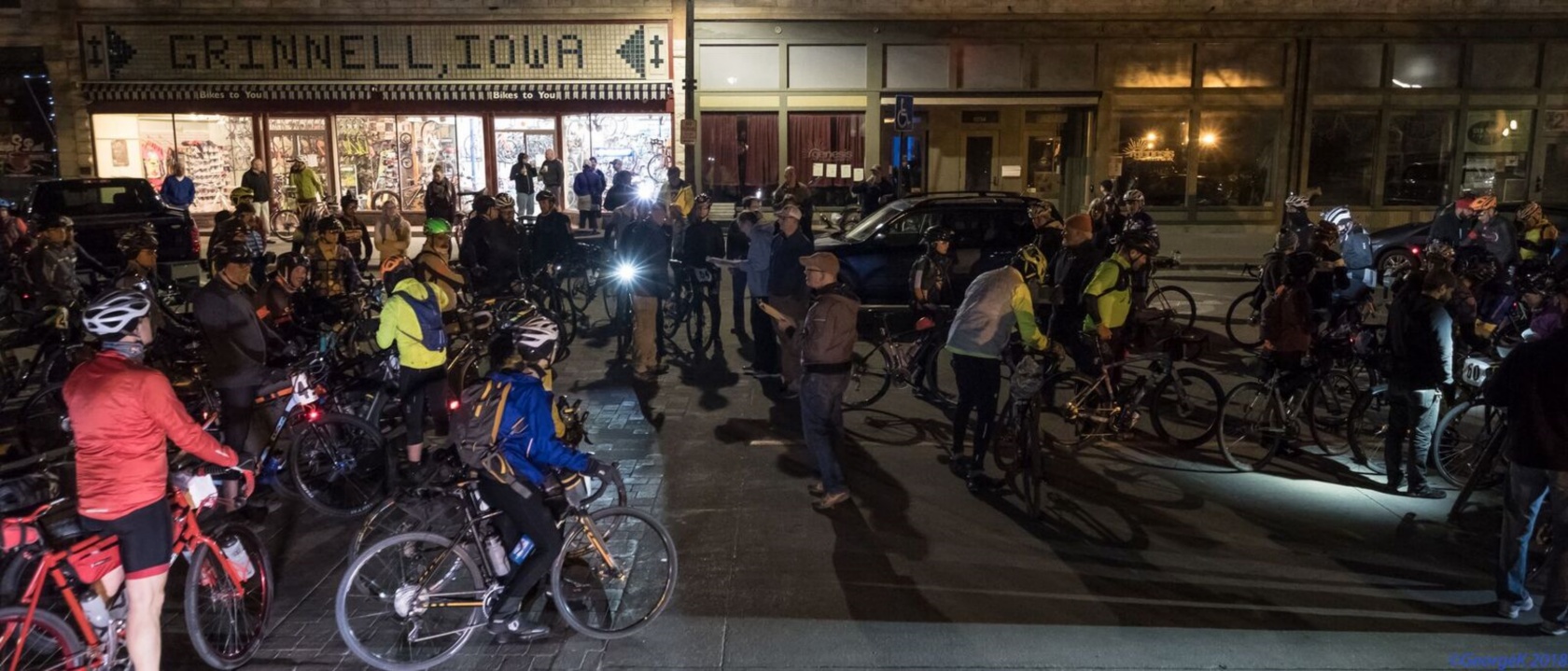
The cue sheet handout procedure went well enough. (Image by G. Keslin)

The riders showed up as instructed and the cue sheet hand-out went down fairly well. Had I decided to keep on doing Trans Iowa this process would have been refined further, but as it was, I came away fairly impressed with how smooth it went for a first time deal. We did have a couple of missed pages but those were minor things in the end which were taken care of right away. 

So, with that out of the way, the first big hurdle for the event was cleared. I was a bit more relaxed at this point, but we had little time to relax, as 4;00am was coming up in a hurry. Fortunately, Dori Jansma, a T.I. volunteer and later on, one of the Race Directors for Iowa Wind and Rock, had arranged with Craig Cooper, the owner/proprietor of Bikes To You, to have a coffee oasis inside the shop before the event start. I availed myself of a cup, thanked Dori, and walked away wistfully, knowing that it would be the last time that would ever happen. It would be the first of many times during the event I would have such feelings. 

The final Trans Iowa start line image taken by George Keslin

After the riders were all settled with their cues, we lined everyone up for a group shot by George Keslin, Wally's good friend. He stayed overnight to take a few shots, but after we got started he also headed back to Chicago. I was glad that he, at the least, got to be a part of the last Trans Iowa, no matter how small a part it was. 

Last minutes before the final Trans Iowa where I gave my final "Fatherly Advice" and did not mention it was the last Trans Iowa. Image by G. Keslin

The folks were all herded up on the street ready to go when a police car came rolling up slowly. The officer politely asked us to move the lead-out car into a proper parking space, despite the fact we were leaving in minutes and this was how we had done it for the last twelve years here. No matter. We acquiesced, moved the car, and then in about five minutes moved it right back again. Anyway....

Moments before we rolled off to start Trans Iowa v14. Image by G. Keslin

Finally it was time. Matt tooted the horn, cowbells clanged, people were filming the roll-out on social media, and Trans Iowa v14 was off and rolling. I kept looking back at the strung out line of headlights beaming back at me. I tried to take it all in, because I had a very unique perspective which most folks would never in their life experience. And I had this experience for over a decade. Once a year, but no more....

MG and I stopped briefly to watch as a corona of LED light began grow from behind a hill we had just crested. Again- most folks will never see such a sight. It was nice that Matt was willing to not only indulge me with these final looks, but to be a willing participant in the savoring of the situation as well. That made the experience all that much sweeter for me. Suddenly, we were off again, as we needed to keep ahead of the riders.

It had been a rough night, but now the adrenaline and excitement of another Trans Iowa had taken over, and being sleep deprived was not a hindrance to our impending adventures. 

Next: A Chorus Of Bovine Voices

Trans Iowa Stories: A Rough Start Part 2

I handed out some nice flasks and coffee mugs to volunteers for v14
  "Trans Iowa Stories" is an every Sunday post which helps tell the stories behind the event. You can check out other posts about this subject  by clicking on the "Trans Iowa Stories" link under the blog header. Thanks and enjoy!  

When I sleep, I snore, and when MG was planning on staying in the same motel room with me for v14, I don't know if he planned for that, but it was too much for him. He had to leave and go try to sleep in his Subaru. It probably would have been okay, but for the "lady of the night" who knocked on his window wondering if he needed anything when he was fast asleep. That was about all it took, well......that and me texting him in the middle of it all to see where he was, to ruin any thoughts he may have had of getting a good night's rest before driving me 300+ gravelly miles. 

And what was I doing up in the middle of the night to be texting him? Well, some late night revelers were up above me in a room bouncing.....something. I'm not sure if it was a basketball, or what, but it may as well have been a medicine ball for the loud thumping I was enduring for over an hour in the middle of the night. 

Eventually, we both just gave up any thoughts of getting any real sleep. I know Matt wasn't very happy about it, and I felt angry at the revelers and at myself for being such a loud snorer. But that soon faded as we had to get downtown and hand out cue sheets. 

The cue sheet handout procedure went well enough. (Image by G. Keslin)

The riders showed up as instructed and the cue sheet hand-out went down fairly well. Had I decided to keep on doing Trans Iowa this process would have been refined further, but as it was, I came away fairly impressed with how smooth it went for a first time deal. We did have a couple of missed pages but those were minor things in the end which were taken care of right away. 

So, with that out of the way, the first big hurdle for the event was cleared. I was a bit more relaxed at this point, but we had little time to relax, as 4;00am was coming up in a hurry. Fortunately, Dori Jansma, a T.I. volunteer and later on, one of the Race Directors for Iowa Wind and Rock, had arranged with Craig Cooper, the owner/proprietor of Bikes To You, to have a coffee oasis inside the shop before the event start. I availed myself of a cup, thanked Dori, and walked away wistfully, knowing that it would be the last time that would ever happen. It would be the first of many times during the event I would have such feelings. 

The final Trans Iowa start line image taken by George Keslin

After the riders were all settled with their cues, we lined everyone up for a group shot by George Keslin, Wally's good friend. He stayed overnight to take a few shots, but after we got started he also headed back to Chicago. I was glad that he, at the least, got to be a part of the last Trans Iowa, no matter how small a part it was. 

Last minutes before the final Trans Iowa where I gave my final "Fatherly Advice" and did not mention it was the last Trans Iowa. Image by G. Keslin

The folks were all herded up on the street ready to go when a police car came rolling up slowly. The officer politely asked us to move the lead-out car into a proper parking space, despite the fact we were leaving in minutes and this was how we had done it for the last twelve years here. No matter. We acquiesced, moved the car, and then in about five minutes moved it right back again. Anyway....

Moments before we rolled off to start Trans Iowa v14. Image by G. Keslin

Finally it was time. Matt tooted the horn, cowbells clanged, people were filming the roll-out on social media, and Trans Iowa v14 was off and rolling. I kept looking back at the strung out line of headlights beaming back at me. I tried to take it all in, because I had a very unique perspective which most folks would never in their life experience. And I had this experience for over a decade. Once a year, but no more....

MG and I stopped briefly to watch as a corona of LED light began grow from behind a hill we had just crested. Again- most folks will never see such a sight. It was nice that Matt was willing to not only indulge me with these final looks, but to be a willing participant in the savoring of the situation as well. That made the experience all that much sweeter for me. Suddenly, we were off again, as we needed to keep ahead of the riders.

It had been a rough night, but now the adrenaline and excitement of another Trans Iowa had taken over, and being sleep deprived was not a hindrance to our impending adventures. 

Next: A Chorus Of Bovine Voices

Saturday, April 23, 2022

Well, A Trip Is In Order

The first class will be inducted June 1st in Emporia.
 Earlier this month I gave you all the news that I had been inducted into the new Gravel Cycling Hall of Fame. This means that there is a ceremony and that means I have a trip planned to attend that coming up.

I knew that this was a possibility, so I had put off planning any rides or attending any events previous to and during that time. I have a very limited amount of chances to do things and very limited amounts of funds to do anything with. That said, I want to thank the GCHoF for their travel and lodging offer to get me there, which helps me out a LOT!

Now I have the details of the events and the timing is set. June 1st, at the Grenada Theater in downtown Emporia, Kansas, there will be a banquet at 6;00pm for the induction ceremonies. Tickets will be sold for the event,  (Link here) , and there will be two options- A dinner ticket for the floor level which will be $75.00/person, or an "observer" ticket, which will go for $10.00 and get you a seat in the balcony.

That's a Wednesday night, so I'll only miss a day of work, and that's good! And I'll be back for the weekend, which is also good. So, I just wanted to put this alert out there in case you wanted to check in on me while I am at Emporia. I should get there by early afternoon on the 1st, be at the ceremony, and if all goes as planned, I'll stay overnight at a local Air B'n'B and head out after breakfast the next day.  (Unless they plan a ride or something I am not aware of at this point) 

I'll be posting more as I find out.

Well, A Trip Is In Order

The first class will be inducted June 1st in Emporia.
 Earlier this month I gave you all the news that I had been inducted into the new Gravel Cycling Hall of Fame. This means that there is a ceremony and that means I have a trip planned to attend that coming up.

I knew that this was a possibility, so I had put off planning any rides or attending any events previous to and during that time. I have a very limited amount of chances to do things and very limited amounts of funds to do anything with. That said, I want to thank the GCHoF for their travel and lodging offer to get me there, which helps me out a LOT!

Now I have the details of the events and the timing is set. June 1st, at the Grenada Theater in downtown Emporia, Kansas, there will be a banquet at 6;00pm for the induction ceremonies. Tickets will be sold for the event,  (Link here) , and there will be two options- A dinner ticket for the floor level which will be $75.00/person, or an "observer" ticket, which will go for $10.00 and get you a seat in the balcony.

That's a Wednesday night, so I'll only miss a day of work, and that's good! And I'll be back for the weekend, which is also good. So, I just wanted to put this alert out there in case you wanted to check in on me while I am at Emporia. I should get there by early afternoon on the 1st, be at the ceremony, and if all goes as planned, I'll stay overnight at a local Air B'n'B and head out after breakfast the next day.  (Unless they plan a ride or something I am not aware of at this point) 

I'll be posting more as I find out.

Friday, April 22, 2022

Friday News And Views

An image found online of the new SRAM DB8 Mineral Oil brake.
SRAM Quietly Introduces Mineral Oil Based Brake System:

Buried in the news after Sea Otter was a tidbit that may indicate a sea change in brake technology at SRAM. They are introducing a mineral oil based brake system, breaking tradition with SRAM's previous hydraulic brake efforts which have all been DOT brake fluid based systems. SRAM claims that they are making these brakes to meet a lower price point and that their high end CODE brakes, which are still DOT fluid based, are more powerful and a better performer overall. SRAM DB8 brakes are not quite here yet but should start appearing on complete builds soon and when available aftermarket should be a bit less than $140.00/wheel. 

The DB8 is based on the same design as the CODE brake and uses the same pads, but that's where the comparisons end. SRAM,in an effort to differentiate the brake from their DOT line, is introducing a new bleed kit and their mineral oil is green in color and not the same as Shimano's, Magura's, or Tektro's. 

Comments: SRAM making this announcement is a bit of a shocker as they were staunchly in the DOT fluid camp. It also is no news to anyone who works on bicycles that SRAM's history with brakes is a checkered one, to be polite about it. It also is no big surprise that SRAM has yet another bleed kit for mechanics to have to stock. What is that? Four bleed kits now? Five if you count the one for the Reverb dropper post. 

Yeah.... I'm not a SRAM brake fan, and while I am glad that they finally have a mineral oil option, I am withholding any judgement calls until I see that this new DB8 is worthy. I sure hope what this signals is a change away from the very toxic and troublesome DOT fluid based brakes of their past. 

I also am hopeful that SRAM brings mineral oil braking to the gravel/road side as well. We'll see, but this development is a big surprise and bears watching.  

Iowa Wind and Rock This Weekend:

This is the time of year that I get a bit nostalgic. The times the Sun rises and sets, the time of season, the song of birds, the smell of the Earth. It all reminds me of gravel riding and ultra-distance gravel riding at that. The descendant of Trans Iowa, which is Iowa Wind and Rock, is set to take place tomorrow morning. 

I would be remiss if I did not wish all who are partaking in that event tailwinds and much success in your quest to overcome this challenge.

Surly Porteur House Bag:

Apparently this Porteur House bag is a new offering from Surly Bikes which was made to sit perfectly on their 24 Pack Rack. It is made from Cordura Nylon and has inner liners in three of the main compartments to keep your cargo dry. The bag seems pretty reasonably priced at $120.00 USD. 

Comments: This thing is freaking ginormous! Naming it "house" is appropriate here as it might just hold all of the essential household items one might need to become an amateur homeless bike person. 

They also make a "Petite Porteur" bag which goes on the 8 Pack rack. That is still pretty huge, despite its name. I've been looking at something along these lines for my Big Dummy, which can use a Surly rack on there and it would allow me a bit more versatility in carrying capacity and options. I'd not go for that big one though. Too much!

The only thing holding me back there is that those types of carrying options can make the front wheel pretty floppy when trying to park, or just move the bike. I sure wish I could find one of those dual-legged Big Dummy kickstands. That would go a long way toward me going all-in on getting a rack and the Petite Porteur bag.

Police fear this idea could spread. (Image courtesy of SFGATE)

Armed Thieves May Be Waiting For You Trailside:

 I was doomscrolling twitter the other day when a Tweet by @bikehugger caught my attention. Apparently, in the hills above Oakland, California, an "alarming trend" is raising fears amongst local cyclists. 

In a story posted by Amy Graf of "SFGATE", you can read how mountain bikers are being robbed of their bikes and more at gunpoint. Police think a couple of the incidents may be related, but fear that copy-catters may pick up on the idea. 

Comments: I get this to mean that bicycles are so hard to come by that thieves are targeting folks out in the woods and then taking these bikes and profiting off them either by way of reselling or parting out the bikes. It would make sense since we are seeing supply trucks getting hijacked for parts and bicycles. 

My concern would be that this spreads and we start seeing this occur in other places. I can see how it could be appealing with the advent of expensive electrified bikes and normally powered bikes reaching into the 10K+ range. Even I have been chased down a local street here by young people demanding that I give them my bicycle. Those efforts have come to naught- so far - but what if I am approached by an armed person? 

It's a troubling thing to hear about, and a cautionary tale for anyone going on a remote destination vacation near an urban area. 

The Jamis Citizen (Image courtesy of Jamis Bikes)
The New Pricing Reality:

As long as I've been in the cycling industry, (1993), I've always gauged how expensive the sport was by the threshold for entry level pricing at the independent bike shop level. While this model is eroding away due to D2C schemes and HPC bikes, it still seems okay to look at the industry like this. 

So, I've been eager to see anything since the pandemic started which would give a true baseline feel for pricing at the bike shop level for bicycles. Well, now I think I have that sense for what is going on now.

While supply chain issues are sure to affect us throughout 2022 and into next year, I think things are settling out and becoming clearer. I knew prices would go up, but by how much?

Well, I saw a shop advertising Jamis Citizen models which are your garden variety hybrid/bike path bikes. The sort of pavement bike which brands sell thousands of, yet you barely see them mentioned in advertising or in reviews, etc. Yet this "bread and butter" level is the lifeblood of most shops across the nation. This or an equivalent MTB style bike. 

And the price? Well, now what used to cost a bit more than $300.00 pre-pandemic is now $500.00. The Jamis Citizen shown here is a 1 X 7, no suspended bits hybrid, which is your base bike shop level quality bike. (Meaning barely above department store levels) The next level up, the Jamis Citizen 2, a 3 X 8 speed bike, with sus fork and seat post, goes for $659.99, and represents what used to be probably the hottest selling type of hybrid bike at one time a few years back. Those days are gone, but back then a bike like this probably was $150.00+ cheaper. 

So, by that gauge, prices have increased by quite a big jump. I would suspect similar price hikes throughout any bicycle company's range these days.
 

That's it for this week. have a fantastic weekend and get out and ride if you can.

Friday News And Views

An image found online of the new SRAM DB8 Mineral Oil brake.
SRAM Quietly Introduces Mineral Oil Based Brake System:

Buried in the news after Sea Otter was a tidbit that may indicate a sea change in brake technology at SRAM. They are introducing a mineral oil based brake system, breaking tradition with SRAM's previous hydraulic brake efforts which have all been DOT brake fluid based systems. SRAM claims that they are making these brakes to meet a lower price point and that their high end CODE brakes, which are still DOT fluid based, are more powerful and a better performer overall. SRAM DB8 brakes are not quite here yet but should start appearing on complete builds soon and when available aftermarket should be a bit less than $140.00/wheel. 

The DB8 is based on the same design as the CODE brake and uses the same pads, but that's where the comparisons end. SRAM,in an effort to differentiate the brake from their DOT line, is introducing a new bleed kit and their mineral oil is green in color and not the same as Shimano's, Magura's, or Tektro's. 

Comments: SRAM making this announcement is a bit of a shocker as they were staunchly in the DOT fluid camp. It also is no news to anyone who works on bicycles that SRAM's history with brakes is a checkered one, to be polite about it. It also is no big surprise that SRAM has yet another bleed kit for mechanics to have to stock. What is that? Four bleed kits now? Five if you count the one for the Reverb dropper post. 

Yeah.... I'm not a SRAM brake fan, and while I am glad that they finally have a mineral oil option, I am withholding any judgement calls until I see that this new DB8 is worthy. I sure hope what this signals is a change away from the very toxic and troublesome DOT fluid based brakes of their past. 

I also am hopeful that SRAM brings mineral oil braking to the gravel/road side as well. We'll see, but this development is a big surprise and bears watching.  

Iowa Wind and Rock This Weekend:

This is the time of year that I get a bit nostalgic. The times the Sun rises and sets, the time of season, the song of birds, the smell of the Earth. It all reminds me of gravel riding and ultra-distance gravel riding at that. The descendant of Trans Iowa, which is Iowa Wind and Rock, is set to take place tomorrow morning. 

I would be remiss if I did not wish all who are partaking in that event tailwinds and much success in your quest to overcome this challenge.

Surly Porteur House Bag:

Apparently this Porteur House bag is a new offering from Surly Bikes which was made to sit perfectly on their 24 Pack Rack. It is made from Cordura Nylon and has inner liners in three of the main compartments to keep your cargo dry. The bag seems pretty reasonably priced at $120.00 USD. 

Comments: This thing is freaking ginormous! Naming it "house" is appropriate here as it might just hold all of the essential household items one might need to become an amateur homeless bike person. 

They also make a "Petite Porteur" bag which goes on the 8 Pack rack. That is still pretty huge, despite its name. I've been looking at something along these lines for my Big Dummy, which can use a Surly rack on there and it would allow me a bit more versatility in carrying capacity and options. I'd not go for that big one though. Too much!

The only thing holding me back there is that those types of carrying options can make the front wheel pretty floppy when trying to park, or just move the bike. I sure wish I could find one of those dual-legged Big Dummy kickstands. That would go a long way toward me going all-in on getting a rack and the Petite Porteur bag.

Police fear this idea could spread. (Image courtesy of SFGATE)

Armed Thieves May Be Waiting For You Trailside:

 I was doomscrolling twitter the other day when a Tweet by @bikehugger caught my attention. Apparently, in the hills above Oakland, California, an "alarming trend" is raising fears amongst local cyclists. 

In a story posted by Amy Graf of "SFGATE", you can read how mountain bikers are being robbed of their bikes and more at gunpoint. Police think a couple of the incidents may be related, but fear that copy-catters may pick up on the idea. 

Comments: I get this to mean that bicycles are so hard to come by that thieves are targeting folks out in the woods and then taking these bikes and profiting off them either by way of reselling or parting out the bikes. It would make sense since we are seeing supply trucks getting hijacked for parts and bicycles. 

My concern would be that this spreads and we start seeing this occur in other places. I can see how it could be appealing with the advent of expensive electrified bikes and normally powered bikes reaching into the 10K+ range. Even I have been chased down a local street here by young people demanding that I give them my bicycle. Those efforts have come to naught- so far - but what if I am approached by an armed person? 

It's a troubling thing to hear about, and a cautionary tale for anyone going on a remote destination vacation near an urban area. 

The Jamis Citizen (Image courtesy of Jamis Bikes)
The New Pricing Reality:

As long as I've been in the cycling industry, (1993), I've always gauged how expensive the sport was by the threshold for entry level pricing at the independent bike shop level. While this model is eroding away due to D2C schemes and HPC bikes, it still seems okay to look at the industry like this. 

So, I've been eager to see anything since the pandemic started which would give a true baseline feel for pricing at the bike shop level for bicycles. Well, now I think I have that sense for what is going on now.

While supply chain issues are sure to affect us throughout 2022 and into next year, I think things are settling out and becoming clearer. I knew prices would go up, but by how much?

Well, I saw a shop advertising Jamis Citizen models which are your garden variety hybrid/bike path bikes. The sort of pavement bike which brands sell thousands of, yet you barely see them mentioned in advertising or in reviews, etc. Yet this "bread and butter" level is the lifeblood of most shops across the nation. This or an equivalent MTB style bike. 

And the price? Well, now what used to cost a bit more than $300.00 pre-pandemic is now $500.00. The Jamis Citizen shown here is a 1 X 7, no suspended bits hybrid, which is your base bike shop level quality bike. (Meaning barely above department store levels) The next level up, the Jamis Citizen 2, a 3 X 8 speed bike, with sus fork and seat post, goes for $659.99, and represents what used to be probably the hottest selling type of hybrid bike at one time a few years back. Those days are gone, but back then a bike like this probably was $150.00+ cheaper. 

So, by that gauge, prices have increased by quite a big jump. I would suspect similar price hikes throughout any bicycle company's range these days.
 

That's it for this week. have a fantastic weekend and get out and ride if you can.

Thursday, April 21, 2022

Ingrid Rear Derailleur Gives Throwback Vibes

The Ingrid rear derailleur is available for mechanical 11 or 12 speed set ups.
Almost three years ago I posted in an "FN&V" that and Italian manufacturer of bicycle parts was working on a CNC'ed rear derailleur. 

Well, that project surfaced again recently looking wildly different and is actually for sale here

According to the Italian based manufacturer, they changed "...all the parts at least 10 time each." since the first prototypes in 2017. It shows too, and this modernized version of the infamous "CNC" derailleur is ready for your bike. It is said to work with SRAM drop bar or bar end shifters in 11 or 12 speed set ups. Maximum tooth capacity is rated at 36T, which on the surface of it, seems a bit off. SRAM cassettes are availabe in 36T spread cog models, but most folks running SRAM are doing 1X drive trains where a 36T spread between low to high is said to be "pretty limiting". 

Stayer Bikes is selling an "Ingrid" equipped model using Shimano based free hubs instead of SRAM's.

Stayer Bikes is getting around that 36T capacity by offering its "INGRID" equipped model with Shimano based free hubs which limit the high cog to an 11T instead of a 10, bringing their spread within the limits on the 11 speed offering at 35T, low to high. I mean, who uses the 10T anyway? Okay....Maybe some of you do. 

At any rate, Stayer pushes the limit with their 10-48T cassette on the 12's which is a 38T spread. Hmm.... CNC'ed and 3-D printed derailleur with a spread outside the stated limits? Okay..... You go! 

But most of us probably are not going for a nearly $700.00 rear derailleur that is not electronic these days, so I have to wonder how many folks are going to get in line for this. (Note: I have confirmation from at least one individual on Twitter that yes- They are getting this Stayer a bike with this set up) 

Oh! And if you really want the retro-vibes, Ingrid is offering a Rasta colored version in May with a very limited run at $800.00. 

Updated: I heard again from the person on Twitter getting this rear derailleur with some further technical information not found elsewhere that I could see: "Just saw your blog post about this. The derailleur also comes in 12spd and—through the modularity of the fin and the cage—can handle a 52t rear cog AND work with any mechanical shifters. I’m going to run it with Campy shifters and an Eagle cassette."  So, that's how Ingrid gets away with a greater derailleur range- they change out the cage.

Ingrid Rear Derailleur Gives Throwback Vibes

The Ingrid rear derailleur is available for mechanical 11 or 12 speed set ups.
Almost three years ago I posted in an "FN&V" that and Italian manufacturer of bicycle parts was working on a CNC'ed rear derailleur. 

Well, that project surfaced again recently looking wildly different and is actually for sale here

According to the Italian based manufacturer, they changed "...all the parts at least 10 time each." since the first prototypes in 2017. It shows too, and this modernized version of the infamous "CNC" derailleur is ready for your bike. It is said to work with SRAM drop bar or bar end shifters in 11 or 12 speed set ups. Maximum tooth capacity is rated at 36T, which on the surface of it, seems a bit off. SRAM cassettes are availabe in 36T spread cog models, but most folks running SRAM are doing 1X drive trains where a 36T spread between low to high is said to be "pretty limiting". 

Stayer Bikes is selling an "Ingrid" equipped model using Shimano based free hubs instead of SRAM's.

Stayer Bikes is getting around that 36T capacity by offering its "INGRID" equipped model with Shimano based free hubs which limit the high cog to an 11T instead of a 10, bringing their spread within the limits on the 11 speed offering at 35T, low to high. I mean, who uses the 10T anyway? Okay....Maybe some of you do. 

At any rate, Stayer pushes the limit with their 10-48T cassette on the 12's which is a 38T spread. Hmm.... CNC'ed and 3-D printed derailleur with a spread outside the stated limits? Okay..... You go! 

But most of us probably are not going for a nearly $700.00 rear derailleur that is not electronic these days, so I have to wonder how many folks are going to get in line for this. (Note: I have confirmation from at least one individual on Twitter that yes- They are getting this Stayer a bike with this set up) 

Oh! And if you really want the retro-vibes, Ingrid is offering a Rasta colored version in May with a very limited run at $800.00. 

Updated: I heard again from the person on Twitter getting this rear derailleur with some further technical information not found elsewhere that I could see: "Just saw your blog post about this. The derailleur also comes in 12spd and—through the modularity of the fin and the cage—can handle a 52t rear cog AND work with any mechanical shifters. I’m going to run it with Campy shifters and an Eagle cassette."  So, that's how Ingrid gets away with a greater derailleur range- they change out the cage.

Wednesday, April 20, 2022

Before There Was "Gravel": Lighting

Lights have come a long way in the last 17 years
The first look back at what we were doing with our equipment before the "Gravel™" thing took off in cycling went over pretty well. So, I thought I'd delve into another topic which we struggled with back in the day. 

Lighting for bicycles circa 2005 was generally centered around 24hr racing needs. Sure, you had your commuter lights, and I'll get to some of those, but generally speaking, a light only had to be blazingly bright for a little over an hour, maybe two (typical lap times at big 24Hr races were in the 1-2 hour range) and you'd be back at the pits where you'd grab another battery pack and so on.

There weren't really any needs being seen beyond that in terms of run time, different light levels, compact design, or what have you. Commuter lights were, frankly, a joke up until the mid-00's. I recall us selling halogen lights right up to about 2004. LED light technology was in its infancy at this time. 

The Blackburn Quadrant was a popular commuter light circa 2004-2005, but was a poor quality LED light.

I should mention that I will be primarily looking at this topic from my unique perspective in gravel events. At the time, Trans Iowa, The Dirty Kanza 200 (Now Unbound Gravel), and the Good Life Gravel Adventure (now Gravel Worlds) were the only 'big' events that required a light at all. Some smaller events which no longer exist did take place at night, such as the Moonlight Metric, which I did a couple of times, or the one-off Moonlight Madness event, which was an all-nighter as well. But for the most part, it was Trans Iowa that required the most from lighting back in the day. 

From my archived blog posts I was able to pull out a bunch of images and was reminded of how things were difficult for the night time gravel grinder back then. What I discovered overall are a few things. First, lights were pitifully weak and had really bad light throw and patterns back then. Secondly, most 'long-run' time set ups (More than 5-6 hours) needed heavy battery packs which had to be externally mounted to frames, bodies, or put into bags. Finally, there were great lights, but they were very expensive and had short run times.

The Cateye Triple Shot was one of the first really good LED lights

Lights like Cateye's then new Triple Shot, which debuted circa 2005, was a promising light, but it was focused on the endurance 24hr scene, and run times were low compared to what was necessary for Trans Iowa. Still, we could see then that this was where lights needed to go, we just needed longer run times. 

One thing that is overlooked here is that gravel events had unique needs. These typically were not addressed in these earlier lighting solutions where all-out power dominated the feature set with narrowish beam patterns that wasted a lot of the light in its beaming twoard the shy. But as you might know from mountain biking, sometimes your bike is pointed down, but you need the light 'out front', not pointed down at the trail, so these big, halo beam patterns made sense for MTB. 

Another issue we had was the nature of gravel, which has a LOT of higher frequency vibrations, and that would rattle loose mounts, lights, and other stuff! Early on into Trans Iowa riders found that a lot of equipment they attached to their bikes would be jettisoned off into the ditch or onto the gravel unexpectedly due to the severity of these vibrations. Fortunately, that is not an issue with these newer mounts which are much more secure. 

Just before the start of Trans Iowa v5 in 2009

So, above we have the riders gathering for the start of the fifth Trans Iowa in 2009. Keep in mind things like the Cateye Triple Shot have been around a few years already. That said, you can see that riders are opting for lower power, (note- not because they wanted to), options with longer run times. There are not a lot of helmet mounted lights, and the lights that are on are not all that impressive. The reflections of the camera flash from the reflective treatments is a LOT brighter than any lighting here. 

 
Trans Iowa v7 start line.


Two years later we start to see some seriously powerful lights creeping into use by the riders. By this time, in 2011, lighting technology had taken a bit of a turn. No longer were the lighting choices all about endurance 24hr riding. Now commuting needs were creeping into the picture, and smaller companies were fulfilling needs that the big companies couldn't cover, or wouldn't. Meanwhile, other older companies fell to the wayside as they were passed by in the ever changing LED technology of that time. 

One of the companies I was aware of at the time that was really pushing the boundaries with powerful LED lights and long run times was Ay Up from Australia. While they still required external battery packs, they were minimized in size and were easily swapped out if need be. I know several top riders of the day relied on this company's lights. But they were expensive and you kind of had to be 'in the know' to even be aware of them.

My light 'hack' circa 2009.

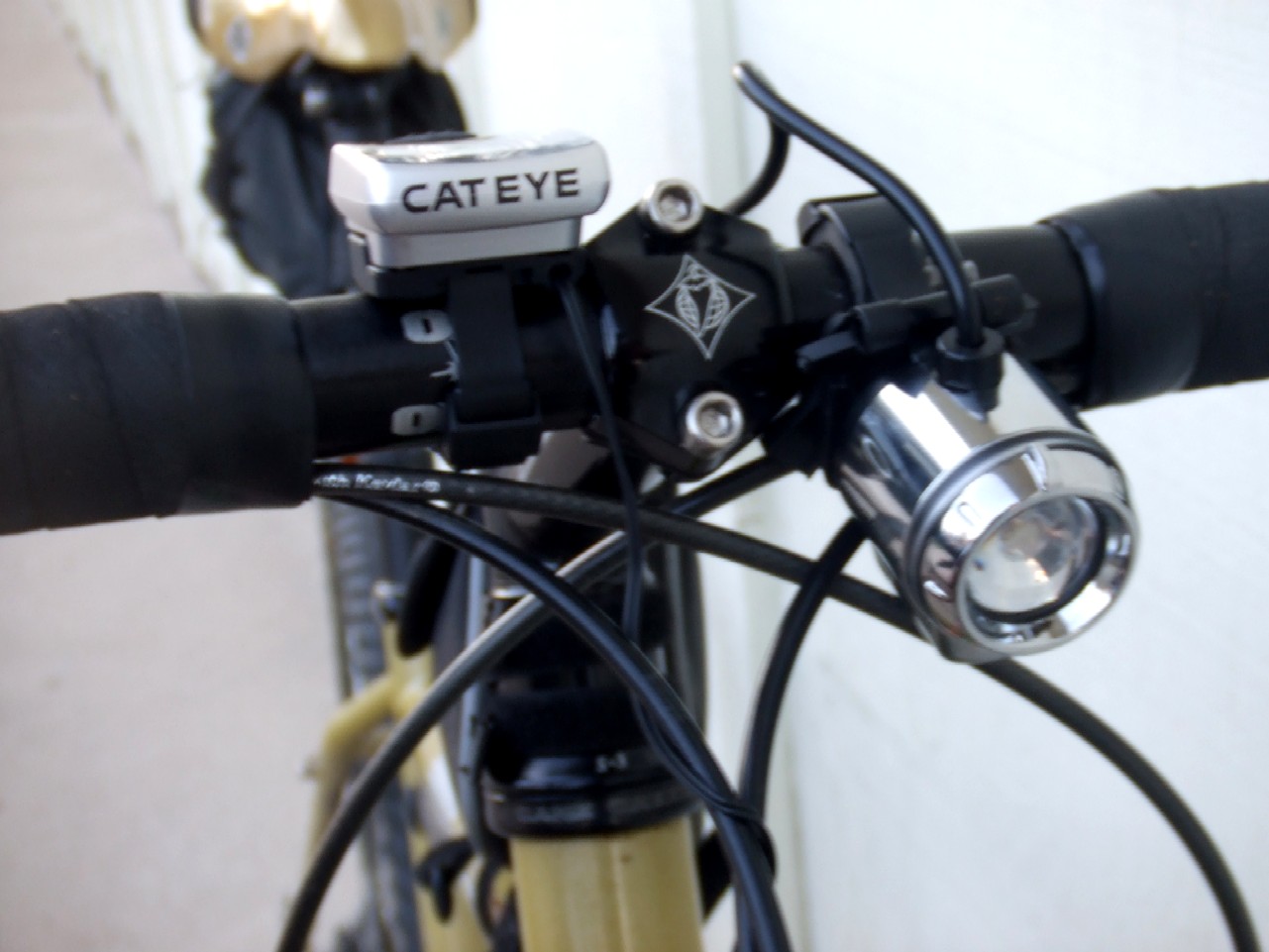
Meanwhile people like myself who were looking for lights to last for really long times were left to their own devices. I was wanting a light for six to ten hours of run time, so I ended up buying a head mounted torch from Eveready. It was meant for campers, but it had 110 Lumen output for 11 hours off three AAA batteries. I made a mount for the handle bar using an old Cateye computer mount and stuffed the battery pack into a top tube bag. 

The really cool thing about this light was that the beam pattern could be adjusted by twisting the lens bezel. It would go from a long-throw spot to a wide, washy light that went the entire width of the road. This was the light I used in the Moonlight Madness event where it rained the entire night, but I never wanted for light. The best part?  spent less than $60.00 on the entire set up.

It's hard to believe what we used to rely on a dozen or more years ago for lights. This was from the Moonlight Metric.

Around about 2010 or so I noted that things were changing rapidly. Suddenly there was a cottage industry springing up with light choices the big brands were not offering. Commuter lights began to become more powerful. No longer was 200-300 Lumen thought of as a high beam. Now it was 500 Lumen, or even 800 Lumen, which became the top setting. "Medium" settings of 150-250 Lumen were then making 4-6 hour run times possible. Now we were getting into some serious light choices! 

By T.I.v10 in 2014 lights had become pretty good and reasonably priced. (Image from a film by P. Ross)

The LED light technology became like an arms race. About every six months to a year some new emitter technology would appear, or new battery technology would appear, or both, and the lights one could get would take another leap forward in capabilities and another leap downward in price for what you got. Value per dolar has never been better now in that regard. 

Let's not forget how generator hub and light technology has changed as well. I recal seeing my first generator hub lights at Trans Iowa in 2007. Then, just three years later I remember seeing generator hub technology that blew anything else away. It was super bright, ran without hardly any drag, and would light up at super-slow speed. The only nit here was, and is, price. Plus you have to accept a dedication to one front wheel. 

The new Planet Bike "Dual Blaze"

Now you can have 1500 Lumen power in light with Medium settings that run up at 800 Lumen for hours and hours. We couldn't even get 800 Lumen lights in the early days! Now? Slap down a Benjamin and walk out with a self-contained, lightweight, durable, reliable light that will be all you'd ever need. Something that would have cost hundreds of dollars back in the day, if you could even find such a thing with those run times. 

So, it is easy to forget where we have come from with regard to lights for night time gravel riding. It's a really fun thing to do, and the lights are not really a barrier to the pursuit of the past time anymore. But yeah, about that...... Trans Iowa is gone. Who needs lights anymore for long gravel events, right?

Well, it's funny when I think about this. Obviously, Iowa Wind and Rock is kind of the evolution of Trans Iowa, but right about when I stopped T.I. other events decided this long distance deal was a thing. Unbound did the XL distance, (originally the DKXL), and then Gravel Worlds added a "Long Voyage" distance as well. So, yeah, you need long runtime, high-output lights. If you do those events, at any rate. 

So, there is a brief overview of lights from the earliest "Modern Gravel" era days till now. I hope that you enjoyed that look back at lights.

Before There Was "Gravel": Lighting

Lights have come a long way in the last 17 years
The first look back at what we were doing with our equipment before the "Gravel™" thing took off in cycling went over pretty well. So, I thought I'd delve into another topic which we struggled with back in the day. 

Lighting for bicycles circa 2005 was generally centered around 24hr racing needs. Sure, you had your commuter lights, and I'll get to some of those, but generally speaking, a light only had to be blazingly bright for a little over an hour, maybe two (typical lap times at big 24Hr races were in the 1-2 hour range) and you'd be back at the pits where you'd grab another battery pack and so on.

There weren't really any needs being seen beyond that in terms of run time, different light levels, compact design, or what have you. Commuter lights were, frankly, a joke up until the mid-00's. I recall us selling halogen lights right up to about 2004. LED light technology was in its infancy at this time. 

The Blackburn Quadrant was a popular commuter light circa 2004-2005, but was a poor quality LED light.

I should mention that I will be primarily looking at this topic from my unique perspective in gravel events. At the time, Trans Iowa, The Dirty Kanza 200 (Now Unbound Gravel), and the Good Life Gravel Adventure (now Gravel Worlds) were the only 'big' events that required a light at all. Some smaller events which no longer exist did take place at night, such as the Moonlight Metric, which I did a couple of times, or the one-off Moonlight Madness event, which was an all-nighter as well. But for the most part, it was Trans Iowa that required the most from lighting back in the day. 

From my archived blog posts I was able to pull out a bunch of images and was reminded of how things were difficult for the night time gravel grinder back then. What I discovered overall are a few things. First, lights were pitifully weak and had really bad light throw and patterns back then. Secondly, most 'long-run' time set ups (More than 5-6 hours) needed heavy battery packs which had to be externally mounted to frames, bodies, or put into bags. Finally, there were great lights, but they were very expensive and had short run times.

The Cateye Triple Shot was one of the first really good LED lights

Lights like Cateye's then new Triple Shot, which debuted circa 2005, was a promising light, but it was focused on the endurance 24hr scene, and run times were low compared to what was necessary for Trans Iowa. Still, we could see then that this was where lights needed to go, we just needed longer run times. 

One thing that is overlooked here is that gravel events had unique needs. These typically were not addressed in these earlier lighting solutions where all-out power dominated the feature set with narrowish beam patterns that wasted a lot of the light in its beaming twoard the shy. But as you might know from mountain biking, sometimes your bike is pointed down, but you need the light 'out front', not pointed down at the trail, so these big, halo beam patterns made sense for MTB. 

Another issue we had was the nature of gravel, which has a LOT of higher frequency vibrations, and that would rattle loose mounts, lights, and other stuff! Early on into Trans Iowa riders found that a lot of equipment they attached to their bikes would be jettisoned off into the ditch or onto the gravel unexpectedly due to the severity of these vibrations. Fortunately, that is not an issue with these newer mounts which are much more secure. 

Just before the start of Trans Iowa v5 in 2009

So, above we have the riders gathering for the start of the fifth Trans Iowa in 2009. Keep in mind things like the Cateye Triple Shot have been around a few years already. That said, you can see that riders are opting for lower power, (note- not because they wanted to), options with longer run times. There are not a lot of helmet mounted lights, and the lights that are on are not all that impressive. The reflections of the camera flash from the reflective treatments is a LOT brighter than any lighting here. 

 
Trans Iowa v7 start line.


Two years later we start to see some seriously powerful lights creeping into use by the riders. By this time, in 2011, lighting technology had taken a bit of a turn. No longer were the lighting choices all about endurance 24hr riding. Now commuting needs were creeping into the picture, and smaller companies were fulfilling needs that the big companies couldn't cover, or wouldn't. Meanwhile, other older companies fell to the wayside as they were passed by in the ever changing LED technology of that time. 

One of the companies I was aware of at the time that was really pushing the boundaries with powerful LED lights and long run times was Ay Up from Australia. While they still required external battery packs, they were minimized in size and were easily swapped out if need be. I know several top riders of the day relied on this company's lights. But they were expensive and you kind of had to be 'in the know' to even be aware of them.

My light 'hack' circa 2009.

Meanwhile people like myself who were looking for lights to last for really long times were left to their own devices. I was wanting a light for six to ten hours of run time, so I ended up buying a head mounted torch from Eveready. It was meant for campers, but it had 110 Lumen output for 11 hours off three AAA batteries. I made a mount for the handle bar using an old Cateye computer mount and stuffed the battery pack into a top tube bag. 

The really cool thing about this light was that the beam pattern could be adjusted by twisting the lens bezel. It would go from a long-throw spot to a wide, washy light that went the entire width of the road. This was the light I used in the Moonlight Madness event where it rained the entire night, but I never wanted for light. The best part?  spent less than $60.00 on the entire set up.

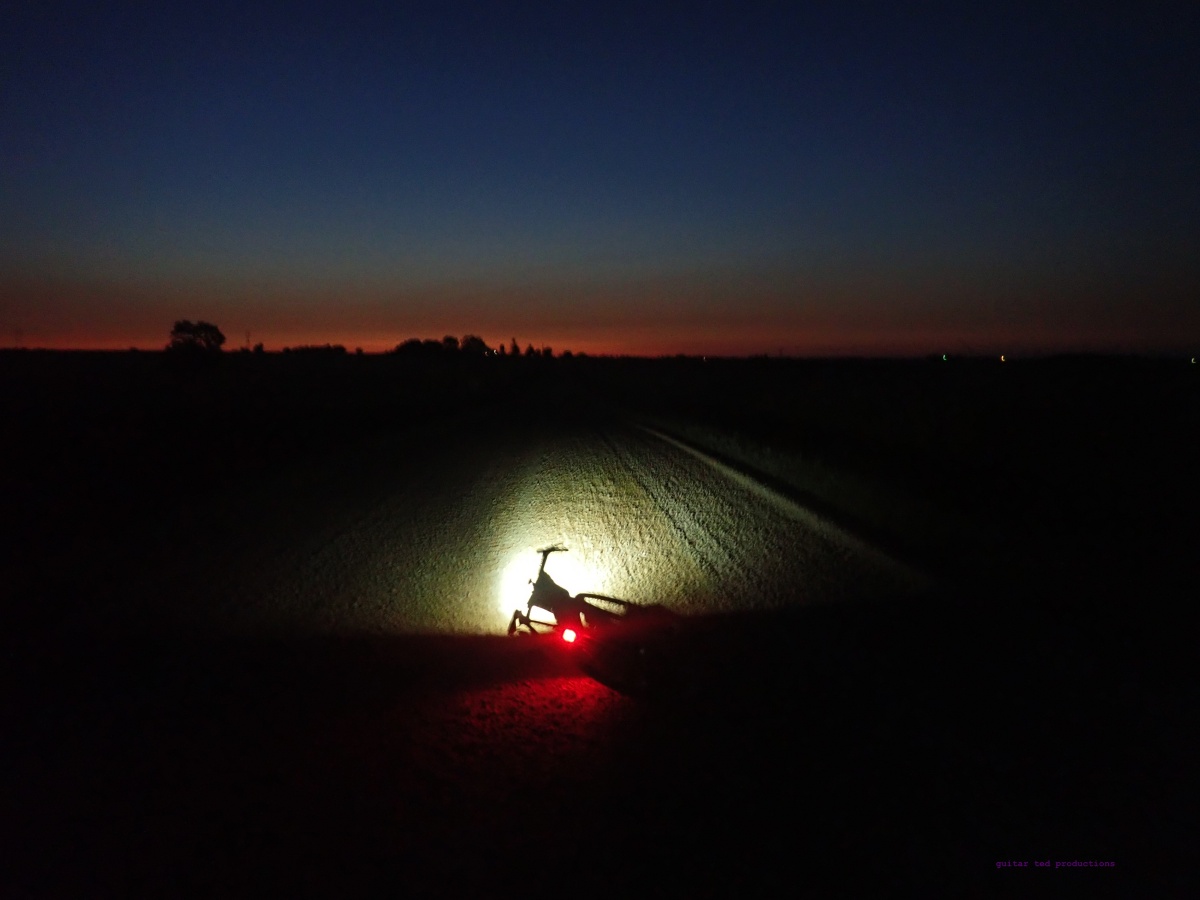
It's hard to believe what we used to rely on a dozen or more years ago for lights. This was from the Moonlight Metric.

Around about 2010 or so I noted that things were changing rapidly. Suddenly there was a cottage industry springing up with light choices the big brands were not offering. Commuter lights began to become more powerful. No longer was 200-300 Lumen thought of as a high beam. Now it was 500 Lumen, or even 800 Lumen, which became the top setting. "Medium" settings of 150-250 Lumen were then making 4-6 hour run times possible. Now we were getting into some serious light choices! 

By T.I.v10 in 2014 lights had become pretty good and reasonably priced. (Image from a film by P. Ross)

The LED light technology became like an arms race. About every six months to a year some new emitter technology would appear, or new battery technology would appear, or both, and the lights one could get would take another leap forward in capabilities and another leap downward in price for what you got. Value per dolar has never been better now in that regard. 

Let's not forget how generator hub and light technology has changed as well. I recal seeing my first generator hub lights at Trans Iowa in 2007. Then, just three years later I remember seeing generator hub technology that blew anything else away. It was super bright, ran without hardly any drag, and would light up at super-slow speed. The only nit here was, and is, price. Plus you have to accept a dedication to one front wheel. 

The new Planet Bike "Dual Blaze"

Now you can have 1500 Lumen power in light with Medium settings that run up at 800 Lumen for hours and hours. We couldn't even get 800 Lumen lights in the early days! Now? Slap down a Benjamin and walk out with a self-contained, lightweight, durable, reliable light that will be all you'd ever need. Something that would have cost hundreds of dollars back in the day, if you could even find such a thing with those run times. 

So, it is easy to forget where we have come from with regard to lights for night time gravel riding. It's a really fun thing to do, and the lights are not really a barrier to the pursuit of the past time anymore. But yeah, about that...... Trans Iowa is gone. Who needs lights anymore for long gravel events, right?

Well, it's funny when I think about this. Obviously, Iowa Wind and Rock is kind of the evolution of Trans Iowa, but right about when I stopped T.I. other events decided this long distance deal was a thing. Unbound did the XL distance, (originally the DKXL), and then Gravel Worlds added a "Long Voyage" distance as well. So, yeah, you need long runtime, high-output lights. If you do those events, at any rate. 

So, there is a brief overview of lights from the earliest "Modern Gravel" era days till now. I hope that you enjoyed that look back at lights.

Tuesday, April 19, 2022

Ridiculous

Urban gravel on the Ti Muk 2
The last two weeks have been pretty crap around here as far as the weather goes. Of course, I got sick the weekend before last, and so during my recovery we had two nice days. Now I feel great again but.....

The weather is ridiculous.

30mph winds with gusts to 50mph? Really?! And it has been way below average in terms of temperatures. March thinks April is on break so it just kept on with things. I dunno......

I've been sticking around in town of late. It's just too cold and windy for me to have any fun out in the country, so I'll wait, and wait.... 

The good news is that it is supposed to start straightening out again. Plus, what do I have to complain about? At least we didn't get any snow, tornadoes, or flooding rains. You folks who did- all the best to you! You've got it harder than I do here! 

I just feel like a bum sitting around town and I sense time slipping away. I was sure hoping to have had some nice, longer rides in by this point. I guess that will come. I just have to be a bit patient. Meanwhile the winds howl and it is hovering around the freezing mark here as I write this.