Friday, January 19, 2024

Friday News And Views

John Ingham (L) and Trenton Raygor (Image by D Markman)
New Article By John Ingham Tomorrow:

Tomorrow (Saturday) a new long form article by John Ingham will be posted. You may remember my introduction to John (Here) or perhaps you read his last article (Here).  

This article will be based upon a similar theme of how endurance training, and gravel riding in specific, can be a good thing for health and longevity. 

If you are unfamiliar with John's work, I suggest that you give the article a try tomorrow, or check out the link above. Be prepared! These are loooooong reads and there is a lot of stuff to think about in these pieces of John's. 

I just want to say that it is a distinct honor to have John's work presented here and I am humbled to be able to collaborate with him on these pieces and get them out in front of people. Truly - this meager site is far beneath what John deserves, so if you can see fit to share the article, that would be great. 

If you have any questions or comments for John just let me know at g.ted.productions@gmail.com and I'll make sure John sees them. Thanks!! 

Ridley & Tommorowland debut collection (Image courtesy of Ridley)
Ridley & Tomorrowland Debut Collection:

The Belgium companies of Ridley and Tomorrowland (Tomorrowland is a large-scale annual electronic dance music festival held in Boom, Belgium) have announced a collaboration which features matching bikes and apparel for those looking for a complete look. 

Calling those types of folks "People of Tomorrow", (gah!) the collection features Ridley's Kanzo Fast models in two configurations. 

Here's a bit from the presser I got:

" Tomorrowland and Ridley are two of a kind, pioneers from Belgium, the beating heart of the festival and cycling culture. By introducing 2 custom bikes, both companies want to encourage the People of Tomorrow to choose a greener and healthier way of traveling."

Comments: Okay, okay.....enough already. I get the matchy-matchy thing, but this seems like a bit of a fashion-fluff piece. Nothing wrong with the bike, per se', but a bike and a music festival that is pretty far outside of what the gravel scene is seems weird. Who knows....maybe the UCI will sanction a music festival now.

Gravel Amplifier: Waterville Gravel Populaire:

A long time ago I was talking about gravel events, the way we used to do them, with written cues and no support, and someone said, "Oh! You mean like an audax?" I said, "Aw-what?" 

Ha! Well, as you may know, "audax" is a form of non-competitive cycling which is time based and generally formatted so that you are cue-sheet navigated and so that you have to hit pre-determined checkpoints within certain time marks. There are two forms of audax cycling: Euraudax and Randoneuring. The event on today's Gravel Amplifier is of the randoneuring type. 

It is put on by the Seattle Randoneurs and it's called the Waterville Gravel Populaire. The event is set for June 1st and will be held out of Waterville, Washington. (Hit the link for finer details.

Image from Whit Johnson/Meriwether Cycles Instagram

More On 750D Wheels:

Cruising Instagram recently I came across a post by Whit Johnson of Meriwether Cycles. He was showing off a bike he made for himself that he calls the "Old Guy's All Terrain Bicycle" or OGATB. In the Instagram post he spoke about the different wheels he has tried on the bike including a set of WTB 750D X 40mm tires

It wasn't clear when Whit tried the wheels and tires but we learn from his post that the bike was built in 2021, so at least it was sometime in the last couple of years. 

Whit said in the post that he did not much care for the wheels and tires, as they weren't tubeless, "and they were very heavy...". He went on to say that he much preferred 29"er wheels in the bike and that this would become a model he would offer sometime in 2024. So, stay tuned for that.

Comments: So, it is plain to see that at least a few folks are playing around with this wheel and tire size out there. I have to imagine others are checking it out but aren't talking. I wouldn't expect much movement in regard to the 750D size as the climate for introducing a new, controversial wheel size now is poor. However; it seems that the idea is - at least for now - being considered. 

New Podcast Episode #37:

Thursday we dropped another podcast episode and we were responding to some listener feedback. 

I already posted about the feedback we got earlier this week in my "A Conversation About Group Rides: A Follow-Up" . But if you'd like to listen to what N.Y. Roll and I have to say further on the subject you can check it out at THIS LINK or wherever you get your podcasts from. 

The next podcast will cover another subject on the gravel scene that was prompted by Dave Pryor, he of the unPAved of the Susquehanna River Valley event. 

He texted me the following query: "Did Racing ruin Gravel, or did Gravel save Racing?"

To be fair, Dave's position is that Gravel DID save racing (in North America), but I thought it might be more interesting to pose the thought Dave had as a question. Reason being is because it was a popular thought that Gravel would be "ruined" by "Racing" back in the earlier parts of the twenty-teens. 

So....what say you? Did Racing "ruin" gravel or did Gravel "save" Racing? Let me know in the comments.

That's a wrap on this week's ramblings here. Stay tuned for John Ingham's long-form article tomorrow and have a great weekend! Thanks for reading Guitar Ted Productions!

Thursday, January 18, 2024

All About Pedals

 Recently I was messaged about doing an "explainer post" on the subject of pedals. The person told me that they used clip and strap pedals and were wondering about clipless and shoes and all of that. So, I thought that we cannot assume that everyone knows about pedals. Because  - obviously - there are questions. I hope that this post provides answers and is valuable to some of you out there. 

Pedals. They are invaluable for cycling and are one of the three VERY important "contact points" humans have with bicycles. As such, I feel that pedals actually deserve more scrutiny than they get from the cycling brands and pundits. A bad, or even a mediocre pedal can ruin a ride, make cycling no-fun, and no one wants that! 

Types of Pedals: There are different pedals but essentially they can be grouped in three categories: Clip & Strap, Clipless, and Flats. I'll discuss the tree types and then we will get into why you might choose one over the other. Plus, I'll share what I think as well about pedals for my cycling purposes.

A typical clip & strap pedal (Image snagged from eBay)

Clip & Strap Pedals: These pedals were developed late into the 19th Century to help racers feet stay on the pedals. Having no ability to coast due to their fixed gear drive trains of the day, these single speeders were in danger of having their legs beaten by whirling crank sets and crashing when their feet slipped off unexpectedly. A metal "clip" was developed that went from the front edge of the pedal, wrapped around the front of the rider's shoe, and the came up over the instep a bit. That end had a loop with a strap through it which crossed the foot, went through the pedal body, and was adjustable for tension. Good for securing the foot to the pedal. Not so good if you had to execute a quick dismount of your bicycle! 

Clip & Strap pedals were usually only used then by racers and cycling enthusiasts who toured or were into racing bikes and track riding. However; when mountain bikes came along, with their rough terrain and often wet, muddy, and therefore slippery aspects, the clip & strap pedal became the defacto MTB pedal of choice by the late 1980's and every good MTB was equipped with them from that point until 1992. Then.....

Dual-entry clipless pedal

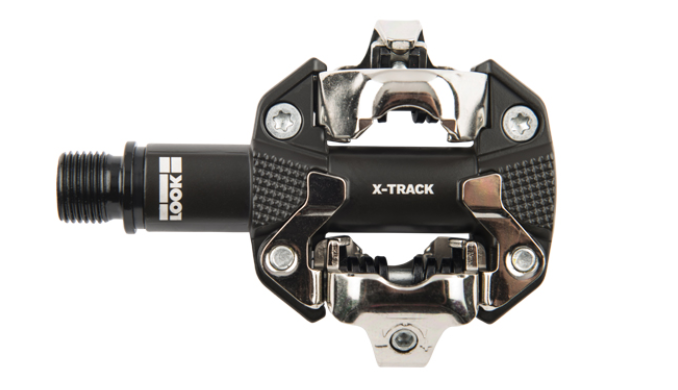
Clipless Pedals: In the mid-1980's, LOOK, a ski binding manufacturer, came up with a binding for cycling, made it in a pedal format, and provided a shoe with a corresponding cleat attached to the bottom that would snap into the pedal via a sprung cleat pocket. This single-sided entry pedal was marketed at first to road racers. Instead of having to reach down to release a toe-strap on a clip & strap pedal, now the rider could disengage from the pedal by simply twisting sideways with the heel. The name "clipless" came about because the pedal LOOK came up with did not have to have the "clip" over the front of the foot. Thus "clipless", even though most people would say that a clipless pedal is one you "clip into", so this is confusing for many folks. 

By 1992 Shimano developed the clipless pedal for mountain biking with a dual-sided entry pedal, two-bolt cleat type shoe interface which became the de-facto industry standard for off-road a few years later. Since then, clip & straps for MTB has fallen out of favor with most mountain bikers.

Of course, the advantages of clipless are that you will not slip off the pedal and you can easily disengage from it, unlike toe clips and straps. Plus your feet won't suffer damage from overly-tight toe straps.  Disadvantages are that you have to have a corresponding shoe and proper cleat. 

A single-sided "road" pedal that takes a two-bolt cleat.

There are typically two types of clipless pedals. MTB and Road. The difference is that Road can usually only be clipped into one way while MTB pedals typically can be clipped into on both sides. The "cleats" vary as well. MTB cleats typically are "two-bolt" while Road cleats typically are triangular in shape and require three bolts to attach to the shoe. And yes, shoes vary according to this standard as well. So, if you have a road bike with road pedals and a mountain bike with mountain bike pedals you will have two sets of pedals and two pairs of shoes. One set for Road, one for MTB.

One note about clipless pedal specific shoes: These can vary wildly, and have styles all over the map. Some look like normal "civvie" shoes while others may look like something an alien fashion model might wear. The general idea, besides matching up with a Road or MTB standard, is that the shoe gives you a better, stiffer platform to pedal off of, theoretically making you more efficient. However; cycling specific shoes can make walking a real chore, or next to impossible, depending upon the shoe. Some of the more casual cycling shoes actually aren't too bad to wear on the daily, but conversely, you might feel compromised while pedaling. 

Flat Pedals (Platform Pedals): These are , like the name implies, a flat platform for your feet to push on. These are the type of pedals you probably learned to ride a bike with. These can vary in form-factor quite a bit. You'll see the most basic, cheaply made flat pedals on department store bikes and even on entry level bike-shop quality bikes. These usually are not very good, being made of poor quality plastic and having poor quality bearings. 

Fyxation Mesa MP flat pedals. (Image courtesy of Fyxation)

However; there are high-quality, durable flat pedals made from composites and plastics. Obviously there are also aluminum ones as well. These can vary in price greatly. 

Most notably used for steep mountain biking, fixed gear, and recreational riding, flat pedals can actually be kind of freeing. You can wear whatever shoes are on your feet, mostly, and there are no special accessories necessary. 

Some flat pedals have pins which provide grip on the shoe to keep your foot in place. These same pins can shred your shin if you inadvertently do slip a pedal and end up slamming the pedal into your leg. Other flat pedals are smoother surfaced but may have a friction material applied to help with foot slippage issues. 

What Pedal is Right For You?: This is a great question and your bicycle may help you answer it. That and how you ride will be your ultimate guide here. So, let's think about some obvious things first. Then I'll get into what I think personally and I will give you some recommendations. 

 The style of bike you have may be all you need to guide you. That said, Road bikes can be fitted with dual-sided MTB pedals and flats. A mountain bike could have flats or road bike pedals. You get the picture. Traditionally Road pedals go on Road bikes and MTB pedals go on MTB's, etc. Flats used to be the realm of BMX bikes but now a lot of different uses for flats have been noted. 

This Ergon flat pedal has a sandpaper-like friction material bonded to it.

I don't think you have to think about the bike much, but rather, how you want to live with your bike. That is most important. Are you the type that doesn't sweat getting a personal record on a segment and just wants to have fun riding? Maybe you are more practically motivated and you use your bicycle for errands and transportation. Maybe you like simplicity and low cost. Maybe all of the above? Then this points you to flat pedals. 

Flats are no less efficient than clipless, and but for foot retention purposes, flats would be the number one choice, in my view. Flats pretty much allow you to use any shoe or boot and the cost is kept low due to that. Plus, the pedals themselves can be less expensive and very high quality. 

But, if foot retention is a high-priority, and ground clearance is an issue, then clipless pedals are better. Also, if you have specific needs based around issues with your feet, you can get customized orthotics and even cycling shoes that mold to your feet. Plus, cycling shoes are more efficient than most civvie shoes, and cooler when it is hot. (If you get warm-weather cycling shoes, that is.) Clipless often is best in severe, muddy, rainy weather and might allow you to do tricks easier than with flat pedals like "bunny-hopping" or moving either wheel sideways or off the ground. 

A variation of the strap system for foot retention. (Image courtesy of Fyxation)

The old-school clip & strap pedals are pretty archaic. You can use them, but if foot retention is an issue, clipless is a lot safer to get in and out of while riding. The safety factor alone is worth the price of the shoes and pedals, in my view. 

There is the fixie single strap type pedal and these may be a good compromise between pure flats and clip and strap styles. 

My personal view is that flat pedals rule. They allow me to just hop on a bike and go at a moments notice. That said, I do like my clipless on gravel. The dust and heat in Summer is best taken in while using cycling shoes which can be vented and cooler. Plus, the rougher sections won't shake me out of my pedals, nor will unseen potholes and ruts. 

So, there you go. The basics of pedals. I can get into the "how" and mechanical bits about pedals if anyone wants to read that. Or, maybe you have questions? Suggestions and questions can be sent to me via the comments or at g.ted.productions@gmail.com

As always, thanks for reading G-Ted Productions!

Wednesday, January 17, 2024

The Six String Side: Boss IR-2 Amp & Cabinet Pedal

The Boss IR-2 Amp & Cabinet pedal.
When I started this blog nearly 20 years ago, I stated that it was a "Bicycle and guitar oriented elixir....". Well, the "guitar" part sort of got pushed out by the bicycle stuff, but I've always been playing. In an Easter post, several years ago, I mentioned playing my '90 Strat, and someone suggested I detail the fleet,which I have done in the past. (Just search "the Six String Side" in the search box in the upper left of the header to find those older posts)

Now I post about guitar related stuff whenever something significant comes my way.  I hope you enjoy this change of pace here.

Okay, so this is a bit of an unusual accessory for guitar players. In simplest terms, this pedal is an approximation of a traditional amplifier and speaker cabinet for electric guitar. Why would anyone that plays electric guitar want this thing? The answer to the question is a part of this review. So is the evolution to how we got to this place. Finally, I will give an overview of the pedal and my take on it. 

Before I get started, a disclaimer: I bought the Boss IR-2 Amp & Cabinet pedal with my own money. Boss has no idea that I have written this and have not supported me in any way. This is my opinion on this product.

How We Got Here: Traditional electric guitar in its most basic format is a system of a guitar, an amplification device, and a electrical cord to connect those together. The amplification device, typically either a vacuum tube  design or a solid state design, has a loud speaker to broadcast the notes made by the guitarist on the guitar. 

Amplifiers are typically very LOUD. This was fine back in the day when public address systems in venues either did not exist, or were barely audible above a typical crowd. But as times changed, and sound design, front of house tech, and tastes changed, loud guitar amplifiers were deemed as not desirable. Added to this was the growing home recording and playing scene which required sound levels to be very low, or even silent other than to the guitarist. 

The IR-2 amp & Cabinet pedal is a traditionally sized Boss pedal.

Why Would A Guitar Player Want Something Like The IR-2?: As technology advanced, guitar players were able to tame their loud amplifiers with "load boxes", or by running them into devices that not only loaded the amplifier, to keep it from blowing up, but added a sampled speaker response (Impulse Response) to mimic very closely what an actual loud speaker does when it is driven by an amplified guitar signal. You could even use such a device to play quietly with headphones on. 

These devices eliminated the amplifier and speaker arrangement, mimicking them as closely as possible, and allowing anyone to play on a stage without a roaring amp, or at home and have some fun rocking out without annoying the neighbors. The trouble, until now, was that these devices were either not good, expensive, or large.and cumbersome. Sometimes all three at once. The Boss IR-2 solves several of these issues. 

What It Is; Obviously, it is small. It comes in the traditional Boss compact pedal format pioneered by Boss in the late 70's, and is an iconic design that has stood the test of time. It isn't cheap, but it is affordable compared to many similar products out in the marketplace. Boss asks about $200.00 for the IR-2. But is it any good? I'll get to that part. Hold on.. 

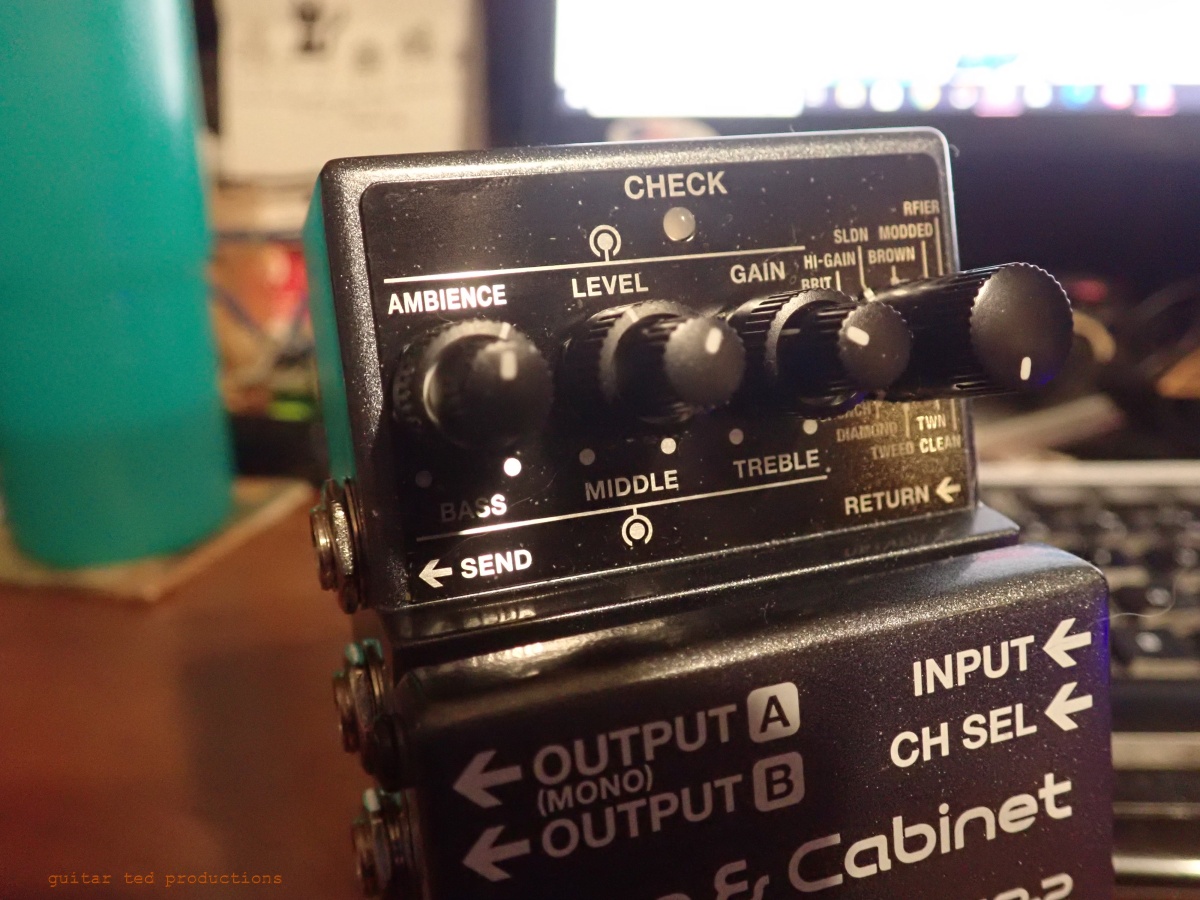
The pedal features dual concentric pot controls and an 11-way amp selector.

The Boss IR-2 Amp & Cabinet pedal is what it sounds like, an amplifier and cabinet replacement tool. The "IR" in the name stands for "Impulse Response". So the pedal can take a guitar signal, amplify it, and send out a signal.  That signal, when hooked up to a powered speaker, a front-of-house PA, or an audio interface, sounds like a "real electric guitar" being played. Supposedly.....

To do this Boss has simulated (modeled) several amplifier types, provided a stereo output, a USB connection, a mono input, and a remote switching option jack. Three dual-control concentric potentiometers control a three-band equalization section, "Ambience" control, output level, and overall gain level. There are eleven modeled "amps" to choose from as well. There is also an effects loop. 

The pedal can be powered using a typical DC pedal supply or internally by the traditional Boss 9 volt battery snap, which if I am not mistaken, makes the IR-2 the only device of its type to be able to be powered independently of an external power supply. This allows you to use the IR-2 Amp & Cabinet pedal as a portable device, if you want to do that. 
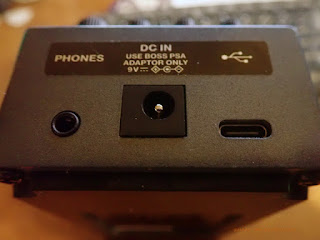
The pedal can be powered by a 9V DC input or by an internal 9V battery.

I'm not going to review every sound and feature here. That would take far too long and there are great You Tube videos on this device that do that anyway. What I am going to do here is give my two cents on how the device is useful to me, will be useful to me, and what I like and don't like about it. 

Playing The Boss IR-2 Amp & Cabinet Pedal: The first thing I did was to plug in an eighth inch headphone jack, (oh yeah, the IR-2 has a head phone jack as well!), and I plugged in a guitar to the input. Oddly enough, I had sound without turning on the pedal! A long press on the pedal foot switch brought up my amp selection. It sounded pretty good. There was a reverb on the signal as well. This reverb was a spring type, but you can perform a certain procedure using the knobs and foot switch in a certain way to choose a different ambient effect. You can use a Hall type reverb or a Plate type besides the Spring which is the stock setting. I ended up on the Plate setting. The "Ambience" control serves as a level control for this effect. It sounds good without being overbearing or ridiculous, even at the higher settings. 

The IR-2 will "remember" your tonal settings and gain and level settings you choose if you leave an amp selection and go to another. You can return to the previous settings simply by tapping the foot switch, or remote switch, if you use an auxiliary foot switch. The indicator light will go from green to red to indicate either settings and you can tab back and forth at will. But......if you reach down and select another amp, the first settings disappear, and now you have the new amp choice and the previous one. There is no Midi capability or easy way to store presets at all. By the way, a long press on the foot switch turns the IR-2 off. 

The pedal has an effects send and return. Note the tiny print to indicate the amp sims.

I also found that when making tonal changes, it may take a few seconds for those to register audibly. But once the pedal starts tracking one change, other changes are instantaneous. I played with the IR-2 as a stand-alone practice tool using the internal battery. Boss says the battery that is shipped with the pedal is for "demonstration purposes only" and that it may not last long. I replaced it with a standard Duracell battery and I found that this lasted about 3-ish hours. 

I also integrated this set up using a fuzz pedal in front of the IR-2 and on one occasion I used a boost pedal. Both sounded great and did what I expected. So, you could set up the IR-2 to be a "bedroom practice tool" and all anyone would hear would be the natural acoustic tone of your particular guitar. Meanwhile, you'd be rocking out. Nice! 

Next, I wanted to see if I could integrate the IR-2 into my existing pedal board. Ideally, all my gain pedals would run straight into the IR-2's input while my modulation and time based effects would go into the effects loop of the IR-2. The output can then be sent to a traditional amp, probably via the "return" of the effects loop of that amp, or by sending the signal to a direct box and then to a sound board, or to an audio interface. You could run the IR-2 into the front end of a traditional amp, but that is kind of the least appealing way to take advantage of this device, in my opinion. (Or maybe not. See UPDATE below) At that point, just plug in your amp and bypass the IR-2, but that said, you can do this. Simply follow the procedure on Boss' website and disable the Celestion impulse response and then use the physical amplifier that you have. 

My test showed me that the Amp & Cabinet pedal integrates easily into the pedal board, (which is a hot mess as I am constantly changing things out), and that my effects all do their thing as I expect. Again, I had my modulation/time based effects in the effects loop of the pedal, and it all worked perfectly, although I cannot say what difference it makes compared to running everything straight in. I didn't try it out that way. 


 What I Don't Like About The IR-2 Amp & Cabinet Pedal: First of all, there is no physical manual. I tried scanning the QR code which Boss claims takes you to a user manual, but after registering my pedal with them, I was sent to the product page which tells you nothing about things like how to switch reverb. 

I ended up learning how to use the deeper functions of this device from an independent You Tuber review, otherwise I would have been stuck with spring reverb. Not that spring reverb is bad, but what was bad was that I couldn't use what I paid for to use. Boss could do a lot better here. If there is a manual, I didn't find it online. Maybe I missed it. It shouldn't be that hard to find if it is there. I will say that in my defense, if - in fact - the manual is there online.

Secondly, those tiny knobs, the tinier print, and the way the controls are set lower behind the foot switch make this annoying as heck to dial in. But, yeah......whatta ya gonna do? The form-factor of a Boss pedal only has so much real estate, and this is a very pedal board friendly device. If it were bigger it would get too much for desktop use or to be stuck on many peoples pedal boards, especially if you use a lot of effects. So, while that is annoying, I will live with it because of the form-factor and the price in light of what you get here. 

I was a bit disappointed in the 9 volt battery life, but maybe I expect too much. Yeah.....I probably do! So that maybe is not a real negative there. There was one other annoying bit, but I'm going to get to that in my "Conclusions" on this device.

What I Do Like About The IR-2 Amp & Cabinet Pedal: The sounds range from "pretty good" to outstanding. I'm not a heavy rock or metal guy, so I'll leave those sounds for someone else to critique, but what I would use here would make me happy in a live or recording context. As a practice tool they are more than fine. 

The versatility of the device is great. I can use it anywhere as a practice amp with headphones running off a 9 volt battery. Yeah.....you'd burn through a lot of batteries! Three plus hours isn't all that long. But you have that choice which is fantastic. You could definitely use the IR-2 as a back-up to a physical amp. If your amp craps out at a gig, the IR-2 could step in as a sub and get you through a gig well enough, I reckon. And of course, for all those venues that hate physical amps or stage volume of any kind, the IR-2's small footprint make it an easy thing to choose for your gigging needs. And it sounds pretty good to boot, I think.  

What I will Likely Do With The Amp & Cabinet Pedal: After messing around with this thing, I think I'm going to set up a mini-board using the IR-2, a dirt pedal, a delay, and a tremolo. This will sit on my desk and I'll use this to record things and to play along with music "silently". With all the amp sims and two choices, or "channels", I would have enough variety in sound to satisfy my needs for enjoying practicing or sketching out recording ideas. 

Testing the Amp & Cabinet pedal.

Conclusions: There is a lot to like here. Quiet practice, recording possibilities, a device that can help keep stage volumes to a minimum, or this could be a big part of a "fly-rig" or bail you out at a gig when the house amp dies. It sounds decent. Maybe not "just like" the amps it claims to emulate, but totally believable as a guitar "amp" and your effects can really be integrated well. All a big plus from where I sit. 

That all said, I have grown up playing physical, "real" tube amps and one thing the IR-2 and its ilk cannot do, two things they cannot do, are push air and create a feedback loop. Both things being a HUGE part of the experience of playing an electric guitar. 

Try turning up a tube amp and "chunk" some rhythm guitar part. Feel that? It's the amp moving the air physically around you. Now hit a single note, let it ring out, and feel that amp start to pick up on a certain frequency and "feed back". The IR-2 gives you neither of these physically felt, visceral feelings. In that sense I feel kind of detached from the guitar as I played the IR-2, especially if I was practicing along with recordings of my favorite music. Update 12/13/24: Just listened to a 'That Pedal Show" episode concerning Leslie/Fender Vibratone and how digital and physical air movement causes different experiences. Worth a listen - and listen on headphones! Episode on YouTube HERE.

Additionally I felt that my effects lost that interaction with an amplifier by using the IR-2. Again, it is something you have to have had experienced playing loudly with an amplifier to have felt that. Musicians who have always played "in the box" without amps on stage, (or in the home), may not miss what I missed. 

On the other hand, I can play along to music again and enjoy "electric guitar sounds" such as they are today. I can record things on guitar into my computer using the IR-2 and an audio interface or direct into my computer via the USB port on the IR-2. I can practice anywhere silently with headphones using the 9V battery option. Now if some sound engineer tells me that I cannot bring an amp, I can get "my sound" reliably with my effects and the IR-2 going to a direct box or front of house PA. 

Maybe young folks who grow up on these sorts of audio interfaces will never miss a "real amp" experience, but as for me, I'm not selling my amps anytime soon. Even if I rarely get to use them. The IR-2 can fill in the blanks, but that "real amp" experience? I'm not ready to give up that just yet.  

UPDATE 3/3/24: I wanted to jump back into this post to let anyone know who cares what my experiences have been with the IR-2 in a pedal board set up. I decided to keep the IR-2 on my board as seen above and I am running dirt pedals into it which include a fuzz, treble booster, mid-boost, a Marshall-in-a-box pedal, a Boss OD1 style pedal, and a fuzz style distortion. The modulation effects are run through the IR-2's effects loop. Those effects are a tremolo, a phaser, a delay, and a reverb. 

I can run direct to front of house, but as of now, I have not had time, nor opportunity, to do that....yet. I have done something that most guitarists would not consider, I think, and that is to run the whole set up straight into a Deluxe Reverb reissue. I didn't even toggle off the IR-2's cab simulation. I know..... You can't do that! But I did. So..... 

It sounded great. Interestingly, I was using the IR-2's Twin Reverb simulation into the "real" Deluxe Reverb and it sounded fine. Like a "bigger" sound, but still that Fender clean tone. Overdrive was glorious through this set up. The sound? I really did not think it was weird or negative at all. I used a big, washy delay, a big reverb, and the tremolo. All sounded fine. I messed with the treble booster and the distortion during rehearsal just to see, and those worked as I would expect.

 I got lots of compliments afterward too. So, yeah.... It may not work in every instance, but I say experiment. You never know until you try. 

A couple of notes: I think you really have to be fastidious with your power cable runs on your pedal board when using the IR-2. My first attempt was met with a LOT of noise, but after straightening out the spaghetti under the board which I caused when I rearranged the board, everything was pretty quiet. I was surprised, actually. 

The other thing would be to make sure you run the level control on the IR-2 at a slightly lower level than the amp you are driving or things get grainy and really loud. Otherwise, I will definitely be using this set up more.

Tuesday, January 16, 2024

A Conversation About Group Rides: A Follow-Up

The original conversation can be heard on the podcast.
The latest "Guitar Ted Podcast", entitled "A Conversation About Group Rides", motivated a comment that I followed up on. A gentleman by the name of John Knowlton let me know that the Kalamazoo Bicycle Club had implemented some solutions to help with getting riders to ride safely in a group situation. I spoke with Mr. Knowlton on Friday for about 45 minutes and he enlightened me regarding what measures were effective in their club to help cyclists be better group riders. 

Mr. Knowlton, the president of the Kalamazoo Bicycle Club out there in Michigan, said that they do have some gravel riding in Southeastern Michigan, being a short distance from where the Barry - Roubaix and Melting Mann courses are. While much of what the Kalamazoo Bicycle Club does is more pavement oriented, some of the tips and procedures they use would cross over to a gravel group ride situation. 

There were two main takeaways from our conversation that I thought I might share here today that could easily be implemented anywhere there is a gravel group ride. I'll also point out that some of what was mentioned on the podcast and more related content that is gravel specific can be found in a 2021 post I made HERE.

A pre-ride briefing (Here @ 2019 C.O.G 100) Image by J. Duke.

Pre-Ride Briefing:

I've done this at most of my events, but it is something that every group ride should have before pedals are turned. A meeting to set expectations, give out guidelines, and point out any important info is a critical piece to group ride success. 

Here you can identify the designated ride leader, (I strongly suggest there be one), and who is responsible for what. I would suggest that you have a ride "sweeper" - someone who sticks around the back of the ride to make sure everyone gets back safely, and maybe that could be someone not riding, but following up in a vehicle. But however you decide to do that, I would suggest that be done. 

Further details like, speed, is it a competitive ride or a chill, friendly one, where stops will be made, etc. All this should be communicated ahead of any riding and preferably right before you leave for the ride. 

Set expectations before the event and enforcing rules and etiquette will be a LOT easier. Ride leaders should be friendly, not aggressive or uncaring. Everyone just wants to have fun and come back unscathed.

A ride clinic might be a good idea (Trans Iowa Clinic 2013)

Ride Clinic/Bike Camp:

Sometimes a separate "class" setting might be a great idea. This is something that the gravel community has embraced to a degree. My only nit with the concept is that many events have monetized this "bike camp" idea which I find anti-inclusive and against what the whole gravel scene is about. 

Mr. Knowlton explained to me that the Kalamazoo Bicycle club does one of these "Bike Camps" for all incoming members of the club, or for members that want to brush up on skills, so that people can engage in their various weekly group rides safely and have an enjoyable time. Knowlton said that it is an effective way to disseminate important skills and that one could even then have a "skills ride" where people could safely employ the knowledge on the bike. 

I don't see any reason why a free gravel bike camp or clinic couldn't be a part of local gravel group rides and be an integral part of joining group rides for newer gravel riders. This could be done for a run-up to an event as well. But making people spend money to gain ride knowledge from some "well known" gravel personalities? 

I guess that has its place, but man..... If you want to grow a community take down as many barriers as possible to joining it. Charging money to learn safe gravel riding skills is bogus. That's my take. Your mileage may vary.... 

And if you are thinking I should put my money where my mouth is, well look at that image above here. That was over ten years ago, I put it on for Trans Iowa, and it was free.

Anyway, there are a couple of ideas I think could be very helpful to making group gravel or pavement rides a lot safer and more enjoyable. A special thank you goes out to John KnowltonPresident of the Kalamazzo Bicycle Club for helping with this subject.

Monday, January 15, 2024

The Blizzard of '24

9:00am, Friday January 2024
Last week you might recall that I posted about how Winter finally started acting like Winter when we received 10.5" of snow in one drop. That snow was a beast due to how wet it was and shoveling out from that snow took three days to take care of what with dealing with snow plow remnants. Then right away after that we got another big dump of snow.

Twenty plus inches in the span of a week. I think that's a new record, at least in my reckoning. After wrasslin' with snow for three days and then seeing another huge dump - this time accompanied by high winds and drifting - I am starting to feel this "old school Winter" feeling. 

Big-time snow, winds whipping it around, and now brutal cold. This is a real Winter. A Winter that brings to mind Winters from my childhood. Except those Winters started out in late November and didn't go away until March.

Snow shoveling counts as training, right? My body thinks it is training. Sore muscles, fatigue, and mental drain are here and very real. Some people wish for Winters of old. I am glad we don't get those much anymore. "Cabin fever" is a real thing. I don't wish to experience that again. 

Yeah...I have fat bikes, but this snow will take a bit to get set up and then we'll need to have "grooming" of some sort. The local soft trails folks do their bit of grooming over in the parks where we have MTB trails, so that's nice. However; to get anywhere around where I live I have to wait for cars, people,, or preferably, the slednecks to come out. Snow machine trails are usually pretty good riding for fat bikes.  

The road West of the Isle Casino in Waterloo on Saturday afternoon.

The neighbors snowman

The second storm brought the blizzard and another round of shoveling. Two and 3/4's hours later I had both the side walk cleared and the two parking places out front for our cars. After I was done shoveling I was entertained by the neighbor's snowman making session. The place next door is being rented by the company that is putting in fiber optic cable here. They hired a bunch of Latin American folks to come up and do the work. 

I'm about 100% sure these guys next door are from Central and South America because they are fascinated by these two snowstorms. On one occasion they were outside taking images on their phones of Mrs. Guitar Ted and I sweeping snow off the car. They also built these two uniquely styled snowmen, one in the back yard, one out front. 

It was kind of heartwarming to see this fellow crafting this snowman Saturday. A grown man reveling in the wonder of snow.  We could stand a little more of that 'round these parts.

Sunday, January 14, 2024

The GTFRI Stories: The 14th One - Part 3

"The GTDRI Stories" is a series telling the history, untold tales, and showing the sights from the run of Guitar Ted Death Ride Invitationals. This series will run on Sundays. Thanks for reading!

As I was trying to ride to our next arranged stopping point, I was feeling worse and worse by the mile. The trouble was that since my lower back was damaged due to that lifting incident and the recent biff I took before this last segment, I had no power in the legs anymore. 

And it was getting beastly hot with that fresh moisture being evaporated back into the air at the surface. This focuses the Sun's energy and it is like being in an oven when this happens. You know how the cold sucks the life out of you? Well, the Sun and high humidity cooks the life out of you. 

My thoughts were that I might get recovered enough at the next stop, which was at 60 miles in, that I could manage the rest piecemeal. There would be about 30 miles to go, and that would be broken up by a stop in Brooklyn, Iowa.

The last arranged stop at 60 miles is where the wheels started coming off this ride for many of us.

I got to Rob's car after a short bit of pavement. I was relieved to have made it that far, and was hoping that a rest would do me good. Meanwhile Rob told me that his companion, Doug, who also came up from Lincoln, Nebraska, was done for the day and that he and Doug were bailing out with Rob's girlfriend back to Grinnell. 

The smart money for me would have been to bail out then and there as well, but I didn't even give that a chance. I was pressing on, and maybe this next bit was the worst I've felt on a bike in my life. It was pure torture. The hills were relentless. The heat was as well. I ended up literally walking up anything that pointed upward. 

This road construction did not deter us from our passing.
While the Level B's were spectacular, I was not enjoying them alone.

I was beyond survival mode at this point and there were a few guys pretty concerned about me. (Thanks again, by the way!) Eventually I made it to the convenience store, but before that, it was decided that my ride was over at Brooklyn and that there would be a ride to take me back to Grinnell. 

As I arrived at the convenience store, I figured the rest of the group would have been up the road quite some time before I arrived, but I was floored to see most of the guys still there. There they were, lounging on a patch of shaded grass located just behind the convenience store. It wasn't long before they did get up and leave. 

My mileage for the day.

In my heat induced and physically injured stupor, I did not realize that the rest of the group was crawling at a snail's pace due to the extreme heat and humidity. In fact, after they left they short-cut the original course for a more straight line route back to Grinnell. 

Meanwhile I waited on a ride. I was left alone, and after about a half an hour, I was starting to wonder if I'd have to ride back anyway. But eventually Jon Duke arrived and got me back into Grinnell. 

By this time we had actually leap-frogged the remaining riders and I only saw Rob's group who bailed out at 60 miles in. We were at Peace Tree Brewing and I had one beer and started to get ready to go home. Just then, the rest of the riders were trickling back into town. I wanted to stay, but having another beer and then driving another 80 miles was out of the question. So, I politely said my goodbyes and left for home. 

It was a very disjointed, dissatisfying way to leave things. I figured on making amends and finishing that course at some point, maybe for a 2020 GTDRI. But at the time, I was sorely disappointed in myself and how the ride went. I shouldn't have been. There were a lot of things beyond my control and we were not deterred by any of the weather earlier on. The planned rest stops with supplies were perfect. The roads were spectacular. By all measures it could have ended up being a classic, and it nearly was. 

Looking back it really bites that this was the last "invitational" Guitar Ted Death Ride. Once I decided not to host rides anymore, getting back to this great Grinnell based course wasn't going to happen. I mean, it could happen again, if I decided to round up a group again, but now with my job status and timing it seems less than likely that I will open that door. 

That all said, this course is on my radar to complete at some point.

Next: The Fall-Out

Saturday, January 13, 2024

Gravel Cycling's Conflicted Soul

SBT GRVL Clashes With Locals Symptomatic Of Issues of Growth In Gravel Events 

 Long ago when Jeff Kerkove and myself set up Trans Iowa in 2004/2005, we had a few meetings and many late night brainstorming sessions regarding just how to set up a gravel based cycling event with a course of 300+ miles. We spoke with successful event directors both on the sanctioned, insured side and on the underground, grassroots side. There was a lot to consider.

One of those issues was based upon a concern for who lived along our route. Both in the rural areas and in the cities, towns, and villages we were to pass through. Keep in mind that we were concerned for these issues based upon an expected field of entrants of 50 riders or less. 

We went as far as to stuff fliers into mail boxes, send press releases out to local law enforcement agencies and governments, and we even went as far as to provide local emergency services numbers and locations to the riders all along the route. Sure, there were some things we left to chance, and for certain we did not get it all right. Not even close, but the point is that we had a mind for care of the venue, its residents, and for being as diplomatic as possible regarding our interactions and impacts. 

While the early gravel scene grew, it was an unspoken rule that, if you were putting on such an event, that care for the riders, the environment, and the local residents who lived on course was to be held as a very important thing. Communications to riders were important, and making sure there were no questions about how to "Ride Right", yield to local traffic, and to conduct yourself as a rider in such a way as to be a credit to the event were things all of us early event directors were keen to impart in our events. 

In my experience, the impact of Trans Iowa on the locals was always of utmost importance. I held relationships with locals as being critical to Trans Iowa's success. I also held that keeping things the way that we found them was as important as those relationships. Litter was not tolerated. We cleaned checkpoint locations and left no trace, as much as humanly possible. 

I could go on, and I could cite other event director's efforts in these areas as well. That said, these events, back in the 2000's, were smaller scaled, less impactful in many ways, and easier to govern because of that. Then something changed. Event promoters sought to become "bigger" and gravel started to slide toward becoming a money-making prospect. 

As event numbers grew the impact upon locals was greater.

I first noted this issue with larger fields of riders in 2014. After the Almanzo 100 there were several reports of locals who were angered by riders pulling off to the side of the road and urinating openly on private property or on the public roadway. There also were reports of some horses that got loose due to becoming agitated by the throngs of riders and running along with them. It was reported that one animal died due to overexertion. Trash on the roads was also reportedly an issue.

The reported rider total was over a thousand riders on a 100 mile course on public roads. While that may have been no big deal to the riders, you can see perhaps how the local residents were none too impressed. And the kicker? The Almanzo 100 was a free event. This same issue started becoming a problem as the Dirty Kanza 200 grew. There in Kansas the remoteness of the Flint Hills perhaps mitigated some of the potential issues, but trash in the form of nutritional wrappers and water bottles was still a big problem.

The DK200 was proactive there in instigating a post-event clean-up which was dubbed "Klean Kanza". The efforts not only cleared the course of the aftermath of 2000+ riders, but they even cleaned trash that wasn't the result of the race. That made a good impression upon local ranchers there.

However; in 2015, the infamous "Mud Year", (the OG Mud Year, not last year's reprise), I witnessed several riders jumping a fence to run in more stable ground. This was a big problem because those riders were trespassing on private land. I wrote a critical email to then RD Jim Cummings and the very next year a policy was put in place addressing the issue. This happening before it was an issue with landowners.

Littering, public urination, and trespassing on private landowner's fields are all things that are bad, but everything gets magnified due to the number of riders and the money brought in by the event. Event promoters like to point to economic windfalls to the towns and cities they affect with their event, and rightly so, but much of that "economic impact" is invisible to a farmer or rancher who is watching his roads be overtaken by cyclists and when they see some of these actions those cyclists are taking. 

Recent landowner concerns have brought scrutiny to the SBT GRVL event

When ranchers cannot pass down the road without dodging riders, or when residents can see riders relieving themselves along the road, it isn't going to go over well. This has cropped up again at SBT GRVL, an event that started in 2018 and boasts 3,000 riders in all their distances. 

Prize money is a big thing and SBT GRVL boasts having 180 Pro riders vying for $20,000 in prize money. 

All that is a non-starter with local ranchers though, who are complaining that riders are in their way of living day-to-day and not just on race day either. With events insisting on giving GPS files for courses days in advance, riders often are seen reconning the courses (open, public roads), and are becoming a further nuisance to local residents. 

Was this practice -riders reconning the courses or getting their equipment dialed in - part of the reason a cyclist was killed when struck by a man driving a truck just West of Emporia, Kansas the week of the 2022 Unbound event? It would appear that was the case. So, this is an issue that is not limited to the event out of Colorado. 

You can read more about the SBT GRVL issues HERE, HERE, and HERE

Proactive vs Reactive: In the case of SBT GRVL, these issues with the local ranchers cropped up right after the last event held in 2023. The organizers then shifted into reactive mode by holding two "listening" meetings where locals were encouraged to voice their concerns to the SBT GRVL staff. In light of the feedback, SBT GRVL has initiated several moves to address the concerns. Limiting two-way rider traffic, providing more portalets for riders to utilize to relieve themselves, and making sure private lands are noted to riders are just some of the measures being taken. SBT GRVL is even sending registered riders a video explaining all the measures being put in place and detailing rider etiquette. 

But are all these reactions a case of "too little, too late"? The answer may lay in the hands of the Routt County Commissioners who have yet to approve the new courses for SBT GRVL. It isn't a slam-dunk that they will approve, and that points to how this all may have been avoided by employing a bit more of a lens toward impacts to residents and land by SBT GRVL before they even held their first event.  

Even a more diligent approach to rider behaviors would have benefited the event and smoothed over a lot of their issues. It has been my experience, as an event promoter and attender of cycling events, that their is a definite air of entitlement within the human community, and in cyclists in particular, when it comes to competing. Anything deemed to have "gotten in the way" is dispatched with extreme prejudice and that includes common decency toward locals, sharing the road, or obeying basic rules of riding on open roads. Now - not every competitive cyclist is this way, but many are. Heck, you even find this happening at RAGBRAI, and that isn't even a rac........ Oh! Wait.......yeah, for some people even that event is a competition! 

A seemingly heavy-handed approach is better than hoping that the "Spirit of Gravel" will lead the disciples of Crushed Rock  to some angelic competitive behaviors. At least you would have been seen as being ahead of these issues. 

Triple-digit entry fees encourage a sense of entitlement.

Gravel's Roots At Odds With Gravel's Economics:

In the end, there is a bit of a disconnect with where many events held on gravel are at with what the intentions for gravel rides were in the beginning. Making a living off a resource that is free (roads) and an activity that has, for all intents and purposes, been turned into road racing on an unpaved surface in many cases, has created conflicts. Conflicts within Pro rider ranks. Conflicts with Pro rider needs versus amateur rider's needs. Conflicts with having large numbers of cyclists taking over normally quiet, empty rural byways. 

Long ago it was those "sanctioned road racing" ideas that were to be rejected at all costs by gravel riders. Maybe it should have been making money at this activity as a rider or as a promoter. Maybe gravel should have stayed small, under the radar, and "pure", but it did not, and it will never be that way again. We are where we are at. So now what?

I think a lot of events are going to end up in a pickle because landowners, communities, and governmental agencies are going to start seeing the economics of gravel and want in on it. Fees to hold events, get events permitted, have police escorts at events/road closures, (such as what SBT GRVL is doing for the Pro peloton), and more are going to put the screws to events like SBT GRVL to the point that they will end up like road races have. Gone. History. Too expensive and too complex to put on.

I don't see how entry fees are going to keep up with the increases in costs without big-time sponsorships, and those are going to be tough to come by in this economic climate. I actually predicted this in my 2020 "State of The Gravel Scene" post. This and the inevitable decline in Gravel™ as a "thing" at some point will bring the whole thing down to a place where we just don't see "big time" racing happening anymore. 

Meanwhile events try to walk a balance between "grassroots" ideals and Pro level, money-making sport. Very few have figured out that recipe and it still shows today.

Friday, January 12, 2024

Friday News And Views

From Domahidy Designs Facebook page
 Viral Bikes Wanderer Features Pinion Drive, TRP Shifting:

Steve Domahidy may not be a name you are familiar with, but he has been a big influence on cycling since around 2004 when he and then partner, Chris Sugai, started Niner Bikes, a 29"er only bicycle company back when 29"ers were still in their infancy. 

After leaving Niner in 2011, Steve went on to design bicycles for Factor bikes, his own Domahidy Designs, and now with Viral Bikes. He has also been a part of working on several other products behind the scenes that you might be familiar with. In other words, he's had his hands in many products and ground-breaking designs over the last 20 years. 

His latest creation is an adventure bike running a Pinion gearbox which is electronically shifted using TRP's Hywire shifting. One of the perceived drawbacks to gearbox and internal geared hub shifting is that you could not shift while applying pedal pressure. But now you can with this system, making it much more easily adapted to by any rider. 

Beyond the image and the few details shared in the Facebook post, I don't have any more information on this bike. Stay tuned for more, hopefully soon....

Image courtesy of Ritchey Design

An Unusual Fork:

The first generation Fargo had a very unusual design and a lot of that had to do with the front end geometry. One of the details that concerned me was that the fork was a very unusual beast. It was short, for a 29"er fork, and it had a LOT of offset. 

Early on, this was no big deal as long as Salsa Cycles had replacements in case of a crash, but those forks have been out of production for years now. If I ever had a bad boo-boo with my Gen I Fargo and managed to screw up the fork, I figured I'd have to score a custom replacement to preserve the geometry.

Well, I came across this Ritchey Design fork the other day and taking a closer look, it would do pretty well as a Fargo Gen I replacement fork, the only thing being it is a Boost spaced fork. (110mm) Otherwise it is very close in specifications having a 435mm axle to crown height and a 52mm offset. 

Yeah, you'd have to lace up a new front wheel, or buy one that is compatible with a through axle and Boost spacing, but at least THAT isn't like looking for a needle in a haystack, like the fork would be. Something to think about if you are a Fargo Gen I owner.

Esker's Hayduke in Saguaro/Desert Fade (Courtesy of Esker)

New Colors And Finishes:

In these times of high inventory and low sales it sometimes takes a little "kick" in the pants to motivate a sale. This takes the form of "refreshes"for many brands. In the bicycle business, this can be as simple as changing the color or finish of a frame. 

Let's face it, how your bicycle looks maters, and if you get jazzed by a new color or finish, you just might decide to dig out that plastic key to your bank account and part with some hard earned credit, or go a bit more into debt, depending on your circumstances. 

Esker has spiffed up both of their hardtail models, the Japhy and the Hayduke, with three new hues for each. The Saguaro/Desert Fade is particularly stunning but the sparkly Unicorn might just be my personal favorite here.

Moots new "Groundswell" anodized finish (Image courtesy of Moots)

Moots has also done up their range with a new option called "Groundswell" which is actually an anodized finish. This new scheme can be had as an option on any of Moots' bikes. 

Titanium has the ability to be anodized or painted, so you can get a lot of different effects on titanium that are not choices for a steel or carbon frame. Plus, you get the durability of titanium. And of course, you can run with no finish at all which is the most utilitarian, and probably most popular, way to go with titanium. 

Anodized titanium has been around, but as an option for a frame, it is more rare. remember those Union anodized titanium spokes/ I think those may have been my first notice of anything anodized in titanium which would have been in the mid-90's. These days I kind of gravitate to what Chumba Bikes is doing in the realm of anodized titanium frames myself, but maybe that's just me. 

Orange Bikes Enters Administration:

Iconic British brand Orange has asked to enter into "administration". That may be a foreign term for a lot of us outside the U.K. What it means is that Orange is asking for protection from creditors and to possibly be saved from going out of business. Kind of like "bankruptcy protection" here, but different... Anyway. 

My blogging comrades from across the pond, "Muddymoles", have a great explainer story that you can read HERE. It's a sad tale because Orange Bikes has such a deep and intertwined history in mountain biking in the U.K. We really don't have anything analogous to Orange here anymore. You might say the absorption of the Fisher brand into Trek, or the buying of the Salsa Cycles brand by QBP back in the 1990's is similar. I gather that it is as if a part of mountain biking would die in the U.K. if Orange Bikes cannot see things through.

From my viewpoint it is a cautionary tale because we could be seeing mid-tier brands falling prey to a similar  fate here. 2024 will mark the end of some things, I think, unless sales and the economy take a big upswing, in which case I would be wrong. But we're in an election year here, and typically that doesn't bode well for a return of a robust economy. So, we'll see. 

Best of luck to Orange in the future!

That's a wrap on this week! Thanks for reading Guitar Ted Productions!