Showing posts with label Bike Radar. Show all posts

Sunday, April 21, 2024

Keep It Big, Keep It Straight

I came across an article on Bike Radar recently that was addressing the uptick in use of big chain rings by Pro roadies. The article is fascinating from the standpoint of how Pro cycling has changed in regard to equipment choices, but what I found most interesting was the technical aspects regarding drive train efficiency. 

What I found there in that article hinges on two basic principles of drive train efficiency and informs all of us how we can make the best use of any chain driven drive train. Both of these ideas were expounded upon years ago and that is where I learned these ideas and have implemented them into my thinking about bicycle components and which has informed my choices about drive train components over the years. 

It's been so long ago that I read about these ideas that I forget where it was I learned these ideas specifically. I know that before the Internet's widespread usage, there was an article published in "Dirt Rag" that was written by Keith Bontrager. In it he attempted to explain how to use a typical for those days triple crank set drive train. 

You can read in the "Bike Radar" piece I linked to about these same ideas, so this is knowledge that has been around for decades, but it is criminally either missing in most rider's knowledge base or completely misunderstood. At any rate, you can break it down into two basic things.

Keep It Big: Chain articulation around cogs is a source of loss of power as the smaller the arc of the cog is the more the chain has to articulate to conform to the cog shape and this causes a loss of energy. Efficient use of a derailleur drive train would be to use the largest cog/chain ring combination that is reasonable and that provides a ratio that allows the rider to do whatever it is that rider is attempting to do, be that climbing, descending, etc. 

There is another reason a rider would consider doing this and that is for the longevity of the drive train parts. Smaller cogs on a cassette contact chain links more often as they spin than larger cogs will. Also, that chain articulation under tension is supported by fewer teeth on a smaller cog, so the combination of frequency of load bearing and the focused wear on fewer teeth means that smaller cogs, when used often, will wear out more quickly than would the same/similar ratio using bigger cogs and chain rings. 

Both reasons are why I try to use bigger chain rings and cogs on my single speed bikes. As an example, I could run a typical 32T x 16T on a 29"er for a gear inch of 58, or I could get the same 58 gear inch by running a more efficient, longer wearing 40T X 20T set up. Of course, the weight conscious amongst us would cry foul, and yeah, some big chain rings will not fit on some bicycles. But the point remains valid. 
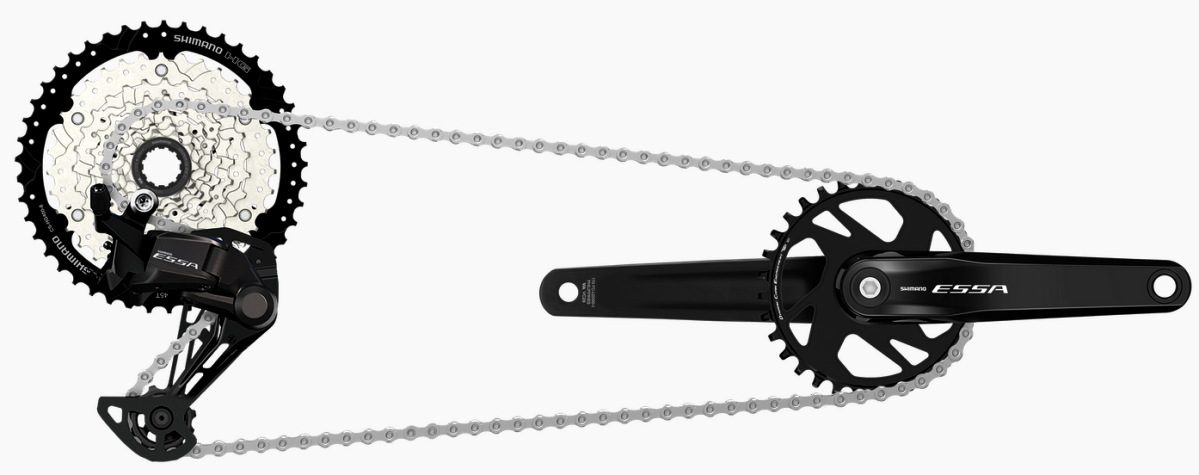
Image courtesy of Campagnolo

Keep It Straight: The other thing Keith Bontrager said in that old "Dirt Rag" article was that the straighter you kept the chain the more efficient the drive train would be. This principle of derailleur drive train usage is also expounded upon in the "Bike Radar" piece. 

This idea helps riders understand when to shift, and why. It helps explain why certain combinations, while usable, should be avoided if possible. The commonly heard term, "cross-chain" came out of discussions about how to use triple and double crank set drive trains. The more misunderstood "duplicate gearing" concept is also part of this discussion. Similarly to how one would want to always defer to a larger combination of cog and chain ring, one also would (or should) want to choose  to use a straighter chain line whenever possible over a cross-chained set up. 

Efficiency increases with a straighter chain over that of a cross-chained choice of gear, but again, wear is accelerated with cross-chained choices. And where do we see a lot of severe chain angles now? That's right. In 1X systems. 

Front derailleurs were eliminated in MTB for several design choice reasons not based on drive train efficiency. Gravel bikes ended up adopting 1X to a degree due to the MTB influences, and rarely will you see 1X in Pro level road racing, because efficiency is king there. I would also put forth the argument that consumers see 1X as being "easier" since they don't have to think about how to use a front derailleur. Compounding this is that shifting a front chain ring is harder to do than shifting at the rear and you can see why 1X is so popular now. 

It may be popular, but 1X has shown that it is not as efficient as a multiple front ring crankset by wearing out chains laterally as well as in the traditional way. In fact, many mechanics have posted online that they change 1X chains now based more on lateral wear than based on the traditional way that chains are measured for wear. That's an indication of less efficient operation.

Conclusions: Of course, you don't have to consider any of this and you can have fun riding a bicycle without any knowledge of the above. That said, if you care about efficiency and wear issues, these ideas might help you out.

Tuesday, January 12, 2016

Seems Pretty Slick

Remember Gore Ride On?
A friend of mine and I were reminiscing the other day about cables for bicycle brakes and derailleurs. I know.........we're such nerds! Anyway.....

The conversation was about the old R.L. Gore company's "Ride On" sealed cable system. It was an ingenious development that took a simple cable for a bicycle, and ran it inside a sheath from front to back, essentially sealing out the elements and making the cable retain its slick, smooth operation far past that of ordinary bicycle cables and housings. This despite the many "open" cable runs that most road and mountain bikes have employed for decades.

The system worked so well that some riders were reporting that their cables were friction free and operating well past a decade of continuous usage. That's hard to imagine, and let's face it- not a good business model. I mean, how do you continue to sell cables and housings if people are using the same set they bought from you for ten plus years! Then too, the competition probably wasn't too chuffed about selling against that track record either. Or at least, one wouldn't think so.

So, why hasn't this product taken over the marketplace? Well, the story begins with a 2012 CPSC recall on R.L. Gore cables due to a few reports of Campagnolo brake cable ends breaking off, causing crashes. Okay....that's a blow to any company, but it doesn't necessarily signal the end. However; this "Bike Radar" story, published in August of 2012, indicated that, " the cables and housing proved too small of an effort to make it worthwhile". SRAM was claiming that they would be offering it through their channels, but a quick search revealed only some older sets available on e-bay and through some Amazon sellers. Probably old, NOS stuff.

Jagwire's  Elite Sealed Kit
So, that was it? No, not exactly. With a little easy digging, one could find out that the R.L.Gore cables were produced in Asia by Jagwire, a company that has a huge OE business with several bicycle brands, and was branching out to sell their own branded product in the aftermarket. Jagwire announced in July of 2013 that they were introducing a "fully sealed system" . In this "Bicycle Retailer and Industry News" article, Jagwire states through a spokesperson that Jagwire's new cables were a , "similar system to Gore in that it's sealed, but there are changes to improve performance and durability.

Well, I for one was not aware that this evolution, and brand change, had happened. It would seem that due to the past popularity of the Gore Ride On system, that one would think that riders would be searching out a replacement, but for whatever reason, this seems to be an under the radar cable system. I'm sure I'll get comments regarding these being in use out there, which is great, but I'll be honest, I would have thought this would be a bigger deal than it is.

Maybe Di2 has supplanted that buzz......

Seems Pretty Slick

Remember Gore Ride On?
A friend of mine and I were reminiscing the other day about cables for bicycle brakes and derailleurs. I know.........we're such nerds! Anyway.....

The conversation was about the old R.L. Gore company's "Ride On" sealed cable system. It was an ingenious development that took a simple cable for a bicycle, and ran it inside a sheath from front to back, essentially sealing out the elements and making the cable retain its slick, smooth operation far past that of ordinary bicycle cables and housings. This despite the many "open" cable runs that most road and mountain bikes have employed for decades.

The system worked so well that some riders were reporting that their cables were friction free and operating well past a decade of continuous usage. That's hard to imagine, and let's face it- not a good business model. I mean, how do you continue to sell cables and housings if people are using the same set they bought from you for ten plus years! Then too, the competition probably wasn't too chuffed about selling against that track record either. Or at least, one wouldn't think so.

So, why hasn't this product taken over the marketplace? Well, the story begins with a 2012 CPSC recall on R.L. Gore cables due to a few reports of Campagnolo brake cable ends breaking off, causing crashes. Okay....that's a blow to any company, but it doesn't necessarily signal the end. However; this "Bike Radar" story, published in August of 2012, indicated that, " the cables and housing proved too small of an effort to make it worthwhile". SRAM was claiming that they would be offering it through their channels, but a quick search revealed only some older sets available on e-bay and through some Amazon sellers. Probably old, NOS stuff.

Jagwire's  Elite Sealed Kit
So, that was it? No, not exactly. With a little easy digging, one could find out that the R.L.Gore cables were produced in Asia by Jagwire, a company that has a huge OE business with several bicycle brands, and was branching out to sell their own branded product in the aftermarket. Jagwire announced in July of 2013 that they were introducing a "fully sealed system" . In this "Bicycle Retailer and Industry News" article, Jagwire states through a spokesperson that Jagwire's new cables were a , "similar system to Gore in that it's sealed, but there are changes to improve performance and durability.

Well, I for one was not aware that this evolution, and brand change, had happened. It would seem that due to the past popularity of the Gore Ride On system, that one would think that riders would be searching out a replacement, but for whatever reason, this seems to be an under the radar cable system. I'm sure I'll get comments regarding these being in use out there, which is great, but I'll be honest, I would have thought this would be a bigger deal than it is.

Maybe Di2 has supplanted that buzz......

Tuesday, March 08, 2011

On A Few Things....

I have a few things to comment on today that are not really full post, feature length rants, so I am giving you three short ones today......

29"er Weight-Weenies: When I was up at Frostbike interviewing Jeff Frane of All City, I made a comment about how 29"er freaks were too weight conscious. That the way some of the aficionados of 29 inch wheels talked, the road wheels some roadies lust after would be considered "too heavy" for use on their mountain bikes. I said that this apparent neglect of reality was "stupid" on the part of these 29"er folks.

This woke up Hurl Everstone's ears, and he was obviously quite surprised to hear someone like me say this. He even asked if he could quote me on it, as if someday he'd need to call me on that. Well, I said "go ahead", because it really is pretty stupid when you face facts.

Check out this link to a set of lust-worthy Zipp 404's. Yeah, all carbon-fibery-slickery-fast, and you would think- pretty light, right? Well, try 1658 grams on for size. Oh.....and we haven't added quick releases to that weight. Want a Power Tap? Make that 1893gms then. Okay, let's say that any company you want to name came out with a XC racing wheel set for 29"ers that weighed 1660 grams. What do you think they would say about those? And keep in mind, the cost of a grand plus some change for the set. Well, I'll tell you that the "masses of 29"er freaks would be crying foul till the cows came home.

Something is just wonky about that.

And I haven't even gotten into rider weight limits, how the wheels may not be "every day trail wheels", and tubelessness. And it isn't just wheels either. This goes for tires, forks, and frames as well. Sometimes I think the term "reality check" should be part of the lexicon of 29"er riders out there. Just sayin'.......

What It Is, And What It Ain't: It seems that a couple of the editors at Bike Radar are trying to convince the unsuspecting public that 29" wheeled drop bar mountain bikes are really "monster-cross" bikes.They got their wires all crossed up over there!

<===This? Monster-cross......

By their definition, anything with wide, high volume tires and drop bars is a "monster-cross" bike. Well, if you read the article and the ensuing commentary, you'd think that all monster-cross bikes had 29"er wheels. Well, they don't, and I'm not sure that what they are talking about over there isn't really just a "mountain bike" with drop bars. That's what it would have been called 25 years ago, just a drop barred mountain bike, ya know?

<===This one? Drop Barred Mountain Bike.....see the difference? 

We went over this a couple years ago now on Twenty Nine Inches in a piece I wrote about monster-cross bikes where a fellow that is pretty steeped in drop bar mountain bike history, and an industry veteran, made this very wise statement:

When I think monstercross, I think of a bike with clearance for 700×45C tires, drop bars, and cyclocross geometry. Change one of the first two items and it becomes something else. Change the tires to 2.1 and it’s just a mountain bike with drop bars. Change the bars to flat and it’s a hybrid"

That makes a whole lot of sense to my mind, and keeps the "monster-cross" tag in a place where it makes the most sense. That being the middle ground between true, straight-up cyclo-cross rigs, and 29"ers. Or, as Wes Williams would say, "28"ers". Not this non-sense Bike Radar is trying to fill our minds with, that's for sure.  Let's quit trying to "re-invent" the wheel, as it were, okay guys? 

The Snow Dog Update:  I know some of you out there are wondering why I haven't been posting about rides on my Salsa Cycles Mukluk. Well, as some of you might remember, I had a Phil Wood rear hub on that bike that failed....twice, in less than a month. It was serviced by Phil Wood the first time it went back, and 12 days ago I sent it back in again.


Well, needless to say, I am extremely disappointed in that fact, and as of this point, I have no idea when or how this situation will be resolved. There are some things I would like to describe about this story for you all, but to be fair, I am going to wait this out until it gets resolved and then the whole story can be told.

So, for now, the whole bike is basically useless until I can move off this impasse I am sitting in the middle of at the moment. More when I have something I can share......


On A Few Things....

I have a few things to comment on today that are not really full post, feature length rants, so I am giving you three short ones today......

29"er Weight-Weenies: When I was up at Frostbike interviewing Jeff Frane of All City, I made a comment about how 29"er freaks were too weight conscious. That the way some of the aficionados of 29 inch wheels talked, the road wheels some roadies lust after would be considered "too heavy" for use on their mountain bikes. I said that this apparent neglect of reality was "stupid" on the part of these 29"er folks.

This woke up Hurl Everstone's ears, and he was obviously quite surprised to hear someone like me say this. He even asked if he could quote me on it, as if someday he'd need to call me on that. Well, I said "go ahead", because it really is pretty stupid when you face facts.

Check out this link to a set of lust-worthy Zipp 404's. Yeah, all carbon-fibery-slickery-fast, and you would think- pretty light, right? Well, try 1658 grams on for size. Oh.....and we haven't added quick releases to that weight. Want a Power Tap? Make that 1893gms then. Okay, let's say that any company you want to name came out with a XC racing wheel set for 29"ers that weighed 1660 grams. What do you think they would say about those? And keep in mind, the cost of a grand plus some change for the set. Well, I'll tell you that the "masses of 29"er freaks would be crying foul till the cows came home.

Something is just wonky about that.

And I haven't even gotten into rider weight limits, how the wheels may not be "every day trail wheels", and tubelessness. And it isn't just wheels either. This goes for tires, forks, and frames as well. Sometimes I think the term "reality check" should be part of the lexicon of 29"er riders out there. Just sayin'.......

What It Is, And What It Ain't: It seems that a couple of the editors at Bike Radar are trying to convince the unsuspecting public that 29" wheeled drop bar mountain bikes are really "monster-cross" bikes.They got their wires all crossed up over there!

<===This? Monster-cross......

By their definition, anything with wide, high volume tires and drop bars is a "monster-cross" bike. Well, if you read the article and the ensuing commentary, you'd think that all monster-cross bikes had 29"er wheels. Well, they don't, and I'm not sure that what they are talking about over there isn't really just a "mountain bike" with drop bars. That's what it would have been called 25 years ago, just a drop barred mountain bike, ya know?

<===This one? Drop Barred Mountain Bike.....see the difference? 

We went over this a couple years ago now on Twenty Nine Inches in a piece I wrote about monster-cross bikes where a fellow that is pretty steeped in drop bar mountain bike history, and an industry veteran, made this very wise statement:

When I think monstercross, I think of a bike with clearance for 700×45C tires, drop bars, and cyclocross geometry. Change one of the first two items and it becomes something else. Change the tires to 2.1 and it’s just a mountain bike with drop bars. Change the bars to flat and it’s a hybrid"

That makes a whole lot of sense to my mind, and keeps the "monster-cross" tag in a place where it makes the most sense. That being the middle ground between true, straight-up cyclo-cross rigs, and 29"ers. Or, as Wes Williams would say, "28"ers". Not this non-sense Bike Radar is trying to fill our minds with, that's for sure.  Let's quit trying to "re-invent" the wheel, as it were, okay guys? 

The Snow Dog Update:  I know some of you out there are wondering why I haven't been posting about rides on my Salsa Cycles Mukluk. Well, as some of you might remember, I had a Phil Wood rear hub on that bike that failed....twice, in less than a month. It was serviced by Phil Wood the first time it went back, and 12 days ago I sent it back in again.


Well, needless to say, I am extremely disappointed in that fact, and as of this point, I have no idea when or how this situation will be resolved. There are some things I would like to describe about this story for you all, but to be fair, I am going to wait this out until it gets resolved and then the whole story can be told.

So, for now, the whole bike is basically useless until I can move off this impasse I am sitting in the middle of at the moment. More when I have something I can share......