Showing posts with label The Guitar Ted Wheel Series. Show all posts

Tuesday, February 13, 2024

The Guitar Ted Wheel Series: Custom Wheels

What You Need To Know:

So, let's wrap up this series on wheels today with a look at having custom wheels laced up by a wheel builder. There is an advantage to having this done, but there is also a responsibility on the rider to have done some research ahead of time. The wheel builder is only going to know what to do if you tell him what you want, how you ride, and what your expectations are. Without those critical bits of information, the wheel builder will have a lot harder time satisfying you. 

So, what should you have decided and be able to share with you wheel builder? Honestly assess your riding style and expectations for the wheel set. Racing wheels, daily-drivers, or will this wheel have to do it all? Then there is the hardware.

Hubs: There are some basics that will fall into place regarding hubs like axle style, overlock dimension, and free hub type that you will likely have already made a decision on. If you don't know the difference between 142 through axle and 148 through axle, or what an XD driver is, those are things you can ask about at your wheel builder of choice. 

Speaking of XD drivers.... The free hub body (The splined bit your gears/cassette slide on to),  on your rear hub matters. So, if you are a SRAM person and run that gear, you'll likely want an XD style driver. (Yes, there is more than one) If you want Shimano running gear, you'll likely want a HyperGlide style free hub body, but nobody calls them that anymore, they are just called "Shimano" style free hub bodies now. There are some MicroSpline Shimano hubs out there now if you are into 12 speed MTB, and of course, there are Campagnolo hubs, but if you have those, you already know about their free hubs.

Shimano style free hub bodies come in aluminum on most aftermarket hubs. This is fine if you don't run cassettes with separate cog/spacer type construction. Cassettes with "carriers", or cogs that are riveted to aluminum center pieces that have a wider base and will not cut into aluminum free hub bodies, are what you will want to use. However; those types of cassettes are top-dollar and the cheaper cassettes are the separate cog/spacer types that will damage an aluminum free hub body. Since cassettes are wear items and get replaced fairly often, many times people want to be able to use the less expensive options. So, be honest with yourself and make an appropriate choice when you have the wheels built.

American Classic Hubs, (R.I.P.) had a steel insert to protect their aluminum free hub from damage.

 Alternatives to a full aluminum free hub body exist. Some aluminum free hubs now have a steel insert, (see above) that prevents cogs from cutting into the aluminum. Otherwise you have to go with a steel option, or as with White Industries, a titanium free hub body option. 

Another free hub related decision would maybe be how quickly the free hub engages after coasting. This is usually measured in degrees of rotation. Some hubs, like the old American Classic design that used cams instead of ratcheting pawls, had a quite noticeable amount of "free turn" after coasting, when you started to pedal, before you felt the mechanism engage. Some free hubs, like Onyx Racing Products hubs, have instantaneous engagement. By the way, if you want to see how many hub options there are, visit Onyx's MTB hub page and take a gander. It is quite comprehensive. 

An exploded view of a Profile Racing free wheel (Image courtesy of Profile Racing)

A Word About "Engagement": A lot of people get hung up on "points of engagement" or how fast the hub starts to transmit power after coasting. I get it, but really, who needs to have "instant engagement" or anything near that? Pro and semi-Pro racers? Those whose livelihoods depend upon racing results? Yes.... But outside of Onyx, who use a sprag clutch design, keep in mind that the more pawls there are and the more teeth there are in the ratchet/drive ring, the more friction you will create during coasting. There is that physics based concern that a lot of people don't talk about. Also, those types of hubs tend to be louder, if that matters to you. Just something to think about there.... 
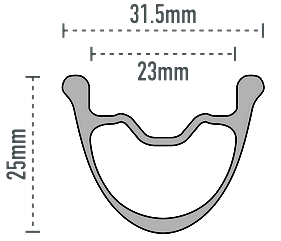
Some rims are hookless (Image courtesy of ENVE)

Rims: We've already covered aluminum and carbon rims, but I wanted to remind folks again that there is a difference in how a rim is designed to engage with a tire. 

Some carbon rim manufacturers have decided to pursue a "hookless" rim design. There are several reasons for this, but for gravel riders, unless you are nearly or are mountain biking with your "skinny" 45mm tires, hookless designs are not necessary and may, in fact, cause you troubles if you alternate using higher pressures for road rides versus gravel or off-road with the same tires.  

As well, if you have to resort to using a tube, or prefer to, hookless rims are not recommended for such use. So, that's a feature that you may want to be aware of and avoid if the use of tubes or higher pressures is a thing you might find yourself doing. 

In terms of gravel use, you also have to decide what width tires you are going to want to run. This will help you determine what inner rim width that you should shoot for. I know from my own experiences that if you are planning on running under 50mm wide tires, say in the 42mm -47mm size range - that a 25mm inner rim width is about as wide as you'll want to go. If you are running less than 42mm wide tires you can drop that down to 21mm inner rim width. That said, My wheels are mostly 25mm inner rim width and that seems to work really well for anything from 38mm - 47mm wide tires. 

Riders using 50mm and up for widths would be better suited to wider inner rim widths to get the most out of your tires. For instance, I am running 2.8" tires on 30mm inner rim width rims and that seems perfect for gravel travel. 

A new choice in tubes (Image courtesy of Tubolito)

Tubeless Or Tubed

Not that it makes a lot of difference anymore, but there was a day when tubeless compatible rims were rare. Now it is probably the opposite, but you will want to double-check that your rim choice is tubeless compatible. If you are a rim brake aficionado, and you like tubeless, your choices get really slim, but there are some choices. 

A good wheel builder will also include a taping job and valves with your wheel build, so you will also want to research your choices there as well. 

Tubed usage is getting a fresh look now with the advent of "TPU" based tubes which are not rubber, weigh a half to a third as much as a butyl rubber tube, and give nearly the same ride qualities as tubeless or latex rubber tubes. The choices are expanding in this area also, you have Tubolito, Pirelli, Schwalbe, and State Bicycle Co. now offering TPU tubes. There are more coming as well. (I am currently testing a new-comer to this space) So, if you don't like doing the tubeless dance, TPU tubes offer the convenience of a traditional tube with less rolling resistance, good to great puncture resistance, and superior air retention characteristics. 

If you want to go tubed, your wheel builder should know this and he can finish tape the wheels accordingly. 

Maintenance: Finally, your wheels will need looking after. Some better wheel builders will offer service after the sale.  A free true of your new wheels after some miles, or "check-ups" can give you more value for the dollar spent. But that said, you should learn how to check your wheels and true them. You don't need to invest in anything more than some time to learn and a spoke wrench. 

In Closing: This is not an exhaustive look at wheels, but this was meant to give you, the reader some basic knowledge and a "where to go" with thoughts and research when it comes to gravel wheels. I may revisit this subject later on if there is a need. 

Thanks for reading Guitar Ted Productions!

Monday, February 12, 2024

The Guitar Ted Wheel Series: Materials Part 2

Alternative Spoke Materials For Gravel Riding:

Now that I've gone over aluminum vs carbon for rims, I want to touch on some exotic materials used for spokes. Hubs are almost always made out of aluminum with aluminum, titanium or steel free hub bodies. Which free hub body you'd want really only comes into play if you use cassettes with separate cogs and spacers instead of the types of cassettes which are built on aluminum carriers. I'll save that for another post in this series, so I won't dive into that here. 

Spokes generally are made of stainless steel, unless you buy an entry level bike which may use spokes made from other steel alloys. We're going to assume here that the wheels we are comparing to have stainless steel spokes. 

Spokes made of stainless steel can be drawn into bladed shapes, or into shapes that are thicker on the ends, thinner in the middle part. Those of the latter type are referred to as butted spokes. There are some attributes for each type that are, in the general sense, not really worth the time to get bent about, although some debates over these choices exist. I will say that bladed and butted spokes generally have higher tensile strength and straight gauge spokes, those with no shaping, are generally tougher and heavier. In the end, these minor differences aren't going to make a well built wheel do anything you, as a rider, will be able to feel differences between - all other things being equal. 

Steel spokes also exist that are "straight pull" and are different than the traditionally made "J" bend spokes. This refers to the anchoring end of the spoke which has a "nail" head which is either bent about 90° from the main shaft in a tight curve that resembles the letter "J", or just terminates in the "nail" head as in a straight-pull spoke design. Again, there are arguments for either design, but all you should know is that "J" bend spokes are a lot easier to find should you need a replacement. 

"J" bend spokes and a spoke cutting/threading machine.
Steel spokes are - by far and away - the most common spoke type, but there are some alternatives to steel. There are the super-rare titanium spokes which have similar characteristics to steel spokes with more stretch and"flex" due to the nature of titanium. Then there are the fibrous based spokes like Spinergy's "PBO" spokes and Berd spokes.

Berd spokes: Very nice riding. VERY expensive!

Spinergy's PBO fiber spokes are always covered in sheaths which can be different colors.

I won't say a lot in this post about the exotic fiber based spokes, but I will refer you to this post written in 2022 that takes a deep dive into wheel dynamics and why fiber spokes actually do absorb vibrations. 

Oddly enough, the Spinergy spokes are built into wheels which retail for pretty reasonable prices. The Berd spokes? Well, at $8.00 to $10.00 for each spoke, and the price to have a trained Berd spoke wheel builder build you a set, you can guess rightly that any wheel with those spokes in them will be at a pretty dear price. 

I will say that of all the alternative spokes that you might consider, the Berd spokes are amazing to ride. You really do feel the difference in smoothness. While this also can be attributed to Spinergy wheels, the effect is more subtle. However; at prices which are in line with average, good quality aluminum wheels and cheaper carbon sets, you really get a good value there. 

The downside is that if you should happen to break a fiber based spoke, it won't be easy to fix quickly. You can do it, but replacement parts will have to be ordered in. I have rebuilt a PBO spoked Spinergy wheel so I can vouch for their repair-ability. 

Industry 9 famously uses aluminum spokes in some of their wheels

A Word About Aluminum Spokes:

I own two sets of Industry 9 wheels that use aluminum spokes and I have ridden a few others enough to say that these wheels are not life-changing because they have aluminum spokes. The spokes can be anodized in an array of eye-popping colors and are really cool, but in the end all they are is window dressing. Great wheels, just don't expect anything radically different from the aluminum spokes. 

A bag of aluminum spoke nipples and a bunch of stainless steel, "J" bend spokes.

A Few Words About Spoke Nipples: If you go ahead with wheels that use traditional steel spokes, you may have noticed that there is a mention of brass or aluminum for spoke nipples. Which is better? 

Well, alloy nipples (aluminum nipples go by this name most often in wheel-nerd language) are lighter, and like the Industry 9 aluminum spokes, can be had in an array of fun colors. If you have to have the colors I get that, but your wheels had best be built with that nipple material in mind. If they are not, they will be prone to shearing off at the nipple's head, where it flares out to anchor inside the rim. Also, you had better be double-careful not to allow any tubeless sealant to touch those nipples because aluminum and sealant don't get along well a lot of times. (See previous Materials post on rims)

Brass nipples, while heavier, and duller because you only get silver or "black" choices for colors, will typically fare better in the long run. So, if you want to have more reliability, and if you don't care about colors, go for the brass nipples. Alloy nipples are technically lighter, but not by much. Usually they are not worth the troubles they can cause. That said, I have built with alloy nips a LOT and I have several wheel sets that use alloy nipples. So, it isn't as though they are terrible. It's just that when I do happen to have trouble with a nipple shearing, you can bet it is an alloy one. And I've had a few fail on me despite doing everything right with regard to sealant and building the wheel. 

Next: Custom Wheels - What You Need To Know.

Sunday, February 11, 2024

The Guitar Ted Wheel Series: Materials - Part 1

Why Aluminum or Carbon Rims May Be Best For You.

What your wheels are made of will help determine the price, but maybe more importantly, how you experience the wheels. Of course, how all that gets put together matters as well. It's kind of like a recipe. You have to get the right ingredients, in the proper amounts, and then prepare them perfectly to get the optimum wheel.

That said, we're going to break it down here to rim materials first. Hubs are usually aluminum. Spokes are usually stainless steel. Sure, there are outliers, but we'll get to that when we talk about the more exotic stuff. 

Rims are pretty much in two camps: Aluminum or Carbon Fiber. Some will tell you that "You gotta have carbon!', while others will tell you "Aluminum rims are just as good but cost less!". Which person is right? Well, let's see about this, shall we?

Keeping in mind that my focus these days is on what works best on crushed rock roads, I will refer to something I discovered when testing some carbon fiber wheels a few years ago now. I was riding a wheelset that was incredibly stable on loose gravel. The bike I had the wheels on I was intimately familiar with, so I knew it wasn't the bike, it was these new wheels I was testing. What was going on here?

These wheels had a profound effect on my understanding of what makes a good wheel.

I'll fast-forward to the good part and spare you all the testing observation. What I found was that these wheels did not oscillate, or 'wobble' in deep, loose crushed rock. They basically were so stiff that the vibrations that would normally induce a wheel to 'wobble' side-to-side weren't having much of an effect on the wheels. 

This really opened up my eyes because I then saw why certain wheels were a chore to ride while others felt better and felt "smoother". This is definitely not what I was looking for, but I found this to be true, and it is why you want stiff rims. Stiff laterally. Not vertically, but unfortunately that probably will be the case anyway. (I'll get to all that later)

So, "Just get carbon fiber rims, right?". Well.....not so fast. Some carbon rims aren't all that stiff laterally, and some aluminum rims are. But yes - In general, getting carbon rims will give a better ride, just not for the reasons you may have thought. Vibration absorption is not a factor. I'm not saying it doesn't happen, but if you are running 35mm-plus wide tires and at a realistic pressure (not MAX). your vibrations are getting soaked up more by tires than by any rim. And there are vibrations at certain frequencies that are going to get passed through to you no matter what. There is no magic bullet. 

But having a wheelset that doesn't oscillate in chunky gravel is a boon to handling and allows the rider to relax, spending less energy on corrective inputs, and then be able to exert more effort into pedaling over a longer period still feeling fresh. 

Other Considerations: As stated, some aluminum rims ride very well, and you can get pretty decent weight wheels for not a lot of cash. Aluminum lasts a long time, is resistant to gravel stones pinging off them, (and they will), and also will do tubeless or tubed very nicely. While spoke count matters for other reasons more heavily, having more spokes is generally better if you want stiffness laterally. However, unless you have your wheels built up, or build your own, 28 spokes is going to be max and there are a ton of 24 spoke count wheels. I'm of the opinion that pre-built, low spoke count wheels aren't always the best thing, especially for riders that want to do some bikepacking, touring, or that are heavier people AND also want to carry stuff on the bike. 

Image courtesy of HED Wheels

Good quality carbon rimmed wheelsets will automatically push you into a price range that isn't cheap, and maybe that's uncomfortable, but I would seriously consider carbon rims for ride quality and especially if you are concerned about rotating weight. That's a place where carbon will also make a big difference without sacrificing strength, in most cases. 

Carbon is pretty tough these days, but do be aware that pinging rocks will ding up the finish and theoretically could damage a rim to a point that you'd be advised to replace the rim. 

I'd stay away from hookless designs in carbon just because they are not high pressure friendly and if you end up having to put a tube in to get you home those hookless designs are not meant for tubed applications, so.... 

Another advantage to carbon rims is that they are resistant to damage from sealants. Aluminum will corrode when exposed to ammonia, which many sealants have in them as one of their ingredients. Any exposed parts of the inner rim well due to tape slippage can be corroded by sealant and allow spoke nipples to be exposed to sealant, which is really bad if you have alloy nipples. This is a common issue with aluminum rims that are used tubeless. 

One other thing that may be of concern if you live in a rockier area is the tendency for aluminum rims to be dented. This can happen when using low pressures and when speed and bigger rocks are in play. Carbon is more resistant to such damage, but it is not impervious to being damaged in this way. 

Of course, any pre-built wheels you consider may have weight limits, so it is wise to check on that before purchasing any wheelset. Be aware that anything you carry on you or on the bike is weight that needs to be considered in that weight limitation as well. Riders needing to have wheels to bear up under their weight and a load, or are just heavier humans, should consult a wheel builder and have a custom set of wheels made just for them. Rims are part of that equation, but I'll get into all that matters with custom wheel builds after I finish up on the materials in my next post. 

Conclusions: Carbon or aluminum? Either can be a great choice. Carbon will cost you more money, all things being equal, but can bring the ultimate performance benefits. Aluminum is a value in that the performance aspect can be very high, but the cost of an aluminum wheelset usually is quite a bit less and for utilitarian purposes, this material is perfectly suited for a rim. Not to say that you cannot race on an aluminum wheelset. You can, and this works well for many riders. 

Personally, I have both types of rims in regular service and I can recommend either as long as the wheel is built well with quality parts and is used appropriately. I have found that carbon is best on gravel due to that "wobble" characteristic described above and that aluminum rims just don't quite have as good a result in that way. Close, but not quite. So that's my personal take on it. 

Next: Materials Part 2: Alternative Spoke Materials For Gravel Riding

Saturday, February 10, 2024

The Guitar Ted Wheel Series: Cheap vs Expensive

What Do You Get For Your Money?

Wheel prices can be all over the place for a wheel that you may be looking for. Cheap, foreign made wheels all the way up to expensive wheels with US made components. Which is best? Can you get top dollar performance for little cash outlay? Do you always "get what you pay for", or is there a point of diminishing returns?

There are a couple of things to keep in mind when looking at wheel sets. I have some opinions based upon my research and experiences. Here goes...

If It Looks Too Good To Be True - It Probably Is: Let's say you are in the market for some gravel wheels with through axles and carbon rims. You shop around online and see an ad for wheels costing $500.00/pr. They look just like the $1500.00 wheels! Why pay more when you can get those wheels for less?

Because they are not as good. How can I say that? Because materials, like carbon fiber, come in varying qualities. There is "excellent" quality carbon, "average quality" carbon, and - you guessed it - poor quality carbon. Same goes for bearings, hub shells, etc. Cheaper parts may look the same, but may not last as long, weigh what you think, or be replaceable/serviceable. A wheelset for $500.00 is not going to have the same quality parts or materials as a $1500.00 set. Not to mention the probability of the more expensive wheels having a crash replacement warranty, service after the sale, and replacement parts down the road. But as always, if you want to gamble with your money, that's your call. 

A good warranty and service after the sale is worth something.
Research & Development, Service, and Warranties Are Not "Free":

Good and better wheelsets have warranties worth the digital images they are communicated with and research and development that goes into a wheelset can make those wheels perform at a higher level. 

That stuff is not free.

And you have to decide - honestly - if that matters to you. If it does, then your wheelset will meet and maybe exceed your expectations, be utterly forgettable while riding (a good thing - See the previous post in the series), and if you have a problem, there can be a reasonable solution. And you'll have better resale value, if that matters to you. 

If It Matters To You - It Is "Worth It": Then you have things like "Made In The USA", brand image, "parking lot cred", (it's a real thing in places), and ultra-technical, fine details that may give you an infinitesimal advantage. These things add dollars and won't make you go any faster, ride smoother, or make the wheels last any longer, probably. But....if you have the scratch, you can buy into those things if they matter to you. As an example, I saw a wheelset offered recently with gold leaf lettering on the carbon rims. No one needs that, and it made the wheelset cost $7,000.00, reportedly. But hey! Who am I to say that's crazy? Well, I am Guitar Ted, and I say "That's crazy!", so there! 

Image courtesy of Easton

There Are Lots Of Great Wheels Out There

This is probably why people have such a hard time choosing wheels for themselves. There are just too many good ones! Seriously. If you purchase a wheelset in Aluminum from $500.00 - $1000.00, or a carbon wheelset from around a grand to maybe a bit more than 1500 bucks, you are probably in the sweet spot for great wheels. 

I've tested a lot of wheelsets and ridden even more. All of them had differences, of course, but almost every one of them were at least "good" and many were great. I can think - off the top of my head - of maybe two or three wheels that were really bad. (Crank Brothers. oof!) So, yes - There are stinkers out there, but in this day and age of instantaneous reviews and reactions, a product cannot afford to be sub-par and last in the marketplace very long. That is just reality in 2024. 

Conclusions: So, to answer the question - Cheap versus Expensive, which is best? The answer? Neither one! Look more toward the middle ground, and only spend more if the nuances mean anything to you. 

Next: Materials: Why Aluminum or Carbon Rims May Be Best For You.

Thursday, February 08, 2024

The Guitar Ted Wheel Series: What Wheels Will Work For You?

 You, Your Riding Style, and Wheels:

So, what pair of wheels would be best for you? That's really what the question is, isn't it? Beyond some standard prerequisites like being true, strong, reasonably lightweight, and affordable, what things do you need to look at when it comes to a pair of wheels? 

I have, in the past when working with customers in a retail setting, asked a few important questions that helped me get them on a set of wheels that they would be happy with. Wheels that they could forget about and just go on about their ride. This is probably the goal most cyclists should strive for when dealing with choosing wheels. Your ability to be able to forget about the wheels and enjoy cycling is not a quality I - nor anyone else - can build into a wheel set.  I will just say that continuous thought about the minutiae of a wheel's details and how that might affect anything is counterproductive and is stealing your joy of cycling. It will be something that will drive you to madness. 

Your choice there, but I would highly discourage such activity.

The Rider: So, with that said let's move on. I would first think realistically about you and your skill level. For example, if I were dealing with a 6'3" man that weighed 250lbs that wanted a low spoke count wheel set that weighed under 1300 grams to be used on weekend rides and for RAGBRAI, and cost $500.00 well...... I might suggest something a bit more utilitarian, and if that wasn't going to fly, well I would wish the man well. There are some things that can be done but maybe should not be done. Assess yourself honestly and buy a wheel set accordingly and you will be able to forget about the wheels and have fun. There are weight limit concerns and materials meant for daily usage. Dismiss this and well..... I hope you have a great working relationship with a wheel builder/repair person. Because you'll be visiting them often. 

Secondly, and related to the above, would be concerning wheels meant for racing. If you only use those wheels for racing, then fine. However; keep in mind that 'racing' by definition, means that the wheel set is bumping against the cutting edges of technology and "long-term durability" is generally not a concern. Racing wheels should get you through an event. They were not meant for daily-driving. Can you get away with that anyway? Maybe. Maybe not. Many people do, but again, if you want to not have to think about the possibility that your racing wheel set will meet its demise sooner than later, then that racing thing should be avoided. Again - your choice. In general, racing wheels that fail because they were used for things beyond what they were designed for doesn't make that wheel set "bad". It usually means the rider chose poorly.

A Note On Gravel Wheels: The category of gravel has infused a bit more utility and durability into wheel sets and this has mitigated the chances that you might choose a fragile set of racing wheels instead of a set of wheels you can forget about and just ride. Fortunately, this has made wheel choice for bikes in this category less dependent upon that concern. However; you still need to honestly assess yourself and how you ride. 

Rider Skill Type: Throughout my thirty-plus years of being a mechanic, I have run across many instances where a rider had a riding style that was incompatible with making things last a long time. There definitely are things riders can do to either shorten a components lifespan or lengthen it, and wheels are not immune to this. 

Leaving the oblivious things aside like doing bunny-hops, jumps, and drop-offs behind, which are all high-stress activities for wheels, I would like to point out a more subtle issue many riders have. I call it "wrestling the bike" down the road. 

This riding style is typified by the use of a gear or two that is too high, low cadence, torquing on the cranks and handle bars, and a general lack of smoothness and the ability to "flow" with the bike, not against it. If you have trouble "holding a straight line" while riding easy, flat terrain, or if you really wrench on the cranks and bars while climbing, you may be a "bike wrestler". (Single speeders may have to do this out of necessity to some degree)

All of that stresses wheels and can shorten the lifespan of a lightweight, more fragile wheel set. So, assess your skill level and intentions for a wheel set. If you are stressing out equipment by your riding style, be that through doing stunts or simply by your natural style, then you might want to account for that in your wheel choices. 

The gravel category has been responsible for bringing more practicality to wheels.

Not Every Wheel Is A Good One For You:

So, keep in mind that there are a lot of wheel choices out there that may not be good ones based upon who you are and how and where you ride. But that doesn't mean that you cannot have a "nice set of wheels". It just means that you need to be realistic in your expectations and match those with an appropriate set of choices. And then  - while it may seem obvious - you actually just have to make a choice. So many people get stuck here that it is mind-boggling. Going to social media for "advice" is also not really going to help you there either. In fact, it causes more confusion. Don't ask there. Ask a professional wheel builder instead. You'll be glad that you did.

In the end, the choices you have in front of you should lead you to many good wheel sets or ways to have some built up for you. Then that all should lead to a set of wheels that will bring you many miles of smiles and an ability to focus on riding, not on wheels

Next: Cheap vs Expensive: What Do You Get For Your Money?

Wednesday, February 07, 2024

The Guitar Ted Wheel Series: Introduction

Introduction:

The Guitar Ted Wheel Series was inspired by a recent thread on social media where I saw one of myriads of "what _____are best" questions. Typically those have to do with tires. I don't touch those with a ten foot pole. Tires are something you just cannot talk sense about with cyclists, so it would be useless to even try that here.

However; I saw a thread on wheels. I won't repeat the question here, but what it asked will be covered in this series. I was inspired to share my years of knowledge concerning wheels and what they can do, cannot do, and the myths behind them which may help someone reading this cut through the fog and find the solution that is right for them. All specifically concerning riding on crushed rock and dirt roads, but you could extrapolate much of what I will share across any wheels for bicycles. 

Some of the topics I will discuss include the following, in no particular order:

  • Materials for rims, spokes, and hubs.
  • Hubs: Bearings, free hubs, axle types, and more.
  • Spokes: Types of spokes and spoking patterns, including nipples.
  • Rims: carbon vs Aluminum. Tubeless vs Tubed. Rim width and its effects on tires. Aero and its importance for gravel riding. 
  • Wheels: Cheap vs Expensive. Does "vertical compliance" in wheels exist? Why is a stiff rim desirable for gravel riding? 
  • You, your riding style, and wheels: What wheels will work for you? 

I will also be answering questions along the way. If you have any now, please submit them via the comments, or you can email me @ g.ted.productions@gmail.com if you'd rather do it that way. I may even bring in some "expert" opinions from other wheel builders into this as necessary. 

Resume': So, as far as my experience goes, I have been building wheels since 1994. I have built wheels for customers in a retail setting, repaired wheels, and worked on about every type of wheel you could imagine. I laced up my first set of carbon wheels back in 2005. I have worked on high end hubs from DT Swiss, Hope, Chris King, Industry 9, and more. I have experience with several types of spokes including bladed, aluminum, and fiber based spokes. 

I also have had the privilege of riding several different types of wheels ranging from cheap, OEM types to high-end, uber-expensive, exotic wheels and everything in between. Aero, wide MTB, narrow roadie rims, and even wheels with composite spokes and spokes made out of threads. 

I've used and built wheels for myself to be ridden on gravel, roads, and for mountain biking. Loaded, lightweight, and standard usage. 

All that to say that I believe I have a vast amount of wheel experience and wisdom to share. But as I say, I am not above asking others about questions you readers may pose nor am I against bringing in other's wisdom here. 

Format: Each post in the series will be on a focused subject, but keep in mind wheels are a system and you really cannot change one thing - say spoke materials - and not have an effect on the rest of the wheel and how it will perform. 

The series will run concurrently with skips to miss "FN&V" days or breaking news. I hope that you enjoy this and as always, Thanks for reading Guitar Ted Productions!