Showing posts with label XC racing. Show all posts

Friday, November 12, 2021

Friday News And Views

 Gravel Riding Clinics To Be Held In Grinnell:

Several years ago I started up an idea to hold a clinic to help those wondering about Trans Iowa, and gravel riding in general. We held it in Des Moines, and at that time, there was an outcry for information to the extent that I was being asked to YouTube the event for consumption after the event was over. I just did not have the resources or emotional energy for such a project on top of everything else I had going on back in 2013.

I have helped with a gravel clinic series here in Waterloo which we called the Iowa Gravel Expo and Bike Party. N.Y. Roll and I put these series of events on locally from 2018-2020. Again, judging from attendance from all corners of the state I knew that this was a viable idea for the gravel-curious. 

So, it comes as no surprise to me that Grinnell's Prairie Burn 100 event directors and Imagine Grinnell have teamed up to put on the "Burner Gravel Clinics". (Note-Link takes you to the Prairie Burn 100's Face Book page) 

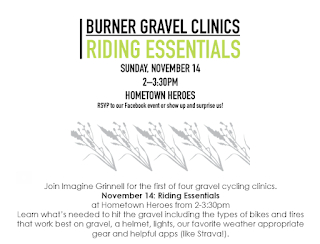
You can see all the pertinent info in my image here, but if you want to know more you can contact Imagine Grinnell through there website here, or head to Prairie Burn 100's Face Book page linked above. 
WTB Debuts The Vulpine 700 X 36mm Tire:

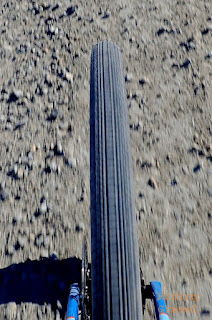
This past Tuesday WTB announced the newest tire for gravel in their range, the Vulpine. I was a bit surprised that this tire was only offered in the one size to start out with, (Hoping that wider sizes come out later), but hey! I am happy too, because I had been pushing for a gravel Vulpine in TCS (tubeless ready) for years. 

So, way back when the Fargo Gen I was introduced, it came with Vulpine 29" X 2.1" tires. The Vulpine back then was not a tubeless tire. It also had a LOT lower tread pattern down the middle as it was a semi-slick XC racing tire to begin with. Those types of tires were falling out of favor in 2008 after about ten years or so of prominence. 

Anyway, I ended up loving the Vulpine on gravel. At the time, tubeless tires were just getting a footing in the MTB market and anything coming out after 2010 for MTB was generally also released as a tubeless ready tire. But WTB was phasing out the older designs they had then, and the Vulpine was shelved. 

So, when WTB introduced the Nano 40 in TCS around 2016, I was on the warpath with WTB to get the Vulpine out again in the TCS format for gravel usage. Their former brand manager, Will Ritchie, knew all too well what I would say anytime talk of new gravel tires came up. "Make the Vulpine again!", I would say, and he'd always graciously reply that he was putting in my requests, but that was all he could really do to make it happen. Ultimately it was up to higher powers at WTB to pull that lever that would release a new Vulpine to the masses. 

Will even sent me the very last Vulpine 29"er tire WTB had in its warehouse. A survivor that had escaped notice until it surfaced one day and Will grabbed it and sent it off to me as a way to say that he had not let my requests fall upon deaf ears. I really and truly appreciated that gesture, and I still do to this day. 

For more on the new Vulpine read my RidingGravel.com post here.
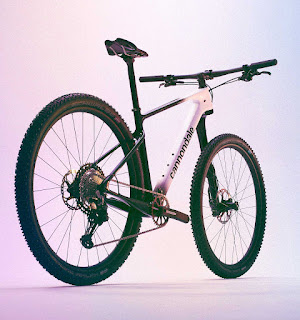
Cannondale's Scalpel HT. Image courtesy of Cannondale.

Cannondale Debuts New Scapel HT XC Racing Bike:

It isn't often that I write about mountain bikes anymore. That is because most mountain bike news these days has been centered around "Enduro" or motorized bikes, or both things together. None of which is relevant to me at all. 

So, when something gets announced that I could see myself riding, I get my ears pricked up. Such was the case Tuesday of this week when Cannondale announced its new, range-topping hard tail XC racing bike, the Scalpel HT

It features a pretty slack head angle of 66.5° which is fairly radical when I think back ten years ago or more in terms of hard tail mountain bikes. I remember when anything slacker than 71° for a 29"er was considered "a wheel barrow" in terms of handling. But now? Pfft! Par for the course to have a choppered out front end on a hard tail. 

And seat angles have steepened up to 74° or so on several bikes. That's just super-weird to me, but hey! The kidz love it. What do I know? Maybe this Scalpel would rule on Iowa single track? Maybe...

I've ridden MTB's with pretty slack head angles on our single track and I found that you kind of have to steer them off the back wheel. Older, steeper bikes you could pin the front wheel down on and rail a corner, maybe even drifting the rear end around. It's just a very different way of doing things now with these slacker head angled bikes, in my opinion. One way isn't necessarily better than another. But maybe when it comes to short, steep climbs? Maybe there I prefer the older geometry which doesn't have all that wandering front wheel flop thing going on. Anyway....

An interesting twist to the traditional XC racing hard tail at least. 

A Guitar Ted Blast From The Past:

I was reminded the other day of an interview I did with "CX Mag" concerning the state of all things gravel. This was conducted in 2018, right at the end of my run with Trans Iowa, so I couldn't let on at the time that 2018's version of the event was my last. Anyway...

Here's the link.

From time to time I think I'll share old stories and tales from other sources where I was interviewed or that I had something to do with. I sometimes forget my own history with all things bicycle related and it maybe would be good for me to remind y'all of those things. Plus, you'll probably enjoy these looks back anyway if you read this blog. 

Okay, so that's a wrap on this week! Got snow coming? It's just around the corner, I think. Get out and ride if you can and have a great weekend.

Friday News And Views

 Gravel Riding Clinics To Be Held In Grinnell:

Several years ago I started up an idea to hold a clinic to help those wondering about Trans Iowa, and gravel riding in general. We held it in Des Moines, and at that time, there was an outcry for information to the extent that I was being asked to YouTube the event for consumption after the event was over. I just did not have the resources or emotional energy for such a project on top of everything else I had going on back in 2013.

I have helped with a gravel clinic series here in Waterloo which we called the Iowa Gravel Expo and Bike Party. N.Y. Roll and I put these series of events on locally from 2018-2020. Again, judging from attendance from all corners of the state I knew that this was a viable idea for the gravel-curious. 

So, it comes as no surprise to me that Grinnell's Prairie Burn 100 event directors and Imagine Grinnell have teamed up to put on the "Burner Gravel Clinics". (Note-Link takes you to the Prairie Burn 100's Face Book page) 

You can see all the pertinent info in my image here, but if you want to know more you can contact Imagine Grinnell through there website here, or head to Prairie Burn 100's Face Book page linked above. 

WTB Debuts The Vulpine 700 X 36mm Tire:

This past Tuesday WTB announced the newest tire for gravel in their range, the Vulpine. I was a bit surprised that this tire was only offered in the one size to start out with, (Hoping that wider sizes come out later), but hey! I am happy too, because I had been pushing for a gravel Vulpine in TCS (tubeless ready) for years. 

So, way back when the Fargo Gen I was introduced, it came with Vulpine 29" X 2.1" tires. The Vulpine back then was not a tubeless tire. It also had a LOT lower tread pattern down the middle as it was a semi-slick XC racing tire to begin with. Those types of tires were falling out of favor in 2008 after about ten years or so of prominence. 

Anyway, I ended up loving the Vulpine on gravel. At the time, tubeless tires were just getting a footing in the MTB market and anything coming out after 2010 for MTB was generally also released as a tubeless ready tire. But WTB was phasing out the older designs they had then, and the Vulpine was shelved. 

So, when WTB introduced the Nano 40 in TCS around 2016, I was on the warpath with WTB to get the Vulpine out again in the TCS format for gravel usage. Their former brand manager, Will Ritchie, knew all too well what I would say anytime talk of new gravel tires came up. "Make the Vulpine again!", I would say, and he'd always graciously reply that he was putting in my requests, but that was all he could really do to make it happen. Ultimately it was up to higher powers at WTB to pull that lever that would release a new Vulpine to the masses. 

Will even sent me the very last Vulpine 29"er tire WTB had in its warehouse. A survivor that had escaped notice until it surfaced one day and Will grabbed it and sent it off to me as a way to say that he had not let my requests fall upon deaf ears. I really and truly appreciated that gesture, and I still do to this day. 

For more on the new Vulpine read my RidingGravel.com post here.

Cannondale's Scalpel HT. Image courtesy of Cannondale.

Cannondale Debuts New Scapel HT XC Racing Bike:

It isn't often that I write about mountain bikes anymore. That is because most mountain bike news these days has been centered around "Enduro" or motorized bikes, or both things together. None of which is relevant to me at all. 

So, when something gets announced that I could see myself riding, I get my ears pricked up. Such was the case Tuesday of this week when Cannondale announced its new, range-topping hard tail XC racing bike, the Scalpel HT

It features a pretty slack head angle of 66.5° which is fairly radical when I think back ten years ago or more in terms of hard tail mountain bikes. I remember when anything slacker than 71° for a 29"er was considered "a wheel barrow" in terms of handling. But now? Pfft! Par for the course to have a choppered out front end on a hard tail. 

And seat angles have steepened up to 74° or so on several bikes. That's just super-weird to me, but hey! The kidz love it. What do I know? Maybe this Scalpel would rule on Iowa single track? Maybe...

I've ridden MTB's with pretty slack head angles on our single track and I found that you kind of have to steer them off the back wheel. Older, steeper bikes you could pin the front wheel down on and rail a corner, maybe even drifting the rear end around. It's just a very different way of doing things now with these slacker head angled bikes, in my opinion. One way isn't necessarily better than another. But maybe when it comes to short, steep climbs? Maybe there I prefer the older geometry which doesn't have all that wandering front wheel flop thing going on. Anyway....

An interesting twist to the traditional XC racing hard tail at least. 

A Guitar Ted Blast From The Past:

I was reminded the other day of an interview I did with "CX Mag" concerning the state of all things gravel. This was conducted in 2018, right at the end of my run with Trans Iowa, so I couldn't let on at the time that 2018's version of the event was my last. Anyway...

Here's the link.

From time to time I think I'll share old stories and tales from other sources where I was interviewed or that I had something to do with. I sometimes forget my own history with all things bicycle related and it maybe would be good for me to remind y'all of those things. Plus, you'll probably enjoy these looks back anyway if you read this blog. 

Okay, so that's a wrap on this week! Got snow coming? It's just around the corner, I think. Get out and ride if you can and have a great weekend.

Friday, September 06, 2019

Friday News And Views

Big Numbers For Series On Trans Iowa:

First of all- Thank You readers! The suggestion to write the stories of Trans Iowa, the more "untold", behind-the-scenes the better, has been a fun thing for me to do. But more importantly, the series has been gaining traction and of late, has become some of the most looked at posts on this blog.

Look- I've blathered on about that event for the better part of 15 years, so I get it if you are one of those that just doesn't care about this stuff. However; it would appear from the stats I get from Google that many of you are actually looking at these posts, and I hope, enjoying them. I just wanted to point this out because it is encouraging to me and helps to push me to write better content.

So, I thought I might share a little bit about the behind-the-scenes on the series. First of all, I write these posts on the "Trans Iowa Stories" series weeks in advance. For example, I am already working on posts for the series that will show up in October. This gives me the chance to revisit each draft and revise, make corrections, or add any newly discovered memories before they "go live" on the site, at which point I don't plan on changing anything.

This also gives me chances to sift through the 15 years of posts that have bits of the story buried in there. I also have been looking at hard physical evidence- roster sheets, drafts of courses, and more that I have squirreled away in folders and three ring binders here. So, it's been fun, and I am enjoying the process, and I hope that it all results in good reads for you.

Thanks again!

Trek Supercaliber w/IsoStrut. Image pinched from Trek's site
 Could It Work On A Gravel Bike?

Design Mission Statement: Make a rear suspension design that is compact, lightweight, pedal efficient, and is "just enough to knock the edges off". This has been an idea that has been tackled by several designers and is an idea that is as old as the Safety Bicycle itself. Many have tried, some have succeeded, but not many have been reasonably priced, effective, and low enough maintenance to prove to be a long term solution.

Of course, we are talking about the "short travel", soft-tail idea. Moots YBB is probably the longest production version of this idea in existence. However, it is crude, not easily tune-able, and is maintenance intensive in dirty environments. Salsa Cycles had the Dos Niner, a fantastic design fraught with breakage due to the flexing Scandium infused aluminum alloy frame bits the design relied upon. Passive versions of this idea exist. Example- Like the aforementioned Salsa Cycles, who now make the Class V VRS system for the Warbird and Cutthroat. However, that passive suspension idea, while fairly bulletproof, is not at all tune-able. This brings us to Trek's latest announcement of the new Supercaliber MTB racing bike.

The Trek design is very much like the Salsa Dos Niner, which also used a strut and relied on flexing stays for its suspension travel. However; Trek's design moves the damper to become part of the top tube, and they employed carbon fiber as a flexing frame material instead of Scandium Aluminum. The Supercaliber has 60mm of rear travel, by the way.

Passive designs, like those being used on gravel bikes these days, all rely on the rider to be seated to work, but a soft-tail design does not, and it makes one wonder- Could something like this be a good thing on a gravel/all-road bike? (I was just thinking- "gravel/all road bike >>>G-ARB?) Anyway....

It's an intriguing thought, and you can bet Trek's in house R&D team have already been toying with just such an idea.

These are NOT looking like motorcycles. Nope! Not in the least....
Eurobike To Be Re-Named "E-eurobike"

Reports coming in from Eurobike are that the "electrification" of bicycles is reaching all-time highs. Euro-folk, apparently, are mad for anything with two wheels and a motor. Now the move is to make these rigs "more connected" and more powerful than ever.

Take this Trifecta RDR bike, shown to the left here. It's 74lbs of futuristic electrified power. It has the options of either 250w, 500w, or 950w power (!!!) and is said to be capable of covering 200K before needing a re-charge. The motor spits out a torque rating of 120Nm. (That's a LOT, by the way. 88.51Ft/lbs of torque on tap, or about 2HP @120rpm)

That's just one example of many. But here's the thing many are not thinking about now. What about all those lithium/ion batteries? What happens when they die? Where do those go? How many chains and chain rings will all this unnaturally created torque eat up? How many more wheels? Freehubs?

The PBMA (Professional Bicycle Mechanics Association) has a forum and you can read about how these HPC's are eating up components at an alarming rate, how these vehicles have to be hooked up to computers and analyzed, like your cars, and how riders, unskilled in shifting and braking techniques, are wreaking havoc on components built for purely human powered bicycles adapted to HPC use to keep weights down.

Eurobike is touting the windfall of profits these vehicles are bringing companies and dealers, but is anyone seeing how we are making bicycling more complex, less inclusive, less environmentally good, and less like.....bicycling? You will retort, "Yeah, but one less car!", or something akin to how your brother's cousin is now enjoying "bicycling" again due to the electrification of cycling. But I say, do we really know that all these HPC's are doing good things like that? My answer to that is- no-we do not. These are platitudes that make us feel better about this move towards complex two wheeled, motorized vehicles. These are things that "sound good" but we have no real metrics we can point to and say these "good things" are actually happening at any real, hugely impactful numbers. All we do know is that a metric ton of these things, full of wires, capacitors, resistors, magnets, and batteries, are being produced and where will they all end up?

Well, if Eurobike is any indication, people will get jaded by the idea of riding outside at all and take up indoor training on virtual bicycle courses, never to be seen in public again on a two wheeled vehicle. That's the other huge trend at the show this year. Indoor cycling.

Okay, that's z'nuff for this week. Have a great weekend and keep on riding!

Friday News And Views

Big Numbers For Series On Trans Iowa:

First of all- Thank You readers! The suggestion to write the stories of Trans Iowa, the more "untold", behind-the-scenes the better, has been a fun thing for me to do. But more importantly, the series has been gaining traction and of late, has become some of the most looked at posts on this blog.

Look- I've blathered on about that event for the better part of 15 years, so I get it if you are one of those that just doesn't care about this stuff. However; it would appear from the stats I get from Google that many of you are actually looking at these posts, and I hope, enjoying them. I just wanted to point this out because it is encouraging to me and helps to push me to write better content.

So, I thought I might share a little bit about the behind-the-scenes on the series. First of all, I write these posts on the "Trans Iowa Stories" series weeks in advance. For example, I am already working on posts for the series that will show up in October. This gives me the chance to revisit each draft and revise, make corrections, or add any newly discovered memories before they "go live" on the site, at which point I don't plan on changing anything.

This also gives me chances to sift through the 15 years of posts that have bits of the story buried in there. I also have been looking at hard physical evidence- roster sheets, drafts of courses, and more that I have squirreled away in folders and three ring binders here. So, it's been fun, and I am enjoying the process, and I hope that it all results in good reads for you.

Thanks again!

Trek Supercaliber w/IsoStrut. Image pinched from Trek's site
 Could It Work On A Gravel Bike?

Design Mission Statement: Make a rear suspension design that is compact, lightweight, pedal efficient, and is "just enough to knock the edges off". This has been an idea that has been tackled by several designers and is an idea that is as old as the Safety Bicycle itself. Many have tried, some have succeeded, but not many have been reasonably priced, effective, and low enough maintenance to prove to be a long term solution.

Of course, we are talking about the "short travel", soft-tail idea. Moots YBB is probably the longest production version of this idea in existence. However, it is crude, not easily tune-able, and is maintenance intensive in dirty environments. Salsa Cycles had the Dos Niner, a fantastic design fraught with breakage due to the flexing Scandium infused aluminum alloy frame bits the design relied upon. Passive versions of this idea exist. Example- Like the aforementioned Salsa Cycles, who now make the Class V VRS system for the Warbird and Cutthroat. However, that passive suspension idea, while fairly bulletproof, is not at all tune-able. This brings us to Trek's latest announcement of the new Supercaliber MTB racing bike.

The Trek design is very much like the Salsa Dos Niner, which also used a strut and relied on flexing stays for its suspension travel. However; Trek's design moves the damper to become part of the top tube, and they employed carbon fiber as a flexing frame material instead of Scandium Aluminum. The Supercaliber has 60mm of rear travel, by the way.

Passive designs, like those being used on gravel bikes these days, all rely on the rider to be seated to work, but a soft-tail design does not, and it makes one wonder- Could something like this be a good thing on a gravel/all-road bike? (I was just thinking- "gravel/all road bike >>>G-ARB?) Anyway....

It's an intriguing thought, and you can bet Trek's in house R&D team have already been toying with just such an idea.

These are NOT looking like motorcycles. Nope! Not in the least....
Eurobike To Be Re-Named "E-eurobike"

Reports coming in from Eurobike are that the "electrification" of bicycles is reaching all-time highs. Euro-folk, apparently, are mad for anything with two wheels and a motor. Now the move is to make these rigs "more connected" and more powerful than ever.

Take this Trifecta RDR bike, shown to the left here. It's 74lbs of futuristic electrified power. It has the options of either 250w, 500w, or 950w power (!!!) and is said to be capable of covering 200K before needing a re-charge. The motor spits out a torque rating of 120Nm. (That's a LOT, by the way. 88.51Ft/lbs of torque on tap, or about 2HP @120rpm)

That's just one example of many. But here's the thing many are not thinking about now. What about all those lithium/ion batteries? What happens when they die? Where do those go? How many chains and chain rings will all this unnaturally created torque eat up? How many more wheels? Freehubs?

The PBMA (Professional Bicycle Mechanics Association) has a forum and you can read about how these HPC's are eating up components at an alarming rate, how these vehicles have to be hooked up to computers and analyzed, like your cars, and how riders, unskilled in shifting and braking techniques, are wreaking havoc on components built for purely human powered bicycles adapted to HPC use to keep weights down.

Eurobike is touting the windfall of profits these vehicles are bringing companies and dealers, but is anyone seeing how we are making bicycling more complex, less inclusive, less environmentally good, and less like.....bicycling? You will retort, "Yeah, but one less car!", or something akin to how your brother's cousin is now enjoying "bicycling" again due to the electrification of cycling. But I say, do we really know that all these HPC's are doing good things like that? My answer to that is- no-we do not. These are platitudes that make us feel better about this move towards complex two wheeled, motorized vehicles. These are things that "sound good" but we have no real metrics we can point to and say these "good things" are actually happening at any real, hugely impactful numbers. All we do know is that a metric ton of these things, full of wires, capacitors, resistors, magnets, and batteries, are being produced and where will they all end up?

Well, if Eurobike is any indication, people will get jaded by the idea of riding outside at all and take up indoor training on virtual bicycle courses, never to be seen in public again on a two wheeled vehicle. That's the other huge trend at the show this year. Indoor cycling.

Okay, that's z'nuff for this week. Have a great weekend and keep on riding!

Friday, August 16, 2013

Friday News And Views

Night time gravel grindin'!
Gravel Adventures In The Dark:

I'm not sure why, but it seems that with the onset of Fall, the night time gavel events kick in. I know of three that are coming up, and I've done one or two in the past. These rides/races are a blast. Riding gravel roads at night is just a wholly different experience. I'd recommend it for sure.

You can check out all the details on the Gravel Grinder News calendar of events here. But here are the three I am aware of now.
You'll need a quality light that has at least 120-150 lumens, and a good tail light. That light should last long enough to get you through a metric century, (63-65 miles), and it should have a good beam pattern. Not too spotty. Look for a helmet light with a spot beam for navigation. An LED torch would do for that job.

This may be THE light, or not....
Speaking of Lights:

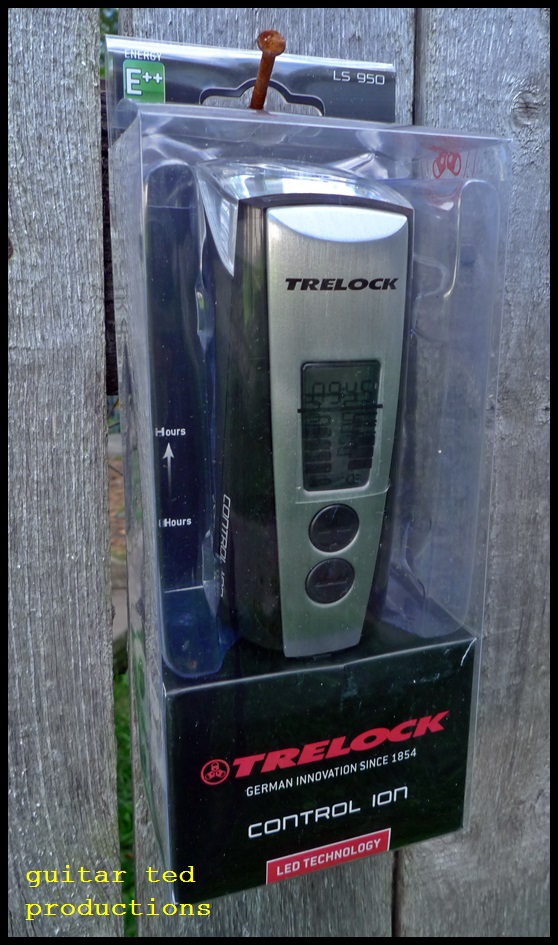
I am checking out this Trelock LS 950 Control Ion Bike Light for Twenty Nine Inches and Gravel Grinder News. It claims to be a very bright light with astounding run times. Like up to 45 hours on low, and six hours at the highest level. In between there are three other steps with run times from over 8 hours to 19 hours. 

The light uses an element that is reflected and therefore doesn't really need to use some blazingly hot LED array to be bright and this obviously makes it more efficient. I like the self contained, USB charger design, and it isn't too big or bulky, but don't get me wrong, it isn't as tiny as some of the LED high powered stuff I've seen. 

It's got a cool backlit LED read out that gives you a running countdown on light left in minutes. I don't know if the clock is accurate to actual energy left on tap, or if it isn't just a simple backwards counting clock set to approximates. That I will have to see during testing. If nothing else, it is a good ride timer! The unit looks well made, as you might expect a German made product to be, and has a swiveling mounting system so you can aim this where you want it to, which I find especially nice on swept back handle bars, or for mounting the light off the center line of the bike.  

I've only had it out briefly, once on city streets, and it throws a beam pattern down the road well enough. I'll be talking more about this soon. Stay tuned..... (Note: The light was sent for test and review to TNI and GGN at no charge. I am not being bribed, nor paid for saying anything about this product. I always strive to tell you my honest thoughts and opinions throughout.

Portland Design Works "Aether Demon"
On the tail light front, a coworker of mine showed me a Portland Design Works "Aether Demon" tail light that I was rather impressed with. It also charges up via a USB cord, but I thought it was well made, light in weight, and it has a nice set of modes that may appeal to some. 

Probably as bright as anyone would really need, the Aether Demon has two useful modes and two more that might be of interest. The two I liked were dubbed "Dance" and "Breathe". Dance is your typical blinky on steroids pattern, nicely annoying. The Breathe mode is a great, softly glowing to full brightness and back to dark again mode that I thought was cool. Think "radio tower" light and you may know what I mean.  Both these modes go a claimed 8 hours. The next two modes were things I'd likely never use, but you might like these. A low powered blinky pattern for group rides that lasts 175 hours, (claimed), or a solid red tail light that goes for up to 3.5 hours. 

Not a bad choice at a MSRP of $49.99, I'd say. If the dang thing holds up for my co-worker, (yes- he is the guinea pig!), I may try one out as well.  Note: I have only held the "little devil" and checked it out briefly. It may suck or it may be the greatest tail light ever, but all I know is that it looks well made and seems like a good deal on the surface of it. I'll chime back in if and when I learn more, or if I decide to pop for one of these things. 

Question: "If I mount an Aether Demon to my seat bag, will I ride like the hounds of Hell are chasing me?" Could be a good motivator!

3GR: Although there is a mountain bike race going on in Geo Wyth this weekend, I will be out doing my usual grind on gravel, as I don't XC race. (Retired in '97) Those that go to that XC event should have a great time, but if you aren't so inclined, I'll be at the Gates Swimming Pool lot at 8:30am once again. 

Friday News And Views

Night time gravel grindin'!
Gravel Adventures In The Dark:

I'm not sure why, but it seems that with the onset of Fall, the night time gavel events kick in. I know of three that are coming up, and I've done one or two in the past. These rides/races are a blast. Riding gravel roads at night is just a wholly different experience. I'd recommend it for sure.

You can check out all the details on the Gravel Grinder News calendar of events here. But here are the three I am aware of now.
You'll need a quality light that has at least 120-150 lumens, and a good tail light. That light should last long enough to get you through a metric century, (63-65 miles), and it should have a good beam pattern. Not too spotty. Look for a helmet light with a spot beam for navigation. An LED torch would do for that job.

This may be THE light, or not....
Speaking of Lights:

I am checking out this Trelock LS 950 Control Ion Bike Light for Twenty Nine Inches and Gravel Grinder News. It claims to be a very bright light with astounding run times. Like up to 45 hours on low, and six hours at the highest level. In between there are three other steps with run times from over 8 hours to 19 hours. 

The light uses an element that is reflected and therefore doesn't really need to use some blazingly hot LED array to be bright and this obviously makes it more efficient. I like the self contained, USB charger design, and it isn't too big or bulky, but don't get me wrong, it isn't as tiny as some of the LED high powered stuff I've seen. 

It's got a cool backlit LED read out that gives you a running countdown on light left in minutes. I don't know if the clock is accurate to actual energy left on tap, or if it isn't just a simple backwards counting clock set to approximates. That I will have to see during testing. If nothing else, it is a good ride timer! The unit looks well made, as you might expect a German made product to be, and has a swiveling mounting system so you can aim this where you want it to, which I find especially nice on swept back handle bars, or for mounting the light off the center line of the bike.  

I've only had it out briefly, once on city streets, and it throws a beam pattern down the road well enough. I'll be talking more about this soon. Stay tuned..... (Note: The light was sent for test and review to TNI and GGN at no charge. I am not being bribed, nor paid for saying anything about this product. I always strive to tell you my honest thoughts and opinions throughout.

Portland Design Works "Aether Demon"
On the tail light front, a coworker of mine showed me a Portland Design Works "Aether Demon" tail light that I was rather impressed with. It also charges up via a USB cord, but I thought it was well made, light in weight, and it has a nice set of modes that may appeal to some. 

Probably as bright as anyone would really need, the Aether Demon has two useful modes and two more that might be of interest. The two I liked were dubbed "Dance" and "Breathe". Dance is your typical blinky on steroids pattern, nicely annoying. The Breathe mode is a great, softly glowing to full brightness and back to dark again mode that I thought was cool. Think "radio tower" light and you may know what I mean.  Both these modes go a claimed 8 hours. The next two modes were things I'd likely never use, but you might like these. A low powered blinky pattern for group rides that lasts 175 hours, (claimed), or a solid red tail light that goes for up to 3.5 hours. 

Not a bad choice at a MSRP of $49.99, I'd say. If the dang thing holds up for my co-worker, (yes- he is the guinea pig!), I may try one out as well.  Note: I have only held the "little devil" and checked it out briefly. It may suck or it may be the greatest tail light ever, but all I know is that it looks well made and seems like a good deal on the surface of it. I'll chime back in if and when I learn more, or if I decide to pop for one of these things. 

Question: "If I mount an Aether Demon to my seat bag, will I ride like the hounds of Hell are chasing me?" Could be a good motivator!

3GR: Although there is a mountain bike race going on in Geo Wyth this weekend, I will be out doing my usual grind on gravel, as I don't XC race. (Retired in '97) Those that go to that XC event should have a great time, but if you aren't so inclined, I'll be at the Gates Swimming Pool lot at 8:30am once again. 

Tuesday, July 01, 2008

Big Time XC Racers To Go 29"er?

The day was coming and it finally happened. A 29"er has won a major elite men's XC race. You can check out the report here. This won't be the last time this happens either.

The thing about 29"ers and elite XC racers is really all down to one little objection: Wheel weight. You will notice that the majority of elite racers that do use 29"ers, (admittedly, most are Subaru/Gary Fisher riders) use sub 2 inch wide rubber to help keep the rotational weight to a minimum. Of course, the wheels themselves are also very light weight works of art in them selves. Ryan Trebon's race winning set weighed 1350 grams complete with tubeless tape and valves.

This is just the beginning, as I said, though. There are newer developments on the cusp of being used in racing that will transform the 29"er from the odd ball choice in elite XC to a commonly seen sight underneath the fastest pros. Some of these new developments are radical.

Things like tubular mountain bike tires and wheels will become much more common place, and are being used now. For 29"ers, this will help relieve the rim from some of its weight. Another development that will change both 26"er and 29"er racing is the carbon fiber rim. It's been coming, and even I have laced up a couple examples in the past. The new versions will be very light, but extremely strong and will overtake the ranks of pro XC racing in a hurry once they become available. Especially when the carbon fiber tubular mountain bike rims I saw become available.

All of these things will affect choices made by the pros. No longer will wheel weight become the deciding factor against using a 29"er in competition. Courses will dictate what gets used and every pro will start to demand that their sponsors have a race level 29"er in the stable for their use. Not right away, mind you. This is an Olympic year, and many riders will be loathe to switch up components or wheel sizes before such an important event. However: that said, it wouldn't surprise me one bit to see one of the pros pull a 29"er out and use it come race day at the Olympics. After the Olympics is when I expect we'll really notice some equipment choice changes.

Big Time XC Racers To Go 29"er?

The day was coming and it finally happened. A 29"er has won a major elite men's XC race. You can check out the report here. This won't be the last time this happens either.

The thing about 29"ers and elite XC racers is really all down to one little objection: Wheel weight. You will notice that the majority of elite racers that do use 29"ers, (admittedly, most are Subaru/Gary Fisher riders) use sub 2 inch wide rubber to help keep the rotational weight to a minimum. Of course, the wheels themselves are also very light weight works of art in them selves. Ryan Trebon's race winning set weighed 1350 grams complete with tubeless tape and valves.

This is just the beginning, as I said, though. There are newer developments on the cusp of being used in racing that will transform the 29"er from the odd ball choice in elite XC to a commonly seen sight underneath the fastest pros. Some of these new developments are radical.

Things like tubular mountain bike tires and wheels will become much more common place, and are being used now. For 29"ers, this will help relieve the rim from some of its weight. Another development that will change both 26"er and 29"er racing is the carbon fiber rim. It's been coming, and even I have laced up a couple examples in the past. The new versions will be very light, but extremely strong and will overtake the ranks of pro XC racing in a hurry once they become available. Especially when the carbon fiber tubular mountain bike rims I saw become available.

All of these things will affect choices made by the pros. No longer will wheel weight become the deciding factor against using a 29"er in competition. Courses will dictate what gets used and every pro will start to demand that their sponsors have a race level 29"er in the stable for their use. Not right away, mind you. This is an Olympic year, and many riders will be loathe to switch up components or wheel sizes before such an important event. However: that said, it wouldn't surprise me one bit to see one of the pros pull a 29"er out and use it come race day at the Olympics. After the Olympics is when I expect we'll really notice some equipment choice changes.