Showing posts with label gravel roads. Show all posts

Friday, March 29, 2024

Friday News And Views

 Cost Of Crushed Rock At Historically High Levels:

Crushed rock, or more commonly known as gravel, is getting expensive. A recent story by kchanews.com, a radio station in Floyd County, Iowa, claims that Floyd County will pay an estimated 1.5 million or more in 2024 for crushed rock for their gravel road maintenance. 

The price per ton two years ago was $13.88 and the price today has risen to $15.28 per ton, the highest amount the county has ever paid for rock for their gravel roads. 

Comments: Obviously a lot of things have increased in price, but I feel as though there are some things we can point to which have caused counties to have to maintain the roads more often than in the past. 

One thing is the drought. Dry conditions seem to cause the gravel to break down more quickly, but I could be wrong about that. It just seems that way to me. Secondly, heavier agricultural equipment and the widespread use of semi tractor-trailers for grain transportation have wreaked havoc on the roads. Finally, Winter plowing grinds off gravel and pushes it into ditches. In years past such aggressive snow removal tactics were not employed. 

All this means now is that taxes extracted from residents will be stretched to cover higher priced materials to maintain the public roads. Paved roads cost even more, so paving everything is not the answer. In my opinion, farmers need to bear more of the responsibility for what their equipment does to roads. 

Image courtesy of Hayes/Manitou

Manitou Throws It Back To The 90's:

Manitou, who were there at the beginning of the suspension revelotion in mountain bikes, has announced a special edition Mattoc Pro fork all done up to look like Manitou's famous elastomeric suspension fork from the early 1990's. 

Those early Manitou forks were black and silver with a reputation for being rather flexy and having nearly no damping characteristics at all. but then again, most early suspension fork efforts were pretty dismal compared to the wild technology we have today. 

At about $1100.00, it is not cheap, but it surely is about 1100 times better than the original the fork is made to look like. 

Manitou doesn't get the "love" these days like Fox and Rock Shox, but they do make nice things which I think more folks should be taking a look at. Take this Mattoc Pro, for instance. It comes out of the box set at 140m of travel, but any user can adjust that at home with a simple procedure to go anywhere from 110mm to 150mm of travel making this 1750 gram fork versatile from XC to light enduro riding. 
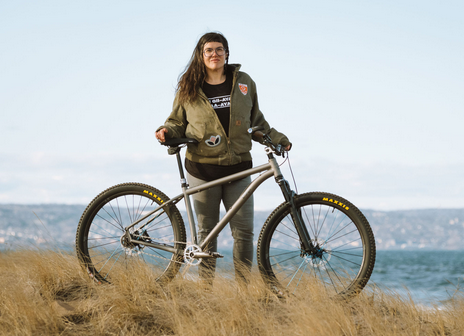
Image courtesy of Esker Cycles
Houchin To Ride Esker Ti Japhy For 2024:

Ultra-distance athlete and single speeder Alexandera Houchin was announced as a sponsored rider by Esker Cycles this week. 

Houchin rides single speed a lot, but will also be using geared and possibly full-suspension bikes from Esker Cycles range in the future, according to a statement in the press release. 

Houchin is a well known and accomplished rider in the off-road ultra-distance field. She has set, or holds several records including the fastest single speed ride for Women and first woman overall at the 2019 Tour Divide, a record setting and winning ride in the Women's category at the Colorado Trail Race, plus many more wins and records. Alexandera has logged an incredible 6 consecutive Colorado Trail starts and finishes. Along with 3 consecutive Arizona Trail Race 800 starts and finishes. 

The Guitar Ted Podcast Episode #42: The Mid-South Review

I know many of you already waded through my written version of things concerning the Mid-South,
and if you did read that report, thank you

But if you are game for more, or would rather listen to two old dudes gab, the podcast version can be accessed HERE or wherever you get your podcasts from these days. 

There is a bit more content here concerning riding bandit, as well as some banter about the "fast folk" doing things that could be seen as unfair. 

Plus we do a Gravel Amplifier on two events also. What's that? Oh....well it is my opinion that mainstream cycling media thinks there are only Pro level gravel events. I don't adhere to that take, so N.Y. Roll and I search out smaller, affordably priced gravel events in places we think a lot of people would find interesting. We talk about that instead of hyping all the European and North American events the pro riders are doing. They get enough amplification.

Also, I'll throw it out here that we are always looking for events to bring to our audience's attention, so if you have any gravel events you think should get some run on "The Guitar Ted Podcast" then you can send me the information to: g.ted.productions@gmail.com

Image courtesy of Race Face

Race Face Introduces ERA Carbon MTB Wheels:

Race Face introduced a new mountain bike wheel set yesterday called ERA. This is an all-new wheel with Race Face's Vault hubs and a 30mm internal rim width. The wheels are available in 29" or 27.5" sizes.

The big deal with these rims on the ERA wheel set is the compliance Race Face has tried to engineer into the wheels. Race Face believes that vertical compliance is a good thing, but that lateral compliance is also key to a successful ride off-road.

They point to how a rigid wheel with no give laterally will "ping" you off rocks and trail obstacles, knocking you off-line and causing handling to go out the window. The ERA wheels are designed to absorb some of that energy that would otherwise be sending you in a new direction.

Will it work? That's the big question here, but you have to give it to Race Face for trying. You can find out for yourself by ponying up $1599.00USD. 

That's a wrap on this week's news and views. Have a great weekend and thanks for reading the Guitar Ted Productions blog!!

Tuesday, January 30, 2024

Grey Skies, Mushy Roads

From the Black Hawk County Engineers Office Face Book page.
All last week the temperatures hovered between 34° and 38°F with little variance day or night. Add in about 36 hours of rain and the nearly 30" of snow on the ground began to melt at a very rapid rate.

Most curiously, the ground, which wasn't frozen prior to these snows, remained unfrozen, so the snow is essentially sinking into the ground. Usually the scene would be that of a ton of run-off, but that happens only if the moisture cannot be absorbed into the ground. 

This week is forecast to be a little warmer, but fog continues to be an issue and clouds are not going 100% away. Hopefully we get some Sun. It's actually all good since we've had a bad drought for two years. But, it sucks for the gravel roads, which have turned into a mushy, dirty mess. 

In fact, as you can see from my snip from the Black Hawk County Engineers Office a& Secondary Roads Facebook page, heavy traffic is being discouraged at this time. I expect this situation to continue throughout this week until most of the snow is gone and only drifts remain. 

This also will - most likely - probably mean that the roads will be pretty torn up to start the gravel riding season. This hasn't happened for several years. I look for lots of rutting and mud coming through the base of the roads in several places. We won't likely have frost boils, but maybe.... Maybe a few. I don't see that being a big deal this Spring.

Scenes like this from 2017 are expected again this Spring.

Of course, we have no idea if Spring will be wet or dry or what. This will also factor into what we see this year to start out with on the gravel roads. But as I said, rutting and some forms of damage are quite likely no matter what. 

That'll be a big change over the last three or four years. Those were the years where we started out with dry roads and they only got dustier with a ton of fresh gravel being applied. That only served to accumulate gravel. That gravel never got pushed into the base of the roadway to form those familiar "three-track" smoother lines we gravel riders crave around here.That made riding harder and less fun. 

We'll see how it goes, but I don't see myself getting out until this weather gets either warmer, Sunnier, or windier. Maybe it'll take all three things to straighten up the gravel roads.

Tuesday, October 31, 2023

Gravel Comes Back To The Tour

It won't be as challenging as Iowa gravel, but crushed rock roads are back in Le Tour.
The pinnacle of Professional road racing on bicycles is certainly the Tour de France. No other Pro road event approaches the scrutiny, passion, and importance to riders and sponsors that this event has over the decades. 

So, when the 2024 Tour de France route was unveiled to a well-heeled, high fashion wearing crowd of Pro cyclists and media there was a lot of attention placed upon one stage in particular. That would be stage #9. A stage that has a high dosage of white crushed rock,

Now, I want to put this into perspective here. Stage 9's length overall is 123+ miles or 199Km. Out of that there will be 14 separate gravel sectors that will total all of approximately 20 miles. Breaking that down, that's an average sector length of a little more than 1.4 miles at a crack. These short gravel sectors will be sprinkled throughout the last 3/4's of the event with none occurring until after 30 miles into the stage. 

So, nothing like what we think of as "gravel racing". But for these pros, the mixing in of narrow, Champagne department French rural farm roads is raising some valid concerns and technical challenges. 

I've seen images of the actual roads that will be used and they are maybe wide enough for a farm tractor of average size. You could get a Ford F-150 down these, but there is essentially no room for an oncoming truck to get by you. These roads are ancient cart roads that were made long before there were cars and trucks. 

The gravel looks to be of a finer gauge than that used here in the Mid-West and in the images I've seen, two clear tracks existed where vehicles have pushed the larger crushed rock aside, essentially making these roads quite attractive to the average gravel cyclist in the Mid-West here. They look nothing like the carpet of chunky crushed limestone I am familiar with, that's for sure!

So, that's my take on the technical aspects of the roads there. Now what this really points to is how the UCI is using this to bring more awareness to its own Gravel World Series and how this is certainly a marketing move to show that the UCI is indeed aware of its history and the importance of gravel cycling today. How the UCI parlays that into more beneficial aspects of events promotions for themselves will be seen later, I am sure. But make no mistake, gravel appearing in the Tour was not done to be cute.

Saturday, April 24, 2021

Where These Roads Came From

Just a line scratched out on the prairie....
Perhaps you might remember how I came across a book recently that I'd been trying to track down. It tells about how the paths and trails in this particular area became the roads- in many cases, but not all- of today. I was out riding this past week on that familiar stretch of dirt called Petrie Road and I was suddenly reminded of a few things that this book spoke of regarding roads. 

Early on, when these lands were inhabited only by the Native Americans, there were paths that were discernible, etched into the prairies by the people's movements. These paths were visible and follow-able to the early White settlers. They made a lot of sense because of how the Native Americans made these paths in the straightest way that made sense between points of interest. They veered away from sloughs, wetter grounds, and forded streams and rivers where it made the most sense to do that. 

Interestingly, this particular area attracted a lot of attention due to specific features of the land at the time. One was "The Big Wood", a large tract of hardwood forest, mostly maples, as I understand it, that was in the vicinity of the "Turkey Foot", where the Shell Rock, West Fork of the Cedar, and Cedar rivers converge. It was an unusual feature since most of the surrounding area was treeless and all grassy prairies. Trees typically only lined waterways. The "Big Wood" was different in that it stretched outard for an estimated five miles in all directions from the Turkey Foot. Making maple syrup, hunting the copious wildlife, and fishing were attracting humans in need of food for harder times, especially Winters, and pathways to get here were used over and over again for years, decades, and who knows how long. 

The Native Americans used a system of single file travel, so tribes and families would walk in long drawn out lines. Some reports describe lines as long as a mile or more of humans, and this sort of consistent traffic over the same lines is what started the 'roads' as we know them today. Over time, as White settlers came up these old, ancient ways, they settled here along the river at first. Eventually, settlers started taking prairieland for farming after all the riverside claims were staked out. 

Then, later on, other trails formed carrying more pioneers Westward, and these cut across claims on the prairie which made farming difficult. So, as Iowa became a state the Northwest Ordinance, set out in the late 1700's to help organize new territories for settlers in U.S. territories, was applied to Iowa. Farmers requested that roads be set along section lines, for the main purposes of stopping the trespassing of travelers over their lands on the ancient trails and newer ones. Eventually, this pushed rail development forward as a way to have passage through the rural areas for people heading through states like Iowa. By the 1860's. railroad travel started to solve the trespassing issues, and road development took somewhat of a back seat to that rail development. 

When early settlers found the ruts too deep, or the mud too bad, they simply went around, much like we still do today!

 Meanwhile, the influx of Whites pushed the Native Americans, who for the most part were not settled in any particular spot here in this area, Westward. As far as I can tell from the book I have, it was a thing that happened gradually and without animosity, but this book was focused on trails and roads, not Native American issues, so I may have that wrong. White settlers staked out claims and set up farms, while government was tasked with setting up schools and other things in accordance with the Northwest Territories Act. As money was tight, roads- when they were made- were more or less just wagon tracks or in some cases were scratched out by crude means in accordance with the grid system. 

By the late 19th Century, what we have as roads across Iowa- gravel roads and dirt roads- were pretty much laid out as we know them now. Of course, they were merely dirt paths, not unlike Petrie Road, which has a mile section that - more than likely- has never seen gravel. This is what struck me. That this 'path' may never have ever had gravel on it since the county was formatted. 

And what of those roads that don't follow the grid around here? Roads like old HWY 218, which probably traces out the original footpaths that the Native Americans made on the West side of the Cedar River. Roads like Waterloo Road, between Waterloo and Cedar Falls, some of which is now called University Avenue, are also on old Native American trail. The trail South is pretty much where 4th Street comes off the Cedar and then starts to veer over toward Black Hawk Creek and eventually becomes Eldora Road, passes through Hudson, and traces of that diagonal trail are still evident today in the form of gravel road sections Southwest of Hudson, Iowa. 

Trails that existed North and east of Waterloo have, for the most part, been obliterated by "The Grid" and have long since been covered by farm operations. But according to the book I have, one can still map out and imagine where these old trails went. I find it vastly interesting to think about while I am out on rides now. Trying to imagine the land mostly treeless, without buildings, and looking like a rolling sea of grass. 

But that isn't always easy to do when we have everything organized into rectangles and cultivated with tall corn and beans and more. But one can try. One can imagine the old roads and paths while traversing the ones we have now, and try to understand where these roads all came from.

Where These Roads Came From

Just a line scratched out on the prairie....
Perhaps you might remember how I came across a book recently that I'd been trying to track down. It tells about how the paths and trails in this particular area became the roads- in many cases, but not all- of today. I was out riding this past week on that familiar stretch of dirt called Petrie Road and I was suddenly reminded of a few things that this book spoke of regarding roads. 

Early on, when these lands were inhabited only by the Native Americans, there were paths that were discernible, etched into the prairies by the people's movements. These paths were visible and follow-able to the early White settlers. They made a lot of sense because of how the Native Americans made these paths in the straightest way that made sense between points of interest. They veered away from sloughs, wetter grounds, and forded streams and rivers where it made the most sense to do that. 

Interestingly, this particular area attracted a lot of attention due to specific features of the land at the time. One was "The Big Wood", a large tract of hardwood forest, mostly maples, as I understand it, that was in the vicinity of the "Turkey Foot", where the Shell Rock, West Fork of the Cedar, and Cedar rivers converge. It was an unusual feature since most of the surrounding area was treeless and all grassy prairies. Trees typically only lined waterways. The "Big Wood" was different in that it stretched outard for an estimated five miles in all directions from the Turkey Foot. Making maple syrup, hunting the copious wildlife, and fishing were attracting humans in need of food for harder times, especially Winters, and pathways to get here were used over and over again for years, decades, and who knows how long. 

The Native Americans used a system of single file travel, so tribes and families would walk in long drawn out lines. Some reports describe lines as long as a mile or more of humans, and this sort of consistent traffic over the same lines is what started the 'roads' as we know them today. Over time, as White settlers came up these old, ancient ways, they settled here along the river at first. Eventually, settlers started taking prairieland for farming after all the riverside claims were staked out. 

Then, later on, other trails formed carrying more pioneers Westward, and these cut across claims on the prairie which made farming difficult. So, as Iowa became a state the Northwest Ordinance, set out in the late 1700's to help organize new territories for settlers in U.S. territories, was applied to Iowa. Farmers requested that roads be set along section lines, for the main purposes of stopping the trespassing of travelers over their lands on the ancient trails and newer ones. Eventually, this pushed rail development forward as a way to have passage through the rural areas for people heading through states like Iowa. By the 1860's. railroad travel started to solve the trespassing issues, and road development took somewhat of a back seat to that rail development. 

When early settlers found the ruts too deep, or the mud too bad, they simply went around, much like we still do today!

 Meanwhile, the influx of Whites pushed the Native Americans, who for the most part were not settled in any particular spot here in this area, Westward. As far as I can tell from the book I have, it was a thing that happened gradually and without animosity, but this book was focused on trails and roads, not Native American issues, so I may have that wrong. White settlers staked out claims and set up farms, while government was tasked with setting up schools and other things in accordance with the Northwest Territories Act. As money was tight, roads- when they were made- were more or less just wagon tracks or in some cases were scratched out by crude means in accordance with the grid system. 

By the late 19th Century, what we have as roads across Iowa- gravel roads and dirt roads- were pretty much laid out as we know them now. Of course, they were merely dirt paths, not unlike Petrie Road, which has a mile section that - more than likely- has never seen gravel. This is what struck me. That this 'path' may never have ever had gravel on it since the county was formatted. 

And what of those roads that don't follow the grid around here? Roads like old HWY 218, which probably traces out the original footpaths that the Native Americans made on the West side of the Cedar River. Roads like Waterloo Road, between Waterloo and Cedar Falls, some of which is now called University Avenue, are also on old Native American trail. The trail South is pretty much where 4th Street comes off the Cedar and then starts to veer over toward Black Hawk Creek and eventually becomes Eldora Road, passes through Hudson, and traces of that diagonal trail are still evident today in the form of gravel road sections Southwest of Hudson, Iowa. 

Trails that existed North and east of Waterloo have, for the most part, been obliterated by "The Grid" and have long since been covered by farm operations. But according to the book I have, one can still map out and imagine where these old trails went. I find it vastly interesting to think about while I am out on rides now. Trying to imagine the land mostly treeless, without buildings, and looking like a rolling sea of grass. 

But that isn't always easy to do when we have everything organized into rectangles and cultivated with tall corn and beans and more. But one can try. One can imagine the old roads and paths while traversing the ones we have now, and try to understand where these roads all came from.

Wednesday, November 04, 2020

Local Changes

Aerial view of the future location of a solar farm (Image courtesy of the Waterloo Courier)
 I have noted a few changes that locally will affect our cycling here. These are probably 'good' changes, but there are changes I want to also touch upon which are bad, in my opinion, and affect cycling in rural areas negatively. But that's just a very personal viewpoint, which I will share briefly in a moment. My bigger point is how we, as a people, tend to misuse and ruin what could be a valuable resource and trade it for a very flawed way of life. But first, the local stuff. 

There was news last week of a new energy project proposed by utility company MidAmerican Energy that would see a new solar farm installation along Burton Avenue and Airline Highway. This is right along a route I use to get out of town to gravel roads. Burton is chip seal at the point past Airline Highway for a little over a mile, then it goes to gravel just North of the intersection with Big Rock Road. (Note: It used to go to gravel just South of Big Rock Road 12 years ago) Anyway, this may impact passage North on that road due to construction, and maybe it will entail an upgrade of that road to better pavement. I don't know that, but you have to figure that with the solar farm that a good access to it might be in the cards. At best I am hoping that this new construction, slated for Sprin 2021, will not affect my routes North. 

As for the solar installation itself, it is claimed that once it is up and running that it will provide enough electricity to run 600 homes. That seems like a good thing, but.....I have no idea what initial costs or maintenance costs might be. 

The other update to the local scene is really taking shape now and should have a fairly radical effect upon how cyclists move from Cedar Falls to Waterloo in the future. Right now, unless you are an intrepid exploratory nutcase, such as myself, getting from Cedar Falls to Waterloo, safely by bicycle, is a bit of a chore and makes for a somewhat tortuous route out of your way through a State Park and another City Park. Not that there is anything wrong with that, it's just not the most efficient route, in terms of time and energy. Now, my combination of alleys, dirt, grassy fields, and some streets is far more efficient and timely. However; it isn't a route I'd recommend to anyone. No......most folks would be ill served by my goofy tracks. 

The old Sergeant Road Trail terminus is gone.
 The new University Avenue project is nearing completion and has, as one of its many features, a bike path all the way down its Southern edge. This will run completely from Cedar Falls to Waterloo, and will make a much straighter shot between the two cities than anything that has come before it for cyclists and pedestrians. (Note- There is a sidewalk on the North edge as well)

Not that this path will be perfect, mind you. I've already seen many future issues this trail will present due, mostly, to a complete lack of any way to deal with water, snow, and ice runoff from the adjacent highway and hills. Mud run off will likely be an issue at points as well. Then there are the many busy intersections cyclists and pedestrians will have to navigate. It will still be a sub-standard route from the terms of design, but it is better than riding on what was University Avenue, that's for sure. 

It is a shame though that the most glaring deficiencies cannot be addressed now since these will end up causing big problems down the road. But yeah..... We will take this and hope for the best here. I may be able to incorporate some of this into my commute in the future. I have been scouting out the possibilities, and so far, things are looking good for me to use at least a tiny portion of this route. (See image with arrows)

Now on to the previously mentioned rural aspects of my thoughts on how we use land. So.... I've noted in my short years on this planet that many folks would like a respite from "The Rat Race". Those folks often times want secluded, rural settings in which to find peace and quiet. I get this. I'm ALL about that part. The thing I wonder is, "Do these people that want to live in rural areas really want "rural" areas? 

See, this is the thing. It progresses from one or two folks building houses on the fringes of a community, or in a beautiful area. Then they complain about dirt, dust, and animal smells. They want their cars to remain 'pristine' and retain their trade-in value. So, you know, gravel and dirt have to be paved. Then the next thing ya know is that cars are zooming down their road at high rates of speed, because they can now, and MORE traffic results in the end. A few more folks end up moving to the edges of town, or out in this little conclave, since, ya know, they paved the roads and all. Then developers see an opportunity for a subdivision, or retail outlets, because these folks are so far out in a rural area, well- they need to sell that seclusion and then make it convenient. 

Next thing ya know this place is indistinguishable from a city.  It finally evolved into exactly what the folks who initially moved out "there" wanted to get away from. We are so stupid this way. And what really chaps my hide is that all the while we gobble up pristine, quiet, beautiful rural areas, we leave our inner cities to rot and decay like an old tree. Looks nice and big from the outside with many lush, beautiful branches, but its growth caused a rotten, hollow core. And you know what happens to trees like that when the winds get strong and the heavy rains come. 

Ah! Well, it all boils down to a short-sighted view of our legacy and money making. That's my opinion, but this is the sort of thing that breaks my heart when I see it on walks in town and on rides in the country. We can do better. We should. 


Local Changes

Aerial view of the future location of a solar farm (Image courtesy of the Waterloo Courier)
 I have noted a few changes that locally will affect our cycling here. These are probably 'good' changes, but there are changes I want to also touch upon which are bad, in my opinion, and affect cycling in rural areas negatively. But that's just a very personal viewpoint, which I will share briefly in a moment. My bigger point is how we, as a people, tend to misuse and ruin what could be a valuable resource and trade it for a very flawed way of life. But first, the local stuff. 

There was news last week of a new energy project proposed by utility company MidAmerican Energy that would see a new solar farm installation along Burton Avenue and Airline Highway. This is right along a route I use to get out of town to gravel roads. Burton is chip seal at the point past Airline Highway for a little over a mile, then it goes to gravel just North of the intersection with Big Rock Road. (Note: It used to go to gravel just South of Big Rock Road 12 years ago) Anyway, this may impact passage North on that road due to construction, and maybe it will entail an upgrade of that road to better pavement. I don't know that, but you have to figure that with the solar farm that a good access to it might be in the cards. At best I am hoping that this new construction, slated for Sprin 2021, will not affect my routes North. 

As for the solar installation itself, it is claimed that once it is up and running that it will provide enough electricity to run 600 homes. That seems like a good thing, but.....I have no idea what initial costs or maintenance costs might be. 

The other update to the local scene is really taking shape now and should have a fairly radical effect upon how cyclists move from Cedar Falls to Waterloo in the future. Right now, unless you are an intrepid exploratory nutcase, such as myself, getting from Cedar Falls to Waterloo, safely by bicycle, is a bit of a chore and makes for a somewhat tortuous route out of your way through a State Park and another City Park. Not that there is anything wrong with that, it's just not the most efficient route, in terms of time and energy. Now, my combination of alleys, dirt, grassy fields, and some streets is far more efficient and timely. However; it isn't a route I'd recommend to anyone. No......most folks would be ill served by my goofy tracks. 

The old Sergeant Road Trail terminus is gone.
 The new University Avenue project is nearing completion and has, as one of its many features, a bike path all the way down its Southern edge. This will run completely from Cedar Falls to Waterloo, and will make a much straighter shot between the two cities than anything that has come before it for cyclists and pedestrians. (Note- There is a sidewalk on the North edge as well)

Not that this path will be perfect, mind you. I've already seen many future issues this trail will present due, mostly, to a complete lack of any way to deal with water, snow, and ice runoff from the adjacent highway and hills. Mud run off will likely be an issue at points as well. Then there are the many busy intersections cyclists and pedestrians will have to navigate. It will still be a sub-standard route from the terms of design, but it is better than riding on what was University Avenue, that's for sure. 

It is a shame though that the most glaring deficiencies cannot be addressed now since these will end up causing big problems down the road. But yeah..... We will take this and hope for the best here. I may be able to incorporate some of this into my commute in the future. I have been scouting out the possibilities, and so far, things are looking good for me to use at least a tiny portion of this route. (See image with arrows)

Now on to the previously mentioned rural aspects of my thoughts on how we use land. So.... I've noted in my short years on this planet that many folks would like a respite from "The Rat Race". Those folks often times want secluded, rural settings in which to find peace and quiet. I get this. I'm ALL about that part. The thing I wonder is, "Do these people that want to live in rural areas really want "rural" areas? 

See, this is the thing. It progresses from one or two folks building houses on the fringes of a community, or in a beautiful area. Then they complain about dirt, dust, and animal smells. They want their cars to remain 'pristine' and retain their trade-in value. So, you know, gravel and dirt have to be paved. Then the next thing ya know is that cars are zooming down their road at high rates of speed, because they can now, and MORE traffic results in the end. A few more folks end up moving to the edges of town, or out in this little conclave, since, ya know, they paved the roads and all. Then developers see an opportunity for a subdivision, or retail outlets, because these folks are so far out in a rural area, well- they need to sell that seclusion and then make it convenient. 

Next thing ya know this place is indistinguishable from a city.  It finally evolved into exactly what the folks who initially moved out "there" wanted to get away from. We are so stupid this way. And what really chaps my hide is that all the while we gobble up pristine, quiet, beautiful rural areas, we leave our inner cities to rot and decay like an old tree. Looks nice and big from the outside with many lush, beautiful branches, but its growth caused a rotten, hollow core. And you know what happens to trees like that when the winds get strong and the heavy rains come. 

Ah! Well, it all boils down to a short-sighted view of our legacy and money making. That's my opinion, but this is the sort of thing that breaks my heart when I see it on walks in town and on rides in the country. We can do better. We should. 


Tuesday, January 06, 2015

The State Of Tubelessness: Here We Go Again

You probably could get this tire to set up tubeless, if......
The other day the tubeless for gravel roads/all roads came up and I researched it a bit. What I found took me right back to 2006-07 and what we were going through as 29"ers became more numerous and tire choices were being tried tubeless on all sorts of rims.

I could close my eyes and recite the enthusiastic reports of successful tubeless conversions and the agony of defeat stories of tubeless failures. They would be nearly identical to the stories I was reading on-line yesterday concerning how tires in the 33mm-42mm range were being tried tubeless. There was an enthusiastic report of a list of tires that "worked set up tubeless" on a certain website. I checked into it, and the claim was that "we've successfully used these tires". Trouble is, one person's success with tubeless conversions of non-tubeless tires is another person's failure story. To wit: The comment section for one of the sites stories was full of folks having various issues and the moderator saying "keep trying! It works, we promise!"

You know what? Promises are one thing coming from some web site. Actual engineered tubeless systems that are reliable are quite another thing. You see, even the website I checked out cautioned that riders should "test their set ups" to ensure they would hold up. You know what? That should never be the case with tubeless recommendations coming from any media or company. You should be able to buy, set up, and ride the same day. I would take any UST system 29"er tire and rim, Bontrager's excellent TLR 29"er system, or maybe a couple of other decent system tire and rim designs, set them up, and ride them with immediate confidence that they would be safe and perform well. Just like you would a tubed tire and rim system.

So, while you may say "such and such" is a set up I've never had any trouble with, or "just do this- Boom!", I can probably also find out from those folks that they had to test a few things out, learned it from someone else who did the testing, and that it works "if"..... That's just it- there should be none of that. Tubeless "works" when it is as easy to do as a tubed set up is to do. Until then, it's just cobbling.

Tubeless fat bike tires are just starting to come around, but mostly it is still garage tinkering.
I'm not saying no one should run their gravel road bike tires tubeless, but I am saying that the responsibility to test and ensure the safety of a set up is on each individual rider unless the set up is manufactured to be tubeless as a tire/rim combo. For a magazine, website, or someone on a web-forum to say that anything is "guaranteed to work" or "it will work tubeless- just keep trying" is overly optimistic at best and dangerous at the worst. Especially when you consider failure on a gravel road, miles from the house or car, and especially when speeds can easily eclipse 40mph on sketchy, loose down hills. There are a few systems available now, but most set ups are just a crap shoot and only work "if you do certain things in a certain way with specific materials". (Even then it isn't a slam dunk you will be successful.) Most are much more fiddly and complex than simple tubed set ups. Most cannot handle higher pressures that gravel road riders would want to run.

For now, the State Of Tubelessness in regard to gravel road set ups is not a very good one. I will be waiting on a true, versatile system to be introduced myself. Until then, I see no problem with experimenting if that's your bag. Be cautiously enthusiastic, and be careful what you recommend. Failure on the gravel is not an option.

The State Of Tubelessness: Here We Go Again

You probably could get this tire to set up tubeless, if......
The other day the tubeless for gravel roads/all roads came up and I researched it a bit. What I found took me right back to 2006-07 and what we were going through as 29"ers became more numerous and tire choices were being tried tubeless on all sorts of rims.

I could close my eyes and recite the enthusiastic reports of successful tubeless conversions and the agony of defeat stories of tubeless failures. They would be nearly identical to the stories I was reading on-line yesterday concerning how tires in the 33mm-42mm range were being tried tubeless. There was an enthusiastic report of a list of tires that "worked set up tubeless" on a certain website. I checked into it, and the claim was that "we've successfully used these tires". Trouble is, one person's success with tubeless conversions of non-tubeless tires is another person's failure story. To wit: The comment section for one of the sites stories was full of folks having various issues and the moderator saying "keep trying! It works, we promise!"

You know what? Promises are one thing coming from some web site. Actual engineered tubeless systems that are reliable are quite another thing. You see, even the website I checked out cautioned that riders should "test their set ups" to ensure they would hold up. You know what? That should never be the case with tubeless recommendations coming from any media or company. You should be able to buy, set up, and ride the same day. I would take any UST system 29"er tire and rim, Bontrager's excellent TLR 29"er system, or maybe a couple of other decent system tire and rim designs, set them up, and ride them with immediate confidence that they would be safe and perform well. Just like you would a tubed tire and rim system.

So, while you may say "such and such" is a set up I've never had any trouble with, or "just do this- Boom!", I can probably also find out from those folks that they had to test a few things out, learned it from someone else who did the testing, and that it works "if"..... That's just it- there should be none of that. Tubeless "works" when it is as easy to do as a tubed set up is to do. Until then, it's just cobbling.

Tubeless fat bike tires are just starting to come around, but mostly it is still garage tinkering.
I'm not saying no one should run their gravel road bike tires tubeless, but I am saying that the responsibility to test and ensure the safety of a set up is on each individual rider unless the set up is manufactured to be tubeless as a tire/rim combo. For a magazine, website, or someone on a web-forum to say that anything is "guaranteed to work" or "it will work tubeless- just keep trying" is overly optimistic at best and dangerous at the worst. Especially when you consider failure on a gravel road, miles from the house or car, and especially when speeds can easily eclipse 40mph on sketchy, loose down hills. There are a few systems available now, but most set ups are just a crap shoot and only work "if you do certain things in a certain way with specific materials". (Even then it isn't a slam dunk you will be successful.) Most are much more fiddly and complex than simple tubed set ups. Most cannot handle higher pressures that gravel road riders would want to run.

For now, the State Of Tubelessness in regard to gravel road set ups is not a very good one. I will be waiting on a true, versatile system to be introduced myself. Until then, I see no problem with experimenting if that's your bag. Be cautiously enthusiastic, and be careful what you recommend. Failure on the gravel is not an option.

Wednesday, November 26, 2014

Thanks Steve!

Steve Hed discussing his Adventure rig with Byron of Bike Hugger at I'bike '13
Las Vegas, Nevada 2013: I am wandering around the Mandaly's convention floor in a snarl of nearly unnavigable booths when I am stopped by someone who asked me if I had seen the bike in the HED Wheels booth. Now I had heard of HED Wheels, of course. If you are a cycling geek worth your salt at all, you knew of HED Wheels. "All about aero" HED Wheels. Tour de France winning wheels. Triathlete wheels, time trials, aero road, yada,yada,yada.....

Okay, so what? HED has a bike in their booth. Not my monkeys, not my circus. I am about mountain bikes and gravel road stuff at this show. Not triathlon. Not time trial geekery. But this person insists that I should check it out and that Steve Hed wants to meet me. (!!!) Uhh......okay, I guess. So I didn't make much of that and went about my way trying to navigate through and find something exciting. This show was a big let down for me, until the moment I actually found the HED Wheels booth and saw the bike. But that wasn't the biggest surprise for me.

Now I should add that I knew HED was getting into the gravel bike scene. Heck, I had already been riding some HED Ardennes+ wheels, which I had reviewed for Gravel Grinder News. That wasn't anything new, really, and maybe Steve Hed just wanted to say "thanks", and maybe they had something else up their sleeve for gravel road riding. You know, it was kind of a "thing" at Interbike that year. Lots of new "gravel specific innovations" were being introduced. I wasn't too expectant of anything "big".

Beautiful fork crown as done by Eric Noren of Peacock Groove for Steve Hed's adventure bike.

 That was until I saw the bike. It was by far and away the coolest bicycle at Interbike '13. Nothing else even came close. A fully customized rig torched up for Steve Hed by Peacock Groove's own Eric Noren. Then a man with a long mane of silver-ish hair with glasses approached me. He was smiling, and his name tag read "Steve Hed". He introduced himself, and what followed during the next 45 minutes or so pretty much blew me away and became the highlight of my Interbike trip.


The sticker on Steve Hed's bike says it all.

You know, I am as guilty as anyone when it comes to preconceived notions. I was found most heinously guilty of this when I met Steve Hed. I figured he was all "aero this- drag coefficient that", but what I learned during our spirited conversation couldn't have been further from that notion. Steve Hed certainly changed the world of aerodynamics when it comes to bicycles, and his contributions are numerous, but his heart for cycling was not to be found there. No, he was a true wanderlust. A guy that totally understood what the gravel riding scene that has risen up was all about. He understood that even better than I do.

There will be stories written in the coming days of Steve Hed's innumerable contributions to cycling and lamentations will be given for his untimely death. It is a very sad thing, certainly, and my condolences go out to his family. That said, I won't be surprised if there are no mentions of his love of riding gravel roads and how Steve Hed wanted to help push gravel racing and riding along. Steve was very active in helping Minnesota based gravel road events get going and stay going. HED Wheels supported the Almanzo 100 and attendant events, the Filthy 50, and were supporters of Trans Iowa and Gravel Grinder News as well.

I will never forget Steve Hed and his passion for the back roads of Minnesota and elsewhere. He surprised me with his stories of his rural upbringing and riding dusty roads. His view of the triathlon scene, the fixie fashions, and all the Pro road racing stuff was eye opening for me. He was a strong advocate for the gravel road rider and his influence will be felt going forward as a passion that will be carried over by those he influenced.

Rest In Peace , Steve. Today, I give thanks for having gotten the chance to meet you.

Happy Thanksgiving Day to all the readers out there. I hope that you all have a blessed and safe day.

Thanks Steve!

Steve Hed discussing his Adventure rig with Byron of Bike Hugger at I'bike '13
Las Vegas, Nevada 2013: I am wandering around the Mandaly's convention floor in a snarl of nearly unnavigable booths when I am stopped by someone who asked me if I had seen the bike in the HED Wheels booth. Now I had heard of HED Wheels, of course. If you are a cycling geek worth your salt at all, you knew of HED Wheels. "All about aero" HED Wheels. Tour de France winning wheels. Triathlete wheels, time trials, aero road, yada,yada,yada.....

Okay, so what? HED has a bike in their booth. Not my monkeys, not my circus. I am about mountain bikes and gravel road stuff at this show. Not triathlon. Not time trial geekery. But this person insists that I should check it out and that Steve Hed wants to meet me. (!!!) Uhh......okay, I guess. So I didn't make much of that and went about my way trying to navigate through and find something exciting. This show was a big let down for me, until the moment I actually found the HED Wheels booth and saw the bike. But that wasn't the biggest surprise for me.

Now I should add that I knew HED was getting into the gravel bike scene. Heck, I had already been riding some HED Ardennes+ wheels, which I had reviewed for Gravel Grinder News. That wasn't anything new, really, and maybe Steve Hed just wanted to say "thanks", and maybe they had something else up their sleeve for gravel road riding. You know, it was kind of a "thing" at Interbike that year. Lots of new "gravel specific innovations" were being introduced. I wasn't too expectant of anything "big".

Beautiful fork crown as done by Eric Noren of Peacock Groove for Steve Hed's adventure bike.

 That was until I saw the bike. It was by far and away the coolest bicycle at Interbike '13. Nothing else even came close. A fully customized rig torched up for Steve Hed by Peacock Groove's own Eric Noren. Then a man with a long mane of silver-ish hair with glasses approached me. He was smiling, and his name tag read "Steve Hed". He introduced himself, and what followed during the next 45 minutes or so pretty much blew me away and became the highlight of my Interbike trip.


The sticker on Steve Hed's bike says it all.

You know, I am as guilty as anyone when it comes to preconceived notions. I was found most heinously guilty of this when I met Steve Hed. I figured he was all "aero this- drag coefficient that", but what I learned during our spirited conversation couldn't have been further from that notion. Steve Hed certainly changed the world of aerodynamics when it comes to bicycles, and his contributions are numerous, but his heart for cycling was not to be found there. No, he was a true wanderlust. A guy that totally understood what the gravel riding scene that has risen up was all about. He understood that even better than I do.

There will be stories written in the coming days of Steve Hed's innumerable contributions to cycling and lamentations will be given for his untimely death. It is a very sad thing, certainly, and my condolences go out to his family. That said, I won't be surprised if there are no mentions of his love of riding gravel roads and how Steve Hed wanted to help push gravel racing and riding along. Steve was very active in helping Minnesota based gravel road events get going and stay going. HED Wheels supported the Almanzo 100 and attendant events, the Filthy 50, and were supporters of Trans Iowa and Gravel Grinder News as well.

I will never forget Steve Hed and his passion for the back roads of Minnesota and elsewhere. He surprised me with his stories of his rural upbringing and riding dusty roads. His view of the triathlon scene, the fixie fashions, and all the Pro road racing stuff was eye opening for me. He was a strong advocate for the gravel road rider and his influence will be felt going forward as a passion that will be carried over by those he influenced.

Rest In Peace , Steve. Today, I give thanks for having gotten the chance to meet you.

Happy Thanksgiving Day to all the readers out there. I hope that you all have a blessed and safe day.

Thursday, August 14, 2014

Home Improvement

Getting rid of the old....
So Wednesdays are usually my day to get out and about on my bicycle. Usually on such a beautiful day that would be the case. However, a bout of "home improvement" is happening now at the Guitar Ted Laboratories which has cut into my free time. It also has prevented me from mowing the lawn for various reasons, so it isn't all bad!

The GT headquarters was built in 1912, so as is the case with older American homes, there is always something to upkeep. This project involves a porch that was literally sagging off the house in an attempt to collapse and allow the elements into the living area. Not a good thing in a true four season climate. Fortunately, things have come together to allow for a remodel/replacement of the old and the potential calamity has been headed off.

A good company has been contacted and the old porch is long gone and the new one is mostly up. There are always setbacks and this project isn't any different. I had to be available most of the day Wednesday in case certain decisions needed to be made and so any extended bicycle gallivanting around was necessarily postponed until a later date.  Turns out I could have been gone after all, but oh well..... You never know.

The day wasn't totally devoid of bicycles though!

But be that as it may, I did get to fiddle with some of the bikes in the stable today. Since Gravel Worlds is happening this weekend, I was reminded of one of the rigs I rode down there in the last Good Life Gravel Adventure, which was the name of the event before it became Gravel Worlds in 2010.

That rig would be the custom Pofahl rig I had made in 2007. Based loosely on a Karate Monkey geometry, the bike is a very unique sled for sure. At the '09 GLGA I ran this single speed with a 37T X 18T gearing and it worked for me so well that at the inaugural Gravel Worlds in 2010 I ran similar gearing on my Singular Cycles Gryphon and did okay on the hills again. Since then, I've pretty much settled on a 38T X 18T or 17T for any gravel road single speed action.

When I got the Pofahl out earlier this year I noted that it was pretty "spinny" feeling. Whoops! Somewhere along the line I swapped out the 18T for a 21T rear cog to make it more of a mountain bike, I guess. Honestly, I can't remember now. Anyway, I meant to take care of that.......someday. I never got around to it until yesterday though.

It's pretty cool that the Pofahl can cover a 3 tooth change with the same chain since the slider set up has a lot of range. I could even drop it to a sixteen tooth, since I have even more room to slide back with the rear wheel. Anyway, it's back to the good old gravel single speed range I like, so I will have to put the wood to this out in the country soon. It's been a long time since I single speeded the gravel roads around here.

Home Improvement

Getting rid of the old....
So Wednesdays are usually my day to get out and about on my bicycle. Usually on such a beautiful day that would be the case. However, a bout of "home improvement" is happening now at the Guitar Ted Laboratories which has cut into my free time. It also has prevented me from mowing the lawn for various reasons, so it isn't all bad!

The GT headquarters was built in 1912, so as is the case with older American homes, there is always something to upkeep. This project involves a porch that was literally sagging off the house in an attempt to collapse and allow the elements into the living area. Not a good thing in a true four season climate. Fortunately, things have come together to allow for a remodel/replacement of the old and the potential calamity has been headed off.

A good company has been contacted and the old porch is long gone and the new one is mostly up. There are always setbacks and this project isn't any different. I had to be available most of the day Wednesday in case certain decisions needed to be made and so any extended bicycle gallivanting around was necessarily postponed until a later date.  Turns out I could have been gone after all, but oh well..... You never know.

The day wasn't totally devoid of bicycles though!

But be that as it may, I did get to fiddle with some of the bikes in the stable today. Since Gravel Worlds is happening this weekend, I was reminded of one of the rigs I rode down there in the last Good Life Gravel Adventure, which was the name of the event before it became Gravel Worlds in 2010.

That rig would be the custom Pofahl rig I had made in 2007. Based loosely on a Karate Monkey geometry, the bike is a very unique sled for sure. At the '09 GLGA I ran this single speed with a 37T X 18T gearing and it worked for me so well that at the inaugural Gravel Worlds in 2010 I ran similar gearing on my Singular Cycles Gryphon and did okay on the hills again. Since then, I've pretty much settled on a 38T X 18T or 17T for any gravel road single speed action.

When I got the Pofahl out earlier this year I noted that it was pretty "spinny" feeling. Whoops! Somewhere along the line I swapped out the 18T for a 21T rear cog to make it more of a mountain bike, I guess. Honestly, I can't remember now. Anyway, I meant to take care of that.......someday. I never got around to it until yesterday though.

It's pretty cool that the Pofahl can cover a 3 tooth change with the same chain since the slider set up has a lot of range. I could even drop it to a sixteen tooth, since I have even more room to slide back with the rear wheel. Anyway, it's back to the good old gravel single speed range I like, so I will have to put the wood to this out in the country soon. It's been a long time since I single speeded the gravel roads around here.

Saturday, November 10, 2012

Trans Iowa V9: Thoughts On Lighting

Trans Iowa is an event that starts in the dark, and usually you will be riding at least a couple of hours in the darkness, maybe a bit longer than that if the cloud cover is thick. So a good lighting set up is a must for every starter.

Figure in that several riders will also see the nightfall on Saturday evening, and may possibly ride up to 10 hours in darkness, it doesn't take a genius to see that a really good set of lights just might be your friend out there. But what constitutes a "good set" of lights for something like Trans Iowa?

Well, here are some things to consider when you start putting together your lights for T.I.V9, (or any night based gravel grinder).

  • Power: Unlike, say- a 24 hour mountain bike race- gravel roads do not demand high powered lights in terms of lumen output. If you can muster 120-150 Lumens from a system, you will be good for most gravel riding. * (More on this later.)
  • Run Times: Obviously, your light run time is a critical figure that you need to consider. How you replenish battery power, (or if you want to avoid having to do that), becomes a major consideration here. 
  • Light Placement/Type: Not only will you need a good light, you may want to consider three good lights. One to see by, one down low to reveal ripples, pot holes, etc, and one to aim at signs and read cues by. Of course, lets not forget that all important tail light. 
  • Reflective Materials: It also is a wise thing to use reflective tape, Scotchbrite or similar clothing, and  small flashers to make sure you are seen by motorists, especially going through towns and cities.
    Night riders with lights and reflective bits.
*NOTE! Any lighting system you consider for use at Trans Iowa V9 should be able to show you objects far up the road, and preferably allow you to read the surface of the gravel well. This is imperative since you will be traveling at speeds of up to and exceeding 35mph many times going down gravel pitches in complete and utter darkness. I can not stress enough how important this is, since almost all of you will certainly not know these roads and speeding down gravel which may be loose and treacherous in the daylight is bad enough. Add in the darkness of rural Iowa and you may find yourself in a pickle you wish you hadn't gotten into with a poor lighting system.

Plus, as if that weren't bad enough, if the gravel the morning of the event's start is wet at all- it will be like thick, gooey peanut butter that will be getting sprayed up into everyone's faces with the exception of the leaders. Add in darkness, bad lights, and well......you could be in big trouble before ten miles go by. 

Finally, Lumen power output is one thing, but you can find lights that will throw a beam far up a road, or flood the road way without spending yourself into the poorhouse. Of course, if you can afford, or if you want, the best, it will get the job done with aces. I'll be revisiting this subject next week on Saturday, so stay tuned for more. In the meantime, add any questions you have in the comments section.

Trans Iowa V9: Thoughts On Lighting

Trans Iowa is an event that starts in the dark, and usually you will be riding at least a couple of hours in the darkness, maybe a bit longer than that if the cloud cover is thick. So a good lighting set up is a must for every starter.

Figure in that several riders will also see the nightfall on Saturday evening, and may possibly ride up to 10 hours in darkness, it doesn't take a genius to see that a really good set of lights just might be your friend out there. But what constitutes a "good set" of lights for something like Trans Iowa?

Well, here are some things to consider when you start putting together your lights for T.I.V9, (or any night based gravel grinder).

  • Power: Unlike, say- a 24 hour mountain bike race- gravel roads do not demand high powered lights in terms of lumen output. If you can muster 120-150 Lumens from a system, you will be good for most gravel riding. * (More on this later.)
  • Run Times: Obviously, your light run time is a critical figure that you need to consider. How you replenish battery power, (or if you want to avoid having to do that), becomes a major consideration here. 
  • Light Placement/Type: Not only will you need a good light, you may want to consider three good lights. One to see by, one down low to reveal ripples, pot holes, etc, and one to aim at signs and read cues by. Of course, lets not forget that all important tail light. 
  • Reflective Materials: It also is a wise thing to use reflective tape, Scotchbrite or similar clothing, and  small flashers to make sure you are seen by motorists, especially going through towns and cities.
    Night riders with lights and reflective bits.
*NOTE! Any lighting system you consider for use at Trans Iowa V9 should be able to show you objects far up the road, and preferably allow you to read the surface of the gravel well. This is imperative since you will be traveling at speeds of up to and exceeding 35mph many times going down gravel pitches in complete and utter darkness. I can not stress enough how important this is, since almost all of you will certainly not know these roads and speeding down gravel which may be loose and treacherous in the daylight is bad enough. Add in the darkness of rural Iowa and you may find yourself in a pickle you wish you hadn't gotten into with a poor lighting system.

Plus, as if that weren't bad enough, if the gravel the morning of the event's start is wet at all- it will be like thick, gooey peanut butter that will be getting sprayed up into everyone's faces with the exception of the leaders. Add in darkness, bad lights, and well......you could be in big trouble before ten miles go by. 

Finally, Lumen power output is one thing, but you can find lights that will throw a beam far up a road, or flood the road way without spending yourself into the poorhouse. Of course, if you can afford, or if you want, the best, it will get the job done with aces. I'll be revisiting this subject next week on Saturday, so stay tuned for more. In the meantime, add any questions you have in the comments section.

Friday, August 17, 2012

Friday News And Views

2013 Trek Crossrip Elite
NOTE: Large doses of "my opinion" will be handed out in gloppy dollops today. You've been forewarned.....

Initial Excitement Dampened: 

This week was the annual dealer only show dubbed "TrekWorld" and although much of what was to be shown was already known, a line of disc only, aluminum framed, budget conscious cross bikes were announced called "Crossrip".

The line up consists of the Crossrip and the Crossrip Elite, (MSRP $1269.00USD), and is being touted as an alternative to commuters, cross racers, and as I understand it, to gravel road riders as well.

Initially I was excited by the offerings due to their subtle looks and pricing, but I am now not quite as enthusiastic as I once was. You see, as I have already pointed out, I have certain ideas on geometry for gravel road riding/racing bikes. The Crossrip series, unfortunately, doesn't measure up so well.

Bottom bracket drop numbers were not available, but the head tube angles on most sizes is 72.5°. Really? That's steeper than most cross bikes, and certainly not gravel bike territory- well, that is unless your back roads are very smooth. Where I live, they certainly are not so. Chain stay length was a nice 430mm though, so for light touring with a front load on pavement, yeah......I can see that. But this ain't no gravel road eating machine. Too bad.

2013 Trek Stache
Initial Excitement Dampened Part II: 

Okay, here is another one I was a bit let down about, the Trek Stache. Initial reports were that this would be a short chain stay, slack angled fun trail bike. Well, they got the slack head angle all right.....

Unfortunately, the listed chain stay length is 445mm, which converts to 17.52 inches. Yeah.......that's not a short chain stay length on a 29"er hard tail, Trek. 

 I had noticed that in all of Trek's hype leading up to the catalog being made public that no mention of chain stay length in specific numbers, or anything alluding to a specific length, was ever mentioned. Just "short chain stays". Ha! Well, that cat is outta the bag now and this model is now going to be seen as a slack head tube angle hard tail 29"er that is neither a XC/Trail ripper or a highly maneuverable AM type hard tail. It will just be an oddball bike. Good? Yes.....probably, but the perception battle has already been lost here. Again......Too bad. 

3GR: Saturday morning at Gateway Park, 8:30am. I'll be there and hopefully will be debuting my tubeless Clement tire set up. I've been working on this all week, and hopeful signs are showing me that I may get away with getting these out on their first long ride Saturday. If not, the Orange Crush has the trusty tubed MSO tires to fall back on.

And while I'm on the subject of tires...here is another nugget that you folks can chew on over the weekend. It was a reminder from a reader here that prompted me to post this link. It is about how wider tires, with supple casings, at lower pressures are faster with less energy expended by the rider. Go here for the deets.

You may or may not agree, but for my money, this stuff makes a heck of a lot of sense. This is also a big influence on my thinking on gravel road bikes. (Yes- I've read through the "Bicycle Quarterly" articles in the past, so I have been aware of these tests for some time.) I've seen the practical results of how skinny tires vs wider tires has played out in Trans Iowa, the Dirty Kanza 200, Gravel Worlds, (which is this weekend!), and on other gravel road rides and events. It is why I like the lightweight, supple, higher volume tires for gravel road riding. And if you read the link, you'll see that running tires like these do not make you slower. On the contrary, seemingly.

Have a great weekend folks! Ride yer bicycles and have some fun already.