Thursday, August 25, 2022

Tire Tools: A Lever Round-Up

You need more than just an air source.
 Tires: Nothing gets people talking more about bicycles than perhaps what tires that they think you should run. But tires are pretty useless without specific tools to work on them with. 

In this post I will cover a little spoken about tool that is an imperative for anyone wanting to ride a bicycle. It involves removal and installation of tires. You really, really  need to know how to remove and install a bicycle tire. This skill set is so valuable and important that I cannot believe that what I am going to share today doesn't come up more often than it does. 

What is that? Well, it is the lowly tire lever, that's what. Everyone knows you have to have air in a bicycle tire, so a pump, or some air source, is important. But when it comes to removing a tube, or a tire, you will quickly learn the importance of a good tire lever.

You've probbaly seen these on the counters of bike shops near the money exchanging machines. (I'd say cash register, but hardly anyone under 30 years of age probably uses a buying method that requires one of those anymore.) Anyway, those odd levers in plastic. Generally stacked together in sets of three. Yeah....whatever. A tire lever. psssshaw! They are all the same.....

So wrong.....soooo wrong! 

I've swapped hundreds of tires- maybe thousands- over my career as a bicycle mechanic, so I'm intimately familiar with tire levers, and I can tell you that there certainly are good ones, bad ones, and okay ones. Today I will show you all three types. Now- this is not an unabridged tire lever review. There are a LOT of tire levers out there and I certainly will not have covered all the good ones. But I do know what to look for, and I know what a bad tire lever is. So, let's take a look at what I have to show you today.

Tire levers from my collection, and this is not all of them!
In the image above you see a collection of tire levers and numbers corresponding to each. Below you will get my take on each one of these. 

  1. KOM Tire Levers: These are pretty darn good tire levers and the reasons why are many. They have a nicely shaped, wide hook to pry with. The material used to make them with is stiff and sturdy, so flex- which is bad- does not hinder your levering. They have ribs on their body for really good grip. They have a Presta Valve core remover built in, (good for you tubeless tire users) and the spoke hook is angled well to allow for you to work on another lever when removing a tire. (How you do that is not covered here) When you buy these from KOM you get a nifty aluminum Schrader/Presta core removal tool which nests right in the lever pair which nests into itself rather securely. Nit: The spoke hook bit s finicky. Overall Rating: 9.5 out of 10
  2. Not really a "tire lever", per se', but a nifty tool nonetheless. This is the Quick Stik. It is used to peel off a bead from a rim on stubborn tire/rim combinations. You probably would never want one on the bike, but this is a great tool for the shop and comes in handy if you have a fleet of family bikes to maintain, for instance. Overall Rating: 7 out of 10 because it isn't a tire lever and is sort of specific in use. 
  3. Generic Lever: This is an example of those cheap, add-on sales type levers you may see in a big bowl, or in a box at the front of a store. Usually sold in sets of three nested together. Note the minuscule lip on the bead hook. See how short the lever is compared to others here and how narrow it is. This is a great example of a bad tire lever. Do not buy! Overall rating 2 out of 10. 
  4. Bontrager Tire Lever, circa late 00's/early 2010's. No longer available. This was a pretty decent lever. The pointed lip on the bead hook was pretty useful in certain situations and the lever was stiff. Could have been longer and the tips on these were prone to breaking off. Overall rating: 5 out of 10 for the weak tip and short length. 
  5. Park Tools TL-1 Tire Levers: These levers, since discontinued for the nearly equally as bad TL 1.2, are not good. Weak plastic means that the bead hook lip deforms quickly, the spoke hook deforms, and the levers become nearly useless. The shape and size of the bead hook are not good.   Overall rating: 1 out of 10. 
  6. Pedro's Tire Levers: These levers, and Maxxis tire levers, (not shown) are some of my all-time favorite tools for tires. A wide bead hook lip and sturdy plastic construction give a firm grip and these are a joy to use. They come in pairs, in several fun colors, and are really durable tools which should last most people nearly forever. Overall Rating: 9.5 out of 10 (Same for the mentioned Maxxis levers) Nearly perfect tools. 
  7. Soma Steel Core Tire Levers; These are good. Really good. I just wish that they were a bit wider. Stiff as all-get-out due to their steel core. Heavy due to their steel core. They do not nest together, so its easy to have them get separated and to lose one one or both. Get these if you have really tight fitting tires with tubes. Overall Rating: 8 out of 10. Just misses on a few points for me. 
  8. Old Bontrager/Trek branded levers: Not a great design due to their overly curved shape and plastic that was a bit brittle which led to a lever easily broken. Shown as an example of a goofy shaped lever which isn't necessary. If you see something like this, avoid it. Overall Rating: 5 out of 10.

So, again- there are more levers you can shake a stick at out there, so I get it if you have your favorites not shown here. Honestly, I could live the rest of my days with Maxxis and Pedros levers and never look back, so perhaps this is why I don't show you more than these. Just grab a set of Pedros levers and be happy. But if you have others you like, rock them! 

I'll have a companion post to this covering other tire tools soon.

Tire Tools: A Lever Round-Up

You need more than just an air source.
 Tires: Nothing gets people talking more about bicycles than perhaps what tires that they think you should run. But tires are pretty useless without specific tools to work on them with. 

In this post I will cover a little spoken about tool that is an imperative for anyone wanting to ride a bicycle. It involves removal and installation of tires. You really, really  need to know how to remove and install a bicycle tire. This skill set is so valuable and important that I cannot believe that what I am going to share today doesn't come up more often than it does. 

What is that? Well, it is the lowly tire lever, that's what. Everyone knows you have to have air in a bicycle tire, so a pump, or some air source, is important. But when it comes to removing a tube, or a tire, you will quickly learn the importance of a good tire lever.

You've probbaly seen these on the counters of bike shops near the money exchanging machines. (I'd say cash register, but hardly anyone under 30 years of age probably uses a buying method that requires one of those anymore.) Anyway, those odd levers in plastic. Generally stacked together in sets of three. Yeah....whatever. A tire lever. psssshaw! They are all the same.....

So wrong.....soooo wrong! 

I've swapped hundreds of tires- maybe thousands- over my career as a bicycle mechanic, so I'm intimately familiar with tire levers, and I can tell you that there certainly are good ones, bad ones, and okay ones. Today I will show you all three types. Now- this is not an unabridged tire lever review. There are a LOT of tire levers out there and I certainly will not have covered all the good ones. But I do know what to look for, and I know what a bad tire lever is. So, let's take a look at what I have to show you today.

Tire levers from my collection, and this is not all of them!
In the image above you see a collection of tire levers and numbers corresponding to each. Below you will get my take on each one of these. 

  1. KOM Tire Levers: These are pretty darn good tire levers and the reasons why are many. They have a nicely shaped, wide hook to pry with. The material used to make them with is stiff and sturdy, so flex- which is bad- does not hinder your levering. They have ribs on their body for really good grip. They have a Presta Valve core remover built in, (good for you tubeless tire users) and the spoke hook is angled well to allow for you to work on another lever when removing a tire. (How you do that is not covered here) When you buy these from KOM you get a nifty aluminum Schrader/Presta core removal tool which nests right in the lever pair which nests into itself rather securely. Nit: The spoke hook bit s finicky. Overall Rating: 9.5 out of 10
  2. Not really a "tire lever", per se', but a nifty tool nonetheless. This is the Quick Stik. It is used to peel off a bead from a rim on stubborn tire/rim combinations. You probably would never want one on the bike, but this is a great tool for the shop and comes in handy if you have a fleet of family bikes to maintain, for instance. Overall Rating: 7 out of 10 because it isn't a tire lever and is sort of specific in use. 
  3. Generic Lever: This is an example of those cheap, add-on sales type levers you may see in a big bowl, or in a box at the front of a store. Usually sold in sets of three nested together. Note the minuscule lip on the bead hook. See how short the lever is compared to others here and how narrow it is. This is a great example of a bad tire lever. Do not buy! Overall rating 2 out of 10. 
  4. Bontrager Tire Lever, circa late 00's/early 2010's. No longer available. This was a pretty decent lever. The pointed lip on the bead hook was pretty useful in certain situations and the lever was stiff. Could have been longer and the tips on these were prone to breaking off. Overall rating: 5 out of 10 for the weak tip and short length. 
  5. Park Tools TL-1 Tire Levers: These levers, since discontinued for the nearly equally as bad TL 1.2, are not good. Weak plastic means that the bead hook lip deforms quickly, the spoke hook deforms, and the levers become nearly useless. The shape and size of the bead hook are not good.   Overall rating: 1 out of 10. 
  6. Pedro's Tire Levers: These levers, and Maxxis tire levers, (not shown) are some of my all-time favorite tools for tires. A wide bead hook lip and sturdy plastic construction give a firm grip and these are a joy to use. They come in pairs, in several fun colors, and are really durable tools which should last most people nearly forever. Overall Rating: 9.5 out of 10 (Same for the mentioned Maxxis levers) Nearly perfect tools. 
  7. Soma Steel Core Tire Levers; These are good. Really good. I just wish that they were a bit wider. Stiff as all-get-out due to their steel core. Heavy due to their steel core. They do not nest together, so its easy to have them get separated and to lose one one or both. Get these if you have really tight fitting tires with tubes. Overall Rating: 8 out of 10. Just misses on a few points for me. 
  8. Old Bontrager/Trek branded levers: Not a great design due to their overly curved shape and plastic that was a bit brittle which led to a lever easily broken. Shown as an example of a goofy shaped lever which isn't necessary. If you see something like this, avoid it. Overall Rating: 5 out of 10.

So, again- there are more levers you can shake a stick at out there, so I get it if you have your favorites not shown here. Honestly, I could live the rest of my days with Maxxis and Pedros levers and never look back, so perhaps this is why I don't show you more than these. Just grab a set of Pedros levers and be happy. But if you have others you like, rock them! 

I'll have a companion post to this covering other tire tools soon.

Wednesday, August 24, 2022

If You Don't Have "Gravel"- You Are Not A Thing

Iron Cross' BikeReg header from 2021
N.Y. Roll sent me a screen shot Monday for an event out in Pennsylvania called "Iron Cross". It's a long-standing event which has been known for ridiculously tough courses that went "beyond cyclo-cross", which is what the original event was based upon. Thus the event became known as an "ultra-cross" event. 

Those types of events then sprung up in the Eastern part of the USA and were noted for their fun atmosphere and adventurous nature. A YouTube video posted on 2013 for the 11th Iron Cross said this about those events: 

"Turned up to 11! The Original North American Ultra CX Race! Iron Cross, a 68 mile race with 7,000+ feet of climbing inside the Michaux State Forest in Pennsylvania, USA. It's not a dirt road race, nor a mountain bike race, but it's not a 'cross race either. At this race you'll see 'Cross, MTBs, 29ers, 26ers, 650Bers, FrankenCross, MonsterCross, UltraCross and SuperUltraDoubleUberCross bikes. The organizers don't care. If it has wheels and is human powered, it's in."

 So, it would seem that, at least in 2013, when the gravel scene had a strong foothold in the cycling scene, that Iron Cross was forging its own identity. Even up until last year, their BikeReg header claimed that Iron Cross was "North America's Original UltraCross". But, as you well know, dear readers, if'n ya ain't got tha gravel, ya ain't got nuthin'! 

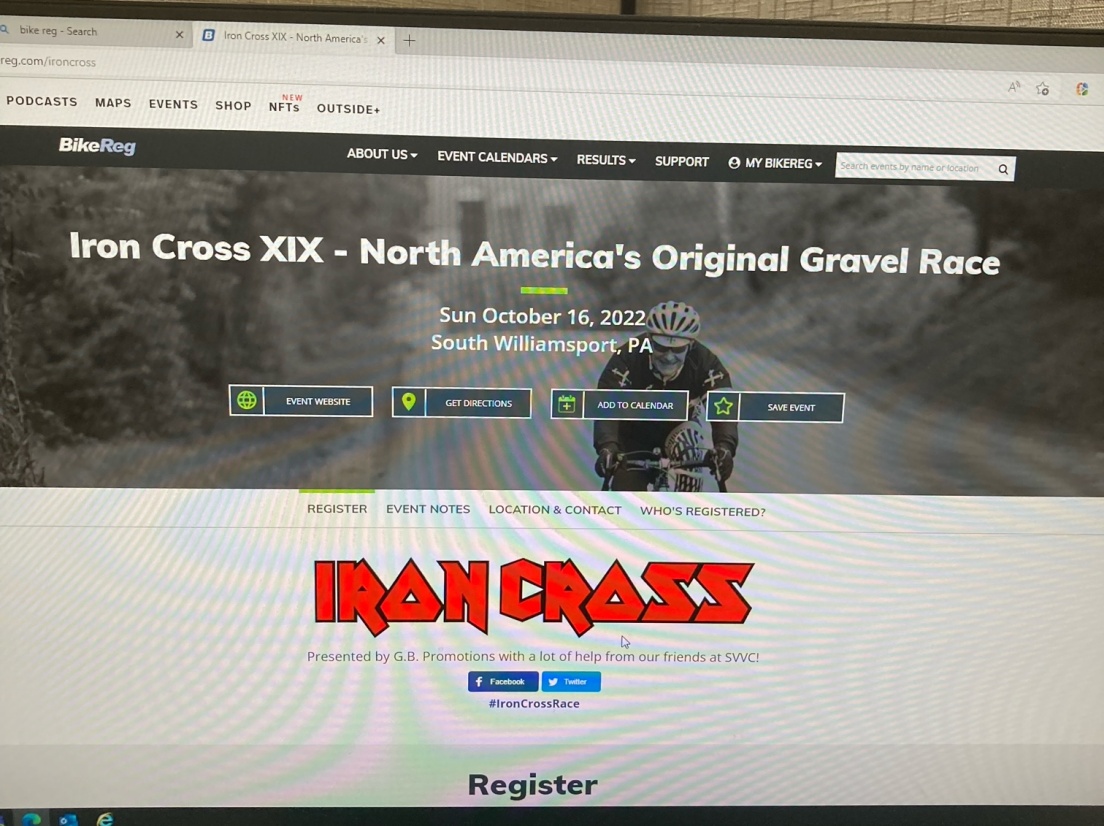
Or, that's what the marketing folks seem to think. Take a look at that screen shot mentioned earlier that I received from N.Y. Roll.......

To Hell with 20 years of marketing as an "UltraCross" event! We're Gravel! Always have been!

Yeah, I think this speaks volumes about what seems marketable and what will make an event successful now in 2022. It's odd, isn't it? 20 years of an identity thrown away to say that your event was the "Original Gravel Race"?

By the way, the Flint Hills Death Ride would like to have a word with you, Iron Cross......

Anyway, like I told N.Y. Roll- Marketing folk will rewrite history however they see fit to turn a marketing plan into a success. Even our podcast guest, Dave Pryor, who is a Pennsylvania resident and knows all about cross and ultra-cross said what those events were doing wasn't really "gravel". But it doesn't matter. 

Expect to see a lot of this sort of nonsense in the future. 

If You Don't Have "Gravel"- You Are Not A Thing

Iron Cross' BikeReg header from 2021
N.Y. Roll sent me a screen shot Monday for an event out in Pennsylvania called "Iron Cross". It's a long-standing event which has been known for ridiculously tough courses that went "beyond cyclo-cross", which is what the original event was based upon. Thus the event became known as an "ultra-cross" event. 

Those types of events then sprung up in the Eastern part of the USA and were noted for their fun atmosphere and adventurous nature. A YouTube video posted on 2013 for the 11th Iron Cross said this about those events: 

"Turned up to 11! The Original North American Ultra CX Race! Iron Cross, a 68 mile race with 7,000+ feet of climbing inside the Michaux State Forest in Pennsylvania, USA. It's not a dirt road race, nor a mountain bike race, but it's not a 'cross race either. At this race you'll see 'Cross, MTBs, 29ers, 26ers, 650Bers, FrankenCross, MonsterCross, UltraCross and SuperUltraDoubleUberCross bikes. The organizers don't care. If it has wheels and is human powered, it's in."

 So, it would seem that, at least in 2013, when the gravel scene had a strong foothold in the cycling scene, that Iron Cross was forging its own identity. Even up until last year, their BikeReg header claimed that Iron Cross was "North America's Original UltraCross". But, as you well know, dear readers, if'n ya ain't got tha gravel, ya ain't got nuthin'! 

Or, that's what the marketing folks seem to think. Take a look at that screen shot mentioned earlier that I received from N.Y. Roll.......

To Hell with 20 years of marketing as an "UltraCross" event! We're Gravel! Always have been!

Yeah, I think this speaks volumes about what seems marketable and what will make an event successful now in 2022. It's odd, isn't it? 20 years of an identity thrown away to say that your event was the "Original Gravel Race"?

By the way, the Flint Hills Death Ride would like to have a word with you, Iron Cross......

Anyway, like I told N.Y. Roll- Marketing folk will rewrite history however they see fit to turn a marketing plan into a success. Even our podcast guest, Dave Pryor, who is a Pennsylvania resident and knows all about cross and ultra-cross said what those events were doing wasn't really "gravel". But it doesn't matter. 

Expect to see a lot of this sort of nonsense in the future. 

Tuesday, August 23, 2022

A Twofold Anniversary: The Story Of The Warbird & A Disclaimer

The Salsa Cycles Warbird in titanium as ridden in 2012
 Ten years ago today a couple of interrelated things happened which have had big impacts on the blog, my life, and likely your's as well if you are here and are into gravel riding. First- Let's remember the Warbird's debut.

The first time anyone had a chance to ride and check out the new Salsa Cycles Warbird gravel bikes was the Summer of 2012 at what was then called "Saddledrive", which was the Quality Bicycle Products dealer only Summer show. 

Afterword, a small demo tour across the U.S. was held by Salsa and one of the visits was in the Twin Cities and I made an effort to attend to see this important development. The gravel scene had its own bike now, and this was a historic occasion. 

The line up consisted of a titanium model and an aluminum model. These bikes were developed over several years at gravel events like the DK200, Trans Iowa, and over miles of Minnesota and Mid-Western roads. The design was informed most by what racer's needs were. A larger front triangle to accommodate the popular "half-frame bags and still have room for water bottles. A slightly slacker, lower, and more stable geometry than the previously popular cyclo-cross bikes had. A taller "stack height" which placed the handle bars in a bit more relaxed position. It was exciting to have a "gravel specific bike" and I wanted to check out and see if Salsa had really understood what I felt the "all-road" bike idea should be.

The Warbird in Aluminum

So, this is where the whole gravel scene really took off from. Previous to the summer of 2012, you "made do". You had to find everything for gravel travel that worked for you, and that was really meant for other cycling purposes, and then mold that into the package for all-road riding that you could use. 

With the debut of the Warbird, a bike already set up for the purposes of all-road/gravel travel at a fast pace was here. From this point onward, the gravel scene gained traction at an ever increasing pace within the marketplace until this day where you can hardly turn around and not put your hands to something or another marketed as "Gravel®". 

Now the second bit I wanted to mark is tied up into this Warbird introduction and has affected this blog down to this day. It all started ten years ago today on August 23rd of 2012. 

My trip to see the Warbird resulted in a mixed review. The bike had some things right, but I was really pretty disappointed in a couple of important details. You can go back and read all about that HERE

That opinion spawned a sometimes heated exchange of emails back and forth with one particular individual who was employed at Salsa Cycles at the time of the Warbird release. That individual did not appreciate my pointing out that the Warbird had limited tire clearances and did not take to my assessments on sizing, materials used, and a few other nits, but mainly it was my beef with tire clearances that caused the dust-up behind the scenes. 

The argument on the Salsa side was that my "dismissal" was presented as factual for everyone. My take was that I had explicitly said it was not a review and was labeled as a "ride impression", although the lack of tire clearances was a proven, and shown, fact on that post. That was a fact I had found out myself at the demo. Myself and a friend I met there surreptitiously removed the wheel set from a Vaya they had at the demo which had Clement (now Donnelly) MSO 40mm tires on it. We swapped that wheel set out with the Warbird Titanium's which was set up with 38mm tires. The 40's barely cleared as I showed on the blog.

That was a big problem, in my opinion, because I felt that a "real gravel bike/all-road bike" should have clearances for 42mm with fenders. Clearly, the Warbird did not measure up.

The impasse over the post I published was settled when I agreed to place a disclaimer on that post which would describe the piece I wrote as only my opinion. However; I made it a bit smart-alecky. Maybe you've seen it here over the years....

"NOTE: Large doses of "my opinion" will be handed out in gloppy dollops today. You've been forewarned....."

So, there is the backstory to that statement, and the bike that inspired it all. Both things which have been around for a decade now.

A Twofold Anniversary: The Story Of The Warbird & A Disclaimer

The Salsa Cycles Warbird in titanium as ridden in 2012
 Ten years ago today a couple of interrelated things happened which have had big impacts on the blog, my life, and likely your's as well if you are here and are into gravel riding. First- Let's remember the Warbird's debut.

The first time anyone had a chance to ride and check out the new Salsa Cycles Warbird gravel bikes was the Summer of 2012 at what was then called "Saddledrive", which was the Quality Bicycle Products dealer only Summer show. 

Afterword, a small demo tour across the U.S. was held by Salsa and one of the visits was in the Twin Cities and I made an effort to attend to see this important development. The gravel scene had its own bike now, and this was a historic occasion. 

The line up consisted of a titanium model and an aluminum model. These bikes were developed over several years at gravel events like the DK200, Trans Iowa, and over miles of Minnesota and Mid-Western roads. The design was informed most by what racer's needs were. A larger front triangle to accommodate the popular "half-frame bags and still have room for water bottles. A slightly slacker, lower, and more stable geometry than the previously popular cyclo-cross bikes had. A taller "stack height" which placed the handle bars in a bit more relaxed position. It was exciting to have a "gravel specific bike" and I wanted to check out and see if Salsa had really understood what I felt the "all-road" bike idea should be.

The Warbird in Aluminum

So, this is where the whole gravel scene really took off from. Previous to the summer of 2012, you "made do". You had to find everything for gravel travel that worked for you, and that was really meant for other cycling purposes, and then mold that into the package for all-road riding that you could use. 

With the debut of the Warbird, a bike already set up for the purposes of all-road/gravel travel at a fast pace was here. From this point onward, the gravel scene gained traction at an ever increasing pace within the marketplace until this day where you can hardly turn around and not put your hands to something or another marketed as "Gravel®". 

Now the second bit I wanted to mark is tied up into this Warbird introduction and has affected this blog down to this day. It all started ten years ago today on August 23rd of 2012. 

My trip to see the Warbird resulted in a mixed review. The bike had some things right, but I was really pretty disappointed in a couple of important details. You can go back and read all about that HERE

That opinion spawned a sometimes heated exchange of emails back and forth with one particular individual who was employed at Salsa Cycles at the time of the Warbird release. That individual did not appreciate my pointing out that the Warbird had limited tire clearances and did not take to my assessments on sizing, materials used, and a few other nits, but mainly it was my beef with tire clearances that caused the dust-up behind the scenes. 

The argument on the Salsa side was that my "dismissal" was presented as factual for everyone. My take was that I had explicitly said it was not a review and was labeled as a "ride impression", although the lack of tire clearances was a proven, and shown, fact on that post. That was a fact I had found out myself at the demo. Myself and a friend I met there surreptitiously removed the wheel set from a Vaya they had at the demo which had Clement (now Donnelly) MSO 40mm tires on it. We swapped that wheel set out with the Warbird Titanium's which was set up with 38mm tires. The 40's barely cleared as I showed on the blog.

That was a big problem, in my opinion, because I felt that a "real gravel bike/all-road bike" should have clearances for 42mm with fenders. Clearly, the Warbird did not measure up.

The impasse over the post I published was settled when I agreed to place a disclaimer on that post which would describe the piece I wrote as only my opinion. However; I made it a bit smart-alecky. Maybe you've seen it here over the years....

"NOTE: Large doses of "my opinion" will be handed out in gloppy dollops today. You've been forewarned....."

So, there is the backstory to that statement, and the bike that inspired it all. Both things which have been around for a decade now.

Monday, August 22, 2022

Country Views: Dave Squared

Escape Route: I-380 to Cedar Rapids
 Several weeks ago I was made aware of an opportunity to share a ride and perhaps get a podcast in with Dave Pryor. Dave is the co-founder of the unPAved of the Susquehanna River Valley event in central Pennsylvania. I've known Dave since the early "twenty-teens" and I have interviewed him several times already, but we'd never really spent any significant time together. 

Dave had an opportunity crop up with his day job that was to send him to Marion, Iowa, just a stone's throw from Cedar Rapids, and he'd signed up for Gravel Worlds as well. He wanted to squeeze in some time on the Sunday after Gravel Worlds to meet up with N.Y.Roll and I. 

So, the plans were laid and everything came together to allow for me to get down there and ride with Dave, and since N.Y. Roll's first given name is also Dave, I think the title to today's post should be self-explanatory. 

So, there ya go.... 

Dave's bike still sporting his number plate from Gravel Worlds.

 
We rode from the heart of Cedar Rapids down this paved bike path to Ely, Iowa.

Our adventure started with some great grub we procured from the NewBo Market. Then we repaired to Goldfinch Cyclery to hook up with Dave. I can highly recommend both places and they are very close to each other in location as well. Goldfinch is a stellar shop, and I enjoyed poking around in there. Thaddeus and the rest of the crew were super nice and confirmed our planned route was a good one. They have a lot of gravel routes figured out down that way, so check in with them if you're ever in the area. 

The first hill on gravel. Welcome to Iowa, Dave!

What a great day for a ride!

The bike path scene in Cedar Rapids is serious business. I saw far more people out than I ever do around Waterloo or Cedar Falls. Sure, Cedar Rapids is a big city, but they've got us beat hands down from a vibrant cycling community perspective. 

Once we got close to Ely, we peeled off the bike path, rode a big hill into the edge of town, hung a downhill to the left and off into gravel. The first hill was a doozy and here I was on my Pofahl single speed! Grunt!

New roads to me means one thing: Barns For Jason #1

Big hills were the order of the day on gravel.

I wasn't of the understanding that this part of Iowa had such big rollers, or I'd have brought the Standard Rando v2, most likely. As it was, I was getting hammered by these hills. I haven't spent a lot of time on a single speed on big rollers in a while and it showed!

Barns For Jason #2

The prairie sunflowers reminded me of last year's Gravel Worlds in places we rode Sunday.

Fortunately "The Daves" would stop and allow me to compose myself after a few of the nastier climbs. I was appreciative of that, and I knew I was dragging a bit, but hey! I was having fun.

The last big climb brought us up to a ridge where we could look out for miles. That's Ely in the distance.

Barns For Jason #3

The route alternated between paved and gravel sections. This close to such a big city, that is not a surprise. There weren't many cars, as I recall, not until we got within a few miles of Cedar Rapids again, so it was all good. The views were spectacular though. 

A nice, twisty section of gravel that went mostly down was a welcome relief.

Barns For Jason #4

We eventually descended down to a chip seal road which was hard up against the Cedar River. We took this toward Cedar Rapids until we reached the same bike path we'd taken out of town. That led us back to the car.

That wasn't the end of the goings on though. Nope! We went then to Dave Pryor's motel room and proceeded to have a great podcast recording session. This should get released soon, and I'll likely put the link up in a future "FN&V" soon, so stay tuned for that coming up. 

Thanks to Dave Pryor for making the time for us after having to ride Gravel Worlds and drive five hours to meet us.

Country Views: Dave Squared

Escape Route: I-380 to Cedar Rapids
 Several weeks ago I was made aware of an opportunity to share a ride and perhaps get a podcast in with Dave Pryor. Dave is the co-founder of the unPAved of the Susquehanna River Valley event in central Pennsylvania. I've known Dave since the early "twenty-teens" and I have interviewed him several times already, but we'd never really spent any significant time together. 

Dave had an opportunity crop up with his day job that was to send him to Marion, Iowa, just a stone's throw from Cedar Rapids, and he'd signed up for Gravel Worlds as well. He wanted to squeeze in some time on the Sunday after Gravel Worlds to meet up with N.Y.Roll and I. 

So, the plans were laid and everything came together to allow for me to get down there and ride with Dave, and since N.Y. Roll's first given name is also Dave, I think the title to today's post should be self-explanatory. 

So, there ya go.... 

Dave's bike still sporting his number plate from Gravel Worlds.

 
We rode from the heart of Cedar Rapids down this paved bike path to Ely, Iowa.

Our adventure started with some great grub we procured from the NewBo Market. Then we repaired to Goldfinch Cyclery to hook up with Dave. I can highly recommend both places and they are very close to each other in location as well. Goldfinch is a stellar shop, and I enjoyed poking around in there. Thaddeus and the rest of the crew were super nice and confirmed our planned route was a good one. They have a lot of gravel routes figured out down that way, so check in with them if you're ever in the area. 

The first hill on gravel. Welcome to Iowa, Dave!

What a great day for a ride!

The bike path scene in Cedar Rapids is serious business. I saw far more people out than I ever do around Waterloo or Cedar Falls. Sure, Cedar Rapids is a big city, but they've got us beat hands down from a vibrant cycling community perspective. 

Once we got close to Ely, we peeled off the bike path, rode a big hill into the edge of town, hung a downhill to the left and off into gravel. The first hill was a doozy and here I was on my Pofahl single speed! Grunt!

New roads to me means one thing: Barns For Jason #1

Big hills were the order of the day on gravel.

I wasn't of the understanding that this part of Iowa had such big rollers, or I'd have brought the Standard Rando v2, most likely. As it was, I was getting hammered by these hills. I haven't spent a lot of time on a single speed on big rollers in a while and it showed!

Barns For Jason #2

The prairie sunflowers reminded me of last year's Gravel Worlds in places we rode Sunday.

Fortunately "The Daves" would stop and allow me to compose myself after a few of the nastier climbs. I was appreciative of that, and I knew I was dragging a bit, but hey! I was having fun.

The last big climb brought us up to a ridge where we could look out for miles. That's Ely in the distance.

Barns For Jason #3

The route alternated between paved and gravel sections. This close to such a big city, that is not a surprise. There weren't many cars, as I recall, not until we got within a few miles of Cedar Rapids again, so it was all good. The views were spectacular though. 

A nice, twisty section of gravel that went mostly down was a welcome relief.

Barns For Jason #4

We eventually descended down to a chip seal road which was hard up against the Cedar River. We took this toward Cedar Rapids until we reached the same bike path we'd taken out of town. That led us back to the car.

That wasn't the end of the goings on though. Nope! We went then to Dave Pryor's motel room and proceeded to have a great podcast recording session. This should get released soon, and I'll likely put the link up in a future "FN&V" soon, so stay tuned for that coming up. 

Thanks to Dave Pryor for making the time for us after having to ride Gravel Worlds and drive five hours to meet us.

Sunday, August 21, 2022

The GTDRI Stories: Where Did This Come From? - Part 2

In 2006 I participated in the first DK200 which sparked ideas in my head.
"The GTDRI Stories" is a series telling the history, untold tales, and showing the sights from the run of Guitar Ted Death Ride Invitationals. This series will run on Sundays. Thanks for reading!

Once I got involved in Trans Iowa, I had pretty much transferred my riding to off-pavement. By this time I had a 2003 Karate Monkey I had set up single speed with drop bars and this became my de facto 'gravel bike'. Again- there weren't any 'gravel specific' bicycles or components at this point. We were borrowing what worked, and for many of us, the new 29" platform was making the most sense. It had a wheel size based on road bikes, and the momentum and stability of 29"ers was prized in gravel riding. 

It bears repeating here that the fact was that the DK200 guys, Jim Cummings and Joel Dyke, had researched and borrowed ideas and inspiration from Trans Iowa and that also comes into play with gravel ideas I had. I've told about how their event inspired later Trans Iowas, but it also inspired the Guitar Ted Death Ride Invitational. It did this in a couple of ways.

Firstly, when the DK200 was announced, I felt compelled to support it by attending and riding in it. This was because 'gravel cycling' was pretty much the DK200 and Trans Iowa. That was it. Note- There were other events "on gravel" but they typically did not bill themselves as "gravel events", as did the DK200 and T.I. The Colesburg race, which was going on then for an example, was billed as a "tune-up race" for the Chequamegon 40 MTB event. It wasn't until 2022 that they started calling that event the "oldest gravel grinder in the Mid-West". 

I was excited about what was happening with gravel events, and I know others were as well. The over-arching feeling I got back then was that this idea was so much fun - No governing bodies, rules that were minimal and easily understood. The do-it-yourself nature surrounding the entire thing. Pushing yourself beyond what you thought was possible. All of that. Event production, how you rode these events, and all the equipment choices were basically unknowns back in 2005-2006. 

I rode a single speed On One Inbred at the first DK200 (image above) and it wasn't the only single speed MTB 29"er at that event. Cyclo cross bikes were also a big deal back in the day, and you'd see a smattering of those as well. But enough about the equipment.....

The thing was that we all were very supportive of each other and wanted to see this take off. 

My '03 Karate Monkey circa 2006
Secondly, as far as how the DK inspired me, I was enamored of the longer, ultra-distance stuff and bigger rides appealed to me. It was my feeling at the time that longer events were preferable since I recalled how disappointed I had been with XC MTB events that cost a lot of money to enter and lasted maybe an hour- maybe and hour and a half. These longer "gravel grinders" were cost efficient for participants because you got an event which allowed you to ride as long as you wanted, and all day if you could. 

The 200 mile distance seemed a bit over the line for me as far as making things more on the "fun" side, so my thoughts were something a hundred plus, but maybe not more than 150-ish. That might be fun, and then that kind of worked its way into my thoughts for a "Death Ride" that I could do in the Summer on gravel. Since the DK200 was a big loop course, that worked its way into my ideas as well. In fact, the whole event idea for the GTDRI was loosely based around the DK200 profile, just not as long.

But then I got to thinking, "This needs to be a group ride." Not so much an "event", per se', as much as just a 'happening' that you could join in on, if you were so inclined. Plus, I didn't know what I was doing in terms of putting on events in 2006. I was all-new to this, and putting on another event, which I deemed necessary to further gravel grinding, wasn't so much in my wheel house. Besides, that "big-event" feel wasn't my bag anyway. So, I made it a group ride, no-drop, and kept things low-key.

My idea was 'to invite people' to my 'death ride' idea that I had been doing all along. Jeff Kerkove was privy to my spoken thoughts on the matter, since we worked together at the time. He encouraged me to take the idea to the public via a blog. Thus the "Guitar Ted Death Ride Invitational" was born. Jeff actually set the blog up, and that's how the abbreviation came about for it, because a web address with the entire name would have been ridiculous. So "www.gtdri.blogspot.com" it was, and I was off and running toward putting this thing on in 2006. 

 Next: Announcing the idea, and putting it into effect.

The GTDRI Stories: Where Did This Come From? - Part 2

In 2006 I participated in the first DK200 which sparked ideas in my head.
"The GTDRI Stories" is a series telling the history, untold tales, and showing the sights from the run of Guitar Ted Death Ride Invitationals. This series will run on Sundays. Thanks for reading!

Once I got involved in Trans Iowa, I had pretty much transferred my riding to off-pavement. By this time I had a 2003 Karate Monkey I had set up single speed with drop bars and this became my de facto 'gravel bike'. Again- there weren't any 'gravel specific' bicycles or components at this point. We were borrowing what worked, and for many of us, the new 29" platform was making the most sense. It had a wheel size based on road bikes, and the momentum and stability of 29"ers was prized in gravel riding. 

It bears repeating here that the fact was that the DK200 guys, Jim Cummings and Joel Dyke, had researched and borrowed ideas and inspiration from Trans Iowa and that also comes into play with gravel ideas I had. I've told about how their event inspired later Trans Iowas, but it also inspired the Guitar Ted Death Ride Invitational. It did this in a couple of ways.

Firstly, when the DK200 was announced, I felt compelled to support it by attending and riding in it. This was because 'gravel cycling' was pretty much the DK200 and Trans Iowa. That was it. Note- There were other events "on gravel" but they typically did not bill themselves as "gravel events", as did the DK200 and T.I. The Colesburg race, which was going on then for an example, was billed as a "tune-up race" for the Chequamegon 40 MTB event. It wasn't until 2022 that they started calling that event the "oldest gravel grinder in the Mid-West". 

I was excited about what was happening with gravel events, and I know others were as well. The over-arching feeling I got back then was that this idea was so much fun - No governing bodies, rules that were minimal and easily understood. The do-it-yourself nature surrounding the entire thing. Pushing yourself beyond what you thought was possible. All of that. Event production, how you rode these events, and all the equipment choices were basically unknowns back in 2005-2006. 

I rode a single speed On One Inbred at the first DK200 (image above) and it wasn't the only single speed MTB 29"er at that event. Cyclo cross bikes were also a big deal back in the day, and you'd see a smattering of those as well. But enough about the equipment.....

The thing was that we all were very supportive of each other and wanted to see this take off. 

My '03 Karate Monkey circa 2006
Secondly, as far as how the DK inspired me, I was enamored of the longer, ultra-distance stuff and bigger rides appealed to me. It was my feeling at the time that longer events were preferable since I recalled how disappointed I had been with XC MTB events that cost a lot of money to enter and lasted maybe an hour- maybe and hour and a half. These longer "gravel grinders" were cost efficient for participants because you got an event which allowed you to ride as long as you wanted, and all day if you could. 

The 200 mile distance seemed a bit over the line for me as far as making things more on the "fun" side, so my thoughts were something a hundred plus, but maybe not more than 150-ish. That might be fun, and then that kind of worked its way into my thoughts for a "Death Ride" that I could do in the Summer on gravel. Since the DK200 was a big loop course, that worked its way into my ideas as well. In fact, the whole event idea for the GTDRI was loosely based around the DK200 profile, just not as long.

But then I got to thinking, "This needs to be a group ride." Not so much an "event", per se', as much as just a 'happening' that you could join in on, if you were so inclined. Plus, I didn't know what I was doing in terms of putting on events in 2006. I was all-new to this, and putting on another event, which I deemed necessary to further gravel grinding, wasn't so much in my wheel house. Besides, that "big-event" feel wasn't my bag anyway. So, I made it a group ride, no-drop, and kept things low-key.

My idea was 'to invite people' to my 'death ride' idea that I had been doing all along. Jeff Kerkove was privy to my spoken thoughts on the matter, since we worked together at the time. He encouraged me to take the idea to the public via a blog. Thus the "Guitar Ted Death Ride Invitational" was born. Jeff actually set the blog up, and that's how the abbreviation came about for it, because a web address with the entire name would have been ridiculous. So "www.gtdri.blogspot.com" it was, and I was off and running toward putting this thing on in 2006. 

 Next: Announcing the idea, and putting it into effect.

Saturday, August 20, 2022

Petty Bickering Stains Gravel Event's Good Works

Moo! You Ruined My Race!
Another gravel race, another gravel related rant. They said this would happen back in the day......

And if you don't want to read about what I think concerning some complaints coming from sponsored, Pro level racers, then you should turn this off and go for a ride right now. This is your cue. (Have a great one, by the way!)

For the rest of you out there with your steaming cuppa whatever in your mitts, read on....

One of the great things that has come of the gravel scene since I've been around is social awareness and efforts to change "How Things Have Always Been Done". These efforts are plain to see these days within the organizations of several events, most notably the Mid-South, SBT GRVL, and Gravel Worlds, but certainly, those are not the only events pushing major changes that reflect social causes and issues to the forefront. Their efforts are to be commended, and are celebrated in some news articles here and there. Awareness and actual discussion and changes are occurring due to these events and riders who are taking up those issues are making differences. It's pretty obvious to see if you pay even a little attention. 

This isn't "new", but our efforts in the gravel scene weren't always so overt and noticeable. For instance, as far as I am aware, gravel race prizing has ALWAYS been equally shared across genders. Men and women got the same rewards. This was never really questioned, and much to our discredit- to be honest- it is something we did not trumpet loudly enough back then. But of course, if you take things in context of the day, we were really not caring if anyone else noticed! And that's another great thing about the early gravel scene- We didn't care about getting published, getting "likes", or satisfying sponsors with "engagement". We were 100% focused on the participant's experience. To the credit of the gravel scene, still to this day, I feel that great gravel events make an effort to do just this. 

The thing is, the gravel scene has always been subtly "political" and an agent of social change. We went out of our way to eschew the trappings of traditional road racing, and we certainly did not want to see any "attitudes" which were seen as a turn-off to participation in events. We took the stance also that "Prizing" and "Money" weren't what the riders should be vying for, but that personal growth, overcoming challenge, and becoming accepted into the community of gravel riders were the "rewards" for participating in events. The idea that "one" winner dominated over the rest of the "field" and that "second place was the first loser" were not acceptable to many of the early modern day gravel pioneers. 

Now, in 2022, we have Pro level, sponsored riders with "beefs" to air because early practices of the gravel racing scene are being bastardized to the benefit of certain, clever Pro sponsored riders. This is not in the vein of "Pro racing etiquette", and as such, a few racers are grousing and airing their complaints on social media. This has already manifested itself as "#gravelbeef" as a hashtag. 

Obviously, all that nonsense is getting amplified by social media which is, ironically, very divisive and doesn't promote community. Meanwhile, all the "good" socially conscientious activity and progress gets overshadowed by that crap. (Or since it is #gravelbeef, maybe "B.S." is better as a descriptor here) 

On the one hand, it is sad and I shake my head. On the other hand I think, "What did we expect?" When the game changes, and it becomes about the economic status of individuals- whether or not that they can maintain their station as "sponsored Pro riders", well then the results we have witnessed should be obvious. 

I wrote about how I think Pro Level Road Racing On Gravel" should be separated out from "gravel races" and that the two things are inherently incompatible with each other. This is true because at its heart, Pro level racing and events are structured completely differently than the gravel races which have spawned this explosion of popularity now. They are socially and politically completely different animals. At the heart of Pro level racing is a focus on selfishness, personal gain measured by prizing and sponsorship, and growth is measured by power meters. The gravel scene was never about any of that. Where we were saying, "You will discover you can do more than you ever thought you could!", this Pro gravel thing seems to be about elevating individuals and corporate windfalls instead. 

What gravel events did before was different. Gravel was about "Everybody". It meant that EVERYONE was capable of reaching that "prize' and equity and acceptance was central to building a "gravel family" which was stronger because of its inclusion and diversity than the old ways of doing events were. 

And again- to be crystal clear- those efforts to be inclusive still are out there. They matter, but they are overshadowed by this Pro level racer mentality and social construct that should be summarily rejected by events and done away with. But, it won't be because of  the way the way the industry has structured its sponsorship of events, the athletes, and how corporate America has latched on to the gravel scene as a way to pad their coffers with millions of dollars in event receipts. 

In other words, it's like Joel Dyke, co-founder of the DK200 told me years ago,"When the money comes in, it'll ruin everything."

I don't think it has to be that way, but that's up to all the rest of you out there to decide. 

Petty Bickering Stains Gravel Event's Good Works

Moo! You Ruined My Race!
Another gravel race, another gravel related rant. They said this would happen back in the day......

And if you don't want to read about what I think concerning some complaints coming from sponsored, Pro level racers, then you should turn this off and go for a ride right now. This is your cue. (Have a great one, by the way!)

For the rest of you out there with your steaming cuppa whatever in your mitts, read on....

One of the great things that has come of the gravel scene since I've been around is social awareness and efforts to change "How Things Have Always Been Done". These efforts are plain to see these days within the organizations of several events, most notably the Mid-South, SBT GRVL, and Gravel Worlds, but certainly, those are not the only events pushing major changes that reflect social causes and issues to the forefront. Their efforts are to be commended, and are celebrated in some news articles here and there. Awareness and actual discussion and changes are occurring due to these events and riders who are taking up those issues are making differences. It's pretty obvious to see if you pay even a little attention. 

This isn't "new", but our efforts in the gravel scene weren't always so overt and noticeable. For instance, as far as I am aware, gravel race prizing has ALWAYS been equally shared across genders. Men and women got the same rewards. This was never really questioned, and much to our discredit- to be honest- it is something we did not trumpet loudly enough back then. But of course, if you take things in context of the day, we were really not caring if anyone else noticed! And that's another great thing about the early gravel scene- We didn't care about getting published, getting "likes", or satisfying sponsors with "engagement". We were 100% focused on the participant's experience. To the credit of the gravel scene, still to this day, I feel that great gravel events make an effort to do just this. 

The thing is, the gravel scene has always been subtly "political" and an agent of social change. We went out of our way to eschew the trappings of traditional road racing, and we certainly did not want to see any "attitudes" which were seen as a turn-off to participation in events. We took the stance also that "Prizing" and "Money" weren't what the riders should be vying for, but that personal growth, overcoming challenge, and becoming accepted into the community of gravel riders were the "rewards" for participating in events. The idea that "one" winner dominated over the rest of the "field" and that "second place was the first loser" were not acceptable to many of the early modern day gravel pioneers. 

Now, in 2022, we have Pro level, sponsored riders with "beefs" to air because early practices of the gravel racing scene are being bastardized to the benefit of certain, clever Pro sponsored riders. This is not in the vein of "Pro racing etiquette", and as such, a few racers are grousing and airing their complaints on social media. This has already manifested itself as "#gravelbeef" as a hashtag. 

Obviously, all that nonsense is getting amplified by social media which is, ironically, very divisive and doesn't promote community. Meanwhile, all the "good" socially conscientious activity and progress gets overshadowed by that crap. (Or since it is #gravelbeef, maybe "B.S." is better as a descriptor here) 

On the one hand, it is sad and I shake my head. On the other hand I think, "What did we expect?" When the game changes, and it becomes about the economic status of individuals- whether or not that they can maintain their station as "sponsored Pro riders", well then the results we have witnessed should be obvious. 

I wrote about how I think Pro Level Road Racing On Gravel" should be separated out from "gravel races" and that the two things are inherently incompatible with each other. This is true because at its heart, Pro level racing and events are structured completely differently than the gravel races which have spawned this explosion of popularity now. They are socially and politically completely different animals. At the heart of Pro level racing is a focus on selfishness, personal gain measured by prizing and sponsorship, and growth is measured by power meters. The gravel scene was never about any of that. Where we were saying, "You will discover you can do more than you ever thought you could!", this Pro gravel thing seems to be about elevating individuals and corporate windfalls instead. 

What gravel events did before was different. Gravel was about "Everybody". It meant that EVERYONE was capable of reaching that "prize' and equity and acceptance was central to building a "gravel family" which was stronger because of its inclusion and diversity than the old ways of doing events were. 

And again- to be crystal clear- those efforts to be inclusive still are out there. They matter, but they are overshadowed by this Pro level racer mentality and social construct that should be summarily rejected by events and done away with. But, it won't be because of  the way the way the industry has structured its sponsorship of events, the athletes, and how corporate America has latched on to the gravel scene as a way to pad their coffers with millions of dollars in event receipts. 

In other words, it's like Joel Dyke, co-founder of the DK200 told me years ago,"When the money comes in, it'll ruin everything."

I don't think it has to be that way, but that's up to all the rest of you out there to decide.