Showing posts with label Mark Slate. Show all posts

Wednesday, August 23, 2023

Another New Wheel Size?!

750D (L), 700c (R) Image courtesy of Mark Slate/WTB
 In February of 2018 I received an email from Mark Slate, designer and head honcho over at WTB. In that email was an image - what you see here to the left. A new wheel size was being tested. Slate called it "29.5", but also referred to it as "750D". He was playing around with it as a gravel bike wheel/tire size. 

Then things went dark on that front....

Just yesterday, my friend in SoCal, Grannygear sends me a text with an image cut from a You Tube video. The caption said "New gravel wheel size! 750D". 

Huh! Wait a minute!........

Where have I seen this before?, I thought to myself. (It has been five years plus some since I had that email from Slate.) At first I thought it was some arcane wheel size being resurrected. I hopped on Sheldon Brown's site (R.I.P.) and checked out all the antique wheel size info there but no dice. Hmm..... "I know I've seen this before!", I thought, but where? 

Then Mark Slate popped into my mind. I searched my email archives, and BOOM! There it was. The entire email thread starting in February of 2018. Well, at least that mystery was solved now! So, about this video... (Watch here)  

The video seems to indicate that, at least initially, this is for larger, taller riders. That's funny because it is exactly what people thought about 29"ers as well. So, don't write this off just yet. The thing I see here is that you get the outer diameter of a 29"er without the weight of a 29"er tire and rim. Oh.... Those are both 40mm Nano's in the image there. Could wider tires be done as well? Maybe that is where it will go, but here is what I think is happening....

Current image of Mark Slate's personal 750D bike. Courtesy of Mark Slate
The trend in gravel bikes is that you can fit "up to a 29" X 2.0" tire", sometimes even larger. What if you can also fit in this 750D'er? Bigger diameter, less weight. Get all the washboard killing roll-over without having the grunt of making a heavier tire and wheel go up a hill? 

I'm not saying that is where WTB's head is at with this 750D thing, but.....maybe?

Or.... It's going to be its own thing. Maybe it will be for larger riders. The bike above equates to about a 59-ish centimeter frame, for reference. So, it would work for "average" sized folks, most likely. Time will tell, but this certainly will fire up all those keyboard warriors who bemoan every new thing as "not necessary", a ploy to make money, or worse.

Saturday, December 11, 2021

The Early Days Of 29"ers- A Gary Fisher Perspective

 During a Fisher Bikes Press camp visit I was on in September of 2009, I was privy to hearing tales told by the famous Gary Fisher himself. This conference of media attendees was entertained and informed on Gary Fisher's take on the history of the wheel size from his perspective. I took notes furiously and after returning home I tossed the note pad in a box which I found again recently. 

So, this is over a decade afterward and some gaps in the notation, which I assume I probably thought at the time would be remembered after I got home, have occurred. This following is, to the best of my ability, a reconstruction of what was told then in the Fall of '09.

There were definitely a few things which Mr. Fisher said that seem to contradict tales told elsewhere, so from that standpoint alone this is an interesting bit of information to add to the history. Who is 'right' and who is 'not so right' really doesn't matter here as much as perhaps being able to see that 'like minds were thinking similarly'. Things said and seen may have been subliminally stored in memories and thought, "not very important', or "obvious" at the time and then brought back to mind later. Then it becomes time to 'fix' timelines and history and you know- things that weren't all that important to mark then have to be marked and well.....it can be messy. 

I'd like to think that some of that happened with regard to 29"ers, because, well, who really thought in 1999 that this wheel size would supplant the mighty 26"er completely? No one did. No one figured this would become what it has, and isn't that the way great things go? With all that in mind......
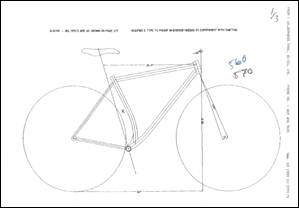
Fisher prototype 29"er drawings
So, this will be given in much the same manner as I received it at the time, which was in a timeline fashion. I will make commentary as this goes along also. 

1999/2000: Starting out with Gary Fisher's first 29"er, which was drawn up and made in Steve Pott's custom bicycle shop. Gary had in mind to do a direct comparison between a 26" and 29" wheeled MTB. His goal was to keep everything he could the same between the two bikes. Geometry, head angles, chain stay lengths, and head tube angles were kept as close as possible to the 26'er. This resulted in a frame with a bent seat tube to keep the chain stays short as possible. Fisher's design goal was to get to an amazingly short 16 1/2" length, which is equivalent to 419.1mm! A modified Manitou Mars fork was crafted as a front fork for the project with travel limited to 50mm. A custom modified XT front derailleur was crafted so it would not interfere with the rear wheel. Much of what was done on this 1st proto were things that would not be seen on 29"ers for a decade or longer. 

Interestingly, Fisher claimed that between he, Mark Slate (head of WTB), and Steve Potts that this was always known as a "29"er" when they referred to this bike. Fisher credits a conversation between he and Mark Slate at Interbike as being when the term was first used. This probably was at the '99 Interbike as "The Tire", the 29"er Nanoraptor, was introduced right at that time. If so, it predates Wes Williams claim of the term by a month, or perhaps a few weeks even. Regardless, as I said, it very well may be that the term was in usage between all the instigators of "The Tire" and no one can really pinpoint when exactly it was first uttered in relation to the wheel size. What matters is that this was a wheel size declared as being the "29"er" out of the gates. 

Update 11/29/23: It has come to light that Slate and Fisher dubbed the tire as a "twenty-nine inch" tire, this according to a Facebook post by Gary himself under his "married name" he uses there, "Gary Zaphiris". I posted the entire written comment by Gary at the bottom of THIS PAGE which is my history of the 29"er. 
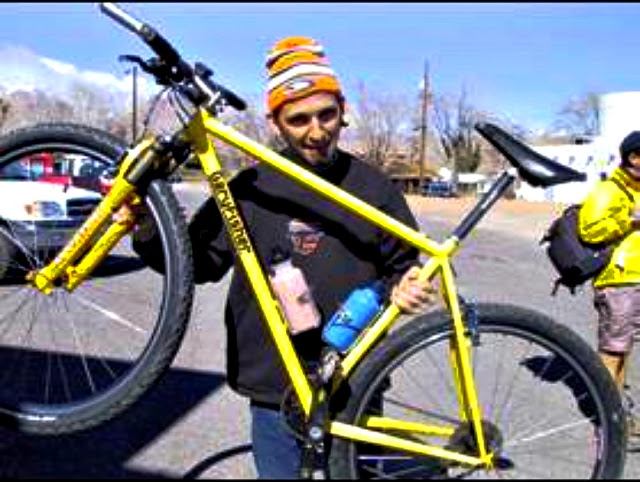
The first Fisher 29"er held by former Mountain Bike Action editor, Zapata Espinoza. (Image courtesy of Gary Fisher.

 As an aside, Gary Fisher claimed that credit for the very first 29 inch wheeled bike belongs to Wes Williams. And what about Fisher's 26'er/29"er comparison? Fisher claimed that in his tests that he was 2-3% faster on the 29"er. That was all he needed to pursue this further. 
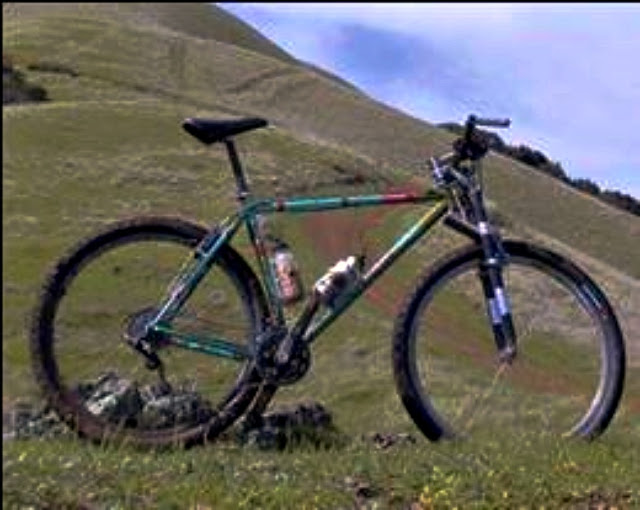
The second Fisher proto 29"er. (Image courtesy of Gary Fisher)
 Two more prototypes were made then in rapid succession. One having a Look Fournales Fork lengthened by none other than Gary Klein to fit a 29"er wheel. The fork was said to have a 450mm axle to crown height. (For reference early 29"er suspension forks with telescoping legs and 80mm of travel were approximately 470-480mm axle to crown. ) This bike had a paint scheme designed by Gary Fisher's daughter. 
The third Fisher 29'"er prototype was made in titanium. (Image courtesy of Gary Fisher)


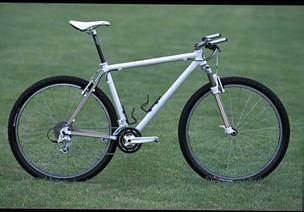
 The second was followed quickly by a third bike, but this time the bike was made in titanium with paint designed by well known designer, Paul Smith. This had a prototype Marzocchi suspension fork on it. In 2000 another 29"er with Paul Smith designed paint was made which featured an integrated head set. Interestingly, Fisher claimed that they also were working on a "69er" design, which was a mixed 29 inch front, 26 inch rear wheeled idea. 

Update 11/29/23: Recently Gary Fisher has been posting a lot of historical images and relating stories about his past that were mostly unknown to the public before now. Relating to the white hard tail above, Gary posted on 11/28/23 the following:

"This frame was built at Trek by Doug Cusack. It is a one-off. (Note: there were other similarly painted "Team Frames" but Gary's had proprietary geometry that the others did not have) The chain stays are super short and the Marziocii (sic) fork had a knob that would lower the front end by 60mm. I set up the geometry, so I still had pedal clearance when the bike was let down, and the head angle when lowered would be 69 1/2°. When you let the fork out to its 100mm travel, the head angle was closer to 68. Degrees.. this was a great bike for European marathons." 

It is interesting to note that a 68° - 69° head tube angle for 29"ers was generally thought to be unthinkable, crazy, and "would never work" on big MTB wheels like 29"ers back in those days. To see that Gary had tried this and that it worked out was a sign of things to come and introduces the notion that early 29"ers were chasing the wrong ideas. Ideas that were entrenched in the 26"er mindset and not focused on what bigger diameter wheels were actually good at, which finally came into being after about 2012-2014. 

Another interesting tidbit that Gray Fisher brought back to mind was that the UCI had rules on their books making alternative wheel sizes (anything other than 559ISO/26") illegal to use in competition. This arcane rule was starting to be implemented in European races to ban 29"ers from sanctioned events. Gary Fisher went to the UCI personally to lobby against this rule and did see success when the UCI finally recinded the rule and 29"ers were then free to be used in UCI sanctioned events. 

Now, on with the originally posted material.....

Fisher was working hard at trying to get Trek to buy into mass producing the 29" wheeled mountain bike. However, wheels were lacking, the Marzocchi fork was 'floppy', (Gary's term), and they were still trying to figure out the proper geometry and were trying to integrate their new Genesis Geometry into a 29" format. Fisher said that they were working with "less than the best technology" which hampered early acceptance of Fisher 29"ers by athletes and dealers. 
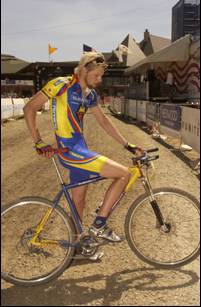
Ryder Hesjedahl on the first Supercaliber in '01 (Image courtesy of Gary Fisher

2001: Fisher Bikes introduces the first Fisher 29"er, the Supercaliber. IRC Tires were developed for the bike. Fisher had a Marzocchi production 29"er fork made for the bikes as well. 

Dealers were baffled by the wheel size and sales people basically ignored the bikes to sell 26"ers. The pressure mounted within Trek to abandon the 29"er experiment. 

2003: Due to poor sales and Fisher being the only company in North America selling 29"ers on a mass scale, Trek seemed poised to cut their losses and kill the 29"er. Internally a suggestion was made to 'hybridize' the 29"er and the Dual Sport models were introduced for the 2003 season. This model, being more closely relatable to hybrid bikes from the 1990's, were a hit with dealers and consumers alike. Gary Fisher said this model line is to be credited with saving the 29"er MTB line from being cut from the Fisher range. In fact, he went as far as to say this was a 'pivotal year' in the history of 29" MTB. 
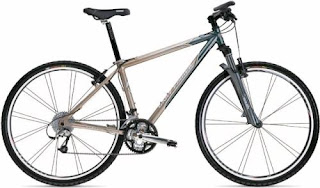
2004 Fisher Dual Sport- the model that saved 29"er MTB.

2004: With the strength of Dual Sport sales, Fisher Bikes was ready to double-down on the 29"er. The company paid out of pocket for all the R&D and tooling to make the Rock Shox Reba 29"er fork, the suspension fork which helped legitimize 29"ers to the mountain biking public. Fisher also designed the new "Rig" model, a single speed MTB which was disc brake specific and came with purpose-built 29"er rims as well. 

2005: The Rig with the Rock Shox Reba is released and it is a Fisher only product. This was a brilliant marketing move in retrospect as Fisher sold out of Rig hard tails and 29"er freaks were left to scramble for Reba take-off forks on the second hand market. This pushed 29"er sales to new heights at Fisher and more good news was coming in as well. Athletes were winning races on 29"ers now. Cam Chambers won on a Fisher 29"er at Single Speed World Championships in '05 as did Jesse La Londe at the Chequamegon Fat Tire 40 that fall. 

2006-2009: Within this three year period 29"ers went from a niche, nearly dead category to the hottest bicycle on the planet. Sales of 29"ers doubled for Fisher in 2006. By 2007, Fisher Team rider Jeremy Horgan-Kobelski was racing 29"ers on the World Cup XC scene. By 2009 he switched to 29"ers exclusively. 

Comments: The early struggles at Fisher Bikes to get 29"ers off the ground nearly sunk the category at Trek. One has to wonder if 29"ers would have remained a niche, small market thing had Trek actually cut the cord in 2004. Remember- Fisher was pretty much the only game in town for non-custom 29" MTB. The rest of the 29"er world was pretty much dominated by custom bike makers. Had Trek pulled out I envision 29"ers being much like what we see today with 36"er wheeled bikes. That being a category of bike on the fringes of the mainstream. 
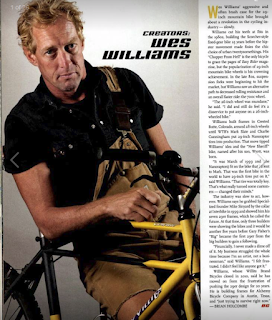
A magazine article featuring Wes Williams and the story of the first 29"er.

You also probably would never have heard about 650B anything. There would have been no reason to move beyond the entrenched 26" wheels. But then again, who knows?

One thing we need to keep reminding ourselves of though is that there are a few key folks who, without their vision, passion, and force of nature in regards to personality, we would not have the bikes we have now. In particular I would single out Gary Fisher, as he not only helped early MTB get off the ground, but it was he that helped push the 29 inch wheel into a place of prominence. Wes Williams has to be credited as the 'force of nature' that would not let big diameter MTB wheels die and no doubt it was Wes that played a pivotal role in getting "The Tire" made in the first place. Then we have to look at Mark Slate and his staff at WTB as the vehicle to get where we are with 29"ers. It was Mark who pretty much had the "kill switch" in his hand which, if pressed, would have pushed the 29 inch wheel off further into the future, or may have killed the idea altogether. 

Obviously there are a host of athletes and industry people to thank here, but if I had to choose a "Mt. Rushmore" of 29"er history it would have Fisher, Slate, Williams, and "The Tire" as its faces. That's my take. You can argue who/what belongs in that pantheon, but in my opinion, those are the main players. 

Thanks: I would be remiss if I did not thank Trek/Gary Fisher Bikes, and specifically Travis Ott, for the invitation all those years ago to go to that Press Camp in Deer Valley Utah. That is where most of the information and images for this post came from.

The Early Days Of 29"ers- A Gary Fisher Perspective

 During a Fisher Bikes Press camp visit I was on in September of 2009, I was privy to hearing tales told by the famous Gary Fisher himself. This conference of media attendees was entertained and informed on Gary Fisher's take on the history of the wheel size from his perspective. I took notes furiously and after returning home I tossed the note pad in a box which I found again recently. 

So, this is over a decade afterward and some gaps in the notation, which I assume I probably thought at the time would be remembered after I got home, have occurred. This following is, to the best of my ability, a reconstruction of what was told then in the Fall of '09.

There were definitely a few things which Mr. Fisher said that seem to contradict tales told elsewhere, so from that standpoint alone this is an interesting bit of information to add to the history. Who is 'right' and who is 'not so right' really doesn't matter here as much as perhaps being able to see that 'like minds were thinking similarly'. Things said and seen may have been subliminally stored in memories and thought, "not very important', or "obvious" at the time and then brought back to mind later. Then it becomes time to 'fix' timelines and history and you know- things that weren't all that important to mark then have to be marked and well.....it can be messy. 

I'd like to think that some of that happened with regard to 29"ers, because, well, who really thought in 1999 that this wheel size would supplant the mighty 26"er completely? No one did. No one figured this would become what it has, and isn't that the way great things go? With all that in mind......

Fisher prototype 29"er drawings
So, this will be given in much the same manner as I received it at the time, which was in a timeline fashion. I will make commentary as this goes along also. 

1999/2000: Starting out with Gary Fisher's first 29"er, which was drawn up and made in Steve Pott's custom bicycle shop. Gary had in mind to do a direct comparison between a 26" and 29" wheeled MTB. His goal was to keep everything he could the same between the two bikes. Geometry, head angles, chain stay lengths, and head tube angles were kept as close as possible to the 26'er. This resulted in a frame with a bent seat tube to keep the chain stays short as possible. Fisher's design goal was to get to an amazingly short 16 1/2" length, which is equivalent to 419.1mm! A modified Manitou Mars fork was crafted as a front fork for the project with travel limited to 50mm. A custom modified XT front derailleur was crafted so it would not interfere with the rear wheel. Much of what was done on this 1st proto were things that would not be seen on 29"ers for a decade or longer. 

Interestingly, Fisher claimed that between he, Mark Slate (head of WTB), and Steve Potts that this was always known as a "29"er" when they referred to this bike. Fisher credits a conversation between he and Mark Slate at Interbike as being when the term was first used. This probably was at the '99 Interbike as "The Tire", the 29"er Nanoraptor, was introduced right at that time. If so, it predates Wes Williams claim of the term by a month, or perhaps a few weeks even. Regardless, as I said, it very well may be that the term was in usage between all the instigators of "The Tire" and no one can really pinpoint when exactly it was first uttered in relation to the wheel size. What matters is that this was a wheel size declared as being the "29"er" out of the gates. 

Update 11/29/23: It has come to light that Slate and Fisher dubbed the tire as a "twenty-nine inch" tire, this according to a Facebook post by Gary himself under his "married name" he uses there, "Gary Zaphiris". I posted the entire written comment by Gary at the bottom of THIS PAGE which is my history of the 29"er. 

The first Fisher 29"er held by former Mountain Bike Action editor, Zapata Espinoza. (Image courtesy of Gary Fisher.

 As an aside, Gary Fisher claimed that credit for the very first 29 inch wheeled bike belongs to Wes Williams. And what about Fisher's 26'er/29"er comparison? Fisher claimed that in his tests that he was 2-3% faster on the 29"er. That was all he needed to pursue this further. 

The second Fisher proto 29"er. (Image courtesy of Gary Fisher)
 Two more prototypes were made then in rapid succession. One having a Look Fournales Fork lengthened by none other than Gary Klein to fit a 29"er wheel. The fork was said to have a 450mm axle to crown height. (For reference early 29"er suspension forks with telescoping legs and 80mm of travel were approximately 470-480mm axle to crown. ) This bike had a paint scheme designed by Gary Fisher's daughter. 

The third Fisher 29'"er prototype was made in titanium. (Image courtesy of Gary Fisher)


 The second was followed quickly by a third bike, but this time the bike was made in titanium with paint designed by well known designer, Paul Smith. This had a prototype Marzocchi suspension fork on it. In 2000 another 29"er with Paul Smith designed paint was made which featured an integrated head set. Interestingly, Fisher claimed that they also were working on a "69er" design, which was a mixed 29 inch front, 26 inch rear wheeled idea. 

Update 11/29/23: Recently Gary Fisher has been posting a lot of historical images and relating stories about his past that were mostly unknown to the public before now. Relating to the white hard tail above, Gary posted on 11/28/23 the following:

"This frame was built at Trek by Doug Cusack. It is a one-off. (Note: there were other similarly painted "Team Frames" but Gary's had proprietary geometry that the others did not have) The chain stays are super short and the Marziocii (sic) fork had a knob that would lower the front end by 60mm. I set up the geometry, so I still had pedal clearance when the bike was let down, and the head angle when lowered would be 69 1/2°. When you let the fork out to its 100mm travel, the head angle was closer to 68. Degrees.. this was a great bike for European marathons." 

It is interesting to note that a 68° - 69° head tube angle for 29"ers was generally thought to be unthinkable, crazy, and "would never work" on big MTB wheels like 29"ers back in those days. To see that Gary had tried this and that it worked out was a sign of things to come and introduces the notion that early 29"ers were chasing the wrong ideas. Ideas that were entrenched in the 26"er mindset and not focused on what bigger diameter wheels were actually good at, which finally came into being after about 2012-2014. 

Another interesting tidbit that Gray Fisher brought back to mind was that the UCI had rules on their books making alternative wheel sizes (anything other than 559ISO/26") illegal to use in competition. This arcane rule was starting to be implemented in European races to ban 29"ers from sanctioned events. Gary Fisher went to the UCI personally to lobby against this rule and did see success when the UCI finally recinded the rule and 29"ers were then free to be used in UCI sanctioned events. 

Now, on with the originally posted material.....

Fisher was working hard at trying to get Trek to buy into mass producing the 29" wheeled mountain bike. However, wheels were lacking, the Marzocchi fork was 'floppy', (Gary's term), and they were still trying to figure out the proper geometry and were trying to integrate their new Genesis Geometry into a 29" format. Fisher said that they were working with "less than the best technology" which hampered early acceptance of Fisher 29"ers by athletes and dealers. 

Ryder Hesjedahl on the first Supercaliber in '01 (Image courtesy of Gary Fisher

2001: Fisher Bikes introduces the first Fisher 29"er, the Supercaliber. IRC Tires were developed for the bike. Fisher had a Marzocchi production 29"er fork made for the bikes as well. 

Dealers were baffled by the wheel size and sales people basically ignored the bikes to sell 26"ers. The pressure mounted within Trek to abandon the 29"er experiment. 

2003: Due to poor sales and Fisher being the only company in North America selling 29"ers on a mass scale, Trek seemed poised to cut their losses and kill the 29"er. Internally a suggestion was made to 'hybridize' the 29"er and the Dual Sport models were introduced for the 2003 season. This model, being more closely relatable to hybrid bikes from the 1990's, were a hit with dealers and consumers alike. Gary Fisher said this model line is to be credited with saving the 29"er MTB line from being cut from the Fisher range. In fact, he went as far as to say this was a 'pivotal year' in the history of 29" MTB. 

2004 Fisher Dual Sport- the model that saved 29"er MTB.

2004: With the strength of Dual Sport sales, Fisher Bikes was ready to double-down on the 29"er. The company paid out of pocket for all the R&D and tooling to make the Rock Shox Reba 29"er fork, the suspension fork which helped legitimize 29"ers to the mountain biking public. Fisher also designed the new "Rig" model, a single speed MTB which was disc brake specific and came with purpose-built 29"er rims as well. 

2005: The Rig with the Rock Shox Reba is released and it is a Fisher only product. This was a brilliant marketing move in retrospect as Fisher sold out of Rig hard tails and 29"er freaks were left to scramble for Reba take-off forks on the second hand market. This pushed 29"er sales to new heights at Fisher and more good news was coming in as well. Athletes were winning races on 29"ers now. Cam Chambers won on a Fisher 29"er at Single Speed World Championships in '05 as did Jesse La Londe at the Chequamegon Fat Tire 40 that fall. 

2006-2009: Within this three year period 29"ers went from a niche, nearly dead category to the hottest bicycle on the planet. Sales of 29"ers doubled for Fisher in 2006. By 2007, Fisher Team rider Jeremy Horgan-Kobelski was racing 29"ers on the World Cup XC scene. By 2009 he switched to 29"ers exclusively. 

Comments: The early struggles at Fisher Bikes to get 29"ers off the ground nearly sunk the category at Trek. One has to wonder if 29"ers would have remained a niche, small market thing had Trek actually cut the cord in 2004. Remember- Fisher was pretty much the only game in town for non-custom 29" MTB. The rest of the 29"er world was pretty much dominated by custom bike makers. Had Trek pulled out I envision 29"ers being much like what we see today with 36"er wheeled bikes. That being a category of bike on the fringes of the mainstream. 

A magazine article featuring Wes Williams and the story of the first 29"er.

You also probably would never have heard about 650B anything. There would have been no reason to move beyond the entrenched 26" wheels. But then again, who knows?

One thing we need to keep reminding ourselves of though is that there are a few key folks who, without their vision, passion, and force of nature in regards to personality, we would not have the bikes we have now. In particular I would single out Gary Fisher, as he not only helped early MTB get off the ground, but it was he that helped push the 29 inch wheel into a place of prominence. Wes Williams has to be credited as the 'force of nature' that would not let big diameter MTB wheels die and no doubt it was Wes that played a pivotal role in getting "The Tire" made in the first place. Then we have to look at Mark Slate and his staff at WTB as the vehicle to get where we are with 29"ers. It was Mark who pretty much had the "kill switch" in his hand which, if pressed, would have pushed the 29 inch wheel off further into the future, or may have killed the idea altogether. 

Obviously there are a host of athletes and industry people to thank here, but if I had to choose a "Mt. Rushmore" of 29"er history it would have Fisher, Slate, Williams, and "The Tire" as its faces. That's my take. You can argue who/what belongs in that pantheon, but in my opinion, those are the main players. 

Thanks: I would be remiss if I did not thank Trek/Gary Fisher Bikes, and specifically Travis Ott, for the invitation all those years ago to go to that Press Camp in Deer Valley Utah. That is where most of the information and images for this post came from.

Thursday, October 10, 2019

Wide Gliders Part 2

The OS Bikes Blackbuck with the "new" wheels.
Well, this has been a crazy beginning to the week. I had plumbing issues (resolved) and a car to get serviced, plus I had to commute by bike after the car was dropped off and to go get it. Then.....well, you get the picture. It was one of those busy days which left very little time for bicycle stuff.

This did leave me time to finish the wheels and get rotors, tires, and a freewheel mounted to the rear wheel. So, the Blackbuck is up and functional again. The Blackbuck may not be familiar to you, so let me give you the background on it, if you are not familiar with this model.

The Blackbuck is an OS Bikes model. The "OS" stands for "Of Spirit", for whatever that is worth to you. I think it is significant. Anyway.... The brand only had one model, the Blackbuck, and the brand only made two production runs of the Blackbuck. Mine is from the first run produced in late 2006, which came out in 2007, and that is when I got mine. OS Bikes was the brand belonging to one of Wilderness Trail Bike's founders, (WTB) Mark Slate, a Mountain Bike Hall of Fame member, designer of many famous tires and saddles, and is still working as a designer of tires and saddles to this day for WTB.

The first run of Blackbucks, as I was told, was 500 pieces. These were CroMoly steel, and were sold as either a frame set with a special, very short, very long offset fork, or as a complete with the OG Reba, which was a bit unfortunate, since by 2007 everyone was all buzzing about longer offset forks, and the original Reba still had the old 38mm offset. So, the original Blackbucks were hard to sell.

Slate made another run of these under the OS Bikes moniker around about 2010, in a different factory, with a different paint scheme from the originals. These were slightly different, had a tiny bit less tire clearance, and for whatever reason weren't quite as well liked, which I suppose had something to do with OS Bikes still running "Gen I" 29"er geometry.

The freewheel is a White Industries one as well as the hub.
So, take a look at that head angle! This looks impossibly steep these days, but let me tell you, this bike slices up twisty single track like nothing out there on today's market. The head angle is nominally 72° with a fork suspension corrected for 80mm of travel. The rigid Blackbuck fork was even more radical! With an axle to crown measurement of something like 430-ish millimeters, and an offset of 51mm, this made the head angle of the Blackbuck a super-steep 74°!

Amazingly, this was how Mark Slate liked to ride his personal Blackbuck on the super steep trails around his home in Marin County. I tried it around here- the super steep set up- and while it was blazing quick in terms of handling, it required such attention to riding that it was no fun. You had to be on your game or you were crashing. So, I ended up letting my co-worker, Joe, have the fork for his Xtra-Cycle conversion.

The Blackbuck was the bike I did my "Fork Tests" on where I ran forks from 420mm AC to 510mm AC both rigid and full suspension. My favorite fork on the bike was the one I have on it now- a Bontrager Switchblade fork with 470mm AC and 38mm offset. Another odd thing about this bike is the crank set. It is square taper, (of course), and vintage Sugino from the late 90's. I had it anodized by some local guy that was doing this back over a decade ago around here and it turned out really nice. Perfect antifreeze green! I had these little chi-chi caps made from alloy that screwed over the crank bolts from back in the 90's and I used those on there as well. Now for the weird part- they are 170mm long. Something about short cranks, 29"ers, and single speed.

So, this bike has been in and out of rotation in the stable for years. I haven't been riding it a lot over the last several years, since I have been focusing on gravel, but I love this bike. I have always just really liked how it handles single track around here. Of course, another thing I really like about it is that it is a dedicated single speed. No derailleur hangar here! Although, you could get a pinned hangar from OS Bikes and make the bike into a geared bike. I never did any of that malarkey!

One other thing this bike has, and which was a foreshadowing of the "three pack boss" idea, is the triple bosses on the down tube which were meant for a Blackburn Bomber Cage. I happen to have a Bomber Cage too. The thing is, it's tough to find a water bottle that'll fit the dang thing these days! But that is a neat feature of this bike too.

So, anyway, there are the wheels. The rear Kenda Honey Badger 2.4" tires barely clears, so I may look for a 2.25"er to put on these wider rims. If I keep this for drier rides, it'd be alright, but we'll see. I'd probably be best to switch out the rear tire. Oh! I taped these for tubeless but I stuck tubes in there for now. I need tires that are easy to get up and running after long periods of no usage. So, tubes it is.

That's a wrap on this project for now. Hopefully I can get into the woods soon and ride it.

Saturday, January 27, 2018

Minus Ten Review - 4

We used to ride in the snow here in January......once....long ago!
Ten years ago here on the blog I was talking about feeling better and getting out for a ride in the snow. Not on a fat bike, of course. Not that you couldn't get one, but to get one you had to build it from scratch via Surly or have a custom fat bike made by one of a few builders making rigs for Iditarod riders in Alaska. Neither option was inexpensive.

The thing was, back then I figured I would only need a fat bike for what? Maybe two months? Then I would be back on my mountain bikes and forgetting those fat bikes for 10 months out of the year. I couldn't justify the thousands of dollars it would take to get something I thought I would use so little.

Of course, I hadn't ever ridden one nor had I considered uses outside the box of Winter riding in snow. Sand and mud are big deals here in the woods at times and a fat bike can traverse that sort of  terrain with ease. They also work as "just a mountain bike", and of course, many folks use them on gravel, so there ya go. I wasn't considering any of those options. Had that made sense to me in '07 or '08 I may have had a Pugs a long time ago.

But I was getting along on 29"ers better than I ever had with 26"ers. I used the widest rims and tires I could. I'm pretty sure those are WTB Stouts on some wider rims in that image there, probably 28mm rims. Later I ran 2.4" Ardents on 35mm Blunts and that was even better. It is why I feel that now a 29 inch by three inch tire on a 50mm rim would be the bees knees. But who knows? It doesn't really snow that much any more!

New frame, borrowed parts from another.
I also revealed a new rig I got near the end of 2007. An OS Bikes Blackbuck frame and fork was purchased from Mark Slate, who ran that venture but is better known as one of the pioneers of mtb and a tire designer extraordinaire at WTB.

I still have this frame and the steel fork that came with it. Here in its first iteration I did not use that fork, but the Bontrager Swicthblade I moved over from the On One Inbred. In fact, everything in the picture came off the Inbred.

This single speed is a real nice single track sled. I probably will never get rid of it. I haven't done a lot of riding on it the last several years, but in the beginning I spent a ton of time riding this bicycle. I used it most famously in my fork test for this blog and TNI where I used something like 8 or 9 different forks on it to see what they all did to the handling of the bike.

Mr. Slate apparently was fond most of all of the steel fork he deigned for this frame. It had a really short axle to crown measurement. Something like 425mm or close to that. (For reference, a typical 29"er suspension fork now is around 500mm or longer) Slate also used a 51mm offset. So with that fork and a typical 29"er tire the trail figure was around 52mm. (For reference a typical XC 29"er these days has about 90-ish millimeters of trail. You can check trail figures by plugging in the info here.)

Anyway, the result of the Blackbuck with its steel fork was nothing short of being like a razor sharp steering missile. You had better pay attention or the bike was going to cause you to crash! I could ride it, but the concentration necessary to do so, and do so fast, was draining. I ended up taking it off and using longer forks which were more forgiving. I still have that fork, of course, but I don't know when, if ever, I'd actually use it! Maybe for bike packing where you carry a weight on the front? Anyway.....

Wednesday, April 19, 2017

Hey There Blackbuck!

Old School 29"er design, but I like it that way.
The ol' Blackbuck had been sitting in the back of the Lab for quite a while. I set it all up last year to ride but the dang Vredestien tire on the rear wouldn't hold air for the world and I would skip over it to ride something else since I didn't want to "do battle" with another tubeless tire. I have enough to maintain already.

So, the ol' rig fell into a state of neglect. I kept seeing it and thinking how much I love to ride that bike, so finally I purposed to get the tires fixed and get it back going again. Even if I just commute on it now and again, I should be using this rig. Hopefully, it will be more than just that. It is an odd, low production number bike, so it is pretty cool and fairly rare to see one of these. Here's the background on it, as far as I can recall.

The OS Bikes brand (The "OS" stands for "Of Spirit") is/was the brainchild of WTB's Mark Slate, who was one of the founders of Wilderness Trails Bikes. Mark is a true mtb pioneer. He was there in the early days of the Marin founders and he also had a hand in guiding how and why we ride bikes the way we do. He is responsible for many of the tread patterns for tires we knew and loved. Even today, "SLATE" does the tire designs at WTB and guides the company forward into the 21st Century.

He decided to do a frame and fork, and why he chose the things he did is not 100% known to me, but he chose some very unique things to put into the Blackbuck. There really is nothing else quite like this bike. On one hand, it has a striking profile and looks sleek, but on the other, it is a design informed by the "26"er experience". In that sense, in my opinion, the Blackbuck is the pinnacle of early 29"er design, which strove to recreate the 26 inch hardtail experience with "wagon wheels". Most of the 29"er bikes of the 00's were striving for this goal, but most were flawed and some were outright disasters. The Blackbuck has it right and fires on all cylinders.

I think the modern interpretation of this bike would keep the brilliant rear triangle but would extend the front triangle out and slacken the head angle by several degrees, have a 44mm head tube, and accept a 120mm travel fork. Then you'd run a "stubby stem", wide bars, and be choppering all over the place. However; the Blackbuck hearkens back to 26"er design. It requires a longer stem, it rides best when your ass is up and your nose is down. It doesn't "pop", jump, or "flick" like modern "trail" (play) bikes, but it carves out a mean turn and flies up hills if you have the legs for it. Twisty single track? Bring it! The Blackbuck eats that stuff for breakfast. It's go fast up and down, if you have the nerve to pilot it.

Want to know how crazy this design is? The rigid fork option has a 51mm offset and brings the head angle to 73°!! (Work that trail figure out and you will get a "Rando Approved", low trail bike number) It has been told to me that Mark Slate rides this bike with a rigid fork with that steep, low trail geo down stuff that enduro guys have a hard time following him down. I've got that rigid fork, and when I've used it on the Blackbuck, it requires all your concentration to ride off road. Doable? Yes. Sketchy? Waaaaay! Props to Mr. Slate. I cannot imagine riding that bike with that fork down steep terrain!

Anyway, I could go on all day. Hopefully I'll have more opportunities this year to talk about that ol' Blackbuck!

Monday, December 20, 2010

More On The Beginnings Of The Modern 29"er: Part V

It's winter, the "off-season", and I don't have much better to do than to delve back into this whole deal again. I wanted to lay some groundwork as to the "pre-history" of the "modern 29"er" as I call it. (You can read Part IV here)

Why The Nano And What Happened Afterward: As we have seen in Part IV, WTB was being pressured to make the first true, 2.0-plus 622ISO tire with a mountain bike tread. No tire this large with this aggressive a tread had ever been proposed, much less built before. Questions as to whether the mold machines in Asia could even handle such a tire were very real and were considered seriously. This on top of whether or not WTB could ever recoup their investment into such a tire in the first place.

These questions and more were what drove the choice of the first tread pattern to be used in making this new 700c based mountain bike tire. Wes Williams wanted to see something like WTB's immensely popular Velociraptor tires become the new tire for 700c mountain biking. However; when he visited WTB in 1998 to pursue his dream of getting a mountain bike tire in 700c, he was shown something different. Charlie Cunningham, (who was a founder of WTB and was still working there at that time), showed him a prototype 26"er tire called the Nanoraptor. It was a racing tread with lots of smallish, low height tread blocks. Not at all like the big-blocked Velociraptor tires. This was the tread design WTB had in mind for the new, bigger diameter mountain bike tire.

Was it a fear that the mold machines wouldn't accept a bigger, blockier tread design? Actually, this is a valid point. 29"er tires have been limited in this regard until very recently, so it may have been a contributing factor to getting the Nano made instead. Was the bigger, more aggressive design not appealing for other reasons? Perhaps. It very well may be that Mark Slate, WTB's head tire designer, may have thought things through and foresaw that the Nano would be a better "first impression" for the 29"er format than the other choices he had at hand.

No matter in the end. WTB made good on the Nano in 700c size and by early 1999, the first prototypes were in the hands of Gary Fisher and Wes Williams. (See this post for more detail) Very quickly things started to move forward in the back round of mountain biking. Wes Williams made several "29"ers", as he dubbed them, early on. It was an obvious step up from his 28"ers, so it only made sense to call the bikes fitted with the new tires 29"ers. The moniker caught on with the early supporters, who included Bob Poor, a fellow who was one of Wes' friends, and internet saavy. Bob hopped on mtbr.com and also started a website that pronounced the benefits of 29"ers to a world-wide audience. Things didn't take off right away, but a small ground swell of riders that believed in the concept and were involved in the internet culture began to make small inroads into the consciousness of the mountain biking's cutting edge riders.

Meanwhile, Gary Fisher was busy doing his own testing, having prototypes made by Steve Potts, and later, by Trek. Gary had the first primitive suspension devices, modified 26 inch forks, and was also instrumental in working out design issues with components like the front derailleurs, and geometry for the big wheelers. Finally, in 2001, Gary Fisher Bikes introduced a 29"er mountain bike in their line up. Across the pond, Nishiki also jumped in with their "Bigfoot" model. 29"ers were commercially available for the first time.

That wasn't the end of the story, and the 29"er story is still being written to this day. In my next post on this topic, I will touch upon "The Early Days Of 29"ers". Stay tuned for that. Then I will offer up a closing post on this series.

Friday, December 17, 2010

More On The Beginnings Of The Modern 29"er: Part IV

It's winter, the "off-season", and I don't have much better to do than to delve back into this whole deal again. I wanted to lay some groundwork as to the "pre-history" of the "modern 29"er" as I call it.(Part III can be read here.)


The Main Players Set The Stage For "The Tire": In all that came before the WTB Nanoraptor, the thing all the riders of 700c based mountain bikes were noting was that a truly voluminous, aggressively treaded mountain bike tire did not exist and was the one thing that most of these folks felt was the thing holding back 700c from becoming a truly viable size for off road bicycles.

Not that there weren't efforts being made despite that fact. Not that things like geometry and proper frames hadn't been made, because they had been done. Still, none of this was quite working as well as 26 inch based mountain biking, but the performance of the 700c stuff was so tantalizingly close and showed so much promise that the people behind the 700c movement were not giving up. If anything, they were even more determined to see it through.

In my last post I mentioned that Gary Fisher (and Charlie Kelly too, by the way), had some big wheeled  influence from Englishman Geoff Apps. Well, they may also have picked up a cue from local frame builder and general mountain bike genius, Charlie Cunningham. Charlie was often seen riding a bike with a 28"er/700c based front wheel because he liked it better than a 26"er front. Here I will quote from Mark Slate of WTB:

"Charlie has been riding a 700x35c tire bike since I think about
1978. I think the first thing Charlie heard of a fat tire for 700c rims
was when Wes came out here and brought his "Mountie" with 700x47c Goliath tires."


So it would seem that Charlie Cunningham also may have had some influence on the thoughts that a 700c mountain bike wheel may be viable thing. 

<=== 1993 Rock n Road. Image from X0-1.org 

 Another of the early "big wheel" proponents was Bruce Gordon, a frame maker in the city of Petaluma, California. Bruce was pushing the idea of a "multi-terrain" 700c bike he called the "Rock n Road" bike. WTB's Mark Slate remembers Bruce in this e-mail transcription found in a thread on mtbr.com:

"Bruce is a highly opinionated and talkative guy (if he has the right audience). He is an ace frame builder himself, so experimenting with bike geometry is something he has done plenty.....No doubt in my mind that Bruce favored the bigger wheels."

Ross Shafer, the founder of Salsa Cycles, had a shop in Petaluma as well, and his remembrances of Bruce and 700c for off road cycling are also found in a thread on mtbr.com:


"Bruce Gordon (his shop was next to Salsa's at that time in history) is indeed the first person I know of who seriously pursued trying to get fatter tires for 700c rims. I know that Wes (Williams, of Willits fame),  and he were pals, but I have no idea how much Wes had to do inspirationally or logistically with those first bigger tires Bruce got ahold of (had made?). I know that before Bruce got his tires going the biggest they could find was indeed the Hakkapelitas (sp?) from Finland. This was back in the days when the bike industry was trying hard to create a new "niche" and tried really hard to push "hybrid" bikes. A hybrid bike being a 700c bike with upright bars and tires that were fatter than your usual 700c fare. Bruce sold quite a few of the "Rock n' Road" bikes that he designed around the bigger tires he got. But the whole hybrid thing became more of a joke in the industry than anything else. Wes' is the man when it comes to really pushing the 29'er mtb thing. Wes was a friend of mine as well and if I recall correctly he first caught the bug by offroading on his fixed gear 700c scorcher bike"

From the above we can safely say that Bruce Gordon was a touchstone for setting off the big wheeled 700c idea in several folks minds, but most importantly, Wes Williams.  Wes, who was the principal frame builder, designer, and production manager at Ibis Cycles for 9 years, was tinkering around with ideas he gleaned from late 19th/early 20th century designers. He built his first "28"er" in 1988 and never looked back to 26"ers again.

Wes was thoroughly convinced that the early bicycling experimentalists that landed on the 28"er as being the ideal size for rough roading were still as right as ever, and he was willing to tell anyone that would sit still long enough to listen. Wes made a trip to see WTB and brought a 28"er with him. Again we hear from Mark Slate:

"Wes and I rode together and he left the bike with WTB so others could
ride and experience the big wheel feel. He pushed hard as you know Wes will
do when he has an idea of the better way and he certainly was not shy about
letting others know that the little wheels were inferior. I'm not sure
of the dates when Wes was here but he might remember."


The stage was being set. Gary Fisher was poking around at this time as well, having a race team sponsored by WTB in the 90's. The big wheeled idea was now seeping into the minds at WTB as shown by this inter-company Word Document Mark Slate shared from WTB in the same mtbr.com thread referenced before:

"Some old Word docs
survived somehow. In search of the "smoking gun" I found this (to the mold
maker):

September 28, 1998 - Gary Fisher has been after WTB to produce a 622

bead "2.1" tire. Several top riders I know in Colorado have bikes to fit
these 28" (+) tires. The Continental Goliath 47mm is now being used. These
guys are also interested in a full size tire to fit 700c rims. There is
validity to this size and we may be seeing future production of bigger wheel
mountainbikes. Mold production for this diameter tire may be a problem. Please
inform me regarding production of the 2.1 Nano Raptor with a 622mm bead.
"


With the tenuous promises of "future production mountain bikes" and Wes Williams passionate evangelism, WTB set off to do what hadn't been done before: Make a true 2 inch wide mountain bike tire based on a racing tread pattern in 26 inch size. What became known as "The Tire" to the early proponents of 29"ers- The WTB Nanoraptor.


Next: Why The Nano And What Happened Afterward.....