Showing posts with label wes williams. Show all posts

Saturday, December 11, 2021

The Early Days Of 29"ers- A Gary Fisher Perspective

 During a Fisher Bikes Press camp visit I was on in September of 2009, I was privy to hearing tales told by the famous Gary Fisher himself. This conference of media attendees was entertained and informed on Gary Fisher's take on the history of the wheel size from his perspective. I took notes furiously and after returning home I tossed the note pad in a box which I found again recently. 

So, this is over a decade afterward and some gaps in the notation, which I assume I probably thought at the time would be remembered after I got home, have occurred. This following is, to the best of my ability, a reconstruction of what was told then in the Fall of '09.

There were definitely a few things which Mr. Fisher said that seem to contradict tales told elsewhere, so from that standpoint alone this is an interesting bit of information to add to the history. Who is 'right' and who is 'not so right' really doesn't matter here as much as perhaps being able to see that 'like minds were thinking similarly'. Things said and seen may have been subliminally stored in memories and thought, "not very important', or "obvious" at the time and then brought back to mind later. Then it becomes time to 'fix' timelines and history and you know- things that weren't all that important to mark then have to be marked and well.....it can be messy. 

I'd like to think that some of that happened with regard to 29"ers, because, well, who really thought in 1999 that this wheel size would supplant the mighty 26"er completely? No one did. No one figured this would become what it has, and isn't that the way great things go? With all that in mind......
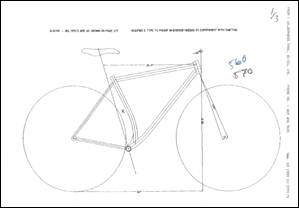
Fisher prototype 29"er drawings
So, this will be given in much the same manner as I received it at the time, which was in a timeline fashion. I will make commentary as this goes along also. 

1999/2000: Starting out with Gary Fisher's first 29"er, which was drawn up and made in Steve Pott's custom bicycle shop. Gary had in mind to do a direct comparison between a 26" and 29" wheeled MTB. His goal was to keep everything he could the same between the two bikes. Geometry, head angles, chain stay lengths, and head tube angles were kept as close as possible to the 26'er. This resulted in a frame with a bent seat tube to keep the chain stays short as possible. Fisher's design goal was to get to an amazingly short 16 1/2" length, which is equivalent to 419.1mm! A modified Manitou Mars fork was crafted as a front fork for the project with travel limited to 50mm. A custom modified XT front derailleur was crafted so it would not interfere with the rear wheel. Much of what was done on this 1st proto were things that would not be seen on 29"ers for a decade or longer. 

Interestingly, Fisher claimed that between he, Mark Slate (head of WTB), and Steve Potts that this was always known as a "29"er" when they referred to this bike. Fisher credits a conversation between he and Mark Slate at Interbike as being when the term was first used. This probably was at the '99 Interbike as "The Tire", the 29"er Nanoraptor, was introduced right at that time. If so, it predates Wes Williams claim of the term by a month, or perhaps a few weeks even. Regardless, as I said, it very well may be that the term was in usage between all the instigators of "The Tire" and no one can really pinpoint when exactly it was first uttered in relation to the wheel size. What matters is that this was a wheel size declared as being the "29"er" out of the gates. 

Update 11/29/23: It has come to light that Slate and Fisher dubbed the tire as a "twenty-nine inch" tire, this according to a Facebook post by Gary himself under his "married name" he uses there, "Gary Zaphiris". I posted the entire written comment by Gary at the bottom of THIS PAGE which is my history of the 29"er. 
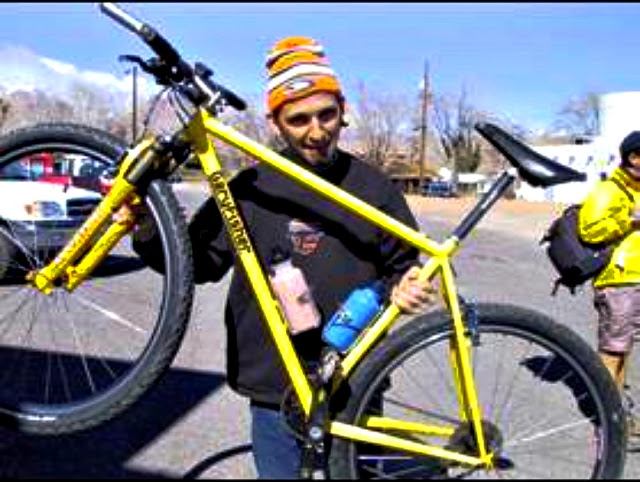
The first Fisher 29"er held by former Mountain Bike Action editor, Zapata Espinoza. (Image courtesy of Gary Fisher.

 As an aside, Gary Fisher claimed that credit for the very first 29 inch wheeled bike belongs to Wes Williams. And what about Fisher's 26'er/29"er comparison? Fisher claimed that in his tests that he was 2-3% faster on the 29"er. That was all he needed to pursue this further. 
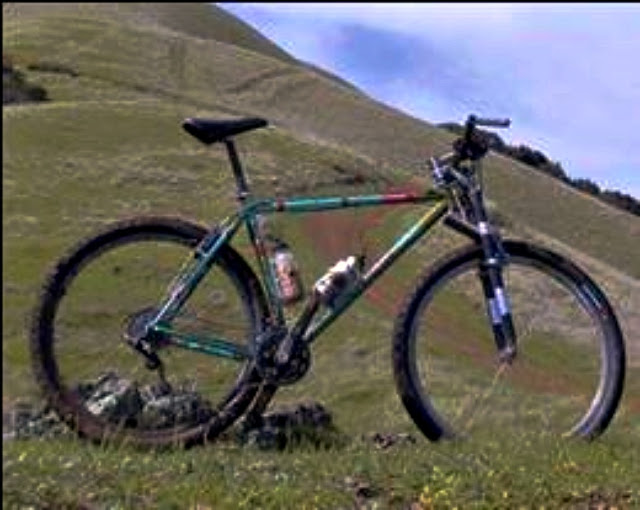
The second Fisher proto 29"er. (Image courtesy of Gary Fisher)
 Two more prototypes were made then in rapid succession. One having a Look Fournales Fork lengthened by none other than Gary Klein to fit a 29"er wheel. The fork was said to have a 450mm axle to crown height. (For reference early 29"er suspension forks with telescoping legs and 80mm of travel were approximately 470-480mm axle to crown. ) This bike had a paint scheme designed by Gary Fisher's daughter. 

The third Fisher 29'"er prototype was made in titanium. (Image courtesy of Gary Fisher)


 The second was followed quickly by a third bike, but this time the bike was made in titanium with paint designed by well known designer, Paul Smith. This had a prototype Marzocchi suspension fork on it. In 2000 another 29"er with Paul Smith designed paint was made which featured an integrated head set. Interestingly, Fisher claimed that they also were working on a "69er" design, which was a mixed 29 inch front, 26 inch rear wheeled idea. 

Update 11/29/23: Recently Gary Fisher has been posting a lot of historical images and relating stories about his past that were mostly unknown to the public before now. Relating to the white hard tail above, Gary posted on 11/28/23 the following:

"This frame was built at Trek by Doug Cusack. It is a one-off. (Note: there were other similarly painted "Team Frames" but Gary's had proprietary geometry that the others did not have) The chain stays are super short and the Marziocii (sic) fork had a knob that would lower the front end by 60mm. I set up the geometry, so I still had pedal clearance when the bike was let down, and the head angle when lowered would be 69 1/2°. When you let the fork out to its 100mm travel, the head angle was closer to 68. Degrees.. this was a great bike for European marathons." 

It is interesting to note that a 68° - 69° head tube angle for 29"ers was generally thought to be unthinkable, crazy, and "would never work" on big MTB wheels like 29"ers back in those days. To see that Gary had tried this and that it worked out was a sign of things to come and introduces the notion that early 29"ers were chasing the wrong ideas. Ideas that were entrenched in the 26"er mindset and not focused on what bigger diameter wheels were actually good at, which finally came into being after about 2012-2014. 

Another interesting tidbit that Gray Fisher brought back to mind was that the UCI had rules on their books making alternative wheel sizes (anything other than 559ISO/26") illegal to use in competition. This arcane rule was starting to be implemented in European races to ban 29"ers from sanctioned events. Gary Fisher went to the UCI personally to lobby against this rule and did see success when the UCI finally recinded the rule and 29"ers were then free to be used in UCI sanctioned events. 

Now, on with the originally posted material.....

Fisher was working hard at trying to get Trek to buy into mass producing the 29" wheeled mountain bike. However, wheels were lacking, the Marzocchi fork was 'floppy', (Gary's term), and they were still trying to figure out the proper geometry and were trying to integrate their new Genesis Geometry into a 29" format. Fisher said that they were working with "less than the best technology" which hampered early acceptance of Fisher 29"ers by athletes and dealers. 
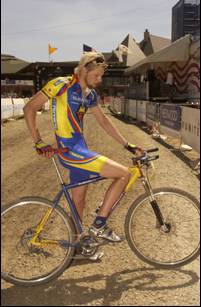
Ryder Hesjedahl on the first Supercaliber in '01 (Image courtesy of Gary Fisher

2001: Fisher Bikes introduces the first Fisher 29"er, the Supercaliber. IRC Tires were developed for the bike. Fisher had a Marzocchi production 29"er fork made for the bikes as well. 

Dealers were baffled by the wheel size and sales people basically ignored the bikes to sell 26"ers. The pressure mounted within Trek to abandon the 29"er experiment. 

2003: Due to poor sales and Fisher being the only company in North America selling 29"ers on a mass scale, Trek seemed poised to cut their losses and kill the 29"er. Internally a suggestion was made to 'hybridize' the 29"er and the Dual Sport models were introduced for the 2003 season. This model, being more closely relatable to hybrid bikes from the 1990's, were a hit with dealers and consumers alike. Gary Fisher said this model line is to be credited with saving the 29"er MTB line from being cut from the Fisher range. In fact, he went as far as to say this was a 'pivotal year' in the history of 29" MTB. 
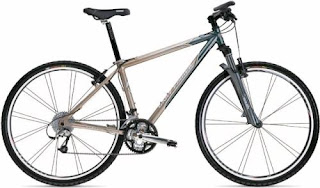
2004 Fisher Dual Sport- the model that saved 29"er MTB.

2004: With the strength of Dual Sport sales, Fisher Bikes was ready to double-down on the 29"er. The company paid out of pocket for all the R&D and tooling to make the Rock Shox Reba 29"er fork, the suspension fork which helped legitimize 29"ers to the mountain biking public. Fisher also designed the new "Rig" model, a single speed MTB which was disc brake specific and came with purpose-built 29"er rims as well. 

2005: The Rig with the Rock Shox Reba is released and it is a Fisher only product. This was a brilliant marketing move in retrospect as Fisher sold out of Rig hard tails and 29"er freaks were left to scramble for Reba take-off forks on the second hand market. This pushed 29"er sales to new heights at Fisher and more good news was coming in as well. Athletes were winning races on 29"ers now. Cam Chambers won on a Fisher 29"er at Single Speed World Championships in '05 as did Jesse La Londe at the Chequamegon Fat Tire 40 that fall. 

2006-2009: Within this three year period 29"ers went from a niche, nearly dead category to the hottest bicycle on the planet. Sales of 29"ers doubled for Fisher in 2006. By 2007, Fisher Team rider Jeremy Horgan-Kobelski was racing 29"ers on the World Cup XC scene. By 2009 he switched to 29"ers exclusively. 

Comments: The early struggles at Fisher Bikes to get 29"ers off the ground nearly sunk the category at Trek. One has to wonder if 29"ers would have remained a niche, small market thing had Trek actually cut the cord in 2004. Remember- Fisher was pretty much the only game in town for non-custom 29" MTB. The rest of the 29"er world was pretty much dominated by custom bike makers. Had Trek pulled out I envision 29"ers being much like what we see today with 36"er wheeled bikes. That being a category of bike on the fringes of the mainstream. 
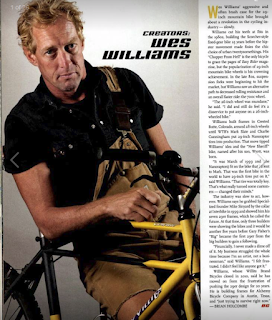
A magazine article featuring Wes Williams and the story of the first 29"er.

You also probably would never have heard about 650B anything. There would have been no reason to move beyond the entrenched 26" wheels. But then again, who knows?

One thing we need to keep reminding ourselves of though is that there are a few key folks who, without their vision, passion, and force of nature in regards to personality, we would not have the bikes we have now. In particular I would single out Gary Fisher, as he not only helped early MTB get off the ground, but it was he that helped push the 29 inch wheel into a place of prominence. Wes Williams has to be credited as the 'force of nature' that would not let big diameter MTB wheels die and no doubt it was Wes that played a pivotal role in getting "The Tire" made in the first place. Then we have to look at Mark Slate and his staff at WTB as the vehicle to get where we are with 29"ers. It was Mark who pretty much had the "kill switch" in his hand which, if pressed, would have pushed the 29 inch wheel off further into the future, or may have killed the idea altogether. 

Obviously there are a host of athletes and industry people to thank here, but if I had to choose a "Mt. Rushmore" of 29"er history it would have Fisher, Slate, Williams, and "The Tire" as its faces. That's my take. You can argue who/what belongs in that pantheon, but in my opinion, those are the main players. 

Thanks: I would be remiss if I did not thank Trek/Gary Fisher Bikes, and specifically Travis Ott, for the invitation all those years ago to go to that Press Camp in Deer Valley Utah. That is where most of the information and images for this post came from.

The Early Days Of 29"ers- A Gary Fisher Perspective

 During a Fisher Bikes Press camp visit I was on in September of 2009, I was privy to hearing tales told by the famous Gary Fisher himself. This conference of media attendees was entertained and informed on Gary Fisher's take on the history of the wheel size from his perspective. I took notes furiously and after returning home I tossed the note pad in a box which I found again recently. 

So, this is over a decade afterward and some gaps in the notation, which I assume I probably thought at the time would be remembered after I got home, have occurred. This following is, to the best of my ability, a reconstruction of what was told then in the Fall of '09.

There were definitely a few things which Mr. Fisher said that seem to contradict tales told elsewhere, so from that standpoint alone this is an interesting bit of information to add to the history. Who is 'right' and who is 'not so right' really doesn't matter here as much as perhaps being able to see that 'like minds were thinking similarly'. Things said and seen may have been subliminally stored in memories and thought, "not very important', or "obvious" at the time and then brought back to mind later. Then it becomes time to 'fix' timelines and history and you know- things that weren't all that important to mark then have to be marked and well.....it can be messy. 

I'd like to think that some of that happened with regard to 29"ers, because, well, who really thought in 1999 that this wheel size would supplant the mighty 26"er completely? No one did. No one figured this would become what it has, and isn't that the way great things go? With all that in mind......

Fisher prototype 29"er drawings
So, this will be given in much the same manner as I received it at the time, which was in a timeline fashion. I will make commentary as this goes along also. 

1999/2000: Starting out with Gary Fisher's first 29"er, which was drawn up and made in Steve Pott's custom bicycle shop. Gary had in mind to do a direct comparison between a 26" and 29" wheeled MTB. His goal was to keep everything he could the same between the two bikes. Geometry, head angles, chain stay lengths, and head tube angles were kept as close as possible to the 26'er. This resulted in a frame with a bent seat tube to keep the chain stays short as possible. Fisher's design goal was to get to an amazingly short 16 1/2" length, which is equivalent to 419.1mm! A modified Manitou Mars fork was crafted as a front fork for the project with travel limited to 50mm. A custom modified XT front derailleur was crafted so it would not interfere with the rear wheel. Much of what was done on this 1st proto were things that would not be seen on 29"ers for a decade or longer. 

Interestingly, Fisher claimed that between he, Mark Slate (head of WTB), and Steve Potts that this was always known as a "29"er" when they referred to this bike. Fisher credits a conversation between he and Mark Slate at Interbike as being when the term was first used. This probably was at the '99 Interbike as "The Tire", the 29"er Nanoraptor, was introduced right at that time. If so, it predates Wes Williams claim of the term by a month, or perhaps a few weeks even. Regardless, as I said, it very well may be that the term was in usage between all the instigators of "The Tire" and no one can really pinpoint when exactly it was first uttered in relation to the wheel size. What matters is that this was a wheel size declared as being the "29"er" out of the gates. 

Update 11/29/23: It has come to light that Slate and Fisher dubbed the tire as a "twenty-nine inch" tire, this according to a Facebook post by Gary himself under his "married name" he uses there, "Gary Zaphiris". I posted the entire written comment by Gary at the bottom of THIS PAGE which is my history of the 29"er. 

The first Fisher 29"er held by former Mountain Bike Action editor, Zapata Espinoza. (Image courtesy of Gary Fisher.

 As an aside, Gary Fisher claimed that credit for the very first 29 inch wheeled bike belongs to Wes Williams. And what about Fisher's 26'er/29"er comparison? Fisher claimed that in his tests that he was 2-3% faster on the 29"er. That was all he needed to pursue this further. 

The second Fisher proto 29"er. (Image courtesy of Gary Fisher)
 Two more prototypes were made then in rapid succession. One having a Look Fournales Fork lengthened by none other than Gary Klein to fit a 29"er wheel. The fork was said to have a 450mm axle to crown height. (For reference early 29"er suspension forks with telescoping legs and 80mm of travel were approximately 470-480mm axle to crown. ) This bike had a paint scheme designed by Gary Fisher's daughter. 

The third Fisher 29'"er prototype was made in titanium. (Image courtesy of Gary Fisher)


 The second was followed quickly by a third bike, but this time the bike was made in titanium with paint designed by well known designer, Paul Smith. This had a prototype Marzocchi suspension fork on it. In 2000 another 29"er with Paul Smith designed paint was made which featured an integrated head set. Interestingly, Fisher claimed that they also were working on a "69er" design, which was a mixed 29 inch front, 26 inch rear wheeled idea. 

Update 11/29/23: Recently Gary Fisher has been posting a lot of historical images and relating stories about his past that were mostly unknown to the public before now. Relating to the white hard tail above, Gary posted on 11/28/23 the following:

"This frame was built at Trek by Doug Cusack. It is a one-off. (Note: there were other similarly painted "Team Frames" but Gary's had proprietary geometry that the others did not have) The chain stays are super short and the Marziocii (sic) fork had a knob that would lower the front end by 60mm. I set up the geometry, so I still had pedal clearance when the bike was let down, and the head angle when lowered would be 69 1/2°. When you let the fork out to its 100mm travel, the head angle was closer to 68. Degrees.. this was a great bike for European marathons." 

It is interesting to note that a 68° - 69° head tube angle for 29"ers was generally thought to be unthinkable, crazy, and "would never work" on big MTB wheels like 29"ers back in those days. To see that Gary had tried this and that it worked out was a sign of things to come and introduces the notion that early 29"ers were chasing the wrong ideas. Ideas that were entrenched in the 26"er mindset and not focused on what bigger diameter wheels were actually good at, which finally came into being after about 2012-2014. 

Another interesting tidbit that Gray Fisher brought back to mind was that the UCI had rules on their books making alternative wheel sizes (anything other than 559ISO/26") illegal to use in competition. This arcane rule was starting to be implemented in European races to ban 29"ers from sanctioned events. Gary Fisher went to the UCI personally to lobby against this rule and did see success when the UCI finally recinded the rule and 29"ers were then free to be used in UCI sanctioned events. 

Now, on with the originally posted material.....

Fisher was working hard at trying to get Trek to buy into mass producing the 29" wheeled mountain bike. However, wheels were lacking, the Marzocchi fork was 'floppy', (Gary's term), and they were still trying to figure out the proper geometry and were trying to integrate their new Genesis Geometry into a 29" format. Fisher said that they were working with "less than the best technology" which hampered early acceptance of Fisher 29"ers by athletes and dealers. 

Ryder Hesjedahl on the first Supercaliber in '01 (Image courtesy of Gary Fisher

2001: Fisher Bikes introduces the first Fisher 29"er, the Supercaliber. IRC Tires were developed for the bike. Fisher had a Marzocchi production 29"er fork made for the bikes as well. 

Dealers were baffled by the wheel size and sales people basically ignored the bikes to sell 26"ers. The pressure mounted within Trek to abandon the 29"er experiment. 

2003: Due to poor sales and Fisher being the only company in North America selling 29"ers on a mass scale, Trek seemed poised to cut their losses and kill the 29"er. Internally a suggestion was made to 'hybridize' the 29"er and the Dual Sport models were introduced for the 2003 season. This model, being more closely relatable to hybrid bikes from the 1990's, were a hit with dealers and consumers alike. Gary Fisher said this model line is to be credited with saving the 29"er MTB line from being cut from the Fisher range. In fact, he went as far as to say this was a 'pivotal year' in the history of 29" MTB. 

2004 Fisher Dual Sport- the model that saved 29"er MTB.

2004: With the strength of Dual Sport sales, Fisher Bikes was ready to double-down on the 29"er. The company paid out of pocket for all the R&D and tooling to make the Rock Shox Reba 29"er fork, the suspension fork which helped legitimize 29"ers to the mountain biking public. Fisher also designed the new "Rig" model, a single speed MTB which was disc brake specific and came with purpose-built 29"er rims as well. 

2005: The Rig with the Rock Shox Reba is released and it is a Fisher only product. This was a brilliant marketing move in retrospect as Fisher sold out of Rig hard tails and 29"er freaks were left to scramble for Reba take-off forks on the second hand market. This pushed 29"er sales to new heights at Fisher and more good news was coming in as well. Athletes were winning races on 29"ers now. Cam Chambers won on a Fisher 29"er at Single Speed World Championships in '05 as did Jesse La Londe at the Chequamegon Fat Tire 40 that fall. 

2006-2009: Within this three year period 29"ers went from a niche, nearly dead category to the hottest bicycle on the planet. Sales of 29"ers doubled for Fisher in 2006. By 2007, Fisher Team rider Jeremy Horgan-Kobelski was racing 29"ers on the World Cup XC scene. By 2009 he switched to 29"ers exclusively. 

Comments: The early struggles at Fisher Bikes to get 29"ers off the ground nearly sunk the category at Trek. One has to wonder if 29"ers would have remained a niche, small market thing had Trek actually cut the cord in 2004. Remember- Fisher was pretty much the only game in town for non-custom 29" MTB. The rest of the 29"er world was pretty much dominated by custom bike makers. Had Trek pulled out I envision 29"ers being much like what we see today with 36"er wheeled bikes. That being a category of bike on the fringes of the mainstream. 

A magazine article featuring Wes Williams and the story of the first 29"er.

You also probably would never have heard about 650B anything. There would have been no reason to move beyond the entrenched 26" wheels. But then again, who knows?

One thing we need to keep reminding ourselves of though is that there are a few key folks who, without their vision, passion, and force of nature in regards to personality, we would not have the bikes we have now. In particular I would single out Gary Fisher, as he not only helped early MTB get off the ground, but it was he that helped push the 29 inch wheel into a place of prominence. Wes Williams has to be credited as the 'force of nature' that would not let big diameter MTB wheels die and no doubt it was Wes that played a pivotal role in getting "The Tire" made in the first place. Then we have to look at Mark Slate and his staff at WTB as the vehicle to get where we are with 29"ers. It was Mark who pretty much had the "kill switch" in his hand which, if pressed, would have pushed the 29 inch wheel off further into the future, or may have killed the idea altogether. 

Obviously there are a host of athletes and industry people to thank here, but if I had to choose a "Mt. Rushmore" of 29"er history it would have Fisher, Slate, Williams, and "The Tire" as its faces. That's my take. You can argue who/what belongs in that pantheon, but in my opinion, those are the main players. 

Thanks: I would be remiss if I did not thank Trek/Gary Fisher Bikes, and specifically Travis Ott, for the invitation all those years ago to go to that Press Camp in Deer Valley Utah. That is where most of the information and images for this post came from.

Saturday, January 19, 2019

Minus Ten Review 2009- 3

Early marketing handout from WTB about the "new" 29"er tire, the Nano
Ten years ago on the blog I was talking about how history was made by "The Tire". Since I've been on a bit of a history bent lately, this seems fitting to discuss for today's look back.

If you haven't heard about "The Tire", you could be forgiven. It was the component necessary to kick into motion the entire movement toward how we experience and know mountain biking today. WTB introduced "The Tire" in 1999, and while it didn't catch on right away, eventually it did, and a bunch of other folks followed in "The Tire's" tracks.

Of course, I am referring to the WTB 29" X 2.1" Nanoraptor tire. This is the tire which spurred Wes Williams of Willits to coin the term "29"er", and it was the tire that Gary Fisher did a lot of testing around and motivated him to want to add 29"ers to the Gary Fisher Mountainbike line up in 2001.

Anyway, ten years ago I came across a scan of a document which was handed out by WTB to dealers and OE manufacturers describing this new thing. It is kind of cool to have these sorts of historical touch points to reflect upon. If you'd like to read more about 29"er's beginnings, I wrote a series on that called "The Beginnings of the Modern 29"er: A History" where you can read all about it, as they say.

Back ten years ago the entire 29'er thing was still being argued about and being put down by many mountain bikers. Of course, things have changed and even those who said ten years ago that 26" DH bikes would never die now are probably riding 650B wheeled DH sleds or even 29"er DH bikes.

My how times have changed!

The Green Belt ten years ago this week. There would be a LOT more fat bike tracks now!
Also ten years ago this week there was a LOT of snow and very cold temperatures. Of course, it would be another two years before anyone around here had fat bikes. But let's be honest here......hardly anyone did anything outside back then. 

I mean, just look at the image. XC ski tracks, and..........nothing else! Think about all the folks walking, snow shoeing, and fat biking. This would be an unheard of scene now in the Green Belt if we have snow. But ten years ago I pretty much had the Green Belt to myself for XC skiing. I cannot recall seeing maybe more than a handful of people doing skiing, or anything else, out there in the winter when I XC skied.

Maybe I should call that time "BF"- before fatbikes! Ha!

But there was something about what happened in 2012-2013 when everyone and their brother discovered fat bikes and started getting outside and off trainers and what not. Suddenly the woods were tracked to death by every mode of Winter-specific travel types. Not to mention all the post-holed bumps given to us by walkers. Yes, suddenly everyone was on the trails.

Weird how that works.

Monday, December 20, 2010

More On The Beginnings Of The Modern 29"er: Part V

It's winter, the "off-season", and I don't have much better to do than to delve back into this whole deal again. I wanted to lay some groundwork as to the "pre-history" of the "modern 29"er" as I call it. (You can read Part IV here)

Why The Nano And What Happened Afterward: As we have seen in Part IV, WTB was being pressured to make the first true, 2.0-plus 622ISO tire with a mountain bike tread. No tire this large with this aggressive a tread had ever been proposed, much less built before. Questions as to whether the mold machines in Asia could even handle such a tire were very real and were considered seriously. This on top of whether or not WTB could ever recoup their investment into such a tire in the first place.

These questions and more were what drove the choice of the first tread pattern to be used in making this new 700c based mountain bike tire. Wes Williams wanted to see something like WTB's immensely popular Velociraptor tires become the new tire for 700c mountain biking. However; when he visited WTB in 1998 to pursue his dream of getting a mountain bike tire in 700c, he was shown something different. Charlie Cunningham, (who was a founder of WTB and was still working there at that time), showed him a prototype 26"er tire called the Nanoraptor. It was a racing tread with lots of smallish, low height tread blocks. Not at all like the big-blocked Velociraptor tires. This was the tread design WTB had in mind for the new, bigger diameter mountain bike tire.

Was it a fear that the mold machines wouldn't accept a bigger, blockier tread design? Actually, this is a valid point. 29"er tires have been limited in this regard until very recently, so it may have been a contributing factor to getting the Nano made instead. Was the bigger, more aggressive design not appealing for other reasons? Perhaps. It very well may be that Mark Slate, WTB's head tire designer, may have thought things through and foresaw that the Nano would be a better "first impression" for the 29"er format than the other choices he had at hand.

No matter in the end. WTB made good on the Nano in 700c size and by early 1999, the first prototypes were in the hands of Gary Fisher and Wes Williams. (See this post for more detail) Very quickly things started to move forward in the back round of mountain biking. Wes Williams made several "29"ers", as he dubbed them, early on. It was an obvious step up from his 28"ers, so it only made sense to call the bikes fitted with the new tires 29"ers. The moniker caught on with the early supporters, who included Bob Poor, a fellow who was one of Wes' friends, and internet saavy. Bob hopped on mtbr.com and also started a website that pronounced the benefits of 29"ers to a world-wide audience. Things didn't take off right away, but a small ground swell of riders that believed in the concept and were involved in the internet culture began to make small inroads into the consciousness of the mountain biking's cutting edge riders.

Meanwhile, Gary Fisher was busy doing his own testing, having prototypes made by Steve Potts, and later, by Trek. Gary had the first primitive suspension devices, modified 26 inch forks, and was also instrumental in working out design issues with components like the front derailleurs, and geometry for the big wheelers. Finally, in 2001, Gary Fisher Bikes introduced a 29"er mountain bike in their line up. Across the pond, Nishiki also jumped in with their "Bigfoot" model. 29"ers were commercially available for the first time.

That wasn't the end of the story, and the 29"er story is still being written to this day. In my next post on this topic, I will touch upon "The Early Days Of 29"ers". Stay tuned for that. Then I will offer up a closing post on this series.

Friday, December 17, 2010

More On The Beginnings Of The Modern 29"er: Part IV

It's winter, the "off-season", and I don't have much better to do than to delve back into this whole deal again. I wanted to lay some groundwork as to the "pre-history" of the "modern 29"er" as I call it.(Part III can be read here.)


The Main Players Set The Stage For "The Tire": In all that came before the WTB Nanoraptor, the thing all the riders of 700c based mountain bikes were noting was that a truly voluminous, aggressively treaded mountain bike tire did not exist and was the one thing that most of these folks felt was the thing holding back 700c from becoming a truly viable size for off road bicycles.

Not that there weren't efforts being made despite that fact. Not that things like geometry and proper frames hadn't been made, because they had been done. Still, none of this was quite working as well as 26 inch based mountain biking, but the performance of the 700c stuff was so tantalizingly close and showed so much promise that the people behind the 700c movement were not giving up. If anything, they were even more determined to see it through.

In my last post I mentioned that Gary Fisher (and Charlie Kelly too, by the way), had some big wheeled  influence from Englishman Geoff Apps. Well, they may also have picked up a cue from local frame builder and general mountain bike genius, Charlie Cunningham. Charlie was often seen riding a bike with a 28"er/700c based front wheel because he liked it better than a 26"er front. Here I will quote from Mark Slate of WTB:

"Charlie has been riding a 700x35c tire bike since I think about
1978. I think the first thing Charlie heard of a fat tire for 700c rims
was when Wes came out here and brought his "Mountie" with 700x47c Goliath tires."


So it would seem that Charlie Cunningham also may have had some influence on the thoughts that a 700c mountain bike wheel may be viable thing. 

<=== 1993 Rock n Road. Image from X0-1.org 

 Another of the early "big wheel" proponents was Bruce Gordon, a frame maker in the city of Petaluma, California. Bruce was pushing the idea of a "multi-terrain" 700c bike he called the "Rock n Road" bike. WTB's Mark Slate remembers Bruce in this e-mail transcription found in a thread on mtbr.com:

"Bruce is a highly opinionated and talkative guy (if he has the right audience). He is an ace frame builder himself, so experimenting with bike geometry is something he has done plenty.....No doubt in my mind that Bruce favored the bigger wheels."

Ross Shafer, the founder of Salsa Cycles, had a shop in Petaluma as well, and his remembrances of Bruce and 700c for off road cycling are also found in a thread on mtbr.com:


"Bruce Gordon (his shop was next to Salsa's at that time in history) is indeed the first person I know of who seriously pursued trying to get fatter tires for 700c rims. I know that Wes (Williams, of Willits fame),  and he were pals, but I have no idea how much Wes had to do inspirationally or logistically with those first bigger tires Bruce got ahold of (had made?). I know that before Bruce got his tires going the biggest they could find was indeed the Hakkapelitas (sp?) from Finland. This was back in the days when the bike industry was trying hard to create a new "niche" and tried really hard to push "hybrid" bikes. A hybrid bike being a 700c bike with upright bars and tires that were fatter than your usual 700c fare. Bruce sold quite a few of the "Rock n' Road" bikes that he designed around the bigger tires he got. But the whole hybrid thing became more of a joke in the industry than anything else. Wes' is the man when it comes to really pushing the 29'er mtb thing. Wes was a friend of mine as well and if I recall correctly he first caught the bug by offroading on his fixed gear 700c scorcher bike"

From the above we can safely say that Bruce Gordon was a touchstone for setting off the big wheeled 700c idea in several folks minds, but most importantly, Wes Williams.  Wes, who was the principal frame builder, designer, and production manager at Ibis Cycles for 9 years, was tinkering around with ideas he gleaned from late 19th/early 20th century designers. He built his first "28"er" in 1988 and never looked back to 26"ers again.

Wes was thoroughly convinced that the early bicycling experimentalists that landed on the 28"er as being the ideal size for rough roading were still as right as ever, and he was willing to tell anyone that would sit still long enough to listen. Wes made a trip to see WTB and brought a 28"er with him. Again we hear from Mark Slate:

"Wes and I rode together and he left the bike with WTB so others could
ride and experience the big wheel feel. He pushed hard as you know Wes will
do when he has an idea of the better way and he certainly was not shy about
letting others know that the little wheels were inferior. I'm not sure
of the dates when Wes was here but he might remember."


The stage was being set. Gary Fisher was poking around at this time as well, having a race team sponsored by WTB in the 90's. The big wheeled idea was now seeping into the minds at WTB as shown by this inter-company Word Document Mark Slate shared from WTB in the same mtbr.com thread referenced before:

"Some old Word docs
survived somehow. In search of the "smoking gun" I found this (to the mold
maker):

September 28, 1998 - Gary Fisher has been after WTB to produce a 622

bead "2.1" tire. Several top riders I know in Colorado have bikes to fit
these 28" (+) tires. The Continental Goliath 47mm is now being used. These
guys are also interested in a full size tire to fit 700c rims. There is
validity to this size and we may be seeing future production of bigger wheel
mountainbikes. Mold production for this diameter tire may be a problem. Please
inform me regarding production of the 2.1 Nano Raptor with a 622mm bead.
"


With the tenuous promises of "future production mountain bikes" and Wes Williams passionate evangelism, WTB set off to do what hadn't been done before: Make a true 2 inch wide mountain bike tire based on a racing tread pattern in 26 inch size. What became known as "The Tire" to the early proponents of 29"ers- The WTB Nanoraptor.


Next: Why The Nano And What Happened Afterward.....

Saturday, December 04, 2010

More On The Beginnings Of The Modern 29"er

Update: Yesterday in my "Friday News And Views" post, I gave a very brief history of the first "modern day 29"er" built by Wes Williams, (<==image again here), and I received some important additional information I put in the comments section.  Since not everyone is going to wade in there and see those comments, I am going to post them up today as an update to the story. (Click the title above or scroll down to see the post from yesterday.)

First off, the information was all provided via Facebook by Wes Williams hisself. So, it is straight from the source here. Wes wanted us to know he was more than just a welder at Ibis back in the day, saying, "...I was principal framebuilder / designer/ production mgr. at Ibis , not just the welder . I worked there 9 years" By the way, those fabulously collectible Scorchers Ibis once made? Yeah.....Wes Williams. Pre-dating hipster craziness by a decade or more.

Then Wes also updated the whole story behind the first 29"er he made. Here is his communication to me in full:

hey
I tried to comment on your blog , but unsuccessfully . Good on you ! I credit Bruce Gordon and Gary Helfrich for finding the first real 28" tire , a 700-47 Nokia Hakkapelitta in 1987 , and I made my first 28" in 1988 .( 700-38 does not qualify ) This was the same year the Rockshox was introduced , yet I was already bored with 26" , and have been riding the 28" off-road since then . The " hybrids " introduced in the early 90's ran 45c Smokes at best , and I imported 300 Goliaths in 1995 . This was the largest tire in existence at the time . The Mountie pictured was completed in 1997 and was designed for a tire that did not yet exist .This was the bike that Mark Slate was loaned over the winter of '98/'99 , to decide if I was full of shit or not . ( I wasn't ) . Bob Poor deserves credit also , as he backed me up all the way and came to my defense for years on the internet . I had told Mike Sinyard ( president of Specialized ) in 2000 that it would take 8-10 years for general acceptance , and that is just about right . Moots built Don Crook's bike in May 1999 , and I had completed several bikes for the Nano by then . Gary had to wait for Potts to build his personal bike , as he doesn't actually build frames , and Fisher introduced one model in 2000 .I hope this helps fill you in further as to who is responsible . Bruce should get some credit for his Rock n Road , which was the precurser to that whole fleet of hybrids of the early 90's and to mine , also .

Okay, so let me 'splain a few points Wes brought up here. First off, the personas of Gary Helfrich and Bruce Gordon. First, Gary Helfrich, who was a partner in Fat City Cycles, and started Merlin back in '86. Bruce Gordon is still a crack frame builder and has been for years. Gordon pioneered the use of bigger rubber on 700c rims with his "Rock and Road" concept back then. Gordon helped push the idea that the bigger diameter wheel was a good thing off road.

Mark Slate, who has been with WTB forever and a early mountain bike pioneer, helped design the Nanoraptor, "The Tire" that got the whole 29"er she-bang going.  Bob Poor is a former Crested Butte resident who used to post on mtbr.com as "Bigwheel" back in the day and was a loud proponent of all things "29"er". (Note: Bob is the reason I continue to post the numerical moniker for the big wheels as I do, and it is a tribute to his early influences on me and others. So: it is written by me as 29"er not 29er, or in other mistaken ways of doing that, like "two-niner", etc)

Next up is Mike Sinyard, who Wes gives the identity of already, so no further word from me is necessary. Following that is the name of Don Cook, who is the curator of the Mountain Bike Hall Of fame, and himself a claimant to the "first 29"er story". (Thus Wes' misspelling of his last name in the quote above. I won't get any further into that!)

Then we have "Gary" and "Potts" who are references to Gary Fisher, (No explanation necessary), and Steve Potts, a frame builder, mountain bike pioneer, and formerly of WTB.

So, there ya go! Like I said, I just scratched the surface on that historical moment and Wes just downloaded all of that additional stuff, which I thought deserved to be seen as well.

Friday, December 03, 2010

Friday News And Views

Milltown Cycles Mukluk Release/Winter Arrival Party: I'll be skipping town this weekend to attend the Mukluk/Winter party-dealio thing at Milltown Cycles in Faribault, Minnesota Saturday evening. Proprietor Ben Witt and his mechanic Curtis have been busy sprucing up the joint of late and this is kind of an excuse to show off their accomplishments and get some bike geeks that Ben wants to see to show up. And there will be some serious bike-geekery going on, lemme tell ya! I happen to have an inside track on some of the esteemed attendees and I know that the vortex of bike gab will certainly be swirling around the confines of Ben's shop well into the evening. Look for a report on that coming up on Monday, most likely.

Time For A Concept Bike: Part of the bike geek-speak that will be happening will have to do with this project while I am up there. Ben tells me that he has been cooking up some ideas and we'll have the ears of various bike designer types to bend while we are there munching on whatever Ben has cooked up on the grill outside. This project is not just an exercise in brain warpage either. I am serious about actually putting the plan into motion for an as yet undisclosed gravel adventure I am putting on my calendar as a goal for next year. More on that goal later, but do look for a report of sorts on this project soon.

And Speaking Of Concepts.... The biggest in mountain biking this century is arguably the 29 inch wheel. It has revolutionized the way people not only think about their off road ride, but how they ride off road. I know it changed the way I looked at mountain biking forever. It's more fun, and that's the bottom line. Well, some know the story and some don't, but I found an image this week I wanted to share with everyone. It's been too long for this blog to have been going without this image having been shown here.


<==March, 1999: The first "modern 29"er" is born. (image credit: Wes Williams)

A bunch of people including Wes Williams, Gary Fisher, and others, had persuaded WTB's Mark Slate to make a ISO622 X 50 tire based upon WTB's then current racing tread, the Nanoraptor. A small batch were made early in 1999 and handed out to the principals involved in the then tiny movement to bring bigger wheels to mountain biking.

Wes Williams, who had formerly been a welder at Ibis Cycles, had been quietly making his "28"ers" in Crested Butte, Colorado using the largest ISO622/700c tires he could get his hands on at the time. These bikes were made under the Willits Brand name. (Mostly Continental Goliaths) These tires were not really mountain bike tires, being somewhat skinny, (45mm or so in width), and not having an ideal tread pattern for mountain biking. Wes noted that the outer diameter was nominally 28 inches, thus the "28"er" designation.

Wes got some of the first Nanoraptors and was quickly turning 28"ers into what he dubbed as "29"ers", seeing as how the overall outside diameter had increased with the Nanoraptor. In March, 1999, Wes unleashed the first of these bikes. Moots made one later in the year, and Gary Fisher and Steve Potts collaborated with Mark Slate to build others by late 1999/early 2000. The 29"er movement was underway.

Now some will point back to other bikes based on 700c wheels and say, "What about ____". Well, the thing is, none of those bikes had a two inch wide/50mm tire and since that was the case, none of them had a nominal 29" outer diameter. Yes- there were 700c  based mtb bikes and even going further back, 28"ers being made in the late 1800's, but nothing had ever been concocted to match that first orange rig in Crested Butte in March of '99. That's where we got our "modern 29"er". That's where this all started as far as a bicycle that could become what it has today. It all hinged upon getting that big, voluminous tire that just didn't exist before 1999.

It is as if several threads of thought got focused on that one moment when "The Tire" was conceptualized and first produced, then all those threads of thought were wrought into something new that spread back out and grew and became the 29"er movement, and now is well on its way to becoming "just a mountain bike".

Well, that's a shortened version of a very big, very complex story, but there ya go! Hope you enjoyed that and I hope ya'all can get outside and enjoy the world this weekend! Ride On!