Showing posts with label Seigla gravel bike. Show all posts

Wednesday, April 13, 2022

Lauf Seigla Breaks Conventions For Gravel Bikes

Lauf Seigla: Image courtesy of Lauf Cycling
With this week's news of Lauf Cycling's new Seigla model, I thought it would be good to take a look at the specifics regarding the changes to typical gravel bicycle conventions that this new design brings to the table. If you want to just read about the overview of the bike, see my RidingGravel.com report here

Okay, so what exactly is the big deal here? Well, first off you should be aware that the differences between "road" and "mountain bike" essentially have been unsaid standards and really- limiters to design over the past 30+ years. 

It has only been since around the early 90's that this really all has fell into place, and the economics of the industry have really kept these unspoken standards in effect up until this day. These are the reasons why mountain bike and road bike drive train compatibilities went to wildly different places. It is why you have to get 'gizmos' to make an Eagle cassette work with a Red crank set. Had 'road' and 'mountain' not been kept so separate, this may not have happened, but for reasons of manufacturing ease and lower costs, that is what happened and basically why we are where we are now. 

So, road bikes have a set, overall spacing for wheels and bottom bracket width so that road crank sets and wheels can align for the best possible shifting performance. This informs much of the rest of a road bike design, such as tire clearances, how big that your chain rings can be, and more. On the mountain bike side, things have shifted, (pardon the pun) to Boost and "Boost Plus", but start out with the basic widths for axles and bottom brackets, which- again- inform chain ring sizes, tire clearances, and help to make 1X shift better around big, fat MTB tires. (Note: Fat bikes are their own thing, and being niche, are not included here) 

Manufacturers and designers have, up until now, been reticent to mess with crossing the lines between "MTB" and "Road" basic dimensional boundaries. However; what Lauf has done here is to push for what is essentially the base dimension for MTB in the crank set/bottom bracket area so that they can get a 29"er tire (700c X 57mm) squeezed into their Seigla without resorting to frame weirdness like dropped chain stays, elevated chain stays, or what have you. 
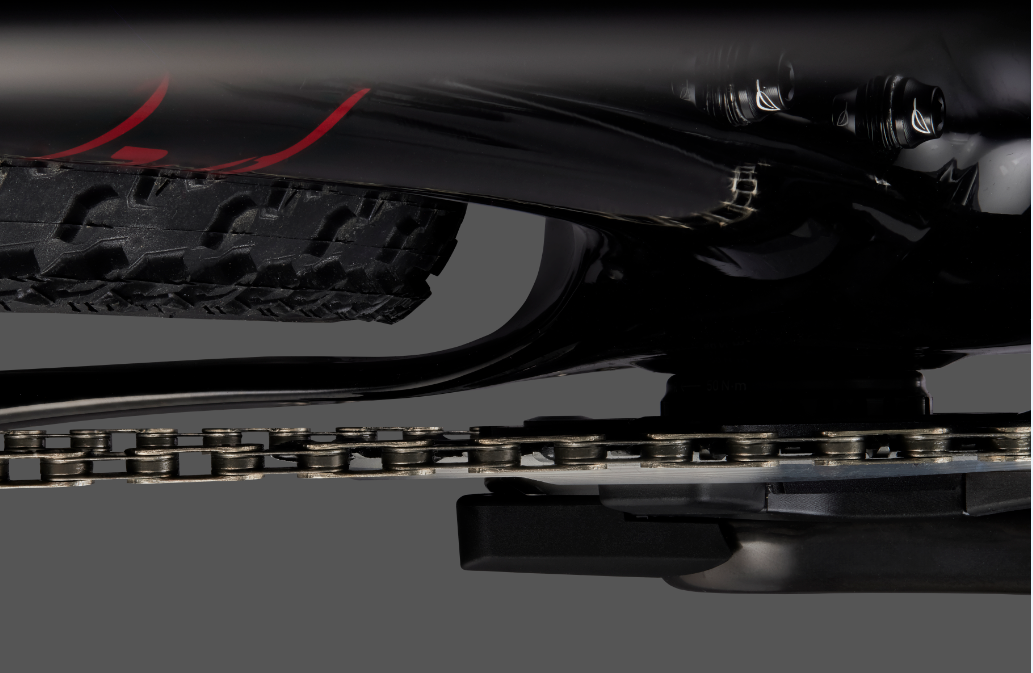
By using the 73mm bottom bracket width, Lauf could go big on tire sizes. (Image courtesy of Lauf Cycling)

Of course, Lauf says this is how it always should have been for gravel bikes. Hmm.....perhaps. But what if Lauf has really only gone 1/3rd of the way to where gravel bikes really should be? Let's see where all of this could lead....

My take is that the Overlock Dimension (distance between drop outs of a frame) that road bikes use, is set for a change again. Disc brakes finally made manufacturers of road bikes move to 135mmOD rear ends, which is where MTB started out as a standard back in the late 1980's as well. But I think that what a few other companies have done should be also done in gravel bikes, (and road bikes, really), and that is to just get on with it and move everything to Boost spacing, which is 148mm through axle. While a few companies are doing this now, this is not adapted to crank sets yet, and so I think matching this up with Lauf's move to 73mm bottom brackets would be wise. 

GRX crank sets, (and some others) have already moved the chain line outboard by 2,5mm's, so we are headed in this direction anyway. Getting to a Boost width may turn off some who are worried about the "Q" factor, that distance between the pedals which determines stance of your feet. I think that should only be a racer's concern, and I think it can also be engineered out of being a concern. 

What is the third thing? Front wheel spacing. there is no reason at all to stick with 100mmOD for gravel. We should already be using 110mm through axle spacing, and honestly, if we wanted to be radical, I'd go to 142mm front. The difference in wheel stiffness is immense, and gravel bikes shouldn't be hamstrung by making room for suspension forks, so there really isn't much that I can think of that wouldn't work there, but we should at least be at 110mm. 

So, Lauf is on the right track, but let's get all of the changes and move forward.

Lauf Seigla Breaks Conventions For Gravel Bikes

Lauf Seigla: Image courtesy of Lauf Cycling
With this week's news of Lauf Cycling's new Seigla model, I thought it would be good to take a look at the specifics regarding the changes to typical gravel bicycle conventions that this new design brings to the table. If you want to just read about the overview of the bike, see my RidingGravel.com report here

Okay, so what exactly is the big deal here? Well, first off you should be aware that the differences between "road" and "mountain bike" essentially have been unsaid standards and really- limiters to design over the past 30+ years. 

It has only been since around the early 90's that this really all has fell into place, and the economics of the industry have really kept these unspoken standards in effect up until this day. These are the reasons why mountain bike and road bike drive train compatibilities went to wildly different places. It is why you have to get 'gizmos' to make an Eagle cassette work with a Red crank set. Had 'road' and 'mountain' not been kept so separate, this may not have happened, but for reasons of manufacturing ease and lower costs, that is what happened and basically why we are where we are now. 

So, road bikes have a set, overall spacing for wheels and bottom bracket width so that road crank sets and wheels can align for the best possible shifting performance. This informs much of the rest of a road bike design, such as tire clearances, how big that your chain rings can be, and more. On the mountain bike side, things have shifted, (pardon the pun) to Boost and "Boost Plus", but start out with the basic widths for axles and bottom brackets, which- again- inform chain ring sizes, tire clearances, and help to make 1X shift better around big, fat MTB tires. (Note: Fat bikes are their own thing, and being niche, are not included here) 

Manufacturers and designers have, up until now, been reticent to mess with crossing the lines between "MTB" and "Road" basic dimensional boundaries. However; what Lauf has done here is to push for what is essentially the base dimension for MTB in the crank set/bottom bracket area so that they can get a 29"er tire (700c X 57mm) squeezed into their Seigla without resorting to frame weirdness like dropped chain stays, elevated chain stays, or what have you. 

By using the 73mm bottom bracket width, Lauf could go big on tire sizes. (Image courtesy of Lauf Cycling)

Of course, Lauf says this is how it always should have been for gravel bikes. Hmm.....perhaps. But what if Lauf has really only gone 1/3rd of the way to where gravel bikes really should be? Let's see where all of this could lead....

My take is that the Overlock Dimension (distance between drop outs of a frame) that road bikes use, is set for a change again. Disc brakes finally made manufacturers of road bikes move to 135mmOD rear ends, which is where MTB started out as a standard back in the late 1980's as well. But I think that what a few other companies have done should be also done in gravel bikes, (and road bikes, really), and that is to just get on with it and move everything to Boost spacing, which is 148mm through axle. While a few companies are doing this now, this is not adapted to crank sets yet, and so I think matching this up with Lauf's move to 73mm bottom brackets would be wise. 

GRX crank sets, (and some others) have already moved the chain line outboard by 2,5mm's, so we are headed in this direction anyway. Getting to a Boost width may turn off some who are worried about the "Q" factor, that distance between the pedals which determines stance of your feet. I think that should only be a racer's concern, and I think it can also be engineered out of being a concern. 

What is the third thing? Front wheel spacing. there is no reason at all to stick with 100mmOD for gravel. We should already be using 110mm through axle spacing, and honestly, if we wanted to be radical, I'd go to 142mm front. The difference in wheel stiffness is immense, and gravel bikes shouldn't be hamstrung by making room for suspension forks, so there really isn't much that I can think of that wouldn't work there, but we should at least be at 110mm. 

So, Lauf is on the right track, but let's get all of the changes and move forward.