Showing posts with label Wide Tires On Gravel. Show all posts

Tuesday, May 13, 2025

Wide Tires On Gravel: The Effects Of Wider Tires On The Bike

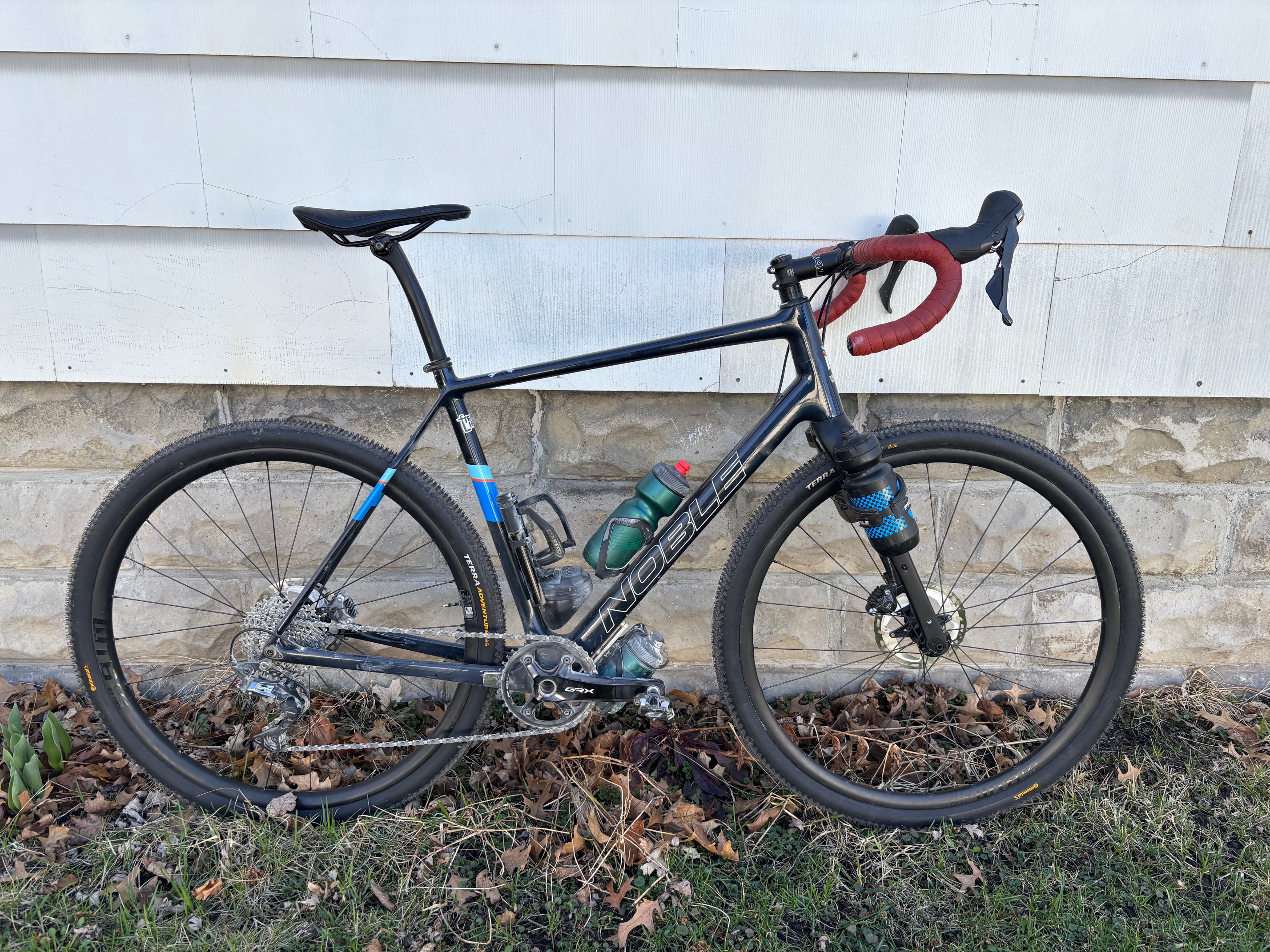
The bike I used for testing: Noble GX5
 Welcome back to the series on why wider gravel tires may or may not be a good idea for you. In this post I will look at what wider tires can do to your bicycle's geometry if you modify a current bike, and what those bigger tires can do to handling. I wrote a bit in the last post in this series about what wider tires can do to your gearing and more. Check that out if you missed it HERE.

Now, let's dive into this subject again by taking a look at whether you can do a wider tire to your current bike, what you can do to gain some advantages via modification, and how this may affect geometry on your bike.

You may not realize this, but any bicycle you purchase through a major brand has probably been made to comply with several European standards so they can be sold in Europe. Typically those standards which must be met are more stringent than Consumer Product Safety Commission (CPSC) standards which hold sway in the US. Specifically to tire clearance, the CPSC standard is 1.6mm clearance from the tire to a fork or frame member. (According to a Google search) I was told several years ago by a product manager for a mid-tier brand in the US that the Euro regs. were 5mm clearance. So, your bicycle may be equipped with tires which are not really the "maximum" size that you could use. Of course, what I am about to share here is all what I have done. I do not recommend that you do this, and if you push tire clearances, that's on you. You are responsible for any choices you make here.

Do You Need A New Bike? 

Many newer gravel bikes are turnkey wide tire capable rigs. However; you may not "need" to go out and grab one of these bikes, and this may be determined by a few options you have available to you. First, as stated above, it is highly likely that your current bike can be fitted with a wider tire. I'll tell you about my bicycle, but as for you, you are on your own! 

My Noble GX5 was designed in the late 2010's, long before this wider, almost 29"er XC tire thing was popular. The designer of the bike told me maximum tire size for the frame was 40mm. Now, keep in mind this is probably advice coming from a mind thinking within the bounds of test parameters to get a bike sold worldwide.

I discovered that the Noble GX5 can easily handle 45mm tires. That is already a pretty significant difference, but then I decided to push the limits and I found I could squeeze in a 47mm tire with about a millimeter of clearance at the chain stays.

So, in dry conditions, not anything wet, I can run a 47mm tire without any issues for myself. I understand the risks of doing this and I can sleep at night with this knowledge. Now....if it were wet? Yeah, I am running a different, narrower tire, but so do the Pros! Dylan Johnson isn't going to run a beefy 29"er tire at Unbound if it is wet. (I've heard him say this exact thing on a YouTube video)

So, think about this. It might be an option for you. In all likelihood your stock tires were very conservative spec and you probably can use a wider tire on your current bike. Especially in the fork, since forks have very little technical hurdles to allowing for clearance. Maybe you can use a LOT wider tire up front, and for some folks, this may be all you need. Wide front/narrow rear tire setups were very commonplace in the 1990's for XC MTB usage, so this idea has merit for gravel bikes as well.

29" x 2.3" front, 700 x 47mm rear in a bike spec'ed as a 40mm tire bike.

I tried this on my Noble Bike GX5. I should also mention I changed out the front fork for a State Bicycle Co Monster Gravel Fork V2. This allowed for a ridiculously sized, (for a gravel bike) 29"er tire to be installed. My stock fork would have easily taken a 50mm tire though. 

So, what is this like? Well, there are a few things to consider if you want to use the bicycle you have and go with a fatter tire up front. First off, the geometry is going to be affected a little bit. In my case, I went from a 70° head angle with the Monster Fork installed fitted with a 700 X 45mm tire front/rear to a 69° front end with the 29" X 2.3|/700 X 47mm set up. I also raised my bottom bracket slightly, and I found my saddle was tilted up a tiny bit as well due to the change. So, keep in mind that a bigger tire up front can affect more than you might think.

In terms of handling, I got a tiny bit of "wander" while riding really slow, so this is when your handle bars want to fall to the right or left a bit. Technically it is called "wheel flop", but I wouldn't be put off by this in my case. Once up to riding speeds I could not detect this at all. Obviously, a slightly slacker head angle will stabilize the bike, with no other geometry changes, so I did gain a tiny fraction of stability here as well as getting a poofier front tire with more comfort and traction.

Next: What alternative bikes do similar things, why these are great choices, and why you may not want wider tires in the first place.

Wednesday, May 07, 2025

Wide Tires On Gravel: Why and Why Not

Deeper, loose crushed rock demands a unique approach to tires. Image by Jon Duke
Welcome back to the series on why wider gravel tires may or may not be a good idea for you. In this post I will look at the "whys" of using wider tires and then I will get into why you may not want to use wider tires as well. Let's jump in....

When Wider Is Better: Let's get this out of the way right up front - Wider tires have been "a thing" for gravel riding in the past. This idea of using wider tires on looser terrain or rocky, bumpy terrain has been here for years. We discussed this a bit in our last podcast, but suffice it to say that if you hear anyone saying this is a "new trend in gravel" you can bet they haven't done their homework in terms of a historical viewpoint.

Now let's move on. It seems as though "gravel tires" were filling a niche between what was offered for road bikes and what was offered for mountain bikes in the mid - 2010's. Road tires were 'maxing out' at 28mm around this time, so anything from where cyclo cross lived up to 50mm wide was considered the territory of gravel bikes. And before you get on your keyboard to post a comment - yes, there were 50mm wide gravel tires several years ago. 

Otso Warakin as tested in 2017 This bike could take a 29"er tire.

There were bikes for wider gravel tires as well, so some of us have actually already been doing this wide tire thing for quite a while already. Using wider gravel tires or even XC 29"er tires in many cases, was fairly commonplace.

There a few reasons we gravitated to wider tires back then. One of the benefits to wider tires on gravel is the stability wider tires lend to the ride. This can help tremendously on roads where loose gravel, sandy gravel, or fine, deep dirt is prevalent. 

Another good reason to ride wider gravel tires is for increased vibration reduction. This is tire and tire pressure dependent though, so one has to work with the air pressure and tire chosen to arrive at a place where the tire starts to do work and absorbs vibrations without being a detriment to rolling. Too high on pressure and you are just pushing around a bigger tire. Too low and you will be wasting energy, or as the punters like to say, 'watts'.

Finally, you might be faster. Maybe.... A lot of things go into being fast, and most of those things are not tire related. However; if you are one who is going to benefit from marginal gains, you might actually be faster just because you use a wider tire. Now, maybe 1% of those reading this would benefit from this after exhausting all other avenues for getting faster, so for the rest of us, I wouldn't bank on being faster because you switched to wider tires. Maybe you will be, maybe not. I know I have a lot more to worry about than tire width when it comes to getting faster. (Putting down the snacks now....)

On the left: Teravail Ehline 29 X 2.3", Right: Teravail Sparwood 700 x 47mm Wheels: WTB Proterra i23
Gearing: This is something a lot of people are unaware of when it comes to swapping out to larger/wider tires. A wheel diameter, whatever this ends up being for any given tire/rim combination, is a part of your gearing. This concept has been lost over the past decades but it was a seriously debated point when high-wheelers, or penny farthings ruled the dirt roads.

The wheel's tread and overall wheel diameter together were responsible for your speed. Smaller wheels were easier to pedal, went up hills easier, but gave up speed to those larger diameter wheels. These bicycles were "direct-drive" - you pedaled the crank attached to the front axle with the rear trailing wheel there just to stabilize you.

When chain drive came along, a "same-sized" pair of wheels came into existence which has evolved over time to give us our 1 X 13, and 2X 12 cutting edge gravel group-sets of today. People think in terms of "low gear" and "high gear" on the cassette to comprehend if they will have enough speed or low enough gears. But they forgot the effects of a smaller or larger overall wheel diameter. It matters. Look at the image above. Those wheels are the same diameter, only the tires are different, and when you go wider on tires, you change the overall wheel diameter, and your gearing.

A lot of us mountain bikers went through this with the switch from 26"ers to 29"ers. The low gears weren't low enough anymore with larger diameter wheels. This is why gravel group sets have deeper gears than road bike group sets. The wheels are inherently going to affect your ability to climb and go fast. Now add a 29"er wheel, which is essentially what folks like Dylan Johnson in the Pro gravel ranks is doing, and suddenly you need a deeper low gear than you did with a 45mm wide rear tire.

Okay, that should be enough to chew on for today's post. Next time I will get into why you may or may not need a new bicycle to do this with, and what a bigger tire does to geometry and handling. Look for the next post in this series on Monday.

Tuesday, May 06, 2025

Wide Tires On Gravel: Overview

This bike has 29" X 2.8" tires. Too wide?
Recently gravel racing has seen a small trend towards using bigger, wider tires. Dylan Johnson is often used as the "poster child" for this trend, but it is obvious brands are buying in with many late model gravel bikes having the capability to fit 700 X 50mm tires and often wider

This is in vast contrast to only several years ago when "wide" gravel tires were 45mm and if you wanted wider than this you had to run 650B wheels and then you could get a 2.1" tire in the bike.

Now 650B for gravel is on life support and manufacturers are turning toward 29"er territory with width capabilities up to 29" X 2.1" in some cases. Some even wider. So, this begs the question: "Do you need a new bicycle which can handle wider tires?" Then you may also be thinking, "Why would I want wider tires in the first place? Aren't they heavier? Wouldn't they be less aero? On the other hand, you may think, "Well, aren't wider tires more comfortable, absorbing chatter better, and allowing me more control with less fatigue?"

I'm going to delve into all of this, and maybe more, in a mini-series starting this week. I'm going to go over all the benefits and al the negatives to wider tires. I'll be touching on why, or why not, you may want to not only use wider tires, but whether or not you really need a new bike to do this with. I'll also show you a bicycle I modified, why I did what I did, and how it affected handling and geometry.

So, stay tuned for the next post in this series, which will cover the reasons for wanting to use wider tires in the first place on gravel.

If you have any suggestions or questions about this subject, feel free to hit the comments section and let me know! Thanks for reading Guitar Ted Productions!