Showing posts with label fabricate. Show all posts

Thursday, May 25, 2023

Going Flat: The Bag

Used Velo Orange Campagne Bag
 I was able to finally complete my vision I had for the Velo Orange Utility Bar/Handlebar and the Karate Monkey recently. This post will detail what I had to do to make it all work. 

The former owner of this bag, a Velo Orange branded handle bar bag, offered me a ridiculously low price for it. In fact, I ended up doubling his offer and at that I still think I came away with a bargain. Most decent handle bar bags like this that I can find are well over $100.00 and I paid less than half of $100.00 for this bag which I cannot hardly tell has been used. 

So, with that score I came home and tried to figure out just how to attach this thing to the Utility Rack. This bag is meant to be held by a decaleur and I did not buy that since the decaleur would not have worked with the Utility Rack. The good thing was that the bag was drilled, or had holes, for the decaleur mount. I was able to kind of make my own mount which came out pretty well. 

Warning: If you are offended by roughed out fixtures and bits, please skip the next section.

If you like tinkering and finding parts to repurpose for other means, as I do, then read on....

Doing a bit of fab work

I searched around for a suitable material or bit to make a set of hooks. I also kept an eye out for something to use as a "backbone" across the back end of the bag to give it some place to be attached to as well. In the end I found an old steel fender brace for a cruiser style bike that gave me inspiration. 

The steel was rigid for sure, and the ends already had holes, which I could use. My mind went to work, and using a hack saw, a hammer, some drift punches, a bench vise, and some files I was able to fashion a brace and hooks from the old fender brace. 

And there ya go!

I won't bore you all with the nitty-gritty details of drilling holes, deburring, filing, and attaching the bits to the bag with hardware I had saved over the years. Suffice it to say that the plan worked out and the bag isn't going to randomly come off the bike now. I'll show you why in a bit here.

It's uncanny. This bag is perfect for this rack in terms of size. It fits the base like a glove. No overhanging at all, and comes up high enough on the Utility Rack's backstop that the lid opens and closes on the bag with no interference from the rack. It was as if these two items were designed for each other, in a way. Well, besides the fact that the rearward facing pockets are next to unusable and that I had to pretty much invent a way to attach the bag to the Utility Rack! 

A look underneath.

The bag originally had a sewn in leather bit with a slot that ran perpendicular to the bike's centerline. The old owner had two plastic cable ties through this slot loosely enough that I could run an old toe strap through them and then through the slotted tabs on the Utility Rack. This will keep the bag from bouncing off the deck of the rack. 

And here you can see what is going on up top.

The hooks and "backbone" I fashioned out of the old fender brace bolted to the bag with water bottle bolts and Nylock nuts and washers. Then I toe strapped the "backbone with downward pressure toward the lower brace of the Utility Bar, drawing the bag down which puts pressure downward on the hooks which are gripping the rack. 

By the way, that's a sleeping bag in a dry bag inside the handlebar bag. Lots of "bag" talk there. Sorry! I may put some Presta Valve caps over the ends of the exposed water bottle bolts just to ward off any possibility for those threads to tear something up, but for now, it's not a concern. 

Loaded up for a test ride.

I loaded up the handle bar bag and went for a ramble around the neighborhood. I rode on gravel, in alleys, on pavement, and across some grassy spaces. Nothing seemed to upset the bag on the rack, so I think this is a go for the time being. 

The next test will be a run somewhere to make coffee and then back again. I want to go by gravel to a place I have in mind, but if time gets short I can always run the Green Belt route. We will see. It may not happen right away and if it doesn't next week is a busy week so it would end up getting pushed back into June. 

Dang! Half the year gone already!

Going Flat: The Bag

Used Velo Orange Campagne Bag
 I was able to finally complete my vision I had for the Velo Orange Utility Bar/Handlebar and the Karate Monkey recently. This post will detail what I had to do to make it all work. 

The former owner of this bag, a Velo Orange branded handle bar bag, offered me a ridiculously low price for it. In fact, I ended up doubling his offer and at that I still think I came away with a bargain. Most decent handle bar bags like this that I can find are well over $100.00 and I paid less than half of $100.00 for this bag which I cannot hardly tell has been used. 

So, with that score I came home and tried to figure out just how to attach this thing to the Utility Rack. This bag is meant to be held by a decaleur and I did not buy that since the decaleur would not have worked with the Utility Rack. The good thing was that the bag was drilled, or had holes, for the decaleur mount. I was able to kind of make my own mount which came out pretty well. 

Warning: If you are offended by roughed out fixtures and bits, please skip the next section.

If you like tinkering and finding parts to repurpose for other means, as I do, then read on....

Doing a bit of fab work

I searched around for a suitable material or bit to make a set of hooks. I also kept an eye out for something to use as a "backbone" across the back end of the bag to give it some place to be attached to as well. In the end I found an old steel fender brace for a cruiser style bike that gave me inspiration. 

The steel was rigid for sure, and the ends already had holes, which I could use. My mind went to work, and using a hack saw, a hammer, some drift punches, a bench vise, and some files I was able to fashion a brace and hooks from the old fender brace. 

And there ya go!

I won't bore you all with the nitty-gritty details of drilling holes, deburring, filing, and attaching the bits to the bag with hardware I had saved over the years. Suffice it to say that the plan worked out and the bag isn't going to randomly come off the bike now. I'll show you why in a bit here.

It's uncanny. This bag is perfect for this rack in terms of size. It fits the base like a glove. No overhanging at all, and comes up high enough on the Utility Rack's backstop that the lid opens and closes on the bag with no interference from the rack. It was as if these two items were designed for each other, in a way. Well, besides the fact that the rearward facing pockets are next to unusable and that I had to pretty much invent a way to attach the bag to the Utility Rack! 

A look underneath.

The bag originally had a sewn in leather bit with a slot that ran perpendicular to the bike's centerline. The old owner had two plastic cable ties through this slot loosely enough that I could run an old toe strap through them and then through the slotted tabs on the Utility Rack. This will keep the bag from bouncing off the deck of the rack. 

And here you can see what is going on up top.

The hooks and "backbone" I fashioned out of the old fender brace bolted to the bag with water bottle bolts and Nylock nuts and washers. Then I toe strapped the "backbone with downward pressure toward the lower brace of the Utility Bar, drawing the bag down which puts pressure downward on the hooks which are gripping the rack. 

By the way, that's a sleeping bag in a dry bag inside the handlebar bag. Lots of "bag" talk there. Sorry! I may put some Presta Valve caps over the ends of the exposed water bottle bolts just to ward off any possibility for those threads to tear something up, but for now, it's not a concern. 

Loaded up for a test ride.

I loaded up the handle bar bag and went for a ramble around the neighborhood. I rode on gravel, in alleys, on pavement, and across some grassy spaces. Nothing seemed to upset the bag on the rack, so I think this is a go for the time being. 

The next test will be a run somewhere to make coffee and then back again. I want to go by gravel to a place I have in mind, but if time gets short I can always run the Green Belt route. We will see. It may not happen right away and if it doesn't next week is a busy week so it would end up getting pushed back into June. 

Dang! Half the year gone already!

Tuesday, September 24, 2019

Ti Muk 2 Upgrade Path: Part 5

Fendered rear Ti Muk 2- Will be doing the front soon.
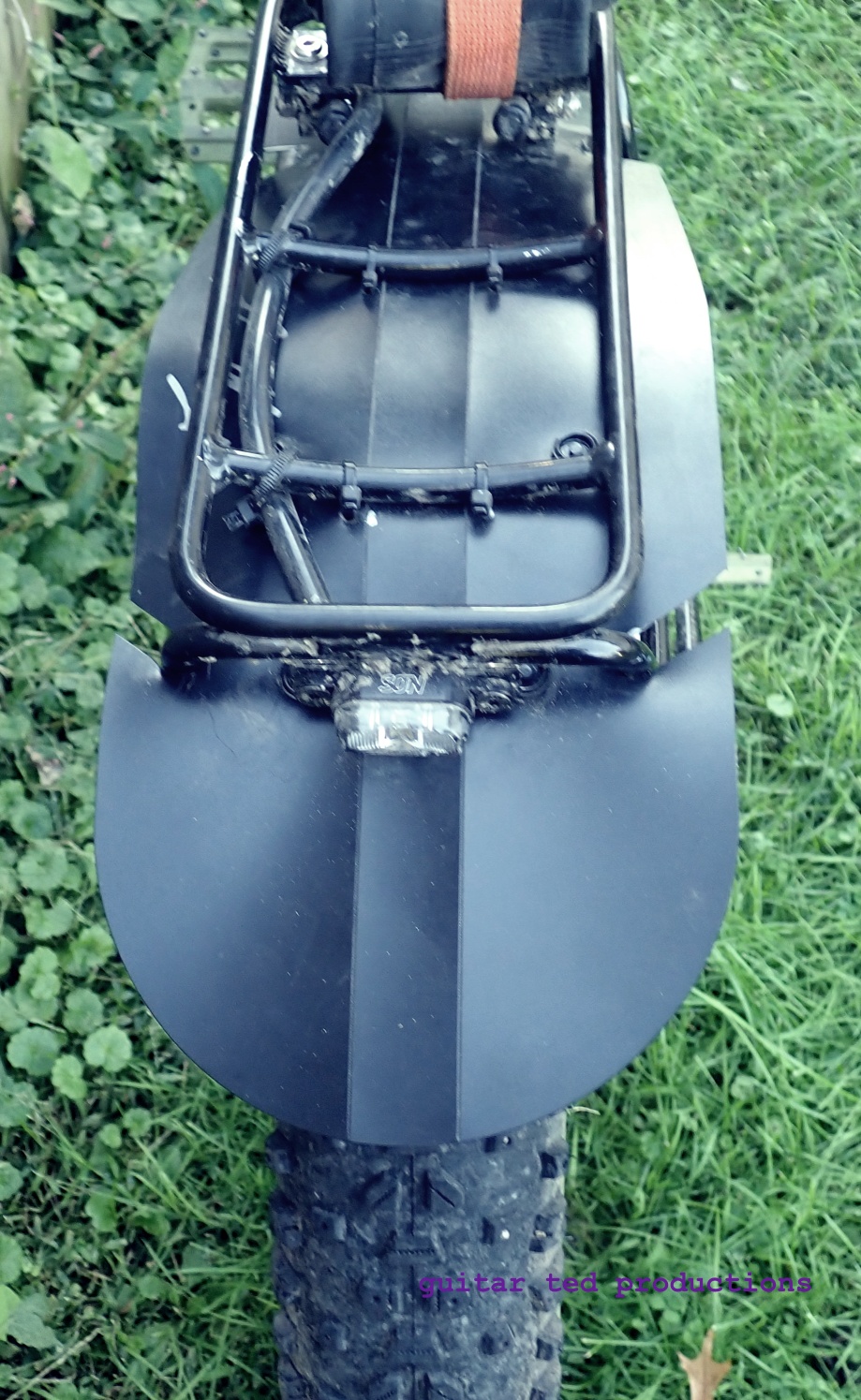
The modification of parts is something I kind of like doing sometimes. Well, I had wanted a fender on the new-to-me Ti Muk 2. But, with a rack on the bike, it kind of precluded using the clip on fender I've had for a while. So, I had an idea, but I just waited until Monday to get it done. Of course, it required some modding.

I used a Dave Grey's Mud Shovel for the rear mount. One of the things I thought was a little goofy about this rear, seat post mounted fender was that it tapered to a smaller width in the back. That spray from a rear fat bike tire always bypassed the rear edges of the fender and got stuff all over the place regardless of having that fender there. Of course, it was better than not having a fender, but it was silly, I thought.

Well, thinking this deal over, what with a rack on there and the light with the wiring harness and all, I was thinking that there may be some way to get that rear specific piece of Mud Shovel plastic to sit so it protected the dynamo tail light's wiring harness and still gave decent clearance for the rear tire. I took the flat black sheet and held it in various ways and then it dawned on me that I could literally get two benefits in one by orienting the Mud Shovel "backward" under the rack top.

With some consideration given to clearance the rack stays, a bit of guesswork, and a pair of scissors, I managed to fit it underneath the rack. Mounting was accomplished by using a dental tool to poke several holes in strategic places to allow for cable ties to be strung up. These wrapped around various points of the rack, drawn up tight, and clipped to length and were enough to secure the now reverse mounted Mud Shovel into place.

Rear view of the modded fender. Note the cable tie mounts.
So, it's on there and with the reverse mount, the widest part of the fender is now at the tail end where the spray is wider off the rear wheel. I expect better coverage for myself and anything I have onboard the rack top. But I'm not done yet.

First off, I have to do a little edge work to completely encompass the rack stays, which will give the fender a bit more rigidity and eliminate those "saw tooth" edges which are now protruding out and could snag on things, potentially, like weeds, clothing, etc. The plan here is to take some point of sale packaging from tires, (typically a hard, thick plastic material, not unlike the Mud Shovel), and form it into a piece that I can bond to the Mud Shovel. I don't plan on ever taking this "fender" off, so a permanent mount is okay.

Secondly, I want to add a bit in front of the back tire to keep spray from coming off the rear tire forward and mucking up my frame bag. That will likely either be another rear Mud Shovel, or maybe the matching front Mud Shovel, or something I completely fabricate from plastic, to be sourced from, as of now, an unknown source. (Maybe milk jugs?) Anyway, I think at first I will mock up something out of cardboard to get an idea of what to do from that point.

The front will likely be a combination of one of those fork crown mounted "fenders" and a front Mud Shovel mounted very low on the down tube, which I experimented with last year and found that it works well. The low mounted front Mud Shovel, placed juuust right, will protect your chain and chain ring from most of the crap flying back from your front wheel. I did this on my Blackborrow DS last year. Since this bottom bracket is a bit narrower, I may actually have to do some trimming, but we will see.

Once the fender sitch is squared away, I will put the frame bag back on and this rig will be ready for Fall and Winter riding. Bring on the muck and mire!

Ti Muk 2 Upgrade Path: Part 5

Fendered rear Ti Muk 2- Will be doing the front soon.
The modification of parts is something I kind of like doing sometimes. Well, I had wanted a fender on the new-to-me Ti Muk 2. But, with a rack on the bike, it kind of precluded using the clip on fender I've had for a while. So, I had an idea, but I just waited until Monday to get it done. Of course, it required some modding.

I used a Dave Grey's Mud Shovel for the rear mount. One of the things I thought was a little goofy about this rear, seat post mounted fender was that it tapered to a smaller width in the back. That spray from a rear fat bike tire always bypassed the rear edges of the fender and got stuff all over the place regardless of having that fender there. Of course, it was better than not having a fender, but it was silly, I thought.

Well, thinking this deal over, what with a rack on there and the light with the wiring harness and all, I was thinking that there may be some way to get that rear specific piece of Mud Shovel plastic to sit so it protected the dynamo tail light's wiring harness and still gave decent clearance for the rear tire. I took the flat black sheet and held it in various ways and then it dawned on me that I could literally get two benefits in one by orienting the Mud Shovel "backward" under the rack top.

With some consideration given to clearance the rack stays, a bit of guesswork, and a pair of scissors, I managed to fit it underneath the rack. Mounting was accomplished by using a dental tool to poke several holes in strategic places to allow for cable ties to be strung up. These wrapped around various points of the rack, drawn up tight, and clipped to length and were enough to secure the now reverse mounted Mud Shovel into place.

Rear view of the modded fender. Note the cable tie mounts.
So, it's on there and with the reverse mount, the widest part of the fender is now at the tail end where the spray is wider off the rear wheel. I expect better coverage for myself and anything I have onboard the rack top. But I'm not done yet.

First off, I have to do a little edge work to completely encompass the rack stays, which will give the fender a bit more rigidity and eliminate those "saw tooth" edges which are now protruding out and could snag on things, potentially, like weeds, clothing, etc. The plan here is to take some point of sale packaging from tires, (typically a hard, thick plastic material, not unlike the Mud Shovel), and form it into a piece that I can bond to the Mud Shovel. I don't plan on ever taking this "fender" off, so a permanent mount is okay.

Secondly, I want to add a bit in front of the back tire to keep spray from coming off the rear tire forward and mucking up my frame bag. That will likely either be another rear Mud Shovel, or maybe the matching front Mud Shovel, or something I completely fabricate from plastic, to be sourced from, as of now, an unknown source. (Maybe milk jugs?) Anyway, I think at first I will mock up something out of cardboard to get an idea of what to do from that point.

The front will likely be a combination of one of those fork crown mounted "fenders" and a front Mud Shovel mounted very low on the down tube, which I experimented with last year and found that it works well. The low mounted front Mud Shovel, placed juuust right, will protect your chain and chain ring from most of the crap flying back from your front wheel. I did this on my Blackborrow DS last year. Since this bottom bracket is a bit narrower, I may actually have to do some trimming, but we will see.

Once the fender sitch is squared away, I will put the frame bag back on and this rig will be ready for Fall and Winter riding. Bring on the muck and mire!

Thursday, January 12, 2017

Fixing What Ya Broke: Part 2

Iowa license plate recycling project- Or in other words, fixing my bicycle part with what's at hand.
The repair of my BarYak "wings" is complete now and I thought I'd show you all what I did here. You may remember my post from a couple days ago where I give you the story on the back ground and inspiration for this repair using some old Iowa license plate I had lying around here.

So, if you reference the image here, you might be able to follow along with this. First off, the carbon fiber material you see here is simply ornamental. It serves little, if any, structural purpose for the design. The "wings", arm rests really, attach to the BarYak extensions via two bolts which pass through at the corners of the "wing" piece of the arm rest. This is what tore through when I crashed last October. The backing material here is a dense foam material which doesn't hold up well to the shearing type forces I applied to it when I endoed.

My theory for the repair was to place some sort of an "end cap" over the edges of the "wing" part and drill two holes into the cap to accommodate the bolts. The end cap would be metal, harder to tear through, and be tougher and especially be able to provide a better clamping surface. However; as I contemplated the design, I realized that the foam material the "wing" was mostly made of would want to compress much easier than the metal end cap. So, I formed a 2/3rds cap. essentially what you see here, and the separate "back plate" would allow for compression of the foam bit.

I have not field tested this yet, but I expect it to perform as I expect and the reinforced bolt holes should give my Bar Yak System new life. Stay tuned for an update later into Spring after this has been tested.

Fixing What Ya Broke: Part 2

Iowa license plate recycling project- Or in other words, fixing my bicycle part with what's at hand.
The repair of my BarYak "wings" is complete now and I thought I'd show you all what I did here. You may remember my post from a couple days ago where I give you the story on the back ground and inspiration for this repair using some old Iowa license plate I had lying around here.

So, if you reference the image here, you might be able to follow along with this. First off, the carbon fiber material you see here is simply ornamental. It serves little, if any, structural purpose for the design. The "wings", arm rests really, attach to the BarYak extensions via two bolts which pass through at the corners of the "wing" piece of the arm rest. This is what tore through when I crashed last October. The backing material here is a dense foam material which doesn't hold up well to the shearing type forces I applied to it when I endoed.

My theory for the repair was to place some sort of an "end cap" over the edges of the "wing" part and drill two holes into the cap to accommodate the bolts. The end cap would be metal, harder to tear through, and be tougher and especially be able to provide a better clamping surface. However; as I contemplated the design, I realized that the foam material the "wing" was mostly made of would want to compress much easier than the metal end cap. So, I formed a 2/3rds cap. essentially what you see here, and the separate "back plate" would allow for compression of the foam bit.

I have not field tested this yet, but I expect it to perform as I expect and the reinforced bolt holes should give my Bar Yak System new life. Stay tuned for an update later into Spring after this has been tested.