Showing posts with label Before There Was "Gravel".. Show all posts

Thursday, May 05, 2022

Before There Was "Gravel": Flared Drop Bars

 Continuing on with this series about the 'pre-gravel' days, I wanted to touch on the subject of the flared drop bar for bicycles. Now this one is a bit tricky, as it can be seen as a thing which grew out of the early 29"er scene. However; I think it has direct ties to the gravel rider, and I hope that this little historical ramble will bear that out for you. 

Going back to the early 2000's, 29"ers were the new thing which had been capturing the imaginations of the new internet forum folks. These big wheeled beasts were so odd that breaking conventions was part and parcel to the group of folks attracted to such things. So, the whole Pandora's box of ideas were open to discussion at the time. Old ideas, new ideas, dumb ideas, and some smart ideas were all bandied about back then. One of the old ideas which gained some traction again was the idea of drop bars for off-roading.

I won't get into a detailed history of that idea, but suffice it to say that those few who were into the 'dirt drop' back then had to scour the ebay, Craigslist, and local flea market newspapers for WTB RM-2 "Dirt Drop" handle bars. They were the only game in town for a mountain bike worthy, ergonomic drop bar for off-road pursuits.

A WTB Dirt Drop handle bar (Image courtesy of Mike Varley)

The idea got hatched then for a copy-cat bar to be made by On One. Some mountain bikers who were intimate with the WTB version were consulted. Most notably Don "Shiggy" Person, who along with On One's Brant Richards developed the first alternative drop bar, the venerable On One Midge Bar.

The Midge was essentially a modified WTB Dirt Drop bar which satisfied Person's desires for a perfected version of that handle bar. This allowed many would-be off-road experimenters to taste and see if dirt drop bars for off roading would be a thing for them. I happened to be one of those experimenters. I bought my first 29"er in 2003, a Campstove Green Karate Monkey, and I don't think I had it a year before it was fitted with Midge Bars. 

My Karate Monkey, circa 2006, set up with the On One Midge Bar.

Once the Midge became somewhat of a cult favorite, it didn't take long for Origin 8 to introduce the very similar, but wildly flared "Gary Bar". These early attempts at the drop bar for off road kept 'sweep' and 'flare' as part of the shallow drop, short reach formula for the off road drop bar. One thing some, including myself, complained about with these early flared drops was that the extensions were too short. Well, the next big moment in off road drop bars addressed this bit quite nicely.

The next 'big' moment for flared drop bars came when Salsa Cycles introduced the Fargo in late 2008. With its original use of the cyclo-cross inspired "Bell Lap" bar, it was okay, but Salsa folk claimed a purpose-designed bar for the Fargo was forthcoming. It took a little while, but at a Fargo Adventure Ride in 2009, I saw a prototype flared drop bar which was to be for the Fargo. It ended up becoming the polarizing Woodchipper Bar. It borrowed the flare and sweep ideas, but it added significant extension length to the design. However; Salsa's designers fell foul to choosing a poorly (my opinion) thought out radius to the drops, which made setting the bars up a royal challenge. 

Martin Bunge's Fargo displays the extensions issue caused by the poor radius of the Woodchipper Bar.

To get the ramps to hoods transition comfortable for riding, one had to rotate the Woodchipper in such a way that the brake lever body sat correctly for that. This, in turn, rendered the extensions useless since that generally pointed them down so steeply it would be uncomfortable to ride there for very long, or at all. Plus, many were turned off by the swept extensions, thinking them too goofy for fast paced riding. Had Salsa stopped here, I think they would have fallen off the radar from the perspective of flared drops for gravel.

But Salsa engineers solved this problem when they introduced the Bell Lap's replacement, the Cowbell Bar. With its minimal flare and nearly no sweep, it quickly was adopted by gravel riders as the perfect flared drop for faster paced gravel travel. Within a year of the Cowbell's release, there were several copy-cat bars which came about with between 12° and perhaps slightly less flare. But then Salsa Cycles was considering a replacement for the Woodchipper Bar, and at a Frostbike show in 2014 I was asked, along with Ben Witt, what that bar should be. We both agreed that a bar with longer extensions and a bit more sweep and flare than a Cowbell would be perfect. By 2015, the Cowchipper, a 'more Cowbell' bar, was out, and then that kind of spawned a slew of bars in a similar vein. 

By 2015, the 'gravel thing' was a thing, so I count the Cowchipper as being the last, real flared drop bar evolution 'pre-gravel' days. But it wasn't really a 'gravel thing' at first, as you can see from this brief history. 

Easton carbon drop bars introduced earlier this year.

Now we have carbon bars with flare and sweep with ergonomic moldings and thinned out sections for more flex leading to more comfort. A far cry from 2005 when this 'modern day gravel' scene kicked off. 

Back then many riders just used road drop bars, or maybe Salsa bell Lap bars, or Nitto randonnuer bars. But things swung to the flared drop bar side as Salsa started pumping out the Fargo, and even more so when the venerable Cowbell became available. The advent of the gravel bike, kicked off by Salsa Cycles, and then Raleigh and others, made the flared drop bar a standard issue item for gravel travel. 

There have been notable off-shoots along the way, but I count this as a main 'timeline/evolutionary' line from the WTB Dirt Drop to the myriad flared drop bars available now. What Salsa designed into the Cowbell, and then the Cowchipper, informed the flared drop bar offerings from almost every other company. It is hard to deny that Salsa Cycles had a huge influence on gravel handle bars. It also is hard to imagine a time when we could count how many flared drop bars you could get on three fingers, but it wasn't all that long ago!

Before There Was "Gravel": Flared Drop Bars

 Continuing on with this series about the 'pre-gravel' days, I wanted to touch on the subject of the flared drop bar for bicycles. Now this one is a bit tricky, as it can be seen as a thing which grew out of the early 29"er scene. However; I think it has direct ties to the gravel rider, and I hope that this little historical ramble will bear that out for you. 

Going back to the early 2000's, 29"ers were the new thing which had been capturing the imaginations of the new internet forum folks. These big wheeled beasts were so odd that breaking conventions was part and parcel to the group of folks attracted to such things. So, the whole Pandora's box of ideas were open to discussion at the time. Old ideas, new ideas, dumb ideas, and some smart ideas were all bandied about back then. One of the old ideas which gained some traction again was the idea of drop bars for off-roading.

I won't get into a detailed history of that idea, but suffice it to say that those few who were into the 'dirt drop' back then had to scour the ebay, Craigslist, and local flea market newspapers for WTB RM-2 "Dirt Drop" handle bars. They were the only game in town for a mountain bike worthy, ergonomic drop bar for off-road pursuits.

A WTB Dirt Drop handle bar (Image courtesy of Mike Varley)

The idea got hatched then for a copy-cat bar to be made by On One. Some mountain bikers who were intimate with the WTB version were consulted. Most notably Don "Shiggy" Person, who along with On One's Brant Richards developed the first alternative drop bar, the venerable On One Midge Bar.

The Midge was essentially a modified WTB Dirt Drop bar which satisfied Person's desires for a perfected version of that handle bar. This allowed many would-be off-road experimenters to taste and see if dirt drop bars for off roading would be a thing for them. I happened to be one of those experimenters. I bought my first 29"er in 2003, a Campstove Green Karate Monkey, and I don't think I had it a year before it was fitted with Midge Bars. 

My Karate Monkey, circa 2006, set up with the On One Midge Bar.

Once the Midge became somewhat of a cult favorite, it didn't take long for Origin 8 to introduce the very similar, but wildly flared "Gary Bar". These early attempts at the drop bar for off road kept 'sweep' and 'flare' as part of the shallow drop, short reach formula for the off road drop bar. One thing some, including myself, complained about with these early flared drops was that the extensions were too short. Well, the next big moment in off road drop bars addressed this bit quite nicely.

The next 'big' moment for flared drop bars came when Salsa Cycles introduced the Fargo in late 2008. With its original use of the cyclo-cross inspired "Bell Lap" bar, it was okay, but Salsa folk claimed a purpose-designed bar for the Fargo was forthcoming. It took a little while, but at a Fargo Adventure Ride in 2009, I saw a prototype flared drop bar which was to be for the Fargo. It ended up becoming the polarizing Woodchipper Bar. It borrowed the flare and sweep ideas, but it added significant extension length to the design. However; Salsa's designers fell foul to choosing a poorly (my opinion) thought out radius to the drops, which made setting the bars up a royal challenge. 

Martin Bunge's Fargo displays the extensions issue caused by the poor radius of the Woodchipper Bar.

To get the ramps to hoods transition comfortable for riding, one had to rotate the Woodchipper in such a way that the brake lever body sat correctly for that. This, in turn, rendered the extensions useless since that generally pointed them down so steeply it would be uncomfortable to ride there for very long, or at all. Plus, many were turned off by the swept extensions, thinking them too goofy for fast paced riding. Had Salsa stopped here, I think they would have fallen off the radar from the perspective of flared drops for gravel.

But Salsa engineers solved this problem when they introduced the Bell Lap's replacement, the Cowbell Bar. With its minimal flare and nearly no sweep, it quickly was adopted by gravel riders as the perfect flared drop for faster paced gravel travel. Within a year of the Cowbell's release, there were several copy-cat bars which came about with between 12° and perhaps slightly less flare. But then Salsa Cycles was considering a replacement for the Woodchipper Bar, and at a Frostbike show in 2014 I was asked, along with Ben Witt, what that bar should be. We both agreed that a bar with longer extensions and a bit more sweep and flare than a Cowbell would be perfect. By 2015, the Cowchipper, a 'more Cowbell' bar, was out, and then that kind of spawned a slew of bars in a similar vein. 

By 2015, the 'gravel thing' was a thing, so I count the Cowchipper as being the last, real flared drop bar evolution 'pre-gravel' days. But it wasn't really a 'gravel thing' at first, as you can see from this brief history. 

Easton carbon drop bars introduced earlier this year.

Now we have carbon bars with flare and sweep with ergonomic moldings and thinned out sections for more flex leading to more comfort. A far cry from 2005 when this 'modern day gravel' scene kicked off. 

Back then many riders just used road drop bars, or maybe Salsa bell Lap bars, or Nitto randonnuer bars. But things swung to the flared drop bar side as Salsa started pumping out the Fargo, and even more so when the venerable Cowbell became available. The advent of the gravel bike, kicked off by Salsa Cycles, and then Raleigh and others, made the flared drop bar a standard issue item for gravel travel. 

There have been notable off-shoots along the way, but I count this as a main 'timeline/evolutionary' line from the WTB Dirt Drop to the myriad flared drop bars available now. What Salsa designed into the Cowbell, and then the Cowchipper, informed the flared drop bar offerings from almost every other company. It is hard to deny that Salsa Cycles had a huge influence on gravel handle bars. It also is hard to imagine a time when we could count how many flared drop bars you could get on three fingers, but it wasn't all that long ago!

Wednesday, April 20, 2022

Before There Was "Gravel": Lighting

Lights have come a long way in the last 17 years
The first look back at what we were doing with our equipment before the "Gravel™" thing took off in cycling went over pretty well. So, I thought I'd delve into another topic which we struggled with back in the day. 

Lighting for bicycles circa 2005 was generally centered around 24hr racing needs. Sure, you had your commuter lights, and I'll get to some of those, but generally speaking, a light only had to be blazingly bright for a little over an hour, maybe two (typical lap times at big 24Hr races were in the 1-2 hour range) and you'd be back at the pits where you'd grab another battery pack and so on.

There weren't really any needs being seen beyond that in terms of run time, different light levels, compact design, or what have you. Commuter lights were, frankly, a joke up until the mid-00's. I recall us selling halogen lights right up to about 2004. LED light technology was in its infancy at this time. 

The Blackburn Quadrant was a popular commuter light circa 2004-2005, but was a poor quality LED light.

I should mention that I will be primarily looking at this topic from my unique perspective in gravel events. At the time, Trans Iowa, The Dirty Kanza 200 (Now Unbound Gravel), and the Good Life Gravel Adventure (now Gravel Worlds) were the only 'big' events that required a light at all. Some smaller events which no longer exist did take place at night, such as the Moonlight Metric, which I did a couple of times, or the one-off Moonlight Madness event, which was an all-nighter as well. But for the most part, it was Trans Iowa that required the most from lighting back in the day. 

From my archived blog posts I was able to pull out a bunch of images and was reminded of how things were difficult for the night time gravel grinder back then. What I discovered overall are a few things. First, lights were pitifully weak and had really bad light throw and patterns back then. Secondly, most 'long-run' time set ups (More than 5-6 hours) needed heavy battery packs which had to be externally mounted to frames, bodies, or put into bags. Finally, there were great lights, but they were very expensive and had short run times.

The Cateye Triple Shot was one of the first really good LED lights

Lights like Cateye's then new Triple Shot, which debuted circa 2005, was a promising light, but it was focused on the endurance 24hr scene, and run times were low compared to what was necessary for Trans Iowa. Still, we could see then that this was where lights needed to go, we just needed longer run times. 

One thing that is overlooked here is that gravel events had unique needs. These typically were not addressed in these earlier lighting solutions where all-out power dominated the feature set with narrowish beam patterns that wasted a lot of the light in its beaming twoard the shy. But as you might know from mountain biking, sometimes your bike is pointed down, but you need the light 'out front', not pointed down at the trail, so these big, halo beam patterns made sense for MTB. 

Another issue we had was the nature of gravel, which has a LOT of higher frequency vibrations, and that would rattle loose mounts, lights, and other stuff! Early on into Trans Iowa riders found that a lot of equipment they attached to their bikes would be jettisoned off into the ditch or onto the gravel unexpectedly due to the severity of these vibrations. Fortunately, that is not an issue with these newer mounts which are much more secure. 

Just before the start of Trans Iowa v5 in 2009

So, above we have the riders gathering for the start of the fifth Trans Iowa in 2009. Keep in mind things like the Cateye Triple Shot have been around a few years already. That said, you can see that riders are opting for lower power, (note- not because they wanted to), options with longer run times. There are not a lot of helmet mounted lights, and the lights that are on are not all that impressive. The reflections of the camera flash from the reflective treatments is a LOT brighter than any lighting here. 

 
Trans Iowa v7 start line.


Two years later we start to see some seriously powerful lights creeping into use by the riders. By this time, in 2011, lighting technology had taken a bit of a turn. No longer were the lighting choices all about endurance 24hr riding. Now commuting needs were creeping into the picture, and smaller companies were fulfilling needs that the big companies couldn't cover, or wouldn't. Meanwhile, other older companies fell to the wayside as they were passed by in the ever changing LED technology of that time. 

One of the companies I was aware of at the time that was really pushing the boundaries with powerful LED lights and long run times was Ay Up from Australia. While they still required external battery packs, they were minimized in size and were easily swapped out if need be. I know several top riders of the day relied on this company's lights. But they were expensive and you kind of had to be 'in the know' to even be aware of them.

My light 'hack' circa 2009.

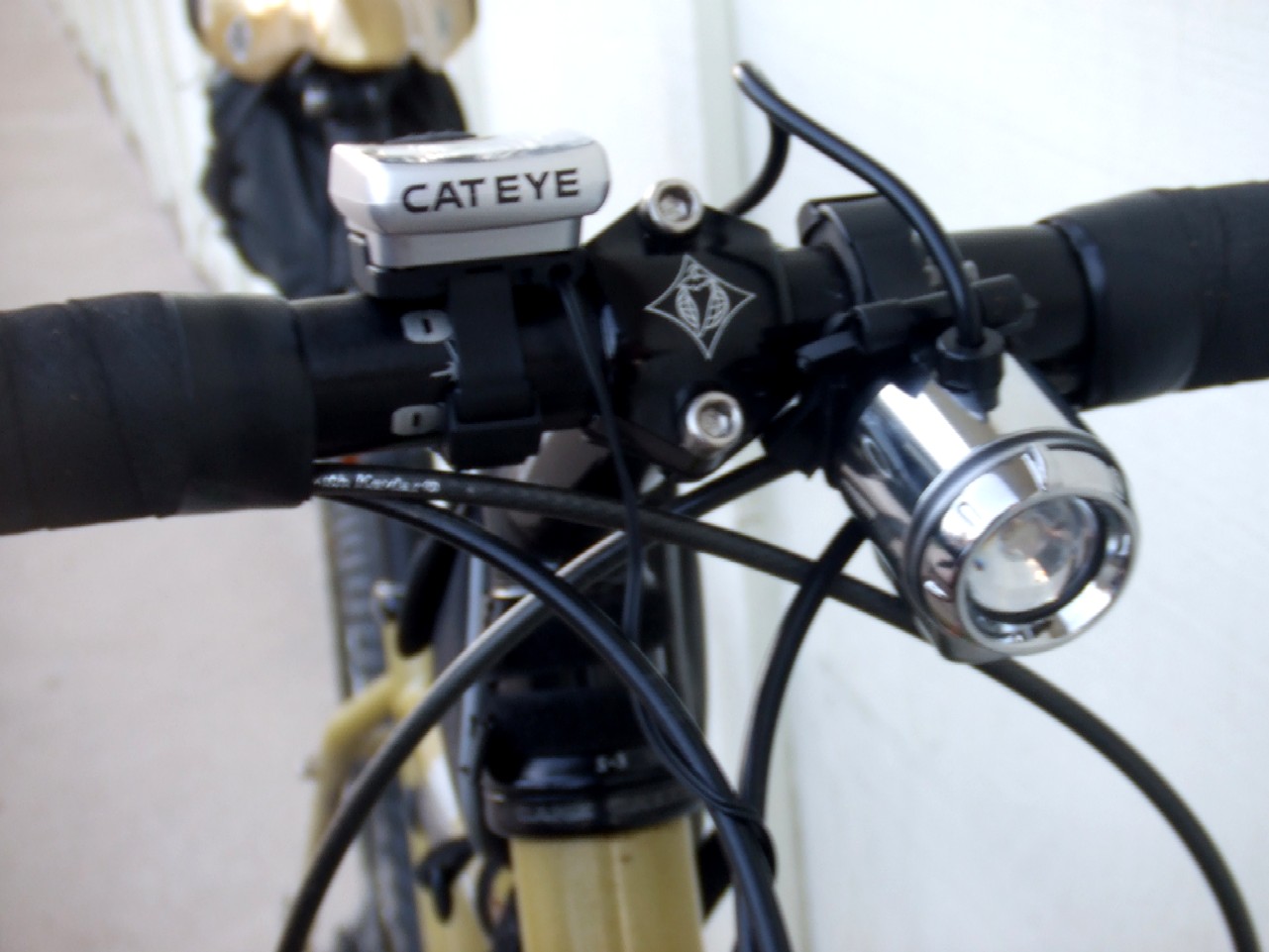
Meanwhile people like myself who were looking for lights to last for really long times were left to their own devices. I was wanting a light for six to ten hours of run time, so I ended up buying a head mounted torch from Eveready. It was meant for campers, but it had 110 Lumen output for 11 hours off three AAA batteries. I made a mount for the handle bar using an old Cateye computer mount and stuffed the battery pack into a top tube bag. 

The really cool thing about this light was that the beam pattern could be adjusted by twisting the lens bezel. It would go from a long-throw spot to a wide, washy light that went the entire width of the road. This was the light I used in the Moonlight Madness event where it rained the entire night, but I never wanted for light. The best part?  spent less than $60.00 on the entire set up.

It's hard to believe what we used to rely on a dozen or more years ago for lights. This was from the Moonlight Metric.

Around about 2010 or so I noted that things were changing rapidly. Suddenly there was a cottage industry springing up with light choices the big brands were not offering. Commuter lights began to become more powerful. No longer was 200-300 Lumen thought of as a high beam. Now it was 500 Lumen, or even 800 Lumen, which became the top setting. "Medium" settings of 150-250 Lumen were then making 4-6 hour run times possible. Now we were getting into some serious light choices! 

By T.I.v10 in 2014 lights had become pretty good and reasonably priced. (Image from a film by P. Ross)

The LED light technology became like an arms race. About every six months to a year some new emitter technology would appear, or new battery technology would appear, or both, and the lights one could get would take another leap forward in capabilities and another leap downward in price for what you got. Value per dolar has never been better now in that regard. 

Let's not forget how generator hub and light technology has changed as well. I recal seeing my first generator hub lights at Trans Iowa in 2007. Then, just three years later I remember seeing generator hub technology that blew anything else away. It was super bright, ran without hardly any drag, and would light up at super-slow speed. The only nit here was, and is, price. Plus you have to accept a dedication to one front wheel. 

The new Planet Bike "Dual Blaze"

Now you can have 1500 Lumen power in light with Medium settings that run up at 800 Lumen for hours and hours. We couldn't even get 800 Lumen lights in the early days! Now? Slap down a Benjamin and walk out with a self-contained, lightweight, durable, reliable light that will be all you'd ever need. Something that would have cost hundreds of dollars back in the day, if you could even find such a thing with those run times. 

So, it is easy to forget where we have come from with regard to lights for night time gravel riding. It's a really fun thing to do, and the lights are not really a barrier to the pursuit of the past time anymore. But yeah, about that...... Trans Iowa is gone. Who needs lights anymore for long gravel events, right?

Well, it's funny when I think about this. Obviously, Iowa Wind and Rock is kind of the evolution of Trans Iowa, but right about when I stopped T.I. other events decided this long distance deal was a thing. Unbound did the XL distance, (originally the DKXL), and then Gravel Worlds added a "Long Voyage" distance as well. So, yeah, you need long runtime, high-output lights. If you do those events, at any rate. 

So, there is a brief overview of lights from the earliest "Modern Gravel" era days till now. I hope that you enjoyed that look back at lights.