Showing posts with label The Six String Side. Show all posts

Sunday, August 30, 2026

The Six String Side: Sully Guitars Stardust Custom Deluxe 12

 When I started this blog over 20 years ago, I stated that it was a "Bicycle and guitar oriented elixir....". Well, the "guitar" part sort of got pushed out by the bicycle stuff, but I've always been playing. In an Easter post, several years ago, I mentioned playing my '90 Strat, and someone suggested I detail the fleet,which I have done in the past. (Just search "The Six String Side" in the search box in the upper left of the header to find those older posts)  Enjoy! NOTE: All images except the first in today's post are courtesy of Sully Guitars.

My 2022 Conspiracy Series Sully Guitars Stardust
Several years ago now I picked up my second Sully Guitars model. A Stardust from Sully's Conspiracy Series. This series is a batch-made guitar run Jon Sullivan offers from time to time and they are made to Jon's specifications in Korea. This lowers the price significantly and allows more people to get in on Jon's awesome designs. 

But the Conspiracy Series is not "custom made" by Jon and his team in the Dallas - Fort Worth area. Those cost a lot more and have more options. I've always wanted to get one, especially after my mother died in 2021. I was thinking of a tribute to her, in some way. 

I also had been itching to try a 12 string electric guitar for some time. Sure, you can get those and at relatively inexpensive prices. Danelectro comes to mind here, but there are other brands as well. I just wasn't jazzed on any of those from a design and aesthetic standpoint. 

Rickenbacker Guitars make some classic designs, and they sound good, but I've never been a huge fan of them, and they are expensive! So, I always put off trying a 12 string, until.... 

The body of the 12 string will have a quilt maple top.

One day in August of 2024, Sully put it out there that he was having a sale on custom orders. He had never done this before, so, I thought, "What the heck! I'll ask." 

I figured Jon would say no. I had heard him put down the idea of a 12 string before, saying tuning something like that would drive him nuts. But would he make one for someone? 

I sent in my request, and a few minutes later Jon gave me a thoughtful answer and somewhat begrudgingly said he'd do it. I was surprised!

Well, to be fair,I knew Jon wasn't 100% jazzed about 12's, and he said he'd have to do a bunch of R&D work, because he'd never made a 12 before. So, I was expecting a long build time. I think Jon was a bit overly optimistic in his estimation for finishing the project, and that's okay. 

See, my philosophy is this: If you are wanting someone to actually make you something, and especially if it is unique and something they haven't necessarily got in their wheelhouse, then you must give that person 100% trust and patience. As a mechanic, I learned that having someone put pressure on you to get a difficult job done by their timeline is not fun. It also is unproductive, as - speaking for myself here - it made me not want to do the job. I always did do the job, but usually it was motivated by a desire to get that customer out of my hair. Not to make them happy, or over deliver on the job. 

Lyrics from a Warren Zevon song

So, Jon was free to get this done on his timeline, whatever that would be. He still is, as this guitar is still in progress as of this writing. I'm 100% trusting him and I believe he is doing his best work for me. 

I don't know about you, but this is how I roll. Yes....it has been over two years going on now. Cool. Whatever it takes. I'm sure it will be fine and a great guitar when I get it, and it's the first 12 Jon has ever made. That's awesome. 

Now, Jon likes writing little messages or song lyrics inside the guitars he makes which won't ever be seen again once everything gets assembled. He chose some Warren Zevon lyrics from "Keep Me In Your Heart For Awhile". Considering what has happened in the last year, it means a lot to me now that Jon chose those lyrics. 

I guess this guitar is a tribute to Mom and Jacob now. 

Anyway, things are progressing along, and now that the woodwork is nearly completed, I expect this will be getting completed sooner rather than later. So, what can I tell you about the rest of this guitar? 

Well, it has a quilted maple top, a mahogany back which is chambered. The top will have what Jon has dubbed as the WTF Hole. Ha! It has a bound headstock, fretboard, and Jon's signature Hollow Block inlays. The color? Well, way back when this got started Jon was talking about some burst finish in a traditional color with his special "Glamazon" treatment which is a sparkly coating along the edges of the body. But whatever he chooses I'll be good with it. I haven't seen one of his finished customs I did not like. 

Jon Sullivan and my guitar. He might be just a bit goofy!

 So, there you go. I'm excited and this will be avery special guitar for me. Not only is it a very cool, one of a kind 12 string electric, but the little details which are part of this build make it even better. 

I'll post again when it is finished, paid for, and in my hands. Thanks for reading Guitar Ted Productions.  

Tuesday, February 04, 2025

The Six String Side: Kittycaster Mohair Fuzztortion Pedal

 When I started this blog nearly 20 years ago, I stated that it was a "Bicycle and guitar oriented elixir....". Well, the "guitar" part sort of got pushed out by the bicycle stuff, but I've always been playing. In an Easter post, several years ago, I mentioned playing my '90 Strat, and someone suggested I detail the fleet,which I have done in the past. (Just search "the Six String Side" in the search box in the upper left of the header to find those older posts) This post is a review of an effects pedal. Enjoy!


While it may seem useless to some to write a review on an effects pedal with no sound samples, that's what I am going to do here. Hey! "Back in the day" all we had were written reviews. Besides, there are a ton of You Tube videos on this pedal out there for you to listen to, if that is your bag. So, here we go...

The Kittycaster Mohair is a fuzz/distortion box that has its roots in the Big Muff from Electro Harmonix. Designer of the circuit in the Mohair, Howard Gee, stated that he did not get on with the Big Muff circuit and he wanted to see if he could make something similar that he did want to play. Okay, this grabbed my attention, as I have had zero luck getting a Big Muff to sound good to my ears. Now before you get all in a huff and hit the comments, I happen to love a lot of players work that used Big Muffs. Gilmore, J. Mascis, and Billy Corgan, who are probably the best known Muff users, are players who have a tone and sound that I do like. It is when I play a Big Muff that I don't like the sound. And I've tried it. With every combination available to me, in two different eras. 

My first Big Muff was bought from the Mandolin Brothers' catalog back in 1980. Back when all I had to go on were magazine articles that stated what people were using. To say I was bitterly disappointed in the sound is an understatement. I sold it in short order. Or did I give it way? Can't remember. I do know I hated the way it sounded. 

Same thing in 2010 when I bought another Big Muff thinking that now I would get it. But.....I didn't. Same hate, different decade. Big Muffs sound cool when other people play them, just not when I do. So, when Howard Gee stated he was going to make a Muff circuit for himself, a person who apparently didn't get on with a Muff, I was intrigued.

Upon opening the box. That's a bandana, by the way.

I followed the Kittycaster social channels and waited to see how this was going to come out. Fuzz is an interesting effect, maybe the most popular form of distortion for guitarists, if what I see being proffered out there by builders is any indication. Fuzz circuits are fairly simple, so getting a fuzz to sound like something interesting probably is pretty hard to do now. This made me even more curious as to just how Howard Gee was going to pull this off.

A typical Big Muff sounds buzzy, with a lot of lower frequencies, and Muff's don't poke out from a mix well due to the lack of midrange. Perhaps this is what makes them hard for me to like when I play the Muff. But I've always been bothered by the graininess and "broken" quality to the sound. The very thing a lot of players say they love about a Muff. Yeah, a Muff just is not for me, right? But this begs the question: How is it that I love the tones these other artists are getting who use a Big Muff? What is the secret? You know, I still don't quite get it. 

I tried eq'ing, using a Rangemaster in front, and other things, but to no avail. Then when I heard that Howard Gee was going to put a Rangemaster circuit into his new pedal I figured it wouldn't work, unless......

Maybe Howard knows what he's on to. Maybe. 

The pedal. The 'case candy'.

Then the official release came out with a long You Tube video of Howard demonstrating the pedal. (The video can be seen on the Mohair page HERE)  And I liked it, but of course I did. I wasn't playing it! Still, the boost circuit seemed like it was the saving grace, and the demonstration showed some really wide-ranging tones. 

Maybe.....

Then Kittycaster ran a sale, and I jumped on and purchased the Mohair back in September of last year (2024) Since then I've played it off and on using it in front of my Roland JC-40 and in front of a Fender Deluxe Reverb RI. 

So..... Was it the same ol' - same ol' or? Well, it was both. The Mohair does a fair interpretation of a Big Muff. Howard Gee wanted the pedal to retain pick attack and clarity, and to some extent, that was successful in my mind. I can hear that when I play just the Mohair side of the pedal. I can dial in a smoother, less raspy/broken distorted tone too. Just the type of thing that maybe some would argue is 'less Big Muff, more something else', and I cannot deny that. But the Muff sound, or a pretty close approximation of the sound, is still in the Mohair. 

Gut shot.

The Boost circuit is based on a Rangemaster, according to Howard Gee, and is accessed via the right foot switch. You can add the Boost to the Fuzz, or not, but you cannot get just the Boost. I feel that is a bit of a miss, but hey..... I did not design the pedal. I wish I could have just the boost though. 

I will say that it is the Boost that makes this pedal something quite different from most Muffs out there. In fact, it 'un-Muffs' the circuit and turns the Mohair into a distortion box that can be mild or gritty and mean. It probably does what a lot of distortion boxes do, but then you can go back to a Muff at the push of a foot switch, so, maybe this is what makes a Mohair a worthwhile pedal. 

It is not a pedal that "cleans up" with a lowering of the volume control on your guitar like a Fuzz Face type circuit. It does clean up a little, and maybe that's enough for you. But if you are looking for a fuzz that does that glassy-clean thing with a tiny bit of hair? This is not that pedal. I happen to have a Reeves Electro 2n2 Face, a silicon based Fuzz Face design, and that does do the clean up thing magnificently, so I know the difference. 

Conclusion: So, did Howard Gee get to the finish line with a design that does Muff but with clarity and definition? Yes, but the Boost circuit makes this something else altogether, and to my ears, the Boost + Fuzz is where I would live. So, it doesn't make me love a Muff based circuit any more than I did, which was not much! I am still exploring ways to use the Mohair, and it is on my board for now. 

From a 'Big Muff family sound' point of view, I think this is more a Muff-adjacent design than something a person who loves a Big Muff would like to hear. Maybe you would like something a hair off center from a true Muff? On the other hand, if you never liked Muffs, but want to? This might work for you. 

It's well made, the presentation of the product is great, and it has Howard Gee pedigree, if that appeals to you. It should be said that Gee left Kittycaster shortly after I bought this pedal and is currently trying to start another company. His first product will be another fuzz design.  Surprise, surprise! Maybe that will be something I'd like, but we'll see. The fuzz quest continues! 

Note: Kittycaster did not pay for this review, nor sponsor me in any way. I paid for the Mohair out of pocket.  Kittycaster were totally unaware that I was going to write this. All opinions are my own.

Wednesday, January 17, 2024

The Six String Side: Boss IR-2 Amp & Cabinet Pedal

The Boss IR-2 Amp & Cabinet pedal.
When I started this blog nearly 20 years ago, I stated that it was a "Bicycle and guitar oriented elixir....". Well, the "guitar" part sort of got pushed out by the bicycle stuff, but I've always been playing. In an Easter post, several years ago, I mentioned playing my '90 Strat, and someone suggested I detail the fleet,which I have done in the past. (Just search "the Six String Side" in the search box in the upper left of the header to find those older posts)

Now I post about guitar related stuff whenever something significant comes my way.  I hope you enjoy this change of pace here.

Okay, so this is a bit of an unusual accessory for guitar players. In simplest terms, this pedal is an approximation of a traditional amplifier and speaker cabinet for electric guitar. Why would anyone that plays electric guitar want this thing? The answer to the question is a part of this review. So is the evolution to how we got to this place. Finally, I will give an overview of the pedal and my take on it. 

Before I get started, a disclaimer: I bought the Boss IR-2 Amp & Cabinet pedal with my own money. Boss has no idea that I have written this and have not supported me in any way. This is my opinion on this product.

How We Got Here: Traditional electric guitar in its most basic format is a system of a guitar, an amplification device, and a electrical cord to connect those together. The amplification device, typically either a vacuum tube  design or a solid state design, has a loud speaker to broadcast the notes made by the guitarist on the guitar. 

Amplifiers are typically very LOUD. This was fine back in the day when public address systems in venues either did not exist, or were barely audible above a typical crowd. But as times changed, and sound design, front of house tech, and tastes changed, loud guitar amplifiers were deemed as not desirable. Added to this was the growing home recording and playing scene which required sound levels to be very low, or even silent other than to the guitarist. 

The IR-2 amp & Cabinet pedal is a traditionally sized Boss pedal.

Why Would A Guitar Player Want Something Like The IR-2?: As technology advanced, guitar players were able to tame their loud amplifiers with "load boxes", or by running them into devices that not only loaded the amplifier, to keep it from blowing up, but added a sampled speaker response (Impulse Response) to mimic very closely what an actual loud speaker does when it is driven by an amplified guitar signal. You could even use such a device to play quietly with headphones on. 

These devices eliminated the amplifier and speaker arrangement, mimicking them as closely as possible, and allowing anyone to play on a stage without a roaring amp, or at home and have some fun rocking out without annoying the neighbors. The trouble, until now, was that these devices were either not good, expensive, or large.and cumbersome. Sometimes all three at once. The Boss IR-2 solves several of these issues. 

What It Is; Obviously, it is small. It comes in the traditional Boss compact pedal format pioneered by Boss in the late 70's, and is an iconic design that has stood the test of time. It isn't cheap, but it is affordable compared to many similar products out in the marketplace. Boss asks about $200.00 for the IR-2. But is it any good? I'll get to that part. Hold on.. 

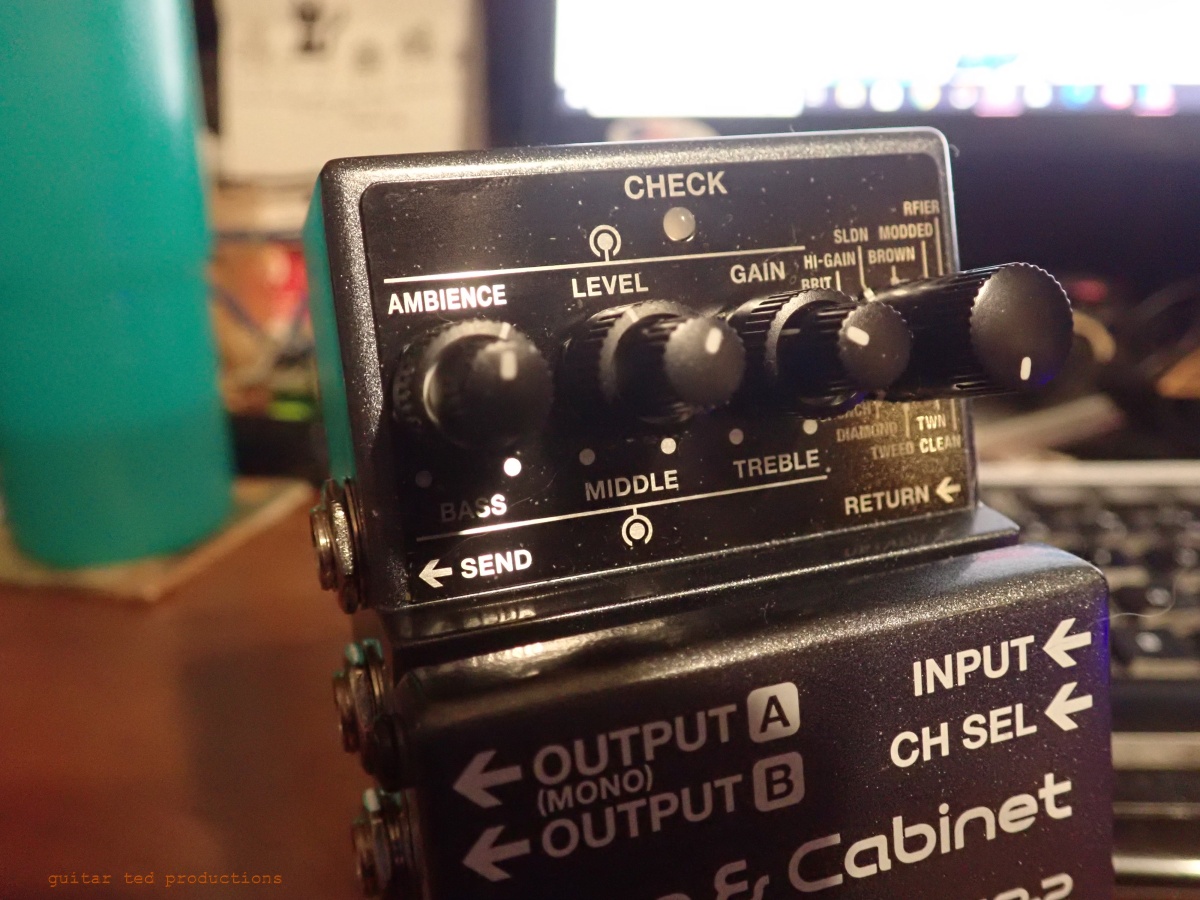
The pedal features dual concentric pot controls and an 11-way amp selector.

The Boss IR-2 Amp & Cabinet pedal is what it sounds like, an amplifier and cabinet replacement tool. The "IR" in the name stands for "Impulse Response". So the pedal can take a guitar signal, amplify it, and send out a signal.  That signal, when hooked up to a powered speaker, a front-of-house PA, or an audio interface, sounds like a "real electric guitar" being played. Supposedly.....

To do this Boss has simulated (modeled) several amplifier types, provided a stereo output, a USB connection, a mono input, and a remote switching option jack. Three dual-control concentric potentiometers control a three-band equalization section, "Ambience" control, output level, and overall gain level. There are eleven modeled "amps" to choose from as well. There is also an effects loop. 

The pedal can be powered using a typical DC pedal supply or internally by the traditional Boss 9 volt battery snap, which if I am not mistaken, makes the IR-2 the only device of its type to be able to be powered independently of an external power supply. This allows you to use the IR-2 Amp & Cabinet pedal as a portable device, if you want to do that. 
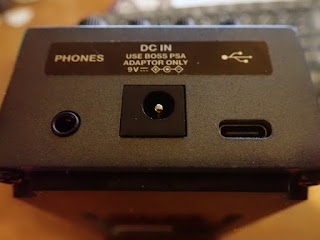
The pedal can be powered by a 9V DC input or by an internal 9V battery.

I'm not going to review every sound and feature here. That would take far too long and there are great You Tube videos on this device that do that anyway. What I am going to do here is give my two cents on how the device is useful to me, will be useful to me, and what I like and don't like about it. 

Playing The Boss IR-2 Amp & Cabinet Pedal: The first thing I did was to plug in an eighth inch headphone jack, (oh yeah, the IR-2 has a head phone jack as well!), and I plugged in a guitar to the input. Oddly enough, I had sound without turning on the pedal! A long press on the pedal foot switch brought up my amp selection. It sounded pretty good. There was a reverb on the signal as well. This reverb was a spring type, but you can perform a certain procedure using the knobs and foot switch in a certain way to choose a different ambient effect. You can use a Hall type reverb or a Plate type besides the Spring which is the stock setting. I ended up on the Plate setting. The "Ambience" control serves as a level control for this effect. It sounds good without being overbearing or ridiculous, even at the higher settings. 

The IR-2 will "remember" your tonal settings and gain and level settings you choose if you leave an amp selection and go to another. You can return to the previous settings simply by tapping the foot switch, or remote switch, if you use an auxiliary foot switch. The indicator light will go from green to red to indicate either settings and you can tab back and forth at will. But......if you reach down and select another amp, the first settings disappear, and now you have the new amp choice and the previous one. There is no Midi capability or easy way to store presets at all. By the way, a long press on the foot switch turns the IR-2 off. 

The pedal has an effects send and return. Note the tiny print to indicate the amp sims.

I also found that when making tonal changes, it may take a few seconds for those to register audibly. But once the pedal starts tracking one change, other changes are instantaneous. I played with the IR-2 as a stand-alone practice tool using the internal battery. Boss says the battery that is shipped with the pedal is for "demonstration purposes only" and that it may not last long. I replaced it with a standard Duracell battery and I found that this lasted about 3-ish hours. 

I also integrated this set up using a fuzz pedal in front of the IR-2 and on one occasion I used a boost pedal. Both sounded great and did what I expected. So, you could set up the IR-2 to be a "bedroom practice tool" and all anyone would hear would be the natural acoustic tone of your particular guitar. Meanwhile, you'd be rocking out. Nice! 

Next, I wanted to see if I could integrate the IR-2 into my existing pedal board. Ideally, all my gain pedals would run straight into the IR-2's input while my modulation and time based effects would go into the effects loop of the IR-2. The output can then be sent to a traditional amp, probably via the "return" of the effects loop of that amp, or by sending the signal to a direct box and then to a sound board, or to an audio interface. You could run the IR-2 into the front end of a traditional amp, but that is kind of the least appealing way to take advantage of this device, in my opinion. (Or maybe not. See UPDATE below) At that point, just plug in your amp and bypass the IR-2, but that said, you can do this. Simply follow the procedure on Boss' website and disable the Celestion impulse response and then use the physical amplifier that you have. 

My test showed me that the Amp & Cabinet pedal integrates easily into the pedal board, (which is a hot mess as I am constantly changing things out), and that my effects all do their thing as I expect. Again, I had my modulation/time based effects in the effects loop of the pedal, and it all worked perfectly, although I cannot say what difference it makes compared to running everything straight in. I didn't try it out that way. 


 What I Don't Like About The IR-2 Amp & Cabinet Pedal: First of all, there is no physical manual. I tried scanning the QR code which Boss claims takes you to a user manual, but after registering my pedal with them, I was sent to the product page which tells you nothing about things like how to switch reverb. 

I ended up learning how to use the deeper functions of this device from an independent You Tuber review, otherwise I would have been stuck with spring reverb. Not that spring reverb is bad, but what was bad was that I couldn't use what I paid for to use. Boss could do a lot better here. If there is a manual, I didn't find it online. Maybe I missed it. It shouldn't be that hard to find if it is there. I will say that in my defense, if - in fact - the manual is there online.

Secondly, those tiny knobs, the tinier print, and the way the controls are set lower behind the foot switch make this annoying as heck to dial in. But, yeah......whatta ya gonna do? The form-factor of a Boss pedal only has so much real estate, and this is a very pedal board friendly device. If it were bigger it would get too much for desktop use or to be stuck on many peoples pedal boards, especially if you use a lot of effects. So, while that is annoying, I will live with it because of the form-factor and the price in light of what you get here. 

I was a bit disappointed in the 9 volt battery life, but maybe I expect too much. Yeah.....I probably do! So that maybe is not a real negative there. There was one other annoying bit, but I'm going to get to that in my "Conclusions" on this device.

What I Do Like About The IR-2 Amp & Cabinet Pedal: The sounds range from "pretty good" to outstanding. I'm not a heavy rock or metal guy, so I'll leave those sounds for someone else to critique, but what I would use here would make me happy in a live or recording context. As a practice tool they are more than fine. 

The versatility of the device is great. I can use it anywhere as a practice amp with headphones running off a 9 volt battery. Yeah.....you'd burn through a lot of batteries! Three plus hours isn't all that long. But you have that choice which is fantastic. You could definitely use the IR-2 as a back-up to a physical amp. If your amp craps out at a gig, the IR-2 could step in as a sub and get you through a gig well enough, I reckon. And of course, for all those venues that hate physical amps or stage volume of any kind, the IR-2's small footprint make it an easy thing to choose for your gigging needs. And it sounds pretty good to boot, I think.  

What I will Likely Do With The Amp & Cabinet Pedal: After messing around with this thing, I think I'm going to set up a mini-board using the IR-2, a dirt pedal, a delay, and a tremolo. This will sit on my desk and I'll use this to record things and to play along with music "silently". With all the amp sims and two choices, or "channels", I would have enough variety in sound to satisfy my needs for enjoying practicing or sketching out recording ideas. 

Testing the Amp & Cabinet pedal.

Conclusions: There is a lot to like here. Quiet practice, recording possibilities, a device that can help keep stage volumes to a minimum, or this could be a big part of a "fly-rig" or bail you out at a gig when the house amp dies. It sounds decent. Maybe not "just like" the amps it claims to emulate, but totally believable as a guitar "amp" and your effects can really be integrated well. All a big plus from where I sit. 

That all said, I have grown up playing physical, "real" tube amps and one thing the IR-2 and its ilk cannot do, two things they cannot do, are push air and create a feedback loop. Both things being a HUGE part of the experience of playing an electric guitar. 

Try turning up a tube amp and "chunk" some rhythm guitar part. Feel that? It's the amp moving the air physically around you. Now hit a single note, let it ring out, and feel that amp start to pick up on a certain frequency and "feed back". The IR-2 gives you neither of these physically felt, visceral feelings. In that sense I feel kind of detached from the guitar as I played the IR-2, especially if I was practicing along with recordings of my favorite music. Update 12/13/24: Just listened to a 'That Pedal Show" episode concerning Leslie/Fender Vibratone and how digital and physical air movement causes different experiences. Worth a listen - and listen on headphones! Episode on YouTube HERE.

Additionally I felt that my effects lost that interaction with an amplifier by using the IR-2. Again, it is something you have to have had experienced playing loudly with an amplifier to have felt that. Musicians who have always played "in the box" without amps on stage, (or in the home), may not miss what I missed. 

On the other hand, I can play along to music again and enjoy "electric guitar sounds" such as they are today. I can record things on guitar into my computer using the IR-2 and an audio interface or direct into my computer via the USB port on the IR-2. I can practice anywhere silently with headphones using the 9V battery option. Now if some sound engineer tells me that I cannot bring an amp, I can get "my sound" reliably with my effects and the IR-2 going to a direct box or front of house PA. 

Maybe young folks who grow up on these sorts of audio interfaces will never miss a "real amp" experience, but as for me, I'm not selling my amps anytime soon. Even if I rarely get to use them. The IR-2 can fill in the blanks, but that "real amp" experience? I'm not ready to give up that just yet.  

UPDATE 3/3/24: I wanted to jump back into this post to let anyone know who cares what my experiences have been with the IR-2 in a pedal board set up. I decided to keep the IR-2 on my board as seen above and I am running dirt pedals into it which include a fuzz, treble booster, mid-boost, a Marshall-in-a-box pedal, a Boss OD1 style pedal, and a fuzz style distortion. The modulation effects are run through the IR-2's effects loop. Those effects are a tremolo, a phaser, a delay, and a reverb. 

I can run direct to front of house, but as of now, I have not had time, nor opportunity, to do that....yet. I have done something that most guitarists would not consider, I think, and that is to run the whole set up straight into a Deluxe Reverb reissue. I didn't even toggle off the IR-2's cab simulation. I know..... You can't do that! But I did. So..... 

It sounded great. Interestingly, I was using the IR-2's Twin Reverb simulation into the "real" Deluxe Reverb and it sounded fine. Like a "bigger" sound, but still that Fender clean tone. Overdrive was glorious through this set up. The sound? I really did not think it was weird or negative at all. I used a big, washy delay, a big reverb, and the tremolo. All sounded fine. I messed with the treble booster and the distortion during rehearsal just to see, and those worked as I would expect.

 I got lots of compliments afterward too. So, yeah.... It may not work in every instance, but I say experiment. You never know until you try. 

A couple of notes: I think you really have to be fastidious with your power cable runs on your pedal board when using the IR-2. My first attempt was met with a LOT of noise, but after straightening out the spaghetti under the board which I caused when I rearranged the board, everything was pretty quiet. I was surprised, actually. 

The other thing would be to make sure you run the level control on the IR-2 at a slightly lower level than the amp you are driving or things get grainy and really loud. Otherwise, I will definitely be using this set up more.

Saturday, January 14, 2023

The Six String Side: Roland Jazz Chorus JC40 Amplifier

When I started this blog over fifteen years ago, I stated that it was a "Bicycle and guitar oriented elixir....". Well, the "guitar" part sort of got pushed out by the bicycle stuff, but I've always been playing. In a post from Easter time 2017, I mentioned playing my '90 Strat, and someone suggested I detail the fleet, so here ya go. Hopefully ya'll enjoy the change in pace. I'll post something periodically throughout the year. 

This time I am reviewing my brand new Roland Jazz Chourus JC40 amplifier which was given to me as a gift for Christmas/anniversary by Mrs. Guitar Ted: 

Okay, I admit that I was one of those guys that thought only a vacuum tube based amplifier was "good enough" for my guitar playing. And right up front, if you don't know what that means, don't worry. It's a guitar player's thing. Kind of like saying "I only ride Campagnolo stuff", or something along those lines. You know- snobbish, thoughtless traditionalism. 

Not that there isn't a difference, because there is, but many guitar players slag off anything that is 'solid state' as being, well......junk. That's just plain not very smart thinking. And again- I was one of "those guys" for many years. 

The JC40 isn't a very big amplifier, but don't let that fool you!
But times change, I have a more open mind now, and I have several tube amplifiers in need of service. Techs are expensive and hard to find that will do a good job on a vacuum tube based amplifier. I was - and still am - working at getting myself set up to service my own amplifiers, learning all I can, and gathering tools and supplies. But it is kind of like trying to set up your first bike shop with all the stuff you'd really need and also trying to learn before you dive in. 

One big difference between amp repair and bicycle repair is that you could easily make a mistake and die doing amplifier repair. So......it's no trifling thing to take up. You really have to do everything 'just so', and have the correct equipment. On bicycles? Yeah.....much safer to work on!

Sorry about the diversion here, but it all leads to where I am at, and that is that I  had no amplifier I could play through here for probably a good four years or more. Finally, I got sick and tired of that enough to start looking at options. Headphone amps, virtual amps, amp modelers, pre-amps, power amps, yada, yada, yada........ It was mind boggling. So, how did I end up here?

I came across a Roland Jazz Chorus JC40 video one day and it sparked interest. Here was a device I could play out with, use at church, use at home, plug into an interface into the computer, and it has headphone jacks for silent practicing. Plus, it weighs about 33lbs and it doesn't have the same issues with vacuum tubes that my other amplifiers do.

The JC40 is true stereo from front to back. That's rare in guitar amps.

I dug in deeper and found out everything I could about this model which is based off of the venerable 1970's era JC120 Jazz Chorus amp which was used prominently by the Police, Metallica, and Albert King, to name a few musicians and bands. 

I liked what I was seeing and hearing, so my wife thought she would buy it for my Christmas/anniversary gift this year. (We got married on January 2nd, 1999, by the way)

I've played around with it enough now and gigged it once so I figured I would also give a brief review. A lot has been said online about this amp, so I will hit the bullet points and comment a bit at the end.

  • Stereo: This amp actually has two amps in it for true stereo output. There is even a stereo effects loop in the back panel. This is not common for guitar amps and this is my first go-round with anything like it. 
  • Loud: Looking at the reviews on this amp, everyone said it was loud. It isn't just loud, it's REALLY LOUD! Check out where I have the volume knob. It looks like it is off, but in fact it is just off 'zero' and that is 'maybe bedroom volume'. At the gig I played I had it set to about "1.5" and it was plenty loud enough to hear for me. 
  • EQ Section: The equalization section is powerful. You can dial in a lot of different timbres and tones with the EQ section on this amp. It has a "Bright" switch which I can see for use on a guitar that is darker, but the EQ section kind of negates the need for it, in my opinion. 
  • Distortion Knob: Okay, here we go! Many reviews mentioned that old JC120's had horrible distortion sounds. It was the first amp with built in distortion, chorus, and vibrato effects in it, so maybe they missed on the first try. Anyway, the distortion sounds here are very usable. You can dial in a bit of "hair" on the notes to a fuzzy, heavy distorted tone. See my "Not So Good" section below for more on the distortion. 
  • Reverb/Vibrato/Chorus: This is the best part of the amp, in my opinion, and other reviewers seem to agree. THIS is THAT tone you've heard before on countless recordings. Nuff said here. 
  • Light Weight: I already mentioned it, but my pedal board and its case weigh more than the JC40 does. Again, nuff said.

The Not-So-Good: My complaints? They are few, but nothing is perfect, right? 

  • Dynamics Remember that distortion? Well, on a tube amp, you can soften your attack, or roll back the volume knob on the guitar, and get a cleaner/clean sound. The JC40 does not respond in that manner. It gets quieter and louder with your varied attack, but the distortion is the distortion- all the time. 
  • Character: I'm calling this "character" because I think it fits best here. The JC40 is a very 'flat' amplifier in that it has great response, it reproduces exactly what you put in, but it is a bit sterile and it definitely gives no quarter when it comes to mistakes or gaffs. Your missed notes will come on through clear as day, and that makes this amp hard to play. That's not a criticism! And actually, I think it is a good thing. This amp will make me play better, and it won't be forgiving of my mistakes, and so I have to be a bit uncomfortable with that to get on with it. It's a hard thing to explain, but I've tried! 

Some folks in reviews I read were asking in the comments if the JC40 was hissy, or had a bad noise floor. I cranked the volume knob here to about "7" and I could hear a hiss, which wasn't all that bad, honestly, and which I suspect is always there, but would I ever play this thing at that level? Not likely, and almost every guitar amp has that white noise at high gain levels, so I see no issues here. At "2", it is too loud to play in the house and I hear nothing out of the speakers when I'm not playing. Of course, that hiss I heard at "7" is there, but it is so low as to be a non-issue. If you've got stuff plugged in that adds noise, this amp will reproduce that out of the speakers. But the amp is really pretty quiet. 

I did notice that the JC40 does pick up interference easily from stage lights, which in my case were within a few inches of the back end of the amp. (Dumb set up, but it was what the venue had going on, so....) Also, I imagine cell phones do what they do to all guitar amps- namely mess them up, so I would be very careful about that known issue with all guitar amplifiers. My gig was in a place filled with cell phones, so this may have contributed to my noise issues there, but I am pretty certain it was the lighting which was Bluetooth controlled and when lights were changed I could hear an audible change in tone of the buzzing noise. Nice! 

Pedal Platform: You'll hear many reviewers say that the clean sound of the JC40 is great (I agree) and this makes for a great "pedal platform amp". Well- is it? I have tons of effects pedals and I will say that this deserves a "qualified yes" as an answer. Remember when I said this amp gives you exactly what you put into it with no compromises? Yeah, well be prepared to actually "hear what your pedals really sound like" without the coloration of a tube amp. You may find out that certain pedals you have are not as good as you thought. You'll find that others jump out from the mix like never before. I know I did. 

A look at the back panel. The JC40 is fitted with two ten inch speakers.

Looks & Overall Construction: The JC120, this amps predecessor, had a quaint, kind of "hippy-leatherwork" appearance what with its bound edges and what look like brass tacks every so often around the border. The JC40 borrows this aesthetic and I don't mind it. It doesn't really say "jazz" to me, but neither does the amp. The whole "jazz" deal is kind of lost on many of us guitarists. Anyway, it looks unique and amp-o-philes and guitar nerds will recognize it as a Jazz Chorus with no problem.  

The box seems to be well put together, and the Tolex covering is smooth and without fault. I have heard and seen enough amp techs to know that you need to check the tightness of all the jack dress nuts and screws that hold on the handles of amplifiers as they are almost never tight from the factory. I went over all of this on the JC40 and found a few loose dress nuts on the back panel and two of the four screws holding in the handle weren't as tight as I'd like to see. Nothing horrible, mind you, but not ship-shape. 

Caution: If you aren't well skilled in fasteners and if you don't have the ability to "feel" tightness, know materials, and know how to fit screw drivers and nut drivers properly, leave this job to someone who does. It is super easy to foul up something and this could end up costing you a lot of money to fix. I have been working with my hands for 40+ years and I trust my hands, but unless you have a LOT of time with tools and fasteners, or unless you are uniquely gifted, DON"T ATTEMPT WHAT I DID! 

Final Word: Is this going to be better than a tube amp, or worse? I would say that this is the wrong question here. The Roland JC40 is different. In a good way, and also, it will do a lot of things my tube amps cannot do. That said, I'm still planning on fixing the Blues Junior, the Peavey Encore 65, the Univox head, and my Vox AC 30. There is just something about those tube amplifiers! 

UPDATE: 7/25/23: I was reading an article in "The Fretboard Journal" earlier this year and there was something in there about a cat that used to go into venues where he had to use a backline amp and he immediately turned the bass control OFF! The reasoning was that most recording engineers were running your guitar tracks through a high pass filter anyway, so any real bass frequencies were being cut out of the mix. Besides, when playing live those are the frequencies that make you get 'lost in the mix'. 

I was intrigued, so I tried this at church on their house Deluxe Reverb RI amp. It worked great! So.....what about this JC-40? Well, it also seems to do just fine with that technique as well. So, just a tip - Try turning the bass control to zero and see what you think. I liked it and I cannot say I'm missing anything. Just played the amp using a Pettyjohn Rail fuzz and it was glorious with the bass control on the amp at zero. 

UPDATE: 1/19/2024: Check out my review of the Boss IR-2 Amp & Cabinet Pedal HERE.

The Six String Side: Roland Jazz Chorus JC40 Amplifier

When I started this blog over fifteen years ago, I stated that it was a "Bicycle and guitar oriented elixir....". Well, the "guitar" part sort of got pushed out by the bicycle stuff, but I've always been playing. In a post from Easter time 2017, I mentioned playing my '90 Strat, and someone suggested I detail the fleet, so here ya go. Hopefully ya'll enjoy the change in pace. I'll post something periodically throughout the year. 

This time I am reviewing my brand new Roland Jazz Chourus JC40 amplifier which was given to me as a gift for Christmas/anniversary by Mrs. Guitar Ted: 

Okay, I admit that I was one of those guys that thought only a vacuum tube based amplifier was "good enough" for my guitar playing. And right up front, if you don't know what that means, don't worry. It's a guitar player's thing. Kind of like saying "I only ride Campagnolo stuff", or something along those lines. You know- snobbish, thoughtless traditionalism. 

Not that there isn't a difference, because there is, but many guitar players slag off anything that is 'solid state' as being, well......junk. That's just plain not very smart thinking. And again- I was one of "those guys" for many years. 

The JC40 isn't a very big amplifier, but don't let that fool you!
But times change, I have a more open mind now, and I have several tube amplifiers in need of service. Techs are expensive and hard to find that will do a good job on a vacuum tube based amplifier. I was - and still am - working at getting myself set up to service my own amplifiers, learning all I can, and gathering tools and supplies. But it is kind of like trying to set up your first bike shop with all the stuff you'd really need and also trying to learn before you dive in. 

One big difference between amp repair and bicycle repair is that you could easily make a mistake and die doing amplifier repair. So......it's no trifling thing to take up. You really have to do everything 'just so', and have the correct equipment. On bicycles? Yeah.....much safer to work on!

Sorry about the diversion here, but it all leads to where I am at, and that is that I  had no amplifier I could play through here for probably a good four years or more. Finally, I got sick and tired of that enough to start looking at options. Headphone amps, virtual amps, amp modelers, pre-amps, power amps, yada, yada, yada........ It was mind boggling. So, how did I end up here?

I came across a Roland Jazz Chorus JC40 video one day and it sparked interest. Here was a device I could play out with, use at church, use at home, plug into an interface into the computer, and it has headphone jacks for silent practicing. Plus, it weighs about 33lbs and it doesn't have the same issues with vacuum tubes that my other amplifiers do.

The JC40 is true stereo from front to back. That's rare in guitar amps.

I dug in deeper and found out everything I could about this model which is based off of the venerable 1970's era JC120 Jazz Chorus amp which was used prominently by the Police, Metallica, and Albert King, to name a few musicians and bands. 

I liked what I was seeing and hearing, so my wife thought she would buy it for my Christmas/anniversary gift this year. (We got married on January 2nd, 1999, by the way)

I've played around with it enough now and gigged it once so I figured I would also give a brief review. A lot has been said online about this amp, so I will hit the bullet points and comment a bit at the end.

  • Stereo: This amp actually has two amps in it for true stereo output. There is even a stereo effects loop in the back panel. This is not common for guitar amps and this is my first go-round with anything like it. 
  • Loud: Looking at the reviews on this amp, everyone said it was loud. It isn't just loud, it's REALLY LOUD! Check out where I have the volume knob. It looks like it is off, but in fact it is just off 'zero' and that is 'maybe bedroom volume'. At the gig I played I had it set to about "1.5" and it was plenty loud enough to hear for me. 
  • EQ Section: The equalization section is powerful. You can dial in a lot of different timbres and tones with the EQ section on this amp. It has a "Bright" switch which I can see for use on a guitar that is darker, but the EQ section kind of negates the need for it, in my opinion. 
  • Distortion Knob: Okay, here we go! Many reviews mentioned that old JC120's had horrible distortion sounds. It was the first amp with built in distortion, chorus, and vibrato effects in it, so maybe they missed on the first try. Anyway, the distortion sounds here are very usable. You can dial in a bit of "hair" on the notes to a fuzzy, heavy distorted tone. See my "Not So Good" section below for more on the distortion. 
  • Reverb/Vibrato/Chorus: This is the best part of the amp, in my opinion, and other reviewers seem to agree. THIS is THAT tone you've heard before on countless recordings. Nuff said here. 
  • Light Weight: I already mentioned it, but my pedal board and its case weigh more than the JC40 does. Again, nuff said.

The Not-So-Good: My complaints? They are few, but nothing is perfect, right? 

  • Dynamics Remember that distortion? Well, on a tube amp, you can soften your attack, or roll back the volume knob on the guitar, and get a cleaner/clean sound. The JC40 does not respond in that manner. It gets quieter and louder with your varied attack, but the distortion is the distortion- all the time. 
  • Character: I'm calling this "character" because I think it fits best here. The JC40 is a very 'flat' amplifier in that it has great response, it reproduces exactly what you put in, but it is a bit sterile and it definitely gives no quarter when it comes to mistakes or gaffs. Your missed notes will come on through clear as day, and that makes this amp hard to play. That's not a criticism! And actually, I think it is a good thing. This amp will make me play better, and it won't be forgiving of my mistakes, and so I have to be a bit uncomfortable with that to get on with it. It's a hard thing to explain, but I've tried! 

Some folks in reviews I read were asking in the comments if the JC40 was hissy, or had a bad noise floor. I cranked the volume knob here to about "7" and I could hear a hiss, which wasn't all that bad, honestly, and which I suspect is always there, but would I ever play this thing at that level? Not likely, and almost every guitar amp has that white noise at high gain levels, so I see no issues here. At "2", it is too loud to play in the house and I hear nothing out of the speakers when I'm not playing. Of course, that hiss I heard at "7" is there, but it is so low as to be a non-issue. If you've got stuff plugged in that adds noise, this amp will reproduce that out of the speakers. But the amp is really pretty quiet. 

I did notice that the JC40 does pick up interference easily from stage lights, which in my case were within a few inches of the back end of the amp. (Dumb set up, but it was what the venue had going on, so....) Also, I imagine cell phones do what they do to all guitar amps- namely mess them up, so I would be very careful about that known issue with all guitar amplifiers. My gig was in a place filled with cell phones, so this may have contributed to my noise issues there, but I am pretty certain it was the lighting which was Bluetooth controlled and when lights were changed I could hear an audible change in tone of the buzzing noise. Nice! 

Pedal Platform: You'll hear many reviewers say that the clean sound of the JC40 is great (I agree) and this makes for a great "pedal platform amp". Well- is it? I have tons of effects pedals and I will say that this deserves a "qualified yes" as an answer. Remember when I said this amp gives you exactly what you put into it with no compromises? Yeah, well be prepared to actually "hear what your pedals really sound like" without the coloration of a tube amp. You may find out that certain pedals you have are not as good as you thought. You'll find that others jump out from the mix like never before. I know I did. 

A look at the back panel. The JC40 is fitted with two ten inch speakers.

Looks & Overall Construction: The JC120, this amps predecessor, had a quaint, kind of "hippy-leatherwork" appearance what with its bound edges and what look like brass tacks every so often around the border. The JC40 borrows this aesthetic and I don't mind it. It doesn't really say "jazz" to me, but neither does the amp. The whole "jazz" deal is kind of lost on many of us guitarists. Anyway, it looks unique and amp-o-philes and guitar nerds will recognize it as a Jazz Chorus with no problem.  

The box seems to be well put together, and the Tolex covering is smooth and without fault. I have heard and seen enough amp techs to know that you need to check the tightness of all the jack dress nuts and screws that hold on the handles of amplifiers as they are almost never tight from the factory. I went over all of this on the JC40 and found a few loose dress nuts on the back panel and two of the four screws holding in the handle weren't as tight as I'd like to see. Nothing horrible, mind you, but not ship-shape. 

Caution: If you aren't well skilled in fasteners and if you don't have the ability to "feel" tightness, know materials, and know how to fit screw drivers and nut drivers properly, leave this job to someone who does. It is super easy to foul up something and this could end up costing you a lot of money to fix. I have been working with my hands for 40+ years and I trust my hands, but unless you have a LOT of time with tools and fasteners, or unless you are uniquely gifted, DON"T ATTEMPT WHAT I DID! 

Final Word: Is this going to be better than a tube amp, or worse? I would say that this is the wrong question here. The Roland JC40 is different. In a good way, and also, it will do a lot of things my tube amps cannot do. That said, I'm still planning on fixing the Blues Junior, the Peavey Encore 65, the Univox head, and my Vox AC 30. There is just something about those tube amplifiers! 

UPDATE: 7/25/23: I was reading an article in "The Fretboard Journal" earlier this year and there was something in there about a cat that used to go into venues where he had to use a backline amp and he immediately turned the bass control OFF! The reasoning was that most recording engineers were running your guitar tracks through a high pass filter anyway, so any real bass frequencies were being cut out of the mix. Besides, when playing live those are the frequencies that make you get 'lost in the mix'. 

I was intrigued, so I tried this at church on their house Deluxe Reverb RI amp. It worked great! So.....what about this JC-40? Well, it also seems to do just fine with that technique as well. So, just a tip - Try turning the bass control to zero and see what you think. I liked it and I cannot say I'm missing anything. Just played the amp using a Pettyjohn Rail fuzz and it was glorious with the bass control on the amp at zero.

Wednesday, January 04, 2023

Randomonium: Catching Up

A look at my desk which is typically messy like this.
NOTE: Okay folks, if you haven't been around long enough here to know what a "Randomonium" post is, then here is the deal. I ramble, rant, and randomly moan about all things cycling in one, incohesive, bizarre post. "Randomonium", okay?

And: This particular version of the Randomonium is dedicated to catching you all up on what has been going on around here in the last ten days or so. The "End of Year" madness kind of takes over, and day-to-day stuff gets shuffled aside for that. Okay? Here we go... 

First, an update on my health. I finally overcame that nasty head cold by December 21st, I'd estimate, which was the first day I felt as though I had no further symptoms of whatever I had. So, good to go on that front for Christmas and beyond.

Of course, the big news was the pre-Christmas Winter storm we had.It's been awhile since we've experienced sub-zero temperatures for up to 48 hours, near blizzard conditions for three days, and a basic shut-down of things due to Winter's blast. But the old memories of hunkering down for a storm like this kept me hopeful for coming out of this one as well. Then we whip lashed into this. This mess above freezing and all that beautiful fat bike-able snow is junk already. Bah!


Pirate Cycling League's New Event:

A new Winter event was announced by the PCL/Gravel Worlds folks late in December which they billed as a "return to the grassroots" of events which they were known for once upon a time. 

The event will feature a metric century or a half-distance cycling course on gravel roads and a 10K running event as well. Registration is open now and the event is set to take place on February 18th, 2023 in Lincoln, NE. 

The event will use a small town as a checkpoint where you will be required to purchase a Nebraska Lottery ticket to prove that you had been there. This reflects how Gravel Worlds was run in its early days. 

Comments: Fun! My initial reaction is that this is the sort of madness the cycling world needs at this time when events are seemingly going toward more rules, bigger crowds, and the chase for a career in gravel means that those of us that are not capable or desiring of that are left behind. In my view, the "Winter Endurance" event reflects how we were thinking when we set up gravel road cycling challenges back in the day. 

The fact that the promoters say the following, " We’re going back to our roots on this one!", would indicate that they had left their roots at some point, for whatever reasons. I'm not going to read anymore into that than to say, "I agree with that". It's hard to stick to your roots, I get that, but some have managed to stay the course all along since those "good ol' days" of yore. There ya go.....

Snip showing Bixby State Preserve and how the North-South road is truncated.
Feedback On The GTDRI Route Redux: 

Last year I posted the GTDRI Stories bit on the 4rth route, a route I stated was one of those GTDRI's I would consider riding again. It is a spectacular route in terms of visuals and in its toughness. 

So, near the end of last week I floated the possibility that this route might be modified and then recorded with notes for a small fee making it available for anyone to ride. I didn't hear much about it on the blog, but after I posted the idea to Instagram, the response was quite noticeable. 

So, here's the deal: I have to do some mods to the route and verify them. There are a few places where things have changed and in one instance, a significant change will require a major rerouting. It isn't an easy decision to make either, as choices for other roads are scant to none. 

Specifically the problem lies in the fact that the former road through Bixby State Preserve is now truncated. Honestly, that's actually a good thing. The Northern section of that road was heinous. I mean, really steep, filled with ruts, it had huge embedded rocks sticking up out of the road, and it was a challenge even on a mountain bike. When we last used that road in 2015 I don't think you could even drive a car or 4X4 down it safely anymore. 

Now, no big deal if we were "on the grid", but this area is far from being on the grid and road choices are few. I also have the task of preserving the feel of the original route, not adding too much mileage, giving chances for a resupply in Edgewood, and keeping pavement miles to a bare minimum. And that's just that problem with this route. 

New Unit:

The Sigma ROX 4.0 GPS computer test is still ongoing. The last time I wrote about this, I mentioned that the navigation function was wonky and that I was to get another head unit to test since my contact felt that the one I had was dysfunctional for some reason.  I was assured that typically Sigma ROX units were pretty bomber. So, I waited....

Then about a day or two after Christmas I got a box with a new ROX 4.0 GPS computer in it. I quickly got it synced with my phone and updated, and this went rather well, so I am hopeful that when I get the weather to try a route I have in the Ride app, I will be able to tell you all if it works as advertised. 

Stay tuned.... 

(L-R) Mrs GT, Vince Goterra, and GT: Image courtesy of St. John;s Lutheran Church

Gigging:

Christmas Eve saw myself and Mrs. Guitar Ted doing a gig at St. John's Lutheran Church in Cedar Falls, Iowa. It was a two set affair and we had a great time. It was a heck of a lot better than sitting in our house and wistfully looking out the window at negative 30+ degree winds and snow. 

I played my new Sully Conspiracy Series Stardust. I have bonded with that guitar pretty quickly, to be honest. It's really kind of odd when you consider that most every guitar is CNC'ed to exacting specifications, made from similar tone woods, and set up with quality hardware, in this case, identical hardware to my other Sully. However; I like the Stardust's feel and play-ability over that of my other one by a large margin. Weird.

Even weirder was playing out at a different venue. I haven't done that in a while. It was good to have that opportunity though. Oh! And I have a new amplifier too. Gotta get that up here on the blog soon.... 

Brief Fat Bike Blast:

I just mentioned the cold blast and snowy Christmas Eve we had, but it sure did not last long. We got another 3" of fluffy white snow on Monday and then it started getting warmer, and warmer, and warmer....

By Wednesday morning the snow was junk. It was around 30°F and was headed to the 40's. So.......so much for that!

I did get in a few short rides in bitterly cold temperatures, but busting drifted in snow and battling wind chills in the negative 20+ range was not a lot of fun. So, those fat bike rides were short. Really short! 

And now? Who knows when, if ever, we will get any fat bike-able snow.  Chances are we'll make it through most of January without that happening, and then, if history is any indication, February will see a return to snow and cold enough to warrant fat tires again. 

And that's all I have to catch you all up on.