Showing posts with label one-by drive train. Show all posts

Thursday, September 05, 2019

Some Eurobike Musings

Pivot's new Phoenix DH 29
 This week is Eurobike, the show in Germany all about bikes. Here following are some newsy bits and musings I have on what has been shown on the MTB side of things.

Nope! Never Happen In DH. 

Ten years ago EVERYBODY that rode DH or long travel mountain bikes were saying you couldn't do it. That "it" would NEVER happen and that 26" wheels would ALWAYS be the standard wheel size for DH machines.

Now it is 2019 going on 2020 and find me a currently produced 2020 model 26 inch wheeled DH bike. There might be one, maybe even two, but everyone knows now that 26 inch wheeled DH bikes are rarer than hen's teeth these days. But.....they said it couldn't be done! Let's review the current release of Pivot's Phoenix 29 DH sled.

First off, it has a mind boggling 190mm of rear travel! Try wrapping your 2009 mind around that. Your head would have exploded. But that's not all. This new bike Pivot is rolling out has a lower stand over height than the outgoing 27.5" model had. Mind = BOOM!

Pivot also says this in their press release for the bike:

"Without a doubt, 29er wheels roll faster, smooth out rough courses and carry a ridiculous amount of momentum. They offer improved tracking and braking in turns too. Short 17” (44.3mm) chainstays add ‘playful’, ‘flickable’ and ‘manuals for days’ to its repertoire. This makes it incredibly fun in a bike park, and extremely quick in tight, technical wooded sections."

Obviously that has to be a fabrication. Lies! There is no way a long travel 29"er can do these things! 

Unless it can. 
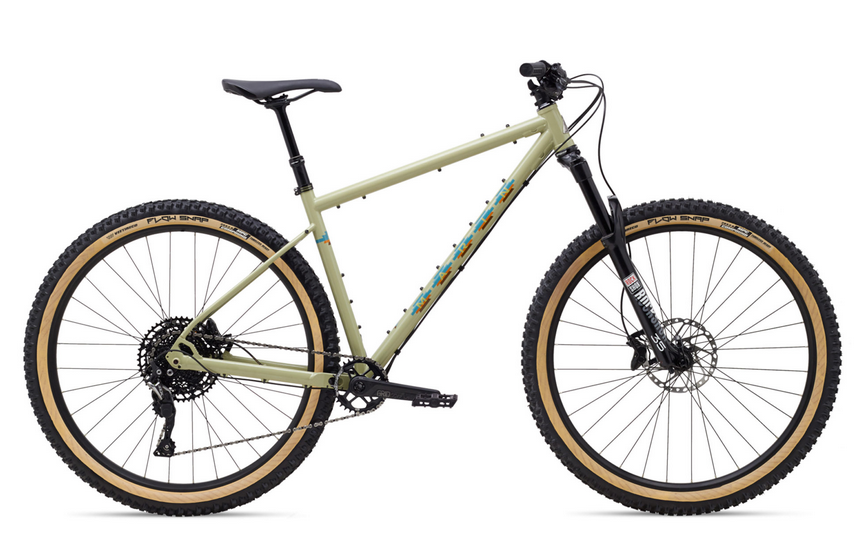

Surly Troll says, "I have the most braze-on warts!" Marin Pine Mountain says, "Hold my beer!":

Bikepacking has gone off the deep end. Well, in terms of mounting points, it has. Example: Marin's 2020 Pine Mountain. Sheesh! Don't clamp a hand around that down tube, you may get punctured! (Only kidding!) But yeah.....that looks ridiculous. 

And that isn't the only thing that looks ridiculous on what makes for a "modern day bikepacking rig". To my mind, many things about these sorts of takes on the load bearing, off road touring rig don't add up. For instance- Short chain stays. Not just short, but really short. Joe Breeze once told me that the longest, uninterrupted tube is the kind that gives the best ride. He was right too. Look at traditional touring rigs, or ride any bike with long-ish chain stays made from high quality steel. Smooth for days. But no- let's make these tubes as short as possible. Then the riders hindquarters will be right above the axle of the rear wheel.  Uh-huh. Yep..... Where do you get the bumpiest ride on the bus again? 

Then there is the whole bed roll on the handle bar deal. Or any loading up front, really. Let's see, who had that all figured out already? Oh! Yeah! Those randonnuer dudes and lasses, that's who. "Short trail" works best for front loading, but, ya know, let's slacken out the head angles to chopper-like status and put even shorter off-set forks on there. Yep.....just the ticket. 

Now lets buy ALL THE BRAZE ONS! We MUST use them!! (Sorry.......not sorry!

Anywho......Maybe I'm the one that just doesn't get it. That could be. 

New BOX Components 9 speed MTB drive train

Less Is More?

The whole down hill mountain bike gig is, perhaps, so far removed from the reality of riding mountain bikes, that any comparisons to "normal" mountain biking activities is sort of an apples to oranges one. However; one thing has come out of DH that is influencing more typical MTB styles and that is less cogs on the rear wheel. 

While the two "Big S" corporations chase 12 speed dominance and a little Spanish operation is pushing 13 speeds already, there are some companies looking at what less cogs on a system can do for mountain bikers. For one thing, the system can be more durable, longer wearing, and less expensive, theoretically. One company pushing this technology is BOX Components

It's a nifty looking system, and it is less expensive. It may not be lighter weight, but it certainly could be more durable. I mean, just look at the chain. If there is one thing that these 11 and 12 speed systems are really pushing the limits on, it is chain technology. I'm starting to hear about more snapped chains and quick links these days. It doesn't take a rocket scientist to figure out why that is. 

One other thing a lot of folks don't understand is the "margin for error". This is the concept that a cassette with less cogs, thicker cogs, and heavier duty chain is less prone to minor out of alignment/adjustment issues. I remember seeing folks with 7 speed MTB components that were running around, happy as larks, with slightly bent out of whack rear mech hangars and derailleur cages. Try that with you fancy-pants 12 speed stuff. Your bike probably won't even shift correctly, if at all. 

So, it is cool to see companies bringing more durable, less complex systems back into the fold. TRP also announced a 7 speed DH based system as well. I think there is definitely a place for such things. Less maintenance, less "margin for error", and it means more fun for a longer time. That's what it really is all about anyway, right? 

Stay tuned for more show related news....

Some Eurobike Musings

Pivot's new Phoenix DH 29
 This week is Eurobike, the show in Germany all about bikes. Here following are some newsy bits and musings I have on what has been shown on the MTB side of things.

Nope! Never Happen In DH. 

Ten years ago EVERYBODY that rode DH or long travel mountain bikes were saying you couldn't do it. That "it" would NEVER happen and that 26" wheels would ALWAYS be the standard wheel size for DH machines.

Now it is 2019 going on 2020 and find me a currently produced 2020 model 26 inch wheeled DH bike. There might be one, maybe even two, but everyone knows now that 26 inch wheeled DH bikes are rarer than hen's teeth these days. But.....they said it couldn't be done! Let's review the current release of Pivot's Phoenix 29 DH sled.

First off, it has a mind boggling 190mm of rear travel! Try wrapping your 2009 mind around that. Your head would have exploded. But that's not all. This new bike Pivot is rolling out has a lower stand over height than the outgoing 27.5" model had. Mind = BOOM!

Pivot also says this in their press release for the bike:

"Without a doubt, 29er wheels roll faster, smooth out rough courses and carry a ridiculous amount of momentum. They offer improved tracking and braking in turns too. Short 17” (44.3mm) chainstays add ‘playful’, ‘flickable’ and ‘manuals for days’ to its repertoire. This makes it incredibly fun in a bike park, and extremely quick in tight, technical wooded sections."

Obviously that has to be a fabrication. Lies! There is no way a long travel 29"er can do these things! 

Unless it can. 


Surly Troll says, "I have the most braze-on warts!" Marin Pine Mountain says, "Hold my beer!":

Bikepacking has gone off the deep end. Well, in terms of mounting points, it has. Example: Marin's 2020 Pine Mountain. Sheesh! Don't clamp a hand around that down tube, you may get punctured! (Only kidding!) But yeah.....that looks ridiculous. 

And that isn't the only thing that looks ridiculous on what makes for a "modern day bikepacking rig". To my mind, many things about these sorts of takes on the load bearing, off road touring rig don't add up. For instance- Short chain stays. Not just short, but really short. Joe Breeze once told me that the longest, uninterrupted tube is the kind that gives the best ride. He was right too. Look at traditional touring rigs, or ride any bike with long-ish chain stays made from high quality steel. Smooth for days. But no- let's make these tubes as short as possible. Then the riders hindquarters will be right above the axle of the rear wheel.  Uh-huh. Yep..... Where do you get the bumpiest ride on the bus again? 

Then there is the whole bed roll on the handle bar deal. Or any loading up front, really. Let's see, who had that all figured out already? Oh! Yeah! Those randonnuer dudes and lasses, that's who. "Short trail" works best for front loading, but, ya know, let's slacken out the head angles to chopper-like status and put even shorter off-set forks on there. Yep.....just the ticket. 

Now lets buy ALL THE BRAZE ONS! We MUST use them!! (Sorry.......not sorry!

Anywho......Maybe I'm the one that just doesn't get it. That could be. 

New BOX Components 9 speed MTB drive train

Less Is More?

The whole down hill mountain bike gig is, perhaps, so far removed from the reality of riding mountain bikes, that any comparisons to "normal" mountain biking activities is sort of an apples to oranges one. However; one thing has come out of DH that is influencing more typical MTB styles and that is less cogs on the rear wheel. 

While the two "Big S" corporations chase 12 speed dominance and a little Spanish operation is pushing 13 speeds already, there are some companies looking at what less cogs on a system can do for mountain bikers. For one thing, the system can be more durable, longer wearing, and less expensive, theoretically. One company pushing this technology is BOX Components

It's a nifty looking system, and it is less expensive. It may not be lighter weight, but it certainly could be more durable. I mean, just look at the chain. If there is one thing that these 11 and 12 speed systems are really pushing the limits on, it is chain technology. I'm starting to hear about more snapped chains and quick links these days. It doesn't take a rocket scientist to figure out why that is. 

One other thing a lot of folks don't understand is the "margin for error". This is the concept that a cassette with less cogs, thicker cogs, and heavier duty chain is less prone to minor out of alignment/adjustment issues. I remember seeing folks with 7 speed MTB components that were running around, happy as larks, with slightly bent out of whack rear mech hangars and derailleur cages. Try that with you fancy-pants 12 speed stuff. Your bike probably won't even shift correctly, if at all. 

So, it is cool to see companies bringing more durable, less complex systems back into the fold. TRP also announced a 7 speed DH based system as well. I think there is definitely a place for such things. Less maintenance, less "margin for error", and it means more fun for a longer time. That's what it really is all about anyway, right? 

Stay tuned for more show related news....

Tuesday, June 27, 2017

Simplified Drive Trains Complicated By Proposed New Developments

Getting rid of that front derailleur and adding wide range cassettes has its pitfalls.
Just the other day I mentioned in a post about how I wasn't necessarily a fan of the 1X drive train craze sweeping the mountain bike world of late. I do really like the idea for fat bikes, but there are issues when you try to make the chain do the physical gymnastics required of it to make a 1X drive train work. Especially if you want a wide range of gears.

Riders are finding this out now. New 2017 bikes with different lower end spec have been plagued by issues such as dropped chains, chains that derail when pedaled backward, and by noises and excessive wear. SRAM and Shimano have responded by making further tweaks to tooth profiles on chain rings and cassette cogs to allow chains to engage and release the teeth more efficiently, especially when coming off those big, 42T-50T rear cogs.

Basically, what has happened is that we've removed our front shifting issues and found them again on the back end.

Think about it- Big chain rings up front didn't want to release the chain or pick it up easily because there was so much more chain to teeth contact by virtue of the chain ring sizes. Now those sized cogs and bigger are found out back on many mountain bikes and the chain release issues have cropped up again.

This Shimano patent applied for design shows an axially movable chain line. Courtesy of Cycling Industry News.
Now Shimano and SRAM are applying for patents to address this issue. The ideas are different, but the results sought for are the same. Shimano suggests a bottom bracket spindle that telescopes in and out to straighten chain line, which would make the drive train more efficient and discourage chain drop. This solution does what we used to do with our triple chain rings and front derailleurs- straighten our chain lines out. Obviously it would make sense that Shimano would require the bottom bracket to telescope in a way somehow synchronized to the shifter. Di2 would make sense here.

It complicates the bottom bracket, for sure, and it puts a mechanism in a place where moisture could wreak havoc on the device. However; if anyone can engineer this to work right, I would place my bets on Shimano. Still, I am not convinced something this complex can survive the rigors of mountain biking. But we may or may not see............

SRAM's solution also alters the chain line but does it by a floating chain ring mount. Image courtesy of Cycling Industry News
 SRAM seems to have taken a different approach which seems to involve canting the chain ring in the direction of how the chain wants to flow back toward the cassette, depending upon the gear chosen. This option seems to not be tied directly to how the shifter operates and would appear to be simpler and effective. However, any time I've seen any chain ring allowed to move, (granted, it wasn't designed to move), it is not a good thing. This solution leaves me with a lot of questions and concerns. Also, the SRAM solution requires a special chain ring carrier, which would suggest that it only would work with removable spider designed cranks, perhaps. More places for creaks to happen, in my opinion, here with this design.

But what really strikes me here, and actually made me laugh out loud when I first saw this, was how all this getting rid of the front derailleur was going to simplify our drive trains. 

Apparently "simple" isn't working out as well as they hoped it would! But making it more complicated is the answer? I don't see this working out well...........


Simplified Drive Trains Complicated By Proposed New Developments

Getting rid of that front derailleur and adding wide range cassettes has its pitfalls.
Just the other day I mentioned in a post about how I wasn't necessarily a fan of the 1X drive train craze sweeping the mountain bike world of late. I do really like the idea for fat bikes, but there are issues when you try to make the chain do the physical gymnastics required of it to make a 1X drive train work. Especially if you want a wide range of gears.

Riders are finding this out now. New 2017 bikes with different lower end spec have been plagued by issues such as dropped chains, chains that derail when pedaled backward, and by noises and excessive wear. SRAM and Shimano have responded by making further tweaks to tooth profiles on chain rings and cassette cogs to allow chains to engage and release the teeth more efficiently, especially when coming off those big, 42T-50T rear cogs.

Basically, what has happened is that we've removed our front shifting issues and found them again on the back end.

Think about it- Big chain rings up front didn't want to release the chain or pick it up easily because there was so much more chain to teeth contact by virtue of the chain ring sizes. Now those sized cogs and bigger are found out back on many mountain bikes and the chain release issues have cropped up again.

This Shimano patent applied for design shows an axially movable chain line. Courtesy of Cycling Industry News.
Now Shimano and SRAM are applying for patents to address this issue. The ideas are different, but the results sought for are the same. Shimano suggests a bottom bracket spindle that telescopes in and out to straighten chain line, which would make the drive train more efficient and discourage chain drop. This solution does what we used to do with our triple chain rings and front derailleurs- straighten our chain lines out. Obviously it would make sense that Shimano would require the bottom bracket to telescope in a way somehow synchronized to the shifter. Di2 would make sense here.

It complicates the bottom bracket, for sure, and it puts a mechanism in a place where moisture could wreak havoc on the device. However; if anyone can engineer this to work right, I would place my bets on Shimano. Still, I am not convinced something this complex can survive the rigors of mountain biking. But we may or may not see............

SRAM's solution also alters the chain line but does it by a floating chain ring mount. Image courtesy of Cycling Industry News
 SRAM seems to have taken a different approach which seems to involve canting the chain ring in the direction of how the chain wants to flow back toward the cassette, depending upon the gear chosen. This option seems to not be tied directly to how the shifter operates and would appear to be simpler and effective. However, any time I've seen any chain ring allowed to move, (granted, it wasn't designed to move), it is not a good thing. This solution leaves me with a lot of questions and concerns. Also, the SRAM solution requires a special chain ring carrier, which would suggest that it only would work with removable spider designed cranks, perhaps. More places for creaks to happen, in my opinion, here with this design.

But what really strikes me here, and actually made me laugh out loud when I first saw this, was how all this getting rid of the front derailleur was going to simplify our drive trains. 

Apparently "simple" isn't working out as well as they hoped it would! But making it more complicated is the answer? I don't see this working out well...........


Friday, March 04, 2016

Friday News And Views

So they do know how to make components look cool.
A Shimano Group That Looks Cool: 

Shimano made some traditional early season announcements this week and you may have heard about one of them, but this probably flew under the radar, for the most part. It was Shimano's announcement of yet another oddball set of components for a niche market. An "urban focused" group of components called "Metreo", which features what I honestly think is some of the best looking components to come out of Shimano in a decade. Specifically, the crank set is awesome, and represents a level of class that should be on Dura-Ace level stuff. Unfortunately, you and I probably will never see a Metreo crankset, which is really too bad. It is the best juxtaposition of Shimano's angular, asymmetric crank spider design against a tasteful, balanced polished brightness, which has been sorely missing from Shimano's overall look since 9 speed Ultegra went out the door in the mid-2000's. Too bad they wasted such a great look and design cues on a group hardly anyone will see, let alone use.

The Missing Link: The other thing that many may have missed in the hoopla over the 1X stuff is the announcement that Shimano will, finally, offer a Shimano approved quick-link which has been designed for the 11 speed
chains only.  Yes, you could always just use a KMC link, (and it is widely rumored that KMC actually is the vendor for many Shimano chains anyway), but what is more important is that Shimano, who has doggedly demanded that only its breakaway chain pins be used on its chains since the mid-90's, has now put its blessing on a quick link attachment.

That's huge, coming from a company that is super-conservative in its design, and from my view, shows a small but important design philosophy change in Shimano. What will come next? It just shows that Shimano is, perhaps, now coming around to making a few breaks from traditional ways of doing things. However that is, I hope that Shimano continues to hold to its past quality commitment, since that is really what they have to hang their hat on. They don't market well, like SRAM does, and because of that, they certainly are not "cool" in any cultural sense from a Western point of view, but they make stuff that is reliable and that works. I would suggest that maybe that is something for other component manufacturers and brands to look at and learn a little bit from. But then again, I am a mechanic. I would say that, right?

A "wide-narrow" chain ring on a Shimano crank? Why yes!
Shimano "One-By"? The one thing you probably did hear about was that Shimano has its own "wide-narrow" chain ring to help retain a chain on a chain ring while being used in a "one-by" set up in conjunction with a clutch derailleur. That and a cassette, that, by the way, does not need a special free hub, which ranges from 11 teeth to 46 teeth.

Okay, I know a lot of you are probably thinking SRAM has "forced Shimano's hand" and that is why you are seeing this now. Well, I am sure that SRAM had something to do with pushing Shimano to look at this, like maybe three years or so ago. Yes, this didn't happen overnight, and I know Shimano doesn't just roll out a new component without a ton of prototyping and testing before a final product is released.

Shimano takes several years to react to market changes because of their inner culture, which demands that ideas be proven in the field and that exhaustive prototyping and analysis be undertaken before you even get wind of something new. So, this is not a "me-too" narrow-wide chain ring idea, nor is the cassette something Shimano just threw together to answer SRAM's push for 1X domination. That much I pretty much know for sure, having been exposed to a tiny window inside the company at one time.

What I don't know is how it will work in comparison to SRAM's stuff. I would be willing to bet that it works as well, and I would not at all be surprised that we find out it works better. That's just how Shimano does things.

Okay, that's a wrap on the news and views today. Have a great week, and keep the rubber side down!

Friday News And Views

So they do know how to make components look cool.
A Shimano Group That Looks Cool: 

Shimano made some traditional early season announcements this week and you may have heard about one of them, but this probably flew under the radar, for the most part. It was Shimano's announcement of yet another oddball set of components for a niche market. An "urban focused" group of components called "Metreo", which features what I honestly think is some of the best looking components to come out of Shimano in a decade. Specifically, the crank set is awesome, and represents a level of class that should be on Dura-Ace level stuff. Unfortunately, you and I probably will never see a Metreo crankset, which is really too bad. It is the best juxtaposition of Shimano's angular, asymmetric crank spider design against a tasteful, balanced polished brightness, which has been sorely missing from Shimano's overall look since 9 speed Ultegra went out the door in the mid-2000's. Too bad they wasted such a great look and design cues on a group hardly anyone will see, let alone use.

The Missing Link: The other thing that many may have missed in the hoopla over the 1X stuff is the announcement that Shimano will, finally, offer a Shimano approved quick-link which has been designed for the 11 speed
chains only.  Yes, you could always just use a KMC link, (and it is widely rumored that KMC actually is the vendor for many Shimano chains anyway), but what is more important is that Shimano, who has doggedly demanded that only its breakaway chain pins be used on its chains since the mid-90's, has now put its blessing on a quick link attachment.

That's huge, coming from a company that is super-conservative in its design, and from my view, shows a small but important design philosophy change in Shimano. What will come next? It just shows that Shimano is, perhaps, now coming around to making a few breaks from traditional ways of doing things. However that is, I hope that Shimano continues to hold to its past quality commitment, since that is really what they have to hang their hat on. They don't market well, like SRAM does, and because of that, they certainly are not "cool" in any cultural sense from a Western point of view, but they make stuff that is reliable and that works. I would suggest that maybe that is something for other component manufacturers and brands to look at and learn a little bit from. But then again, I am a mechanic. I would say that, right?

A "wide-narrow" chain ring on a Shimano crank? Why yes!
Shimano "One-By"? The one thing you probably did hear about was that Shimano has its own "wide-narrow" chain ring to help retain a chain on a chain ring while being used in a "one-by" set up in conjunction with a clutch derailleur. That and a cassette, that, by the way, does not need a special free hub, which ranges from 11 teeth to 46 teeth.

Okay, I know a lot of you are probably thinking SRAM has "forced Shimano's hand" and that is why you are seeing this now. Well, I am sure that SRAM had something to do with pushing Shimano to look at this, like maybe three years or so ago. Yes, this didn't happen overnight, and I know Shimano doesn't just roll out a new component without a ton of prototyping and testing before a final product is released.

Shimano takes several years to react to market changes because of their inner culture, which demands that ideas be proven in the field and that exhaustive prototyping and analysis be undertaken before you even get wind of something new. So, this is not a "me-too" narrow-wide chain ring idea, nor is the cassette something Shimano just threw together to answer SRAM's push for 1X domination. That much I pretty much know for sure, having been exposed to a tiny window inside the company at one time.

What I don't know is how it will work in comparison to SRAM's stuff. I would be willing to bet that it works as well, and I would not at all be surprised that we find out it works better. That's just how Shimano does things.

Okay, that's a wrap on the news and views today. Have a great week, and keep the rubber side down!

Friday, January 08, 2016

Friday News And Views

Yo! Wheel change here!
Leadville 100 Announces Riders To Get More Support:

There's a newsy bit out the other day saying that Mavic will have its famously yellow vehicles out on course supporting Leadville 100 riders. So, if you win the lottery to get into that event, maybe you can lighten your load now and not have to carry stuff to fix a flat tire anymore.

However that might work out for riders in reality, it was a certain comment about the proposal that I found very interesting. It came from a well respected mountain bike magazine's Twitter feed, and stated that this would send up Leadville's status to "a real race" level. Okay, that's a comment from a mountain bike magazine. Really?

I remember when mountain biking and self-sufficiency went hand in hand. Heck.....I can remember when all mtb events were accomplished on one bike! Boy.....we've come a long way away from that ideal! I'm cool with the different tools to get the different jobs done, but all the creeping in of things to make racing easier is really sucking the spirit of the sport out, in my opinion. Especially when it comes to mountain biking. Yep, it would not at all surprise me to see Mavic getting the nod to do neutral support at a gravel road racing event sometime in the future either. Maybe they already do here in the US. (No.....Strada Bianca doesn't count.)

Well, there's that.......
The idea of a variable speed crank isn't a new one

Wave Transmission: A New Bicycle Drive Train For The Future?

Bicycle innovation has been ongoing for well over 100 years now, and since there are many old ideas that weren't possible to produce due to manufacturing and materials technology limitations, we sometimes see things resurface. The idea for a variable speed crank without using multiple, fixed chain rings, isn't new, but it wasn't really possible to manufacture back a century ago. 


As an example, I got this e-mail the other day concerning a "new" transmission for cycling. It's a "proof of concept" exercise at this stage, so you'll have to look past the crude, industrial, "works" nature of the component, but click the video here and watch what this does. It is pretty crazy.

Some of you might remember the Browning Automatic, or as it is known now, SmartShift. This isn't like that, although they both claim some similar benefits. The Wave Transmission does its thing by an expanding sprocket. I cannot comment on exactly how the system works, because the fellow behind this is trying to sell the idea to a bigger company to have it produced. He's guarding his secrets until that time.

I gotta say that it is pretty cool, but I am not sure it has an application for much of the cycling I do. I also have to say that my first inclination was that something maybe not quite as "wide ranging" could be used in tandem with an internal gear hub or gear box set up. Changing the initial drive ratio slightly in tandem with 14 to 18 internal gears might become something interesting for several applications, like cargo bikes, ultimate touring fat bikes, and the like. 

Chris Holloway, a student at London's Brunel University, developed this variable ratio crankset in 2010
 Again, the above is not anything new, not as far as the concept goes. A bit of  "innergoogle" searching turned up another prototype by a student engineer from the UK. How long will it be before we see a variable ratio crank set without multiple chain rings? Well, we already have. 

Think about the Hammerschmidt, the Patterson crank, or the Schlumpf Speed Drive. All attempts at putting a variable ratio on a crank/bottom bracket without multiple chain wheels. Then you could even throw in the Pinion gear box system into this conversation, although it doesn't necessarily have to be a bottom bracket/crank mounted system. 

Will anything like these examples supplant the traditional multiple chain wheel/front derailleur set ups prevalent today? Will materials technologies and manufacturing processes become advanced enough that these alternative ways of driving a bicycle will become competitive in terms of efficiencies and weight?  

Well, that's the thing, innit? The derailleur drive train surely has the fewest moving parts, lightest weight, and highest efficiency of any of the alternatives. Maybe someday we'll see a takeover, but there is a pretty solid reason we've seen the drive trains the way they have been for so many decades, and it has nothing at all to do with marketing.


Gizmo alert! A Bell Super with a 360° camera?
Bell Introduces A New Integrated Camera/Helmet Concept: 360 FLY

You can't get it until Fall of this year, and no one knows exactly what it will cost, ("Expensive" would be a good guess), but this new helmet/camera product should be the wave of the future for active sports video capture fans. No more funky looking "box on the head" craziness. Or so it is hoped.

Okay, as a concept, I like this idea. It's streamlined, looks great, and makes a lot more sense than what passes for helmets and cameras these days. But the technology that this set up promises is radical. By the way, Bell is doing this on a MX motorcycle helmet, a road motorcycle helmet, a snow sports helemet, and this mountain biking version. I can't imagine that at some point a road cycling helmet option wouldn't be offered, but that isn't in the cards for now. Anyway, check out the list of what it is claimed to do:
  • 360° perspective video capture
  • Shoots video at 2880 X 2880 @ 30FPS
  • Also Shoots Conventional 16 X 9 Video
  • Developed In Conjunction With 360fly
  • Uses 360fly's Mobile Ap To Stream Live Video To Social Media
  • Built In GPS Sensor, Barometer, Altimeter, Accelerometer  
  • WiFi and Bluetooth Enabled
  • 2hrs Battery Life
  • AutoPilot action tracking – Allows users to track and follow the main subjects in their videos, making it easy to create dynamic edits with the rider at the center of it all.
  •  Collision Avoidance Alert – Senses and automatically notifies the rider of potential oncoming dangers that are outside the rider’s natural field of vision
  •  Live Streaming -- For professional, commercial or advanced users looking to live stream 360-degree video, the integrated camera pairs with its Micro-HDMI accessory base (sold separately) and is able to output a real-time full 360-degree HD video stream 
I, for one, welcome our new insect overlords. (<===HA!) No....I'll probably not be getting one of these, but I think you can expect to see the lowly bicycle helmet become a device sooner than later. In fact, just this week Garmin announced a HUD display unit that can be used with any eyewear you might have. Oh, and did you see that Nikon sports camera? Yeah......cyclists could end up looking like a rolling Robocop sooner than you think!

Now.......where did I leave that USB cord? I have to plug my helmet in for the night!

That's all for this week folks! Stay warm and roll those wheels when and where ya can!

Friday News And Views

Yo! Wheel change here!
Leadville 100 Announces Riders To Get More Support:

There's a newsy bit out the other day saying that Mavic will have its famously yellow vehicles out on course supporting Leadville 100 riders. So, if you win the lottery to get into that event, maybe you can lighten your load now and not have to carry stuff to fix a flat tire anymore.

However that might work out for riders in reality, it was a certain comment about the proposal that I found very interesting. It came from a well respected mountain bike magazine's Twitter feed, and stated that this would send up Leadville's status to "a real race" level. Okay, that's a comment from a mountain bike magazine. Really?

I remember when mountain biking and self-sufficiency went hand in hand. Heck.....I can remember when all mtb events were accomplished on one bike! Boy.....we've come a long way away from that ideal! I'm cool with the different tools to get the different jobs done, but all the creeping in of things to make racing easier is really sucking the spirit of the sport out, in my opinion. Especially when it comes to mountain biking. Yep, it would not at all surprise me to see Mavic getting the nod to do neutral support at a gravel road racing event sometime in the future either. Maybe they already do here in the US. (No.....Strada Bianca doesn't count.)

Well, there's that.......
The idea of a variable speed crank isn't a new one

Wave Transmission: A New Bicycle Drive Train For The Future?

Bicycle innovation has been ongoing for well over 100 years now, and since there are many old ideas that weren't possible to produce due to manufacturing and materials technology limitations, we sometimes see things resurface. The idea for a variable speed crank without using multiple, fixed chain rings, isn't new, but it wasn't really possible to manufacture back a century ago. 


As an example, I got this e-mail the other day concerning a "new" transmission for cycling. It's a "proof of concept" exercise at this stage, so you'll have to look past the crude, industrial, "works" nature of the component, but click the video here and watch what this does. It is pretty crazy.

Some of you might remember the Browning Automatic, or as it is known now, SmartShift. This isn't like that, although they both claim some similar benefits. The Wave Transmission does its thing by an expanding sprocket. I cannot comment on exactly how the system works, because the fellow behind this is trying to sell the idea to a bigger company to have it produced. He's guarding his secrets until that time.

I gotta say that it is pretty cool, but I am not sure it has an application for much of the cycling I do. I also have to say that my first inclination was that something maybe not quite as "wide ranging" could be used in tandem with an internal gear hub or gear box set up. Changing the initial drive ratio slightly in tandem with 14 to 18 internal gears might become something interesting for several applications, like cargo bikes, ultimate touring fat bikes, and the like. 

Chris Holloway, a student at London's Brunel University, developed this variable ratio crankset in 2010
 Again, the above is not anything new, not as far as the concept goes. A bit of  "innergoogle" searching turned up another prototype by a student engineer from the UK. How long will it be before we see a variable ratio crank set without multiple chain rings? Well, we already have. 

Think about the Hammerschmidt, the Patterson crank, or the Schlumpf Speed Drive. All attempts at putting a variable ratio on a crank/bottom bracket without multiple chain wheels. Then you could even throw in the Pinion gear box system into this conversation, although it doesn't necessarily have to be a bottom bracket/crank mounted system. 

Will anything like these examples supplant the traditional multiple chain wheel/front derailleur set ups prevalent today? Will materials technologies and manufacturing processes become advanced enough that these alternative ways of driving a bicycle will become competitive in terms of efficiencies and weight?  

Well, that's the thing, innit? The derailleur drive train surely has the fewest moving parts, lightest weight, and highest efficiency of any of the alternatives. Maybe someday we'll see a takeover, but there is a pretty solid reason we've seen the drive trains the way they have been for so many decades, and it has nothing at all to do with marketing.


Gizmo alert! A Bell Super with a 360° camera?
Bell Introduces A New Integrated Camera/Helmet Concept: 360 FLY

You can't get it until Fall of this year, and no one knows exactly what it will cost, ("Expensive" would be a good guess), but this new helmet/camera product should be the wave of the future for active sports video capture fans. No more funky looking "box on the head" craziness. Or so it is hoped.

Okay, as a concept, I like this idea. It's streamlined, looks great, and makes a lot more sense than what passes for helmets and cameras these days. But the technology that this set up promises is radical. By the way, Bell is doing this on a MX motorcycle helmet, a road motorcycle helmet, a snow sports helemet, and this mountain biking version. I can't imagine that at some point a road cycling helmet option wouldn't be offered, but that isn't in the cards for now. Anyway, check out the list of what it is claimed to do:
  • 360° perspective video capture
  • Shoots video at 2880 X 2880 @ 30FPS
  • Also Shoots Conventional 16 X 9 Video
  • Developed In Conjunction With 360fly
  • Uses 360fly's Mobile Ap To Stream Live Video To Social Media
  • Built In GPS Sensor, Barometer, Altimeter, Accelerometer  
  • WiFi and Bluetooth Enabled
  • 2hrs Battery Life
  • AutoPilot action tracking – Allows users to track and follow the main subjects in their videos, making it easy to create dynamic edits with the rider at the center of it all.
  •  Collision Avoidance Alert – Senses and automatically notifies the rider of potential oncoming dangers that are outside the rider’s natural field of vision
  •  Live Streaming -- For professional, commercial or advanced users looking to live stream 360-degree video, the integrated camera pairs with its Micro-HDMI accessory base (sold separately) and is able to output a real-time full 360-degree HD video stream 
I, for one, welcome our new insect overlords. (<===HA!) No....I'll probably not be getting one of these, but I think you can expect to see the lowly bicycle helmet become a device sooner than later. In fact, just this week Garmin announced a HUD display unit that can be used with any eyewear you might have. Oh, and did you see that Nikon sports camera? Yeah......cyclists could end up looking like a rolling Robocop sooner than you think!

Now.......where did I leave that USB cord? I have to plug my helmet in for the night!

That's all for this week folks! Stay warm and roll those wheels when and where ya can!

Wednesday, January 06, 2016

Front Derailleurs: Should We Really Lose Them?


Not all front derailleurs are weak, ineffective, or a hassle to use.
There is a move afoot by a certain purveyor of cycling hardware to rid the world of that pesky protuberance on the seat tube known as the "front derailleur". It's a pox, if you believe the hype, and should be gone so you can have a cleaner, more streamlined drive train.

I'm not going to go where you think with this rant, by the way. Nope. Gear range is a conversation for another day. What concerns me is something I've not seen mentioned by anyone until very recently. There was a review on an all-road bike posted recently on the "Bike Radar" site, and in the review on this particular bike equipped with a "one-by" drive train, you can find this gem:

Shifting across the wide 11-32t cassette is no different to any other SRAM DoubleTap groupset, with just a little extra noise in the biggest cog, where the chain is at its most extreme angle.
Did you catch that? The bit about the "extra noise" when the chain is in the "most extreme angle"? Think about that for just a minute......

What is it that you've heard preached about when using a multiple geared drive train? Long ago, Keith Bontrager had an article in "Dirt Rag" which covered the four cardinal rules of shifting. In that piece he described how one of the principle rules of multiple speed drive trains was to keep the chain line as straight as possible. Why? Because a straighter chain is more efficient. A chain that angles from one cog in the rear to another chain ring on the front becomes less efficient as the angle increases. This accelerates wear as well. In order to maintain a straighter chain line, the rider should shift the drive train into an appropriate chain ring up front. Then use the rear cogs on the back the more closely approximate a straighter chain. This keeps efficiency high and reduces wear to a minimum.

With only one front ring, there is no way to correct for extreme chain lines.
While it is true that materials technology has taken a huge leap since the 90's when Keith Bontrager penned that article, it doesn't erase the fact that we're still functioning in the same relative spaces when it comes to bicycle drive trains and that with narrower chains and slimmer cogs and chain rings. It would seem then that wear and efficiency would be even more important to pay attention to, yet for some strange reason, the front derailleur and multiple front chain rings have been targeted as being out of fashion. Why?

In my opinion it is because the appeal to riders is that it makes understanding the drive train easier. To a lesser degree, it also helps you to get a slightly lighter drive train. Finally, for mountain bikers it clears up enough real estate on the handle bar so that a dropper post remote has a place on the bar without being affixed in a strange, poor ergonomic position. However; it would seem nigh unto impossible to show that it is actually more efficient unless you spend the majority of your time in the middle of your cassette, in which case the higher gears and lower gears are essentially dead weight.

This also doesn't even touch how shorter cage rear derailleurs shift more quickly, and are lighter, or how you don't need enormous rear cogs which rear derailleurs aren't the most efficient at shifting into or out of. It doesn't begin to tell how that big cog/front ring chain line is actually more severe than a typical 2X set up. Nor does it touch on how some front derailleurs are actually quite easy to shift and these don't have to be electronic either. Finally, multiple front chain rings distribute wear across more material/teeth, and a single front ring is going to wear out faster.

While a "one-by" chain ring set up might seem really cool for your bike, it has its drawbacks and compromises. Something to think about before you "make the leap".

Front Derailleurs: Should We Really Lose Them?


Not all front derailleurs are weak, ineffective, or a hassle to use.
There is a move afoot by a certain purveyor of cycling hardware to rid the world of that pesky protuberance on the seat tube known as the "front derailleur". It's a pox, if you believe the hype, and should be gone so you can have a cleaner, more streamlined drive train.

I'm not going to go where you think with this rant, by the way. Nope. Gear range is a conversation for another day. What concerns me is something I've not seen mentioned by anyone until very recently. There was a review on an all-road bike posted recently on the "Bike Radar" site, and in the review on this particular bike equipped with a "one-by" drive train, you can find this gem:

Shifting across the wide 11-32t cassette is no different to any other SRAM DoubleTap groupset, with just a little extra noise in the biggest cog, where the chain is at its most extreme angle.
Did you catch that? The bit about the "extra noise" when the chain is in the "most extreme angle"? Think about that for just a minute......

What is it that you've heard preached about when using a multiple geared drive train? Long ago, Keith Bontrager had an article in "Dirt Rag" which covered the four cardinal rules of shifting. In that piece he described how one of the principle rules of multiple speed drive trains was to keep the chain line as straight as possible. Why? Because a straighter chain is more efficient. A chain that angles from one cog in the rear to another chain ring on the front becomes less efficient as the angle increases. This accelerates wear as well. In order to maintain a straighter chain line, the rider should shift the drive train into an appropriate chain ring up front. Then use the rear cogs on the back the more closely approximate a straighter chain. This keeps efficiency high and reduces wear to a minimum.

With only one front ring, there is no way to correct for extreme chain lines.
While it is true that materials technology has taken a huge leap since the 90's when Keith Bontrager penned that article, it doesn't erase the fact that we're still functioning in the same relative spaces when it comes to bicycle drive trains and that with narrower chains and slimmer cogs and chain rings. It would seem then that wear and efficiency would be even more important to pay attention to, yet for some strange reason, the front derailleur and multiple front chain rings have been targeted as being out of fashion. Why?

In my opinion it is because the appeal to riders is that it makes understanding the drive train easier. To a lesser degree, it also helps you to get a slightly lighter drive train. Finally, for mountain bikers it clears up enough real estate on the handle bar so that a dropper post remote has a place on the bar without being affixed in a strange, poor ergonomic position. However; it would seem nigh unto impossible to show that it is actually more efficient unless you spend the majority of your time in the middle of your cassette, in which case the higher gears and lower gears are essentially dead weight.

This also doesn't even touch how shorter cage rear derailleurs shift more quickly, and are lighter, or how you don't need enormous rear cogs which rear derailleurs aren't the most efficient at shifting into or out of. It doesn't begin to tell how that big cog/front ring chain line is actually more severe than a typical 2X set up. Nor does it touch on how some front derailleurs are actually quite easy to shift and these don't have to be electronic either. Finally, multiple front chain rings distribute wear across more material/teeth, and a single front ring is going to wear out faster.

While a "one-by" chain ring set up might seem really cool for your bike, it has its drawbacks and compromises. Something to think about before you "make the leap".