Showing posts with label Sparwood. Show all posts

Tuesday, April 25, 2017

New Tire Day For Gen I

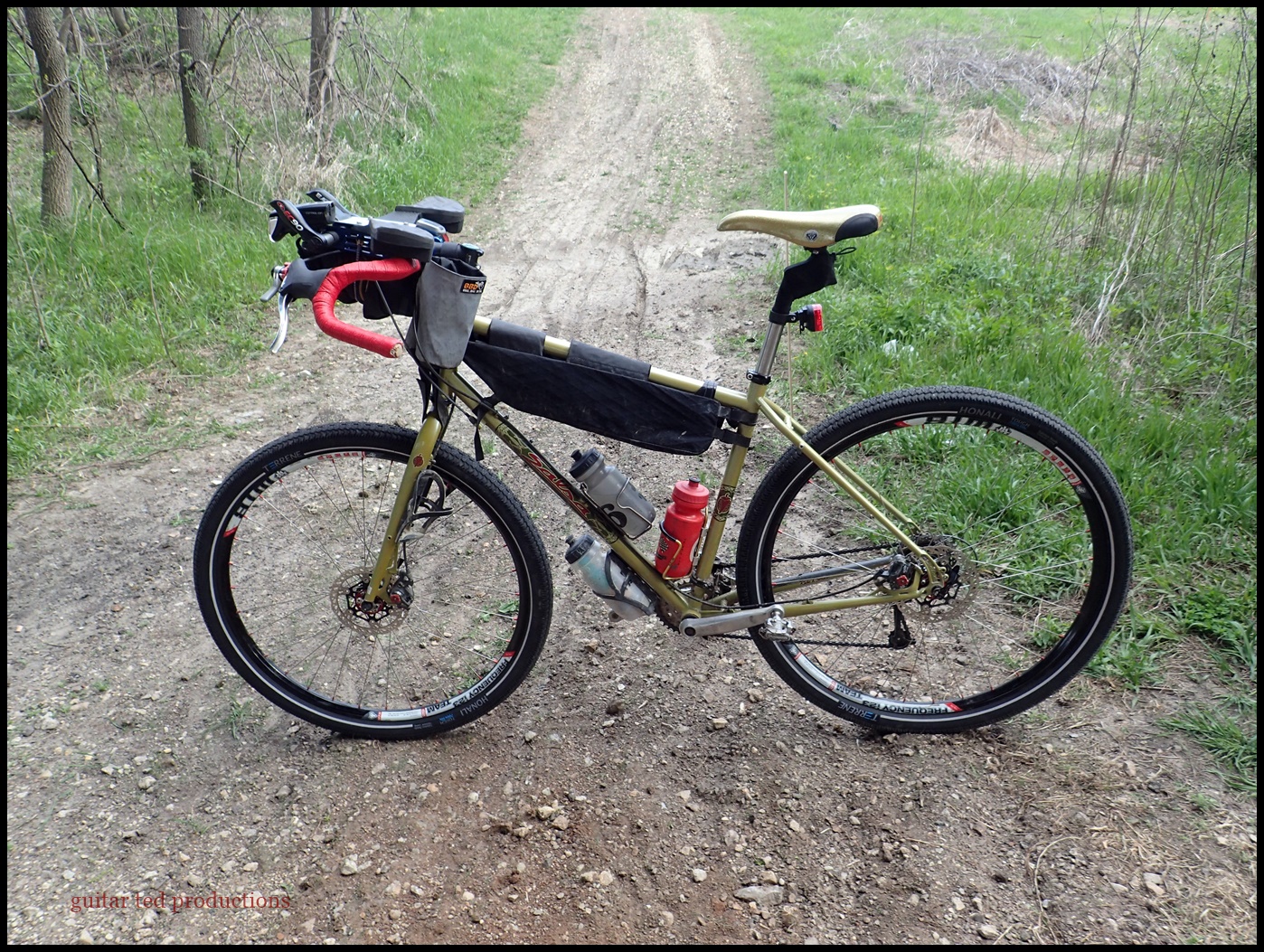
New tires AND different wheels.
The ol' Gen I Fargo has been modified for the umpteenth millionth time. This time it is the wheels and tires that got swapped out.

I had been running some Sun Ringle' Black Flag wheels which have rims that are based on the Stan's tubeless bead socket standard. That doesn't play well with many tubeless ready tires since Stan's bead socket thing is really meant to convert non-tubeless tires to tubeless. This means that the tighter tolerances of many tubeless tires are not an ideal fit to a Stan's rim.

Now, before y'all fire up your keyboards to tell me how your such-and-such tires have been awesome on Stan's rims for years with zero problems, you need to understand that I am not saying you cannot put tubeless ready tires on Stan's rims. You can. I have. It is just that many tires are not an ideal fit. As in, you may break tire levers getting them on or off. That isn't a good thing if the fit is that tight.

Ideally, you should be able to mount and dismount tires with no tools. If you have to sweat bullets and use a massive DH rated steel tire lever to mount your tires, or if you have to use some "slippery-slide" type concoction to mount your tubeless tires, something is not right. Why? Because you won't be field servicing that set up if the need arises, and you should be able to do that easily. 

So, the long way around to say that my Teravail Sparwood/Sun Ringle' set up was stupid tight and was a big problem waiting to happen. So, I ran that set up for as long as I felt I had gotten some good out of the money I spent on them and then I was going to ditch those things off. Actually, I had figured that this wouldn't have happened just yet. The thing is, the Sparwoods, while great in Kansas Flint Hills, really aren't very good in Iowa. In fact, they are what I would term as "not very good" riding tires. But that's another story for another day.

Terrene Tires' Honali 700 X 50mm
So, I have these new Terrene Honali tires in for testing at RidingGravel.com. They have tubeless ready casings and I wanted to use a tubeless ready designed rim. I happened to have a wheel set I built up for an old TNI test with WTB Frequency rims. 

These rims are tubeless designed and have a 23mm inner rim width which is perfect for a 50mm wide tire. They mounted up with the Honali tires with a simple.almost dead, 15 year old Blackburn floor pump. I mounted them by hand. I could remove them with the aid of one plastic tire lever if I needed to do the job quickly. In other words- This set up is completely field serviceable with your hands or simple bicycle tools with little effort. 

Now, it is completely possible that I won't like the Honali tires any better than I do the Teravails, but I can say that the Honali feels twice as supple already and that the profile of the Honali on the rim is already better than that of the previous tire set. So far.......so good. 

The wheels have American Classic hubs, which aren't the best in terms of engagement of the hub, but they have been reliable and for gravel travel the slack engagement shouldn't be an issue. Plus, these hubs are loads quieter than the Sun Ringle' ones were. Those things were really loud! That got on my nerves a few times on longer rides. 

So, at any rate, I am set with new wheels and tires. I'll give this a go and then report back soon......  

New Tire Day For Gen I

New tires AND different wheels.
The ol' Gen I Fargo has been modified for the umpteenth millionth time. This time it is the wheels and tires that got swapped out.

I had been running some Sun Ringle' Black Flag wheels which have rims that are based on the Stan's tubeless bead socket standard. That doesn't play well with many tubeless ready tires since Stan's bead socket thing is really meant to convert non-tubeless tires to tubeless. This means that the tighter tolerances of many tubeless tires are not an ideal fit to a Stan's rim.

Now, before y'all fire up your keyboards to tell me how your such-and-such tires have been awesome on Stan's rims for years with zero problems, you need to understand that I am not saying you cannot put tubeless ready tires on Stan's rims. You can. I have. It is just that many tires are not an ideal fit. As in, you may break tire levers getting them on or off. That isn't a good thing if the fit is that tight.

Ideally, you should be able to mount and dismount tires with no tools. If you have to sweat bullets and use a massive DH rated steel tire lever to mount your tires, or if you have to use some "slippery-slide" type concoction to mount your tubeless tires, something is not right. Why? Because you won't be field servicing that set up if the need arises, and you should be able to do that easily. 

So, the long way around to say that my Teravail Sparwood/Sun Ringle' set up was stupid tight and was a big problem waiting to happen. So, I ran that set up for as long as I felt I had gotten some good out of the money I spent on them and then I was going to ditch those things off. Actually, I had figured that this wouldn't have happened just yet. The thing is, the Sparwoods, while great in Kansas Flint Hills, really aren't very good in Iowa. In fact, they are what I would term as "not very good" riding tires. But that's another story for another day.

Terrene Tires' Honali 700 X 50mm
So, I have these new Terrene Honali tires in for testing at RidingGravel.com. They have tubeless ready casings and I wanted to use a tubeless ready designed rim. I happened to have a wheel set I built up for an old TNI test with WTB Frequency rims. 

These rims are tubeless designed and have a 23mm inner rim width which is perfect for a 50mm wide tire. They mounted up with the Honali tires with a simple.almost dead, 15 year old Blackburn floor pump. I mounted them by hand. I could remove them with the aid of one plastic tire lever if I needed to do the job quickly. In other words- This set up is completely field serviceable with your hands or simple bicycle tools with little effort. 

Now, it is completely possible that I won't like the Honali tires any better than I do the Teravails, but I can say that the Honali feels twice as supple already and that the profile of the Honali on the rim is already better than that of the previous tire set. So far.......so good. 

The wheels have American Classic hubs, which aren't the best in terms of engagement of the hub, but they have been reliable and for gravel travel the slack engagement shouldn't be an issue. Plus, these hubs are loads quieter than the Sun Ringle' ones were. Those things were really loud! That got on my nerves a few times on longer rides. 

So, at any rate, I am set with new wheels and tires. I'll give this a go and then report back soon......  

Tuesday, July 19, 2016

Teravail Sparwood Review

The Sparwood is Teravail's widest gravel tire at a claimed 2.2" width.
NOTE: Large doses of "my opinion" will be handed out in gloppy dollops today. You've been forewarned..... 

Okay, first off, these views are based upon my recent experiences with this tire and on observations I've made of others bikes and comments made by others who use these tires. I had to buy some new tires while I was in Kansas recently, and these Sparwoods seemed to have a good reputation with many whose opinions I trust, so I was willing to give them a go. Having ridden them in varying gravel conditions I feel confident in sharing my opinions on these treads.

When I purchased these tires, I did not have the liberty to weigh them, so I can only point to the Teravail spec on these tires, which is a claimed 690 grams for the 60TPI versions I chose. Hmm......that's a tad heavy, but the Teravail tires are supposed to have an under-tread flat protection, (only under the tread on 60TPI, bead to bead on the 120TPI versions), which is going to bring the weight up. That said, these tires seem to be a true 2.2"er, so that's not a stellar weight, just a tad heavy compared to many tires for XC in the 29"er world. Considering the design intentions- that these are to be tough, durable tires- I will give them a hall pass on the weight here.

Now I want to get back to that flat protection feature for a minute. This will help explain why I went with the 60TPI versions, and why I would never go with the 120TPI ones. When most any tire is designed with a flat protection belt or some other means of armoring the casing, be that with an elastomeric material, Kevlar, or what have you, it stiffens the casing. It only stands to reason that it would, since almost every material used to help prevent flats has to resist puncturing, and that usually means something stiffer than rubber and nylon carcass materials which tires are made from.

I've tried the bead to bead flat protection before
Adding anything to the casings, other than what you would have in a normal tire, not only adds weight, but thickness to that casing which is also going to make the tire less supple. As we're finding out more and more, less supple tires cause higher rolling resistance. I found that to be true with the Teravail Cannonball 38's with the bead to bead flat protection. Those tires, while probably being tougher than shoe leather, rode really harshly. Plus, they were shown to have a higher resistance to rolling in my testing. I did not like the way those tires performed or how they felt at all, and ended up trading them for a sixer of beer. Really. I think I got the better end of the deal there.

Anyway, to further anchor my opinion, a friend has the 120TPI Sparwoods and is running them at 6psi-8psi below the minimum recommended by Teravail just to get them working in an acceptable manner for him. I have found that to be the case with flat protection 29"er mountain bike tires as well. I recall the GEAX TNT AM version of the Gato was such a tire. I ran it at least 5-8psi lower than anything else I had just to get it to feel right and roll without excessive harshness. That's okay for off roading, but you give up some to rolling resistance on harder surfaces just to get a ride quality that is similar to other tires out there. I just don't feel it is worth it to buy into the full flat protection for my riding.

The Sparwoods showed their mettle on Kansan flint roads.
There you have it. That's why I went with the 60TPI versions over the 120TPI versions, and the theory was that the 60TPI versions would actually ride nicely. Given that I am a heavier dude, I cannot really compare my pressure settings to my friends, but I have been happy at right around the minimum recommended pressures by Teravail, which is 30psi. The tire works really well, the rolling resistance isn't bad, and it feels nice. Not at all harsh. Looking back at the Teravail Cannonball, I cannot help but think that the 60TPI version of that tire outshines the 120TPI one by a country mile in terms of ride quality and rolling resistance.

So much for that techno-babble. How do they do on gravel? Well, it isn't a bad tire, but I have found that it can be a bit squirrely on loose, deep gravel due to its very rounded casing. The Sparwoods also do a bang up job of squirting chunks of gravel laterally out from under the tires as you ride. I nailed my riding companion pretty good a couple of times this past weekend. I only mention that because it was told to me early on that these tires weren't supposed to do this. Well, so much for that theory! In the end, it isn't a big deal.

On a typical gravel road, the Sparwoods roll fast, are decent feeling, and cornering is better than some others due to the tread pattern. However; it is when the gravel gets loose and marbley that you have to pay attention. Again, it is that rounded casing, and the stiffness right under the tread area that is to blame. It makes the Sparwood want to roll on rocks laterally rather than absorb the rocks. On high speed descents you can only hold on and go for the ride as the bike jumps sideways in the deeper gravel sections.

The Sparwoods are keepers, but you'll have to forgive a few characteristics you may not agree with.
One thing to note on the tubeless feature- these are a super tight fit on Stan's designed rims or rims that use a Stan's dimension. The Sun-Ringle' rims I have are a Stan's design for the diameter of the bead seat, and therefore are a tick larger than your typical tubeless rim design. This slight variation in diameter causes the Teravail Sparwood to fit really, really tight on the rims I have here on my Fargo. I had to lever them on myself at the Sunflower Bike shop pop up store at the Dirty Kanza 200 expo area. The mechanic on duty couldn't get them on, they are so tight. This may be a big deal, if the Sparwood's beads do not stretch at all, or it may end up becoming not that big a deal. I'll find out when the Orange Seal sealant needs checking here in a month or so. Oh.....and Orange Seal is not on the recommended list of sealants on Teravail's site, by the way. Kind of funny that the tires were set up with that as a special deal since the sealant company is a sponsor of the DK200, whose "official tire" is offered by Teravail. . Anywho.....

So, in the end, these are okay tires, and probably pretty good ones if you are looking for a tougher, more cut resistant tire. They actually roll faster than the Maxxis Ikons I had on this same wheel set and bike before, although they are quite a bit heavier than those tires were.  They do not toss rocks, which is something a lot of other tire designers could do well to keep in mind when designing a tread for gravel, and they roll well on pavement. They do squirt out rocks laterally, so warn your riding buddies! I don't care for the performance in deeper, loose gravel, but other than that I find them to be good treads. I won't belabor the stiffness complaints. Just stay away from the 120TPI versions if you value a nice ride feel and lower rolling resistance. Get the 120TPI versions if you are deathly afraid of flats or cannot afford a tire failure in a remote area at all.

Note: I bought these tires at full retail with my own damn money. I was not asked to do this review by Teravail, nor was I paid or bribed in any way for this. The opinions expressed are my own and may not reflect the opinions of anyone else on the planet. So there........

Teravail Sparwood Review

The Sparwood is Teravail's widest gravel tire at a claimed 2.2" width.
NOTE: Large doses of "my opinion" will be handed out in gloppy dollops today. You've been forewarned..... 

Okay, first off, these views are based upon my recent experiences with this tire and on observations I've made of others bikes and comments made by others who use these tires. I had to buy some new tires while I was in Kansas recently, and these Sparwoods seemed to have a good reputation with many whose opinions I trust, so I was willing to give them a go. Having ridden them in varying gravel conditions I feel confident in sharing my opinions on these treads.

When I purchased these tires, I did not have the liberty to weigh them, so I can only point to the Teravail spec on these tires, which is a claimed 690 grams for the 60TPI versions I chose. Hmm......that's a tad heavy, but the Teravail tires are supposed to have an under-tread flat protection, (only under the tread on 60TPI, bead to bead on the 120TPI versions), which is going to bring the weight up. That said, these tires seem to be a true 2.2"er, so that's not a stellar weight, just a tad heavy compared to many tires for XC in the 29"er world. Considering the design intentions- that these are to be tough, durable tires- I will give them a hall pass on the weight here.

Now I want to get back to that flat protection feature for a minute. This will help explain why I went with the 60TPI versions, and why I would never go with the 120TPI ones. When most any tire is designed with a flat protection belt or some other means of armoring the casing, be that with an elastomeric material, Kevlar, or what have you, it stiffens the casing. It only stands to reason that it would, since almost every material used to help prevent flats has to resist puncturing, and that usually means something stiffer than rubber and nylon carcass materials which tires are made from.

I've tried the bead to bead flat protection before
Adding anything to the casings, other than what you would have in a normal tire, not only adds weight, but thickness to that casing which is also going to make the tire less supple. As we're finding out more and more, less supple tires cause higher rolling resistance. I found that to be true with the Teravail Cannonball 38's with the bead to bead flat protection. Those tires, while probably being tougher than shoe leather, rode really harshly. Plus, they were shown to have a higher resistance to rolling in my testing. I did not like the way those tires performed or how they felt at all, and ended up trading them for a sixer of beer. Really. I think I got the better end of the deal there.

Anyway, to further anchor my opinion, a friend has the 120TPI Sparwoods and is running them at 6psi-8psi below the minimum recommended by Teravail just to get them working in an acceptable manner for him. I have found that to be the case with flat protection 29"er mountain bike tires as well. I recall the GEAX TNT AM version of the Gato was such a tire. I ran it at least 5-8psi lower than anything else I had just to get it to feel right and roll without excessive harshness. That's okay for off roading, but you give up some to rolling resistance on harder surfaces just to get a ride quality that is similar to other tires out there. I just don't feel it is worth it to buy into the full flat protection for my riding.

The Sparwoods showed their mettle on Kansan flint roads.
There you have it. That's why I went with the 60TPI versions over the 120TPI versions, and the theory was that the 60TPI versions would actually ride nicely. Given that I am a heavier dude, I cannot really compare my pressure settings to my friends, but I have been happy at right around the minimum recommended pressures by Teravail, which is 30psi. The tire works really well, the rolling resistance isn't bad, and it feels nice. Not at all harsh. Looking back at the Teravail Cannonball, I cannot help but think that the 60TPI version of that tire outshines the 120TPI one by a country mile in terms of ride quality and rolling resistance.

So much for that techno-babble. How do they do on gravel? Well, it isn't a bad tire, but I have found that it can be a bit squirrely on loose, deep gravel due to its very rounded casing. The Sparwoods also do a bang up job of squirting chunks of gravel laterally out from under the tires as you ride. I nailed my riding companion pretty good a couple of times this past weekend. I only mention that because it was told to me early on that these tires weren't supposed to do this. Well, so much for that theory! In the end, it isn't a big deal.

On a typical gravel road, the Sparwoods roll fast, are decent feeling, and cornering is better than some others due to the tread pattern. However; it is when the gravel gets loose and marbley that you have to pay attention. Again, it is that rounded casing, and the stiffness right under the tread area that is to blame. It makes the Sparwood want to roll on rocks laterally rather than absorb the rocks. On high speed descents you can only hold on and go for the ride as the bike jumps sideways in the deeper gravel sections.

The Sparwoods are keepers, but you'll have to forgive a few characteristics you may not agree with.
One thing to note on the tubeless feature- these are a super tight fit on Stan's designed rims or rims that use a Stan's dimension. The Sun-Ringle' rims I have are a Stan's design for the diameter of the bead seat, and therefore are a tick larger than your typical tubeless rim design. This slight variation in diameter causes the Teravail Sparwood to fit really, really tight on the rims I have here on my Fargo. I had to lever them on myself at the Sunflower Bike shop pop up store at the Dirty Kanza 200 expo area. The mechanic on duty couldn't get them on, they are so tight. This may be a big deal, if the Sparwood's beads do not stretch at all, or it may end up becoming not that big a deal. I'll find out when the Orange Seal sealant needs checking here in a month or so. Oh.....and Orange Seal is not on the recommended list of sealants on Teravail's site, by the way. Kind of funny that the tires were set up with that as a special deal since the sealant company is a sponsor of the DK200, whose "official tire" is offered by Teravail. . Anywho.....

So, in the end, these are okay tires, and probably pretty good ones if you are looking for a tougher, more cut resistant tire. They actually roll faster than the Maxxis Ikons I had on this same wheel set and bike before, although they are quite a bit heavier than those tires were.  They do not toss rocks, which is something a lot of other tire designers could do well to keep in mind when designing a tread for gravel, and they roll well on pavement. They do squirt out rocks laterally, so warn your riding buddies! I don't care for the performance in deeper, loose gravel, but other than that I find them to be good treads. I won't belabor the stiffness complaints. Just stay away from the 120TPI versions if you value a nice ride feel and lower rolling resistance. Get the 120TPI versions if you are deathly afraid of flats or cannot afford a tire failure in a remote area at all.

Note: I bought these tires at full retail with my own damn money. I was not asked to do this review by Teravail, nor was I paid or bribed in any way for this. The opinions expressed are my own and may not reflect the opinions of anyone else on the planet. So there........