Showing posts with label WTB. Show all posts

Friday, July 03, 2026

Friday News And Views

Twin Six 3X2 32"er frame set (Image courtesy of Twin Six)
 Order Up! 32"er Companies Pushing Big Wheels:

You may have noted some promotions over the past week, week and a half, by several small purveyors of 32"ers. The orders are going in and minimums must be met to get production started. 

Esker, Twin Six, Curve Cycling, and others were pushing social media posts hard recently in hopes of getting riders to bite on this enticing, (for taller folks, mostly) technology.  

I know someone who has an order in, and I'm sure many of you out there are either in line to get one, or are considering it. One thing to note here: 32 inch wheels will probably not have the "gen I issues" 29"ers had. So, biting on the 32'er bait shouldn't get you an obsolete rig in five years. 

Hopefully..... 

 I'm very curious about 32"ers. But I do not need another bicycle. Plus, I'm willing to wait to see how things shake out. If this is all that and a bag of chips, I can get one whenever I want in the near future. And this means that if things change in regard to geometry, etc with 32"ers, I will not have bought into something that will be obsolete. 

Maybe....

Seeing on social media that Trek will have hard tail and FS 32"ers out in February 2027. (Heard they were taking orders now.) Specialized, Pivot, and Ari Cycles are rumored to be doing 32"ers as well. So, perhaps it won't be obsolete right away.  

Probably..... 

Guitar Ted Approved:

Well folks, I found a silver seat post and a saddle and now the Singular Cycles Peregrine Mk4 is all finished (for the near future - I make no guarantees!)

The seat post is an old Campagnolo aero post. If you are familiar with those, you know they are not very long! I was able to get the correct seat height and still have the minimum insertion mark inside the seat tube, but only just! 

The saddle is a tried and true WTB Silverado, which has been my 'go-to' saddle of late. The two pieces cap of the build and now everything is ready to go for a longer gravel ride. 

The final 'approved by Guitar Ted' action was to sticker the frame up with a Trans Iowa sticker and a 'Jacob' sticker in honor of my late son. So I'm pleased with the switcheroo and all systems are go for gravel travel now. 

Image courtesy of Giant Bicycles

Giant Announces Revolt Advance SL Model With Carbon Hub/Spoke Wheel System

On Tuesday of this week online sites were going ga-ga over Giant's newest gravel bikes. The Revolt Advance SL is the range topper with racing focused geometry and parts. 

And how about those wheels? Carbon hubs and spokes with a wheel weight under 1,300 grams total for front and rear wheels.  

Comments: Fun stuff for the bike nerds to geek out over, but dive into the marketing, specs, and geometry and really let it sink in. This is a bike for the less than 1% of gravel riders. It is a Pro level racing bike and much of the "feature list" descriptions could have been pulled directly from marketing of Tour de France bikes from the 2000's. "Stiffer", "feedback from racers". and  aero everything, of course. 

Is this a bike for The Every-person? No. It is not. But that is who will end up buying this bike because "weight", "aero", and "Pro racing" sells bikes to.....I guess some folks? Anyway, congratulations on race-ifying gravel bikes, Giant.  

And is it just me, or does this bike resemble every Chinese brand gravel bike I've seen recently? Hmm.... 

Date Set For GT's Ride For Jacob:

Thanks to Nick from the Board of the Cedar Valley Bicycle Collective, I have secured a date for GT's Ride For Jacob. We will be riding from the North parking lot at Big Woods Lake starting at 8:00am on Saturday, July 25th. 

The ride will consist of a loop from the parking lot at Big Woods Lake to gravel North of Waterloo, Iowa. We will pass through Janesville, Iowa, cross the Cedar River, then we will go on to cross the Shell Rock River and travel through Shell Rock, Iowa. From this most Northern point of the loop we will head West and South towards New Hartford, our last pass-through town. 

The ride will end by coming into Cedar Falls from the West toward downtown on mostly bike path. There could be a stop downtown if folks are so inclined. The ride from downtown to the parking lot at Big Woods Lake is a short one all on bicycle path.  

Stay tuned for any further updates here or on the ride site.  

Image courtesy of WTB
WTB Teases New Unreleased Hub, Hints At New Wheels To Come:

A press release from WTB on Wednesday pointed out a new hub WTB has designed which is being used by the Cannondale Factory Race Team and won with at a recent Elite XCO World Cup event.

Looking through the release I was able to glean out that the rear hub will use a "DLC ratchet ring-drive system". It may be similar to DT Swiss' ratcheting drive design. This is a fairly commonplace move since the patent ran out on the design formerly held by DT Swiss. 

Dubbed "Frequency 7X" hubs, the set for MTB usage is a claimed sub 300 grams for the pair. These hubs spin on "oversized Enduro bearings" and are claimed to be tough enough for World Cup MTB while being amazingly light. 

The press release hinted that these, as yet unreleased hubs, will appear with new carbon rims for MTB and gravel use. So, look for some news on the wheel front from WTB in the near future. Another tidbit I gleaned from a thread on social media is that WTB is also working on an aero gravel tire design. Could it be that the new rims, hubs, and tire will be presented as a racing wheel system for gravel which is very aero? 

Could be a thing. 

That's a wrap on this week! If you are a US citizen, enjoy a safe and enjoyable 4th of July weekend! Get out there and ride some bicycles! 

Monday, June 23, 2025

Gravel Grinder News: WTB's New Peacekeeper Tire, Niner's ORE 9 RDO Bike

 Note: All images and information used in today's post were provided by WTB or Niner Bikes. Comments and opinions are Guitar Ted's.

Image courtesy of Niner Bikes
Niner ORE 9 RDO:

The new gravel bike from Niner is dubbed the ORE 9/ Since the beginnings of the company the bike names have been acronyms and this hasn't changed. The "ORE" stands for "Off Road Explorer", and the "RDO" is Niner's acronym which stands for Race Day Optimized. (Essentially designating the frame is carbon fiber)

The ORE 9 was designed to be a "mountain biker's first gravel bike" and allow gravel riders to get "deeper into the woods". To help in this the ORE 9 has a 69° head tube angle and a bit longer reach than a standard gravel bike. The fork is suspension corrected for a 40mm telescopic fork and the tire clearance is good up to 2 inch/50mm tires. The bottom bracket drop/offset is 70mm. 

The ORE 9 is tested to MTB standards, It also features a T-47 bottom bracket for better stiffness in the bottom bracket area. The frame has fully guided internal routing and is dropper post compatible. The post size is 27.2mm.

ORE 9 is available as a frame/fork or in one of several Niner complete builds and it comes in two colors. Price for a frame set starts at $2,499.99. You can check this frame set out and more HERE.

Comments: Okay, first up is what I like about the ORE 9: The head angle, the T-47 bottom bracket, and fully guided cable routing. What I don't like: The price. Is this the result of tariffs or a "new normal" for a carbon frame and fork? Holy cow.... Also, the bottom bracket drop. Too little for a bike meant for big tires, unless......

Unless this is really supposed to be an adventure hard tail MTB. You may have noted the phrasing Niner used above: "mountain biker's first gravel bike". and getting "deeper into the woods". Niner is pitching this bike as a single track/fire road bike. I come from way back. We used to use front suspended, 80mm - 100mm travel hard tail MTB's for this activity. And furthermore; if Niner had dumped the bottom bracket a bit more, I'd be all over this for riding on actual gravel roads. But maybe this is just me being an outlier here, or Niner hitting this angle up because gravel is the cool thing now.

WTB 29" X 2.4" Peacekeeper Tire:

WTB has a new fast rolling trail tire out now with all-around off-road potential. Using WTB's SG2 bead-to-bead puncture protection and Tritec compound, this tire should be a very versatile 29"er tire with good characteristics across a wide range of terrain types

 The WTB Peacekeeper carries an MSRP of $76.95/€69.95

 The tire will only be available in this size and with no skin wall option for now. 

Comments: I typically wouldn't cover a MTB tire here, however, this figures to be a great, fast rolling tire for bikes like the Fargo, or anything related to that bike, which often are used out on gravel. Besides, with some gravel bikes pushing above 2" wide tire clearance, well......you never know

For more context here, I used to run a Maxxis Ikon for years on my Fargo Gen I and it was a great gravel road tire. So, this has precedence and I feel it is a relevant choice for dirt or gravel cycling.  For more information please see www.wtb.com

Wednesday, October 30, 2024

Why "The Tire" Matters Today: 25 Years Of 29"ers

Now known as the "Nano" (Image courtesy of WTB)
Yesterday I covered three major players in 29"er development and acceptance that, in my opinion, helped 29"ers be successful and not just a passing fad. It is my belief that those three players, amongst a few others, were responsible for the early momentum behind big wheels for MTB. 

It all started with the 29" Nanoraptor, without which none of what followed it may have happened. So why should we give the Nano a nod in 2024 and beyond? Why should any cyclist care? 

Well, today I am going to play a game of "What if?" regarding the Nanoraptor, 29"ers in general, and the influence of big wheels on cycling. What if the Nanoraptor never happened

Well, for one thing there is a pretty good chance that you would still be riding a 26 inch wheeled mountain bike. Not only that, but front derailleurs would probably still be alive and well, since those smaller diameter wheels lower gearing range enough that getting a wide range of gears out of smaller wheels would pretty much exclude any 1X type drive trains. 

Fork Offset: The ability to tune your ride today is a given with the ability to choose different offsets for your suspension forks. This was not an option until 29"ers came along and Gary Fisher Bikes debuted their "G2" geometry which included a longer offset fork. Getting Fox to make this was a huge hurdle, and afterward other companies had to follow suit. Now you have choices, thanks to 29"ers.

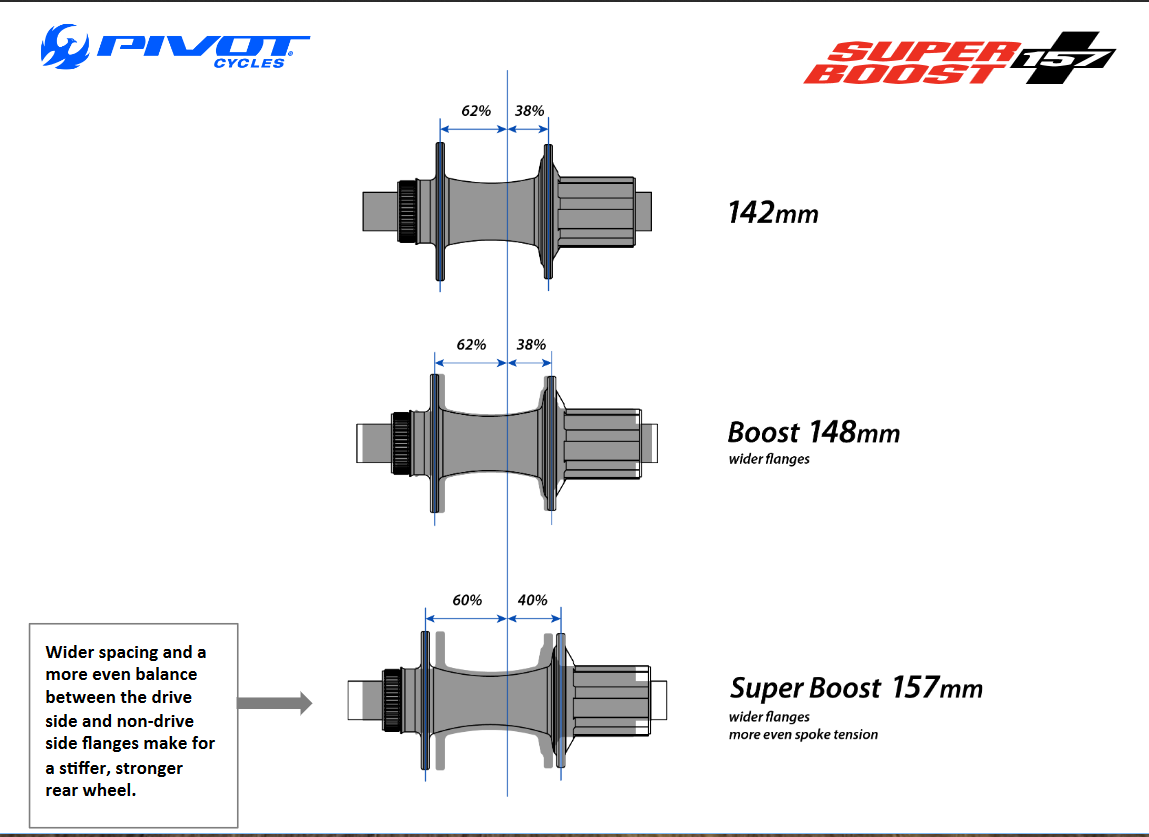
Image courtesy of Pivot Cycles

Wider Spaced Wheels: 

While wide overlock dimension wheels probably came along due to tandems and down hill bikes, it may have not caught on for all MTB's if we were still stuck on 26"ers yet. 

29 inch wheels, with their longer spokes, needed a wider base (hub flnge spacing) to really get the wheels to work well off-road. I recall a set of wheels I was to review that were so laterally unstable that I made it about 100 yards down a trail and turned back to head for the shed. Wider spaced flanges helped 29"er wheels immensely and may not have happened had it not been for their existence. 

650B/27.5 Mountain Bike Wheels:

The "mid-sized" 27.5" wheels we still see being utilized on some mountain bikes may not have ever happened without the existence of 29"ers. It wasn't until after 29"ers were gaining a lot of market share that Kirk Pacenti literally stitched together a set of tires to stretch across a 650B rim and the first 2"+ wide 650B tires were seen for MTB. 

Had it not been for the 29"er this alternative to 29"ers may have been seen as just not enough of a difference from 26"ers to matter. In fact, 650B originally was a 26" diameter wheel size! It took the larger volume mountain bike sized 650B tires to get that 27.5" overall diameter. Of course, a bigger, more voluminous 26" tire would do about the same thing. So, in my "what if world", 650B MTB doesn't happen without 29"ers. 

Drop Bar MTB/Adventure Bikes:

Part of the early 29"er scene was about adopting niche, or one could say "weird" traits seen in MTB from years past. Certainly single speeding was one of those things widely adopted by 29"er freaks in the early days. This was so pervasive that brands often made their first 29"er offering a single speed. 

Another widely adopted niche component by 29"er fans was the flared drop bar. Many were drawn to these bars as a way to make a statement and stand out from the crowd of "same thing/different day" 26" wheeled bikes. 

This became something of a movement and became an influence on Salsa Cycles to introduce a drop bar 29"er "adventure" bike. In 2008, the Fargo, a bike well ahead of its time, debuted in the Fall of that year. This bike and its fans would forecast the emergence of the now commonplace drop bar 29"er adventure/bikepacking rigs. Had 29"ers not happened, would this segment of bicycles exist today? I am thinking that they would have been far less attractive, if they existed at all, as 26"ers.  

Gravel grinding on a drop barred Karate Monkey in 2006

Gravel Bikes:

This might seem like a bit of a stretch. But here I go anyway! My feeling is that had the 29"er not come into existence when it did that gravel bikes, as a category, would have been based upon road bikes a lot more than they were. However; elements of MTB have always been a part of gravel riding. This hasn't been more true than with today's fashion for bigger gravel tires bordering on 29"er sized rubber. 

Originally many gravel riders were using cyclo - cross bikes, drop bar 29"ers, or just any mountain bike they could find, for the lack of any true gravel designs. While a cyclo - cross style was eventually adopted, some features influenced by 29'ers were there right away in the flared drop bars and disc brakes. 

Had 29"ers never been in existence it also calls into question whether or not any tires for gravel bikes would have been done. Manufacturers were into playing it safe, up until the 29"er came along. The big wheels took a bit to catch on, but when they did, it was the hottest trend of the late 2000's in off-road and many brands were caught on the outside looking in. This fueled a sort of consciousness amongst brands and marketers to not miss "The Next Big Thing". When gravel bikes did hit the floors of dealers in 2012, brands started to get geared up to hop on that trend immediately. One of the big hold ups was the lack of "real" gravel tires. This spurred WTB, (Yes - them again!) to come out with the Nano 40, a tire probably chosen to reflect that this gravel trend was much like that of the 29"er. 

While other brands, notably Clement/Donnelly, had a gravel tire, it was WTB that stepped up the production levels and offered a true tubeless tire for gravel first. Their experiences with the Nanoraptor 29 were certainly an influence here. So, while gravel bikes and that whole scene may have happened without 29"ers, it probably would have looked a lot different than it has looked. 

That's a wrap on this series. I hope that you enjoyed that look back at the 25 years since 29"ers were first hitting the single track. Thanks for reading Guitar Ted Productions.

Tuesday, September 17, 2024

Review: 700 X 45mm Vulpine S - Final Word

 Note: WTB sent over one set each of the Vulpine S, Vulpine, and Resolute tires for testing and review to Guitar Ted Productions at no cost. I was not paid nor bribed for this review and I will always strive to give my honest thoughts and opinions throughout.

The Vulpine S  tires are WTB's newest tread design for gravel riding. They are a modification of the Vulpine design, with a slick central tread and the Vulpine's smaller knobs out on the shoulders. If you have missed my previous posts on this review, you can start catching up by clicking HERE

In that last update I speculated that the reason I may have been feeling that the Vulpine S was smoother and more forgiving than the Vulpine, (also being tested), was that the Vulpine S tires were mounted to my BERD spoked carbon wheel set. Those BERD spokes are claimed to have a 200% better damping capability than a stainless steel spoke does. So I figured I had better swap out tires to make sure that the wheels weren't what was coloring my impressions of the Vulpine S. 

I decided to swap the tires then and chose a set of Roval carbon wheels which have a narrower inner rim dimension than the previous wheel set. At about 21mm inner rim width, I was expecting the tires to be measuring out narrower on these rims than the almost 46mm that they measured out to on the wider rims. However; the difference was negligible at 45.3mm. Slightly narrower, but nothing to concern myself over.

Now I was running the Vulpine S on wheels more akin to what many folks might be using. Especially due to the more traditional spoke choice. These wheels are not particularly forgiving either, and in total, with all the changes, the ride quality was different. Now these tires feel more like the Vulpine tires, which I happened to have swapped over to the BERD wheel set. I'll have the results on that swap in my final Vulpine review coming up, but you might guess the outcome already!

Back to the Vulpine S. It is a fast tire no matter what rim you use the tire on, as long as it is a reasonable choice. The tire spins up fast, coasts a long way on harder surfaces, and is decently smooth, but it was really quite apparent that those BERD spokes have a very pronounced effect on ride quality. The Roval wheels feel harsh in comparison and the tires cannot be blamed for that. 

I see no alarming wear issues and I think this aspect of the Vulpine S is normal. So, is this a good tire? The answer to that is, as always, dependent upon what your expectations are. If you are looking for a tire that does gravel well, is fast, and excels (for a gravel tire) on pavement, then yes - the WTB Vulpine S is a good tire. If, however, you are looking for a gravel tire for what amounts to XC MTB riding, then no - the WTB Vulpine S is not a good tire. 

Final Word

The Vulpine S is a great tire for Mid-West gravel if it isn't fresh and deep all across the road. Even then it will handle it and my only complaint there is that the tire has a tendency to lose lateral grip a bit more than some other more treaded tires. 

WTB positions this tire as its gravel racing choice. I think that is right on for many courses and roads, but there are some events where this tire may not be good from a grip and cornering standpoint due to its minimal tread design. I would have no problems running this tire anywhere in the Mid-West, at Mid-South, or on roads that were mostly smoother dirt as far as racing goes. 

However; I think another excellent use case for the Vulpine S is for that rider that does a lot of mixed surface roads where pavement is a large portion of the riding. This is the tire that will get you out of town efficiently and once out on the dirt roads, it will handle fine. As long as fast cornering on looser dirt or loose gravel is not a big part of the ride, I think the Vulpine S is a tire to consider strongly for all-road use. 

And just to close out here, yes - Those BERD spokes are the real deal. They are eye-wateringly expensive but I have not ridden anything else that comes close to damping out vibrations like BERD spokes do in a wheel set. Highly recommended.

Friday, August 23, 2024

Friday News And Views

Image courtesy of Wilde Bicycles
Wilde, Cane Creek Team Up On One Inch Head Sets:

With the sub-culture of restoration of late 1980's mountain and road bicycles being quite popular now, and with a certain special project from Wilde on the horizon, Wilde Bicycles and Cane Creek have teamed up to release a limited time option to get yourself a Cane Creek 110 quality threaded headset in one inch size. 

Why Wilde Bicycles? Well, they have a project called the Side Quest which will be using these head sets. To get the MOQ (Minimum Order Quantity) to green light the project, Wilde is offering the chance to purchase a one inch threaded headset from Cane Creek. 

The Wilde X Cane Creek 110ZN headsets will be offered in black or silver and the cost is projected to be $120.00 USD. The head sets will be a pre-book and should be delivered in October. 

Specs:

● Fork type: 1" English threaded
● Stack height: 41mm
● S.H.I.S. Upper: EC30 / 25.4-24tpi
● S.H.I.S. Lower: EC30
● Crown Race: ISO (26.4mm)
● Machined from 7075 series aluminum
● ZN40 Sealed Cartridge Bearings
● Weight: 91g 

Get in on the action at www.wildebikes.com

Image courtesy of Merit Bikes
Czechoslovakian Company Merit Goes 750D Gravel:

Now you can buy a 750D wheeled gravel bike from Merit Bikes which they call, appropriately, the "Merit Jumbo 750d Gravel Bike". Never heard about 750D wheels? I last wrote about them in a "Two Things" post in July which you can read HERE. There are further links back to other posts I have written about these bigger wheels to be found there as well. 

Merit is a Czech based company and has been making high-end titanium and carbon bikes for gravel for a while now. This time they are offering pre-orders for October delivery for this carbon frame and fork gravel bike with the bigger 750D wheels being provided by WTB. They are currently the only manufacturer doing these bigger wheels and tires. 

The Jumbo comes in three sizes: Large, XL, and XXL. Obviously Merit feels this wheel size caters to a taller rider. For reference I ride a 58cm bike at 6'1". The Merit Jumbo size Large would work for me, but the others are way too big! 

The approximately $4,350.00 bike (at current exchange rates) features the aforementioned carbon frame and fork, SRAM Rival drivetrain, and Ritchey Design cockpit parts. The geometry is interesting as the bike is said by Merit to be able to handle 50mm wide 700c tires and wheels along with the 750D X 45mm WTB tires. The numbers on the geometry all are pretty spot on though with a surprising low stack height for the bike that would fit me. 

This, in my opinion, is going to be a litmus test for 750D wheels and tires. If more companies jump on this idea, WTB will not be the only game in town for these tires and wheels for long. But that all remains to be seen. Stay tuned....

Image courtesy of Velocity USA

Velocity USA Refreshes AERO Model:

Velocity USA announced on Tuesday of this past week that they have a newly refreshed version of their original rim, the AERO, out now. Velocity partnered with Arizona based Profile Precision Extrusion to bring a Velocity USA exclusive alloy for this new design. 

Velocity says on the webpage for the AERO rims the following: "6069 alloy offers improved resistance to denting and fatigue damage. Riders who are tough on wheels will enjoy greater impact resistance; those who pile on miles can expect a longer service life compared to traditional 6061 or 6063 alloy."

Velocity states that, besides the traditional offerings, they will have 36 hole and 40 hole versions of the AERO also. They also said all their Deep Custom options can be applied to this model as well, which includes some wild anodized colors and schemes. Stock rims will be available in Silver, Black, or Polished. 

Velocity states that this rim is optimized for tire widths from 28mm - 50mm and will be available in 650B and 700c diameters. The AERO weighs a claimed 500 grams each and is priced at $198.00 USD each. 

Comments: I gotta admit, when I saw the price for this rim I was a bit surprised. Apparently it is this new tougher alloy that makes the price what it is. I like that Velocity is trying this because it makes a lot of sense for heavier riders or touring/bikepacking applications where wheel failure is not an option. I'd gladly pay the price for that peace of mind. My only wish is that Velocity would do a wider internal width in a similar rim. Heck, just looking over their "gravel" rim range makes me wish that Velocity would do this with the entire range. 

As it stands now I am really only interested in using Blunt SS rims from Velocity for gravel. The inner rim width is a bit wider at 26.6mm which is kind of a sweet spot for tires in the 43mm - 50mm range.

Salsa Shows Off 2025 Cutthroat C Force XO AXS Transmisson Bike:

Salsa Cycles showed its latest incarnation of its long-running Cutthroat bikepacking/adventure/gravel bike. The elongated named Cutthroat C Force XO AXS Transmission (whew!) is set up with - obviously - SRAM's new 12 speed Transmission rear drive train components and an Eagle Transmission crank with a 34T ring onboard. 

You get a UDH compatible frame, and the "Road Boost" set up which allows a maximum 50T/34T crank set up. All that and the typical Cutthroat amenities you've become accustomed to at a price of  $7,499.00 USD. 

Comments: Well, what the heck is "Road Boost" anyway? Yep! Get used to seeing that as this is where we will start to see a move in gravel bikes away from the old 100mm/142mm through axle standard. Frame makers will adopt this "new" 110mm/148mm "road" spacing as a way to better accommodate the trend for riders to gravitate toward fatter gravel tires in the 45mm+ range up to 2.2" 29"er rubber. 

This all started with Shimano offsetting GRX 2.5mm outboard and then SRAM doing a similar thing as well to get better clearances for bigger gravel tires, at that time in the 45mm - 47mm range. But with the big switch to top-tier gravel riders riding 2.2" wide XC rubber on gravel bikes this "Road Boost" thing has legs and whether the meat and potatoes of gravel riders wants it or not, this is how the bicycle industry has always operated - At the whim and fancy of the high-end competitive fields in any discipline. They call it "progress", but it is really just another marketing tool in the end. 

Whether or not anyone likes it, it will be the next trend in gravel bikes. At least the comments sections of social media will be interesting for the short term future. 

Okay, that's a wrap on this week! Get out and ride those bicycles!

Saturday, March 16, 2024

Review: WTB Max-Flow Tubeless Valves

The business end of a WTB Max-Flow tubeless valve stems.
 Note; WTB sent over the Max-Flow Tubeless Valve Stems at no charge to Guitar Ted Productions for test and review. I always strive to be honest when I share my thoughts and views.

The suite of new WTB products I was sent to review, including the Max-Flow valve stems, were introduced HERE in case you missed that. This article will focus on the valve stems only. 

Today's riders that use tubeless bicycle tires have different needs and expectations than they did ten years ago, or even five years ago. WTB has responded with a new tubeless valve design which addresses many of these new concerns. The Max-Flow Tubeless Valve Stem's name should give you one hint about this new design.

Things have changed with regard to tubeless tires for bicycles and now the expectation is becoming more and more that a rider should be able to inflate a tubeless tire on a tubeless rim with a floor pump alone. WTB's Max-Flow design has a claimed 84% more airflow than their previous valves. Now, I cannot verify that, but as we will learn here, the valves did work nicely for me.

The Max-Flow valve, valve cap with integrated core remover, and the valve nut.

The Max-Flow also features a valve cap with an integrated core removal tool made in aluminum. This is great as a way to reduce weight and tools in your tool kit, if you aren't one to lose valve caps, that is! 

Finally, the valve nut, (Presta valve nut), is designed in a squarish shape with a machined in grip texture which aids in not only tightening the nut against a rim, which also helps seal the rubber stopper of the stem on the inner rim, but also aids in the tooless removal of the stem in case of a catastrophic failure requiring a tube, tire boot, etc. 

The length of the valve is a nice, but not overly long, 44mm. Enough to clear most average gravel rims. The core is removable, of course, and the Max-Flow design is also claimed to reduce clogging as well. The stopper is a sensible conical shape which should work in most tubeless rims. 

I liked the valve nut.

In Use: The WTB Max-Flow valve was used on my new front wheel for my new King Fabrications Honeman Flyer. The rim is a Velocity Blunt SS which has a 26.6 mm inner rim width. 

The tire I was trying to use is a Teravail 42mm wide Rutland model which had already been mounted once and ridden several hundred miles.

The squarish valve nut really was nice for tightening the stem into the rim. I usually have to gently use a pliers to snug up valves good enough to prevent internal sealant seepage. 

I was a bit concerned about the way the valve protruded into the inner rim well. The Max-Flow design is intended to work with those new-fangled rim inserts that are designed to help prevent tubeless tires from "burping" or pinch-flatting the tire against the rim when running lower air pressures. To enable the valve to clear these inserts, it sticks into the rim well area more. My thought is that without running an insert, you could hit something hard enough to contact the valve end and potentially break it off or damage it. Admittedly, the chances of it happening are slim, but....there is that chance

While the Max-Flow valve end does flow more air, it does also stick out into the area of the inner tire more.

When I mounted my used Teravail Rutland, I did so by keeping the Presta valve core in the valve. Obviously, this restricted air flow, so I wasn't enjoying "max" air flow, but regardless, the tire was inflated easily with my old Topeak Joe Blow floor pump. So, I cannot say that the Max-Flow valve did anything there for me, but maybe it did. 

I can say that since I have had the valve in that air retention has been excellent and that I have seen no issues with the valve stem at all. My sealant (WTB's own sealant in this case) hasn't caused any clogging either. That said, I am careful to always air up tires with the valve stem at around the 8:00 - 9:00 o'clock position which seems to keep all my valve stems clear of clogging. 

Conclusions: The Max-Flow Tubeless Valve Stems have a unique, high airflow design which may come in handy when setting up a tubeless tire or while dealing with a tubeless tire in the field. The valve cap with the core remover is nice, albeit not unique to WTB, and I really liked the square valve nut which has tons of grip and better leverage than a standard Presta valve nut does. 

The aluminum construction is well anodized to prevent the valve from corrosion from ammonia which is a common ingredient in sealants. The 44mm length is very good, but if you are running some of the newer aero profile gravel rims you may need to look elsewhere for valve stems. 

My concern is for the protruding valve head in the rim area. Yes, if you run a tire insert, this is a good thing, but what if that is not necessary? Hmm.... As I stated, while potential for hitting the stem inside the tire while riding is there, it probably is a low percentage failure mode. That said, that potential does not exist with some other high-flow design valve stems. 

So, I like the Max-Flow valves and the idea of the design from an airflow standpoint is sound. I would be reticent to use these without a tire liner in a gravel sized wheel/tire combination. I think anything 29"er sized would be fine. Bikepacking set-ups, and the like, with their larger volume tires are not going to be an issue. However; I would like to see a "low-profile" Max-Flow design which would address my concerns when using tires in narrower widths than two inches wide.

Monday, March 11, 2024

WTB Nano Air TPU Tubes Reviewed

A WTB Nano Air tube in 29"er size next to its butyl equivalent.
 Note: WTB sent a few Nano Air tubes to Guitar Ted Productions at no charge for review. I was not paid, nor bribed for this review, and I always strive to give my honest thoughts and opinions throughout

 This review is going to focus on the Nano Air TPU tubes from WTB exclusively as the product is going to see a lot more use than a tubeless repair kit for most cyclists. That said, I will be posting a separate look at the Rocket Repair Kit later on. The introduction to the tubes can be seen HERE

Those not familiar with TPU tubes should know that they have had a slightly marred introduction to cyclists as the first brand to widely distribute these types of tubes suffered a rash of failures which colored a lot of people's opinions about these products for use as inner tubes. That said, subsequent improvements have come along and I think that these deserve a second look if you happen to be one of those who has a negative opinion on TPU for inner tubes. 

What The Heck Is It? TPU stands for "Thermoplastic Polyurethane", a flexible plastic with an inherently low weight. This material is fashioned into a "hose" shape and the bonded at the ends together to form a hoop which can then be fitted with a valve and used as an inner tube in a bicycle tire. It is very durable, can last for years, and is 100% recyclable. The TPU also resists rolling resistance issues and has very similar characteristics to a latex tube, only TPU holds air pressure far better. In fact, I have experienced better air retention with TPU tubes than with many butyl rubber tubes.

Downsides are that it doesn't stretch all that much, so you must fit the tube a bit more precisely than you can get away with using a butyl rubber tube, which can stretch seemingly infinitely. The cost of TPU tubes can be as much as 3 times that of a butyl rubber tube as well. Although budget TPU tubes can be had from Amazon, I cannot vouch for their quality.


The weight savings is no joke. This alone may be the best reason to go TPU.

WTB Nano Air: TPU can be made to be about any color and can even be "clear", but why on the Earth did WTB choose this tan color? Blecch! Good thing I don't have to look at this once it is installed! I received three TPU Nano Air tubes. One each for 29"er, gravel, and road. Currently I have more bikes set up with traditional tubes that are 29"ers so I decided to A-B the 29"er Nano Air tube against the traditional butyl rubber tube. I chose my Karate Monkey as the test bike. 

I installed the Nano Air tube in this Maxxis Ardent tire with a rim brake set up.

You can see how the tube is joined here in this image.

The tube already had a thin film of talc on it out of the box, but I would definitely recommend talcing the inside of your tire if you can. This will make for a tube that doesn't get snagged or stuck on the casing and should provide a longer lifespan of the tube. Any tube, really. 

In the case of the Karate Monkey, I was a bit disappointed when I initially set up the bike with the Maxxis Ardent tires because they felt dead and "draggy", as if they had a higher rolling resistance. Once I installed the Nano Air tube in the rear tire I realized that it was not the tires so much as it was that tube. The lighter weight TPU and the way it can move against the casing made for a much livelier and enjoyable ride feel. 

Incredible air retention allowed me to ride for an entire month without checking the air pressure and when I did it was only down a few pounds. That could be attributed to the opening of the Presta valve and putting the pump head on the valve stem. At any rate, these Nano Air tubes hold air like a champ. I used the gravel sized one in a static air pressure retention test in the shop and found similar results. The road sized Nano Air went to N.Y. Roll, as he has road bikes. He decided to keep it in his repair kit as a lightweight repair option. 

With all the glass around here this Spring I never encountered a flat with the Nano Air tube, but had I gotten one there are two glueless patches which come with each Nano Air tube with which I could make a repair with. 

The Karate Monkey which I installed the WTB Nano Air tube in the rear tire.

Conclusions: I see no reason not to use a TPU tube like the Nano Air for daily use, and with similar performance gains to latex, this beats those types of tubes hands down simply on air retention alone. Tubeless has a legitimate competitor now in the TPU tubes and I would suggest that if you have a bike that doesn't get a lot of attention, these TPU Nano Air tubes could give you near-tubeless benefits and no messy sealant to re-up or clogged valve stems to deal with. 

Obviously, a Nano Air tube would also be a prime candidate as a bail-out option for a tubeless set up due to the small pack size and super light weight. However; I think these TPU tubes, and in particular, the Nano Air tubes, are a perfect fit for many cyclists that don't want to deal with tubeless tires, yet want to upgrade from traditional butyl tubes. The TPU tubes like these Nano Air tubes are pricey, but if they last for years, unlike sealant does, they would have to be considered "better" at that point. Of course, "better" is a term best defined by the end user, but I do feel that the TPU tube has a place now in the cyclist's kit.

Wednesday, March 06, 2024

Gravel Grinder News: WTB Nano Air TPU Tubes, Valves, Plug Kit

WTB announces new tubeless accessories and TPU tubes
WTB Nano Air TPU Tubes, TCS Rocket Tire Plug Kit, TCS Max-Flow Tubeless Valve Stems Announced.

Today WTB has released news of new tubeless accessories and a TPU tube for cyclists. The TPU tube is dubbed the Nano Air, and like other TPU tubes, it has a minimal pack size and they are very lightweight compared to standard butyl rubber tubes. 

Along with this TPU tube offering WTB also has a tubeless plug kit called the TCS Rocket Plug Kit and there is an accessory to this called the "Plug Pack" which extends the usefulness of the TCS Rocket Plug Kit by offering more plugs to use with the Plug Kit. 

Finally, the TCS Max-Flow tubeless stems have a design which is tire-insert compatible and has a higher air-flow rate to accommodate easier tubeless set-ups using a floor pump. 


 The Nano Air tubes come in three sizes in a tan color only. These sizes cover a range of tire sizes. They are: 29" X 1.9" -2.5" - 700c X 32mm-47mm - 700c X 18mm - 32mm. All have 48mm length valve stems with removable cores. Cost are $32.95 for the two 700c sizes and $34.95 for the 29"er size. Each tube comes with two glueless patches for repairs. 

As with most TPU tubes, the Nano Air packs down to about a third of the size of its butyl rubber counterparts while weighing in at about a third of a butyl tube's weight. Nano Air tubes are available now. 


 The TCS Max-Flow valves have a 44mm length and are made from aluminum. They have a tire insert compatible design which stands proud of any insert for maximum air flow while inflating a tire for initial set up. In fact, WTB claims this valve has an 84% increase in air flow and a larger bore diameter which reduces the clogging factor significantly. 

The valve also features an ergonomically designed nut to secure the valve stem to the rim. Finally, the valve cap features an integrated core remover. Prices for the TCS Max-Flow valves are $24.95/pair.


 The Rocket Plug Kit is a tool for in-the-field tire repair. This tool features an aluminum canister which conceals a plunger and several "bacon strips" to plug a tire with. The Rocket Plug Kit also features separate aluminum insert bits which are reusable and help to seal bigger punctures. 

The aforementioned "Plug Pack" has more plug strips and four "Rocket Anchors" (insert tips) in two sizes. 

The price for the Rocket Plug Kit is $44.95 and the Plug Pack refill kit is $17.95

Comments: WTB sells tires so this should not be a big surprise, but I was not expecting WTB to jump into the TPU tube market. That they have hit with three sizes right out of the gate is impressive and shows that WTB means business here. 

I'll reserve comments for my reviews of all three products. I was afforded the opportunity to try these items out ahead of the release today. I already have the three products in hand and I have already ridden the Nano Air tube for about a month or so now. Stay tuned for the review coming up shortly here. 

Note: All images by Guitar Ted Productions. Information used in this post was provided by WTB.

Thursday, January 11, 2024

It Finally Happened! (With WTB Bailiff News)

8:30am, Tuesday, January 8th, 2024
 The warnings were all over the airwaves starting Sunday and into Monday. We were finally going to get a significant snow event. The weather people were saying we'd see anywhere from 5" - 9" of snow. By 7:00am we already had 6+ inches and it was snowing heavily. We ended up with a record one-day snow total of 10.5" for that day.

I'm not complaining. First of all, we need moisture here in Iowa. We are still in a drought and anything we get is welcomed in terms of precipitation. Secondly, fat biking! This amount of snow should pack in and be groom-able. In fact, my testing out of the initial snow layer we got showed great packable snow and a higher moisture content which should show up as a great base layer. 

By the way this snow is acting in the wind, I'd say that it might just prove to be some of the best riding snow we've seen. but time will tell on that front. 

Thirdly - This makes the cold weather worthwhile, in my eyes anyway. Because if it is just too darn cold to ride in the country without snow, it just makes life miserable - for me - and it is not very fun. But add in snow? My attitude changes 180 degrees. 

Plus, all that white snow just makes everything look better. Again, maybe that's just me. But a drab, grey and brown scene is harder to draw any uplifting inspiration from to brighten my day. So, this snow is awesome, and Winter finally looks the part. 

The new WTB Bailiff tire in 27.5 X 4.5" (image courtesy of WTB)

WTB Finally Makes A Fat Bike Tire:

Yesterday news broke concerning a new fat bike tire from WTB. They are offering the new tire as a 4.5" X 27.5" diameter only tire at this time.

The new tire, called the Bailiff, comes in a studded or non-studded versions with studd-able pockets molded in. These accept any Terrene or 45NRTH studs. 

The rubber compound is designed for grip in cold weather conditions, so it is a softer compound. TCS ready means these are tubeless ready tires. Prices are $134.95 for the non-studded and $279.95 for the studded version. (Prices for one tire only)

You can read more about these HERE on WTB's site. 

Comments: Wow! I recall asking about fat bike tires probably ten years ago from my WTB contacts and they weren't real interested in them at that point. Apparently more pressure was brought to bear from some "Canadian bike partners" and so WTB went into development with some testers in Vermont to come up with this tire "after several revisions". 

"Bike partners" means "OEM spec", and so I would be looking for new fat bikes coming out with WTB branded Bailiff tires soon. I suspect that since the "amazing bike partners" were only interested in 27.5" diameter tires that this is why WTB is not offering a 26"er version. 

Question: If I told you this tire was a 45NRTH tire, would you have believed me? I think the design is very derivative of a 45NRTH Wrathlord tire, but maybe I'm not seeing that correctly.... Anyway. Too bad there isn't a 26"er version. I might have tried those on my fat bikes. 

One last note: WTB sells these Bailiff tires saying they are TCS compatible, but their own TCS sealant is not rated for temperatures that fat bikes often see. Kinda weird..... Their is always Orange Seal Sub-Zero.

Thursday, October 19, 2023

WTB Siverado v2 Saddle: Review Part 2

 NOTE: WTB sent over a Silverado titanium railed saddle to Guitar Ted Productions at no charge for test and review. I was not paid, nor bribed for this review and I always strive to give my honest thoughts and views throughout. 

The new version of the WTB Silverado saddle
Back in September I received a new WTB Silverado saddle, the version 2 of this model, and since then I have been riding it off and on to get a feel for this design. You can read my initial impressions HERE

I also rode the Gravelier saddle a few times in between riding the new Silverado to see what, if any differences there are. Both saddles are of the newer 'short-nosed, wide rear' type of saddles many are gravitating toward now. 

The first saddle I rode in this vein was the Ergon saddle, the SR Allroad Comp, and I was very impressed with that saddle. So, along comes the Gravelier and it was good, but there were some things I wasn't 100% liking and it wasn't quite as nice as the Ergon saddle. A very good saddle, to be sure, but that Ergon one was the bees knees. (A brief review of that Gravelier saddle can be found HERE)

Now, this Silverado, well......I was skeptical. I mean this is something I was thinking would not be as good as the version 1 saddle, which I was really liking in the newer 143mm wide version. I was already using that saddle on my Black Mountain Cycles MCD, the bubblegum princess, and I wasn't in a hurry to replace it with some unproven "new" design. 

Add in that I thought that the Gravelier was not quite as good as the old Silverado, and well, you might see that I wasn't in the mood to be very forgiving if the new Silverado wasn't really, really good. So, was it, or was I dissatisfied?

Another view of the new Silverado.

The first few test rides weren't convincing me that I was going to get on with this saddle. But I have learned through testing parts for many years that you shouldn't make any judgement calls until after you've ridden something more than a few times and at least once for several hours. Now I have done this. 

I got a long ride in with Jason Boucher using the new Silverado.

Now that I've ridden it enough, and backed that up with another good gravel ride on my Gravelier, I can say that this new Silverado is 'very' good. It isn't a "very, very" good, but it's close. So, I will probably give this one some more time and see what I think later. 

I want to say now that it is better than a Gravelier, for my posterior, at least. I also want to say that it is as good as the old Silverado, but I cannot say - not yet anyway - that it is better than the old Silverado. And that's a big deal, because if you already own a Silverado, why bother unless this new one is better? 

My feeling is that the main customer for Silverado v2's will be customers replacing old Silverado saddles. So, my testing will see me using an old Silverado versus the new, and then we'll see what I think, anyway. You may not agree, but hey! Saddles are a very personal thing. It is okay if you don't think I get this right.

Wednesday, August 23, 2023

Another New Wheel Size?!

750D (L), 700c (R) Image courtesy of Mark Slate/WTB
 In February of 2018 I received an email from Mark Slate, designer and head honcho over at WTB. In that email was an image - what you see here to the left. A new wheel size was being tested. Slate called it "29.5", but also referred to it as "750D". He was playing around with it as a gravel bike wheel/tire size. 

Then things went dark on that front....

Just yesterday, my friend in SoCal, Grannygear sends me a text with an image cut from a You Tube video. The caption said "New gravel wheel size! 750D". 

Huh! Wait a minute!........

Where have I seen this before?, I thought to myself. (It has been five years plus some since I had that email from Slate.) At first I thought it was some arcane wheel size being resurrected. I hopped on Sheldon Brown's site (R.I.P.) and checked out all the antique wheel size info there but no dice. Hmm..... "I know I've seen this before!", I thought, but where? 

Then Mark Slate popped into my mind. I searched my email archives, and BOOM! There it was. The entire email thread starting in February of 2018. Well, at least that mystery was solved now! So, about this video... (Watch here)  

The video seems to indicate that, at least initially, this is for larger, taller riders. That's funny because it is exactly what people thought about 29"ers as well. So, don't write this off just yet. The thing I see here is that you get the outer diameter of a 29"er without the weight of a 29"er tire and rim. Oh.... Those are both 40mm Nano's in the image there. Could wider tires be done as well? Maybe that is where it will go, but here is what I think is happening....

Current image of Mark Slate's personal 750D bike. Courtesy of Mark Slate
The trend in gravel bikes is that you can fit "up to a 29" X 2.0" tire", sometimes even larger. What if you can also fit in this 750D'er? Bigger diameter, less weight. Get all the washboard killing roll-over without having the grunt of making a heavier tire and wheel go up a hill? 

I'm not saying that is where WTB's head is at with this 750D thing, but.....maybe?

Or.... It's going to be its own thing. Maybe it will be for larger riders. The bike above equates to about a 59-ish centimeter frame, for reference. So, it would work for "average" sized folks, most likely. Time will tell, but this certainly will fire up all those keyboard warriors who bemoan every new thing as "not necessary", a ploy to make money, or worse.

Another New Wheel Size?!

750D (L), 700c (R) Image courtesy of Mark Slate/WTB
 In February of 2018 I received an email from Mark Slate, designer and head honcho over at WTB. In that email was an image - what you see here to the left. A new wheel size was being tested. Slate called it "29.5", but also referred to it as "750D". He was playing around with it as a gravel bike wheel/tire size. 

Then things went dark on that front....

Just yesterday, my friend in SoCal, Grannygear sends me a text with an image cut from a You Tube video. The caption said "New gravel wheel size! 750D". 

Huh! Wait a minute!........

Where have I seen this before?, I thought to myself. (It has been five years plus some since I had that email from Slate.) At first I thought it was some arcane wheel size being resurrected. I hopped on Sheldon Brown's site (R.I.P.) and checked out all the antique wheel size info there but no dice. Hmm..... "I know I've seen this before!", I thought, but where? 

Then Mark Slate popped into my mind. I searched my email archives, and BOOM! There it was. The entire email thread starting in February of 2018. Well, at least that mystery was solved now! So, about this video... (Watch here)  

The video seems to indicate that, at least initially, this is for larger, taller riders. That's funny because it is exactly what people thought about 29"ers as well. So, don't write this off just yet. The thing I see here is that you get the outer diameter of a 29"er without the weight of a 29"er tire and rim. Oh.... Those are both 40mm Nano's in the image there. Could wider tires be done as well? Maybe that is where it will go, but here is what I think is happening....

Current image of Mark Slate's personal 750D bike. Courtesy of Mark Slate
The trend in gravel bikes is that you can fit "up to a 29" X 2.0" tire", sometimes even larger. What if you can also fit in this 750D'er? Bigger diameter, less weight. Get all the washboard killing roll-over without having the grunt of making a heavier tire and wheel go up a hill? 

I'm not saying that is where WTB's head is at with this 750D thing, but.....maybe?

Or.... It's going to be its own thing. Maybe it will be for larger riders. The bike above equates to about a 59-ish centimeter frame, for reference. So, it would work for "average" sized folks, most likely. Time will tell, but this certainly will fire up all those keyboard warriors who bemoan every new thing as "not necessary", a ploy to make money, or worse.

Saturday, July 22, 2023

Fat Tires On Gravel: From Krampus To Gryphon

 The Experimental Phase - Part 1

 Continuing on with this series concerning my thoughts and experiences with 29+ tires and gravel, today I am going to tell the story behind one of two ideas I had to mimic the Mukluk/29+ idea I had seen work so well at Odin's Revenge in 2014. You can go back to read that post here

That year, 2014, was a pivotal year for alternative wheel sizes. But first, we have to understand one thing about bicycle design that, without this innovation, none of what followed would have happened. That means this innovation is very influential, and to my mind has been the biggest influence on bicycle design in the last 30 years. What is it? 

The disc brake.

Without the disc brake, alternative wheel sizes and tire sizes would have been hindered by having to make a frame and fork for each wheel size instead of allowing for anyone to slap any sized disc wheel in a frame to  'just see what would happen'. It is arguable that 650B for MTB, 650B for gravel bikes, all "plus-sized" tires, and fat bike conversion wheels would have never happened without the disc brake. 

So, a shout out to disc brakes for, at the minimum, making all these niche wheel choices possible. Following is one example of a story that would not have happened without the disc brake's existence on bicycles. 

A "spy-shot" of a 650B+ WTB Trailblazer sent to me in 2014.

Not long after the 2012 (I think it was this time period) Interbike show I got a message from 29"er pioneer, Bob Poor which tipped me off to an idea he had for a 650B tire that was wider than most and due to that, it had an overall diameter which approximated a 29" wheel. This was all hush-hush at the time, but the word was that WTB was the company that was going to push this idea forward.

During late 2013 and into 2014 I kept hearing bits and pieces of news that led me to believe that 650B+, as it was being called, was actually going to happen. The idea was that many then current 29"ers could convert to a fatter, more plush ride by simply swapping in a 'B+" wheel set. Initial tires for this size were set to come out as 2.8" wide and on wider rims the ride was claimed to be transformative. 

I made mention of this development, which was to be released at Interbike in 2014, on my blog in August of that year. I got so much blow-back, saying the idea was preposterous and would never happen, that a "spy-shot" was sent to me to prove that the idea did, in fact, exist already. And as we all know, it still is around these days, albeit in a much less popular form.

This all led up to myself getting one of the very first sets of "B+" tires made. A set of WTB 650B X 2.8" Trailblazers. This was a significant development for myself in terms of gravel riding, but that would take some time to evolve into what became, for me, the most successful use of 650B+ wheels. 

Much wheel swapping between bikes in my stable happened. The whole idea was that you could put these B+ wheels into almost any 29" frame and make it go. Well.....not really in reality. No, that did not pan out 100%. In fact, I had three 29"ers in which the rear wheel would not work in my possession alone. This raised a question. What other 29"ers existed that this idea wasn't going to work out on? So, it was obvious to me that the promise of the B+ idea, at least in its conceptual form, was not what it was cracked up to be. Not 100%.

That's not to say it was a bad idea. But it was an idea that, in the end, got its own frames and forks which made the fitment issues with 29"ers go away. Meanwhile, I came to the conclusion that this was a wheel for things beyond singletrack. 

One of the first bikes I tries 'B+" tires on was my OS Bikes Blackbuck
The Fargo Gen I with the B+ wheels.

After a while my experimentation led me to try these new wheels and tires on my Gen I Fargo. One ride on that set up revealed a couple of things. First that the bike didn't really accommodate the width and lowered bottom bracket resulting from the wide tires and slightly smaller diameter of the B+ wheels. Secondly, Holy cow! Was this idea a home run or what

Forget about mountain biking on B+ wheels and tires, this entire set up for bikepacking would be the bomb, and I knew this immediately. A non-suspension corrected frame was 100% the only way it would ever really work, in my mind, at least. So, with that thought in mind, I looked for something that would do what I was thinking. There was nothing commercially viable at that point though. Yes, I could go custom, but that was outside of my means. 

But that attempt was the seed that grew toward a result that has been manifested in my Gryphon Mk3. But we're getting ahead of ourselves here. A lot happened between 2014 and now which factors into this story. 

Next, The second idea I had and its eventual demise, but with an element to it that made a big difference to this story.