Showing posts with label gravel history. Show all posts

Monday, August 24, 2026

Two Things

700c based Tumbeleweed Sunliner (Image courtesy of Tumbleweed Bicycles)
32" Done Right:

When the idea started looking real concerning 32" wheeled bicycles, I stated here what I thought should happen with this platform. Specifically with regard to wheel axle standards. 

I stated that SuperBoost rear and 150mm OLD front axles should be considered. Some agreed with the rear axle ideas, but most laughed at, or dismissed my thoughts on the front being 150mm wide. 

Well, I feel a little bit validated now due to what I saw and heard listening to the Bikepacking.com video from the MADE Show. (See the written page with the Sunliner 32"er HERE. Scroll WAY down the page!) NOTE - that link won't tell you about the axle spacing. It's only found in the video. 

Anyway, like Daniel from Tumbleweed says, this wider axle in front lends a ton of stability and precision in terms of handling, especially with a load. I experienced this when I transitioned from fat 26"er wheels to 29"er wheels in a fat bike. Those wheels were so much better than most 29"er wheels it was not even a discussion. 

Tumbleweeds are not cheap. But if I were to get a 32"er, the 32" Sunliner would top my list because of this design choice. That and it would make a killer flat bar gravel touring rig. I know someone who might just know about this. Maybe we need to talk....

2012 Salsa Cycles Titanium Warbird

The Evolution Of The Species:

This past weekend marked the anniversary of my trying out the first purposely designed bicycle for gravel racing, the Salsa Cycles Warbird. 

It was August 22nd 2012. I was at a Salsa Cycles demo in the Twin Cities. My test ride was on single track, so..... Not really representative of what I wanted to see in terms of what the bike was capable of, but it was a portent of how many would eventually see "gravel bikes". 

My test rides were on both the titanium and aluminum versions of the bike. Looking back, the original Warbird was analogous to what an "endurance road bike" is in 2026 terms. Maximum tire clearance was 38mm. (!!!) A far cry from the bikes labled "gravel" today which can swallow 29"er rubber with ease. 

It is notable to remember the context of those times though. First of all, it was 2012. The bike was developed over a period of two to three years, so the idea was hatched somewhere around 2008 -2009. Think about this: Gravel racing was a very niche sport. Obviously Salsa Cycles saw the potential for gravel racing to become something more significant, so this bicycle came into existence, but from a lens of nearly twenty years ago, it was a big gamble. 

What was, perhaps, a bit of a saving grace to making this decision was that a Warbird could just as easily have been a cyclo- cross bike, making the "excuse" to buy one a little easier to swallow, perhaps. But this is just my feeling from my recollections of those days. 

Another point: There were no tires for gravel in 2008. Getting Clement ( which became Donnelly after a few years) to jump in with the MSO tire was key to getting the Warbird off the ground, (no pun intended). Remember folks: Tires drive market trends. You can make a "gravel bike", but if Salsa had been stuck putting touring tires in this bike it would have been a big fail. 

Now we have gravel aero bikes, 2.2" wide tires, and carbon everything. But wait! Now there are 32" wheels! (Monster Gravel, right "Bike Rumor? You saw that here first.) So the breed evolves yet again. 

One could say much of this is being perpetuated to keep Gravel™ afloat as a driver in the market. Perhaps this theory has some merit. But I'll say it again: The bicycle industry cannot help itself. Everything it does gravitates toward racing, top level competition, and technical innovations for the sake of technical innovations. It is painfully obvious that the vast majority of cyclists are expected to hang on to where the industry goes or risk getting spat out the back, (shamed), so.....get on board with the latest! 

Or just 'eff it all' and ride for fun. 

Where will it evolve from here? 

The consumer will decide. 

NOTE: Tomorrows post  won't publish until 7:00am CST due to an embargo. 

Tuesday, August 04, 2026

Ghost Town Discovery

I was cruising Facebook the other day and I came across a post about an Iowa ghost town called "White Pigeon", a town which used to be in Keokuk County. As I read about it, I realized I may have been by the area doing Trans Iowa recon, or maybe it was on a route I came up with. 

Well, as it turns out, Trans Iowa v14 went right by the spot where this ghost town used to be! I don't know about anyone else, but I was excited to learn about this. 

As is the case for me involving Trans Iowas, I recall this road well. The situation was from the last set of cues for the route, and I was trying to find a way back toward Grinnell without adding a ton of extra miles. 

Keeping in mind that this route did not come together until very late into the process, I was also under a lot of self-inflicted pressure to find roads which would not only work, but be something of interest. I guess I stumbled onto something I had no idea of at the time! Had I known about this, I surely would have made a big deal about the route going by a ghost town. 

So, here's a bit of history gleaned from The 29th State page on Facebook. White Pigeon was founded before the Civil War and grew to a decent size with several businesses and churches in its day. However; the railroad bypassed the site of the town, which in the 19th Century was a death sentence for any village. 

White Pigeon hung on for many years though, and it was only after the last business in town burned to the ground around 1930 that it disappeared from the landscape. The only thing remaining is the cemetery which is on the West side of the road from the original town plat. 

From my viewpoint at the time, the gravel road going North from our final checkpoint in Webster, Iowa, was an interesting road because it had a few turns in it. Otherwise I may have chosen another route. Somewhere between mile 2,4 on the cues and mile 5.7 on the cue sheet you would have ridden by the cemetery and the old town site would have been on your right side. 

From the 1895 Atlas of Keokuk County, Iowa by H.G. Bishop

If I'm not mistaken, this road also bears right North of the old site of White Pigeon and turns into a pretty cool Level B Road. That "T"s into H Avenue and the route went North from there. 

I also may have utilized that Level B Road in another Trans Iowa, but I don't think we went South by White Pigeon in that one. 

Anyway, that was a fun discovery, and I am proud now to know I routed Trans Iowa by a legit ghost town. 

I'm also sure we went by others, and some villages we went through maybe will become ghost towns in the future.  

This is partially why I love riding rural areas. I like history, and finding out about the past is good because sometimes there are lessons we can learn from. You never know what you'll find in Iowa, that's for certain, and I'm sure other areas are similarly graced with nuggets of history just waiting for you to discover by bicycle.  

Saturday, April 04, 2026

The Path To Discovering Gravel Grinding: Part 6

 This is Part 6 of a mini-series of posts telling the story of what it was like to attend events in the early days of the Modern Gravel Era. In today's post I am going to explore things which, in my opinion, made early gravel events unique and more than just a competition. 

Image by Ari Andonopoulos
Early gravel races and rides had something which up until the start of the Modern Gravel era in 2005 were mostly unheard of anywhere else. This would be a side of gravel which drew many into the scene and gave rise to the term, "Gravel Family". A term co opted by a certain big-time gravel event now. 

What am I speaking of, you might ask? Well, it would be the social functions surrounding many of the different gravel events in those early days of gravel grinding. 

This was always a part of the gravel scene right from the jump. At the first two Trans Iowa events there was a pre-race meeting, but it was held at a Pizza Ranch restaurant with a full spaghetti meal for all in attendance. This served as a social meeting, as the riders were all in one place and could meet each other. Given the low-key nature of these early events, the front-runners mixed in with the back-of-the-packers and everyone got along famously. It was as if Pro racer perks were against the rules. And in a way, this was kind of an unspoken rule in gravel. No one was above anyone else. Snobbery, in even the slightest form, was looked down upon. 

From the beginnings, in the mid-2000's, this facet of gravel events was evolved by different event promoters. Some copied the Trans Iowa format, while others invented their own ways, and it even infiltrated the actual events in some cases. 

The first Gravel Worlds held their sign-in at Oso's restaurant in downtown Lincoln, Nebraska.

Trans Iowa held a "meat-up" where riders had to grill their own meals. Image by Wally Kilburg (R.I.P.)

Eating together is a basic human activity and is conducive to having people engage in discourse with each other. This helped bond the riders and created reasons to go to other events which had similar social gatherings to reconnect. 

Odin's Revenge sandwiched their event with a beginning social at the Walker's Steakhouse...

...and ended at a KOA Kampground with food, beer, and socializing.

Events branched out to do some different things then and each event director tended to have a bit of a different spin on the social activities. It was a fun time to go see how things would be done, and if the event was successful, word of mouth would spread and the event was sure to get even more attention in following years. 

Night Nonsense, an event held entirely at night, had a truck with volunteers handing out slices of pizza about 3/4's of the way through the course. 

The Moonshine Metric started and ended in the RD's garage and there was a potluck afterward. 

Not every event did things this way, and some still do, but I think early on this facet of the gravel scene was a huge draw for riders tired of going to an event, racing, packing up, and driving home. Now you had reasons to go besides the bicycle racing/riding. You went to see those folks you met at another gravel event, and you had time to talk, and maybe even enjoy something like a meal, a cold one, or some other activity with those folks. 

The Fargo Adventure Rides often had meet-ups the evening prior with food and drink with a social gathering afterward, (Image by Jason Boucher)

Gravel clinics, like this one for Trans Iowa held in 2014, were another excuse to gather together outside of competitive riding.

I truly believe that without a social component to these pioneering gravel events we would not have seen the rise of gravel as a sport such as we have now in the last ten years. All this talk about how "gravel has grown up" and become "serious" now is not possible without the bedrock foundation the Pro level sport stands upon now. People are making a living off gravel because of the way events were done back then, not despite the way they were done. (And in many cases, still are being run.)

So, when you see the malarkey being posted online concerning how Pro racing has legitimized gravel, you should call "BS", because that isn't what happened. The early gravel scene made what they are doing now to the sport possible, and without it, no one would be making bank off gravel. Not that I am concerned about the money, because I honestly don't care. But when the story gets twisted, I don't like the results the twisting of the actual background stories causes. Or the out-right ignorance of the way gravel history unfolded. Which, honestly, is more the case than not, unfortunately. 

Too bad there isn't some organization out there to gather up this history, preserve it, and tell the real stories behind gravel cycling. Hmm.... anyway. 

Now you know, and knowing is half the battle.  

Wednesday, February 26, 2025

So, When Did You Discover Gravel?

It isn't as though you can go out and buy it. You have had to experienced it.

I often realize my perspective on gravel cycling is a bit different than many people's perspectives. This says a couple of things to me. 1 - I'm old! 2 - People who "discovered" gravel cycling lately have a far different view of the sport. A view that often times is a bit lacking in a historical perspective. 

I will say here that there are , most likely, a LOT of newer to gravel cyclists that just plain do not care. History regarding anything may not be their bag. So, I understand my perspective falls on deaf ears many times in many cases. This doesn't mean history doesn't exist, however; and I am going to write it down, or record it on a podcast, whenever I get the chance.

This is my motivation to do a series of podcasts with the early gravel riding people. I want this to be a story they tell, along with myself, who will continue to write this historical viewpoint up here. Perhaps some new-to-gravel riders will stumble upon this and gain some perspective on the sport. If not, well I will be able to say that at least I tried. To anyone reading this who may gain some insight, welcome! I hope you find these efforts to be worthwhile learning. 

Winter 2006, probably February by the looks of it here.

My journey with gravel cycling started along with my involvement in Trans Iowa back in late 2004. The event was the first "modern day gravel event" which Jeff Kerkove and I started  and which I was involved with continuing onward from there until Spring 2018 when I shut the event down. 

Obviously, the "boom" in gravel cycling did not start then. Arguably it started in 2017/2018, but really took off right after the pandemic, when participation numbers soared worldwide. The influx of new-to-gravel cyclists is a number unknown, but certainly numbers worldwide have doubled since 2017 when "gravel" was still mostly a North American cycling sport. 

I know this because I kept track of gravel events worldwide up to the beginning of the pandemic. There were certainly events outside of North America in the earliest days of gravel, but they were odd, and until post-pandemic times, not numerous. Now that gravel is a UCI recognized arm of competitive cycling, the worldwide exposure and interest in gravel cycling is spiking. 

So the prevailing thought about gravel cycling for many is "this is new!", when in fact, it is definitely NOT new. New to them? Yes. I agree with this, and due to this new introduction it is fair to say many think the entire genre' is a "new thing" to cycling, which some in cycling media still like to intimate to their readership. 

The same bicycle as above from this Winter of 2025.

Online forums are rife with questions from people who just bought their first gravel bike in 2025. Often these people are asking what tires they should run, what upgrades should they consider, and more chatter like this is quite commonplace. These are natural questions and have nothing to do with gravel cycling in general, but are usually questions seen concerning any "newbie" to any genre' of cycling. So, this does not surprise me when it comes to all the questions about what to do with your newfound cycling pursuit. 

What I do find amazing is this: There is little to no appreciation for where any of these ideas, designs, and applications of technology have come from in regard to gravel cycling. Again: Most people don't care, most likely, but I remember when it was not this easy. We have an embarrassing amount of choices now. Many of the newer riders don't realize how "rich" they are sometimes. 

So, along with the interviews and my thoughts in general, I also want to paint a picture of how things used to be so there is at least a place someone could go to for context. I hope to provide this resource soon in the form of several posts in the series I have been calling "Gravel History With Guitar Ted".  The series will have it's own archive which will be accessible from under the header in the pages tab.

I haven't decided to stick to the name I have for this series now, but when I settle on a name things will start in earnest. You, my dear readers, will be able to see the posts as they come out in the regular feed, and those posts will then be archived on its own page. Podcasts with early gravel riders will also be linked here and on this new page. 

Of course, I am open to suggestions for this series and you can choose to email me here at g.ted.productions@gmail.com or comment on this post from the hyperlink below the post. 

Thanks for reading Guitar Ted Productions!

Tuesday, July 02, 2024

Gravel's Beginnings, Culture Past, Present & Future

As part of my 20th year of blogging here I present today this article on the history, culture, and future of "gravel" riding. This was an assignment I took on after meeting Taiki Sakamoto, a journalist from Japan who is an editor at "Bicycle Club" magazine. 

Sakamoto-San asked me to write in brief about the way gravel began here, what the early years were like, and what "gravel culture" was defined as here. He specifically wanted to understand if "gravel" was racing only, or was there more to it than that. He wanted to know if gravel had a non-competitive element. 

I have no idea if Sakamoto-San will use any of what I wrote, but I was honored that he asked me to write this. I thought I would share it with my readers here. So, following is the manuscript of my responses to Sakamoto-San. See what you think.... 

Riders during Trans Iowa v1 April 2005

Gravel's Beginnings: 

 This may be a fool's errand to try to pin down the beginnings of gravel riding as we know it in 2024. In fact, it probably is a foolish thing to try to ascertain. As long as there have been bicycles people were riding them on unpaved surfaces, racing these machines, and mostly having adventures. That is no different than what we witness today. So, let's just agree to say that at some point there was a turn to crushed rock road riding which spurred on a way of cycling that has overtaken the world.

This can be narrowed down to a time when a certain set of unique circumstances in history gelled together to create the "perfect recipe" for what became "Gravel". There is a lot to try to make sense of here, but throughout it all, let's keep in mind that the main thing is that riding bicycles with others - or alone - is a lot of fun.

Now, let us look at the early 2000's in the U.S.A. and what was going on, both culturally and within the realm of off-road cycling. The home computer was still a new thing in those days. People were connecting to sites that catered to special interests which mainstream media was incapable of covering at the time. Specialized information was shared in "chat rooms" online, and the form of social media/communication known as "blogging" was extremely popular at that time.

Within the cycling circles, a decline in participation in road cycling events was evident, mostly due to two factors - costs to produce such events and people's dissatisfaction with the product. Then too, we had an off-road component that was suffering similar issues. Mountain biking venues were hard to get to, being strung across the nation in far-flung locations in many cases. Costs to participate were rising, and many people had no real motivation to undertake what was perceived as an "extreme activity". Especially when it came to the 24hr MTB events, which arguably reached their peak of popularity in the mid-2000's. People were ready for something new.

That new thing ended up becoming "Gravel". After Trans Iowa was announced in November of 2004, my co-founder of the event, Jeff Kerkove, was inundated with requests about the event format and rules. People wanted to know what was going on, and because Jeff, who was at that time a very popular 24hr mountain biking athlete, had a highly trafficked blog, this became the conduit for this new information.

Many ultra-endurance athletes participated in the first T.I., including Steve "Doom" Fassibinder, seen here at the Algona Checkpoint.


A couple of the cyclists that caught wind of this new thing were named Jim Cummings and Joel Dyke. They decided that they wanted to ride on gravel in their home state of Kansas. Joel rode in the first two editions of Trans Iowa and that helped inform what they created. The event known then as the Dirty Kanza 200 became another gravel race which, as you may know now, eventually grew into what is known as Unbound Gravel today.

Between blogs, emails, and word of mouth, gravel cycling started to spread throughout the Mid-West of the United States, an area mostly looked at as being a desolate, unlovely part of the country by many. "Fly-over Country", it was called, because people deemed the West and East coasts of the USA as being more interesting and important. However, as people began to travel to the Mid-West to partake in this new, wild variety of cycling competition, the viewpoint of these participants began to change.

Early gravel events also helped shape what would become known as "the spirit of gravel", which really is a cultural ethos that began as a rejection of what was then deemed to be negative in traditionally formatted, sanctioned racing events. Rules were simple in gravel events, with some simply saying "Don't be a Dick", meaning that if we could all trust one another to follow fair play practices and get along well with each other, we didn't need any other rules.

All types of bicycles were used during the early years of gravel. This scene is from the 2015 Gravel Worlds

Of course, there were rules, but many were simple and with the format being new, promoters and organizers were welcoming one and all. Race fields made up of misfits and rebels, all manner of gender, political leanings, and all types of bicycles were allowed as long as we all got along and shared in the adventures. It wasn't uncommon for race winners to mingle with last place finishers, and even those who did not finish, and share an adult beverage while the telling of each other’s day on the bicycle went on long after the finish.

There was also an element amongst the early practitioners of Gravel which was experimental and pioneering. Keep in mind that while the roads were "Gravel" there was no equipment or clothing specific to Gravel. One had to experiment and discover what worked and what did not work. This also included nutrition and how to deal with the way gravel and dirt roads changed due to road maintenance and weather. 

Mountain, cross, and varying ways to tackle water carrying, etc, were all part of the early gravel scene. This was from the beginning of the 2010 Dirty Kanza 200.
 Just about everything was on the table to experiment with in the early days of gravel. Dual suspension mountain bikes, old 1970's road bikes with 27" X 1 1/4" tires, cyclo- cross bikes, and even traditional road bikes were seen at the early events on gravel. It did not take long, however, for the cyclo-cross bike to become the most popular choice amongst gravel riders. 

 But experimentation continued with issues pertaining to hydration, how to deal with wet, muddy roads, dust, lighting, and more. This "pioneering" phase of gravel brought riders closer together as information was freely exchanged at events and on the various cycling blogs and websites. It was a unique phase in gravel cycling history, and because of the way the knowledge was handled, "Gravel" started to gain a reputation for being inclusive and more down to earth in regard to how riders were treated at events and online. No one was trying to hide secrets, for the most part, and it seemed like the participants were treated more as family members than they were rivals of each other.

You could see this and feel it at the early events whenever we gathered for meetings or after the event was finished up. The term "gravel family" was coined and it seemed that every event was another chance for a "family reunion", which in this country is referring to how related family members often gather yearly from scattered locations to "reunite" and share a meal together. In that sense, the gravel family was a place to belong, and was unlike traditional road and mountain bike events where racers experienced a sort of 'caste system' in terms of groups and interaction with - or between - participants was not fostered by the event promoters. 

The "Moonshine Metric" started and ended in the event host's garage with a potluck dinner after the ride. This scene from 2012.

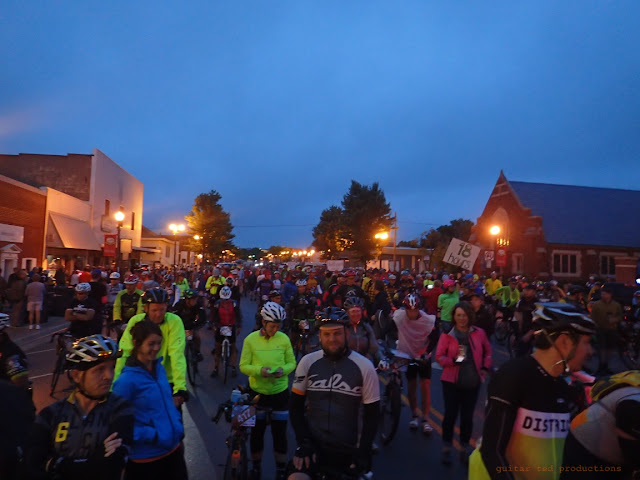
In fact, this was an important cultural phenomenon in early gravel events. The social gathering was an integral part of the racing experience. Trans Iowa had a pre-event meal where riders spent time getting to know one another. Some events like the Almanzo 100, an early grassroots gravel event in the state of Minnesota put on by Gravel Cycling Hall of Fame inductee, Chris Skogen, invited people to camp in Skogen's back yard the night before the event. Another event I participated in called the Moonshine Metric was held starting at the race director's home and riders were invited to a garage potluck dinner and party after the ride was over.

Gravel Grows Up: 

 Eventually things started to change. One of the most influential changes occurred in 2010 when Jim Cummings and Kristi Mohn decided to bring the Dirty Kanza 200 start and finish to downtown Emporia, Kansas. The event went from being an underground, out of the way event that started at a local motel on the Northwest side of town to a marquee event for not only gravel riders but for the city of Emporia itself.

This focus on the integration of local businesses and city with an elevation of the rider experience at the finish line became a prototype for many other gravel events. Finish line arches, chip timing, professional looking number plates, and announcers were implemented which elevated the appearance of the event and attracted even more people. A similar formula for gravel events has spread across the country and world now since that early move by the DK200.
The Dirty Kanza 200 set the bar for gravel events and challenged the genre to become more professional and polished.
 Another growing up of gravel came when in 2012 Salsa Cycles announced the Warbird model, a gravel racing bike which was the first "gravel specific", mass-marketed bicycle for this niche sport. Subsequently, tires and more gravel specific gear started becoming available. Wilderness Trail Bikes made the first commercially available gravel tubeless tire and HED Wheels started offering a gravel specific wheel early on as well. Suddenly every brand seemed to have a gravel bike and more tires and other gravel related gear started flying off shelves as gravel riding participation numbers skyrocketed in the late twenty-teens.

With larger fields taking part in events and with specific gear now becoming a reality for gravel, the genre started having a tug of war within itself. The days of discovery were passing, older ways of doing events were also going by the wayside, mostly because it was becoming increasingly impossible to have intimate, more familial feeling events with such large numbers of participants. That and the sheer number of gravel events went from a handful of mostly Mid-Western USA events to upwards of 600-700 events by the end of the twenty-teens spread across the continents of North America, Europe, Australia, and elsewhere.

A professional element in terms of the look and feel of events was also met with a professionalism in the event participants, to a small degree. Former World Tour pros started dabbling in gravel, finding a home for their competitive inclinations without the rigors of having to live through a long season of disciplined training and racing. But keep in mind that while the North American cycling media saw this as a positive and focal moment in gravel cycling, it was the continued increase in the average citizen's participation in gravel events, and now just recreational gravel riding, that was spurring on the movement to greater heights.

Professional cyclists started racing gravel events in the 2010's like Allison Tetrick, the winner of the 2018 Gravel Worlds Open Women's field

Current Gravel Culture: 

 The increase of smart-phone usage has been linked to the rise in numbers of distracted individuals driving cars and this has caused much death and injury to cyclists. Not to mention near-misses for people riding paved roadways. The panacea for many was gravel, A place where traffic was slow, lower in numbers of vehicles, and there was the distinct possibility that you might not even see a vehicle.

The capability of gravel bikes also factored in as riders discovered that these bikes - lighter and faster than mountain bikes - could go almost anywhere whereas the road racing derived bicycles were limited to smooth pavement. No longer were these gravel bikes limited to riders racing in the Mid-West, these bicycles were viable the world over, and people took to them in larger and larger numbers.

Subsequently the gravel bike helped to provide ways for groups to enjoy cycling outside of traditional events. Group rides became more commonplace. Impromptu adventures promoted on social media became more common, and communities of "gravel" riders sprang up in locations as far flung as the Philippines and New York City. 

Many group rides and low-key events happen on gravel now which are not related to racing.

Racing has taken on an even higher level of professionalism with the entrance of the Union Cycliste Internatinale and the Gravel World Series. Meanwhile, racing franchises/series like the Belgian Waffle Ride, the Life Time Grand Prix, and events like Unbound Gravel and SBT GRVL have continued to be covered extensively by cycling media and have raised the level of gravel to the casual observer who now has heard about "gravel racing", most likely.

This dichotomy of Gravel, where we have high-level racing which garners all the media's attention, and the grassroots, "DIY" type events and community driven groups now exists and continues to show no signs of reversing its growth anytime in the near future.

The Future of Gravel And Its Culture: 

 The two largest movers of bicycles in the cycling industry in 2024 are the categories of eBikes and gravel bikes. The number of gravel events seems to be increasing as well, so it stands to reason that we should have a continuation of the sort of "gravel culture" we have today. While cycling media will undoubtedly raise awareness of Professional level gravel racing and technology whenever it can, it is also important to remember that this represents a smaller portion of a much larger number of riders who enjoy riding bicycles on unpaved surfaces.

As an example, while it is easy to think that the recently completed 2024 Unbound event was all about Professional racers, keep in mind that there were only 151 "Elite" (pro and semi-Pro) riders in the field of close to 5,000 individuals who rode out of Emporia, Kansas on June 1st. Many of those folks were simply trying to find out if they could stretch their personal limits, finish something that they thought impossible for themselves to do, and perhaps there were several people just out for a great challenge and ride on the bicycle.

In fact, I had one person comment on my blog concerning the event who stated the following: "Great experience overall though, I think we're all going to head back next year. One of things that seemed to work well was it did cater to people like us, just out for fun but meanwhile there was a serious race going on for some. " So, it seems that while the attention is focused on the few Professional athletes, the fun and really, the main body of gravel riders is about having fun and adventure. This is what gave rise to gravel riding, this is what made gravel riding attractive and popular, and as long as that continues onward, gravel will continue to be one of the most popular forms of cycling world-wide. 

Thanks for reading Guitar Ted Productions!

Saturday, April 20, 2024

It Has Been Ten Years Already?! Part 2

From the recon of Trans Iowa v10's course.

 Here's another tale I'd forgotten about concerning Trans Iowa v10 which happened ten years ago this month. Oh, and by the way, good luck to those riding in Iowa Wind and Rock today, tonight, and tomorrow!

If you missed the first tale, you can read that HERE.

One of the enduring facets concerning riding gravel in the Mid-West has to do with our unmaintained roads. Those (usually) dirt roads that leave you wondering if you've made a right choice by entering an event that uses them. The mystery of the dirt road has caused much wonder, consternation, and has been the hammer that forged a lot of people's characters over the past 20 years of gravel grinding. 

This all started when, back in 2005, I included, unwittingly, two miles of what we call in Iowa, a Level B Road. This was a feature that was expanded upon for the following year, but with copious amounts of moisture, it made the event unfinishable that year. The legend was born concerning muddy dirt roads and ever since then these roads have been a legendary part of several gravel events. 

A previously unpublished image by Jeff Kerkove from T.I.v2 showing riders dealing with mud from a Level B Road.

Of course, being the RD of Trans Iowa all those years, I got a LOT of queries concerning Level B roads and how to deal with them. The effects of putting these roads into my courses was weighed heavily and was not done willy-nilly by any means. Each section of dirt was carefully considered and work-arounds were usually in place in case things got really crazy. But even then, keeping the crazies happy by including these challenges was not easy as a LOT of people would cry foul as well. 

The whole thing with the Level B road madness came to a head in Trans Iowa v10's run-up as potential riders of the event were concerned that I would be putting in too many roads of dirt and doom and that this alone would prevent their finishing of Trans Iowa. Little did they know what would actually happen that year that would knock most of the field out, and it was not any dirt roads! 

Of course, the riders had no clue as the event approached. The focus for them was on what these roads, which I had said there would be 10 sections of in the event, one for each year of T.I.'s existence, would be on their efforts. One or two riders asked about how long it might take to traverse a Level B Road with a typical bike set up for Trans Iowa. Well, I took that as a challenge. 

From my test of 2014 to see how long it took to walk one mile of Level B Road.

I had a bike, my Raleigh Tamland Two, that was all set up for gravel travel, much as a Trans Iowa competitor might have a bike set up, and as fortune would have it, it was a rainy Spring. I had an opportunity to go down to Petrie Road's Level B Section, a prototypical Level B Road from the standpoint of how it had a hill, a flat section, sand, and mud when wet, so that I could actually time myself walking that section of road. That particular Spring the road was wet, muddy, unrideable, and so it was perfect for this test. 

Turns out that, at a moderately fast pace, it takes 20 minutes to walk a muddy mile of Level B Road. That was what I found, at any rate, and was what I reported to my riders for T.I.v10. How they used that information was up to them after that.

Naturally, as I alluded to above, it wasn't muddy Level B Roads that would knock riders out of the running that year. No, it was a mighty East wind, sideways rain in the night, and lots of miles. The Level B roads? Certainly, they played a part, but they were not the knock-out punch many were thinking that they could be that year. 

One more tale to go!