Showing posts with label gravel racing. Show all posts

Friday, September 05, 2025

Friday News And Views

Image courtesy of Pashley Bicycles
 Pashley Wildfinder: Another "Fargo-Like" Adventure Bike Introduced:

This past Tuesday word came out about Pashley, a UK bicycle brand, and their new Wildfinder adventure bicycle. Sporting a Reynolds 853 DZB frame, this bike is aimed at what Pashley says are "off-grid adventures".  

Featuring suspension corrected geometry for the addition of a suspension fork, this bike also has all the accessory mounts you may need for touring, bike packing, or adventures way off the main path. 

The Wildfinder has clearance for a 29" x 2.4" tire maximum. It is compatible and available with a few different geared drive trains but the Wildfinder has no single speed option native to the design. 

Prices start at $2,595.00 USD for a frame and fork. 

Comments: I find this bike to be a great idea which is probably better executed by others for less money. For instance, the original Adventure Bike, the Fargo, can be had as a frame and fork, (a carbon fork, by the way) at 1K.  Plus the Fargo, as well as others in this category, can handle much larger tires if so desired. The Fargo also is single speed capable in case of emergency, or if an IGH type hub is utilized. Another awesome bike in this category, the Tumbleweed Stargazer, is $1,300.00 for the frame and steel fork. 

I get most others are not using Reynolds tubing, but this is of such a minute relevance it seems silly to bring this up as a nit against other adventure bikes in the category of the Wildfinder. Great idea, a nice bike, but a bit pricey, in my opinion, for what you get.  

Logo courtesy of Life Time Fitness
"The 40"

In the early days of mountain biking one of the toughest parts concerning this, then new, activity for cyclists was finding proper venues to enjoy off-road cycling here in the Mid-West. Obviously, most of the land is put to use for agriculture, so forests and woodlands are few.

One of the earliest opportunities to engage in competitive, off-road riding in this part of the country was started in 1983 in Northwestern Wisconsin and was called the "Chequamegon Fat Tire 40". A local rider named Gary Crandall started the event by promoting it via local ski and bicycle shops and on various cork bulletin boards in grocery stores in his area. 

During the 1980's and early 90's, I used to go on a fishing trip to Northwestern Wisconsin with friends every year starting on Memorial Day Weekend. I recall being in a grocery store in Hayward, Wisconsin, waiting for my friends to check out with our supplies for the week. As I was waiting I scanned the bulletin board on the wall. Grocery stores in those days used to have these cork boards for people to post yard sales on, local services, business via business cards, and posters for upcoming events. Amongst all this chaos was a lined sheet torn from a spiral bound notebook with information on "The Chequamegon Fat Tire 40" with a pen dangling from a pinned string next to it. On this sheet you could write your name and phone number so Gary Crandall could call you and get you on the roster for the event. 

Can you believe that? Well, believe it, because this is how "grassroots" this event used to be. Maybe I saw the first sign up sheet for this event. It had to be one of the first years the event took place, at any rate. They had 27 riders at that first Fat Tire 40, and today Life Time expects a field of over 1,700 riders in "The 40" with another approximately 800 in the "Short and Fat" event, which is a shorter distance. 

My belief is "The 40" kind of represents what happened to gravel events. Say what you will about the event itself, or the course, (many would say the Fat Tire 40 is essentially a "gravel race" anyway), but it is easy to draw parallels to another Life Time event called "Unbound". The 40 has been around over 40 years now and shows no signs of disappearing. Maybe gravel events have a similar trajectory? 

Maybe...

Image courtesy of Fulcrum Wheels

Fulcrum Wheels Announce New, More Affordable Aero Wheel Set:

On Wednesday news came down concerning a new aero wheel set from Fulcrum. Their new Soniq 42 wheels employ the radical "shark tooth" profile which is said to lend more stability in cross-winds. This variable rim height also acts like a deeper section wheel would in calmer air, or in tailwinds/headwinds.  

The section is called "mid-profile" by Fulcrum and amounts to a 42mm height varying to 45mm height along the rim profile. Other features include 24 rounded spokes in each wheel, a 25mm inner rim width, and a claimed tire width compatibility from 29mm to 76mm (!!!) 

Offered in several free hub combinations in 100mm/142mm through axle configuration only at  approximately $1,855.00 USD. 

Comments: The tire width compatibility is laughable. 76 mm is approximately 3 inches, in case you were wondering. Yeah..... That's insane. But otherwise I can see these being on a serious gravel racing set up, or for anyone who rides in windier conditions on the regular. By the way, the sub-1600 gram weight for the pair is not bad, considering the price and size of the rims here.  Probably not a climber's wheel set, but on the plains of the Mid-West, I can see these doing well. 

Maybe more competition will bring the prices down, and perhaps we will see even more aero wheel offerings for gravel in the near future. I still think this is a severely overlooked asset for gravel riding by many gravel riders.  

New Episode Of The Guitar Ted Podcast:

If you have not heard the latest episode of the podcast, the link to Spotify is HERE. You can also find us on Apple Podcasts, and most other podcasting platforms. We appreciate it when you listen!

This latest episode was a fun one for me. N.Y. Roll and I ramble on about several subjects. One in particular I wanted to touch upon here. 

The subject of muddy dirt roads seems to crop up every year lately. Some big gravel event will have a rain event, then the following day, or on following days, an event with muddy roads. Then the typical complaining and grousing about why muddy roads have to be a part of any gravel event. Complaints about "ruined races" or damaged equipment are often seen and heard.

Most gravel racers at the "pointy end" of things are what? Thirty years of age or younger? Let's say the average age is 30. Well, there are 2/3rds of their years with gravel racing history knowledge at their disposal. All VERY public, and VERY accessible. Finding out about "muddy dirt roads" is easy to do. So......who is at fault for a lack of knowledge

My mind is boggled by the lack of historical knowledge displayed by most top-flite gravel Pros and semi-Pros. They often seem to be oblivious to any sort of practical decision making skills when presented with difficulties like a muddy dirt road. They definitely often do not know these sorts of roads have featured in gravel events since the beginning of the Modern Gravel era.

Two decades worth of historical information on your specific sport is a treasure trove of information with which one could use to their advantage, but we'd rather obsess over tire widths and aero frames. None of this matters when you come across a muddy dirt road. 

I hope promoters don't cow-tow to the desires of pampered gravel Pros and take these roads out of events in the future. If this does happen, and those types of roads cease to exist in gravel racing, then it will be just one more step toward the road-ification of gravel racing. 

Have a great weekend! Get out there and ride those bicycles!

Sunday, April 06, 2025

Two Things

Fat Tires For Gravel? Nothing New, Maybe Not The Best Thing Either...

Besides cycling media, racers, and brands harping on "aero" lately, I've seen a lot of digital space given to running mountain bike tires as "gravel tires" on "gravel bikes". Okay, so here's my opinion on all of this.

First of all, most  "gravel bikes" are not, and should not be racing bikes for gravel. Just as all squares are rectangles but not all rectangles are squares. Also, not everyone should be looking to racers, or gravel racing, for their direction to take for riding a bicycle on gravel. 

However; this has been, and still is modus operandi for the cycling industry in the USA. Everything revolves around racing, to the great detriment of the average cyclist and those who might become cyclists. (I know, I probably sound like Grant Petersen here) What is happening in "gravel" cycling now is a repeat of the story which happened to road cycling and mountain biking. Competitive ______ racing (fill in the blank) is the measuring stick for ALL ______ biking (fill in the blank) cyclists. The equipment is put up as the "best", and all the things racers do are "better" for you, (even though you probably are the furthest thing from those Professional racers) and their actions and equipment are the goals you are to attain to. 

This is one of the main drivers for all the weird standards, ill fitting bike designs (ill fitting for average shaped humans), and expensive bicycles. But bringing it back to the tire thing, some racer said MTB tires are "better" for gravel, and there is "no reason" to race gravel on 40mm tires. Here's the really bad part about this sort of messaging.

Most people don't consider the source and the context of commentary like this. Maybe for a particular course, and for a small handful of humans who are professional (read: Have tons of time to train, are sponsored, or paid to race) these recommendations may have some merit. But telling me not to consider 40mm tires for gravel racing is pretty bogus. What if the bike I have to "race gravel on" is also my daily driver? Maybe I have pavement for long stretches of my ride, or I commute. A MTB tire at 29" X 2.2" is kinda "not the right tire", perhaps? 

And no - none of what these racers are saying about gravel racing in terms of tires is "new". These racers, and many who are influenced by these racers just don't know what they don't know. That is a completely different story for another day. Point is, if you are not a professional racer, you may want to sift what they suggest very carefully before jumping on their bandwagon. 

Or not...... 

 When It Becomes "Not An All - Roads Bike", What Is It?

Image courtesy of Ridley Bikes

This fat tire gravel thing is leading some down a road which looks suspiciously like XC mountain biking with drop bars. I reported on the Ridley bike in a recent FN&V here. Ridley call this concept "Alpine Gravel"

Another online cycling media outlet asked if full-suspension gravel bikes were the "vision" going forward for gravel bikes.

A certain photographer I follow on social media answered back with, "You mean a drop-bar mountain bike? No.

Some people have far more sense than the media, or cycling brands give them credit for. Just about anyone with a decent amount of time in mountain biking, gravel riding, or cycling in general can see right through all of this crap. The thing is, most of these brands and media sources don't really care. Their narrative will win out the day eventually if they keep banging the drum for whatever they deem is "The Next Big Thing" and as long as it sells units.

Drop bar mountain bikes, in and of themselves, are not a 'bad' thing. What is wrong about this is how these bikes are being sold to the naive cyclist as something 'new' and different. An XC mountain bike hard tail with drop bars is nothing new. Not even one with 29"er wheels. And especially in this instance, it is laughable to try to push this narrative.

These bikes also do not really fit the originally intended purposes of what became known as "gravel bikes". In the beginnings of all of this, the idea was to have a bicycle which would cover the area between single track and fully paved roads. A bicycle for roads, no matter what their surface was. Not single track. Not mountainous, rock infested terrain. We already had mountain bikes for this activity. We already had great choices for bicycles which did well on fully paved roads.

Somewhere along the way we have been asked to think gravel bikes are mountain bikes as well. Why? Maybe because gravel is a hot category, and XC MTB is not? Yes.....that's pretty much it right there

NOTE: Next week a lot of press releases come off embargo previous to Sea Otter. I'll have some news posting at odd times. Thank you for your patience in this matter and for reading Guitar Ted Productions

Thursday, July 11, 2024

The Tour And Gravel

 Last weekend the Tour de France had a stage where an approximately 123 mile course had 14 sectors of gravel equaling approximately 20 miles. These sectors caused more ruffled feathers than you would imagine. Some of the complaints and comments ranged from mildly agreeable to outright comical. 

First of all, there are a few layers to this that we, as Americans anyway, need to keep in mind here. First is the European viewpoint of what a "professional road race" is. There are "certain things" one does and does NOT do which can really tilt the viewpoint on any given road race. 

Secondly, "gravel" is defined  differently by many folks and is physically something different wherever you go. Gravel could mean a few rocks embedded into a dirt road, silty rock, pea gravel, or chunky crushed rock. And that's just scratching the surface of all that is deemed "gravel" in the world. 

Specifically to this stage 9 in the Tour, some riders complained that what they reconned and what ended up being the course were two different things. They found much steeper grades in places and looser gravel across the roads in other places that seemed to upset some of the riders. I can get behind these complaints to a degree as that situation, if true, is a failure on the part of the Tour organizers to set expectations correctly. 

But all that aside, I was thinking that these guys in the Tour would likely quit races in the USA which are held on gravel. For one thing, a "gravel race" or a "gravel stage" in a race should have more gravel than pavement. I think that is not universally held as a standard here, but  I do think it is safe to say most gravel enthusiasts would agree that a "gravel stage" should have a LOT of gravel miles and 20-ish out of a 123 isn't that. It should have been reversed. The stage should have had 100 miles of gravel and about 23 miles of pavement. That would be legit. 

Can you imagine what would have happened had it rained at the Tour on stage 9?
I found it interesting to listen to rider interviews after the stage and hear their thoughts on the day. It became apparent that European Pro roadies see "Classics" and Stage Racing" as two separate entities. I'm not sure we see that in the same light as the Europeans do. 

Many here feel that it is all "Pro road racing" and that the salad days of yore, when Pros rode all the types of races, were the better days. It wasn't until people like Lance came around and only did a certain style of event, that I think this idea that both "classics" and "stage races"weren't to be done by Pro racers. You do one or the other. Or at least only think you'll win one type or the other type. 

That all said, having a gravel sector in a road race doesn't make it a "classic" and not a stage in a stage race. Because if having gravel somehow isn't stage racing then what were those pre-WWII riders doing at those tours in France? We have better bikes for gravel now than they did then, so there should be no complaints. 

And then the comments online afterward stating that the stage was "unsafe". Umm......like bombing a mountain pass at 50mph or faster is not "unsafe'? Or how about those wild bunch sprints? That looks "safe" to me. (HA!) Whatever. 

I will say that what I said about trying to run a gravel event like a Pro road race was proven to be true. Motos, team cars, and any vehicle that is not a bicycle should not be on the gravel with the riders. Dust was a big complaint. But then maybe we should let motos and cars on the course.  Cars and motos actually were cited as an advantage by some who discovered that the compacted gravel from tires on the vehicles was a better and more advantageous place to ride. (I still think the cars and motos need to stay off gravel in races)

All this does is reinforce my opinion that the UCI doesn't really want a "real" gravel event, and neither do their top-tier riders. Stick to pavement if the short punchy climbs, the loose gravel, and the dust bother you. Stick to cute little sections of crushed rock if it offends the riders. It'll be easier to take for them and would be over sooner. Don't even consider a mostly gravel course and I won't even think you'd ever have an event that is 100+ miles of crushed rock. Just leave that to us here in the US. 

Tuesday, July 02, 2024

Gravel's Beginnings, Culture Past, Present & Future

As part of my 20th year of blogging here I present today this article on the history, culture, and future of "gravel" riding. This was an assignment I took on after meeting Taiki Sakamoto, a journalist from Japan who is an editor at "Bicycle Club" magazine. 

Sakamoto-San asked me to write in brief about the way gravel began here, what the early years were like, and what "gravel culture" was defined as here. He specifically wanted to understand if "gravel" was racing only, or was there more to it than that. He wanted to know if gravel had a non-competitive element. 

I have no idea if Sakamoto-San will use any of what I wrote, but I was honored that he asked me to write this. I thought I would share it with my readers here. So, following is the manuscript of my responses to Sakamoto-San. See what you think.... 

Riders during Trans Iowa v1 April 2005

Gravel's Beginnings: 

 This may be a fool's errand to try to pin down the beginnings of gravel riding as we know it in 2024. In fact, it probably is a foolish thing to try to ascertain. As long as there have been bicycles people were riding them on unpaved surfaces, racing these machines, and mostly having adventures. That is no different than what we witness today. So, let's just agree to say that at some point there was a turn to crushed rock road riding which spurred on a way of cycling that has overtaken the world.

This can be narrowed down to a time when a certain set of unique circumstances in history gelled together to create the "perfect recipe" for what became "Gravel". There is a lot to try to make sense of here, but throughout it all, let's keep in mind that the main thing is that riding bicycles with others - or alone - is a lot of fun.

Now, let us look at the early 2000's in the U.S.A. and what was going on, both culturally and within the realm of off-road cycling. The home computer was still a new thing in those days. People were connecting to sites that catered to special interests which mainstream media was incapable of covering at the time. Specialized information was shared in "chat rooms" online, and the form of social media/communication known as "blogging" was extremely popular at that time.

Within the cycling circles, a decline in participation in road cycling events was evident, mostly due to two factors - costs to produce such events and people's dissatisfaction with the product. Then too, we had an off-road component that was suffering similar issues. Mountain biking venues were hard to get to, being strung across the nation in far-flung locations in many cases. Costs to participate were rising, and many people had no real motivation to undertake what was perceived as an "extreme activity". Especially when it came to the 24hr MTB events, which arguably reached their peak of popularity in the mid-2000's. People were ready for something new.

That new thing ended up becoming "Gravel". After Trans Iowa was announced in November of 2004, my co-founder of the event, Jeff Kerkove, was inundated with requests about the event format and rules. People wanted to know what was going on, and because Jeff, who was at that time a very popular 24hr mountain biking athlete, had a highly trafficked blog, this became the conduit for this new information.

Many ultra-endurance athletes participated in the first T.I., including Steve "Doom" Fassibinder, seen here at the Algona Checkpoint.


A couple of the cyclists that caught wind of this new thing were named Jim Cummings and Joel Dyke. They decided that they wanted to ride on gravel in their home state of Kansas. Joel rode in the first two editions of Trans Iowa and that helped inform what they created. The event known then as the Dirty Kanza 200 became another gravel race which, as you may know now, eventually grew into what is known as Unbound Gravel today.

Between blogs, emails, and word of mouth, gravel cycling started to spread throughout the Mid-West of the United States, an area mostly looked at as being a desolate, unlovely part of the country by many. "Fly-over Country", it was called, because people deemed the West and East coasts of the USA as being more interesting and important. However, as people began to travel to the Mid-West to partake in this new, wild variety of cycling competition, the viewpoint of these participants began to change.

Early gravel events also helped shape what would become known as "the spirit of gravel", which really is a cultural ethos that began as a rejection of what was then deemed to be negative in traditionally formatted, sanctioned racing events. Rules were simple in gravel events, with some simply saying "Don't be a Dick", meaning that if we could all trust one another to follow fair play practices and get along well with each other, we didn't need any other rules.

All types of bicycles were used during the early years of gravel. This scene is from the 2015 Gravel Worlds

Of course, there were rules, but many were simple and with the format being new, promoters and organizers were welcoming one and all. Race fields made up of misfits and rebels, all manner of gender, political leanings, and all types of bicycles were allowed as long as we all got along and shared in the adventures. It wasn't uncommon for race winners to mingle with last place finishers, and even those who did not finish, and share an adult beverage while the telling of each other’s day on the bicycle went on long after the finish.

There was also an element amongst the early practitioners of Gravel which was experimental and pioneering. Keep in mind that while the roads were "Gravel" there was no equipment or clothing specific to Gravel. One had to experiment and discover what worked and what did not work. This also included nutrition and how to deal with the way gravel and dirt roads changed due to road maintenance and weather. 

Mountain, cross, and varying ways to tackle water carrying, etc, were all part of the early gravel scene. This was from the beginning of the 2010 Dirty Kanza 200.
 Just about everything was on the table to experiment with in the early days of gravel. Dual suspension mountain bikes, old 1970's road bikes with 27" X 1 1/4" tires, cyclo- cross bikes, and even traditional road bikes were seen at the early events on gravel. It did not take long, however, for the cyclo-cross bike to become the most popular choice amongst gravel riders. 

 But experimentation continued with issues pertaining to hydration, how to deal with wet, muddy roads, dust, lighting, and more. This "pioneering" phase of gravel brought riders closer together as information was freely exchanged at events and on the various cycling blogs and websites. It was a unique phase in gravel cycling history, and because of the way the knowledge was handled, "Gravel" started to gain a reputation for being inclusive and more down to earth in regard to how riders were treated at events and online. No one was trying to hide secrets, for the most part, and it seemed like the participants were treated more as family members than they were rivals of each other.

You could see this and feel it at the early events whenever we gathered for meetings or after the event was finished up. The term "gravel family" was coined and it seemed that every event was another chance for a "family reunion", which in this country is referring to how related family members often gather yearly from scattered locations to "reunite" and share a meal together. In that sense, the gravel family was a place to belong, and was unlike traditional road and mountain bike events where racers experienced a sort of 'caste system' in terms of groups and interaction with - or between - participants was not fostered by the event promoters. 

The "Moonshine Metric" started and ended in the event host's garage with a potluck dinner after the ride. This scene from 2012.

In fact, this was an important cultural phenomenon in early gravel events. The social gathering was an integral part of the racing experience. Trans Iowa had a pre-event meal where riders spent time getting to know one another. Some events like the Almanzo 100, an early grassroots gravel event in the state of Minnesota put on by Gravel Cycling Hall of Fame inductee, Chris Skogen, invited people to camp in Skogen's back yard the night before the event. Another event I participated in called the Moonshine Metric was held starting at the race director's home and riders were invited to a garage potluck dinner and party after the ride was over.

Gravel Grows Up: 

 Eventually things started to change. One of the most influential changes occurred in 2010 when Jim Cummings and Kristi Mohn decided to bring the Dirty Kanza 200 start and finish to downtown Emporia, Kansas. The event went from being an underground, out of the way event that started at a local motel on the Northwest side of town to a marquee event for not only gravel riders but for the city of Emporia itself.

This focus on the integration of local businesses and city with an elevation of the rider experience at the finish line became a prototype for many other gravel events. Finish line arches, chip timing, professional looking number plates, and announcers were implemented which elevated the appearance of the event and attracted even more people. A similar formula for gravel events has spread across the country and world now since that early move by the DK200.
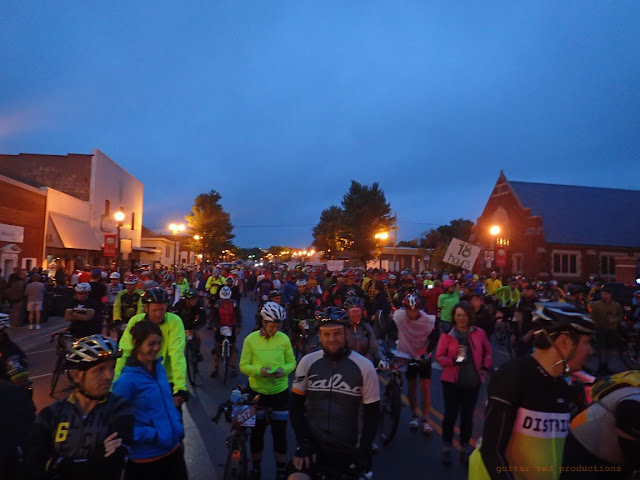
The Dirty Kanza 200 set the bar for gravel events and challenged the genre to become more professional and polished.
 Another growing up of gravel came when in 2012 Salsa Cycles announced the Warbird model, a gravel racing bike which was the first "gravel specific", mass-marketed bicycle for this niche sport. Subsequently, tires and more gravel specific gear started becoming available. Wilderness Trail Bikes made the first commercially available gravel tubeless tire and HED Wheels started offering a gravel specific wheel early on as well. Suddenly every brand seemed to have a gravel bike and more tires and other gravel related gear started flying off shelves as gravel riding participation numbers skyrocketed in the late twenty-teens.

With larger fields taking part in events and with specific gear now becoming a reality for gravel, the genre started having a tug of war within itself. The days of discovery were passing, older ways of doing events were also going by the wayside, mostly because it was becoming increasingly impossible to have intimate, more familial feeling events with such large numbers of participants. That and the sheer number of gravel events went from a handful of mostly Mid-Western USA events to upwards of 600-700 events by the end of the twenty-teens spread across the continents of North America, Europe, Australia, and elsewhere.

A professional element in terms of the look and feel of events was also met with a professionalism in the event participants, to a small degree. Former World Tour pros started dabbling in gravel, finding a home for their competitive inclinations without the rigors of having to live through a long season of disciplined training and racing. But keep in mind that while the North American cycling media saw this as a positive and focal moment in gravel cycling, it was the continued increase in the average citizen's participation in gravel events, and now just recreational gravel riding, that was spurring on the movement to greater heights.

Professional cyclists started racing gravel events in the 2010's like Allison Tetrick, the winner of the 2018 Gravel Worlds Open Women's field

Current Gravel Culture: 

 The increase of smart-phone usage has been linked to the rise in numbers of distracted individuals driving cars and this has caused much death and injury to cyclists. Not to mention near-misses for people riding paved roadways. The panacea for many was gravel, A place where traffic was slow, lower in numbers of vehicles, and there was the distinct possibility that you might not even see a vehicle.

The capability of gravel bikes also factored in as riders discovered that these bikes - lighter and faster than mountain bikes - could go almost anywhere whereas the road racing derived bicycles were limited to smooth pavement. No longer were these gravel bikes limited to riders racing in the Mid-West, these bicycles were viable the world over, and people took to them in larger and larger numbers.

Subsequently the gravel bike helped to provide ways for groups to enjoy cycling outside of traditional events. Group rides became more commonplace. Impromptu adventures promoted on social media became more common, and communities of "gravel" riders sprang up in locations as far flung as the Philippines and New York City. 

Many group rides and low-key events happen on gravel now which are not related to racing.

Racing has taken on an even higher level of professionalism with the entrance of the Union Cycliste Internatinale and the Gravel World Series. Meanwhile, racing franchises/series like the Belgian Waffle Ride, the Life Time Grand Prix, and events like Unbound Gravel and SBT GRVL have continued to be covered extensively by cycling media and have raised the level of gravel to the casual observer who now has heard about "gravel racing", most likely.

This dichotomy of Gravel, where we have high-level racing which garners all the media's attention, and the grassroots, "DIY" type events and community driven groups now exists and continues to show no signs of reversing its growth anytime in the near future.

The Future of Gravel And Its Culture: 

 The two largest movers of bicycles in the cycling industry in 2024 are the categories of eBikes and gravel bikes. The number of gravel events seems to be increasing as well, so it stands to reason that we should have a continuation of the sort of "gravel culture" we have today. While cycling media will undoubtedly raise awareness of Professional level gravel racing and technology whenever it can, it is also important to remember that this represents a smaller portion of a much larger number of riders who enjoy riding bicycles on unpaved surfaces.

As an example, while it is easy to think that the recently completed 2024 Unbound event was all about Professional racers, keep in mind that there were only 151 "Elite" (pro and semi-Pro) riders in the field of close to 5,000 individuals who rode out of Emporia, Kansas on June 1st. Many of those folks were simply trying to find out if they could stretch their personal limits, finish something that they thought impossible for themselves to do, and perhaps there were several people just out for a great challenge and ride on the bicycle.

In fact, I had one person comment on my blog concerning the event who stated the following: "Great experience overall though, I think we're all going to head back next year. One of things that seemed to work well was it did cater to people like us, just out for fun but meanwhile there was a serious race going on for some. " So, it seems that while the attention is focused on the few Professional athletes, the fun and really, the main body of gravel riders is about having fun and adventure. This is what gave rise to gravel riding, this is what made gravel riding attractive and popular, and as long as that continues onward, gravel will continue to be one of the most popular forms of cycling world-wide. 

Thanks for reading Guitar Ted Productions!

Friday, May 03, 2024

Friday News And Views

Image courtesy of Hutchinson Tires
Hutchinson Introduces New Gravel Racing Tires:

On Thursday news hit concerning a new gravel racing tire from Hutchinson, the French tire maker, called "Caracal Race". Caracal is a name of an African feral cat, by the way. You may also know it from open wheel auto racing circles as the name of a particular racing car chassis. 

The unique  tread of the Caracal Race was developed using Hutchinson's road racing tire technology and features only two overlapping casing layers under the tread and three in the sidewals making this tire very fast, but also not as tough as you might want for rugged, rough gravel. In fact, Hutchinson recommends this 475 gram tire (claimed weight) as only suitable for all-road and hard packed gravel tracks. There is a puncture protected version of the Caracal Race called just "Caracal" and that tire is claimed to weigh the same 475 grams for each tire. It is also a bit less expensive. The Caracal Race tire cost around $65.00 each USD. The Caracal and Caracal Race are only available in 700 X 40mm size. The "race" version being tan wall only while a black wall version is available in the Caracal version.

Comments: First of all, good luck finding these in the USA. Hutchinson essentially pulled its distribution of tires toward the end of the pandemic and has not reestablished any significant network of distribution here since. That isn't to say that you could not find these in a 'non-traditional' way, but these Hutch tires are not going to be widely available here. 

Now about that weight. The Caracal weighs the same as the race version? I doubt that is the case. If so, why bother buying the race version? This makes it seem like there is some missing information there. It may be true, but this strikes me as being odd from a marketing standpoint. 

The mere existence of a 'racing only' gravel tire seems pretty ironic to me. Maybe it is my particular perspective regarding gravel riding, but why spend well over a hundred bucks on a set of tires you are only going to use a handful of times, if they last that long. Then again, maybe you are a sponsored rider, or are chasing the money in bigger races. But for the average person? Maybe if a lot of your rides are pavement, then yeah, I could see this being your tire. Especially the puncture protected one. 

For what it is worth, I do love the Hutchinson Touareg which comes in a ton of sizes in 650B and 700c. It is amazingly air-tight when used tubeless and rolls very well on Mid-West gravel. It is puncture protected and you might be able to track down the 700 X 50mm size. That'd be cool!

Image courtesy of Wheels Manufacturing.

 Single Speed News From Wheels Manufacturing:

This is news leftover from Sea Otter, but since I love me some single speed action, I thought that this was interesting enough to put into today's FN&V. 

Wheels Manufacturing is making single speed cogs in various anodized colors now. But what is really cool is that they are coming out with a kit for Shimano Micro Spline hubs. You can see that version in the image here to the left. 

Wheels already has a kit for converting SRAM XD freehub bodies to single speed as well, so now all bikes can be single speed. Well.....okay, not Campy! Oh well....

Wheels also sells spacer kits in matching anodized colors. The new Solo cogs will also be available in Shimano Hyperglide cassette spline standard as well. Cogs vary from 16T to 23T in size. 

Is single speed making something of a resurgence? Is this all a reaction to the hyper-technology in racing bicycles costing well above 10K? I don't know but I cannot recall a time when so many companies were making anodized single speed gear for the cycling market. Can you? Let me know in the comments what you think. 

Image courtesy of Shimano.
Rebound '24 Aims To Hit The 10 Million Miles Ridden Mark:

Riders are invited again to join in with others around the world to ride gravel/non-paved tracks in the Rebound '24 event which happens world-wide June 1st. 

Shimano Gravel Alliance, in conjunction with Live Slow Ride Fast, invite you to participate in logging 25, 50, 100, or 200 miles starting at 6:00am your local time, (just like Unbound starts - or used to start, now its Pro only and staggered between men and women, and.....Never mind!)

Just make your own route and start at 6:00am, okay? Alrighty then! Shimnao wants to see the total from last year's Rebound event, which was 4,789,142, reach 10,000,000 miles this year. That's a BIG goal! 

Shimano only asks that you sign up HERE and track your mileage. Preferably doing the course you set up self-supported, (although the Pros at Unbound will have fully staffed aid at checkpoints, but......Never mind!) Anyway, check it out if you are so inclined and be a part of a global cycling event, which is kind of cool if you consider that. One thing is for sure, Rebound probably will cost you less than Unbound. Just a guess..... (sarcasm alert)

Propain Terrel CF Image courtesy of Propain Bikes.

More Gravel Bikes:

The influx of brands coming into the gravel market seems to continue unabated. New releases by current gravel brands also are keeping pace as well. The latest offerings from Ridley Bikes and Propain Bikes are prime examples. 

Ridley has a new line up in its Grifn range which is kind of an in between bike in that it isn't necessarily a gravel bike (limited tire clearances) but it is not an "endurance road bike" either. Ridley is saying it is more of an "all roads" bike. Funny how that is what I thought ALL fat tire, pavement to non-pavement bikes should be named. But here we are with "gravel". 

At any rate, Ridley added an eGravel bike in this family of bikes and also a more affordable aluminum bike as well. All have geometry which, in my opinion, isn't all that "gravel-ish" and with the limited tire clearances, these bikes have a weird place in the market. 

Now Propain, a brand mostly known for its aggressive downhill oriented MTB's, has a gravel bike in its range dubbed the Terrel CF. Many 'gravel' bikes emanating from traditionally MTB-specific brands can be wonky in the geometry department with super-slacked out head tube angles and whatnot. Not so with Propain's Terrel CF. 

This bike has a 71° head tube angle, 72.5mm of bottom bracket drop, and the only thing on the chart that jumped out at me was the long effective top tub measurements. For instance, in my size, which typically runs anywhere from 57.5cm - 58cm, the Terrel has a 59.5cm measurement. That's going to require a short stem, but Propain says that they designed the bike so the axle appears a bit forward of the handlebar while riding. This, they claim, provides more stability in sketchy terrain.  

The gravel bike category just seems to be one of the only categories with any growth. You have to wonder when the growth will slow down. I just am not seeing it yet, and at a time when the rest of the industry is contracting, this growth in the gravel category seems pretty weird. 

Pirate Cycling League Merch:

As you may know, the Pirate Cycling League is now separated from Gravel Worlds. The PCL is now getting itself settled in on its own, once again, and has now announced some merchandise to mark this occasion. 

A couple of t-shirts and a hat are on offer now, (See HERE), and the word is that much more is in the works along with some other "new ideas" which will be coming in the future. 

I picked up a t-shirt and I will give my thoughts on that when it arrives. These new items are all pre-order for now, so I'll be waiting a bit before I see this shirt in hand.

That's a wrap on this week! Get out and ride those bikes! Thank you for reading Guitar Ted Productions!