Showing posts with label gravel bike. Show all posts

Friday, May 01, 2026

Friday News And Views

Image courtesy of Reeb Cycles
Reeb Cycles Offers Taiwan Made Hall Pass Hardtail:

The hardtail is dead! Long live the hardtail! For so many years people were saying full suspension bikes would eventually push out the rigid rear-ended mountain bike. However; once 29"ers came around, a resurgence in hardtail MTB's occurred and the industry hasn't looked back since. 

Currently there seems to be a run on new 29"er, slack front ended, steep seat tubed designs. Recent introductions from Esker, Otso, and now this one from Reeb cycles point to a healthy amount of choices out there in this style of bicycle. The Reeb model is called the Hall Pass, and it is made in Taiwan to help make the bike a bit more affordable. 

A frame will run you $1.299.00  or you can choose from one of six complete builds including two single speed versions of the Hall Pass. Hit the link above for more on this frame designed around a 130mm travel fork. 

Image courtesy of Hutchinson Tires

Hutchinson Announces New Touareg Race Gridskin Tires:

One of my favorite tires I've used on gravel was the Hutchinson Touareg 700 X 45mm tire.  I finally had to retire my pair, and then found the Hutchinson brand was difficult to get here in the USA afterward. So, I moved on.

However; I may have to revisit that as Hutchinson has now released a Touareg Race with its high end "Gridskin" sidewall technology.  

This knitted mesh reinforcement was first used to great success in Hutchinson's road tire range and now is offered in this gravel race tire. The application of Gridskin does not result in higher rolling resistance and adds minimal weight, according to Hutchinson. 

Hutchinson uses its high-end race rubber compound for this model. Dubbed "Mach Tread 3.0", it  is claimed to be Hutchinson's fastest tread compound ever. 

Hutchinson offers this tire in 700c diameter and in 40mm, 45mm, and 50mm widths. Check it out on Hutchinson's site HERE.  

Image courtesy of GRVL
GRVL Shows New ADVNTR Hydration Pack:

Many riders prefer hydration packs for longer gravel rides due to the easy access to water/electrolytes and for cargo carrying capacities as well. For those in this camp, the GRVL brand offers their new ADVNTR hydration pack with a removable cargo pouch. 

The pack comes with a 2L hydration bladder. This bladder is removable from the pack and is easily washed out and easy to refill. 

The pack itself is made from X-PAC fabric which is tear resistant and lightweight. A one click, four point harness is adjustable for the rider from a chest size of 36" to 44". 

The cargo pouch is held in place by clickable connectors so it is easily removed for a race-day effort or attached easily for longer, ultra-distance efforts where more capacity for food and accessories is desirable. 

The ADVNTR hydration pack comes in three colors and is priced at $159.00USD. See this pack on GRVL's website HERE

Comments: Another vowel fearing company in the gravel market, GRVL is a performance apparel brand which is branching out into bicycles (1816 brand) and now this hydration pack. It looks like a "high on the back" type pack which may allow usage of jersey pockets. We may be getting one in for review, so stay tuned on this front. 

Image courtesy of Wilde Bicycle Co. 

Wilde Bicycle Co. Partners With Cane Creek On "Logo-less" Headset:

Wilde Bicycle Co. and Cane Creek have partnered again on a head set. This time it is a traditional external cup 1 1/8th inch threadless type head set with no logos. Wilde says in the press release:

 "The branding is very subtle as our logo isn't the point, having a headset that seamlessly blends into
a classy build is. If you don't like the Wilde icon logo on the lower cup, simply rotate it toward the
back and hide it under the down tube.
"

Available in Purple, Black, or Silver for $120.00 USD. See Wilde Bicycle Co.'s website for more details HERE.  

Comments: I was a bit nonplussed when I first read the press release, but upon further reflection, I began to see how this appeals to me. Logos on parts are, on one hand, just a way to low-key "brag" about your bike. Plus, they can take away from the larger aspect of having a nice, slick looking bicycle overall. I mean, do we really need to know where that part is from? I just want these things to look good and.....well, you know......work.  

I would imagine this chance to get a quality head set with no logos will be a limited time thing. Plus, at one hundred and twenty bucks, it isn't out of line, in terms of pricing, so I see good value here. That is if you don't care about product logos on your components.  

Image courtesy of BMC Bicycles
BMC Shows Off New Gravel Bike:

BMC just released details on the new Kaius 01 model. They used the tagline "Unbound Speed" in their marketing language. An obvious reference to the World's Premier gravel event called Unbound Gravel. 

Using such language would point to a bike with some aero and big tire clearance capabilities, as this seems to be the preference of the top-tier racers at Unbound BMC does not disappoint on both counts in this new bike. 

Boasting tire clearance for 700c X 52mm tires, there is plenty of tire capability for a race like Unbound Gravel. Aero? The new Kaius is designed with such an eye towards aero that the bottle cages are integrated into the design! 

Image courtesy of BMC

The new Kaius 01comes in four different specifications with the top three in the range coming in a choice of two color schemes. Prices range from $14,072.99 USD for the Kaius 01 ONE down to $7.676.30 USD for the Kaius 01 FOUR. A frame set, including fork and integrated bottle cages, goes for $5,754.56 USD. 

Comments: The price to be at the top of the heap in gravel technology just went crazy. I'm pretty sure we won't be seeing any BMC Kaius 01's around here any time soon, unless there is a sponsored athlete or a rich professional with a LOT of disposable cash on hand in the local area. Sheesh! 

I wouldn't ordinarily post about a halo bike which most cannot afford or justify purchasing. However; this bike has all the characteristics which seem to be what brands think racers, (not necessarily gravel riders, by the way), seem to be asking for in a bicycle for gravel racing. The geometry is of particular interest here. 

BMC has provided a 71° head tube angle for smaller sizes to a steepish 72° head tube angle for the largest sizes. Yet they have kept the same trail figure across the range of sizes. They accomplished this by altering the fork offset for each head tube angle. Very unusual and a very detailed design specification here. 

There is no room for a telescopic suspension device here either, with BMC betting on tire volume and their ride tuned compliance in the carbon to account for rougher roads and trail. This keeps the front end low. This is reflected in the short axle to crown and shorter stack heights across the range. A true racing machine with fat tire clearances.  

New Podcast Drop!

If you have a little off-the-bike time this weekend why don't you give our latest episode a listen? It's about the Bicycle Ride Across Nebraska, and specifically their gravel route. 

N.Y. Roll and I hosted Jayme Frye and Adreinne Detanico of BRAN to find out what the deal is with BRAN. 

It is a small-scale, fully supported, cross-state ride which originally began on pavement. While the event is a week long ride, people interested can choose to ride three, two, or even single day section of the route. 

The ride is more grassroots in feel and smaller than something like RAGBRAI. The gravel ride is actually pretty much a group ride, or a ride of groups. But give the episode a listen to get the gist. 

Find out more about the BRAN event HERE
 

 That's a wrap for this week! get out and ride those bicycles!

Tuesday, March 31, 2026

Gravel Grinder News: Shand Cycles Stramish Gravel Bike

The new Stramish by Strand Cycles
Note: All images and information used in this article were provided by Shand Cycles. Comments are Guitar Ted's. 

Today Shand Cycles from the United kingdom unveils its all-new version of the Stramish gravel bike. This steel frame, carbon forked bike has several new features which  should pique the interest of the adventurous cyclist. 

This bike is hand fabricated and painted in the UK and is available by order with a delivery of six to eight weeks. 

Shand says that "stramish" means a racket, or disturbance, in Scottish, and fits the intentions of this adventure/gravel bike perfectly. The Stramish uses a Columbus steel tubing for the main frame and has 50mm tire clearance. There are two sets of water bottle bosses in the main triangle, a set under the down tube, and top tube "bento-box" accessory mounts as well as the "Three-pack" style mounts on the carbon fork. Of course, it wouldn't be a UK bike without mudguard mounts and rack mounts.    

Shand is now making their own stainless steel rear drop outs and with this model the addition of a UDH hanger is also adopted. Note the split in the frame which allows the rider to choose a belt driven drive train, if so desired. 

Furthermore, the T-47 type bottom bracket shell allows for the use of a standard threaded bottom bracket or an eccentric insert, so the bike is compatible with geared drive trains, single speed, or internally geared hubs as well. This provides for a multitude of set ups using the Stramish as a platform. 

The geometry of the Stramish is ready for adventure, but not too far removed from standard gravel geometry that it looses its identity trying to be a drop bar mountain bike. The frame comes in four sizes: Small, Medium, Large, and Xtra Large.  

The Stramish is available now and starts at  £5,495/$7,245.00 USD See this bike and other Shand Cycles models at their website HERE

Comments: I'm fairly picky about what I choose to post here for press releases. So much of what gets slid across my inbox represents sameness or is of little relevance to gravel or adventure cycling, so it gets passed on from me. However; this bike has something unique and fits right into the adventure/ultra-distance/gravel grinder type thing which I personally find intriguing. I hope that you do as well.  

The Stramish isn't what I would term as "racy", although one could race on it. The geometry is very good, in my opinion, and stack height is neither too slammed or too upright. While I realize there are some elements of gravel riders who are not going to look at anything new without mahoosive tire clearances, I find this 50mm maximum to be quite adequate for all-around - all-road uses. If you ride on single track, mountain trails, or the like, then maybe I can see your point but there are plenty of drop bar mountain bikes now for those pursuits.  

The price is steep. Especially to get one here in the USA. However; what isn't really expensive now and what other steel bikes have the versatility the Stramish has? Stateside we have the Co-Motion Divide, a similar steel bike, and when configured to do what the Stramish could do it costs about the same. So, I think the value is certainly there with this Shand Cycles model.  

Tuesday, February 03, 2026

Dreaming

Image courtesy of Cannondale's social media
I had a crazy dream this past weekend about road bikes! I know.......weird! Why should I care about road bikes? I do not understand the dream, but it was a vivid one where I was asked what I thought should be done in the future for road bikes. 

Road bicycles, the ones with a racing influence and drop bar handlebars, haven't changed their parameters for years. There is a kind of unseen "box" which road designs seem to be locked into which has been around for decades. 

Wheel spacing, bottom bracket widths, crank set design, and some other details are seemingly lines you cannot cross in road bike design. But in my dream, two things I remember from the dream were pretty outrageous. The first was wheel spacing. In my dream I said the rear wheel spacing would be widened to match current MTB Boost standards. That would be rear 148mm and front 110mm. 

The other thing was regarding bottom brackets as I said in my dream that this should also match MTB standard width. This would make sense because road wheel and tire combinations are getting ever wider and this would allow for clearances and better chain lines. 

Now, perhaps this is too extreme for road bicycles, but gravel bikes? Maybe gravel bikes will be assimilated into MTB anyway,. and road bicycles can become the "all-road" thing I was advocating for in 2011 and I can just ride some fancy new road bike with clearance for 45mm tires maximum and forget about "gravel bikes". 

Ha! Fancy that.....

Wednesday, November 19, 2025

The Thirty-Two Watch

Image courtesy of Velocity USA
Evidence is mounting for an introduction of 32" wheels for mountain biking in 2026. As more niche brands are exploring the wheel size, it is becoming increasingly probable we will see the wheel size being offered from at least a few mid-tier brands in an effort to get a jump on the 'Big Four', (Trek, Cannondale, Giant, Specialized) before these big companies commit to selling something risky like 32"ers. 

While the benefits of a larger wheel size are straight out of what I've learned from the transition from 26"ers to 29"ers, many feel 32' is just a ruse by cycling insiders to make more money. Of course, capitalism is certainly a motivation, but there is actually good, researched reasoning behind the idea. See THIS YouTube video for the details. 

Meanwhile, all you have to do is pay attention to what is bubbling up to the surface regarding the necessary pieces to put together a 32" wheeled XC racing bike. Things like tires are already here. One of the next things to look for is a suspension fork, (rumors abound concerning big name suspension fork companies looking at 32" wheels) but for now, only Wren Sports is a 'real' option. Rims would be another issue to overcome, and just this week Velocity USA announced a 32" diameter Blunt with hole drilling from 28H - 40H available. 

While XC MTB is the focus now, gravel bikes will be seen soon enough sporting this wheel size, especially since a suspension fork is not necessary for success in the gravel market. I know of at least one niche manufacturer who is looking into this currently, but I would not be at all surprised to find out there are others developing bicycles for gravel and 32" wheels. I'd keep a keen lookout for something to pop up around Sea Otter time. 

Personally, I feel 32" wheels have a place in gravel cycling. I would certainly be all over trying a bike out fitted with 32" wheels and having the proper geometry. Maybe it is worth a custom frame. 

But I need a bicycle like I need another hole in my head, so..... 

Stay tuned.
 

Saturday, September 13, 2025

Review: Singular Peregrine Mk4

NOTE: Guitar Ted paid for the Peregrine Mk4 out of pocket. Singular Cycles is not paying for, nor has any knowledge of this review, (that is - until Sam reads this post!) All thoughts and opinions are Guitar Ted's.

The Singular Cycles Peregrine Mk4 fresh out of the box

 As mentioned earlier here on the blog, the Singular Cycles Peregrine Mk4 was headed to me here at Guitar Ted HQ. Well, as you can obviously see here, it has arrived. I wanted to give my first impressions of this frame set as I took it out of its shipping box and unwrapped the thing to see it with my own eyes now for the first time. Technical data be damned, at least for now, because all I want to convey with this first post is what I am thinking about this frame set initially. Techy stuff will come later. (Or you could click the link toi the Peregrine Mk4 page above. )

First of all, I want to point out the images here are of the frame and fork directly after unpacking. There was no attempt made to clean up the finish from all the fingerprints, dust, and shipping detritus accumulated since the frame and fork were packed up at Singular Cycles US warehouse. So, no apologies for the dullness of the colors here and there. This will look a lot prettier once I have it cleaned up.

Okay, with this out of the way, this thing is gorgeous. In a very neo-classic cycling way, that is. Sam Alison, Singular Cycles founder, has a way of taking classic bicycle design and paint scheme cues and integrating those within a fully modernized bicycle which makes no compromises, in a general sense, because of those classic influences. 

So here we have through axles, disc brakes, (flat mount, natch!), and accommodation for large gravel tires in 700c or 650B sizes. Full accessory mounts are integrated in a way which seems unobtrusive and does not detract from the classic looks. Of course, the paneled British Racing Green and Ivory only adds to those classic looks leanings. Worth noting is the custom paint option Singular offers, at an up-charge, should this hue just not appeal to you. 

The cable routing is all external, and this may seem, upon first considerations, to be a 'not very modern' way of doing things. Given the hidden cables craze, it would seem very 'retro', but it is by far the most practical and easily maintained way to run cables. I like the removable cable guides in case you should decide to run a single speed/fixed gear set up.

Some folks are surprised to find the Peregrine uses lugged steel construction in several places on the frame. This is a huge attraction for myself, as I love lugged steel frames. Plus, a modern lugged steel frame is a pretty rare thing in 2025. This is also appealing to me.

Look at the head tube! Straight 1 1/8th as it should be with a standard external cup Chris King headset installed. Obviously classic, and easily maintained for the foreseeable future. 

I mean, a 'clean' looking integrated headset can be okay, but those are not 'classic', and many have parts not easily obtained in case of a need for replacement arises. This Chris King head set will likely outlast me!

Besides, a straight steer tube gives a bit, which enhances comfort, and this will be plenty strong enough. So stiffer is maybe okay for Pro roadie sprinters, but this is not what I am looking for in my gravel bikes. I have always thought tapered steer tubes were overkill for road and gravel for the vast majority of the riding public. 

Standards for this frame are all pretty basic. Flat mount brakes, 27.2mm seat post, threaded bottom bracket. the aforementioned head set, standard through axles. Nothing proprietary or odd here. 

These are all things I like to see. These are the things which make building up a bicycle like this far easier.

 For instance, my Twin Six Standard Rando v2 has a port through the front fork for the brake hose. To get this out, or installed, one has to disconnect the hydraulic hose from the lever and thread the hose through the fork, reattach the hose with a new barb and compression nut, then bleed the system. 

What a hassle! Just to switch components in or out from the fork.  This is something which I find irritating. Your mileage may vary. The Peregrine has a much easier set up and ability to swap components. 

Of course,it wouldn't be a true Singular unless you could run it as a single speed bike! Sam Alison usually integrates an eccentric bottom bracket into his designs which allows for an easy way to go single speed/fixed. Not all Singulars were made this way, but I appreciate this feature in the Peregrine Mk4.

In my opinion, a single speed option is critical for any self-supported type cycling. Having this option could help you pedal home in case of a catastrophe regarding the rear derailleur. So, as a cyclist who spends a lot of time alone in remote county areas, I desire this sort of "bail out" option in my bikes. 

Another, less considered feature of the eccentric bottom bracket is the ability to alter your effective bottom bracket drop. Of course, this only applies if you are running a geared set up, but where you place the eccentric will affect your seat height slightly, and with big tires, I probably will set my eccentric at the "six o'clock" position to accommodate for this. 

I know some folks are down on eccentric bottom brackets due to rumors or old experiences with these making noise. I have had several eccentric bottom bracket bicycles and I can report this has never been an issue with any of those bicycles so equipped. 

I said I wasn't going to get all techy, didn't I? Oh well! These are things I see when I look at a frame and fork. So, forgive my more "mechanic's viewpoint", but again, this bike is just really good looking. Sam knocked it out of the park with the Peregrine Mk4 as far as the aesthetics go. 

I mean, just look at the fork crown! If you do not find this part of the frame attractive I have no words for you. 

Okay, enough of this! I have to quit writing and start turning wrenches!

I'll be posting a build series around this bike in the next few days and then, hopefully, a first ride post. In case you missed it, I plan on putting on a 2X GRX Limited Silver group with my GRX wheel set and those Schwalbe G-One Overland tires I introduced the other day. 

The plan after this is to use the Peregrine Mk4 as my main bicycle for gravel travel for the remainder of the gravel riding season of 2025. This should provide a good basis for giving a final verdict on the Peregrine Mk 4 as a gravel riding platform. 

Thanks to Sam Alison for getting the frame and fork shipped out so promptly and for the excellent customer service. Look for more on the Peregrine Mk4 coming soon! 

Friday, May 03, 2024

Friday News And Views

Image courtesy of Hutchinson Tires
Hutchinson Introduces New Gravel Racing Tires:

On Thursday news hit concerning a new gravel racing tire from Hutchinson, the French tire maker, called "Caracal Race". Caracal is a name of an African feral cat, by the way. You may also know it from open wheel auto racing circles as the name of a particular racing car chassis. 

The unique  tread of the Caracal Race was developed using Hutchinson's road racing tire technology and features only two overlapping casing layers under the tread and three in the sidewals making this tire very fast, but also not as tough as you might want for rugged, rough gravel. In fact, Hutchinson recommends this 475 gram tire (claimed weight) as only suitable for all-road and hard packed gravel tracks. There is a puncture protected version of the Caracal Race called just "Caracal" and that tire is claimed to weigh the same 475 grams for each tire. It is also a bit less expensive. The Caracal Race tire cost around $65.00 each USD. The Caracal and Caracal Race are only available in 700 X 40mm size. The "race" version being tan wall only while a black wall version is available in the Caracal version.

Comments: First of all, good luck finding these in the USA. Hutchinson essentially pulled its distribution of tires toward the end of the pandemic and has not reestablished any significant network of distribution here since. That isn't to say that you could not find these in a 'non-traditional' way, but these Hutch tires are not going to be widely available here. 

Now about that weight. The Caracal weighs the same as the race version? I doubt that is the case. If so, why bother buying the race version? This makes it seem like there is some missing information there. It may be true, but this strikes me as being odd from a marketing standpoint. 

The mere existence of a 'racing only' gravel tire seems pretty ironic to me. Maybe it is my particular perspective regarding gravel riding, but why spend well over a hundred bucks on a set of tires you are only going to use a handful of times, if they last that long. Then again, maybe you are a sponsored rider, or are chasing the money in bigger races. But for the average person? Maybe if a lot of your rides are pavement, then yeah, I could see this being your tire. Especially the puncture protected one. 

For what it is worth, I do love the Hutchinson Touareg which comes in a ton of sizes in 650B and 700c. It is amazingly air-tight when used tubeless and rolls very well on Mid-West gravel. It is puncture protected and you might be able to track down the 700 X 50mm size. That'd be cool!

Image courtesy of Wheels Manufacturing.

 Single Speed News From Wheels Manufacturing:

This is news leftover from Sea Otter, but since I love me some single speed action, I thought that this was interesting enough to put into today's FN&V. 

Wheels Manufacturing is making single speed cogs in various anodized colors now. But what is really cool is that they are coming out with a kit for Shimano Micro Spline hubs. You can see that version in the image here to the left. 

Wheels already has a kit for converting SRAM XD freehub bodies to single speed as well, so now all bikes can be single speed. Well.....okay, not Campy! Oh well....

Wheels also sells spacer kits in matching anodized colors. The new Solo cogs will also be available in Shimano Hyperglide cassette spline standard as well. Cogs vary from 16T to 23T in size. 

Is single speed making something of a resurgence? Is this all a reaction to the hyper-technology in racing bicycles costing well above 10K? I don't know but I cannot recall a time when so many companies were making anodized single speed gear for the cycling market. Can you? Let me know in the comments what you think. 

Image courtesy of Shimano.
Rebound '24 Aims To Hit The 10 Million Miles Ridden Mark:

Riders are invited again to join in with others around the world to ride gravel/non-paved tracks in the Rebound '24 event which happens world-wide June 1st. 

Shimano Gravel Alliance, in conjunction with Live Slow Ride Fast, invite you to participate in logging 25, 50, 100, or 200 miles starting at 6:00am your local time, (just like Unbound starts - or used to start, now its Pro only and staggered between men and women, and.....Never mind!)

Just make your own route and start at 6:00am, okay? Alrighty then! Shimnao wants to see the total from last year's Rebound event, which was 4,789,142, reach 10,000,000 miles this year. That's a BIG goal! 

Shimano only asks that you sign up HERE and track your mileage. Preferably doing the course you set up self-supported, (although the Pros at Unbound will have fully staffed aid at checkpoints, but......Never mind!) Anyway, check it out if you are so inclined and be a part of a global cycling event, which is kind of cool if you consider that. One thing is for sure, Rebound probably will cost you less than Unbound. Just a guess..... (sarcasm alert)

Propain Terrel CF Image courtesy of Propain Bikes.

More Gravel Bikes:

The influx of brands coming into the gravel market seems to continue unabated. New releases by current gravel brands also are keeping pace as well. The latest offerings from Ridley Bikes and Propain Bikes are prime examples. 

Ridley has a new line up in its Grifn range which is kind of an in between bike in that it isn't necessarily a gravel bike (limited tire clearances) but it is not an "endurance road bike" either. Ridley is saying it is more of an "all roads" bike. Funny how that is what I thought ALL fat tire, pavement to non-pavement bikes should be named. But here we are with "gravel". 

At any rate, Ridley added an eGravel bike in this family of bikes and also a more affordable aluminum bike as well. All have geometry which, in my opinion, isn't all that "gravel-ish" and with the limited tire clearances, these bikes have a weird place in the market. 

Now Propain, a brand mostly known for its aggressive downhill oriented MTB's, has a gravel bike in its range dubbed the Terrel CF. Many 'gravel' bikes emanating from traditionally MTB-specific brands can be wonky in the geometry department with super-slacked out head tube angles and whatnot. Not so with Propain's Terrel CF. 

This bike has a 71° head tube angle, 72.5mm of bottom bracket drop, and the only thing on the chart that jumped out at me was the long effective top tub measurements. For instance, in my size, which typically runs anywhere from 57.5cm - 58cm, the Terrel has a 59.5cm measurement. That's going to require a short stem, but Propain says that they designed the bike so the axle appears a bit forward of the handlebar while riding. This, they claim, provides more stability in sketchy terrain.  

The gravel bike category just seems to be one of the only categories with any growth. You have to wonder when the growth will slow down. I just am not seeing it yet, and at a time when the rest of the industry is contracting, this growth in the gravel category seems pretty weird. 

Pirate Cycling League Merch:

As you may know, the Pirate Cycling League is now separated from Gravel Worlds. The PCL is now getting itself settled in on its own, once again, and has now announced some merchandise to mark this occasion. 

A couple of t-shirts and a hat are on offer now, (See HERE), and the word is that much more is in the works along with some other "new ideas" which will be coming in the future. 

I picked up a t-shirt and I will give my thoughts on that when it arrives. These new items are all pre-order for now, so I'll be waiting a bit before I see this shirt in hand.

That's a wrap on this week! Get out and ride those bikes! Thank you for reading Guitar Ted Productions!

Sunday, March 03, 2024

The "Gravel Influence"

A "gravel bike" is any bike (you want to sell)
 Long ago, when I first got involved in riding regularly on gravel roads (2004/2005) we did not have "gravel" anything specific to cycling. We used cross bikes, mountain bikes, and hybrid bikes. Converted hybrids, cruisers, and old 27 X 1 1/4" tired 70's road bikes. Anything, really, was a possibility for your gravel bike as long as you got along with it. 

This spawned the "any bike is a gravel bike' generalizing amongst cycling punters back in the day when gravel specific bikes started showing up in the early twenty-teens. "You don't need a gravel bike! Any bike is a gravel bike! They (The cycling brands) are just coming up with excuses for you to buy something. You don't need a gravel specific bike!

We all know now how that went. Now we have "gravel everything" and the cycling brands have gone gaga over the category which is about the only positive category in cycling now. Is it silly? Is it nonsense? In several ways, yes, it is completely marketing hooha and should be seen as such. Not that we don't need tires, bicycles, and some accessories geared for the gravel enthusiast. We do, but you probably know what I mean here. 

What I have seen recently are a lot of bicycles being fitted with drop bars and being offered on used sites like Facebook Marketplace where the sellers say this is a "gravel bike". I find this trend interesting to observe. Obviously what is going on here is two-fold. On the one hand you have folks tinkering around with relatively cheap, inexpensive used 90's era hard tail MTB's. Cool. I get that this might be kind of a fun past time, sort of akin to the guitar people who assemble Fender-like "partscasters" out of aftermarket parts. There is a feeling of accomplishment and satisfaction in the sense that "I built this". 

But I also think that there are a certain number of these bikes that are being spiffed up with a drop bar, being tagged as a "gravel bike", and posted in the hopes that what was once a $75.00 used bike could bring in $150.00 - $250.00. Because "gravel".

In that sense it would seem that the term "gravel" has become a currency of sorts. Not only for legitimate brands in the cycling industry, but for the individual who is hoping to turn a buck on a 30 year old bicycle. Not that this is a "bad" thing. The marketplace will vote with their dollars, as always. I just find it intriguing.

Tuesday, November 14, 2023

Blurred Lines Or Just Bicycles? Part 2

Specialized Roubaix SL8 Apex Sport (Image courtesy of Specialized)
About three weeks ago I wrote a post concerning the blurred lines with regard to drop bar bicycles. Ten years ago a "drop bar bicycle" was generally a road racing style bike, a touring bike, or maybe a cyclo-cross bike. This new, weird segment being foisted upon the marketplace called "gravel bikes" was just coming on-line at that time. But everyone knew all you really needed was a cyclo-cross bike. These so-called "gravel bikes" were an invention by marketers to cause you to feel that you needed to buy another bicycle. That was all THAT was about. (Remember those comments?) 

Also, as I have written on these pages ad nauseum, these gravel bikes, so-called,were really meant to be "all-roads bikes", and not pigeonholed by a name like "gravel". That is like calling what we now know as "fat bikes" snow bikes. Remember that? That name was dropped pretty quickly when marketers found out that "snow" was a turn-off for consumers. 

I wanted to point those things out because today we have bicycle companies marketing bicycles which are "all-roads" bikes as "endurance road bikes" (Because why? What a weird category!) which are confusing some people because they think they might be gravel bikes. 

What?!!

This one takes up to 38mm tires (Image courtesy of Trek)

With tires from 38mm to 40mm fitting these bikes, what is the difference between these and gravel bikes

Well, first you need to understand what a "gravel bike" even is. 

Back in 2012 Salsa Cycles created the category with the introduction of the Warbird Titanium and Aluminum models.The tire clearance? Up to a 38mm width.

In 2012 you'd be lucky to squeeze a 28mm tire into any "road bike" of that time. So, keep that in mind.

The "endurance" name for these current, new "road bikes" is just another way to say "comfort-focused". But saying that would be....what? Marketing suicide? Can't say that now, can we? So "endurance" is the word used because, c'mon? Who doesn't want to have "endurance"?  That sounds a LOT better than "comfort-road bike". 

And what sells? Gravel™! That's what. So if you had an "endurance" road bike that you could ride on "Gravel™", well, that's a winning combination, and you wouldn't have to buy into this trendy BS called Gravel Bikes", right? 

But these are gravel bikes, aren't they? Yes. These are gravel bikes because you could easily ride these on gravel. So, what the heck? 

Is this all just marketing gone haywire? Perhaps a little bit of that is going on here. But there is a silver lining to this. People have more access than ever before to "all-roads bikes", no matter what the media wonks and marketers want to call them. 

I'd say they are just "nice bicycles".

Saturday, October 14, 2023

Two Things

Canyon Grail v2 (Image courtesy of Canyon)
 Canyon Announces V2 of the Grail Gravel Bike:

Canyon Bikes announced the second version of their Grail gravel bike recently. Stating that they had spent hours and hours testing a prototype with adjustable geometry and with race feedback from Pro level gravel racers, they had arrived at the perfect geometry for a gravel bike. 

They needn't have gone to all that trouble though. These things were figured out many decades ago. I wrote a series (which that link is one entry of four in that series) about gravel bike geometry and why things have come to be the way that they are now. Again- these geometry issues have all been thoroughly vetted out and tested. Years and years ago. 

But Canyon did their research and ended up with geometry which is nearly identical to my 2014 Raleigh Tamland Two which was inspired by, you guessed it, geometry from the early 20th Century. I find it not so much a silly thing that we keep hitting on similar things in terms of geometry for gravel/all-road bikes, but I think it is more a validation of those ideas which early bicycle designers found which worked. Yes, the materials have changed, the way we utilize technology has changed, but the basics really have not changed. What makes a bike handle well on rough roads? It seems to be a generally accepted idea that something along the lines of a Tamland Two and a Canyon Grail is where the target is for good geometry.

Now, as for aero, features, and weight, yes- the new Grail is light years better.  I like the integrated storage, the neat frame bag, and Canyon says that bag makes the bike more aero. Cool! That's some good thinking there. Tire size is limited out at 42mm, which is probably a bit tight for many folks, but this is right at where I think most people are wanting to be in terms of tires. Racers especially aren't going to run much bigger tires typically than that.

Yes- the Grail is expensive, but what carbon flagship gravel bike isn't? I don't like to see the prices escalate as that is just another barrier to entry to a sport that needs less stuff like this and more 'not-so-sexy', halo-ish product. But racers are going to want something like this, and I think that overall, the Canyon Grail looks pretty spot-on. 

Gravel Mutt v3: Return Of The Gravel Mutt:

Some years ago now I put together two bicycles from older Trek models to demonstrate the way many riders used to cobble together a bicycle for gravel travel before the advent of "gravel specific" bikes and gear. I used a Trek 720 and an old "barn-built" Trek from 1978. 

Neither were what I would be able to put up with for long and the experiments were both short-lived. The biggest issue I had were the too-high bottom brackets, especially on the 720, which surprised me. You'd think a touring bike would have a deep bottom bracket, but apparently Trek didn't see things that way. 

The older Trek was somewhat better, but there was something weird with the layout of that bike which put your weight way out over the front of the bike. That was a deal-killer. Both Treks went to the scrap heap as a result.

I've been on the lookout for a suitable replacement for those bikes and an old Raleigh I used as a fixed gear bike. Since I have been at the Collective, several near-misses have come and gone as donations there, but none have been close enough for me to take seriously as a project, until now, that is. 

What is really cool is that this bike is a bit of an outlier in terms of its geometry and what it is capable of in terms of gravel set up. I found an old catalog scan which confirmed my quick measurements of the geometry. I decided it was worthwhile and so this bike is nearly done now and it will be ready to show soon. 

In terms of my discussion of the Canyon above, I think we will see this "gravel mutt" is another example of a hold-over from an earlier time in terms of geometry and capabilities. A bike that will point to how the Canyon's geometry isn't anything all that new. 

Stay tuned....

Wednesday, October 04, 2023

When Gravel Was Trying To Find Its Way, The Cross Check Helped It Get There

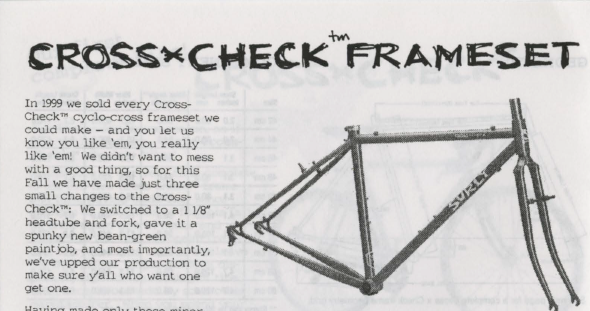
A snippet from a 2000 Surly catalog on the Cross Check.
Yesterday I saw reports that Surly Bikes had discontinued the long-running Cross Check model from its line up going forward. This cannot go unnoticed by myself, and I feel this bike deserves a few comments. It is, in my humble opinion, THE bike that helped launch the gravel cycling scene in the 2000's.

Originally the Cross Check was a bike meant to fulfill the market demand for an inexpensive bike to go ride in cyclo cross events. At that time, in the late 1990's, cyclo cross was seeing bigger numbers for events, and "bandit" cross racing was surging in popularity. The underground cyclo cross scene was a kindred spirit to the single speed scene in that both embraced the renegade stance against traditional sanctioned events. The Cross Check fit that scene as it embodied a "do-it-yourself" ethos and allowed the use of standardized parts so people who purchased the original run of frames in 1999 could "make it their own" out of whatever parts they could scrounge up. 

Single speed, geared, flat bar, drop bar, or whatever. The Surly offering was versatile and Surly found that demand was surprisingly high for the frame set. Taking cues from original Cross Check owners, Surly modified the Cross Check for 2000 slightly and, for the first time, offered a complete bike. The sales continued to be strong into the early 2000's.

From the beginnings of the "Modern Gravel Scene" here at T.I. v1 2005, the Cross Check has made its mark

That same renegade spirit and versatility in set-up served to make the Cross Check THE gravel bike of choice as the 2000's saw the dawn of what would become today's gravel scene. With bike choices ranging from 26" full suspension rigs to carbon fiber cross bikes, and back again to "rat-rod" gravel mutts, the Cross Check emerged as the gravel bike that could do it all. Single speed, 1X, multiple ring chain sets, drop or flat bar, the Cross Check was an inexpensive, durable, well-designed bike with the ability to be fitted with a wide range of current or vintage components. 

Craig Irving  (L) piloting his well-loved Cross Check in 2013 on a gravel group ride.

The reign of the Cross Check saw its zenith in the early twenty-teens as gravel cycling started to take off. By 2012, Salsa Cycles introduced the first purpose built gravel bike, and by 2014 other companies were jumping into the fray. The Cross Check's days of being probably the most common bike at many gravel events were numbered. 

Greg Gleason (L) and Walter Zitz, (R) on a Cross Check, winning the fastest ever Trans Iowa in 2016.

Still, the Cross Check remained a gravel cycling staple well into the late twenty-teens. However; the encroachment of disc brakes and riders who weren't brought up with the more renegade, underground ethos, which was a mainstay of the early gravel scene, saw the Cross Check getting passed by for more technologically advanced bikes. Turnkey gravel rigs which were lighter and designed more for rider comfort and endurance took center stage in the gravel bike stakes and consumers were smitten by the shiny, new bikes which were not anything like the Cross Check.

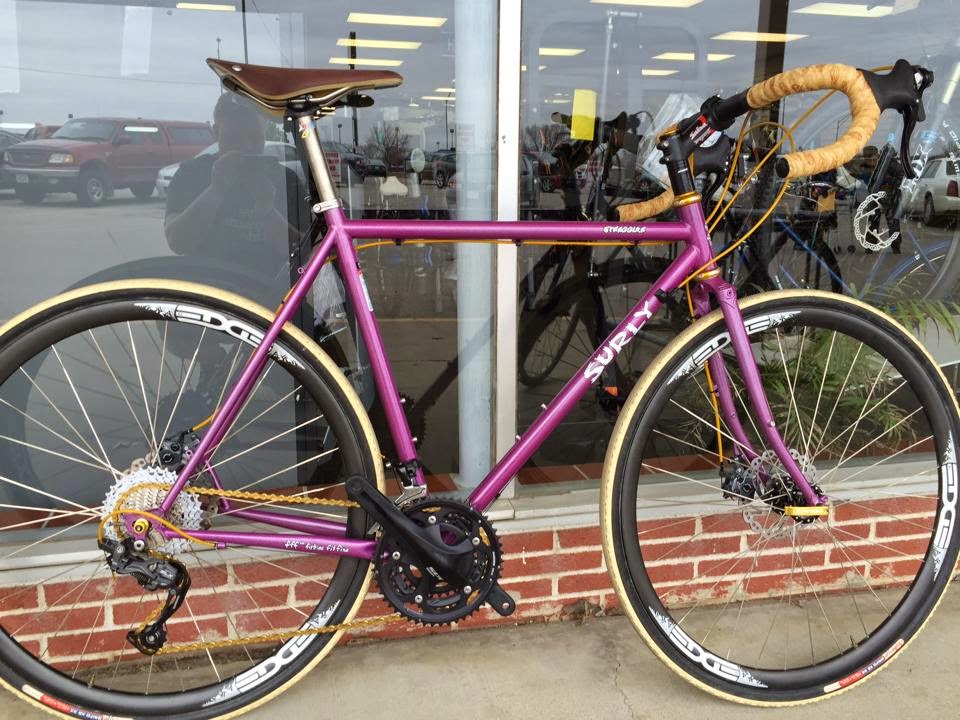
Should the Straggler have been the "Cross Check Disc" instead?

The Cross Check may have survived all of that, but instead of choosing to evolve the design, Surly came out with the disc brake standard Straggler in 2013. The bike that could have been the Cross Check Disc, but was not. Surly then confused matters even more with the introduction of the Bridge Club, the Midnight Special, and Preamble bikes. All bikes taking cues from the Cross Check, but none of which had that same versatility and "mojo" that the Cross Check had.

Meanwhile the Cross Check was left behind, staying largely as it had been since the year 2000. After a 24 year run, maybe it should not be surprising that Surly dropped the bike. Now that the model is no more, it is only fitting that we remember the contribution that the Surly Cross Check made in enhancing and furthering along the early gravel scene. Had there not been such an inexpensive, easy to set up, versatile and capable machine, it is not out of the realms of possibility that the gravel scene may not have been as quick to grow as it did. 

Surly put this out on social media Tuesday evening. Take from that what you will.

  So, it is time to take stock of what it was to the gravel cycling scene. The bike that once was sold as the renegade cross bike choice, or every-man's commuter rig, became the vehicle which drove gravel cycling toward its massive popularity. Showing that there was a market to be had for products specifically aimed at gravel riding, be that fast or slow. Thanks Surly and to you owners of Cross Checks, keep rolling on!

Saturday, September 09, 2023

The "All-Purpose" Bike vs "Gravel Bike"

Trek's new Domane AL-4 (Image courtesy of Trek Bikes)
Back around 2010 or so, I was banging the drum for a bicycle that could be used from pavement to nearly mountain biking. A bicycle that could be ridden comfortably and easily on any road surface, maybe even smooth dirt paths. Most importantly, it had to be a bicycle that was versatile, more universally acceptable than not, and that it should have the flared, short reach drop bars. 

This bike would need bigger, more voluminous tires than the then current standard of 25mm for road bikes and it had to eschew any hint of "racing" geometry. It had to have accessory mounting points like rack and fender mounts. 

Since that time things like disc brakes, tubeless tires, and fancy electronic shifting at decent price points has also crept on the radar for my "all-purpose" road bike. But the majority of the things I mentioned above were what drove my ideas for the bike I wanted to see. Ultimately a lot of that was realized in 2014 when the Raleigh Tamland Two came about. 

Certainly these ideas were spurred on by my personal desires, but perhaps what is less obvious to outsiders is that I was sick and tired, as a mechanic at a shop, of trying to make road racing bikes do what the "every-human" wanted those bikes to do. The average cyclist was not of the same mold as Pro racers, and as such, that sort of bicycle design, which reigned supreme for road riding, was not right for 99% of the population. Yet we had boat loads of Pro racing geometry road bikes coming at us every year. Sure, there were exceptions to that, but almost none of those exceptions fit my mold for an "all-purpose" bike, and those bicycles still didn't do what a lot of people wanted to do.

My Raleigh Tamland circa 2014

And then "Gravel™" happened. Suddenly there was an influx of rebadged cyclo cross bikes, and eventually, many companies started actually building purposed geometry into their "gravel bikes". But then the versatility, the "every-human" aspect of "gravel bikes", started to disappear. 

Now we have "race rockets" and bikes that cost 5k and up for riding "gravel". That's cool, but hey! Are you really going to commute to work, go to the post office, or pay your water bill using a seven thousand dollar blinged-out gravel bike? 

I mean, you can do that, but really. C'mon! Most of those bikes are garage queens between training rides and events. I'm talking about bikes that are reasonably priced, versatile, and can ride any road. The new Trek Domane AL-4 seems, in my opinion, to hit on a lot of my salient points here. 

This is maybe just one example of many types of bikes like this, but you just don't see a lot of people pushing a bike like this on review sites that are "gravel oriented". So, many people probably are not aware that bikes like these are out there for your "every-road" riding. 

I gotta say a few nice things about Trek here, which, to be honest, I usually don't have a whole lot of anything to say about this company. However; they position this bike remarkably well in their marketing. They are careful to not call it a "gravel bike", to their credit, and as most of you know, I feel "gravel bike" is a very regrettable name choice for this category of cycling. Secondly, Trek mostly got the geometry and versatility points correct. The Domane AL-4 even has a flared drop bar with short reach! (Okay, it's only 4° of flare, but it's something!) The bike fits up to a 38mm tire, which is pretty good for many gravel roads. Not ideal, but we are not talking about the "ideal" crushed rock road bike here. 

Trek sells the Domane AL-4 for 1700 bucks with a ten speed, full Shimano Tiagra group. That's perfect for the every-human's needs. Not too expensive, but a bike that could be your commuter and adventure/country bike on weekends easily. Not so dear that you'd not want to run errands on it, but good enough for every purpose most folks want a bicycle for. 

Yeah, you kickstand freaks will cry foul, but otherwise? THIS is what "gravel" bikes should have been.

Monday, July 10, 2023

Two Things

My custom Pofahl Signature bike
 Friday it was rainy for most of the day so I decided to work on the old Pofahl Signature custom bike I have. If you've been around here awhile, you know this bike. But if you are fairly new here, I'll hazard a brief introduction.

In 2007 I showed Ben Witt, then owner of Milltown Cycles in Faribault, Minnesota, a sketch I had made in the early 2000's of an idea I had for a frame for a 29" wheeled bike. Ben got excited about this, tweaked out the idea based upon my love of my 2003 Karate Monkey, and came up with this design based off my sketch. 

Ben then sent the BikeCad drawings to Mike Pofahl who brazed up the ChroMoly tubing into what you see here. This was always a dedicated single speed idea, so there are no cable stops for gearing. The bike was intended to be a flat bar bike and Ben Witt designed a killer looking handle bar and sent it off to Black Sheep in Colorado to have the design made for this bike in titanium. Well, that never happened because Black Sheep basically "ghosted" Ben and despite multiple attempts to contact them, Ben finally had to give up on the idea. 

Not too surprisingly, about a few months after Ben gave up on getting his design made by Black Sheep, the custom builder there made a handle bar eerily similar to Ben's renderings. But.....whatever. That's the story no one knew about this bike, and since it's been, what? Sixteen years ago? I figure the statute of limitations has expired on keeping back that story. So, I don't mind telling it here now. 

The bike as it appeared a year ago.

No matter, and back to today... I had been running the Pofahl with drop bars for years now and over the last few years it has been set up with a short, 50mm stem. I also had an ancient Bontrager Inform saddle on it. Well, I retired those two items for a bit longer stem and a different Bontrager saddle. That older Inform design used to accommodate me okay, but now I'm older and things have changed. 

The stem seemed to me to be a bit too short. I could have lived with the 50mm stem, but I thought something that might stretch me out a bit would be better. I found the perfect candidate while going through the stem stash. It was a Redshift Sports ShockStop stem with their "out front" GPS mount. 

While digging through the saddle stash, I found a saddle that seemed very similarly shaped to the newer Ergon Allroad saddle. I compared them and they are so close in shape and length to be nearly identical. Only the way the top was formed by the cover and padding was really any different, and in that it was a cushier saddle than the Ergon one is. 

And wouldn't you know? It's a WSD Bontrager saddle. A woman's saddle. Cool with me. And what about the changes? Well, they are good. I plan to do a country ride on the bike soon to verify this. 

Oh yeah....I swapped out top tube bags. So there's that as well! 

The "Guitar Ted Podcast" is back with one of the more popular topics concerning gravel riding - Dogs. 

We talk about that in context of our (N.Y. Roll and my) experiences and other things, of course. But the dog thing is probably the big draw here. 

One thing I didn't mention, and I hope to when we talk about dogs again on the show, is that there is a bit of "privilege" as a bigger male when dealing with dogs versus when you are diminutive or female, or both. Dogs can and will size you up, so my experiences with dogs might be tempered by that a bit. 

Take for instance the image I chose for the podcast episode tile. That was from a solo ride I did in 2017 in Kansas. The image was taken at the point which I had talked to these two dogs long enough that they were giving up being concerned anymore. I think maybe up to ten minutes was spent here.These dogs finally realized that (a) I wasn't a threat, and (b) I was a pretty large human that wasn't afraid and was not going to be easy to take down. Despite the fact of one being a huge Great Pyrenees and the other a slightly smaller breed of unknown to me origins. 

The other thing I forgot to mention is that if you are in a group, it's best to stick together when dealing with dogs. They know when they are outnumbered and will look for a straggler to pester. Yes, the old saw about outrunning your riding partner and leaving them to deal with the dog is partially true. 

Anyway, if you haven't already listened to this episode, it is about an hour long. Click here or go to your favorite podcast provider and look up "The Guitar Ted Podcast". Thanks to CORE4 for sponsoring this episode.

Two Things

My custom Pofahl Signature bike
 Friday it was rainy for most of the day so I decided to work on the old Pofahl Signature custom bike I have. If you've been around here awhile, you know this bike. But if you are fairly new here, I'll hazard a brief introduction.

In 2007 I showed Ben Witt, then owner of Milltown Cycles in Faribault, Minnesota, a sketch I had made in the early 2000's of an idea I had for a frame for a 29" wheeled bike. Ben got excited about this, tweaked out the idea based upon my love of my 2003 Karate Monkey, and came up with this design based off my sketch. 

Ben then sent the BikeCad drawings to Mike Pofahl who brazed up the ChroMoly tubing into what you see here. This was always a dedicated single speed idea, so there are no cable stops for gearing. The bike was intended to be a flat bar bike and Ben Witt designed a killer looking handle bar and sent it off to Black Sheep in Colorado to have the design made for this bike in titanium. Well, that never happened because Black Sheep basically "ghosted" Ben and despite multiple attempts to contact them, Ben finally had to give up on the idea. 

Not too surprisingly, about a few months after Ben gave up on getting his design made by Black Sheep, the custom builder there made a handle bar eerily similar to Ben's renderings. But.....whatever. That's the story no one knew about this bike, and since it's been, what? Sixteen years ago? I figure the statute of limitations has expired on keeping back that story. So, I don't mind telling it here now. 

The bike as it appeared a year ago.

No matter, and back to today... I had been running the Pofahl with drop bars for years now and over the last few years it has been set up with a short, 50mm stem. I also had an ancient Bontrager Inform saddle on it. Well, I retired those two items for a bit longer stem and a different Bontrager saddle. That older Inform design used to accommodate me okay, but now I'm older and things have changed. 

The stem seemed to me to be a bit too short. I could have lived with the 50mm stem, but I thought something that might stretch me out a bit would be better. I found the perfect candidate while going through the stem stash. It was a Redshift Sports ShockStop stem with their "out front" GPS mount. 

While digging through the saddle stash, I found a saddle that seemed very similarly shaped to the newer Ergon Allroad saddle. I compared them and they are so close in shape and length to be nearly identical. Only the way the top was formed by the cover and padding was really any different, and in that it was a cushier saddle than the Ergon one is. 

And wouldn't you know? It's a WSD Bontrager saddle. A woman's saddle. Cool with me. And what about the changes? Well, they are good. I plan to do a country ride on the bike soon to verify this. 

Oh yeah....I swapped out top tube bags. So there's that as well! 

The "Guitar Ted Podcast" is back with one of the more popular topics concerning gravel riding - Dogs. 

We talk about that in context of our (N.Y. Roll and my) experiences and other things, of course. But the dog thing is probably the big draw here. 

One thing I didn't mention, and I hope to when we talk about dogs again on the show, is that there is a bit of "privilege" as a bigger male when dealing with dogs versus when you are diminutive or female, or both. Dogs can and will size you up, so my experiences with dogs might be tempered by that a bit. 

Take for instance the image I chose for the podcast episode tile. That was from a solo ride I did in 2017 in Kansas. The image was taken at the point which I had talked to these two dogs long enough that they were giving up being concerned anymore. I think maybe up to ten minutes was spent here.These dogs finally realized that (a) I wasn't a threat, and (b) I was a pretty large human that wasn't afraid and was not going to be easy to take down. Despite the fact of one being a huge Great Pyrenees and the other a slightly smaller breed of unknown to me origins. 

The other thing I forgot to mention is that if you are in a group, it's best to stick together when dealing with dogs. They know when they are outnumbered and will look for a straggler to pester. Yes, the old saw about outrunning your riding partner and leaving them to deal with the dog is partially true. 

Anyway, if you haven't already listened to this episode, it is about an hour long. Click here or go to your favorite podcast provider and look up "The Guitar Ted Podcast". Thanks to CORE4 for sponsoring this episode.