Showing posts with label Surly. Show all posts

Friday, June 26, 2026

Friday News And Views

Image courtesy of Surly Bikes
 Okay....we're back with a regular FN&I. Finally! This week I'm kicking things off with some items which happened while I was away and reporting on BRAN. 

Surly Brings Back The Steamroller:

After a 23 year run starting in the year 2000, the Surly Steamroller was allowed to pass into the annals of Surly's archives. However, as of June 23rd, you can order a new Steamroller for a limited time. 

Surly didn't mess with the format too much. You still get track bike geometry and clearance for up to a 700 x 38mm tire, but the legal issues surrounding production of brakeless bikes has forced Surly to put cable stops on the frame for brakes. 

Surly says, "once they're gone, they're gone", so if the Anxious Lavender hue appeals to you and you always wanted a new Steamroller, well ya better get on it! $699.00 USD. (What?! Not $666.00?) 

Image courtesy of Thamus Bikes
The 32" Watch: Not Going Anywhere Soon

If you haven't noticed lately, 32" wheels are popping up everywhere. A 32" wheeled bike recently placed top three at a World Cup XC MTB event. Canyon is showing a radical 32"er at Eurobike with a weird, bi-plane handlebar. Esker Cycles is releasing its Lorax model with 32" wheels. Trek reportedly inadvertently showed a 32"er MTB racing bike in its latest documentary film. 

Meanwhile more small builders are producing 32" wheeled bikes for upcoming shows and for customers. 

As noted on these digital pages, we have seen prototype suspension forks for 32" wheels and as of now not many of those forks have shown up yet. This means more 32"ers are coming. (There may be a good reason for the no-show as of now. See below)

My prediction? Many of you readers will see a 32"er by this time next year near you, and many of you will have tried one.The 32"er isn't going anywhere soon, but this doesn't mean they are here to stay either. Think about how entrenched 26"ers were, or how many companies were jumping on 27.5"ers fifteen years ago. The 27.5"er is still hanging on, but I think it is obvious that it is a dead wheel size in gravel and nearly an obscure choice for MTB. The 32" wheel could find itself in a similar situation as these other wheel sizes five years from now. 

Gary Fisher's response to a BikeRumor post about the possible Trek 32"er in the video.
Or not. Time will tell. But I think it is safe to say 32" is an alternative choice which will soon be readily available to anyone soon. So, pretending it is an upcoming trend or curiosity is disingenuous now. So, no more "The 32" Watch" segments. I'll just report on these bikes as another choice from here on out.  

Image courtesy of Shimano

Shimano Keeps Mechanical Shifting Alive:

Shimano recently released news on their Deore and Deore XT level MTB components in a mechanical shifting format.  

XT now features a long cage or short cage rear derailleur in 12 speed for various sized cassettes or a LinkGlide 11 speed version. 

The rear derailleur is also advanced in its abilities to take on hits from trail debris. Manufactured to be able to be mounted on "modern hangars", the Deore XT rear derailleur can be used on any bike meant for derailleur drive trains. The rear pulleys are of a solid design which eliminates debris from catching in the pulleys and causing damage. 

 The rear derailleur now has a dual sprung design which Shimano says increases tension on the chain by 70% helping prevent chain drops and allowing for good shifts even on a worn cassette and chain. 

Deore features much the same upgrades as the XT version with less cost. 

Brakes were also addressed in this news where Shimano has now produced rotors with a 2.2mm thickness. This should provide more robust braking performance over a longer period of time than with the thinner rotors. This is especially critical with regard to modern e-MTB bikes.  

Comments: While SRAM continues to push proprietary electronic groups at least Shimano is keeping the versatility/mechanical shift crowd somewhat happy. XT stuff is impressive and with a mechanical 12 speed option now it should appeal to those who don't want to have batteries to charge or unfixable failures in the field due to software malfunctions. (Which have been reported on SRAM systems by some on social media). 

Image courtesy of Avinox
Avinox Shows Gearbox/E-Motor:

The days when a bicycle becomes more moto are coming sooner than not. The new Avinox E-Bike motor now showing at Eurobike is another step in the full-moto direction. The new motor/gear box eliminates the need for derailleurs and perhaps even traditional shifters. 

While Avinox would likely not agree with my assessment, one has to wonder is this  a step toward full-moto MTB's or is it not? Answering this question is subjective, perhaps, but elimination of key traditional bicycle components and adding more electronic controls and assists - to my way of thinking - is less "bicycle" and "more moto". 

Yes, you will still have to pedal the bike, however, it is getting easier and easier to do so, and at some point, we have to decide if pedals are just another way to have a throttle without having a throttle. 

At any rate, this new Avinox system eliminates the need for a derailleur and shifting can be programmed by the rider. Lots of MTB brands are jumping on this now, so it will be a thing soon out on the trails. See HERE for a list of manufacturers offering this motor and for more details. 

Cannondale Announces Factory MTB Team To Cease At End Of 2026:

Cannondale's Factory Race Teams have competed in MTB events for over three decades but will cease to be after the 2026 season concludes later this year. This according to a news release sent out to Cannondale dealers and the press on Wednesday. 

In its place, Cannondale will introduce a new "Rogues Program". This program will "... bring together professional racers, content creators, community leaders, and emerging voices - a roster larger and more varied than a traditional factory race team" according to Cannondale's release. 

Cannondale seeks to bring its rider experience to more everyday cyclists and to more events by having Rogue Program riders show up at events, group rides, and shops across the USA. Cannondale is also stating it will make a more concerted effort to bring demo rides and event activations to riders which they hope will put more riders on Cannondale bicycles to try them out, and buy them, of course. 

In the release Cannondale states that it still supports the EF cycling team and the women's St. Michaels program. 

Comments: Racing isn't selling bicycles, or so it would seem from this news release. Cannondale is taking a more direct to consumer approach in marketing using influencers, social media, and demo ride experiences instead.  

This will be embraced by the promoters of events as something like a Cannondale expo/demo adds value to their events. Shops also should benefit likewise. As riders, it is a boon to decision making as being able to actually ride a bike before buying is a big deal and should allay concerns over buying consumer direct where there is always that risk that the bike won't be quite what you expected. 

My take ultimately is that this could be a smart marketing decision if implemented correctly. And if it does pan out for Cannondale, look for other brands to follow suit. This should be interesting, but we will have to wait until 2027 to see if it flies or if it dies.  

Hey, Thanks Folks!

A special "thank you" to all who read through the BRAN coverage recently. I was quite amazed by the amount of readers who checked in during the week of BRAN and the week afterward when I did the ride recap. 

I even received advice on how to get my Wahoo ELEMNT ROAM to behave which made the remainder of the week a lot better. So, I really do appreciate those of you who have read the blog and give your feedback on it. 

You never know how odd things like BRAN are going to be received by the audience out there and I was a bit concerned how that would all go over with you all. Apparently it was a good thing. I don't know if I will ever get another opportunity like that, so I had to take it and I am very happy I did on several fronts. 

Thanks again and now it is time to get out there and ride those bicycles! 

Friday, February 20, 2026

Friday News And Views

US Patent Office image of SRAM UBM
SRAM Universal Brake Mount:

SRAM, who promoted the UDH derailleur mount, which is being widely adopted now, has patented a new MTB brake mount called Universal Brake Mount. 

The patent was granted last year, and the idea was discussed a bit in certain circles of the bike industry, but now it is seemingly gaining some traction in mentions of a near future adoption by the industry. 

The mount centers the brake mount from the axle, and everything references off this point instead of being a jig for each frame, or a different set of parameters to be used. This does make the mount dependent on an attachment point on the seat stay. 

Obviously, this idea would be a bit more difficult if we were still in a quick release world. However; since through axles are ubiquitous on MTB, road, and gravel bikes now, this idea makes sense. Obviously, this is a post mount brake standard, but perhaps a flat mount standard could be developed as well. 

I can see how the design would require extra beef on seat stays and how it might limit some full suspension designs, or designs which employ seat stays as flexing members for comfort. So, I do not believe this is a "universal" solution for everyone, but I also see how manufacturing frames would be easier and more streamlined by using this standard. Saving factories and brands more money will be the motivation for adopting this. 

Image courtesy of Zirbel Bike social media

Zirbel Bike Offers "Electronic Grip Shift" Type Shifters

Grip Shift - Remember that? It was largely forgotten after SRAM moved off of doing mechanical flat bar shifters with the introduction of AXS. 

But a company called Zirbel Bike  has adapted a wireless twist ring style shifter reminiscent of Grip Shift to operate a SRAM AXS/Transmission rear derailleur.  

They also make a trigger style ring which has minimal mass and takes up little handlebar space. The trigger can be easily operated by a thumb.  

Some riders preferred a twist style shifter due to hand issues which make using triggers painful or difficult. This Zirbel product could be a solution then for such individuals. 

Prices look to be reasonable and the shifters can be purchased as a unit complete with flat bar and stem for a mountain bike.  

Comments: Now that I've seen this, it seems odd SRAM did not attempt to go in a similar direction with AXS for MTB/flat bars. The product Zirbel offers takes up little space which is a big deal now with MTB cockpits having dropper levers and shock lockouts competing with brake levers and shifters for space on handlebars.  

Image courtesy of Jay Petervary's social media.
IDITAROD Trail Race Sunday:

One of the older ultra-distance bicycle events in North America is set to occur this Sunday. The IDITAROD Trail Invitational will send off its riders on Sunday. 

I grabbed this image of Jay Petervary's fat bike set up from his social media to show just how far things have come in bicycle design for this event. It seems a longer wheel base, slacker front end, and different width rims are the hot set-up in 2026. 

Obviously a credit to materials technology and its application to fat bike components has to be recognized here. Without carbon rims, carbon components, and lighter weight, titanium tubing a machine like this would have weighed a silly amount 20 years ago. 

I would also think recent developments in tire set ups are making machines like this even more capable. I asked Jay about the wheels here. The tires are the same but the rims are different. I find it interesting that Jay is using differing rim sizes. The rear is 105mm wide and the front is a whopping 128mm wide. This gives the tires a truly different shape and, I would imagine, a different type of performance on snowy trails.  I don't know what the thinking he has is on this is, but I would be interested to hear is take on this idea. 

What do you think of Jay's bike set-up? Let me know in the comments. 

Image courtesy of fizik
The Arione Is Back!

Almost 20 years ago fizik introduced a very long, flat, kind of tear-dropped shaped saddle which was so different you could identify the model from a distance easily. It was the fizik Arione, a saddle which pushed the limits of UCI regulations, and which many riders grew to love for its allowance for several comfortable positions across its length. 

Now the Arione is back, and it has some features which are unique. The length has been trimmed back from the original's nearly aircraft carrier deck length to a more modern length. Not surprising there. However; the flat profile remains, as does the "boat-tail" rear extension. 

Of course, there are 3D printed covers, (shown) and there are more traditional covers available as well. The range features  rail choices, from carbon to fizik's "Kium" hollow alloy rails, and the S-Alloy rails. . Top range models get the Adaptive padding while there are EVA and PU foam padded models when you move down the range, which is reflected in the price. 

Image courtesy of fizik

Interestingly, fizik addresses how many racers want there saddles positioned as forward as possible in relation to the bottom bracket by attaching the rear of the rails to the saddle base in a unique way. This allows for a very forward saddle placement which is not available in any other saddle model I am aware of currently. 

Times have certainly changed! I recall a day when we could not get our saddles far enough back on a seat post. So, this is an interesting development in saddles and rider fit. 

Arione R 5 (Image courtesy of fziik)
The Arione is available in available in five models. The top of the range features the Arione R1 Adaptive with carbon rails. The Arione Adaptive R1 Light has EVA padding instead of a 3D printed cover. This model also features an ergonomic cutaway central channel for pressure relief. Next we have the Arione R3 Adaptive which has the same 3D printed cover as the R1 but has Kium alloy hollow rails. 

Then we move to the Arione R3 and R5 models which have the PU foam padding and differ mostly in the rail choice with the R3 having the hollow Kium alloy and the R5 having the S-Alloy rail. 

Prices range from $399.00 for the range topping Arione R1 Adaptive to $99.99 for the Arione R5. All saddles come in two widths - 145mm or a narrower 135mm. 

For more details see fizik's site HERE

Life Time Announces Wildcard Rosters

Last year the Life Time Grand prix announced a "wildcard" category which allowed racers who qualified to enter into the opener for the series, and any man or woman in the top three placings for either category would get on the Wildcard chance at Unbound to possibly race their way into the Grand Prix series. In fact, the Grand Prix Men's overall winner, Cameron Jones, came out of the Wildcard category. 

A press release received Thursday here at Guitar Ted Productions lines out the rosters for possible Wildcard entrants. There are 27 women on that side of the roster. Notably in this roster I see Haley Smith, former Canadian Olympian and Grand Prix rider. 

On the Men's side there are 59 individuals listed with several notable names in the running. Russel Finsterwald, Dylan Johnson, and Adam Roberge being but a few of the names listed . 

My reading of the press release may be off, but as I understand this, the rosters listed must race Sea Otter where the top three in Men's and Women's categories from the WildCard rosters can then compete in Unbound and then whomever is the best of the three in each category there will be added to the Grand Prix riders. 

Again- apologies if I have this wrong but the press release wasn't 100% clear to me on these points. 

So, the bigger question is, does any of this matter to you? (I already know what N.Y. Roll will say!)

Image courtesy of Surly Bikes
 

 Disc Trucker Update:

Surly released an updated Disc Trucker complete and frame set available now through your Surly dealer. As before, smaller sizes are available in 26" wheels and 56cm and up is 700c. 

The Disc Trucker is an amalgamation of old touring bikes and new technology/components. You've got that steel frame, a spoke holder, rack mounts galore, fender mounts, and good ol' touring bike geometry. 

Modernization come in the form of tubeless ready tires, disc brakes, and through axles. Honestly, all good things. 

Gotta give a shout out to the externally routed cables and dynamo routed fork. There is a nice, upright seated position here also, which is great for long, all-day riding. 

Touring nerds will probably sniff at the 2X crank set with 46T/30T gearing. Not that it doesn't provide a low enough gear with a 39T low gear in the cassette, but because you don't get that nice "transition" range with, say a 36T middle ring. Ah! ..............But triples are too confusing. Hmm..... Okay. I believe cycling is a skill set. This stuff can be learned. But I digress.... 

And did you notice you could put a set of down tube shifters on this frame? Now that is old school right there! Ha ha! Also of note: 36 spoke wheels. Nice! 

That is going to wrap things up for this week here at Guitar Ted Productions. Thank you for reading here and please, get outside and ride a bicycle this weekend!

Tuesday, September 30, 2025

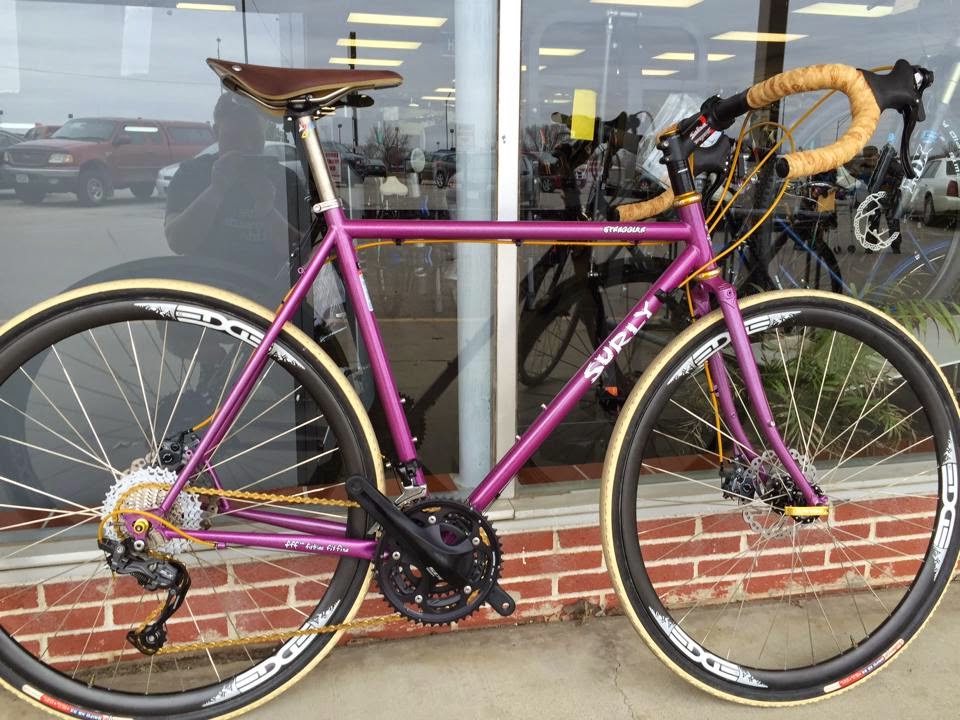
Let's Talk About The New Surly Straggler

Image courtesy of Surly Bikes
 Last week a new version of the Surly Straggler was released. It had been quite some time since the Straggler was released originally, so it was long overdue for an update. This is also one of the issues with the new version, ironically. 

When the Straggler was set to be released originally I was onboard at "Twentynine Inches", the website which covered 29"ers from 2005 until 2015. I was in attendance at the 2013 Outdoor Demo for Interbike, the former big-time bicycle show once held in Las Vegas, Nevada. This was where I met and rode the Straggler. 

The bike, to my mind, should have been called the Disc Crosscheck, which would have followed what Surly had done with the Long Haul Trucker/Disc Trucker models. But anyway..... Straggler it was. My intial take on the bike was that it was heavy and the rear drop outs looked clunky. As with all Surly bikes up to that point, it was single speed capable, so this was the reason for the weird rear drop outs. Okay....moving on.  

Wait! Is that a Vaya? No! It's a Surly Straggler in "Shaggy Carpet" (Image courtesy of Surly Bikes)

 Of course, in 2013/14 there weren't many choices yet for gravel bikes, and I knew the Raleigh Tamland was also debuting in 2014. There was no doubt in my mind which was the better of the two for gravel, and the Raleigh ended up in my clutches for this and other reasons some of you long-time readers know all about. But this is another story.... 

There were a few things about the original Straggler which  were missed opportunities, but again - It was 2013, and gravel bikes weren't an established category then. In a few years this would be a different story, but Surly chose not to direct any efforts into the Straggler. Maybe the brand had sunk resources into other projects, and could not afford a redesign of the Straggler at that point in time. Maybe Surly has something against the whole "gravel" thing. It is notable that Surly does not have any gravel category listed on their site for its bicycles. (Although it recommends the Straggler for gravel on its page for the model) Whatever the case may be, the Straggler probably should have been redesigned five years ago, at minimum, and it would have been really good had they done it in the 2017 - 2019 window when gravel went bananas. 

A first generation Straggler I built up for "Duluth Dave" many years ago. 

 So, back to 2025 and the current Straggler. This newest version of the model has no single speed capabilities native to the design. This has been pointed to as another issue with the current version of Surly Bikes which built its reputation upon the ethos of single speed biking. Yes, this is pretty much just another example of brand identity being purged. 

One can pass off the single speed thing as being unnecessary and say it makes the Surlys of the past overly-complicated, but brand identity does help with perceptions. When you abandon something which made your reputation and made your brand unique, well it means something. Usually something not good.  

So, when I saw the new Straggler I was not very impressed. Honestly, it looks like a poorer version of the Salsa Vaya. A bicycle which was axed from Salsa's line earlier in this year. So, a not very impressive "update" in my mind, and certainly not very "Surly Bikes" of them when you consider Surly's past reputation. 

Those are my thoughts, but what do you think? Could Surly have done something truly remarkable and kept the single speed thing?  Am I just not understanding what has happened here? Let me know in the comments. 

And as always, thank you for reading Guitar Ted Productions, (if you are actually human).  

Wednesday, September 24, 2025

Are Fat Bikes Dead?

Text from N.Y. Roll
Ten years ago it was fat bike utopia. Everyone had jumped on the fat bike hype-train. Maybe you do not remember those days. I do, and those were heady times in the world of fat bikes. 

Remember these fat bikes? The Raleigh Rumson. Or how about the Fuji Wendigo? No? Well, how about the Heller Bloodhound, or the Jamis Roughneck? Surely you recall the Fat Cad with the Lefty fork and the Coast Bikes full suspension fat bike, don't you? 

Hmm.....all bikes gone by the wayside these days. Fat bikes fell off a cliff in terms of sales by the late twenty-teens, and by the pandemic they were nearly relegated to only the long time brands in the space like Salsa Cycles, Surly, and Fatback Bikes. Most brands who had jumped in around 2014 - 2015 were out of the game by 2020. 

Now fat bikes are pretty much gone from the performance/human powered cycling space. But they are thriving for the brands which attach motors to frames which can handle big, corpulent tires. Since little regard has to be given to weight when motors are involved, these fat bikes are heavy. Since they dominate the market, manufacturers are trending toward making stuff for them. Not so much for the human powered fat bikers. 

Try finding a variety of 26" x 4.0 tires with tubeless ready casings and fast tread design. You'll run into exactly what I mean. Lots of wire bead, heavy, non-tubeless e-bike fare. The market for those 26"er fat bikes that can handle around a 4" tire is getting pretty thin. 

Bring back the Black Floyd!

Only half kidding there. But anyway, fat bikes are not dead as in "not around anymore", but their development is non-existent. I mean, how many seasons has Salsa trotted out the exact same bikes as the year before donned in a different color? Same with Surly. 

In this sense, fat bikes are 'dead'. At least you can still get a 100% human powered one. 

Friday, July 11, 2025

Friday News And Views

 Note: This edition of the "FN&V" will be a bit of a 'catching up' due to not having a FN&V last week. Some of the 'news' will be a bit older than usual as a result..

A view of the inner workings of an Ochain unit (Image courtesy of Ochain)
Last week SRAM announced the acquisition of MTB component maker, Ochain. The company is well-established in the down hill and enduro circuits. Their claim to fame is a device which decouples the direct interface between a chain ring and chain. The Ochain device allows for a certain degree of rotation of the chain ring without the crank moving, thus allowing full-suspension bikes to achieve a more efficient and 'chain free' operation.

Ochain is a device which solves the age-old problem of suspension 'kick-back' and makes suspension work 'freer' due to the decoupling aspect. SRAM claims the Ochain device results in a 'calmer and quieter' bike.

Comments: SRAM has, in the past, filed various patents on chain ring design to address various aspects of 1X drive trains and suspension use. None of which, to my knowledge, have come to see the light of day....yet. However; it is interesting to note SRAM's history of innovation by acquisition. Ochain being the latest brand to be acquired by SRAM. Many people forget SRAM bought brands like Rock Shox, Sachs, (thus bringing chains into their catalog), and TIME (for pedals), along with Hammerhead for GPS/controller duties.

I doubt SRAM will sit with Ochain only being used for MTB and full-sus e-Bikes. I look for some sort of further development to make this acquisition more versatile. Just what may come of this should be interesting. 

Image courtesy of Wheels MFG.

Wheels MFG Announces New Single Speed Kit For Hyperglide:

Wheels Manufacturing announced last week that their Solo Cog single speed kit will be available for Shimano HG style free hubs on August 22nd, 2025. The SOLO HG Single Speed Kit will be available in various anodized colors. This kit will have several spacers for centering your cog, or Wheels MFG Solo Cogs, which will be sold separately.

Both the kit and the cogs are machined from aluminum. The spacers are from 6061 aluminum and the cogs from 7075 series aluminum. The spacer kit, which comes with a color-matched lock ring, goes for $51.9 USD.

The Solo Cogs come in 16T, 18T, and 20T for now with more sizes promised. These cogs are going for $46.99 each USD. 

Comments: At $99.00 for the full set of spacers, lock ring, and cog, this is not a "cheap" option. (You can get a Surly spacer kit and cog for around $75.00 - $80.00), but it is in line with others I can find in aluminum and anodized hues. 

Image courtesy of Ortlieb
Ortlieb Announces New "Quick Rack" System:

If you have a bike which you'd like to have a rack on, but only occasionally, or a bike that doesn't have rack mounts, you might want to check out Ortlieb's new Quick Rack. 

This rack attaches via a unique collar and axle attachment design, (please click the link for details) and Ortlieb claims this can be installed in fifteen seconds. So, an applicable solution for anyone who may need a rack at a moments notice.

With a load capacity of 44lbs, and ability to accept any of Ortlieb's bags for rear racks, this seems like a pretty cool way to add some versatility to a bike you use for any mission.

The Quick Rack sells for $130.00 USD.

Comments: At first I thought this rack attached with an ordinary alloy type seat post collar, but it is not anything like this. (Again, check Ortlieb's site for details) I'm in a situation where I do not have to rely on one or two bicycles for everything, but, if I were in this sort of situation, the Quick rack might come in pretty handy.

I cannot vouch for the incredible quick change out time, but even if it took three times as long, it would be a pretty easy to consider swap, in my opinion. The only other curious thought I have here is if this would be a steady enough platform to rely upon for commutes, or errands, or even touring.

Rough Stuff MTB Rally:

Wilde Bicycle Company is sponsoring the Rough Stuff Rally August 1 -3, 2025 at Copper Harbor, Michigan. Jeffrey Frane, of Wilde Bicycle Company has this to say about the festival:

 "The Rally is two days of riding, revelry, and community on some of the best trails in the world. Friday we have shuttle runs from 4-8pm accessing legendary trails such as The Flow, Danimal, and Overflow followed by a bluff top sunset Happy Hour. Saturday is the main event, a 22 or 43mile loop of the trail system taking in a highlight reel of singletrack followed by a gourmet dinner at the Campground hosted by Chef Adam Blake with bonfire, music and free refreshments from Fat Tire to follow." 

Interested? Registration is open now and you can join in for $120.00. by checking in HERE. Entry gets you free shuttle service on Friday, an event t-shirt, an stocked aid station on Saturday, the free meal, and free refreshments Friday night and Saturday night. 

A schedule of events for the Rally can be found HERE. 

Image courtesy of Surly Bikes.
Surly Shows Updated Ogre:

Surly Bikes showed on Thursday an update to their Ogre 29" inch wheeled commuter/bike packing bike. With tire clearance for 29" X 2.5" tires, or 27.5" X 2.8" tires (with fenders!!), this bike could be a very versatile bike in a person's bike stable. Or it easily could be your only bike.

As one might expect from Surly, the Ogre has a plethora of mounts, is Rohloff compatible, and has a mount for Surly's own Bill or Ted trailer. This version of the Ogre is in a hue Surly calls "Orlock's Shadow". Se mor about the Ogre and other surly products by clicking the link HERE. 

Comments: The Ogre has, in my opinion, "old school" 29"er geometry. If it looks like the front end has been pushed in, this is because the Ogre has a 72° head tube angle, which most 29"er's haven't used for well over a decade now. Not that this is "bad", but it is unique now in 2025. 

This Ogre reminds me a lot of what a modernized version of my 2003 Karate Monkey would maybe look like. It even is close to the same color, which is Campstove Green. So, the comparison is easier for me to make, I suppose. 
 

Thanks for reading Guitar Ted Productions! NOTE: A press release from Pinarello will be featured at 7;30am CST today here. Stay tuned...

Tuesday, October 29, 2024

Three Major Players: 25 Years Of 29"ers

Yesterday I wrote about "The Tire" and wheel diameter as it relates to 29"ers and off-road bicycling.  Today I wanted to highlight three major players in the early 29"er movement that, I believe, without whom the 29"er was doomed to the dust heap. 

The Karate Monkey by Surly as shown at the 2002 Interbike show. (Image courtesy of Surly Bikes)

The Karate Monkey:

In my opinion the Surly Karate Monkey was probably the most influential 29"er ever made. One, because it was the first, widely available, affordable 29"er option that was well thought out. This design was so well done that it inspired a slew of other 29"er models in its wake, not to mention a bunch of custom builders as well who were brazing and welding up new 29"er frames as fast as they could. 

However; the affordability provided by the Karate Monkey maybe was the biggest influence here. One could buy a frame and fork, then pull together the rest of the build from inexpensive parts, parts bin finds, or in whatever way one desired. This provided the 29"er curious an avenue to try bigger wheels before they were forced into plunking down big money for a rare bike shop model or custom build. 

Because Surly built their reputation on versatility, single speed capability, and value to the customer, there perhaps was no better company suited to "evangelizing" the 29"er. You could go a hundred different directions with your build, which was probably another part of why this bike caught on as quickly as it did and was responsible for many converts to big wheels in the early 2000's. 

Niner Bikes was solely focused on 29"ers in 2005. (Image courtesy of Niner Bikes)

The Big Revolution - Niner Bikes:

In late 2004 an advertising banner appeared on the 29"er forum at mtbr.com ballyhooing a new company no one had ever heard of before called Niner Bikes. All it said was "The Big Revolution". No bike was shown. The previous banner for the forum was from a small custom builder called WaltWorks, a builder that had been an early champion of big wheels off road. 

This stirred up a lot of interest and speculation. Was this new imposter really behind 29'ers, or was someone just trying to make a buck on a new trend? Such was the sentiment of many 29"er fans back in the day, earning all of the 29"er crowd the derogatory "29"er zealots" tag from the rest of the MTB community. 

But Chris Sugai and Steve Domahidy were dead serious about this venture. They bankrolled their future success on the big wheels and never looked back. This eventually had a major impact on the 29"er community. By the way, I interviewed both Chris and Steve from Niner Bikes at the time in this "Ted-terview" from 2006.

Niner pushed the boundaries of what 29"ers were capable of from being just a niche, single speed bike to full-on 29"er down hill type rigs. Niner was so confident that 29"ers would eventually be the first choice for wheel size amongst off-roaders that Chris Sugai made the bold statement that 26"ers would be extinct in the near future. 

The bold, forward-thinking direction that Chris and Steve had for 29"ers was a major influence on the cycling industry and showed riders that no off-road discipline was off limits for 29 inch wheels. "Big Revolution" indeed! And what of Chris Sugai's bold prediction? 

You tell me where all the 26"ers are in 2024. 

A titanium Gary Fisher prototype circa 2000. (Image courtesy of Trek Bicycles)

 From The Godfather of Mountain Biking - Gary Fisher Bikes:

Of course, no discussion of this type can be had without the mention of the importance of Gary Fisher and his namesake company. Gary Fisher is also one of those important figures in mountain biking and his influence came to bear behind the scenes in the late 1990's which was critical in the push to get a true 2" wide 29"er tire. Fisher, himself a racer at the time, was interested in how such a larger diameter tire could be utilized to gain an advantage in racing, specifically XC MTB racing. 

Even after "The Tire" was made, Fisher's effervescent personality and endless energy came to bear on Trek, the parent company, and he was convincing enough that by 2002 Gary Fisher Bicycles had a 29"er MTB in their line up. Keeping the foot in the gas, Fisher convinced team racers to try a 29"er, and by the mid 2000's he saw results as Jeremy Horgan-Kobelski became the first successful 29"er XC racer. More results followed and other brands, teams, and athletes began to take notice. By the time the 2000's came to a close, XC MTB racing was starting to see many more 29"ers on the start lines. This all thanks to Gary Fisher's inestimable influence on big wheels. 

On the retail side the road was bumpy, but Trek stuck behind the 29"er and with the coup Trek pulled by getting Rock Shox to give Fisher Bikes the exclusive on the Reba 29"er fork for a year, sales skyrocketed. Soon 29"ers were outselling 26 inch MTB's at Fisher Bikes, and again, brands were taking note. By the close of the decade you could more easily count those companies who were not offering a 29"er than you could count those who were offering 29"ers. 

Perhaps even less known than all of the above was Fisher's influence on women and 29"er acceptance. By offering 29 inch wheeled MTB's to the woman's team, Fisher encouraged the switch to women riding on 29"ers in races all throughout the world. This very thought, that shorter people could ride 29"ers effectively, was a major criticism of big wheels in the 2000's and this eventually was blown away as well by the late twenty-teens. 

Sadly, Trek folded the Fisher brand into its Trek brand in 2010 by saying "The Gary Fisher Collection" will give Trek retailers acces to a unique product line up of 29"ers". In reality the Fisher brand name disappeared and the legacy of Gary Fisher was hidden from view afterward. Whether Trek honestly believed its own marketing hype, or if it was a veiled attempt at killing off the Fisher brand, I don't know. But in my opinion, it is a travesty on Trek's part that they have erased the Fisher brand from the consciousness of the mountain biking public. 

In Closing: All three of these brands built their legacy in 29"ers off the introduction of the 29" WTB Nanoraptor 25 years ago. Had that tire not happened, and it nearly did not, the landscape of MTB would look radically different today. 

Next: Why "The Tire" Matters Today

Monday, September 30, 2024

Two Things

Last delivery of the year.
 Community Service:

This "Two Things" has a common thread. That being the Cedar Valley Bicycle Collective where I work these days. 

Last week I delivered the last supplies for the year from our vendor who had my order dropped shipped to the local UPS Store, which is several miles away from the shop. 

While I haven't been there in a few months, the UPS Store employees have gotten to know me and I would wager that is due to my chosen mode of transportation. There probably are not too many cargo bike riders going there to make a pick-up. I always get the side-eye glances and I'm sure many folks think I'm 'stupid' or worse. Once in awhile I get a compliment, and I did on this last run of 2024.

A middle-aged looking lady, who did not look at all like a typical cyclist, saw me run my boxes out and said, "I wondered who had the cargo bike. Cool bike!" I thanked her and went on my way. As I lashed the boxes to the bike, I thought about how rare that interaction is likely to be in Waterloo, Iowa and I smiled as I savored that one. I bet it will be awhile before I hear anything like that again. 

Usually, if anyone dares to say anything, it is more like, "Are you sure that bike can handle that?", or "Ya need a motor on that thing!". When that happens I just smile and nod politely while I'm doing my 'internal eye roll' and thinking that these folks would probably be amazed by eBikes.

Last Thursday I had to hoof it down to the Collective by 7:15 am to let in a group of six John Deere engineers who were volunteering through a program John Deere encourages their employees to get involved in. John Deere wants their employees to volunteer at non-profit organizations that benefit their local community. So, since the Collective is a non-profit, we qualify to host some of the employees throughout the year to help us do our work. 

Typically this is a "tear-down day" where I have the volunteers take bikes down to bare frames and forks. The parts are then sorted into bins and later on I sort those and save what we need to use as a source for rebuilding donated bikes, and in a secondary need, as parts for people trying to build up used bikes that cannot afford bike shop's new part prices. 

I hosted six fellows and in four hours they tore down around 30 bikes and several wheels as well. That'll keep me busy for quite some time! But this program helps us out tremendously at the Collective with being able to process bikes through more efficiently and allows us to continue to help needy people in the community with transportation needs, as well as helping with kid's programs and educational programs. 

Late 1980's vintage Shimano bottom bracket

Old Technology Rears Its Head:

Another thing that happens at the Collective from time to time is what I call "a blast from the past". Something on a bicycle that gets donated that I once knew about but had forgotten until it shows up in the Collective. 

One such thing occurred last week when my co-worker Carl was puzzled by an odd looking bottom bracket in a bicycle he was working on. It looked like a typical cartridge bottom bracket but the plastic cup was on the wrong side. I didn't even have to look at it to know what this was going to be. I was instantly reminded of early Shimano cartridge bottom brackets. 

Now, I may be wrong, but I think these were Shimano's first efforts at a cartridge bottom bracket. At least in the form-factor we know them as today. The main difference being that the steel cup which was attached to the cartridge was on the non-drive side instead of the drive side, which only lasted for a short time before Shimano flip-flopped the cups to what we all know today.  

Also back then, these were adjustable and rebuildable cartridge bottom brackets. I assume Shimano did this to appease the "old ways" and sway mechanics into accepting these new designs. Again, it did not take long for Shimano to abandon this first version of the cartridge bottom bracket for their well known sealed, non-serviceable type. 

I pulled the rubber seal off one end of this bottom bracket to show the ball bearings. The non-drive side has an actual jamb nut and adjusting nut set up, much like a wheel might have, in classic Shimano style. I actually have a Park tool to adjust these with that has followed me to every stop along my mechanic journey since my first shop job in 1993. 

By the way, as I recall, these bottom brackets were already out of the catalog by the time I started wrenching. So, those drive side, left hand threaded plastic cups were like gold! I saved every one I could because they were the weak link in those early cartridge bottom brackets as they were prone to breaking under high-stress pedaling. 

Anyway, it was fun to come across one of those old dinosaurs. Of course, I saved it. I plan on trying to service it later this Winter.

Friday, September 06, 2024

Friday News And Views

The new Surly Moonlander (Image found on various Internet sites)
A 'Fat' Friday News And Views

Surly's New Fat Bike:

Last week I found an image of an information card featuring a 24" X 6.2" wheel and tire combo called the Clown Royal and Molenda respectively. I posted the image I found on "X" (Twitter) and then was contacted via Facebook messenger about the wheel/tire combo and I was told the wheel and tire combo was real. It was coming on a new Surly fat bike to be introduced in about a month. Guess a 'month' was a few 'days' in reality!

Tuesday I found a Bike Radar story featuring the same and this bike is the new Moonlander which has a Pinion gearbox. The bike features the 9 speed Pinion gearbox located where the bottom bracket on a typical frame would be. This 9 speed gearbox allows for a single speed external, 1 to 1 ratio drive train set up. (Other sizes for the drive ring could be utilized as well) The bike does not have wider axle or bottom bracket standards (with a twist, you'll learn in a bit) and can also accept 26" X 5.1" tires, 27.5" X 4.8", or 29" X 3.0" tires. 

Image first posted by fatbike.com

Surly went with a compact triangle on this bike eschewing the huge frame bag idea in favor of a bike that can be mounted and dismounted more easily.  The bottom bracket is high to allow for more clearance over uneven or deep terrain. The rear end is extended to better center the rider's weight over both tires. This is a flotation bike, of course, so that all makes 100% sense. Perhaps more surprising than the wheels is that the front axle is also spaced at 197mm like the rear end.

There is a bunch of accessory mounts, as one might expect, and the bike comes in four sizes, Small, Medium, Large, and XL. The bike is priced at $4,199.99 and there is only one spec level. Steel frame, natch! There is a rack sold separately that fits this bike.

(L-R) Molenda and Bud.  Image courtesy of Surly

Comments: Wow! This is likely the most unexpected fat bike innovation yet. People have been dreaming of super-fat tires for years. Is this the way to go? While I have not seen all the dimensions given for this wheel, the overall diameter is  31" (according to this detailed and fair review by Neil Beltchenko on Bikepacking.com) Surly couldn't have used 26" or larger diameter compatible wheels because the weight and the height of those wheels would have limited the bike's appeal and fit for smaller folks. Besides, when it comes to flotation, contact patch is what it all is about. 

And that really is what this bike is all about - Flotation. Unless you are trying to ride deep sand, loose snow, or mud, (or other unrideable loose, deep grounds), this bike is not going to be all that fun to ride. (See linked review above for confirmation of this) I suppose you could build up a wheel set with 29 X 3's, but why? That kind of defeats the whole idea behind this bike, which is to go where no other bike can go. That Pinion box and single speed drive train set up add to the off limits versatility. That said, you have a rear derailleur hangar there as well.

Cool rig. Expensive, but probably not out of line seeing that these tires and wheels have to be pretty expensive on their own due to low production numbers. That and the gearbox drive the price on this. I don't need it as I have my flotation covered with the Blackborow DS and it's 4.8" tires (although I could put 5.1"ers on it). Also, did Neil say the bike he reviewed had TPU tubes in it? What?!!

Image courtesy of Salsa Cycles

Salsa Shows New Colors/Spec For 2024/25 Fat Bikes:

Salsa Cycles showed a pared down offering of fat bikes for 2024/2025 in their Beargrease and Heyday ranges. (Heyday used to be Mukluk)

Both the Beargrease and Heyday are now only available in two specs and colors. There are frame/fork only options as well. Heyday is a 26" wheeled bike and the Beargrease is optimized for 27.5" fat bike wheels. 

Image courtesy of Salsa Cycles

Comments: The interesting thing here is the usage of Shimano CUES on one spec level each for Beargrease and Heyday. CUES, as you might recall, is Shimano's new system for drive trains from 9 speed to 11 speed with all components swappable. CUES does have its own pull ratio in the shifters and cassette spacing is different so it cannot be mixed and matched with other current Shimano groups. 

While Salsa did not provide pricing at the release of this information it is assumed that CUES is a more budget friendly drive train, so the interest is high in it. However; there are some claims by mechanics that the quality level is somewhat concerning. So, it will be interesting to see how this goes over on a fat bike with a carbon fiber frame and fork. 

Image courtesy of CUBE Bikes

Shimano CUES To Come To Drop Bar Bikes In 2025:

Speaking of CUES, it was revealed on Wednesday that CUBE, a European brand, has a bike for 2025 showing CUES drop bar levers. The bike, called the Nuroad Pro, comes in at $1,325.00 in US dollars at current exchange rates. 

Comments: This is a big deal for budget bikes and people who are looking for super-wide range gearing on drop bar bikes outside of SRAM and the lesser component makers. That is because CUES drop bar levers (Shimano part #ST-U6030) will be using the same cable pull ratio as CUES flat bar levers making all Shimano CUES rear derailleurs and cassettes fair game to use with these drop bar levers. Looking at CUBE's renderings, it appears that the CUES left lever can operate a front derailleur as well. 

Furthermore; CUES drop bar levers are hydraulic, meaning that savvy mechanics could graft in any Shimano brake caliper so these brake levers could operate post mount calipers on a MTB, for instance. CUBE's spec on the Nuroad shows flat mount calipers.

I suspect CUES will gain a lot of spec on OE bikes coming out in 2025 due to CUES being available in 11 speed. However; 10spd and 9spd set ups will surely be on more budget priced bikes as well. This represents some pretty exciting possibilities here for gearing coming our way. Look for the CUES drop bar levers to appear for sale here in early 2025.

You Know What They Say About "Assume"?

 Recently a discussion found on Facebook between some local (to me) cyclists raised concerns over group ride etiquette and communication in particular. It seems to me that an air of arrogance mixed in with lack of communication skills is combining to be a gate-keep for newer folks to the groups. 

Now, I don't mean to speak for everyone, but I have seen similar issues arise in other places. N.Y. Roll and I thought the issue was important enough that we did a podcast episode on this subject HERE. We got so much feedback on this subject we followed it up with another episode HERE.

It is hard to be welcoming, and you have to work at it to get good at doing the things which, hopefully, become natural after a while. Too many times riders get caught up in being comfortable with their group and lose the ability to see how others that may want to join a group ride need detailed communication and even some training. It may seem tedious and so simple that "anyone should know this", but remember - there was a time you did not know what you now take for granted. 

It is easy to fall into the trap of pushing off the need for a welcoming, kind, and patient attitude when all those communicative and knowledge based things you take for granted are assumed to be "easy" for others to pick up on. News flash: It isn't easy or natural for new riders to understand these things. 

Yes, it may seem ignorant to you if someone leaves for a ride without an air pump or a tube, or that they do not understand what a "drop ride" is. It doesn't matter what you may assume to be "common knowledge" if a rider gets left behind, gets discouraged, and ends up leaving cycling because the group neglected to be welcoming, communicative, and a leader in passing on knowledge. I know. I was "that guy" that was left behind once, and I recall how that made me feel, and I will never forget the person that came back, encouraged me, and rode me back on the group again.

We can all do better....

That's it for this week! Have a great weekend and ride those bicycles!

Wednesday, October 04, 2023

When Gravel Was Trying To Find Its Way, The Cross Check Helped It Get There

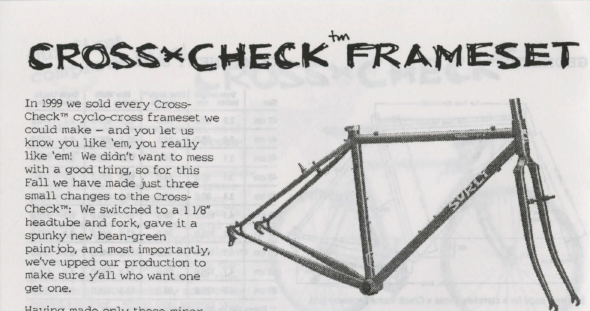
A snippet from a 2000 Surly catalog on the Cross Check.
Yesterday I saw reports that Surly Bikes had discontinued the long-running Cross Check model from its line up going forward. This cannot go unnoticed by myself, and I feel this bike deserves a few comments. It is, in my humble opinion, THE bike that helped launch the gravel cycling scene in the 2000's.

Originally the Cross Check was a bike meant to fulfill the market demand for an inexpensive bike to go ride in cyclo cross events. At that time, in the late 1990's, cyclo cross was seeing bigger numbers for events, and "bandit" cross racing was surging in popularity. The underground cyclo cross scene was a kindred spirit to the single speed scene in that both embraced the renegade stance against traditional sanctioned events. The Cross Check fit that scene as it embodied a "do-it-yourself" ethos and allowed the use of standardized parts so people who purchased the original run of frames in 1999 could "make it their own" out of whatever parts they could scrounge up. 

Single speed, geared, flat bar, drop bar, or whatever. The Surly offering was versatile and Surly found that demand was surprisingly high for the frame set. Taking cues from original Cross Check owners, Surly modified the Cross Check for 2000 slightly and, for the first time, offered a complete bike. The sales continued to be strong into the early 2000's.

From the beginnings of the "Modern Gravel Scene" here at T.I. v1 2005, the Cross Check has made its mark

That same renegade spirit and versatility in set-up served to make the Cross Check THE gravel bike of choice as the 2000's saw the dawn of what would become today's gravel scene. With bike choices ranging from 26" full suspension rigs to carbon fiber cross bikes, and back again to "rat-rod" gravel mutts, the Cross Check emerged as the gravel bike that could do it all. Single speed, 1X, multiple ring chain sets, drop or flat bar, the Cross Check was an inexpensive, durable, well-designed bike with the ability to be fitted with a wide range of current or vintage components. 

Craig Irving  (L) piloting his well-loved Cross Check in 2013 on a gravel group ride.

The reign of the Cross Check saw its zenith in the early twenty-teens as gravel cycling started to take off. By 2012, Salsa Cycles introduced the first purpose built gravel bike, and by 2014 other companies were jumping into the fray. The Cross Check's days of being probably the most common bike at many gravel events were numbered. 

Greg Gleason (L) and Walter Zitz, (R) on a Cross Check, winning the fastest ever Trans Iowa in 2016.

Still, the Cross Check remained a gravel cycling staple well into the late twenty-teens. However; the encroachment of disc brakes and riders who weren't brought up with the more renegade, underground ethos, which was a mainstay of the early gravel scene, saw the Cross Check getting passed by for more technologically advanced bikes. Turnkey gravel rigs which were lighter and designed more for rider comfort and endurance took center stage in the gravel bike stakes and consumers were smitten by the shiny, new bikes which were not anything like the Cross Check.

Should the Straggler have been the "Cross Check Disc" instead?

The Cross Check may have survived all of that, but instead of choosing to evolve the design, Surly came out with the disc brake standard Straggler in 2013. The bike that could have been the Cross Check Disc, but was not. Surly then confused matters even more with the introduction of the Bridge Club, the Midnight Special, and Preamble bikes. All bikes taking cues from the Cross Check, but none of which had that same versatility and "mojo" that the Cross Check had.

Meanwhile the Cross Check was left behind, staying largely as it had been since the year 2000. After a 24 year run, maybe it should not be surprising that Surly dropped the bike. Now that the model is no more, it is only fitting that we remember the contribution that the Surly Cross Check made in enhancing and furthering along the early gravel scene. Had there not been such an inexpensive, easy to set up, versatile and capable machine, it is not out of the realms of possibility that the gravel scene may not have been as quick to grow as it did. 

Surly put this out on social media Tuesday evening. Take from that what you will.

  So, it is time to take stock of what it was to the gravel cycling scene. The bike that once was sold as the renegade cross bike choice, or every-man's commuter rig, became the vehicle which drove gravel cycling toward its massive popularity. Showing that there was a market to be had for products specifically aimed at gravel riding, be that fast or slow. Thanks Surly and to you owners of Cross Checks, keep rolling on!