Tuesday, March 21, 2023

Spring Brings The "New" In For Review

Shimano S-Phyre Ridescape GR sunglasses.
Well, the supply chain is full to over-flowing again and that means review items are coming in hot this Spring. I thought I'd share with you all what I have going on here as a lot of this stuff will be figuring into my upcoming rides. Generally I have shared what I was up to anyway with regard to reviewing product, so this shouldn't be too much of a shock for you readers here.

As always, The Standard Disclaimer applies. 

First up I have these Shimano S-Phyre Ridescape GR sunglasses in for review which has this magnetic lens retention system. It's pretty crazy to see how many uses for neodymium magnets that there are now. 

These have the frameless design, which I like as there are no frames to hinder your peripheral vision. Plus it is big enough not to look goofy on my large noggin. That is a plus! 

Then I have what seems like my most popular review category product of all-time which would be tires. The first proper review I ever wrote was on a set of bicycle tires. So, maybe I was destined for this? Maybe....

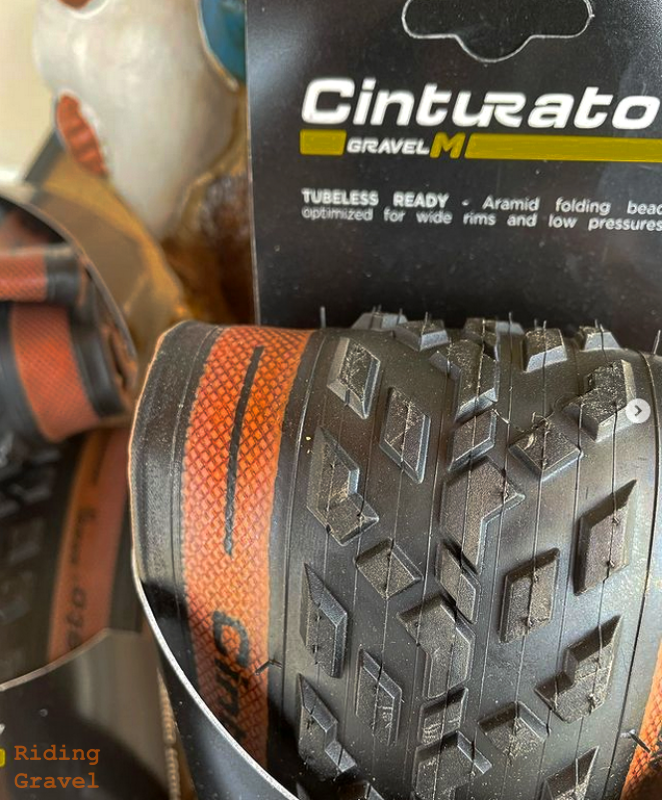
Anyway, I have two sets of Pirelli Cinturato Gravel M tires to test now. These are Pirelli's "multi-surface" tires, thus the "M" in the name. 

A couple of odd things I noted about these tires when I first laid eyes on them. One was that the sidewalls on these "Classic" versions of the Gravel M look a lot like a Continental tire sidewall. The second? These Italian brand tires are made in France. Weird. 

These kind of remind me of old ATB tires like the Tioga versions of mountain bike tires from back in the day. Actually, my friend Ari was the first to point this out when he spied my image of them on Instagram. Despite the old-school ATB looks, these are not designed to do anything like those old tires. 

They have a centralized tread block pattern that creates a virtual solid center line which helps with hard surface rolling.The other knobs are there ostensibly for traction and stability in looser soil and gravel. I will have to ride them a bit before I know if that is true or not.

I will say that they set up tubeless well and hold air like a champ. So far, so good.....

Security minded seat collar from Kinekt

Sometimes I get these odd items which sort of defy categorization in terms of "gravel" or MTB or road biking. Maybe commuting? But sometimes it's just an odd deal that someone wants me to amplify that is out there as a choice. This Kinekt  "Anti-Theft Locking Collar" is such a product. 

It's obvious job is to prevent anyone from hijacking your saddle and seat post. The keyed tool, which comes with the $44.95 collar, has a hex key socket on the one side and the 4-pin interface on the other. The tool is tethered which you can connect to a key chain for convenience. it also comes with the proper 4mm hex key as well. 

I dunno..... I guess if you live and ride in an urban or collegiate area that has a higher chance for saddle/post theft, this might make sense. Maybe for a bikepacking trip, or a tour, where a bit of security can go a long way toward peace of mind. I get it. I don't think this is necessarily anything I'd ever need, but there you go.

Now that the snow is gone....

I have even more stuff that I either cannot talk about yet or that is on its way in yet. So, stay tuned for more review items to be mentioned here. Of course, I will also review the Teravail tires on my Gryphon Mk3, as well as the bike, in future posts. 

So, now you know some of what to expect here over the coming months. reviews will be happening. Of course, that also means ride reports will be happening as well. That is, if I ever get over this stinkin' cold I have! 

Monday, March 20, 2023

Gents Race Preview 1

From my ride out in the country 3/2/23
Well, it is less than two weeks until the Gents Race and I.......I am NOT ready!! This Spring , so far, has been a rotten one for riding here in this locale. Things started out great, but they went down a path of more Winter-like conditions and that has prevented me from getting any significant rides in at all. 

Now, a little cold, that I can take. Wind? Not that big of a deal. But throw in snow, ice, and wind chills in the single digits? Nope.... Not gonna do that. And then....

I got sick. Some nasty cold thing. It has been a drainage down the back of my throat that collects until some thick, gooey mass and then I wake up in the middle of the night, cough it all up, and then sit there unable to return to sleep. My sleep patterns are in rags. 

Not that it has mattered much. I mean, with the crap weather, I am probably not going out anyway, but all of this is making me anxious and feeling unready is not fun. I suppose I am not the only one, I only feel that I am the only one. Which is bad enough in itself.

The Raleigh may see duty as a training bike.

All this cold, wet weather also may be lasting long enough that the sandy roads South of Ames where the Gents Race course is may be soft and inconsistent, much like last year. Maybe - hopefully - not as wet at the beginning! 

The good news about that course is that it dries out in a hurry. Give it a bit of Sun and wind and things straighten right up quick. Like last year when it was a mess to start out with and then a bit of Sun and wind straightened things right out. But I expect that whatever the weather is, it won't be "good weather", because "Gents Race" and that should be explanation enough. 

I mean, yeah.....there have been good years, but they are not the norm, and I don't expect that anytime I go into this event that it will be "nice" weather. It would figure in that since I am in no shape to ride a metric century that the weather would also be sucky as well. Why not? 

I say, "Bring it!" 

At this point, I have to give up any expectations that I will be comfortable, ready, or in any modicum of "fitness", whatever that is, for this event. I will just plan on getting there, riding, and trying to have some fun. If that can happen I will be satisfied and I will consider the event a success for myself.

Sunday, March 19, 2023

The GTDRI Stories: The Seventh One - Part 1

Another year for this as the GTDRI site header!
 "The GTDRI Stories" is a series telling the history, untold tales, and showing the sights from the run of Guitar Ted Death Ride Invitationals. This series will run on Sundays. Thanks for reading!

The seventh Guitar Ted Death Ride Invitational turned out to be one of the iconic rides in the series. This one had a little bit of everything. Weather, great people, and a great, very memorable route. I cannot claim to have much of a hand in this ones outcome because there are always just too many wild cards in making any ride a "classic". That this ride went to "classic" status, in my opinion, right away, was due to many things far beyond my control. One of the most important parts of that was the people that showed up for this one.

That started out with meeting one of the riders the night before for a nice sit-down dinner in Grinnell. Then the next morning, when bright and early, Matt Wills came up from Lincoln, once again driving through the middle of the night to get there. That's one of the odd things about the GTDRI. The fact that I would draw riders from hundreds of miles away, from different states, yet Iowans were largely ignoring the ride up to this point. That would change in later years, but I always found it odd that Iowa cyclists were either unaware of, or ignoring gravel riding. 

Matt Wills arrived at 5:00am after driving through the middle of the night to ride this version of the GTDRI

The spectacular Sunrise was a portent of the heat, rain, and beauty to come during this ride.

This particular GTDRI had three people drive up from Kansas, (two riders, one photographer), and the aforementioned Matt Wills who drove over from Nebraska. I had two fellow Trans Iowa riders from the Waterloo/Cedar Falls area show up in Mike and Jeremy. Courtney was also a fellow T.I. veteran and was from the Des Moines area. Craig drove over from Marion, and Dennis, a local Grinnell public defender showed up on his Fargo. 

Nine of us riding. I mean, that was okay by me. I was thrilled that anyone should show up at all, but the gravel ride thing was still pretty odd yet in 2012 and I guess it took several more years for many to decide it was something worth looking into. So, pardon me for saying this, but anyone who showed up back then, well they were pioneers of gravel riding in my estimation. 

But it was obvious to me by 2012 that this thing wasn't going away. Gravel riding was here to stay whether or not any tires or bikes were ever made for it. We were having way too much fun to just let this fade away by this point. 

John Mathias cresting a steep Level B dirt road hill during the morning of the 2012 GTFRI

Maybe the 2012 ride was even more special because it kind of marked that moment for me. The time when the gravel riding part became ingrained in the community of riders that were taking part in it then and weren't letting it go. These were the people that made this whole thing start to snowball into a really big segment of cycling. 

Between 2012 and 2018, that six year period, was when "Gravel™" became what it is most like today. Pre-2012 it was an "under-the-radar" deal. I'm not saying one era was better than the other, or that anyone "missed" anything. If you feel one way or the other, that's your decision to deal with. But I saw a sea change, and to me, it all started to gain steam about at this time. 

Mike Johnson (R) and Craig Irving climbing a Level B dirt road just North of Brooklyn, Iowa.

We had a photographer on the seventh GTDRI, Celeste Mathias, who did a bang-up job photographing the ride. That was a first for the GTDRI and her imagery really made people look at Iowa gravel riding differently. I got a lot of comments on her images that I used in my original report on this ride. (I'll share some in my next post in this series)

Things like that made gravel riding look more appealing and fun for those who saw those reports and social media posts. The idea that having a group ride, not necessarily a race, started to take a hold of the imaginations of more people. I'd like to think that this GTDRI was a "classic" for those reasons as well.

Next: Part 2

Saturday, March 18, 2023

Another Viewpoint: Jeff's Side Of The Story

Jeff Kerkove was a recent guest on the Bikepack Racing Podcast.
Monday of this week I saw Jeff Kerkove linked to a podcast he was a guest on called the "Bikepack Racing Podcast". He was a guest on that podcast for a recently released episode. (You can access the Spotify link to the show HERE) 

My interest was piqued when I read Jeff's description of the show which stated, "Last week I sat down with Ezra and Andrew of the Bikepack Racing Podcast to talk Atlas Mountain Race, how Trans-Iowa got started, my journey thru cycling, the Colorado Trail Race attempts...and much more! "

Jeff was going to talk about Trans Iowa?!  I had to hear this! So, I settled into the show and anxiously awaited to hear what Jeff's recollections and thoughts about the event he and I started up were. You see, we don't talk much and the times when I did see him we just never felt that the Trans Iowa story was worth discussing. I mean, we were both there at the start of it all, so why talk about it? That's not odd, in my opinion. 

But now many years have passed and Jeff, for the most part, hasn't spoken publicly, that I am aware of, about Trans Iowa and his viewpoint of how things got started. There was really no need for him to talk about it. But with this whole gravel thing blown up to epic proportions now, I suppose those who are younger, who never knew those days of cycling, are wondering what the story was with Jeff. His whole story, and that includes 'gravel'. 

I'm not going to give it away here, you'll have to listen in to the first 16 minutes or so to get the T.I. stuff, but I enjoyed Jeff's viewpoint very much. It's obvious to me that he never really thought that Trans Iowa would start this gravel grinding thing nor that it would become so important because he seemed to have a vagueness on some dates and details, but I get it. Trans Iowa wasn't a big deal for him, as he had bigger fish to fry in terms of endurance racing, bikepacking, and getting himself to his goal of living in Colorado. Still, his take on things is really interesting. I learned a few things and Jeff's viewpoint is important to story of the Modern Gravel Era because Jeff gives a great view of where Trans Iowa came from, how the gravel scene got started, and who were the main players in it, which really informed how gravel events were done early on. 

I also enjoyed the podcasts host's view of Jeff, which I readily agree with, and which I have spoken to here and elsewhere before. But to hear the hosts "fanboy" on Jeff was fun for me. Jeff really deserves it, despite his obvious humility around that. 

Anyway, for the Trans Iowa nerds and endurance racing freaks, you should listen to this podcast. It's worth your time.

Friday, March 17, 2023

Friday News And Views

Pinarello Nytro e-Gravel bike. (Image courtesy of Pinarello)
 Pinarello Announces New "Nytro" e-Gravel Bike:

Hybrid Powered Cycles (HPC's) have been getting more and more diverse and in some cases, hard to tell from fully human powered bicycles. That bike that passes you on that gravel climb in the future may very well be a hybrid powered bike featuring a well integrated electric motor which is giving the rider an unseen advantage. 

This new Pinarello Nytro e-Gravel bike is already such a bike. According to Pinarello, it offers a 300watt at peak assistance boost with 50nm of torque, even at high pedaling cadences. The Nytro e-Gravel has a range of approximately 63 miles, but with an additional "range extender", (the press kit does not say what this is, but it most likely is an external battery accessory), you could ride up to 89 miles. 

But does it weigh a lot? Actually, no- it doesn't. The bike weighs in at a claimed 26-27lbs, depending on the size, and that really is not a lot when you consider that this bike has assist. But yeah....no where near a racing bike for gravel which is going to be sub-20lbs by a fair amount. 

At $7800.00-$8800.00, depending on specifications, this isn't a cheap bike either. So, who is this for? 

Well-heeled, not-so-athletic, race-aspiring folks, I would guess. While there aren't many races coming in at sub-metric century distances, there are a lot that are right at that distance, and well..... Let the "Is this fair to have racing with fully-human powered bikes?" debates begin. Because this is coming everywhere and when battery technology gets better, and the motors are already imperceptibly quiet, well, then you've got a big problem on your hands if you are a race director. 

Fake websites are rearing their heads again.

Buyer Beware: Fake Websites & Counterfeit Goods On The Rise:

With the economy turning the corner in terms of cycling goods from a seller's market to a buyer's market, there has been an observed increase in web-based chicanery, 

This has come in two forms; fake websites and counterfeit goods. This "Bike Radar" story is a good primer on what to look for and how to protect yourself. 

Comments: With more and more on-line ordering going on, I think some of what you used to value in face-to-face retail is applicable to on-line retail. You've got to value the relationship over price. When price becomes the motivating factor, you can easily get burned. 

Now, I shop on-line a fair amount. I also support a local bike shop when I can. I'm not going to name names, but I will say I use the same vendors over and over again because they are very well established on-line retailers or bicycle shops. I've seen things cheaper from sites I never have heard of, and - nope! Not gonna go there. Not worth it in the long run. 

So, you do you, but as the saying goes: "Buyer Beware!"

Grizl CF SL 7 Throwback (Image courtesy of Canyon)

Canyon Grizl CF SL 7 Throwback: A Marketing Exercise With A Goofy Twist:

Tuesday of this week Canyon Bikes had a bicycle making the social news rounds. It is a version of their Grizl series gravel bikes called the Grizl SL 7 Throwback.

It is essentially a paint job and marketing shtick. And does the Canyon marketing team ever lay it on thick here! The theme overall is that "gravel bikes are just rigid 1990's MTB's".

Here's a bit of the blather from the bike's webpage:

"The bikes of the 90s didn’t flatter your skill level, skittering over what modern MTB riders wouldn’t even notice. Making ‘mellow’ trails deliver big grins, just like our gravel bikes do now.
But this time with brakes and shifting that work properly.
"

Comments: Bah! "brakes and shifting that work properly"? Really? What a load of BS. And later into the page they trot out the old saw that "under-biking" will hone your skill level and bring you more in-tune with your terrain. As if people really want that. (Hint: They don't, or rigid MTB's would still be a big category)

This is a perfect example of what I am calling the "mountain bike-ification" of gravel bikes. It's no where close to a 1990's MTB bike, and nothing like a rigid 29"er either, so yeah..... Don't fall for this ruse by the marketing departments. 

(L-R) President G. Bush, Steve Domahidy, Chris Sugai. circa 2011.
Chris Sugai Leaves Niner Bikes For Gates:

Back in 2005 an unheard of company called "Niner Bikes" appeared as the sponsor banner on the then dominant site for 29'er news and rumors, the 29"er page on MTBR.com. "Who are these guys?", was the comment from us, and we were all very suspicious of the intentions of this new player on the scene. The fear being that this company was just a ruse to make a quick buck on a new trend and that they were not a serious concern that would bring more credibility to the nascent 29"er movement.  

Well, as it turned out, Niner Bikes, and their two founders, Chris Sugai and Steve Domahidy were dead serious and all-in on 29"ers. Nothing to fear here! In fact, I learned as much in a "Ted-terview" I did with the pair back in 2006. (Read a partial text of the interview here)

Chris Sugai famously made a statement at Interbike proclaiming the death of the 26" wheel as the dominant wheel size for MTB, going as far as saying it would die out as a choice. And back then, people thought he was off his rocker. But we all know what happened.....

In 2011, co-founder of Niner Bikes, Steve Domahidy, left the company. Several years later, Niner Bikes filed for bankruptcy, and was eventually bought up by the same company that owns Huffy in 2018. Now in 2023, the final original member of Niner Bikes is leaving the company which pioneered and pushed forward the technology of 29"er wheels for the masses. Chris leaves Niner Bikes to join Gates, the belt manufacturer, to work in their mobility department where he will help develop drive train solutions for e-Bikes, e-Scooters, e-Motorcycles, and the like. 

It's a sub-note on the history of 29 inch wheels. I've seen the very beginnings of the genre, its rise, its acceptance as "just a bike", and now this may seem like no big deal. However; there once was a time when what Chris was doing was moving the needle big time in the realm of 29'ers, so I feel as though he, (and Steve) deserve a little respect from the MTB community for his contributions. So, if you ever read this: Thanks Chris! Good luck on your future with Gates and I hope that future is a bright one!  

USAC Announces Gravel National Championships In Gering, NE.:

Well, they finally did it. USAC stakes a claim on legitimacy in the field of gravel racing by announcing that they are holding their inaugural Gravel National Championships in Gering, Nebraska in September of this year. 

Using elements of the remote High Plains area which have been a part of the Robidoux gravel event in the past, USAC is staging this event with no prerequisite requirements for participation other than that you have to be a holder of a USAC license. The price for entry has not been set, but the webpage for the event states that "Pricing will be aligned with other large domestic gravel events." 

There will be several age categories and an Open and Pro/Elite Mens and Womens categories with a further breakdown in classment featuring single speed, para cycling, and collegiate. Both the Mens and Womens Pro/Elite classes will be paid equally with a total prize purse to be $60,000.00 according to the press release. It is claimed to be the biggest single day payout for a gravel race ever. registration opens July 14th. 

Comments: Yeah, I expected something like this, but Gering Nebraska? I was a bit surprised by that.  But this is a plum event landing for the Scottsbluff area. Just for context, the area has close to 25.000 residents. 

Pricing to be "in line with other large gravel events", eh? So, above $200.00 a head? Probably, because USAC is funding most of the prize purse off racer's entry fees. So, those pack-fodder athletes will be paying the people standing on the podium. USAC says they also plan on gaining funds from sponsorships, which in this economic climate may be a bit hard to come by, but we'll see. 

This is a watershed moment for USAC and the UCI in gravel, since this event is a qualifier for the  Gravel World Championships held by the UCI. If they don't get the numbers of folks they need to make it float, it will be a difficult thing to sustain. Don't kid yourself, USAC needs you to buy into this. It's all about money to attract the sponsored Pro athletes, and in the end, the only way they've ever been able to make their system work is to have a LOT of average folks paying money to support the pointy-end of the racer pool. Otherwise, this is going to fail miserably, just like road racing has in the USA under their watch.

That's a wrap on the News and Views for this week! Have a great weekend and get out and ride!

Thursday, March 16, 2023

Gravel Cycling Hall of Fame Class of 2023 Announced

Joel Dyke, nominated for the Gravel Cycling Hall of Fame 2013
 First of all - CONGRATULATIONS to all the Class of 2023 who are to be inducted into the Gravel Cycling Hall of Fame this May on the 31st of that month in Emporia, Kansas. 

The new class consists of four members. Athletes, race/event promoters, and innovators of gear are part of this class which includes Allison Tetrick, Joel Dyke, Miguel Crawford, and Yuri Hauswald. 

You can read the well written bios for each person HERE.

Comments: As a voter on the selection panel, I had a hand in getting these folks in this class, so there is some bias, I suppose, in my analysis based upon that. But you all know that anyway. With that said....

I'm going straight in with a similar thought to what I had to say about the 2022 Class, which you can read in its entirety by clicking here.  So what about Jim Cummings? Yes.....I said it. I'll summarize what I said last year by posting my quip about this situation here: "Someday Jim Cummings has to be in this hall of fame, or it will be laughable. Kind of like 'Pete Rose' laughable. But we'll see......"

Okay, let the darts fly if they must, but that's my take on that. I'm glad to see that Joel was voted in this time. That is a wrong from last year righted. Joel and his story deserve a lot more notoriety than it has gotten since he helped instigate the DK200 and his other event and promotional activities in the Kansas City area. Joel epitomized the inclusive, "everybody gets a chance to play" mentality that became integral to the gravel scene. That and his calling me, and others, "sexy-pants" when he addressed you. Man! I miss that man....

Allison Tetrick on the podium for the 2018 Gravel Worlds

Both Yuri Hauswald and Allison Tetrick represent the bridge between the underground days of gravel and its growing up to become the mainstay of North American competitive cycling that it is today. 

Both are also tirelessly advocating for inclusivity, fairness in opportunities, and adventure for all in the cycling realm. Both have had fairly high profile recognition amongst cyclist and have brought their competitiveness and associations with high profile athletes and sponsors in the realm of performance cycling to gravel. It's pretty easy to see how what these two have brought to the table has grown the gravel scene in many ways and pushed the boundaries out in many directions. 

Miguel Crawford is a name that not only most of you probably have never heard of, but one I was completely unfamiliar with as well when nominations for the Class of 2023 opened up. However; when I read his story which was submitted to the GCHoF, I immediately understood his impact when I read that he instigated the Hopper Series of events in California. 

I had the Hopper Series on my radar going as far back as the early twenty-teens when I was busy compiling events for the Gravel Grinder News events calendar. Back then, a certain fellow named "Murphy Mack" would keep trying to get me to come out for one of those or his event series, which was in a similar area of California. I think his deal was the Superhopper Series, and maybe those were the same thing. I don't remember anymore. That was up to ten years ago now!

But I knew that the Hopper was a big deal in West Coast events that were "underground", under-the-radar type things and were gravel-type deals which were developed before gravel was "gravel". These events were very important from the standpoint of influence, and since Miguel was the instigator of this, I felt he deserved to be in the GCHoF.

Looking Ahead: I've said this before, but a LOT of the nomination stories sent in for the Selection Committee to read were so varied and narrowly focused on one area that it was hard to navigate them. My suggestion for future nominations would be for those who are considering nominating someone to read what is on the GCHoF site for backstories on current members of the GCHoF and pattern their stories in a similar fashion. (See the link above if you are so inclined)

My thoughts would be that any future nominee would have to have included in their stories some, or all of, the following points:

  • Influence: Not just "locally", or for a specific group, but in a wider sense. Did the event, performances, actions, or results of this person reach out in a meaningful way to the cycling community overall? Does this person influence through advocacy and ways that are not necessarily via media, race results, or in cycling business? 
  • Historical: You can look at an event or person and determine whether or not anything we have seen in gravel cycling today would exist at all, or in a form as we know it now, without them and their efforts. 
  • Pioneering: Here I would look at pre-Modern Era Gravel or early Modern Gravel era (2004-2012) people and events that made a dent, influenced others, or were significant in some meaningful way to what we know as the gravel scene today. Not all that were on gravel before 2004 made any marks on the gravel scene today, but some did. 

Yeah, I think making real sure your nominee has a strong case in those three areas would make for a solid nomination and if the story was written cohesively and well like the bios on the GCHoF site, well you are going to get better consideration than you would for a "list of accomplishments" only, or some heart-felt but not very influential plea that goes something like, "this person really made a difference for me and so many others". Like- "Okay..... Tell me how, where, when and why". Just saying "it is so" doesn't cut it. 

Again- CONGRATULATIONS to the four new members of the Gravel Cycling Hall of Fame!

Wednesday, March 15, 2023

The "Boucher Route" Cabling Method Explained

My cabling routing I use which was learned from Jason Boucher
Earlier this week I received a comment from a reader asking if I might explain what the "Boucher Route" was which I used on my new Singular Cycles Mk3 Gryphon build. This post will help explain not only what that routing is, but the name behind it, and why I use that name for this technique. 

History: When I went to visit Quality Bicycle Products in late 2008 to see and ride the then new Salsa Cycles Fargo, I was invited to tag along with Jason Boucher, who was then the brand manager for Salsa Cycles. 

As we prepared the bikes at Jason's home for the Fargo ride the following day, Jason taught me a new-to-me cabling method for external routing of a geared drop bar bike that was elegant and kept the head tube from being rubbed by cable housing. I found the idea so worth using that I associated it with Jason Boucher and ever since I have called this method of cabling a drop bar bike "The Boucher Route". 

Now, Jason would be the first to tell you that this is not his idea or invention, and that is true. However; this is what I am calling it, and have been calling it for over ten years, so there! Ha! It is what it is....

Besides, I wanted to honor Jason for his friendship and early advocacy of my efforts in reviewing product and events production. These days Jason has moved on from the bicycle business to doing his own line of camera bags. Check those out HERE. 

My old "Fat Fargo" from 2015 using the "Boucher Route" cabling method.

 Explainer: Okay, so let's dig into what is going on here. I've done the "Boucher Route" on nearly every geared, disc brake drop bar bike I have owned since 2008, but this "Fat Fargo" example from 2015 is a great example since I employed two different shifters on the same bike. Note: this routing only works in its entirety for disc brake drop bar bikes. Cantilever brake bikes will require different front brake cable routing than this example does.

#1: This is the route for the rear shifting which you would use with an external cable housing run for most earlier Shimano STI levers up to about 2010-ish when Shimano started routing the cables under the bar tape. Note that instead of having the right side cable go to the right side cable stop, it goes to the left. The example here is showing a Gevenalle shifter set up.

#2: Here you see the route for the left shifter, which in this case is a bar-end shifter, but the routing would exit the bar tape in a similar manner for STI/SRAM under-the-bar-tape shifting as well. The left side shifter cable housing goes to the right side of the bike.

#3: The brakes. Note that the brake cable route for the left/front goes behind the head tube and fork from the right. So, you do not go from the left brake and try to make a tight curve down toward the left fork leg here, On steel frames you have the option of cable tying the housing to the center hole on the fork crown, but you do not have to do this in every case. The rear/right side brake cable housing goes to the down tube cable mounts from the left side of the head tube. 

Benefits: The "Boucher Route" keeps the gentle curves which cause less cable friction and also it keeps the cable housings bowed outwards from the head tube in a better way. This causes less paint damage due to its keeping the housings from contacting the paint on the head tube unless you turn the bars enough that the cable housings eventually contact the frame at the head tube.  

Cons: The "Boucher Route" can cause really long runs of cable for the derailleurs and rear brake. I've had to use tandem cables many times, longer housings, and those are more expensive, Also- It won't work on every bike. Typically I have found this is a great idea for steel and titanium bikes. However, many carbon bikes and lots of aluminum bikes won't benefit from this, or they have internal cable routing, or no cables because you have hoses and wireless shifting.

I hope that explains the "Boucher Route", its history, and how it might be a benefit to you. Got any more questions? You know what to do! 

Thanks for reading Guitar Ted Productions!