 |
My Raleigh Tamland Two, circa 2015
|
This story has been told, in part or in whole, in several posts throughout the years here on this blog. So,
why bother now again? Well, this month marks ten years since that day at work when I was rudely interrupted from a busy schedule of repairs by a strange phone call.
This post will tell the story leading up to that call, and then briefly what happened afterward. The timeline of events is kind of important from a historical point of view here.
So, in the late 2000's I am pretty much known in the cycling industry as "that guy that is a 29"er freak". I pretty much started out on this blog being a big proponent of that wheel size for mountain biking. The industry soon took note, for whatever reasons, and I started getting shadowed here by industry people who were keeping tabs on 29"er gab going around on the web. This in turn brought me to the attention of blog and website folks who were eager to add - and I use this term cautiously - 'talent', to describe why it was that 29"ers were great, and a person that in turn could review product coherently. I guess I was on folks radar for those reasons.
So, because of all of that, I had a "voice" that was being heard. Then I started in on what it would take to make a great all-road bike. I liked riding on gravel- a lot - and 29"ers were okay at that, road bikes were not, and cyclo cross bikes were almost- but not quite- right for the job. I wanted a better tool for the task. This led me to some brainstorming sessions with Ben Witt, at the time he was a bicycle shop owner and was really into design and philosophy of bike design in general. We had an idea, and I talked about that a lot here.
Guess someone was listening again. Because I got a phone call......
That's the backstory in a nutshell. Essentially, then Raleigh brand manager Brian Fornes, who had dealt with me a lot on 29"er stuff, was interested in getting Raleigh on the front end of the gravel scene. At this point, in 2012, there was one bike, and one brand doing anything in the space, and that was Salsa Cycles.
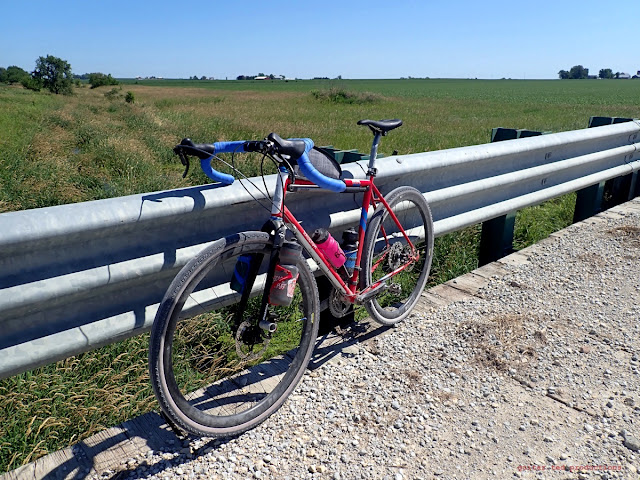 |
My Tamland Two from Tuesday's ride
|
Their Warbird bike came in titanium or aluminum, and it had limited tire clearance. You could squeeze in a 40mm tire, but that was about it. When Ben and I had been brainstorming this idea for ourselves, we were wanting room for 700c X 42mm tires with fenders. The Warbird wasn't quite that bike.
So, with the Warbird being either too expensive, (Titanium) or too stiff (Aluminum) and then not being quite where I needed it to be, I was on the search for a custom built steel frame that would have all the things I wanted. Ben suggested that maybe we could have Mike Pofahl do a couple of these "allroad" bikes for us. Then I got "The Phone Call" mentioned above.
It was Brian Fornes. He asked if I would mind if he put me on speaker phone so the team of engineers and product managers could hear me. I agreed. (But why? What on Earth could THIS be about?) So, then the question: "If you could build a bike for gravel, what would you do? Anything is on the table as long as it is marketable. Nothing crazy. Okay? Go!"
So, I gave it to them, but I slightly modified a couple of things, thinking them too "radical" for the Raleigh folks. I wanted a 71° head angle, but I told them 71.5°. I wanted a 75mm bottom bracket drop, but I said that it had to be more than 70mm. They ended up with 72.5mm. I wanted cantilever brakes, but knowing that road and cyclo cross were rushing head long toward disc brakes, I told them that this bike had to be a disc brake bike to sell. I told them it had to have rack and fender mounts. I told them I wanted a chain hangar on the drive side seat stay. I told them I had to have 700 X 42mm tires and fenders. I said it had to have a steel fork, because at that time, carbon forks were stiff as jackhammers. I told them it should have a straight steer tube to look right. We discussed how the fork should look. I really wanted a sloping cast crown, but a uni-crown was more cost effective, and it was to be a curved fork blade design, not a straight bladed fork. I suggested they use something from the Reynolds catalog for frame tubes. I suggested 853, but they used 631 instead because it was better for the design. I wanted a more traditional look, not severely sloped in the top tube. Yeah, I think that's about it....
And then I waited, and I put off that custom bike, because "What if?" What if Raleigh does this, and the shop I worked at was a Raleigh dealer, so.....
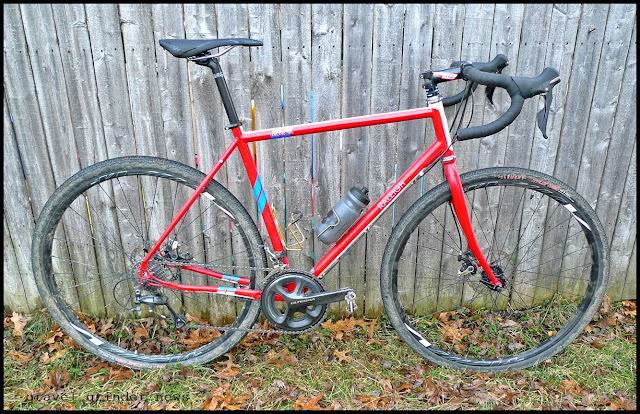 |
My Tamland Two, bone stock, right after I bought it in 2014.
|
Well, obviously I got it. But that time between 2012 and 2014 was a time of anticipation and wonder. I remember that the bikes broke cover in a cycling mag in the Summer of 2013. I was intrigued by what I read, but the details weren't available. Did they do anything I asked of them? I had no idea.
Then I went to Interbike in 2013. I made a hasty path to the Raleigh booth where Brian Fornes met me and asked me if I had seen the Tamland yet. I said no, I hadn't, and what, if anything, did Raleigh use of my suggestions?
Brian instantly retorted, "They used all of it!" (With the mods mentioned above)
I was horrified! I actually replied, "Well, I guess if it doesn't sell then it's my fault!", and I really felt responsible for the success of the bike in that moment. However; Brian assuaged my fears by telling me that the first run of the Tamland had sold out to the dealers, so at least they believed in the bike! But it still had to sell off the dealer showroom floors, and it did pretty well, from what I understand.
The reason, I think, was that many had hoped that Salsa would have come out with a steel Warbird, but they didn't. The Tamland, being Reynolds 631 steel, kind of was 'that' bike in 2014. And also considering the fact that in 2014, you could buy a Warbird, or this, and that was about it for gravel. At least from a well-known brand. (The Vaya notwithstanding, and that's another curious tale I've already written about here.)
 |
The Raleigh with 650B X 47mm tires and fenders
|
I ended up buying mine at shop discount, but it was still almost 2G at the time. Many who understood what was going on thought that Raleigh should have given me one, but keep in mind, Raleigh couldn't keep these in stock at first. So, to insure that I would actually get one, I bought one. Because, let's be honest, how many times do you get to have any influence at all on a bicycle design sold at retail in a bicycle shop? I'm going to say, almost never, is the probability for that happening at all, never mind ever again.
Regrets? Yeah, I have a few. I probably should have told Raleigh to make the Tamland a through axle bike. I should have asked for fork mounts for a rack, or water bottles. But I was pretty pleased with how it came out. And, to boot, it actually works the way I envisioned it to work. Bonus!
Afterward the wave of gravel bikes came, and now almost no one ever would even think about Raleigh as a company selling a gravel bike. Brian left the company, then they went consumer direct, way before they should have, and whatever has become of Raleigh is sort of a mystery now. But the legacy of the Tamland lives on in that it set a standard for design that many, many gravel bikes use to this day. Big tire clearances, (I can almost run 29" X 2.0's in the Tamland), 650B compatibility, the geometry, and most of the mounting options are all things today's gravel bikes share with the Tamland.


