Showing posts sorted by relevance for query Honeman. Sort by date Show all posts

Thursday, March 14, 2024

Inspiration And Some History

The page posted on Facebook that started this journey.

 The Honeman Flyer project has taken up a lot of space here on the blog of late. However; you may not have read what the reason for the project was, or how this all came to be a thing. So that's the point of this post.

Today I am traveling to the Mid-South event mainly because of an idea that germinated last year when I saw a post by frame builder Steve Garro on Facebook. The image Steve posted was from an issue of "Popular Mechanics" from the mid-40's (1940's) which showed an advertisement from a frame builder by the name of Willie Honeman. (Image to left here)

The name of the builder did not catch my attention, but what Steve said did. He essentially noted that the geometry of the frame drawing in the ad was eerily close to gravel bike geometry. He wondered what such a bike might ride like. So did I, along with other commenters on the image. 

This prompted myself to go into research mode and I found a site that had a page on Bill "Willie" Honeman, a much decorated national champion track racer.  The site, called Classic Cycles, has a wealth of obscure track cycling information from the turn of the 20th Century to the 1950's. Searching further, I found out that Iowa figured into track racing lore. 

There was a racer who took up crafting racing bikes and running a shop out of Davenport, Iowa named Worthington Mitten. Worth, as he was known by, was himself a well accomplished six-day racer from the time when those contests were actually ridden for six consecutive days by one rider. Once he took up a torch, he made a small number of frames and forks out of his Davenport shop under the "Mitten" brand. One of his clients was an orphaned paper boy who made his rounds by bicycle named Victor Hopkins

Vic was an Iowa native, and his story is compelling. From a tough childhood he was eventually moved to try racing bicycles after he discovered Worth Mitten's Davenport cycling club. Vic immediately was successful. Some of his exploits were something which might resonate with ultra-distance, self-supported gravel riders today.

Willie Honeman's track racer (Image courtesy of Classic Cycles)

Vic apparently went at least once to Chicago to race. He didn't take the train, nor did he drive a car. Instead he rode to the event and back. Then, in an effort to qualify for the 1924 Paris Olympics, he did a similar thing, only this time he rode over 1000 miles from Davenport. Most of the roads he used to get there were dirt. It turned out that he qualified for the Olympics since he won the event by 20 seconds. 

I assume Vic did that self-supported as well. This got me to thinking - these bicycles must have been pretty decent for rough roads.  

Examining the Honeman geometry, and then realizing that it was a design from the 1930's led me to Pop Brennan, who was the maker of Honeman's track bike. Reading further I found that Brennan's bikes were quite popular with the major star track racers on the circuit back then. Many of the other builder's bikes seemed to be of a similar geometry as well. Finally, the Mitten model built for Vic Hopkins was especially meant for rougher roads found in Iowa and Illinois at the time. 

So, how would a modernized version of these bikes do on gravel

Fast forward to 2024: The "Honeman Flyer" project came to life, as I have detailed here on these pages. The project culminates with this trip to Stillwater, Oklahoma as I will be riding (hopefully) on Oklahoma's red clay roads and getting to be a part of the story Erik Mathy is crafting around this idea, and more than that. 

The finished Honeman Flyer by King Fabrcations made to the geometry of a Brennan track bike from the 1930's.

Was It A Good Idea? There was a huge risk involved in doing this project, that mainly being that my resources for this experiment were based on a paltry amount of evidence and a lot of my past experience and my own guesswork. There was a good chance that I paid out of pocket for a pretty wall hanging. 

The price for admission to this deal was not cheap. Yes - there also was the chance that I would have "confirmation bias" and think it was a fine bike even though it might not be. But if you really knew me you'd know that I cannot stand a bike that handles poorly. Most bikes have "pretty decent" traits, but there are some that have some bad warts and I think that in the past I have been pretty honest about those things. 

 The point of the experiment is to find if we, as a community of cyclists, can take anything from history and apply it to today. This is not easy to do. Today it would be difficult to ascertain "why" things were done the way they were done without direct evidence from builders and period riders, most of whom, if not all, are deceased. Then there is also the factor with materials technology. Certain things could not be done back then and have reliability. Things which we can do now and not worry about. 

But did we, (cyclists, designers, brands) cross a line at some point and start doing things "because we could' or because "rules" disallowed certain aspects of design? I think fashion and marketing also have affected cycling design. Think about Worth Mitten. He probably wasn't as concerned about how his product made people feel when they looked at it as he was concerned about how his product worked for a cyclist training and racing. Mitten's designs were most assuredly executed accordingly. 

We also have lost a lot of wisdom and information about cycling from days of yore. For example, I think it is fair to say that most of us unfamiliar with wooden rimmed wheels would be quick to say that today's carbon fiber rims are lighter. If the Classic Cycles site is to be believed, a claim is made there that they have examples of racing wheels from the 20's and 30's that rival the weights of today's carbon wheels. Maybe something along those lines goes for geometry also. Maybe our own assumptions about "what is old" affects our views of those old bicycles as well. 

So, can we learn anything from the past by having a modernized version of what was raced and ridden on rough roads back then?

So far I would say - Yes. I need to ride it more to really know if anything will crop up that bugs me. I need to get into various situations with the bike. I need more time to decide. But I don't think I wasted my money, if that is what you are wondering out there. I have wasted my money on custom design before, so I am not necessarily going to hold back judgement on the King Fab bike because it is "custom" or cool, or because the geometry is whatever. In fact, I have already pointed out a few things about the process with King Fab that weren't ideal and that I found a flaw in the paint job, if you were paying attention. 

So, in the future I think you'll find an unvarnished take on the bike and the point of it being this experiment. Until then I'll point out again that back in the first half of the 20th Century there were a lot of bicycles like this and there were good reasons for their design. You'd have to be pretty blind to ignore those facts. There is something to this. The question is, should we be looking at this sort of design for gravel in the 21st Century? 

Anyway... stay tuned.....

Saturday, September 23, 2023

A Search For "Gravel" Geometry": Part 4 - Inspired By History, Still "New"

 Today I will wrap up this series and in this post I am going to show what the bike design is and why this idea I started out with has garnered interest with a few folks.

But first, let's review:

Purpose: The idea is to see what, or even if, any past efforts in bicycle design have any bearings on where we are at with geometry regarding"gravel bikes" today.

Okay, and with that, let's keep in mind that the ideas that were presented in the page I shared this past week are what this post is mainly based on.  That page, which featured a bike design shared by Willie Honeman, an accomplished track racer and frame builder, is the genesis for this whole series. Willie is someone who I believe exemplifies the ideas which influenced my thoughts on gravel bike design, and in turn, ideas which have impacted the cycling industry in terms of gravel bike design. 

 Many of Willie Honeman's ideas were congruent with gravel bike design as I saw it.  I should also point out that master frame builder, Steve Garro was the one who posted about this design on his Facebook page. Steve had similar thoughts about this design being an influence on current gravel bike design. You can see my original thoughts about the bike HERE from an April 2023 blog post. 

Willie Honeman's Brennan Track bike from 1932 Image courtesy of "Classic Cycles")
  

Willie's championship winning sprint bike was built by John "Pop" Brennan, according to this information I found. Read that link's information and you will learn that Willie Honeman was the first cyclist to wear the Stars and Stripes jersey, that he advocated for helmet usage by his fellow racers, and that he rode the bike, imaged above, for racing, training, and for recreational pursuits. 

That bike is also the same that was detailed in my last post which showed the original plans for the bike. So, this gives a little better context for that drawing.

There are a lot of things about this bike that would work for me today, but the thought is to take the basic foundation here and modernize it for today's components and for me, obviously, because I would need a longer seat tube and head tube than Willie did. 

But the basics like head tube angle, offset, bottom bracket drop, and chain stay length is all easily transferable. How one approaches the extra long top tube/short stem factor in this design scaled up for my size would be the challenge here. (Yes! Short stem, long top tube, slack and "low' are NOT a new thing.) And before anyone asks, yes. This would be a single speed gravel bike.

But some things would be smart to change. Modern wheels use disc brakes and drop-outs are through axle now. Bottom bracket standards, fork length to accommodate bigger tires, and even that fork's material are all up for consideration. Do you steepen that seat tube? What about the top tube? How wide a tire are we talking about. Several salient points here that need clearing up. And then there is this....

Do I already have "that bike"?

My Twin Six Standard Rando frame has very similar numbers to the Honeman bike built by Pop Brennan. The bottom bracket drop, head tube angle, and chain stay length are all almost identical. The seat tube angle is different though. So, other than that, the Standard Rando is steel, does single speed, (although now mine is set up geared), and it is likely "close enough" to the 1930's track bike design that making a custom one-off might seem, well......unnecessary

Plus, the T-6 is a modernized bike with all the typical standards of a 21st century bicycle for gravel. No need to re-invent the wheel, as it were, unless there is a compelling reason to pursue this idea. Like maybe sticking to the original plans for a bike like this more closely. Otherwise I am hard pressed to see what I would learn from having to go through a custom bike build. 

Now, I am not saying I will get a custom done or not, but if I do, the working name would be "The Honeman Sprinter", since that is the inspiration for this bike.

Conclusions: Can we say with any certainty that a bike like the Brennan made for Willie Honeman influenced gravel bike design? Perhaps the answer is no if we are looking for a definitive, direct lineage, but the answer is "yes" in a general sense. Bicycles in the Pre-WWII era were made to be ridden on roads that, at that time, were still mostly unpaved. Riders that bought these expensive, custom made machines rode them all over. I read one account of a professional track rider that was from Davenport, Iowa that rode to a national event held in Chicago, raced his bike, and rode back to Davenport again. So it would seem that many of these track racing designs also had to work off-track as well, making them a forerunner of gravel bikes, in a way. 

That I found inspiration in these older designs, which I used to relate my design ideas to Raleigh in 2012, which resulted in the Tamland series of bicycles, is another facet which speaks to the relevance that these track bikes and road bikes had from the pre-WWII era as well. So, does gravel bike design owe anything to old designs like the Brennan? Probably. Yes. 


Another question: Will I have this custom single speed gravel bike built? Maybe.... Again, I don't need another gravel bike. I have the T-6 which, for all intents and purposes, is 80% of what a modernized old Brennan would be. So, why bother? (Read a review on the Standard Rando HERE)

Well, if the design sticks more to the original, (in particular, the slack seat tube), then perhaps it would be an interesting experiment and it probably would be a fun bike regardless. But that said, things like this cost money, I would need help getting parts and pieces lined up, and maybe to make it all make sense, I'd need a goal. (There is one that would make sense, but no need to go there unless the bike comes first.) 

That all said, I'm not now feeling a great need to pursue the custom Honeman Sprinter idea. Even though it might be fun to see how that design would stack up against today's bikes, I am more than sure I can tell you, at least from my viewpoint, how it would work,because of the Standard Rando. 

Again, this is all my opinion, and I'm not doing anything in this series but espousing my views on what a gravel bike should be like, for myself. So, contrasting opinions will abound, but just go dig into so-called gravel bike geometry charts and you'll see that the Honeman, the Twin Six, the Raleigh Tamland, and many others are pretty closely related. And in my opinion, that is significant from a historical point of view. Gravel bikes may be relatively "new", but I think it is safe to say that they are indeed inspired by the past bicycles that came before them. 

That brings this series to a conclusion, for now. Thanks for reading Guitar Ted Productions!

Thursday, March 06, 2025

Honeman Flyer: One Year Review

Image courtesy of King Fabrications

A year ago now I was frantically trying to find all the parts I would need to build up the King Fabrications frame and fork I had received at the beginning of March. I had a short window of time to get it done before I had to leave for Mid-South. Everything had to be right in that time so I would be safe and confident to ride this bike in Oklahoma's Red Dirt hills for 50+ miles.

Fortunately for me, it mostly worked out well. I know many of you dear readers know all about this project, but in case you haven't been here long, this bicycle design was a huge risk and had the potential for being a very expensive mistake. 

The genesis of the design idea was based upon an advertisement I came across on social media for a 1930's track bike ridden by National Champion Willie Honeman. Why this design? Because this time period was a unique one in American bicycle history. Riders often could not afford a training bike and a racing bike, so the race bike was the training bike as well. 

This meant that the bike, often ridden on unpaved roads due to the scarcity of pavement in the 1930's, had to handle gravel and dirt well. Now you may see why I was keenly interested in how something from this era would ride in modernized form. Even Steve Garro, of Coconino Bicycles, a noted frame builder who originally posted the ad I saw, said the geometry for this track bike design was "almost modern day gravel geometry". 

So, with some nudging from story-teller/photographer/instigator Erik Mathy, I took the plunge and spent over a couple thousand bucks on a hunch. Now many of you know how it turned out for me. Short story: It is one of my favorite bikes I've ever owned

The current state of the King Fabrications "Honeman Flyer".

As I stated, this is a direct copy of the 1930's National Championship winning track bike geometry, extrapolated to a size 58cm to fit me. Willie Honeman was slightly shorter than I! But the main angles which determined handling are all intact. 

I love the way this bike handles and I love to ride it. It is safe to say that the gamble paid off in spades. However, there are a couple of things I would change, given the second chance to, and one recurring, weird issue I had with this bike over an odd component. 

The first iteration. (Image by Erik Mathy)

Oddly enough, it was the seat post which caused me some real head scratching early on. I kept thinking the seat collar was not working when in fact, the seat post I originally chose for the Honeman Flyer was slightly undersized. Instead of being 27.2mm it was more like 27 and some change millimeters! 

This discrepancy caused a constantly slipping seat post until I figured it out after Mid-South. Then I got a Redshift ShockStop Pro seat post to review and I used the chance to run the post in this bike. After this experiment I ended up swapping over to a Salsa Regulator Titanium post and I have not looked back since then. 

Now for the two things which bother me about the bike. One, and the main thing I am regretting, is that I did not spec clearance for up to a 47mm wide tire. The Honeman Flyer will accept a 40-42mm tire with clearance to spare for mud and whatnot, but it would have been nice to have had the clearance for a bigger tire. I know I stated originally that I already have a big tire single speed gravel bike, but ..... you know.... Bigger tires rule. 

My other nit is that I did not spec a third bottle cage in the inner triangle and one underneath. Budgetary reasons came into play there, because more braze-ons mean more expense. I was pretty tight on this project and the fact that it may have been a bust was a factor in this decision as well. 

This bike has a painted to match Salsa Cycles Waxwing carbon fork on it. There is an issue with the through axle being ever so slightly oversized to the point where I had to hit the through axle with a dead blow hammer to get it in and I had to really work to get the axle out. Other through axles worked fine. So, I know it is the Waxwing through axle which is slightly out of spec. It has gotten better over time and now is only a slight annoyance. I have noted the anodized finish is worn away in a few places though. I probably should just get a new front through axle and use that Waxwing one as a pencil holder or something. Anyway....

The bike just is smoother, inspiring to ride, and with the 76mm of bottom bracket drop, it rides lower and more stable on looser gravel. It has an uncanny ability to allow me to do really hard seated climbing efforts, which, honestly, it doesn't make any sense at all why this would be the case.  There were those  early issues with slipping seat posts. Yes, but......

Summer 2024

Now I am very much okay with where I am at with this bike. The main changes since it was first put together are the aforementioned titanium seat post, a Redshift ShockStop Stem has been added, and I've been through a few saddles and three sets of bar tape since it was new. I was running Teravail Rutlands and now this bike sports Ritchey Speedmax 700 x 40mm tires which measure out at 45+mm on my Blunt SS rims! 

So, I think things have settled down on the changes and this year I want to put in some longer rides on the Honeman Flyer to see how things go. So, hopefully this will happen in 2025.

Monday, March 04, 2024

Honeman Flyer: Parts

Image courtesy of Erik Mathy
I thought Friday would be the day I got my mitts on my King Fabrications Honeman Flyer, but that was delayed until today. In fact, it was tracked in town on Saturday, at the UPS distribution center, but it won't show up at the delivery spot until this afternoon. (Maybe by the time that you read this.) 

So, while I thought I might be sharing images of the completed build today, I instead will be building it today. The bike, that is, and until that finishes up, I thought I'd share some of the parts that are going into this. 

My personal build procession goes something like this: Fit the seat collar, insert the seat post, hang the frame by the post in the work stand. Then I fit the head set and put the fork on with a stand-in set of spacers and a stem. 

Next is getting the threads chased in the bottom bracket shell, (if needed), and then fitting the bottom bracket and crankset. On a single speed I would then fit the wheels, brake calipers, and turn my attention to the cockpit with a lot of measuring and finally cutting down of the steer tube. Then I would fit the saddle, the final stem, handle bar, brake levers, and set up the brakes. I then would wrap the bars. I don't know why, but the chain is almost always the last thing I put on a bike I build. 

Weird, but maybe that's just me. 

I chose a Cane Creek head set for this build. I think black anodized parts work best to highlight this wild paint job on the bike. I just so happened to have had a Cane Creek 40 head set for a 44mm head tube on hand that was new. 

Honestly, the brand of head set doesn't matter that much to me. Cane Creek is good. Wolf Tooth is great, especially if you want color. Chris King is bling, but again, only if you want anodized colors. Black? Heck..... At that point a Cane Creek is hard to beat. So, I think it will likely stay in there as long as I have this bike, and I doubt I'll ever have to service it or do anything but clean the outside once in a while. 

The Honeman Flyer was built to accept a 27.2mm seat post by King Fabrications. That's the "standard" size for gravel these days, and there are a TON of choices I could have gone with. 

My conundrum with the Honeman Flyer was with the design. It's based on a 1930's track bike design, which back in those days used a seat post with a brazed forward extension and a very slack seat tube angle. This set up had the appearance of a stem for a handle bar. The extension would be fitted with a clamp. That clamp could slide fore and aft to allow for different positions for different riders. During my research on 1900's to mid-century track bikes, I learned that these forward extended seat posts and stems were done because many times racing bicycles were so expensive that sometimes several riders would use the same machine. The sliding saddle and handle bar set ups allowed for the precise fitment of different riders. 

Okay, so back to 2024. The Honeman Flyer has a slack, 70° seat tube. Generally I ride 73° seat tube angled bikes and a fair amount of saddle set-back using set-back seat posts. To get in approximately the same position on the Honeman Flyer as I would on my other gravel bikes, I would necessarily need a 0 degree set back post to have any chance of getting the angle right. 

That led me to an old friend in the parts bin. A carbon fiber Tamer seat post from the late 1990's/early 00's. When I last used this, oh....maybe 12 -15 years ago, I remember it being pretty flexy and comfortable. The Honeman Flyer will have less exposed seat post than almost any bike I have other than maybe the Twin Six Standard Rando v2, so this Tamer post should do the trick for me. 

Wolf Tooth is represented on the build by their Morse Cages and rear through axle. I love Wolf Tooth's B-Rad rails that allow me to move water bottle mounting points around on my various bikes, but the Morse Cage also allows for several mounting options as well. 

I've never used the stainless steel Morse Cages so I am curious to see how they will handle the rigors of gravel riding. They look pretty well thought out and the construction looks top-notch. I'll be reviewing them in the future so stay tuned for my thoughts on them coming in the following weeks and months. 

The rear through axle should work well, as long as I picked the right length one! I had to take a stab in the dark since I don't have the frame in front of me to measure things and King Fab didn't give me those precise dimensions when I asked either. So......we will see

Wheels Manufacturing got the nod for the SRAM compatible bottom bracket. (Not DUB! yecch!) This particular version they sell has Enduro bearings, (GOOD!), and a double-row bearing on the drive side cup. Plus these are angular contact bearings, which should be better for the rigors that a bottom bracket will see. 

It was spendy but I think it will be worth it. Yes......it is not black! That wasn't an option, and anyway - who looks at bottom brackets? They are hidden behind crank sets and covered in dust. It'll be fine. Don't worry about it!

I'll be inserting my SRAM Rival crank with a 40T ring on it, so this is why I chose this particular bottom bracket. I gave some thought to doing a full-on Enduro Max-Hit bottom bracket, but those are even more expensive and maybe when this wears out, well, we will see.... I suspect this one will last quite some time. 

How could I not include these sleek, black levers I received from "Charlie", a blog reader here, who gifted these like-new levers for the build. (Maybe they are new? Don't know)

The TRP design is the very same that I was thinking of using anyway, and these fit the design manifesto like a hand in glove. All black and shiny!

These will be pulling cable in Jagwire black housing which in turn will work against the flat mount TRP Spyre calipers, so it all makes for a fitting system. 

Rotors will be six bolt SRAM affairs due to the WORD Disc not having Center Lock capabilities. Otherwise I might have used TRP rotors here as well. 

Okay, that's a big part of the build right there and hopefully by tomorrow I should have some build images to share. I was afeard that this all would come down to a short time span before Mid-South, and this is about as minimal, in terms of time, as I would feel comfortable with. I sure hope it all falls into place as planned, because if it doesn't, I think it will be time to push the panic button. Especially if I have to order in more parts. 

Stay tuned......

Monday, April 01, 2024

Honeman Flyer: Reviewed

This review of my Honeman Flyer from King Fabrications is going to cover mostly what I think about the geometry of this bicycle. I will also touch upon a few other things concerning the way it handles and on some of the parts I have on the bike. 

NOTE: The frame, fork, wheels, and a few other small parts were paid for out of pocket by Guitar Ted. Most of the cockpit components were gifted or sent in for previously written up reviews at no cost. 

None of the companies represented in this review paid for this post or have any pre-knowledge of this review being done. As always, I strive to give you my honest thoughts and views throughout. 

Now, on with the review.

Obviously the whole intention of the Honeman Flyer project was to prove if old 1930's track bike geometry had any bearing on current gravel bike geometry. It sounds like a far-fetched idea, but when you dig into history a bit, it starts to make more sense. I already wrote about this in an earlier post which you can read HERE

In this post, I will give you my take on what this unique geometry feels like and how it handles on gravel roads in the 21st Century, nearly 100 years after bicycles with this geometry first appeared on the board tracks across the United States. This post will also dispel the uninformed notion that "gravel bikes are just 1990's MTB's".

A long grade I rode up during the Mid-South gravel event recently with the Honeman Flyer.

The radical part of this bike is the rear end. The front? Pretty standard fare, actually, and I was quite surprised that 1930's track bikes would use numbers almost spot-on for a gravel bike made in 2024. However; no one is currently using the odd rear end geometry that the King Fabrications Honeman Flyer does. 

Just to quickly recap, the seat tube angle is a slack, slightly less than 70° while the chain stay is currently set at 450mm with the slider drop-outs. That connects to a bottom bracket that has 76mm of drop, which is what the geometry I found dictated for the 1930's track bike geometry I copied. That's a little lower than most, but not as low as I've seen today by far in a gravel bike. 

Just to keep things interesting, I went with a single speed specific frame and my gearing was "John Deere 4020" at 40T X 20T. A little lower than a lot of folks single speed gravel gearing, but my worst facet of gravel single speeding is climbing, so I erred to that side. 

Remarkably, I found that, while standing and mashing was certainly possible on this geometry, seated climbing worked better. It just seemed to fit my style and was a bit less of an effort to do, which is counter-intuitive for single speed riding. Especially when your cadence drops very low. 

Image by Erik Mathy

I'm not sure what else to attribute this to other than that perhaps having the bottom bracket a little further in front than I would normally have. This made seated climbing more desirable. Standing and mashing was fine, and I have no trouble getting into a standing position for climbing, it is just that seated climbing felt better and less strenuous, despite the low speeds at times. 

Even with the longer chain stays, I had no troubles with climbing in either position, dispelling any notions that longer chain stays are "bad" for climbing. I did get the rear tire to break loose twice during the same climb while standing but it wasn't detrimental and only was a brief "scratch" of the rear tire. 

I've already mentioned that cornering was a trait I immediately felt was a big improvement with this geometry, and that single track section at Mid-South only furthered my feelings that this is a strong suit of the Honeman Flyer. 

Another time when stability was prized was a brief moment during the Mid-South when I crossed over some looser dirt/gravel during a descent and the rear end broke loose. I was easily able to correct and ride it out, which seemed intuitive and not at all 'twitchy'. That was a nice revelation. 

Another interesting thing about this geometry is that the wheelbase is not crazy-long. It measures a touch over 41 inches at 1043mm, which isn't out of the ordinary. My Twin Six Standard Rando measures exactly the same, as an example. The thing is, this King Fab bike rides like a much longer wheelbase bicycle. It is definitely springy in the vertical plane and because of that, it rides quite smoothly. 

In fact, this is probably why I came out of the Mid-South without any physical issues. Normally my hands would get numb at some point, and the feeling of being "beaten up" would have been happening. However; I felt great after that ride, in terms of what I normally feel like, and I am pretty sure that was all in the bike's design. 

Now with the slipping seatpost issue squared away I can ride the bike without a constantly varying saddle height! That has proven to be a good thing and has reinforced my feelings about the geometry. Oddly enough, I actually moved the saddle back a couple more millimeters when I swapped out the post and this has been a good move so far. I never would have dreamt that making the bottom bracket a bit further forward would have this dramatic of an effect on so much of the bike's handling.

Why, exactly, the old track bike designers made the bikes like this is still a guess. I can speculate, but without some definitive dissertation from a designer from that time, all I can do is guess. There was the reference I found that intimated that these machines were often used on rough, unpaved roads while training, so that would make sense if the geometry was defined by that part of the rider's needs for a racing bike. 

Conclusions On The Geometry: So, are we the beneficiaries of old track bike geometry during these gravelly times? Maybe. I doubt that it was a direct influence, but in a roundabout way, we have ended up, at least partially, where we started. 

 As far as a connection to mountain bikes of the 1990's goes, it pays to keep in mind that early mountain bikes were an outgrowth of 1930's Schwinn/cruiser style bikes made for youths. (And their smaller diameter wheels, by the way.) Early MTB's were carbon copies of 1930's cruisers, in terms of their angles, as an example.  

So, to say that "gravel bikes are just 1990's MTB's" is really missing the mark. Those 1990's bikes were evolutions of the first generation MTB's and their 1930's inspired cruiser bike geometry with smaller diameter wheels. 1990's MTB's were not the predecessor of the modern gravel bike then. Nor were gravel bikes influenced by those early MTB's. 

The Parts: Some of the bits and pieces I used on the Honeman Flyer deserve a little attention here as well. I have Wolf Tooth Morse cages on the bike as well as their rear through-axle. I am using a painted to match Salsa Waxwing carbon fork, and those sweet TRP brake levers. 

The bottle cages are actually really good. If I were to eject a bottle, it would have been on one of the bone-jarring high-speed descents at Mid-South, or in that single track they had there. But that did not happen and I would 100% trust these cages in almost any situation. 

The through axle did its job, and that's a good thing. I did actually witness a guy have his rear through axle eject on a high-speed down hill at Mid-South. Frightening! Fortunately he was able to bring the bike to a stop without crashing. But that just points out that a good through axle used correctly is a key to a safe, enjoyable ride. Thanks Wolf Tooth! 

The TRP brake levers on the bike which were gifted to me by a reader of this blog are top notch. I love the feel and the hoods are super-comfy for my paws. Thank you!!

Finally, the Waxwing fork was something I feared would be super-stiff and unforgiving. I was pleasantly surprised to find out it was nothing of the sort. That smoother ride and those Three-pack bosses are much appreciated. 

Conclusions: So, with all of that said, does this bike do the things I need in a single speed gravel bike? To that the short answer is "Yes". However; there are always things I'd change about any bike I've ridden, and this one is no different in that regard. 

First, I'd add another bottle cage mount under the down tube and I would have arranged for two on the inside of the main triangle on the down tube. But I am a water bottle hoarder and I don't always need that many mounts. Having just four places for a water bottle will force me to pare back on the packing! Plus it would have increased the price to me for the frame and I was on a pretty strict budget.

I'd probably ask for a tiny bit more tire clearance so I could run 45-47mm tires. No big deal. At least this bike has more clearance than the Twin Six does! Interestingly, it doesn't need bigger tires, mostly due to the already fantastic ride quality of the frame and fork. The Stormchaser single speed I tested in 2020 was a great single speed gravel bike but the front end of that bike was super-stiff and unforgiving. It took me putting in 50mm tires to tame that. It is nice to have this Honeman Flyer be so smooth, and lighter, since it doesn't require those heavier, fatter tires to smooth things out.

Otherwise I am quite happy for now. I don't see anything glaringly "wrong" with the geometry. It is a super-smooth riding bike. The wheels, especially the Paul Components hubs, roll like crazy. The handlebar is comfy and along with the smoother ride, my hands are pretty happy. So, yeah.....this one is a keeper. I am excited to roll with it for years to come.

Wednesday, November 26, 2025

Bikes of 2025: The King Fabrications "Honeman Flyer"

 It's another end-of-year period on the blog. You know what that means? Yep! Another round of my bikes I used in 2025. This round-up will not include some of the bikes I did not use this year much, or at all. I focus only on the bikes that played a big role in my riding during this year.  As always, any changes or future plans for any bike I feature will also be detailed. I hope that you enjoy this year's round-up.


 The Honeman Flyer has quickly risen to become one of my favorite bicycles I've ever ridden. This purely based upon my feelings when I ride it. It's so good, thanks in no small part to Li King of King Fabrications. Li had a lot of latitude in this bicycle's details. Sure, the geometry was a lock due to my demand the design reflect all the angles and degrees the original Pop Warner design for Willie Honeman had going on. But Li picked the tubing, decided how to miter the tubes and join them, and Li was the painter as well. I let Li do whatever Li wanted with the paint, and Li knocked it out of the park, in my opinion. I just wanted to make a point of Li's choices in the tubing which contribute heavily to how this bicycle rides.

Still, I find it hard to believe the Honeman Flyer rides as well as it does. It could have been a disaster even though Li did such a great job. This is due to how weird the rear half of this bicycle was designed originally. I have nothing which even comes close to how this bicycle is designed. It makes zero sense, when you think about it, as to why I would even get along with such a radically different bicycle. 

The seat tube is super-slack. The chain stays are really long. The bottom bracket drop is pretty deep. By all accounts, when considering geometry for gravel bicycles in 2025, this should not work for anyone. 

But it works great for me!

The combination of the weird stuff I already mentioned and a somewhat slack 71° head tube angle all combines to make a bike which feels super-stable and accelerates with immediacy when I stomp on the pedals. It handles well enough that during the 2024 Mid-South I was able to navigate the single track section with ease. 

I have only one beef with the bike and it has to do with tire clearances. I wish I would have asked for clearance for up to a 50mm tire. But as it is, I can fit around a 44mm wide tire and I have adequate clearance, so I can live with that. 

Changes? Well, this bicycle is kind of an inside joke regarding seat posts. I think I've gone through a half a dozen trying to find "the one" which will stay on the bike. Currently it sports a straight, no offset, Thompson in silver.  This works great, and I love the look, but eventually I think I'm going back to a carbon post or a titanium post with zero offset. 

I love Ritchey VentureMax bars, which is what the bike has, but I could see myself going with a carbon version for a bit more compliance. I could upgrade the brakes to Paul Klampers as well, since this bike is so custom, and I like it so well, it deserves this level of parts.  

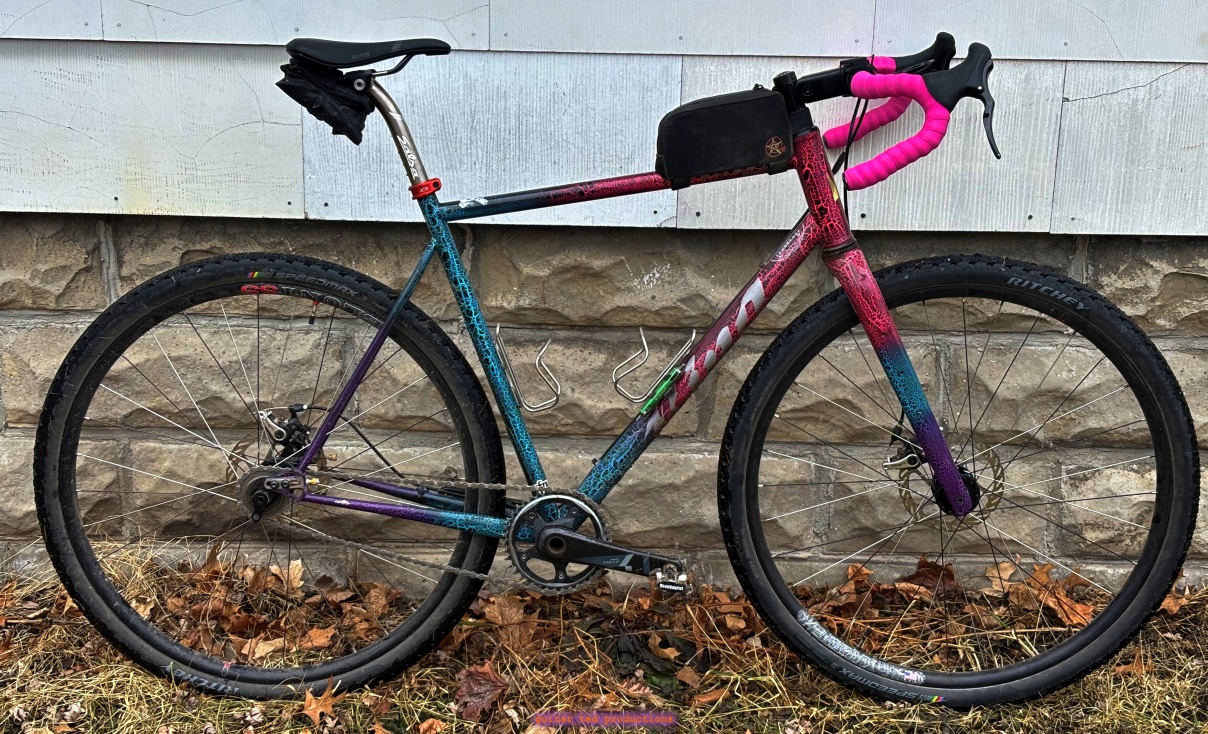
The current state of the King Fabrications Honeman Flyer

Another consideration is a new crank set. I like those Paul cranks which came out recently. I can see upgrading to something like those and doing a nicer bottom bracket as well. 

But I do not need to do anything. These are all just wants/desires. The bike is serviceable and rides so well. So, I am in no hurry to change it up at any point in the near future. 

Monday, December 02, 2024

Bikes Of 2024: King Fabrications "Honeman Flyer"

 It's another December here on the blog. You know what that means? Yep! Another round of my bikes I used in 2024. This round-up will not include some of the bikes I did not use this year much, or at all. I focus only on the bikes that played a big role in my riding during this year.  As always, any changes or future plans for any bike I feature will also be detailed. I hope that you enjoy this year's round-up. 

The King Fabrications "Honeman Flyer" in March of 2024 in Oklahoma. Image by Erik Mathy
The story of this bike is well told, but if you are pretty new here and don't know about the backstory, a brief synopsis to bring you up to speed here will suffice. 

The idea was spawned when I saw an old advertisement posted on Face Book by frame builder Steve Garro of Coconino Bikes. He mentioned that a spec drawing recreated in the ad showing a 1930's era track bike ridden to National Championships in the late 30's by Willie Honeman might actually make a great gravel bike. I said as much on the blog here and then one thing led to another, (See "People Of 2024: Erik Mathy") and I ended up with an exact copy of the geometry of the Pop Warner designed and built bike which Willie Honeman used in the 30's. Extrapolated to fit me, of course. Willie was of smaller stature than I. 

The Honeman Flyer in its most recent incarnation.

I won't get into all nitty gritty of the bike and how it rides. That can be read HERE. What I will say is that I was very surprised by how much I liked this bike and how often I wanted to ride it. I would even throw some shoes on just to ride it around the neighborhood for ten minutes some days. That's an example to show you that there is something to this bike, for me at least, and I am very happy with it. 

I also will say that I did not expect that I would love riding this bike. In the beginning of the project I thought it could be a failed experiment that might end up sitting around the shop for years until I decided to scrap it. But that will not be happening! Thankfully... By the way, yes, a custom bike I had made in 2007 did end up like that minus the scrapped part. I gave it to a friend who loves it now.

Maybe at some point I can get away for a really long ride on this bike. I have some ideas for that..... 

As far as changes go, I went through several seat posts before landing on one of my four Salsa Cycles Regulator Ti posts. I could see going back to a no-offset post again though. So, if one pops up on my radar in titanium I may have to bite on that. Otherwise there is nothing I am seeing here that will change anytime soon.

Saturday, September 27, 2025

Peregrine Mk4 Update


 Someone in the comments said earlier this week the following statement: "Too much Peregrine content?? No way. It’s your New Bike Day/Month! We want all the details! "

Well, be very careful what you ask for, because here is more content about the Peregrine.  

I'm in my "getting to know you" phase of ownership here which includes my making small tweaks to my set up. I can only do this fine tuning after rides lasting from 30 minutes to an hour or so. I ride. I make a tweak. I ride and see if what I did results in what I am after. Rinse and repeat until I finally am satisfied. 

So, to describe why I was 'tweaking' what I was tweaking I have to go back to the original intentions for the build. One of those was to use what I had on the Twin Six as much as possible. This meant avoiding new cables and housings, new brake hoses, and all the things this can entail. In this I was successful. However; because of this I had painted myself in something of a corner which I had to find a way out from behind. 

This mostly had to do with how I was sat on the bike. I was a tiny bit cramped due to the need for the stubby Whisky Parts Co. stem I used. I could not put a longer stem on the bike because I'd have to switch out the rear brake hose, rear cable housing, and rear cable. So, to gain a little bit of the lost reach back, I decided to try to find and use a seat post with a little more setback and a saddle which would also accommodate me in this way as well. I was hoping both things would get me closer to the number I like to see for my reach.  

The Honeman  Flyer with the Thomson seat post, zero offset. 

 Looking at my fleet of bicycles I noted I had not addressed the seat post issue on the Honeman Flyer 100% to my liking.  (The bike with the seemingly never-ending seat post saga!) Anyway..... I had been using a Salsa Cycles Ti Regulator post on this bike which has a fair amount of set back. This was not ideal for the Honeman Flyer's 70° seat tube angle. I started off with a zero offset post on the Flyer and it was better, from an ergonomic standpoint. It was undersized though, and slipped all the time, so it had to go. I eventually landed on the Ti Regulator as a stop-gap solution to end all the slipping seat post madness I was experiencing with this bike. 

Well, if I could find a suitable post for the Honeman Flyer maybe I could poach the seat post for the Peregrine. So, to the seat post bin! (Yes......I have multiple unused seat posts sitting in a big tin can!) I rummaged through this assortment of seat posts and came across a nice silver Thomson post with zero offset. Nice! Now I could swap posts with the Honeman Flyer and maybe get the setback I was looking for. 

The Peregrine Mk4 with the Salsa Ti Regulator and WTB Solano saddle installed. 
Now the Flyer also had a WTB Solano saddle fitted, so I knew this saddle was pretty good with me, and it had a fair amount of rail to use for adjustment. With the saddle slid back as far as allowed, and with the set back on the Ti Regulator, I gained back almost all my preferred reach. Almost, which is fine, because I wanted to try a little less reach and see if I wasn't setting my bicycles up with too much reach, ending up being too stretched out, perhaps. We will see. Remember: Test & Tweak.  Now on to one other interesting point about this bike. 

I'd say that looks like a good half of an inch there.
I had a reader ask about toe overlap with the Peregrine Mk4. Good question! Since this bike can handle big tires, this could be a concern, right? Well, I went out with my size 46 Shimano gravel shoes on, clipped in, and tried to get my foot to touch the front tire. This tire is a 700 X 50mm Schawlbe G-One Overland, for reference. The crank arm length is 172.5mm. 

The image here shows the closest I could get to touching the tire with my toes. I'd say this is not very close! Also, I try to set my cleats back as far as I can, but not all the way back. Very close to it, but I would still have room for my foot even if my cleats were slammed all the way back.

So, the good news here is that a size Large should not cause any issues with toe overlap. Maybe if I were running fenders, I might have toe overlap with this big of a tire, but I bet I'd still be good, if just barely so. 

Had I been sporting the biggest tire which would clear the Peregrine's frame and fork, I probably would get a bit of toe contact, in my opinion, but I'm not planning on going to the extreme which would cause this to happen. 

Next, I had someone in the comments ask about contrasting the ride of the Peregrine with my Gen I Fargo. So, this is really an apples and oranges thing, in my opinion. The Fargo Gen I being a more MTB-leaning drop bar bike, while the Peregrine is based on a classical road bike. Certainly the two overlap in certain aspects, but as far as the ride quality, these are very different bicycles.  

I think it might prove to be enlightening if I just put it this way: I'm not getting rid of either of the two bikes and they will do different things for me. Now if one was doing the same thing for me as the other? One would have to go away, as I wouldn't ride one of them. As it stands, again for myself, this is not the case and both bikes will remain in my service for the time being. 

If anything, this Peregrine is probably more like my Black Mountain Cycles MCD. But I will have to do some back-to-back comparisons to verify this. Keeping in mind the MCD can run 'up to' a 50mm tire, while the Peregrine can handle even slightly larger tires.  

Okay, I think I've covered just about everything I wanted to get to on this update. I hope you folks who had indicated you were fine with more Peregrine content are satisfied! Ha! 

I'll have more to share here soon. I know of one more tweak which is coming, and there may be more. Plus I hope for ride content as well. Stay tuned. 

Monday, March 09, 2026

The Honeman Flyer: Two Years With A Weirdo

The Honemann Flyer March 2026
 This marks the beginning of Year 3 with the bike I dubbed "The Honeman Flyer", a single speed bicycle built by King Fabrications in California. 

Regular blog readers will know this bike well. I thought I would give my impressions of the bike again in view of my previous comments. If this bike is new to you, I have an AI overview of the bike, which is pretty spot-on, concise, and will serve as a way to bring you up to date:

 "The Honeman Flyer is a custom, single-speed gravel bike built by King Fabrications for Guitar Ted Productions, designed based on the 1930s-era track bike geometry of national champion Willie Honeman. It is a unique, super-smooth riding, -framed bike featuring a slack seat tube and modern components, intended to test the relevance of classic geometry for modern gravel riding."

I'll only add that the geometry and the frame and fork Willie rode to three national championships on the track was built by John "Pop" Brennan.  

My last look at this bike was last December in my "Bikes of 2025" post.  You can check that one out if you'd like to. 

Ben Petty (L) and Guitar Ted riding the Honeman Flyer last October

 I have written a ton about this bike so I won't try to rewrite again things I've covered before. I will say this bike seems to be tied to seat post changes. I went with a carbon Whisky Parts Co. post on this, switching out the old post in early March. About a week ago, to be exact. Early returns are good with the original look being present once again, which I happen to like better. 

I re-wrapped the bars with Ergon AllRoad tape. I also installed the Ergon saddle I recently recieved in for review. Both parts were introduced HERE. The black handlebar tape really looks different. I'm so used to running pink hues for handlebar tape on this bicycle. With all the black additions I think it brings out the black crackle overcoat on the paint job. 

I'll be doing a lot of riding on this bike in 2026. Again, it is one of my better riding bicycles. Li King did a great job choosing tubing and fabricating the design. It's kind of funny, but Li hasn't ever shown or mentioned this bicycle since. I would imagine because it seems too weird for many folks to even contemplate. 

It is not in the latest geometry trends or feature trends for a gravel bike. It won't take anything wider than a 44mm tire. It really should be a 40mm tire. It is steel. It doesn't have gears. No down tube storage box. And that radical rear end of this bike. 

I mean, how does anyone ride a bike like this in 2026

Easy - One pedal stroke at a time!

And what about this experiment's relevance to modern day gravel geometry? I'd say everything from the bottom bracket forward is spot on. The back end? Weird. Not relevant at all.  

Anyway, the bike is surprisingly fun to ride, it handles very well for myself, and in the end, this is all that really matters. It suits me very well. I would not expect anyone else to like such a weird bike. To ride, at any rate. It does also look cool, which is good, but yeah - 1980's crackle finish paint is not everyone's cup of tea. 

Weird bike, weird paint job, weirdo rider. Seems like a match made in heaven.  

Wednesday, February 21, 2024

Introducing "The Honeman Flyer"

The Honeman Flyer by King Fabrication. (Image courtesy of Li King)
  Okay, I kind of kept this under wraps until I was sure that it was going to be a reality. Now that it is, I can tell you that I own this frame and fork and it is currently on its way to me now. 

If you've been around the blog from late last year you already have a clue as to what this is, but for those that may not know, this is a single speed specific bike based upon a 1930's track bike design by a Mr. Brennan and was a design I came across from a Facebook post. 

That post showed an advertisement from a page from a Popular Mechanics issue from the 1940's. Willie Honeman's frame building business was advertising his talents in that magazine and in the ad he showed his 1930's track bike which he won a championship on. The ad was very detailed so frame measurements and angles and such were all there. 

This prompted me to consider if track bikes, which were ridden by their owners at times over the roads to track events or for training, was a precursor to modern day gravel geometry. I wondered if such a beast, modernized, would actually work today. 

Image courtesy of Erik Mathy

Briefly, the design borrows from the geometry of the Honeman/Brennan bike right down to the super-slack seat tube, but extended to fit my 6'1" frame. (The original was long, a top tube that would work for me, but had a short seat tube) The numbers will be double-checked when it arrives and I will divulge what we have here at that point. 

The modern bits are flat mount brakes, a carbon Salsa Waxwing fork, and Paragon Machine Works sliding drop outs for through axles. The head tube is a straight 44mm one so I will be using a modern, threadless head set. But the bottom bracket is still a standard, threaded BSA version, just like the old Honeman had.

The frame features King Fab's signature double brake bridge and through-to-bare metal logo on the downtube and top tube. That rectangular patch on the non-drive chainstay is where the serial number is stamped into the frame. The paint I left up to Li to choose other than that I told him that I liked King Fab's crackle-paint jobs and that my favorite colors were purple, green, and that I liked pink. What you see here is what Li decided on for me. I quite like it.

The parts are almost all figured out for this rig and I do have to get to building it right quick as this is going to Mid-South with me. 

Yes, I also hadn't said anything about that, but it is all part of "The Plan" and no- I was not 100% in charge of "The Plan".  This will all be explained in due time. Stay tuned....

Thursday, September 21, 2023

A Search For "Gravel" Geometry": Part 3 - Is This Really New?

Okay, so far we've looked at how geometry can be a tradition, a myth, and how the "human factor" can adapt differing geometries making anyone saying that "this" geometry is THE geometry for any particular bicycle an erroneous statement. We also know that manufacturing, fashion, and popular figures in sport can influence what geometry might be baked into a bicycle at your local retailer. 

But certain things are better than others, so where do you look to find out what works? Well, you need to think about what you want to do with your bike, and then you need to think about how your rides might look, and of course, where your rides will take place in terms of terrain. 

never thought about anyone else but myself when I was thinking about a "gravel bike". I was thinking about long rides. I was thinking about stability, comfort, and all that on crushed rock roads, which we have 70,000+ miles of in the State of Iowa. I never was what you'd call a "roadie", having come from a mountain biking point of view, but before that, a rider that just wanted to ride a bicycle wherever I could go. In Iowa, that means gravel, pavement, and some dirt. 

My cycling as a youth was all over my small Northeastern Iowa city. I enjoyed bikes that I could ride no-handed for blocks upon blocks. It was easy, and the bike was friendly, not a hassle to pilot. Why ride a bicycle if you have to fight the bike just to get down a road, be that into a wind, on a rough surface, or on gravel? I figured that I wasn't the first person to have done this, or to have thought about this. So, I searched online years ago to see what sorts of bicycles riders used in the early 20th Century. 

A page from "Bicycling" magazine from the 40's detailing Willie Honeman's track bike.

A few things were becoming evident in my searches. The front end geometry was going to be numero uno in importance here. That, more than anything else, was going to determine how my "ideal gravel bike" would handle. 

My research pointed to a bike with a slightly slacker head tube angle, a healthy amount of fork offset, but nothing crazy, and a lower bottom bracket coupled with a bit longer than road bike chain stay length. Everything would be wrapped around some poofy tires, 42mm at least, and there would be room for mudguards too. 

That was all derived from older road bikes, but the discovery earlier this year of a page out of "Bicycling" dated from the 1940's kind of opened up my eyes to another source of geometry ideas that I had not considered before - Track racing. 

Nowadays a track bike isn't what it was back in the 1930's, when a man by the name of Willie Honeman was a track cycling champion, and neither were the machines like they are now back then. If you read the article correctly, the head tube angle is not some crazy steep degree. It is 72° and the bottom bracket drop, which is hardly anything on a modern track bike, is a healthy 75mm on this older design. The seat tube angle is 70°, rather slack, but that was still not uncommon in the 1930's.  Chainstays? About 430mm. Perfect for a 42mm tire. Well....not a track racing tire, but you know what I was thinking now. 

And the kicker? That is a 58cm top-tube on this frame. That's my size. 

And so what? What does this have to do with a gravel bike? Well, in old school track racing, which could be a multiple day affair, stability was prized. That also is reflected in the fork offset on the Honeman bike which is approximately 38mm. You had to be able to hold a line, especially no-handed. You could not be fighting the bike, because all the rider's energy had to go into moving forward and not be wasted by fighting the geometry. All the things I'd want in a bike, this track bike design has also. 

It's interesting to note that in the article, Honeman recommends a slightly slacker head tube angle for rough road riding. So, right up my alley. And again, all things which were race and rider proven design. It only makes sense then that gravel bikes have a similar design to cover rougher roads with stability and less rider fatigue induced by bad angles or less comfortable geometry.  

But I gotta admit. A track bike wasn't where I thought I'd find my ideas being proven out. 

Next: On Saturday - The Honeman Sprinter