Showing posts with label clipless pedals. Show all posts

Thursday, January 18, 2024

All About Pedals

 Recently I was messaged about doing an "explainer post" on the subject of pedals. The person told me that they used clip and strap pedals and were wondering about clipless and shoes and all of that. So, I thought that we cannot assume that everyone knows about pedals. Because  - obviously - there are questions. I hope that this post provides answers and is valuable to some of you out there. 

Pedals. They are invaluable for cycling and are one of the three VERY important "contact points" humans have with bicycles. As such, I feel that pedals actually deserve more scrutiny than they get from the cycling brands and pundits. A bad, or even a mediocre pedal can ruin a ride, make cycling no-fun, and no one wants that! 

Types of Pedals: There are different pedals but essentially they can be grouped in three categories: Clip & Strap, Clipless, and Flats. I'll discuss the tree types and then we will get into why you might choose one over the other. Plus, I'll share what I think as well about pedals for my cycling purposes.

A typical clip & strap pedal (Image snagged from eBay)

Clip & Strap Pedals: These pedals were developed late into the 19th Century to help racers feet stay on the pedals. Having no ability to coast due to their fixed gear drive trains of the day, these single speeders were in danger of having their legs beaten by whirling crank sets and crashing when their feet slipped off unexpectedly. A metal "clip" was developed that went from the front edge of the pedal, wrapped around the front of the rider's shoe, and the came up over the instep a bit. That end had a loop with a strap through it which crossed the foot, went through the pedal body, and was adjustable for tension. Good for securing the foot to the pedal. Not so good if you had to execute a quick dismount of your bicycle! 

Clip & Strap pedals were usually only used then by racers and cycling enthusiasts who toured or were into racing bikes and track riding. However; when mountain bikes came along, with their rough terrain and often wet, muddy, and therefore slippery aspects, the clip & strap pedal became the defacto MTB pedal of choice by the late 1980's and every good MTB was equipped with them from that point until 1992. Then.....
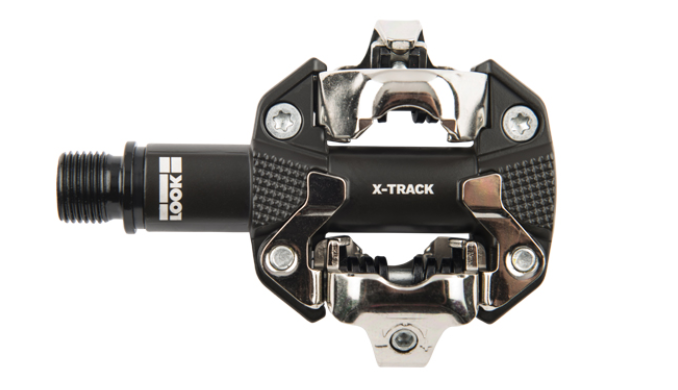
Dual-entry clipless pedal

Clipless Pedals: In the mid-1980's, LOOK, a ski binding manufacturer, came up with a binding for cycling, made it in a pedal format, and provided a shoe with a corresponding cleat attached to the bottom that would snap into the pedal via a sprung cleat pocket. This single-sided entry pedal was marketed at first to road racers. Instead of having to reach down to release a toe-strap on a clip & strap pedal, now the rider could disengage from the pedal by simply twisting sideways with the heel. The name "clipless" came about because the pedal LOOK came up with did not have to have the "clip" over the front of the foot. Thus "clipless", even though most people would say that a clipless pedal is one you "clip into", so this is confusing for many folks. 

By 1992 Shimano developed the clipless pedal for mountain biking with a dual-sided entry pedal, two-bolt cleat type shoe interface which became the de-facto industry standard for off-road a few years later. Since then, clip & straps for MTB has fallen out of favor with most mountain bikers.

Of course, the advantages of clipless are that you will not slip off the pedal and you can easily disengage from it, unlike toe clips and straps. Plus your feet won't suffer damage from overly-tight toe straps.  Disadvantages are that you have to have a corresponding shoe and proper cleat. 

A single-sided "road" pedal that takes a two-bolt cleat.

There are typically two types of clipless pedals. MTB and Road. The difference is that Road can usually only be clipped into one way while MTB pedals typically can be clipped into on both sides. The "cleats" vary as well. MTB cleats typically are "two-bolt" while Road cleats typically are triangular in shape and require three bolts to attach to the shoe. And yes, shoes vary according to this standard as well. So, if you have a road bike with road pedals and a mountain bike with mountain bike pedals you will have two sets of pedals and two pairs of shoes. One set for Road, one for MTB.

One note about clipless pedal specific shoes: These can vary wildly, and have styles all over the map. Some look like normal "civvie" shoes while others may look like something an alien fashion model might wear. The general idea, besides matching up with a Road or MTB standard, is that the shoe gives you a better, stiffer platform to pedal off of, theoretically making you more efficient. However; cycling specific shoes can make walking a real chore, or next to impossible, depending upon the shoe. Some of the more casual cycling shoes actually aren't too bad to wear on the daily, but conversely, you might feel compromised while pedaling. 

Flat Pedals (Platform Pedals): These are , like the name implies, a flat platform for your feet to push on. These are the type of pedals you probably learned to ride a bike with. These can vary in form-factor quite a bit. You'll see the most basic, cheaply made flat pedals on department store bikes and even on entry level bike-shop quality bikes. These usually are not very good, being made of poor quality plastic and having poor quality bearings. 

Fyxation Mesa MP flat pedals. (Image courtesy of Fyxation)

However; there are high-quality, durable flat pedals made from composites and plastics. Obviously there are also aluminum ones as well. These can vary in price greatly. 

Most notably used for steep mountain biking, fixed gear, and recreational riding, flat pedals can actually be kind of freeing. You can wear whatever shoes are on your feet, mostly, and there are no special accessories necessary. 

Some flat pedals have pins which provide grip on the shoe to keep your foot in place. These same pins can shred your shin if you inadvertently do slip a pedal and end up slamming the pedal into your leg. Other flat pedals are smoother surfaced but may have a friction material applied to help with foot slippage issues. 

What Pedal is Right For You?: This is a great question and your bicycle may help you answer it. That and how you ride will be your ultimate guide here. So, let's think about some obvious things first. Then I'll get into what I think personally and I will give you some recommendations. 

 The style of bike you have may be all you need to guide you. That said, Road bikes can be fitted with dual-sided MTB pedals and flats. A mountain bike could have flats or road bike pedals. You get the picture. Traditionally Road pedals go on Road bikes and MTB pedals go on MTB's, etc. Flats used to be the realm of BMX bikes but now a lot of different uses for flats have been noted. 

This Ergon flat pedal has a sandpaper-like friction material bonded to it.

I don't think you have to think about the bike much, but rather, how you want to live with your bike. That is most important. Are you the type that doesn't sweat getting a personal record on a segment and just wants to have fun riding? Maybe you are more practically motivated and you use your bicycle for errands and transportation. Maybe you like simplicity and low cost. Maybe all of the above? Then this points you to flat pedals. 

Flats are no less efficient than clipless, and but for foot retention purposes, flats would be the number one choice, in my view. Flats pretty much allow you to use any shoe or boot and the cost is kept low due to that. Plus, the pedals themselves can be less expensive and very high quality. 

But, if foot retention is a high-priority, and ground clearance is an issue, then clipless pedals are better. Also, if you have specific needs based around issues with your feet, you can get customized orthotics and even cycling shoes that mold to your feet. Plus, cycling shoes are more efficient than most civvie shoes, and cooler when it is hot. (If you get warm-weather cycling shoes, that is.) Clipless often is best in severe, muddy, rainy weather and might allow you to do tricks easier than with flat pedals like "bunny-hopping" or moving either wheel sideways or off the ground. 

A variation of the strap system for foot retention. (Image courtesy of Fyxation)

The old-school clip & strap pedals are pretty archaic. You can use them, but if foot retention is an issue, clipless is a lot safer to get in and out of while riding. The safety factor alone is worth the price of the shoes and pedals, in my view. 

There is the fixie single strap type pedal and these may be a good compromise between pure flats and clip and strap styles. 

My personal view is that flat pedals rule. They allow me to just hop on a bike and go at a moments notice. That said, I do like my clipless on gravel. The dust and heat in Summer is best taken in while using cycling shoes which can be vented and cooler. Plus, the rougher sections won't shake me out of my pedals, nor will unseen potholes and ruts. 

So, there you go. The basics of pedals. I can get into the "how" and mechanical bits about pedals if anyone wants to read that. Or, maybe you have questions? Suggestions and questions can be sent to me via the comments or at g.ted.productions@gmail.com

As always, thanks for reading G-Ted Productions!

Friday, October 11, 2019

Friday News And Views

Updated Cutthroat for 2020. Image courtesy of Salsa Cycles
Salsa Cycles Announces Redesigned Cutthroat:

If you follow social media at all, you already have seen the new Salsa Cycles Cutthroat by now. I won't go over all of the nitty-gritty of the new design, but I wanted to touch upon a few things that struck me about this announcement and the bike.

I've not been a big fan of carbon fiber as an adventure bike/gravel bike frame material since I've seen first hand what a muddy ride can do to a carbon frame. Now, you may say something to the effect of "Well, how many times is that going to happen on typical gravel rides?" Well, I've been doing this activity around the Mid-West for a decade and a half and I can tell you the answer is, "It happens a LOT". Yes- even when it doesn't rain. 

So, with that out of the way, I have advocated for some sort of protective inserts in high wear areas on carbon frames to ward off premature wear through while traversing muddy areas. I've seen damage occur with one passing on a one mile section, and that without riding the entire section. So, this isn't a wild, out of the ordinary request. Now Salsa is doing this on the new Cutthroat. It's a start, but more bike companies need to adopt this practice on gravel/adventure rigs,

The other thing they did with more fork compliance is another "no-brainer" design feature other bike companies need to adopt. At least we aren't still thinking those overly stiff carbon Enve forks and their ilk are good for gravel. Compliance is king, and Salsa figured this out. Kudos.

But did anyone notice that they are calling these new models "Carbon Cutthroats"? Hmm..... This begs the question, "Why even bother using Carbon in the name unless there is a Cutty coming in another material?" I mean, of course a Cutthroat is carbon. They have always been so. Makes you wonder.......

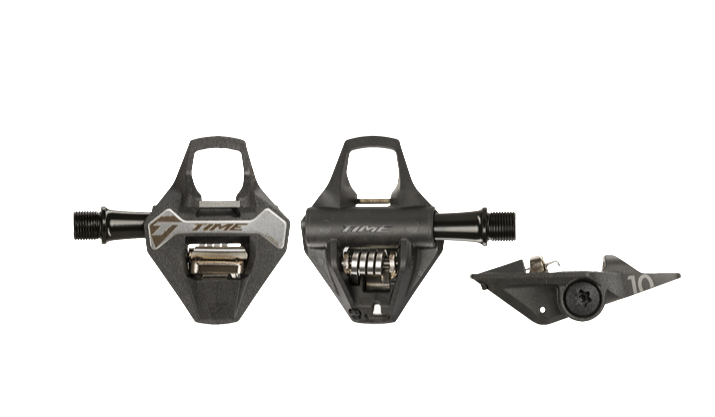
TIME Ciclo "gravel" pedals.
At First They Said It Was Stupid......

1990: Shimano introduces a clipless mountain bike pedal dubbed the M-737, but it quickly became known as "Spud", a verbal rendering of "SPD" which stood for Shimano Pedal Dynamics.

Howls of "you don't need mountain bike specific pedals!" were heard from all sectors of the land back then. But today? While there has been a renaissance of flat pedal use, the clipless pedal is "The Standard" for more than mountain biking.

Fast forward to 2019. TIME introduces a pedal based on road pedals wider, more performance oriented platform, but capable of being used with any two-bolt cleat compatible shoe. (A cleat/shoe compatibility first introduced by the "Spud" in 1990) TIME calls it "the first gravel pedal design". Cue the howls of derision.

I'm really not quite sure about the "how" of this pedals supposed advantages, but here's the deal. If there is anything to it, it will catch on. MTB shoes and pedals are, generally, over-built for what amounts to road riding without the paved roads. You aren't likely to be side swiping big rocks, branches, or pointy, sharp things wielded by desert plants. Not on typical gravel and dirt roads anyway. A more efficient platform and walk-able shoes? Sounds good to me. If it is an advantage, I can totally see it taking off.

Now I have seen comments like, "Yeah, but how many times do you actually get off your bike during a gravel race?" To which I would answer, "Well, if you even have to get off once, wearing road shoes is a disadvantage, not to mention mud, which can foul your pedal interface even if you don't get off." I've actually seen this in an MTB race I was in in the 90's. I've also seen road pedals and shoes finish Trans Iowa. (That rider mentioned the wider platform which he preferred) So, horses for courses and whatever works.

But for those of you that like to poo-poo the latest "specific" component, accessory, or bike, I hope that you are consistent in your lifestyle and use only one bike for everything and use a fixed gear bike, because anything else "you don't really need". On the other hand, if you have some well thought out criticisms or thoughts about the latest craze, well then, carry on......

MG checked out the Roval wheels recently in Calli.
Materials Technology: 

When it comes to bicycles, almost anything you see that is called an "innovation" was already thought of over a hundred years ago, or close to that. When bicycles represented technology akin to what we feel about artificial intelligence, or digital ......well almost anything, back in the 1890's, ideas were flowing like water. Things were dreamt up then that would not look alien to a savvy cycling aficionado today.

So, why didn't they have full suspension bikes, wide, tubeless rims and tires, and more back then? 

Materials technology. Mostly, that is what held everyone back from realizing their dreams back in the day. The recent Roval wheel debut in California is a prime example of what I am talking about.

You don't have to go back a hundred years to see this at work either. Think about 29"er rims circa ten years ago or maybe 12 years ago. The widest thing going was, what? A Stan's Flow? There were oddball rims like the SUN Ringle' MTX and the Salsa Gordo, but those weighed a metric ton. Stan's Flow rims were 28mm outside width, or so. Inner width? Maybe what? 24mm? (HOLD ON)...... Okay, I just remembered I have an old Flow rim. It measured a hair over 27mm outer and 22.3mm inner. Okay.....those were considered trail MTB rims in 2007. 

Build weights for rims that wide back then were close to 2000 grams a pair and we thought that was fine. Fast forward to today. Roval introduces a gravel rim/wheel set. It has 25mm inner width, and full wheel builds are sub-1300 grams for a pair.

WTH!! 

The thing is we are like, "Oh..... Yeah, that sounds pretty cool." When we should be floored. We are sooooo jaded when it comes to this sort of thing, in my opinion. Yes......the wheels are prohibitively expensive. Yes.....no one "needs them", at least in the sense that you cannot cycle without them, or whatever. But, you cannot deny that they would be awesome to ride with. Rims that wide, and light? That's materials technology right there. That's what I was talking about. It's amazing how this facet of engineering has brought so many cool ideas from long ago (or even just ten years ago) to life, or made them practical.

That's it for this week. Have a great weekend and get out and ride!

Friday News And Views

Updated Cutthroat for 2020. Image courtesy of Salsa Cycles
Salsa Cycles Announces Redesigned Cutthroat:

If you follow social media at all, you already have seen the new Salsa Cycles Cutthroat by now. I won't go over all of the nitty-gritty of the new design, but I wanted to touch upon a few things that struck me about this announcement and the bike.

I've not been a big fan of carbon fiber as an adventure bike/gravel bike frame material since I've seen first hand what a muddy ride can do to a carbon frame. Now, you may say something to the effect of "Well, how many times is that going to happen on typical gravel rides?" Well, I've been doing this activity around the Mid-West for a decade and a half and I can tell you the answer is, "It happens a LOT". Yes- even when it doesn't rain. 

So, with that out of the way, I have advocated for some sort of protective inserts in high wear areas on carbon frames to ward off premature wear through while traversing muddy areas. I've seen damage occur with one passing on a one mile section, and that without riding the entire section. So, this isn't a wild, out of the ordinary request. Now Salsa is doing this on the new Cutthroat. It's a start, but more bike companies need to adopt this practice on gravel/adventure rigs,

The other thing they did with more fork compliance is another "no-brainer" design feature other bike companies need to adopt. At least we aren't still thinking those overly stiff carbon Enve forks and their ilk are good for gravel. Compliance is king, and Salsa figured this out. Kudos.

But did anyone notice that they are calling these new models "Carbon Cutthroats"? Hmm..... This begs the question, "Why even bother using Carbon in the name unless there is a Cutty coming in another material?" I mean, of course a Cutthroat is carbon. They have always been so. Makes you wonder.......

TIME Ciclo "gravel" pedals.
At First They Said It Was Stupid......

1990: Shimano introduces a clipless mountain bike pedal dubbed the M-737, but it quickly became known as "Spud", a verbal rendering of "SPD" which stood for Shimano Pedal Dynamics.

Howls of "you don't need mountain bike specific pedals!" were heard from all sectors of the land back then. But today? While there has been a renaissance of flat pedal use, the clipless pedal is "The Standard" for more than mountain biking.

Fast forward to 2019. TIME introduces a pedal based on road pedals wider, more performance oriented platform, but capable of being used with any two-bolt cleat compatible shoe. (A cleat/shoe compatibility first introduced by the "Spud" in 1990) TIME calls it "the first gravel pedal design". Cue the howls of derision.

I'm really not quite sure about the "how" of this pedals supposed advantages, but here's the deal. If there is anything to it, it will catch on. MTB shoes and pedals are, generally, over-built for what amounts to road riding without the paved roads. You aren't likely to be side swiping big rocks, branches, or pointy, sharp things wielded by desert plants. Not on typical gravel and dirt roads anyway. A more efficient platform and walk-able shoes? Sounds good to me. If it is an advantage, I can totally see it taking off.

Now I have seen comments like, "Yeah, but how many times do you actually get off your bike during a gravel race?" To which I would answer, "Well, if you even have to get off once, wearing road shoes is a disadvantage, not to mention mud, which can foul your pedal interface even if you don't get off." I've actually seen this in an MTB race I was in in the 90's. I've also seen road pedals and shoes finish Trans Iowa. (That rider mentioned the wider platform which he preferred) So, horses for courses and whatever works.

But for those of you that like to poo-poo the latest "specific" component, accessory, or bike, I hope that you are consistent in your lifestyle and use only one bike for everything and use a fixed gear bike, because anything else "you don't really need". On the other hand, if you have some well thought out criticisms or thoughts about the latest craze, well then, carry on......

MG checked out the Roval wheels recently in Calli.
Materials Technology: 

When it comes to bicycles, almost anything you see that is called an "innovation" was already thought of over a hundred years ago, or close to that. When bicycles represented technology akin to what we feel about artificial intelligence, or digital ......well almost anything, back in the 1890's, ideas were flowing like water. Things were dreamt up then that would not look alien to a savvy cycling aficionado today.

So, why didn't they have full suspension bikes, wide, tubeless rims and tires, and more back then? 

Materials technology. Mostly, that is what held everyone back from realizing their dreams back in the day. The recent Roval wheel debut in California is a prime example of what I am talking about.

You don't have to go back a hundred years to see this at work either. Think about 29"er rims circa ten years ago or maybe 12 years ago. The widest thing going was, what? A Stan's Flow? There were oddball rims like the SUN Ringle' MTX and the Salsa Gordo, but those weighed a metric ton. Stan's Flow rims were 28mm outside width, or so. Inner width? Maybe what? 24mm? (HOLD ON)...... Okay, I just remembered I have an old Flow rim. It measured a hair over 27mm outer and 22.3mm inner. Okay.....those were considered trail MTB rims in 2007. 

Build weights for rims that wide back then were close to 2000 grams a pair and we thought that was fine. Fast forward to today. Roval introduces a gravel rim/wheel set. It has 25mm inner width, and full wheel builds are sub-1300 grams for a pair.

WTH!! 

The thing is we are like, "Oh..... Yeah, that sounds pretty cool." When we should be floored. We are sooooo jaded when it comes to this sort of thing, in my opinion. Yes......the wheels are prohibitively expensive. Yes.....no one "needs them", at least in the sense that you cannot cycle without them, or whatever. But, you cannot deny that they would be awesome to ride with. Rims that wide, and light? That's materials technology right there. That's what I was talking about. It's amazing how this facet of engineering has brought so many cool ideas from long ago (or even just ten years ago) to life, or made them practical.

That's it for this week. Have a great weekend and get out and ride!

Wednesday, October 21, 2015

The Curious Case Of Onza

Back in the late 80's and early 90's, you knew, if you were into mountain biking, who Onza was. You had either seen their product, read about it, or had seen the ubiquitous porcupine sticker on a buddies rig at the trail head. You knew what Onza was. Bar ends, Porcupine tires, and those infamous HO Pedals.

But before I get to more about those pedals, I wanted to revisit the Onza juggernaut for a bit. Thinking back on that time, I cannot really say that any other company had such an over-arching success with mountain bikers. They had the bar end business locked up. You either rode Onza bar ends, or you weren't cool. The same with their tires for a time as well. Who could forget the white Porcs?

An old Onza catalog page courtesy of the "new" Onza's Facebook page.
  They also did something before anyone else did, in my opinion. Onza had a wide range of OE spec on mountain bike product and across more brands than anyone else. (English Translation: Their parts came on all kinds of mountain bikes) They made chain rings, seat posts, tires, brakes, and grips. Many higher end bikes from many companies were spec'ed out with at least something from the Onza catalog.

Added to this was the fact that Onza was a presence on race bikes of the best racers. One must understand that there was no internet to see things with. We had to actually wait to get our next monthly fix of Mounatin Bike Action, or Dirt Rag and we would disect the Pro race bike overviews to see what they were running, because, you know, that's what we should be running, right? And those guys and gals, in many cases, were sporting something Onza made on their rigs. Sponsorships for Pro mtb racers were something of a free-for-all back in the day, and racer's set ups were often rather eclectic mixes of several brand names.

Another thing we did was that we devoured everything in print in the mags, including the ads, and Onza spent a lot of bucks on adverts. Like I said, it seemed like Onza was everywhere on everyone's bikes. Plus, it didn't hurt that their product was fairly priced and worked pretty well.

So, when clipless pedals came out, and Onza introduced the HO's, riders went ga-ga over them, because their retail price was significantly less than Shimano's or Time's for their pedals, and they were actually available, unlike Graftons and some others. Consequently, tons of people bought tons of Onza HO pedals. Oh yeah.....and they were also significantly lighter in weight than anyone's pedal designs. I remember that being a big selling point as well. Shimano 747's and Time pedals, while vastly superior designs, were tankish anchors that were far heavier than our old toe strapped caged pedals. No one was interested in slapping more weight on their rigs. Then of course, some of us never did get clipless pedals because you had to buy special shoes. What? No Chuck Taylors anymore? Blasphemy!! 

An Onza HO pedal still in use as seen on my workstand the other day.
 What is more, Onza HO pedals were many folks first rodeo with clipless pedals. So, when the elastomer sprung pedals started to exhibit very unpredictable behaviors out in the field, many riders were befuddled, discouraged, or just got mad and either ponied up for another system or reverted back to toe straps and caged pedals.

I was one of these "first timers", but not for lack of trying to get into a competing system. I initially went for Grafton pedals, which were a cool, caged pedal design that had a funky, triangular cleat. I got the pedals, but I never could get the cleats, so finally, after a few months of going back and forth with Grafton, I "settled" for the wildly popular Onza pedal. Boy.....was that ever a mistake! (Both the Graftons and the Onzas!) Anyway, it wasn't long before I was crashing my brains out on just about every ride because I was a clipless pedal newbie. Or was that really why. Eventually I caught on to the fact that it was really the pedals, and I was looking like an idiot falling over after every body else had stopped safely. Eventually, my HO's came off, and I got some Shimano based Ritchey pedals instead. Funny thing happened after that........I didn't crash anymore like I had been. 

Suddenly the word got around- Onza pedals suck- and riders turned in their Onza pedals with the boxes of extra elastomers by the dozens, literally. I can remember down at the old shop where I started that we had piles of Onza clipless pedals in boxes that no one wanted anymore. Well.......that isn't entirely true. Some people actually liked Onza HO pedals, and so they eventually bought up all the piles of parts and pedals to keep theirs going. Oh- and if you are still in the market for some Onza HO pedal stuff, click here.

This all coincided with the "CNC Era" and many folks were getting burned by poor performing, high priced "chi-chi" parts, and Onza kind of got caught in the cross hairs. Plus, their OE spec went way down when other companies started doing their own branded accessory parts. Combined with the poor PR from the pedals, Onza disappeared as a major force in the mtb marketplace by the late 90's. The only thing they left behind were those silent reminders, those porcupine stickers, which seemed to be on about every used mountain bike for several years afterward.

The "new" (again) Onza is UK based and just introduced a couple of cool steel frames like this 29"er. 
Onza disappeared completely from the US scene, and from mountain biking as a whole, for years. The brand was revived in the 00's by a UK company and the brand was seen on many trailsin parts and bikes for several years. I actually had an Onza branded trails freewheel on my Blackbuck, albeit for a very short time, as it failed rather quickly. Then, later on in the 00's the brand was used by another firm for tires only. You may have noticed Onza branded tires on some BMC bikes and other Euro brands recently.

Now it seems that the UK Onza is getting back to doing mountain bike stuff again with a line of handle bars, stems, and flat pedals. I just caught on to the new frames as well, which look rather cool. So, Onza, a company once on top of the mtb hill, is back at it again, albeit in a much smaller, localized way. Will they ever be a player in the US again? Who knows, but if they decide to come over and play here again, I would advise against any elastomer based clipless pedal reprises!

The Curious Case Of Onza

Back in the late 80's and early 90's, you knew, if you were into mountain biking, who Onza was. You had either seen their product, read about it, or had seen the ubiquitous porcupine sticker on a buddies rig at the trail head. You knew what Onza was. Bar ends, Porcupine tires, and those infamous HO Pedals.

But before I get to more about those pedals, I wanted to revisit the Onza juggernaut for a bit. Thinking back on that time, I cannot really say that any other company had such an over-arching success with mountain bikers. They had the bar end business locked up. You either rode Onza bar ends, or you weren't cool. The same with their tires for a time as well. Who could forget the white Porcs?

An old Onza catalog page courtesy of the "new" Onza's Facebook page.
  They also did something before anyone else did, in my opinion. Onza had a wide range of OE spec on mountain bike product and across more brands than anyone else. (English Translation: Their parts came on all kinds of mountain bikes) They made chain rings, seat posts, tires, brakes, and grips. Many higher end bikes from many companies were spec'ed out with at least something from the Onza catalog.

Added to this was the fact that Onza was a presence on race bikes of the best racers. One must understand that there was no internet to see things with. We had to actually wait to get our next monthly fix of Mounatin Bike Action, or Dirt Rag and we would disect the Pro race bike overviews to see what they were running, because, you know, that's what we should be running, right? And those guys and gals, in many cases, were sporting something Onza made on their rigs. Sponsorships for Pro mtb racers were something of a free-for-all back in the day, and racer's set ups were often rather eclectic mixes of several brand names.

Another thing we did was that we devoured everything in print in the mags, including the ads, and Onza spent a lot of bucks on adverts. Like I said, it seemed like Onza was everywhere on everyone's bikes. Plus, it didn't hurt that their product was fairly priced and worked pretty well.

So, when clipless pedals came out, and Onza introduced the HO's, riders went ga-ga over them, because their retail price was significantly less than Shimano's or Time's for their pedals, and they were actually available, unlike Graftons and some others. Consequently, tons of people bought tons of Onza HO pedals. Oh yeah.....and they were also significantly lighter in weight than anyone's pedal designs. I remember that being a big selling point as well. Shimano 747's and Time pedals, while vastly superior designs, were tankish anchors that were far heavier than our old toe strapped caged pedals. No one was interested in slapping more weight on their rigs. Then of course, some of us never did get clipless pedals because you had to buy special shoes. What? No Chuck Taylors anymore? Blasphemy!! 

An Onza HO pedal still in use as seen on my workstand the other day.
 What is more, Onza HO pedals were many folks first rodeo with clipless pedals. So, when the elastomer sprung pedals started to exhibit very unpredictable behaviors out in the field, many riders were befuddled, discouraged, or just got mad and either ponied up for another system or reverted back to toe straps and caged pedals.

I was one of these "first timers", but not for lack of trying to get into a competing system. I initially went for Grafton pedals, which were a cool, caged pedal design that had a funky, triangular cleat. I got the pedals, but I never could get the cleats, so finally, after a few months of going back and forth with Grafton, I "settled" for the wildly popular Onza pedal. Boy.....was that ever a mistake! (Both the Graftons and the Onzas!) Anyway, it wasn't long before I was crashing my brains out on just about every ride because I was a clipless pedal newbie. Or was that really why. Eventually I caught on to the fact that it was really the pedals, and I was looking like an idiot falling over after every body else had stopped safely. Eventually, my HO's came off, and I got some Shimano based Ritchey pedals instead. Funny thing happened after that........I didn't crash anymore like I had been. 

Suddenly the word got around- Onza pedals suck- and riders turned in their Onza pedals with the boxes of extra elastomers by the dozens, literally. I can remember down at the old shop where I started that we had piles of Onza clipless pedals in boxes that no one wanted anymore. Well.......that isn't entirely true. Some people actually liked Onza HO pedals, and so they eventually bought up all the piles of parts and pedals to keep theirs going. Oh- and if you are still in the market for some Onza HO pedal stuff, click here.

This all coincided with the "CNC Era" and many folks were getting burned by poor performing, high priced "chi-chi" parts, and Onza kind of got caught in the cross hairs. Plus, their OE spec went way down when other companies started doing their own branded accessory parts. Combined with the poor PR from the pedals, Onza disappeared as a major force in the mtb marketplace by the late 90's. The only thing they left behind were those silent reminders, those porcupine stickers, which seemed to be on about every used mountain bike for several years afterward.

The "new" (again) Onza is UK based and just introduced a couple of cool steel frames like this 29"er. 
Onza disappeared completely from the US scene, and from mountain biking as a whole, for years. The brand was revived in the 00's by a UK company and the brand was seen on many trailsin parts and bikes for several years. I actually had an Onza branded trails freewheel on my Blackbuck, albeit for a very short time, as it failed rather quickly. Then, later on in the 00's the brand was used by another firm for tires only. You may have noticed Onza branded tires on some BMC bikes and other Euro brands recently.

Now it seems that the UK Onza is getting back to doing mountain bike stuff again with a line of handle bars, stems, and flat pedals. I just caught on to the new frames as well, which look rather cool. So, Onza, a company once on top of the mtb hill, is back at it again, albeit in a much smaller, localized way. Will they ever be a player in the US again? Who knows, but if they decide to come over and play here again, I would advise against any elastomer based clipless pedal reprises!