Showing posts with label through axles. Show all posts

Friday, January 11, 2019

Friday News And Views

Guitar Ted To Speak At The Iowa Bicycle Summit:

Recently I received a request to speak and give a presentation on gravel routes, how gravel events benefit communities, and more at the upcoming Iowa Bicycle Summit in Des Moines, Iowa January 25th.

It is an honor to have been asked to do this and I am excited to share what I know about the gravel scene with city planners, county officials, and city and county engineers.

This summit is on a Friday and precedes the Iowa Bicycle Expo the next day. I may stay overnight.....maybe not. It depends on how Friday late afternoon/evening goes. I speak between 1:45pm and 2;45pm, so I think I will plan on seeing some folks while I am down there. Weather could factor into things as well, so who knows at this point. I may not even get down there if we have some crazy storm.

Stay tuned.......

Just another example of another new event for 2019.
And The Hits Just Keep On Coming:

My "State Of The Gravel Scene" posts were talking about several things, but the last one, about events, is getting the most run. Lots and lots of views on that post.

It's no wonder too. I think that 2019 is going to be a banner year for first time events. Cracking the record, perhaps, from last year. It's crazy. I still find it hard to believe that so many new events are still being planned, produced, and happening. But as I said, the smaller communities are really grabbing a hold of the gravel cycling scene and they are not letting go.

Kansas, Nebraska, and Iowa seem to be the main instigators of late. No wonder- That's where most of these small towns and villages are that could use a boost and they have tons of gravel roads surrounding them. But certainly, there are more places doing gravel than just the Mid-West. Oddly enough, Florida is another hot spot for gravel. I think I've mentioned Mississippi, and their Gravel Cup Series, and that is a burgeoning scene. I expect to see more coming out of the Deep South in the years to come.

Texas is another hot spot for gravel. The Spinistry, a local to Dallas/Fort Worth club, is the big promoter down there. Those guys keep doing new stuff from time to time also. You may have heard about the SBT GRVL event, a first time event in Colorado which has been a big state for gravel events in the past as well. I'm sure I am missing many events, but the point is, there is still a LOT of expansion of events in the gravel scene, and there seems to be no plateau to it yet.

Wolf Tooth's new through axle offering.
 Wolf Tooth Debuts New Rear Through Axles:

Those guys and gals in Minneapolis are up to something again. This time it is through axles. Wolf Tooth is now offering 9 different lengths of rear through axles, all 12mm, in various thread pitches. What's more, because of their design, they have a cap, so they thought, "Hey! Why not anodize those?" So they have. Pretty rad.

The really cool thing is that they also are doing "Trainer Caps" which pop into each end of the through-bolt and allow you to stick your through axle bike on a trainer, or smart trainer. (Why? I don't know. Just ride outside! But yeah.....I get it. )

Anyway, these are available now, which is good, because a lot of you use trainers about right now. Now these are actually through-bolts. That means you need a tool to insert and remove them in a bicycle. In this case, a 6mm hex key does that job. Another cool feature is the stainless steel washer which will help you get the axle properly tightened and help to not mar your frame.

No front axles as of now, but you can guess why. First, rolling out front axles requires far more parts to be made since there are 12mm and 15mm through bolts with many different thread pitches, in 100mm, 110mm, and 150mm. Plus, you don't need a special doohickey on a front axle to use a trainer, and this is trainer season. So, makes sense to me why the rear axles are out with no front offerings. I bet fronts come later. But that's just me guessing. I don't know.
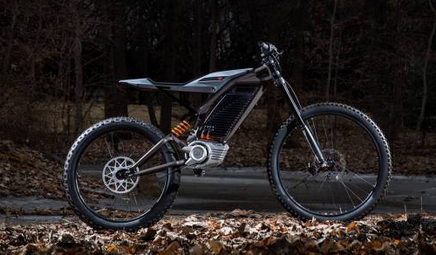
Harley-Davidson concept "e-bike". Image courtesy of Gear Junkie
 The Evolution Continues:

The Consumer Electronics Show, or "CES" for short, is going on now and quite a stir was caused when this "e-bike", so-called, was shown by Harley Davidson as a concept to attract future young customers. The concept appeared on-line on the "Gear Junkie" site here.

The article is also saying: "Harley designed these new electric bike concepts to attract a younger, more urban audience to the brand. The brand also designed them to be super easy to ride, with no clutch, no shifting, and no license required."

Now, a couple of points. First, on-line criticism from many in the bike community focused on the wording used, especially the use of the term "e-bike', saying that since "it doesn't have pedals, it cannot be an e-bike". I think the criticism is misplaced. The reason being is that what should be focused on, and changed by all of us in the cycling community, is how the vehicle is powered. Saying "e-bike" doesn't work anymore, and this is a perfect example.

When automobile manufacturers started combining different types of power in four wheeled vehicles the term used was "hybrid". This is the exact term we should adopt as cycling becomes "hybrid powered- or "human/electric" vehicles, if you will. What Harley is showing is, in fact, an "e-bike'. It is an electric powered ("e") motorbike (bike). They aren't wrong in the description. That's why the focus has to be on the power plant, be that a dual source, or "hybrid", or single source, as in the case with the Harley shown. Non-bike people don't know "e-bike" and it's "classes". That's geek talk and it flies right over most folks heads. Say "hybrid powered bicycle" though, and then we're getting some where with better understanding.

Harley also showed this electric scooter concept. Image courtesy of Gear Junkie.
Now the other point I wanted to bring up is that I have said all along that the so-called "e-bike" was a stepping stone toward an all electric powered motorcycle concept. Add scooters now to this idea I have. It is happening. Here is the proof.

I also have said that bigger companies- non-cycling companies, would get a hold of this idea and walk right past what cycling companies are doing with better performing, better looking products. Harley Davidson have done this. It's here. It is happening. Cycling companies spent far to long trying to keep "e-bikes" looking like bicycles, and now these more cutting edge designs are going to take over. Volkswagon, Ford, and GM, amongst others, are already making new designs to fit this demographic and category. I predict the "heyday" of bicycle companies in "e-bike" categories is coming to an end.

But, time will tell. Maybe I have a dim view of humanity, but in my experience, humans always take the easier way out, and not pedaling, versus pedaling, is the easier way. Pedals, as they did on gas powered, "hybrid" bicycles of the early 20th Century, will become like useless appendages and eventually disappear altogether. It's simply evolution.

That's all for this week. Have a great weekend and thanks for reading the blog!

Friday News And Views

Guitar Ted To Speak At The Iowa Bicycle Summit:

Recently I received a request to speak and give a presentation on gravel routes, how gravel events benefit communities, and more at the upcoming Iowa Bicycle Summit in Des Moines, Iowa January 25th.

It is an honor to have been asked to do this and I am excited to share what I know about the gravel scene with city planners, county officials, and city and county engineers.

This summit is on a Friday and precedes the Iowa Bicycle Expo the next day. I may stay overnight.....maybe not. It depends on how Friday late afternoon/evening goes. I speak between 1:45pm and 2;45pm, so I think I will plan on seeing some folks while I am down there. Weather could factor into things as well, so who knows at this point. I may not even get down there if we have some crazy storm.

Stay tuned.......

Just another example of another new event for 2019.
And The Hits Just Keep On Coming:

My "State Of The Gravel Scene" posts were talking about several things, but the last one, about events, is getting the most run. Lots and lots of views on that post.

It's no wonder too. I think that 2019 is going to be a banner year for first time events. Cracking the record, perhaps, from last year. It's crazy. I still find it hard to believe that so many new events are still being planned, produced, and happening. But as I said, the smaller communities are really grabbing a hold of the gravel cycling scene and they are not letting go.

Kansas, Nebraska, and Iowa seem to be the main instigators of late. No wonder- That's where most of these small towns and villages are that could use a boost and they have tons of gravel roads surrounding them. But certainly, there are more places doing gravel than just the Mid-West. Oddly enough, Florida is another hot spot for gravel. I think I've mentioned Mississippi, and their Gravel Cup Series, and that is a burgeoning scene. I expect to see more coming out of the Deep South in the years to come.

Texas is another hot spot for gravel. The Spinistry, a local to Dallas/Fort Worth club, is the big promoter down there. Those guys keep doing new stuff from time to time also. You may have heard about the SBT GRVL event, a first time event in Colorado which has been a big state for gravel events in the past as well. I'm sure I am missing many events, but the point is, there is still a LOT of expansion of events in the gravel scene, and there seems to be no plateau to it yet.

Wolf Tooth's new through axle offering.
 Wolf Tooth Debuts New Rear Through Axles:

Those guys and gals in Minneapolis are up to something again. This time it is through axles. Wolf Tooth is now offering 9 different lengths of rear through axles, all 12mm, in various thread pitches. What's more, because of their design, they have a cap, so they thought, "Hey! Why not anodize those?" So they have. Pretty rad.

The really cool thing is that they also are doing "Trainer Caps" which pop into each end of the through-bolt and allow you to stick your through axle bike on a trainer, or smart trainer. (Why? I don't know. Just ride outside! But yeah.....I get it. )

Anyway, these are available now, which is good, because a lot of you use trainers about right now. Now these are actually through-bolts. That means you need a tool to insert and remove them in a bicycle. In this case, a 6mm hex key does that job. Another cool feature is the stainless steel washer which will help you get the axle properly tightened and help to not mar your frame.

No front axles as of now, but you can guess why. First, rolling out front axles requires far more parts to be made since there are 12mm and 15mm through bolts with many different thread pitches, in 100mm, 110mm, and 150mm. Plus, you don't need a special doohickey on a front axle to use a trainer, and this is trainer season. So, makes sense to me why the rear axles are out with no front offerings. I bet fronts come later. But that's just me guessing. I don't know.

Harley-Davidson concept "e-bike". Image courtesy of Gear Junkie
 The Evolution Continues:

The Consumer Electronics Show, or "CES" for short, is going on now and quite a stir was caused when this "e-bike", so-called, was shown by Harley Davidson as a concept to attract future young customers. The concept appeared on-line on the "Gear Junkie" site here.

The article is also saying: "Harley designed these new electric bike concepts to attract a younger, more urban audience to the brand. The brand also designed them to be super easy to ride, with no clutch, no shifting, and no license required."

Now, a couple of points. First, on-line criticism from many in the bike community focused on the wording used, especially the use of the term "e-bike', saying that since "it doesn't have pedals, it cannot be an e-bike". I think the criticism is misplaced. The reason being is that what should be focused on, and changed by all of us in the cycling community, is how the vehicle is powered. Saying "e-bike" doesn't work anymore, and this is a perfect example.

When automobile manufacturers started combining different types of power in four wheeled vehicles the term used was "hybrid". This is the exact term we should adopt as cycling becomes "hybrid powered- or "human/electric" vehicles, if you will. What Harley is showing is, in fact, an "e-bike'. It is an electric powered ("e") motorbike (bike). They aren't wrong in the description. That's why the focus has to be on the power plant, be that a dual source, or "hybrid", or single source, as in the case with the Harley shown. Non-bike people don't know "e-bike" and it's "classes". That's geek talk and it flies right over most folks heads. Say "hybrid powered bicycle" though, and then we're getting some where with better understanding.

Harley also showed this electric scooter concept. Image courtesy of Gear Junkie.
Now the other point I wanted to bring up is that I have said all along that the so-called "e-bike" was a stepping stone toward an all electric powered motorcycle concept. Add scooters now to this idea I have. It is happening. Here is the proof.

I also have said that bigger companies- non-cycling companies, would get a hold of this idea and walk right past what cycling companies are doing with better performing, better looking products. Harley Davidson have done this. It's here. It is happening. Cycling companies spent far to long trying to keep "e-bikes" looking like bicycles, and now these more cutting edge designs are going to take over. Volkswagon, Ford, and GM, amongst others, are already making new designs to fit this demographic and category. I predict the "heyday" of bicycle companies in "e-bike" categories is coming to an end.

But, time will tell. Maybe I have a dim view of humanity, but in my experience, humans always take the easier way out, and not pedaling, versus pedaling, is the easier way. Pedals, as they did on gas powered, "hybrid" bicycles of the early 20th Century, will become like useless appendages and eventually disappear altogether. It's simply evolution.

That's all for this week. Have a great weekend and thanks for reading the blog!

Tuesday, February 27, 2018

How Are We Going To Do This?

Those two threaded holes? That's an early attempt at a disc brake mount.
Everyone that nerds out on bicycles seems to have a pretty strong opinion on "standards", (like "there aren't ANY"!), and these opinions often times will be without any regard to history. Usually "it has been done before" and the reason it didn't catch on might be one of several things. Money being one of the biggest reasons, but material technology is usually reason number one. That means that the idea was "there" but the means to make it work right was not. Materials and the way they are applied generally are the reason many innovations ultimately become realities for bicycles. Like disc brakes, for instance.

Shimano had working disc brakes for bicycles back during the bike boom of the 70's. While the calipers were heavy and clunky, and the rotors were solid steel, they did work. There were concerns , of course, and since forks of the day were spindly and not very strong, disc brakes on bicycles then were typically only mounted on rear wheels. Ironically, Shimano chose to thread on the rotor to the hub, much like a freewheel, and if you think about it, Centerlock brakes are just a minor variation on that theme.

The whole disc brake thing then "went away" for a time, but during the late 70's, 80's and 90's, mountain bikers started tinkering around with disc brakes and by the late 90's, it was going to happen. Early adopters were within the ranks of the Marin clunker gang who used the Shimano disc brakes of the time despite their tank-ish weight. Later in the 80's there was a few attempts at using disc brakes on down hill mountain bikes. The 90's saw more activity with disc brakes, maybe most famously by Mountain Cycle who had an "upside down" fork design which required disc brakes to make it work. Gary Fisher also had a bike with disc brakes at the time, but it was........ahhh.... not very good!

Most suspension forks now use the 74mm post mount standard developed by Manitou
Finally, a concerted effort to make disc brakes work cranked up in the 90's. There was the Rock Shox mechanical disc brake with their funky 3 bolt rotors. Hayes Brakes had a 22mm direct mount, Manitou had a 74mm post mount, (yes, Manitou came up with that), and there was a 51mm mount that required adapters floating around as well. Eventually, the 51mm standard got adopted as the "International Standard" while Manitou, (and ironically, Hayes after they bought Manitou), stuck with 74mm mounts which eventually became the standard across most suspension forks and now rigid mtb forks. While the 51mm "IS" standard is still around, it requires different adaptors for front and rear brakes, while the 74mm post mounts do not. 74mm isn't widely adopted by the frame builders though since it requires a bit more effort to make precisely.

Now around about 2014 Shimano unveiled plans to make a new standard called "Flat Mount", which is not unlike what Hayes was trying to do in the late 90's with its 22mm mount. The idea was that the calipers would sit flush to the frame and fork without unsightly adapters or posts sticking off forks and frames. Unfortunately, by the time flat mount came about there were many carbon forks which were using the post mount standard for road applications. To further complicate things, not many custom or high end builders liked the flat mount aesthetic on the rear chain stay, nor were too keen on not using already available IS compatible drop outs which had been refined to look rather good.

Complicating things further is Shimano's lack of interchangeable adapters to fit other types of calipers to flat mount and flat mount calipers to other types of mounts. SRAM has done more in this vein. There are issues with adapters, but one thing flat mount does do is make adapting the caliper to either a 140mm or 160mm rotor an easy affair. You just flip the adapter mount around to use one size or the other. (No 180mm or 203mm rotors can be used with flat mount Shimano calipers.)

Shimano Flat Mount Disc Brakes
Flat mount seems to have been developed to make disc brakes look sleeker and to limit rotor sizes to smaller rotors. While it confuses the market further, it probably isn't going away, since aftermarket brake, fork, and some frame makers are adopting this for road and "gravel" applications.

It also is worth mentioning that along with flat mount disc brakes Shimano also foisted 12mm front through axle for road on us at the same time. This all makes one ask a few hard questions, such as, "What is wrong with 15mm through axles?", (a standard, ironically also foisted on us partially by Shimano), and how about "What is wrong with 74mm post mount, or IS brake mounts we already have?". Don't hold yer breath for any answers to those questions, by the way.

So, in a way, Shimano has brought us full circle back to the flat mount brake, which Hayes proposed in the late 90's. Weird, huh?

The whole disc brake mounting question isn't 100% settled just yet, but it would seem that IS and 74mm post mount will be the realm of off road applications only and this flat mount technology will be the realm of road and gravel. Maybe.......

Then there is the whole through axle thing which is already changing road bike wheels and will, no doubt, upset the apple cart with regard to legacy wheels not working, people wanting certain combinations that won't be possible any longer, and with the brake thing, it will be even worse. Change is often frustrating and painful. This looks to be no different, but we've been through this before with mountain bikes, so welcome to the nightmare......again.

How Are We Going To Do This?

Those two threaded holes? That's an early attempt at a disc brake mount.
Everyone that nerds out on bicycles seems to have a pretty strong opinion on "standards", (like "there aren't ANY"!), and these opinions often times will be without any regard to history. Usually "it has been done before" and the reason it didn't catch on might be one of several things. Money being one of the biggest reasons, but material technology is usually reason number one. That means that the idea was "there" but the means to make it work right was not. Materials and the way they are applied generally are the reason many innovations ultimately become realities for bicycles. Like disc brakes, for instance.

Shimano had working disc brakes for bicycles back during the bike boom of the 70's. While the calipers were heavy and clunky, and the rotors were solid steel, they did work. There were concerns , of course, and since forks of the day were spindly and not very strong, disc brakes on bicycles then were typically only mounted on rear wheels. Ironically, Shimano chose to thread on the rotor to the hub, much like a freewheel, and if you think about it, Centerlock brakes are just a minor variation on that theme.

The whole disc brake thing then "went away" for a time, but during the late 70's, 80's and 90's, mountain bikers started tinkering around with disc brakes and by the late 90's, it was going to happen. Early adopters were within the ranks of the Marin clunker gang who used the Shimano disc brakes of the time despite their tank-ish weight. Later in the 80's there was a few attempts at using disc brakes on down hill mountain bikes. The 90's saw more activity with disc brakes, maybe most famously by Mountain Cycle who had an "upside down" fork design which required disc brakes to make it work. Gary Fisher also had a bike with disc brakes at the time, but it was........ahhh.... not very good!

Most suspension forks now use the 74mm post mount standard developed by Manitou
Finally, a concerted effort to make disc brakes work cranked up in the 90's. There was the Rock Shox mechanical disc brake with their funky 3 bolt rotors. Hayes Brakes had a 22mm direct mount, Manitou had a 74mm post mount, (yes, Manitou came up with that), and there was a 51mm mount that required adapters floating around as well. Eventually, the 51mm standard got adopted as the "International Standard" while Manitou, (and ironically, Hayes after they bought Manitou), stuck with 74mm mounts which eventually became the standard across most suspension forks and now rigid mtb forks. While the 51mm "IS" standard is still around, it requires different adaptors for front and rear brakes, while the 74mm post mounts do not. 74mm isn't widely adopted by the frame builders though since it requires a bit more effort to make precisely.

Now around about 2014 Shimano unveiled plans to make a new standard called "Flat Mount", which is not unlike what Hayes was trying to do in the late 90's with its 22mm mount. The idea was that the calipers would sit flush to the frame and fork without unsightly adapters or posts sticking off forks and frames. Unfortunately, by the time flat mount came about there were many carbon forks which were using the post mount standard for road applications. To further complicate things, not many custom or high end builders liked the flat mount aesthetic on the rear chain stay, nor were too keen on not using already available IS compatible drop outs which had been refined to look rather good.

Complicating things further is Shimano's lack of interchangeable adapters to fit other types of calipers to flat mount and flat mount calipers to other types of mounts. SRAM has done more in this vein. There are issues with adapters, but one thing flat mount does do is make adapting the caliper to either a 140mm or 160mm rotor an easy affair. You just flip the adapter mount around to use one size or the other. (No 180mm or 203mm rotors can be used with flat mount Shimano calipers.)

Shimano Flat Mount Disc Brakes
Flat mount seems to have been developed to make disc brakes look sleeker and to limit rotor sizes to smaller rotors. While it confuses the market further, it probably isn't going away, since aftermarket brake, fork, and some frame makers are adopting this for road and "gravel" applications.

It also is worth mentioning that along with flat mount disc brakes Shimano also foisted 12mm front through axle for road on us at the same time. This all makes one ask a few hard questions, such as, "What is wrong with 15mm through axles?", (a standard, ironically also foisted on us partially by Shimano), and how about "What is wrong with 74mm post mount, or IS brake mounts we already have?". Don't hold yer breath for any answers to those questions, by the way.

So, in a way, Shimano has brought us full circle back to the flat mount brake, which Hayes proposed in the late 90's. Weird, huh?

The whole disc brake mounting question isn't 100% settled just yet, but it would seem that IS and 74mm post mount will be the realm of off road applications only and this flat mount technology will be the realm of road and gravel. Maybe.......

Then there is the whole through axle thing which is already changing road bike wheels and will, no doubt, upset the apple cart with regard to legacy wheels not working, people wanting certain combinations that won't be possible any longer, and with the brake thing, it will be even worse. Change is often frustrating and painful. This looks to be no different, but we've been through this before with mountain bikes, so welcome to the nightmare......again.

Wednesday, October 25, 2017

When The Simplest Thing Fails

The Raleigh Tamland Two- Highly evolved, not much stock here anymore!
I was doing maintenance on a couple of my gravel rigs yesterday. The first up in the stand was the Twin Six Standard Rando. I wasn't happy with the SRAM cheapo cassette that was on it as it was making a racket whenever I shifted due to the individual cogs not being secured perfectly. I opted for a lower geared cassette, an 11-36T, and in eleven speed, of course. The cogs are mounted on a carrier for the last three, largest cogs, and the others are made more precisely and should not rattle. I have the same model cassette on the Tamland Two which has worked really well.

I thought I might need a chain also, but when I checked it with my tool for wear it was well within spec. Such a waste to pull it off, so I left it on there. I am chalking the longevity up to using DuMonde Tech lube which I have used on that chain for a while and on the Tamland's chain for ever. That chain also checked out good as well. The Tamland just needed a bit of fresh lube on its chain and a refresh on sealant. Then it was out for a bit of a test ride.

I noted a "clunk" which was hard to repeat. Was it the chain not shifting quite right? Hmm.....nope! What about that bottom bracket? I couldn't remember ever replacing it. It could be time for it to go. However; the noise wasn't tied to pedaling. Weird. What was it?

Bad part! Bad part! Go to the bin!
I got off my bike and grabbed the rear wheel and tried to see if the hub bearing maybe had loosened up. To my surprise, I could wiggle the wheel and recreate the clunk. That White Industries hub had a bad bearing already? Well....... I do ride it in severe dusty conditions a lot. It was possible, but I had ridden other wheels more miles on gravel with no ill effect. Maybe the axle was broken? Gah! That would suck!

But once the wheel was pulled I could not find fault with the hub at all. Hmmm...... What about that QR lever? Now, I'd be real surprised if it was that, because the wheel moved a lot when it was clamped in the frame. But whatever..... I had to try it to see if I could eliminate that as a reason for my troubles. I grabbed a good Shimano skewer, they are the best, you know, and slammed the wheel with that Shimano skewer installed into the frame and clamped it up.

No more wiggle, no more noise!

A simple part swapped in and no more issues. Shimano skewers are always a sure bet.
I'm not sure what company made that skewer, but it won't ever get used again after that! It is ironic that Shimano makes such a dead reliable skewer and hardly anyone else can seem to come close. Most skewers that you see are external cam skewers and most of those are junk. Then you have some internal cam skewers which can be relied upon other than Shimano, (Velocity USA's are pretty good), but those are rare. I have a set sold by FSA that were designed like Mavic/Simplex skewers and those are pretty decent, but they are an oddball design.

Obviously, through axles get rid of a lot of this, but they also have their own issues. One being that no one wants to pay SRAM or Shimano/Fox a royalty for their good designs and they come up with their own. Some are good, some are........dumb. Some are so difficult to get to work properly you may as well just use a bolt, and some other through axles are bolts! So don't just say QR's are dumb and everyone should use a through axle, becuase there are some real clunkers in the through axle world too.

The bottom line is that a simple part like a skewer should just work, and when it doesn't, and fails, I find that to be rather amazing. Just quit trying to make it different so you can avoid the fees and make simple parts that actually work!

When The Simplest Thing Fails

The Raleigh Tamland Two- Highly evolved, not much stock here anymore!
I was doing maintenance on a couple of my gravel rigs yesterday. The first up in the stand was the Twin Six Standard Rando. I wasn't happy with the SRAM cheapo cassette that was on it as it was making a racket whenever I shifted due to the individual cogs not being secured perfectly. I opted for a lower geared cassette, an 11-36T, and in eleven speed, of course. The cogs are mounted on a carrier for the last three, largest cogs, and the others are made more precisely and should not rattle. I have the same model cassette on the Tamland Two which has worked really well.

I thought I might need a chain also, but when I checked it with my tool for wear it was well within spec. Such a waste to pull it off, so I left it on there. I am chalking the longevity up to using DuMonde Tech lube which I have used on that chain for a while and on the Tamland's chain for ever. That chain also checked out good as well. The Tamland just needed a bit of fresh lube on its chain and a refresh on sealant. Then it was out for a bit of a test ride.

I noted a "clunk" which was hard to repeat. Was it the chain not shifting quite right? Hmm.....nope! What about that bottom bracket? I couldn't remember ever replacing it. It could be time for it to go. However; the noise wasn't tied to pedaling. Weird. What was it?

Bad part! Bad part! Go to the bin!
I got off my bike and grabbed the rear wheel and tried to see if the hub bearing maybe had loosened up. To my surprise, I could wiggle the wheel and recreate the clunk. That White Industries hub had a bad bearing already? Well....... I do ride it in severe dusty conditions a lot. It was possible, but I had ridden other wheels more miles on gravel with no ill effect. Maybe the axle was broken? Gah! That would suck!

But once the wheel was pulled I could not find fault with the hub at all. Hmmm...... What about that QR lever? Now, I'd be real surprised if it was that, because the wheel moved a lot when it was clamped in the frame. But whatever..... I had to try it to see if I could eliminate that as a reason for my troubles. I grabbed a good Shimano skewer, they are the best, you know, and slammed the wheel with that Shimano skewer installed into the frame and clamped it up.

No more wiggle, no more noise!

A simple part swapped in and no more issues. Shimano skewers are always a sure bet.
I'm not sure what company made that skewer, but it won't ever get used again after that! It is ironic that Shimano makes such a dead reliable skewer and hardly anyone else can seem to come close. Most skewers that you see are external cam skewers and most of those are junk. Then you have some internal cam skewers which can be relied upon other than Shimano, (Velocity USA's are pretty good), but those are rare. I have a set sold by FSA that were designed like Mavic/Simplex skewers and those are pretty decent, but they are an oddball design.

Obviously, through axles get rid of a lot of this, but they also have their own issues. One being that no one wants to pay SRAM or Shimano/Fox a royalty for their good designs and they come up with their own. Some are good, some are........dumb. Some are so difficult to get to work properly you may as well just use a bolt, and some other through axles are bolts! So don't just say QR's are dumb and everyone should use a through axle, becuase there are some real clunkers in the through axle world too.

The bottom line is that a simple part like a skewer should just work, and when it doesn't, and fails, I find that to be rather amazing. Just quit trying to make it different so you can avoid the fees and make simple parts that actually work!

Wednesday, February 15, 2017

Maybe We Need Wingnuts

There are probably some "wingnuts" out there that could find creative ways to screw these up too.
The ubiquitous quick release is probably one of the most misused components in cycling. Well.....maybe saddle bags are a close second. But those are accessories, not really a component. Yeah.....so quick releases it is. At least this is my observation from my repair stand.

There are a lot of lawyers that have made a lot of money from issues arising from failure to use quick release mechanisms properly. For instance, did you know that those dratted "lawyer tabs" found on everyone's front forks since the late 1980's were a result of a quick release issue? There are probably instances of the misuse of this clever invention by Tulio Campagnolo going back to Tulio's days. I think how the the "QR" works is definitely one of the hardest concepts for people to grasp today. I see all sorts of glazed eyes when I try to gently explain how these are to be used.

I thought that the through axle, as devised by Fox Shox and Shimano, would eventually be the device that would finally put the long in the tooth QR out to pasture. It was so simple to use, it was insane. Maybe DT Swiss' Ratcheting Skewer is actually better. Either one would have been okay with me. But noooooo! You have to license those designs and, of course, no one is going to want to do that. So now we have about ten different through axle styles and many of them really suck. They are so fiddly to use that all they end up doing is pissing you off.

So, getting a through axle standard for all bikes was not going to happen. What then? Hmm...... Maybe we need to just go back to the point when Tulio invented the infernal quick release thing and do what they were doing back then. We could use wingnuts.

Nah! They would probably find ways to screw that up too.


Maybe We Need Wingnuts

There are probably some "wingnuts" out there that could find creative ways to screw these up too.
The ubiquitous quick release is probably one of the most misused components in cycling. Well.....maybe saddle bags are a close second. But those are accessories, not really a component. Yeah.....so quick releases it is. At least this is my observation from my repair stand.

There are a lot of lawyers that have made a lot of money from issues arising from failure to use quick release mechanisms properly. For instance, did you know that those dratted "lawyer tabs" found on everyone's front forks since the late 1980's were a result of a quick release issue? There are probably instances of the misuse of this clever invention by Tulio Campagnolo going back to Tulio's days. I think how the the "QR" works is definitely one of the hardest concepts for people to grasp today. I see all sorts of glazed eyes when I try to gently explain how these are to be used.

I thought that the through axle, as devised by Fox Shox and Shimano, would eventually be the device that would finally put the long in the tooth QR out to pasture. It was so simple to use, it was insane. Maybe DT Swiss' Ratcheting Skewer is actually better. Either one would have been okay with me. But noooooo! You have to license those designs and, of course, no one is going to want to do that. So now we have about ten different through axle styles and many of them really suck. They are so fiddly to use that all they end up doing is pissing you off.

So, getting a through axle standard for all bikes was not going to happen. What then? Hmm...... Maybe we need to just go back to the point when Tulio invented the infernal quick release thing and do what they were doing back then. We could use wingnuts.

Nah! They would probably find ways to screw that up too.