Showing posts with label road bikes. Show all posts

Friday, January 09, 2026

Friday News And Views

Image posted by an account "John_Doe" on X social media.
 Rumored Cannondale CAAD14:

Rumors and images have been swirling across the internet of late showing what is purportedly the next CAAD road bike. Cannondale is notable for perpetuating aluminum frame racing bikes, despite everyone else's fascination with carbon fiber, (which Cannondale also does, admittedly).  

Interesting features being discussed online are the return to traditional seat stays, rumored 32mm tire clearances, and fully integrated cabling.  

Comments: I'm not a roadie, far from it. I don't typically show road bikes in this space. However; I found this interesting as it is an example of some classic design cues being seen as "refreshing" in comparison to what is seen on offer from many other brands.  

Are riders being drawn toward classic looks while also desiring modern touches? Perhaps this is what has been missed by other brands who are chasing aero and showing sloping top tube frame design as being what is "cutting edge". Perhaps people are missing bicycles that look like.....bicycles? The only thing missing here is silver componentry. 

What do you think of this?  

Calvin Jones. Image courtesy of Park Tool
Director of Education At Park Tool, Calvin Jones To Retire:

Perhaps you've seen this man's face before. No wonder, as Calvin Jones has become "the face" of Park Tool over the past couple of decades. 

Jone's videos have become a staple resource for home mechanics, bike shop employees, and others interested in knowing how bicycles work over his 28 year tenure as Park Tools' Director of Education. Known for his clear, concise explanations of typical repairs, his video legacy will live on bearing witness to his valuable contributions. 

Jones will still be involved in some Park Tool videos and educational efforts, but he says in Park Tools announcement he plans of doing more riding and will be a contributor to local cycling efforts. 

Comments: Congratulations, Mr. Jones! What a career and your contributions to cycling will always be treasured. In some ways, Calvin Jones is the video equivalent to Sheldon Brown, who if he had lived long enough, would have surely been a staple of You Tube as well. Between those two icons of bicycle mechanics, you should be able to accomplish most any typical bicycle repair. 

Image courtesy of Sam Alison/Singular Cycles

The 32"er Watch: Singular Cycles Albatross:

 Sam Alison of Singular Cycles dropped a few images of the new 32"er bicycle he is testing and planning on releasing later this year in a limited drop. Dubbed the "Albatross" for now, this bike is a 32 inch wheeled MTB design. 

 In the comments on the post seen on Facebook, Sam had a few interesting things to say about the bike's performance and ideal rider size. 

 "The most obvious and immediately noticeable thing is just how well they roll and carry speed. The momentum over rough ground is really quite incredible. 

Climbing traction is also pretty insane..... The long stays, low BB and long contact patch combine to get up just about anything. 

 Of course, it's a big old bike and they are some huge wheels, so you do definitely notice the gyroscopic effect - turn initiation is definitely slower. Practically speaking I think riders will need to be > 6'/183cm for these to make sense."

Sam stated he would have rolling chassis available "soon" for pre-order with delivery hopefully this Spring. Look for details on Singular Cycles site, or reported here soon. 

Image courtesy of SRAM 

SRAM Files Patents For Gear Box E-Bike Drive Train Sans Derailleurs:

Some patent images have been making the rounds on the internet of late showing a drive train system utilizing a gear box. This has been met with interest and with some saying "derailleurs are dead!" Well......maybe for electrified bikes. Which, when you consider the slow evolution of these toward becoming electric motorcycles, makes all the sense in the world.  

By the way, in another, separate filing by SRAM, they have revealed they are playing around with wireless -sans hoses and cables - type brakes

Yeah....no.  

Comments: Of course, you might guess this will be all integrated into SRAM's AXS protocol for electronics with a likely addition of automatic shifting. I'd say that is quite likely. 

With weight being less an issue with this type of bicycle, (ahem!), if we can call this a bicycle anymore, you will also probably see automatically adjustable suspension as well. Simply plug in your weight, riding style, and  the bike will self-adjust. Then, to activate your "ride", simply start pedaling at whatever cadence and power you want, and the bike will self-adjust to this input with gearing and power assist adjustments. All you have to do is hang on, guide the bike down the correct course, and be able to use brakes. 

Or you could just play video games. Your choice. 

Honestly, this development isn't surprising, or even shocking. But it probably will be expensive. Yeah.....I'm pretty sure about it

Image courtesy of Brembo
Motorsports Brake Giant, Brembo, To Enter DH Bicycle Competition:

Brembo, a name more familiar to F1 and NASCAR aficionados, has released news concerning their partnership with Specialized Bicycles in their DH racing program. 

Brembo will supply braking systems with prototype designs exclusively for the team for now. There was no indication the company will begin production of OE or aftermarket brake systems, but one might assume this is in the cards for the future. 

Featuring 18mm pistons with thermal insulators for heat management, the calipers and levers are both DH specific. Braided steel lines connect the two components in the system. Interestingly, Brembo runs their rotor spokes in the opposite orientation than every other bicycle rotor for disc brakes. Their claim is this is how motorcycle rotors are oriented and causes the rotors to work under tension instead of compression. 

Comments: Interesting development. My take is this is Brembo's dress rehearsal for entering the electric bicycle market. I could be wrong, but this makes more sense than a general entry onto bicycle disc brake systems, since DH is a very demanding category on par with demands for electrified bikes which are heavier and need more powerful brakes. 

So, while it is not out of the realm of possibilities, I do not foresee gravel bikes getting Brembo brakes anytime soon. Perhaps I will be proven wrong, but at any rate, it is an interesting development.  

Thanks for reading Guitar Ted Productions! Get outside and ride those bicycles!

Tuesday, February 06, 2024

Is The Cycle Complete When It Comes To Gravel?

Colnago's C68 Gravel (Image courtesy of Colnago)
 I ran across some news on "X" (formerly known as Twitter) the other day regarding a new gravel bike from Colnago

Colnago?

Yes, Colnago, the storied Italian bicycle maker whose bicycles have been ridden by the icons of road racing's past and present. THAT Colnago. 

So what? Well, to me, this signals a high-water mark in this segment of cycling I've been enjoying for nearly twenty years now. See, back then, "gravel bike" didn't mean anything. Now? It's the backbone of the industry, racing, and popular cycling nationwide, with the possible exception of urban areas. 

How'd that happen?

Before I answer that question, I want to go over a few of my feelings about this new Colnago and gravel cycling in general. Then we'll get to answering that question of how we got here and what that might mean.

Long-time readers of the blog might remember my Colnago seen here.

When I started in the bicycle business as a retail salesperson and mechanic, my boss at the time, Tom Webb, (RIP), was an avid road cycling fan. Now, this was at a time, in the early 1990's, when road cycling was at a nadir. Literally no one wanted a road racing style bicycle around here. Things may have been different where you lived, but here, in Waterloo and Cedar Falls Iowa? Forget about it. Road cycling was pretty much underground at that point.

This matters because I was a mountain biker guy and Tom got me to care about road bikes, Pro road racing, and why it was a beautiful sport. This was before I was jaded by all the doping madness, by the way. Anyhow.... The point is that Tom got me hooked on Colnago, which by his estimation, was the "pinnacle" of road cycling in terms of tech and tradition. 

So, there is my sift spot for Colnago, still within me, and maybe why it is that when I saw the C68 Gravel, I thought it was really something special. And it is, but the frame set cost seven thousand dollars plus! Gah! Guess I'll keep dreaming..... 

A "gravel mutt" from the 2019 Solstice 100

Fast-forward to the 2000's. I started riding gravel on what I had at the time for a bike. It happened to be a 29"er, but that is not important. We had bicycles and we were starting to discover not only gravel cycling, but what worked and what did not on gravel. 

Trans Iowa, April 2005: The gravel race that started it all had several mountain bikes, both 26"ers and 29"ers, cross bikes, and even a road bike show up for the 300+ mile slog across Iowa on gravel roads. It was the beginning of the stage in gravel where maybe it did not matter what bicycle that you were on, but it quickly became a matter of "hey! that bike seems like it is 'faster' and a better idea than mine."

That led to a winnowing out of the random weirdness that was commonplace in the 2000's and even up into the twenty-teens when you would see bicycles that looked like garage sale rejects converted to gravel duty. Many brands were making purpose-built gravel bikes by late into the last decade, but not the serious, big-time roadie brands. That would maybe never happen, right? I mean, we filthy, uncouth Americans came up with this crushed rock road madness, and that would never reach the highest pinnacle of cycling.

But it did.

Now, about that question, and what does it mean in the end?

Cycling has banked out on "gravel" Image from Merchant Cycles in Emporia, KS

I've been a part of two big 'waves' in cycling in the last 25 years. First it was 29"ers. The bicycling industry at the time that 29"ers became available was pretty complacent, and even dismissive of the trend. This turned out to be a bad business move and many companies were left behind in the rush to cash in on the big wheel trend of the late 2000's. 

That seemed to galvanize the industry's brands and when the "next big thing" hit the train wasn't leaving the station without them being onboard this time. So, a kind of manufactured "next big thing" was tried when the industry pushed 650B really hard in the early twenty-teens, but that did not go as well as hoped. Same thing with fat bikes, which flared up in 2011 and flamed out spectacularly by 2015. 

Gravel was being seen as a growing, grassroots sport at this time and several companies were dabbling in the segment by 2015. This suddenly awoke the giants of cycling and by the late twenty-teens they all were jumping on the bandwagon of gravel.

Trek and other big brands jumped into the gravel market in the late 2010's. Here is a Trek Checkpoint in 2018

Now with the "Big Four" brands offering gravel specific bicycles, only the high-end, "bougie" brands like Colnago, Pinarello, and the like were holding out. But when the UCI announced professional level racing in its Gravel World Championship events in 2023, the entire cycling industry capitulated to this form of cycling. Only electrified bicycles were matching the growth in sales. Gravel events were pulling big numbers world-wide, and money was being made. 

That's a short story on "how we got here" and why a storied road cycling brand like Colnago would even consider making such a high-end gravel bike. Imagine this happening ten years ago. Ha! 

So, what - if anything - does it all mean? Are we at a point that, much like 29"ers, a gravel bike is "just a road bike"? I mean, nobody distinguishes the wheel size on a mountain bike anymore as it is pretty much assumed that a "standard" MTB has 29"er wheels. If it does not, or if it has mixed wheel sizes, only then does that matter. Are we at the point where any drop bar bike for roads is "just a road bike"? 

I think we are getting really close to that when you see current road bike offerings accepting up to 38mm tires, when you see bigger gearing ranges on 'traditional' road bikes, (remember when ALL road bikes had a 53/39T chainset and 11-25T cassettes?), and when all road bikes have disc brakes. The distinguishing traits of a "gravel bike" and a road bike are being blurred now. Maybe these bikes that take 29"er rubber are where "gravel" is going, but then aren't those just really drop bar MTB's? 

I don't know, but I feel like the "cycle" the industry takes with any trend in cycling has just about come full-circle. We've only got to figure out a few small details and then? I think we are there. "Gravel bike" will just become "road bike" and you know what? I'm okay with that. 

Let me know what you think in the comments. Thanks for reading!

Tuesday, December 07, 2021

Neglected But Not Forgotten: Part 4

 I posted about a couple of my bicycles which I had left sitting for far too long without a ride. Well, those aren't the only two bikes with that issue! Far from it! I have a LOT of bicycles, you see, so it becomes a bit of an issue to throw a leg over all of them in one calendar year if  I have review stuff to do and , well, ride all this gravel around here. Someone has to do it! 

So, here's one that I would be surprised if many of you that read the blog would know about, or guess I would own. Obviously, it isn't a gravel bike, or is it? (A debate for another time, perhaps) I think I need to explain the existence of this bike in my stable for you all though, and with that.....

The origins of my acquiring this bike are somewhat clouded to me, mostly because I bought it so long ago now that the details of the transaction have been forgotten. I'll tell you what I know, and a bit of my history with this bike, and then I'll bring it all up to date at the end here.

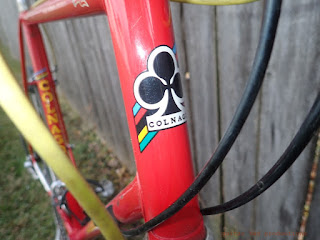
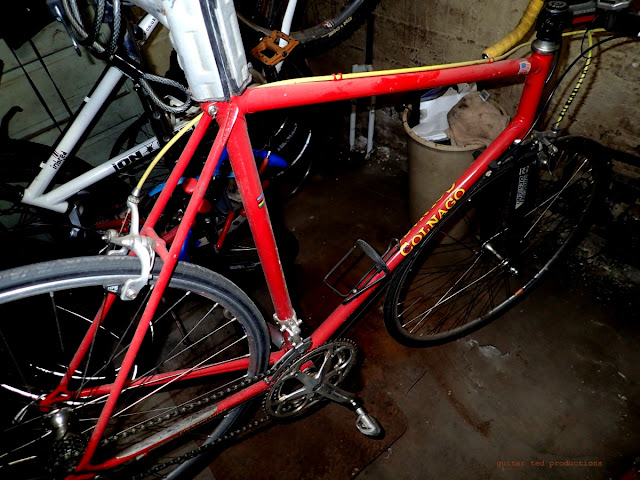
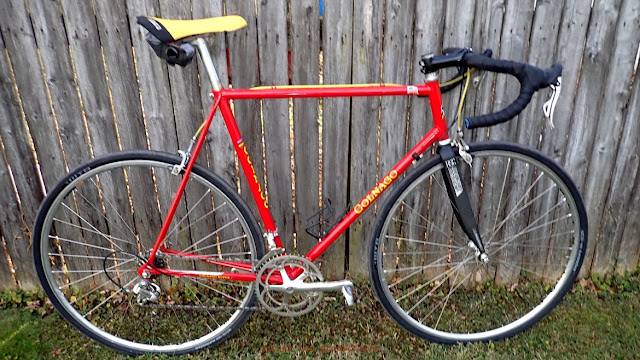
Obviously, this is a Colnago racing bike. It is a "Super" model, and I was told it was from 1984. I do know that Supers were built the same, or similarly, for years, so dating one usually comes down to the components, but this old road dog had long since lost all of its original equipment by the time I laid hands on it. I do know, however, that it originally had a curved, not the straight legged, steel fork, which dates it before 1985 (according to what I have heard) or so, therefore I am calling it an '84 based upon that and what I was told back when I got the bike. But whatever....it is OLD!  

After years of sitting around, I finally got this up and running. Here is the "before" look.

 The original fork was chrome plated steel, but it was soooo rusty that I, and those at the shop at the time, decided that it was unsafe to use anymore. See, the owner before me used this as his Winter hack, you know? When people still trained outdoors? So, he had ridden this through salt and snow for years and neglected to really take care of it. Although at one point he had the bike repainted and re-decaled. So, this is not the original color of the bike- another reason it is hard to date this one. 

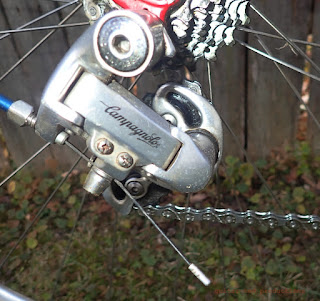
So, back in these days I was more into road biking than I was anything else. This was before I was back into the bicycle business, by the way, so maybe around 2001-2002 was when I got this bike. I had two other road bikes at the time. I know! Weird to think that, right? Anyway... All my road bikes then were Campy equipped and I essentially had been buying old parts when the owner of Europa Cycle & Ski upgraded to new stuff. That's mostly what this Colnago is. There is another bit on the bike that pre-dates all of that though, and that is the hubs and rims. 

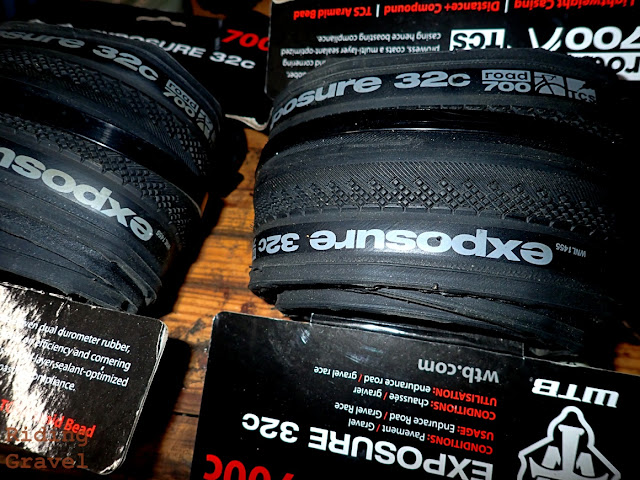
I had these WTB Exposure tires just sitting around, so I decided to try them out on the Colnago.

 So, at my first bike shop job, I acquired a set of Campagnolo Record hubs, brand new at the time, so 9 speed, if I recall. I also picked up a pair of Sun Mistral rims which were polished silver. These are impossibly narrow aluminum rims in light of today's standards, by the way. Anyway, I laced these up around 1999, 2000 using a 2X pattern, which I rarely ever do, but I was trying to be all ligtweight and whatnot! 

So, at any rate, I believe the story was that this Colnago was traded in to Europa and I happened to see it one time and the owner suggested it fit me and maybe I should buy it. Anyway, I got it, obviously, and I set it up with those wheels I built and the second hand parts I acquired. So, it is kind of a mish-mash of Campy stuff, mostly 9 speed era parts, and the only exception to that is the rear brake, which is a Suntour item which the bike had on it when I got it. 

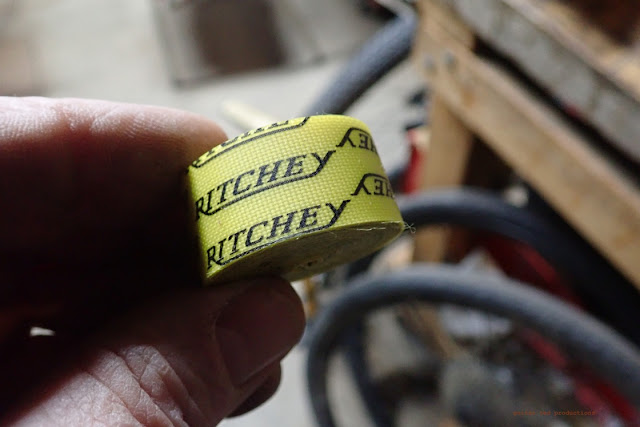
During the refurbishing, I had to install new rim strips. These were sponsor schwag for T.I.v5!
 

The fork, which had to be replaced, was thrown out, and I got this Profile Carbon fork, which at the time was about as cheap as I could stand to go. The seat post and the water bottle cage are American Classic items. (ONE water bottle cage? What were these guys back then, camels? ) I have a no-name 1 1/8th stem on there which is wrapping a shim to fit the 1" steer tube. The saddle was from my ancient stash of MTB stuff, a SDG saddle, and the original tires were Continental GP 4000's . 

I rode this for a bit. I remember a "GTDRI" ride I did on it to a family reunion in New Hampton, Iowa. I also rode this one on the 2003 RAGBRAI route, that is until I got the call that my son was to be born. Then after this I think the bike went into mothballs as 29"ers, and then gravel bikes, took over most of my riding. 

The Colnago Super as it sits now

 So, I finally got this back out and decided to swap out a few things.The handle bars were some ugly Dimension ones I put on back in the day, but I have replaced those with a set of Salsa Cycles Cowbell bars. The tape is some no-name synthetic black cork tape, and I have the SILCA tool roll under the SDG saddle now for repairs.. Tires are the new WTB Exposure - supposedly 32's- and these barely clear the Profile fork, (which I will address here shortly). On my first test ride I discovered that the head set was loose and the chain broke! 

So, I installed a new chain, and I dug into the wonky plug Profile used to pre-load the head set bearings. After much thought, I came up with a slight modification to their poor design which allowed me to actually tighten the preload down enough to prevent a loosening head set. (We've come a long way with how we do things, let me tell ya!) 

The bike is rideable now, but I am going to search out a steel fork for this. The Profile carbon fork really isn't 'right' on this bike and a steel fork should afford me juuuust enough clearance to get the WTB tires to work on this thing. I also am going to see if I can swap over to some shiny, polished Velocity A-23 wheels I have. I am going to see if Velocity has a Campy compatible free hub and if they do, my thought is to convert the hub I have, and see if the slightly wider A-23 won't lower the crowned out profile of these WTB tires on the Mistral rims. Those rims, by the way, are 90's technology and they bend like butter. You have to be really careful riding these things. So, a swap over to my A-23's, which are not being used now, would be good. Then if that worked out I would re-lace the Record hubs into some other wheels. 

Okay, that's it for the Colnago for now. If I make any more headway on this one I will return with another post.

Neglected But Not Forgotten: Part 4

 I posted about a couple of my bicycles which I had left sitting for far too long without a ride. Well, those aren't the only two bikes with that issue! Far from it! I have a LOT of bicycles, you see, so it becomes a bit of an issue to throw a leg over all of them in one calendar year if  I have review stuff to do and , well, ride all this gravel around here. Someone has to do it! 

So, here's one that I would be surprised if many of you that read the blog would know about, or guess I would own. Obviously, it isn't a gravel bike, or is it? (A debate for another time, perhaps) I think I need to explain the existence of this bike in my stable for you all though, and with that.....

The origins of my acquiring this bike are somewhat clouded to me, mostly because I bought it so long ago now that the details of the transaction have been forgotten. I'll tell you what I know, and a bit of my history with this bike, and then I'll bring it all up to date at the end here.

Obviously, this is a Colnago racing bike. It is a "Super" model, and I was told it was from 1984. I do know that Supers were built the same, or similarly, for years, so dating one usually comes down to the components, but this old road dog had long since lost all of its original equipment by the time I laid hands on it. I do know, however, that it originally had a curved, not the straight legged, steel fork, which dates it before 1985 (according to what I have heard) or so, therefore I am calling it an '84 based upon that and what I was told back when I got the bike. But whatever....it is OLD!  

After years of sitting around, I finally got this up and running. Here is the "before" look.

 The original fork was chrome plated steel, but it was soooo rusty that I, and those at the shop at the time, decided that it was unsafe to use anymore. See, the owner before me used this as his Winter hack, you know? When people still trained outdoors? So, he had ridden this through salt and snow for years and neglected to really take care of it. Although at one point he had the bike repainted and re-decaled. So, this is not the original color of the bike- another reason it is hard to date this one. 

So, back in these days I was more into road biking than I was anything else. This was before I was back into the bicycle business, by the way, so maybe around 2001-2002 was when I got this bike. I had two other road bikes at the time. I know! Weird to think that, right? Anyway... All my road bikes then were Campy equipped and I essentially had been buying old parts when the owner of Europa Cycle & Ski upgraded to new stuff. That's mostly what this Colnago is. There is another bit on the bike that pre-dates all of that though, and that is the hubs and rims. 

I had these WTB Exposure tires just sitting around, so I decided to try them out on the Colnago.

 So, at my first bike shop job, I acquired a set of Campagnolo Record hubs, brand new at the time, so 9 speed, if I recall. I also picked up a pair of Sun Mistral rims which were polished silver. These are impossibly narrow aluminum rims in light of today's standards, by the way. Anyway, I laced these up around 1999, 2000 using a 2X pattern, which I rarely ever do, but I was trying to be all ligtweight and whatnot! 

So, at any rate, I believe the story was that this Colnago was traded in to Europa and I happened to see it one time and the owner suggested it fit me and maybe I should buy it. Anyway, I got it, obviously, and I set it up with those wheels I built and the second hand parts I acquired. So, it is kind of a mish-mash of Campy stuff, mostly 9 speed era parts, and the only exception to that is the rear brake, which is a Suntour item which the bike had on it when I got it. 

During the refurbishing, I had to install new rim strips. These were sponsor schwag for T.I.v5!
 

The fork, which had to be replaced, was thrown out, and I got this Profile Carbon fork, which at the time was about as cheap as I could stand to go. The seat post and the water bottle cage are American Classic items. (ONE water bottle cage? What were these guys back then, camels? ) I have a no-name 1 1/8th stem on there which is wrapping a shim to fit the 1" steer tube. The saddle was from my ancient stash of MTB stuff, a SDG saddle, and the original tires were Continental GP 4000's . 

I rode this for a bit. I remember a "GTDRI" ride I did on it to a family reunion in New Hampton, Iowa. I also rode this one on the 2003 RAGBRAI route, that is until I got the call that my son was to be born. Then after this I think the bike went into mothballs as 29"ers, and then gravel bikes, took over most of my riding. 

The Colnago Super as it sits now

 So, I finally got this back out and decided to swap out a few things.The handle bars were some ugly Dimension ones I put on back in the day, but I have replaced those with a set of Salsa Cycles Cowbell bars. The tape is some no-name synthetic black cork tape, and I have the SILCA tool roll under the SDG saddle now for repairs.. Tires are the new WTB Exposure - supposedly 32's- and these barely clear the Profile fork, (which I will address here shortly). On my first test ride I discovered that the head set was loose and the chain broke! 

So, I installed a new chain, and I dug into the wonky plug Profile used to pre-load the head set bearings. After much thought, I came up with a slight modification to their poor design which allowed me to actually tighten the preload down enough to prevent a loosening head set. (We've come a long way with how we do things, let me tell ya!) 

The bike is rideable now, but I am going to search out a steel fork for this. The Profile carbon fork really isn't 'right' on this bike and a steel fork should afford me juuuust enough clearance to get the WTB tires to work on this thing. I also am going to see if I can swap over to some shiny, polished Velocity A-23 wheels I have. I am going to see if Velocity has a Campy compatible free hub and if they do, my thought is to convert the hub I have, and see if the slightly wider A-23 won't lower the crowned out profile of these WTB tires on the Mistral rims. Those rims, by the way, are 90's technology and they bend like butter. You have to be really careful riding these things. So, a swap over to my A-23's, which are not being used now, would be good. Then if that worked out I would re-lace the Record hubs into some other wheels. 

Okay, that's it for the Colnago for now. If I make any more headway on this one I will return with another post.

Friday, January 15, 2021

Friday News And Views

 Sea Otter Moves date To Fall:

In a short statement sent to media via e-mail on Monday, Sea Otter confirmed rumors that it was going to move its traditional Spring date to Fall for 2021, citing COVID issues. The statement read as follows:"After recent discussions with health and permitting officials, we’ve determined we will not be able to conduct an event in May."

The new dates are October 7-19th, 2021 and the event will still be held at Laguna Seca raceway near Monterey, California. 

Comments: As of this writing California is in strict lock down due to a rise in COVID-19 cases recently. While there is a vaccine being distributed, it is widely accepted that most people will not have gotten vaccinated before late Summer at the earliest. 

Sea Otter has become the de-facto consumer/trade show/exhibition since the demise of Interbike. Traditionally the mid-April date was used as a way for companies to introduce new product. With shortages due to COVID-induced demands causing supply short-falls, it was dubious as to what, if any interesting products would have actually been there for introduction. Waiting until Fall may actually prove to be advantageous in this regard. Plus, many more North American dealers could go and make this an Interbike replacement of sorts. 

Road Boost rear spacing is a thing now. Focus Atlas 6.8 image courtesy of Focus.
You Knew It Was Coming, Didn't You?

I have said for years that the next big innovation/evolution in road bike standard would be the move to a wider rear spacing standard. Well, it appears that Focus, a brand some may know from cyclo cross or MTB, has made 'Road Boost' a thing now with the introduction of the 2021 Atlas gravel bike range. 

First things first: Up until now, all road bike based bicycles used a 130mm rear overlock dimension standard. This determined not just the spacing between the faces of the inner rear drop out where the wheel axle interfaced with the frame, but it also determined where the rear derailleur sits in relationship to the crank set, and essentially, it limits what a designer can do with regard to tire clearances, frame members, etc. When through axles became ubiquitous, this standard did not change, excepting that a through axle fit differently, so the dimension was listed as 142mmOD. Through axles did not fundamentally change anything else, just the way wheels were attached. 

Now with 'Boost' spacing, designers can take advantage of the moving of the drive line outboard a bit. The rear axle is wider now at 148mm, so that 'pushes' the cassette outward that much more also.  This removes barriers to wider tires and still having traditional frame member bits like straight chain stays instead of drooped ones, or elevated ones, to get short chain stays, wider tires, and crank sets all a space to 'live in'. 

You'll note that the Focus Atlas 6.8 has Shimano GRX cranks. Those cranks were set outboard from traditional road bike crank set chain line to allow designers to get wider tires in, so yes- In a way the Focus Atlas is the first all Boost road bike. I suspect it won't be the last. 

Gravel Worlds Registration Opens Tomorrow:

Get ready, get set, GO! Gravel Worlds registration opens tomorrow at 8:00am CST. Hit that link and it will take you to the 2021 registration site on BikeReg.com. (I post that as much for my convenience as anything, just to be forthcoming!)

Gravel Worlds will have the 150 mile, 75 mile, and 50K distances available which are the traditional distance offerings from recent years. The 50K is a 'non-competitive' ride, by the way. All rides will start and end at the Schilling Bridge Cork & Tap House in the Northwest area of Lincoln, Nebraska on August 21st, pandemic pending, of course. 

I have gone on and on about this event, and I have participated in this event many times, but if you are new and wondering if Nebraska is even worth considering, I can give you my hearty recommendation. The terrain is HILLY! The weather will be hot, humid, and there most likely will be wind. The gravel has a sandy consistency which can make for some interesting handling characteristics at times. But more than anything, Gravel Worlds is a snapshot of what made the genre famous and attractive. That being that the event has a definite grassroots feel, the people are welcoming, the locals have a hand in making the experience more like visiting relatives, (good ones, the ones you have fun with), and overall Gravel Worlds just encompasses everything good about gravel riding. Go do it. You won't be disappointed. And hopefully we will be able to "go do it"!

G-Ted Productions Notes:

Okay, once again, this is probably going to get mentioned regularly for a while here, so if you've seen these announcements already, please bear with me or skip over this section. 

  • Quick Links To Series Posts: Just a reminder that now you can look at any "Trans Iowa Stories" post or any "Touring Series" post by clicking on the page link for each series. Those page links are under the header here. (Look above, just under the main page image) Each newly published "Trans Iowa Stories" post will be added as I go along. 
  • Archived Drop Bar Articles: I also finally figured out how to publish page header links with these series posts which meant that the long hidden drop bar page got published there as well. The page was set up a long time ago and I quit working on it when Blogger changed the formatting here over a year ago on the backside where I work on stuff. So, now that I have that figured out I will be adding links to more G-Ted Productions drop bar posts as time goes on now. 
  • G-Ted Productions Merchandise: And finally I will remind you all that t-shirts, stickers, mugs, and more can be purchased with the "G-Ted" icon at the link for my daughter's Redbubble site which you can find under the "My Events and Web Sites" header in the far right column here on the blog. Remember- I don't make a penny off that, it helps support my daughter's art habit. She gets a cut from sales there. 
  • C.O.G. 100, Events Announcement: Just to make sure you are all aware- First off, the C.O.G.100 is no more. Gone, se ya later! N.Y. Roll and I decided to cut bait and close down the event since we cannot in good conscience hold it with the pandemic going on. And since that is the case, I took the opportunity to end my involvement in events promotions. I've been at this since late 2004, so it is high time to move along now. So- no C.O.G.100 ever again. If and when N.Y. Roll wants to do something I will post about that here. 
That's about it! Have a great weekend and try to get out and ride if you can.

Friday News And Views

 Sea Otter Moves date To Fall:

In a short statement sent to media via e-mail on Monday, Sea Otter confirmed rumors that it was going to move its traditional Spring date to Fall for 2021, citing COVID issues. The statement read as follows:"After recent discussions with health and permitting officials, we’ve determined we will not be able to conduct an event in May."

The new dates are October 7-19th, 2021 and the event will still be held at Laguna Seca raceway near Monterey, California. 

Comments: As of this writing California is in strict lock down due to a rise in COVID-19 cases recently. While there is a vaccine being distributed, it is widely accepted that most people will not have gotten vaccinated before late Summer at the earliest. 

Sea Otter has become the de-facto consumer/trade show/exhibition since the demise of Interbike. Traditionally the mid-April date was used as a way for companies to introduce new product. With shortages due to COVID-induced demands causing supply short-falls, it was dubious as to what, if any interesting products would have actually been there for introduction. Waiting until Fall may actually prove to be advantageous in this regard. Plus, many more North American dealers could go and make this an Interbike replacement of sorts. 

Road Boost rear spacing is a thing now. Focus Atlas 6.8 image courtesy of Focus.
You Knew It Was Coming, Didn't You?

I have said for years that the next big innovation/evolution in road bike standard would be the move to a wider rear spacing standard. Well, it appears that Focus, a brand some may know from cyclo cross or MTB, has made 'Road Boost' a thing now with the introduction of the 2021 Atlas gravel bike range. 

First things first: Up until now, all road bike based bicycles used a 130mm rear overlock dimension standard. This determined not just the spacing between the faces of the inner rear drop out where the wheel axle interfaced with the frame, but it also determined where the rear derailleur sits in relationship to the crank set, and essentially, it limits what a designer can do with regard to tire clearances, frame members, etc. When through axles became ubiquitous, this standard did not change, excepting that a through axle fit differently, so the dimension was listed as 142mmOD. Through axles did not fundamentally change anything else, just the way wheels were attached. 

Now with 'Boost' spacing, designers can take advantage of the moving of the drive line outboard a bit. The rear axle is wider now at 148mm, so that 'pushes' the cassette outward that much more also.  This removes barriers to wider tires and still having traditional frame member bits like straight chain stays instead of drooped ones, or elevated ones, to get short chain stays, wider tires, and crank sets all a space to 'live in'. 

You'll note that the Focus Atlas 6.8 has Shimano GRX cranks. Those cranks were set outboard from traditional road bike crank set chain line to allow designers to get wider tires in, so yes- In a way the Focus Atlas is the first all Boost road bike. I suspect it won't be the last. 

Gravel Worlds Registration Opens Tomorrow:

Get ready, get set, GO! Gravel Worlds registration opens tomorrow at 8:00am CST. Hit that link and it will take you to the 2021 registration site on BikeReg.com. (I post that as much for my convenience as anything, just to be forthcoming!)

Gravel Worlds will have the 150 mile, 75 mile, and 50K distances available which are the traditional distance offerings from recent years. The 50K is a 'non-competitive' ride, by the way. All rides will start and end at the Schilling Bridge Cork & Tap House in the Northwest area of Lincoln, Nebraska on August 21st, pandemic pending, of course. 

I have gone on and on about this event, and I have participated in this event many times, but if you are new and wondering if Nebraska is even worth considering, I can give you my hearty recommendation. The terrain is HILLY! The weather will be hot, humid, and there most likely will be wind. The gravel has a sandy consistency which can make for some interesting handling characteristics at times. But more than anything, Gravel Worlds is a snapshot of what made the genre famous and attractive. That being that the event has a definite grassroots feel, the people are welcoming, the locals have a hand in making the experience more like visiting relatives, (good ones, the ones you have fun with), and overall Gravel Worlds just encompasses everything good about gravel riding. Go do it. You won't be disappointed. And hopefully we will be able to "go do it"!

G-Ted Productions Notes:

Okay, once again, this is probably going to get mentioned regularly for a while here, so if you've seen these announcements already, please bear with me or skip over this section. 

  • Quick Links To Series Posts: Just a reminder that now you can look at any "Trans Iowa Stories" post or any "Touring Series" post by clicking on the page link for each series. Those page links are under the header here. (Look above, just under the main page image) Each newly published "Trans Iowa Stories" post will be added as I go along. 
  • Archived Drop Bar Articles: I also finally figured out how to publish page header links with these series posts which meant that the long hidden drop bar page got published there as well. The page was set up a long time ago and I quit working on it when Blogger changed the formatting here over a year ago on the backside where I work on stuff. So, now that I have that figured out I will be adding links to more G-Ted Productions drop bar posts as time goes on now. 
  • G-Ted Productions Merchandise: And finally I will remind you all that t-shirts, stickers, mugs, and more can be purchased with the "G-Ted" icon at the link for my daughter's Redbubble site which you can find under the "My Events and Web Sites" header in the far right column here on the blog. Remember- I don't make a penny off that, it helps support my daughter's art habit. She gets a cut from sales there. 
  • C.O.G. 100, Events Announcement: Just to make sure you are all aware- First off, the C.O.G.100 is no more. Gone, se ya later! N.Y. Roll and I decided to cut bait and close down the event since we cannot in good conscience hold it with the pandemic going on. And since that is the case, I took the opportunity to end my involvement in events promotions. I've been at this since late 2004, so it is high time to move along now. So- no C.O.G.100 ever again. If and when N.Y. Roll wants to do something I will post about that here. 
That's about it! Have a great weekend and try to get out and ride if you can.

Tuesday, February 27, 2018

How Are We Going To Do This?

Those two threaded holes? That's an early attempt at a disc brake mount.
Everyone that nerds out on bicycles seems to have a pretty strong opinion on "standards", (like "there aren't ANY"!), and these opinions often times will be without any regard to history. Usually "it has been done before" and the reason it didn't catch on might be one of several things. Money being one of the biggest reasons, but material technology is usually reason number one. That means that the idea was "there" but the means to make it work right was not. Materials and the way they are applied generally are the reason many innovations ultimately become realities for bicycles. Like disc brakes, for instance.

Shimano had working disc brakes for bicycles back during the bike boom of the 70's. While the calipers were heavy and clunky, and the rotors were solid steel, they did work. There were concerns , of course, and since forks of the day were spindly and not very strong, disc brakes on bicycles then were typically only mounted on rear wheels. Ironically, Shimano chose to thread on the rotor to the hub, much like a freewheel, and if you think about it, Centerlock brakes are just a minor variation on that theme.

The whole disc brake thing then "went away" for a time, but during the late 70's, 80's and 90's, mountain bikers started tinkering around with disc brakes and by the late 90's, it was going to happen. Early adopters were within the ranks of the Marin clunker gang who used the Shimano disc brakes of the time despite their tank-ish weight. Later in the 80's there was a few attempts at using disc brakes on down hill mountain bikes. The 90's saw more activity with disc brakes, maybe most famously by Mountain Cycle who had an "upside down" fork design which required disc brakes to make it work. Gary Fisher also had a bike with disc brakes at the time, but it was........ahhh.... not very good!

Most suspension forks now use the 74mm post mount standard developed by Manitou
Finally, a concerted effort to make disc brakes work cranked up in the 90's. There was the Rock Shox mechanical disc brake with their funky 3 bolt rotors. Hayes Brakes had a 22mm direct mount, Manitou had a 74mm post mount, (yes, Manitou came up with that), and there was a 51mm mount that required adapters floating around as well. Eventually, the 51mm standard got adopted as the "International Standard" while Manitou, (and ironically, Hayes after they bought Manitou), stuck with 74mm mounts which eventually became the standard across most suspension forks and now rigid mtb forks. While the 51mm "IS" standard is still around, it requires different adaptors for front and rear brakes, while the 74mm post mounts do not. 74mm isn't widely adopted by the frame builders though since it requires a bit more effort to make precisely.

Now around about 2014 Shimano unveiled plans to make a new standard called "Flat Mount", which is not unlike what Hayes was trying to do in the late 90's with its 22mm mount. The idea was that the calipers would sit flush to the frame and fork without unsightly adapters or posts sticking off forks and frames. Unfortunately, by the time flat mount came about there were many carbon forks which were using the post mount standard for road applications. To further complicate things, not many custom or high end builders liked the flat mount aesthetic on the rear chain stay, nor were too keen on not using already available IS compatible drop outs which had been refined to look rather good.

Complicating things further is Shimano's lack of interchangeable adapters to fit other types of calipers to flat mount and flat mount calipers to other types of mounts. SRAM has done more in this vein. There are issues with adapters, but one thing flat mount does do is make adapting the caliper to either a 140mm or 160mm rotor an easy affair. You just flip the adapter mount around to use one size or the other. (No 180mm or 203mm rotors can be used with flat mount Shimano calipers.)

Shimano Flat Mount Disc Brakes
Flat mount seems to have been developed to make disc brakes look sleeker and to limit rotor sizes to smaller rotors. While it confuses the market further, it probably isn't going away, since aftermarket brake, fork, and some frame makers are adopting this for road and "gravel" applications.

It also is worth mentioning that along with flat mount disc brakes Shimano also foisted 12mm front through axle for road on us at the same time. This all makes one ask a few hard questions, such as, "What is wrong with 15mm through axles?", (a standard, ironically also foisted on us partially by Shimano), and how about "What is wrong with 74mm post mount, or IS brake mounts we already have?". Don't hold yer breath for any answers to those questions, by the way.

So, in a way, Shimano has brought us full circle back to the flat mount brake, which Hayes proposed in the late 90's. Weird, huh?

The whole disc brake mounting question isn't 100% settled just yet, but it would seem that IS and 74mm post mount will be the realm of off road applications only and this flat mount technology will be the realm of road and gravel. Maybe.......

Then there is the whole through axle thing which is already changing road bike wheels and will, no doubt, upset the apple cart with regard to legacy wheels not working, people wanting certain combinations that won't be possible any longer, and with the brake thing, it will be even worse. Change is often frustrating and painful. This looks to be no different, but we've been through this before with mountain bikes, so welcome to the nightmare......again.

How Are We Going To Do This?

Those two threaded holes? That's an early attempt at a disc brake mount.
Everyone that nerds out on bicycles seems to have a pretty strong opinion on "standards", (like "there aren't ANY"!), and these opinions often times will be without any regard to history. Usually "it has been done before" and the reason it didn't catch on might be one of several things. Money being one of the biggest reasons, but material technology is usually reason number one. That means that the idea was "there" but the means to make it work right was not. Materials and the way they are applied generally are the reason many innovations ultimately become realities for bicycles. Like disc brakes, for instance.

Shimano had working disc brakes for bicycles back during the bike boom of the 70's. While the calipers were heavy and clunky, and the rotors were solid steel, they did work. There were concerns , of course, and since forks of the day were spindly and not very strong, disc brakes on bicycles then were typically only mounted on rear wheels. Ironically, Shimano chose to thread on the rotor to the hub, much like a freewheel, and if you think about it, Centerlock brakes are just a minor variation on that theme.

The whole disc brake thing then "went away" for a time, but during the late 70's, 80's and 90's, mountain bikers started tinkering around with disc brakes and by the late 90's, it was going to happen. Early adopters were within the ranks of the Marin clunker gang who used the Shimano disc brakes of the time despite their tank-ish weight. Later in the 80's there was a few attempts at using disc brakes on down hill mountain bikes. The 90's saw more activity with disc brakes, maybe most famously by Mountain Cycle who had an "upside down" fork design which required disc brakes to make it work. Gary Fisher also had a bike with disc brakes at the time, but it was........ahhh.... not very good!

Most suspension forks now use the 74mm post mount standard developed by Manitou
Finally, a concerted effort to make disc brakes work cranked up in the 90's. There was the Rock Shox mechanical disc brake with their funky 3 bolt rotors. Hayes Brakes had a 22mm direct mount, Manitou had a 74mm post mount, (yes, Manitou came up with that), and there was a 51mm mount that required adapters floating around as well. Eventually, the 51mm standard got adopted as the "International Standard" while Manitou, (and ironically, Hayes after they bought Manitou), stuck with 74mm mounts which eventually became the standard across most suspension forks and now rigid mtb forks. While the 51mm "IS" standard is still around, it requires different adaptors for front and rear brakes, while the 74mm post mounts do not. 74mm isn't widely adopted by the frame builders though since it requires a bit more effort to make precisely.

Now around about 2014 Shimano unveiled plans to make a new standard called "Flat Mount", which is not unlike what Hayes was trying to do in the late 90's with its 22mm mount. The idea was that the calipers would sit flush to the frame and fork without unsightly adapters or posts sticking off forks and frames. Unfortunately, by the time flat mount came about there were many carbon forks which were using the post mount standard for road applications. To further complicate things, not many custom or high end builders liked the flat mount aesthetic on the rear chain stay, nor were too keen on not using already available IS compatible drop outs which had been refined to look rather good.

Complicating things further is Shimano's lack of interchangeable adapters to fit other types of calipers to flat mount and flat mount calipers to other types of mounts. SRAM has done more in this vein. There are issues with adapters, but one thing flat mount does do is make adapting the caliper to either a 140mm or 160mm rotor an easy affair. You just flip the adapter mount around to use one size or the other. (No 180mm or 203mm rotors can be used with flat mount Shimano calipers.)

Shimano Flat Mount Disc Brakes
Flat mount seems to have been developed to make disc brakes look sleeker and to limit rotor sizes to smaller rotors. While it confuses the market further, it probably isn't going away, since aftermarket brake, fork, and some frame makers are adopting this for road and "gravel" applications.

It also is worth mentioning that along with flat mount disc brakes Shimano also foisted 12mm front through axle for road on us at the same time. This all makes one ask a few hard questions, such as, "What is wrong with 15mm through axles?", (a standard, ironically also foisted on us partially by Shimano), and how about "What is wrong with 74mm post mount, or IS brake mounts we already have?". Don't hold yer breath for any answers to those questions, by the way.

So, in a way, Shimano has brought us full circle back to the flat mount brake, which Hayes proposed in the late 90's. Weird, huh?

The whole disc brake mounting question isn't 100% settled just yet, but it would seem that IS and 74mm post mount will be the realm of off road applications only and this flat mount technology will be the realm of road and gravel. Maybe.......

Then there is the whole through axle thing which is already changing road bike wheels and will, no doubt, upset the apple cart with regard to legacy wheels not working, people wanting certain combinations that won't be possible any longer, and with the brake thing, it will be even worse. Change is often frustrating and painful. This looks to be no different, but we've been through this before with mountain bikes, so welcome to the nightmare......again.

Friday, March 13, 2015

Friday News And Views

Did Fox just announce a fat bike fork, or something else?
Fox Muddies The Fat Waters:

You may have seen the news yesterday that Fox Forks announced what was dubbed by some folks as a "fat bike fork" and by most media as a "27.5+ fork".

I've talked quite a bit about the "mid-fat", 27.5+, B+ thing here. I've said it was going to be a "thing" and now we see this announcement. Here's what it means, like it or not......

Fox Forks doesn't do anything unless they sell, (or can sell), OE (Original Equipment) contracts to big bike brands that can afford to pay Fox's tooling costs. Think back to 2007 when Trek paid Fox to tool up for 29"er forks for their Gary Fisher bikes. Fox stayed out of 29"er forks until that happened. So, based upon that history, it is reasonable to say that Fox has a lot of orders to fulfill to companies planning to unleash 27.5+ bikes on the masses. You can bet on this: 27.5+ will be everywhere post Sea Otter and into next year. Enduro bikes will be unleashed, bike packing bikes will be unleashed, and slack hard tail, AM type bikes will be unleashed. The bike industry is hoping this will be "the next 29"er" thing.

The last thing the industry banked on to be "the next 29"er" didn't really pan out. Sure, 27.5" bikes are everywhere, but in reality, they replaced 26"ers, and anybody looking for the next new thing was on to 29+, fat bikes, and other odds and ends. The fat bike craze has topped out, (yes folks......it's old hat now), and this 29+ thing, well it is too big. So 27.5+ will be the deal. It is seen as something that isn't so "snow/sand specific", so heavy, so weird, and maybe will fit a wider slice of the mtb market while being "different".

The dirty little secret? 27.5+ is just about identical in diameter to 29"ers. So, really what you have here is a 29 inch, 3 inch plus wide wheel that still fits all the industry knows about 29"er geometry. All they have to do is widen out a few things and there ya go! New! Shiny! Gotta have one!

You'll have a traction heavy, (pun intended), 29"er bike. Will it be fun? Yes. All bicycles can be fun. But don't get too rolled up in the marketing folks. Your current 29"er will be more nimble and faster, if that's what floats yer boat. Otherwise, have at it.

Gravel bikes are somehow evil, unnecessary, and sub-road bike?
So, The Road Bike Is Dead? 

A recent article on "Bike Radar" called
"Bend in the Road: The end of the road bike" laments the fact that road bikes, as a category, are marginalized into sub-groups, much like mountain bikes, but then seems to come around at the end by saying " All road bikes are no longer created equal. And that's a beautiful thing." 

Seriously, they could have just have written that two line paragraph they have at the bottom of the article and that would have been enough. The drivel that amounts to the bulk of the rest of the article is purely fodder for the bird cage. 

The notion that "road bikes" are based on "race bikes" is clearly lined out in the piece and that's the trouble with the industry. Of all bicyclists that ride roads, most are not racers. So, why would they need a bike optimized for racing? Or from another perspective, why would anyone want a bike based off a racing bike if they do not race? How is it that road racing is the basis for practical road riding? It just doesn't add up. Guys and gals that spend all day riding to be the fastest they can be is great. However; more people are out there than them, and these people are not interested in training 8 hours a day, nor will they ever race. How about a road bike for them? Maybe the "road bike is dead" should be rephrased to say that the "road racing bike is dead". If that is the case, I would say "hallelujah!" Maybe I won't have to install so many stem extenders, shorter stems, and comfy saddles since the bikes will start coming stock with them. You know, maybe if road bikes were not based on the very specialized task of road racing there wouldn't be so many sub-divisions of road bicycles. 

But probably not.......

Sweet Sixteen:

Mark Slate's design notes on a 29"er circa 1999
While all this hoopla is going on, let's go back to calmer times, shall we? Sixteen years ago, there were road bikes, mountain bikes, and hybrid bikes in most bicycle shops. Mountain bikes were 26" wheeled, road bikes and hybrid bikes were 700c. Shimano had unleashed another milestone XTR group, and disc brakes were the latest thing folks were arguing about. (In the mtb world, that is.) A little known fella by the name of Lance Armstrong would win the TDF, and in September, a new wheel size quietly debuted in the WTB booth at Interbike meant for a thing dubbed "29ers". 

You can read a great post on the WTB blog about this here that was posted yesterday for their Throwback Thursday post. There in the post you will see the actual bike that was in the WTB booth that year. Plus there you can read Mark Slate's actual note that appeared with the bike. 

Sixteen years ago 29"ers took a bow and, as you might realize, it took about six more years for them to finally come into their own. (See the Fox Shox story above as an example.) While WTB played a pivotal part in the 29"er introductions, the industry largely ignored their presence. Unlike today's "manufacture invented trends", 29"ers grew at a grassroots level for 5-6 years before the industry was forced to notice. Trek/Gary Fisher Bikes were selling these things like hotcakes by 2005, and other companies sales of 26"ers were either flat or declining. It was becoming clear that riders were into 29"ers, and that the industry had better get ther act together or miss the boat. And you know what? Some did. 

That's partly to blame for why it is that companies like Giant have abandoned the 29"er, for all intents and purposes, and have thrown in their hat with the 27.5 size. They don't want to miss out on the hoped for rising tide of sales connected with this "new wheel size". Other companies have hedged their bets with complete or partial lines in both 29" and 27.5" sizes. The "missing the boat on 29"ers" is the reason why fat bikes blew up so quickly this past year, year and a half, after many companies saw what QBP was doing in 2011 and 2012. 

Will there ever be another grassroots driven bicycle style/innovation/trend in the coming years? Not likely, since marketers are quick to jump on anything emerging as a trend and try to own it. But......you never know. 

For more on the history of the modern 29"er, see my series page HERE.

Have a great weekend!