Showing posts with label disc brakes. Show all posts

Wednesday, May 08, 2024

Brake Talk: Adjustments

 Monday's post about mechanical disc brakes was a pretty big hit with some of you readers. In that post I mentioned that one of the keys to a successful mechanical brake set up is getting the caliper aligned with the rotor correctly. A commenter requested a "how-to" concerning this. So, today's post will cover some tricks and tips on how to get the moist out of your mechanical disc brake set up. 

Some of these tips will cross over to setting up a hydraulic caliper as well. (I even will show one today) So, if you have flat mount or post mount calipers that are hydraulic, or semi-hydraulic, this could be for you as well. 

One other thing that bears mentioning before we dig in. The cable housing and levers you use will influence how your mechanical disc brake will feel and perform to a great degree. Pay attention to those things and you will reap the benefits. I am not going to cover any of that in this post. Finally, poorly maintained cables and housings will adversely affect mechanical disc brake performance, so that is also something to be aware of going forward. 

The Goal: The main goal here is to align the caliper to the rotor so that the pads are parallel to the rotor and hit the rotor without deflecting it. Perfect alignment may not be possible depending upon mounting points for the caliper not being properly aligned, poorly designed calipers that won't hold the pads correctly, or lack of facing the mounting points on a heavily painted frame, or when those points are slightly off. See a professional mechanic if any of these issues are preventing you from getting really close to a perfect caliper alignment. 

Tip #1

The basic alignment technique is to use the adjustment for the pads or to tie down the lever to activate the brake with a toe strap or a rubber band after you loosen up the calipers. This will align the pads with the rotors. 

If you use adjusters to move the pads against the rotor, (the main way to align an Avid BB-7, for instance), make sure that you use the adjusters evenly and that the caliper is as centered over the rotor as possible. 

Post mount calipers are easier to loosen because of how the fastener bolts face upward toward you, Flat mount calipers can be a real chore since many rear mounts pierce the chain stay and the bolt heads face downward. Some fork flat mount bolts are hard to access while others , as with my image above, pierce the fork. Get to know what you are dealing with, what wrench you require, and dial up your patience before attempting this!

Tip #2:

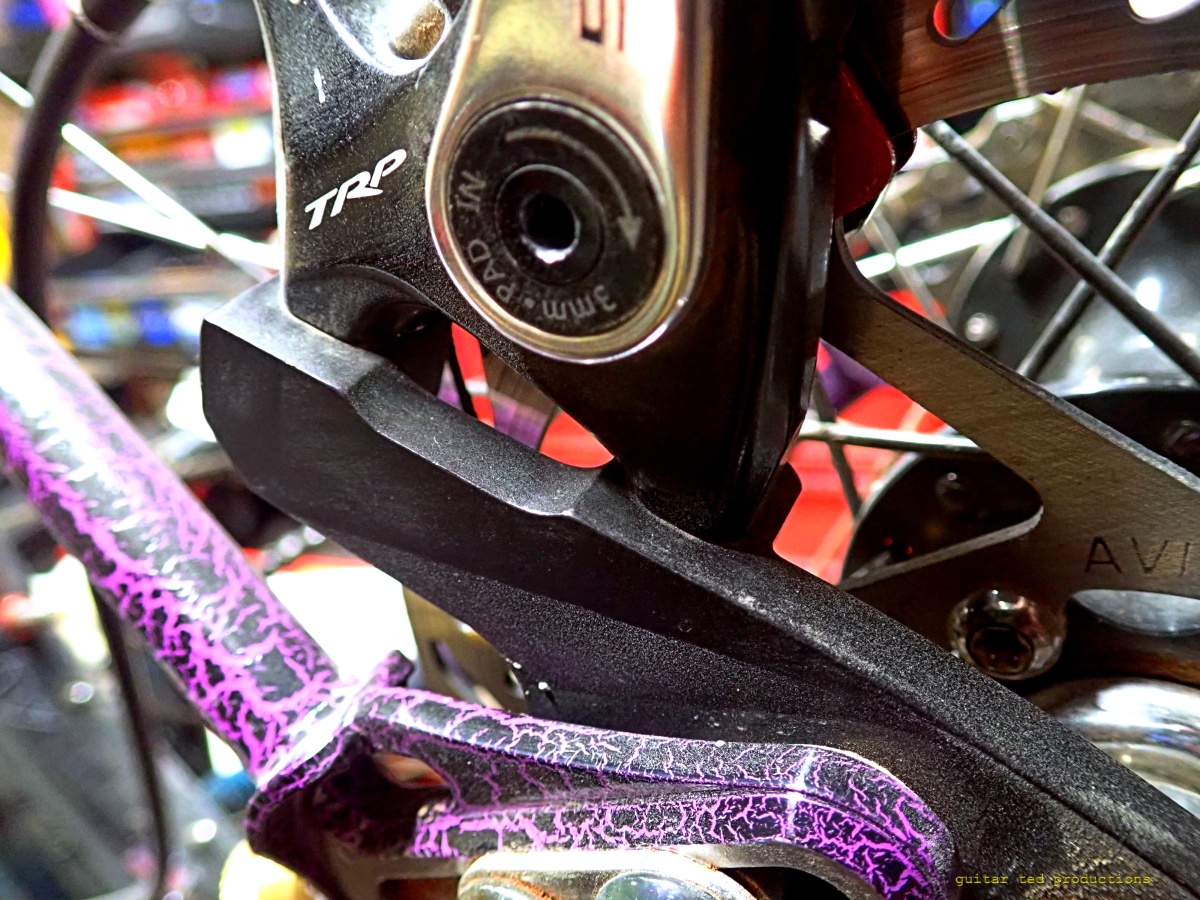
The image tells you all, but to reiterate, reefing one bolt down before the other on the caliper mount is a sure-fire way to twist the caliper out of alignment with the rotor. Once you release pressure that you applied either by using the levers or pad adjusters, the caliper will be out of alignment or rubbing the rotor on one side. 

The winning technique here is to gently apply torque alternately to each bolt. Maybe only turning the bolt head a few degrees at a time. First one - then the other, rinse and repeat until the caliper is firmly fixed to the frame or fork. 

In some rare cases I have had to apply a drop of chain lube under a bolt head for a caliper to prevent it from torquing my caliper off-axis. But generally speaking, using a gentle and alternating application of torque will yield the best results. 

Tip #3 For Avid Brakes or any Caliper That Uses Concave/Convex Washers:

A few things to know here about Avid calipers that use those pesky concave/convex washers. They are generally made from aluminum, and since they are of a softer metal, the effect of tightening them down against one another will make them take a set. What that means is that - even if you loosen the bolts, those washers may stick together, or go back to their original positions when re-tightened. 

To prevent this from happening, you should always make sure those washers are loosened from each other and rotated so that they won't just go right back where they were, preventing you from getting a good adjustment. 

This is important since Avid calipers, and some others that adopted this design, not only adjust side-to-side, but also adjust for vertical plane, This makes Avid calipers a bit more fussy, but if you follow this tip regarding the washers, you should have better chances for success, 

Finally, those washers can corrode and will eventually fail. Always inspect these washers for signs of corrosion or breakdown and replace them if you have any questions about them. You can get replacement washers from SRAM or in a pinch, you can use the concave/convex washers from a set of linear pull brakes. 

Okay, I hope those tips and tricks are useful. Let me know in the comments if you have any tricks or tips of your own. If you have any questions that you'd like me to answer in a post like this, just let me know there in the comments as well.

Tuesday, May 23, 2023

Brake Job

A slotted fastener? C'mon Shimano! Really?
 Not long ago I had a weird thing happen on a ride on the Noble GX5 where I applied the brakes hard to slowly descend a flood control dike. There was no issue there, but later into the ride I had the rear brake lever come all the way back to the bars with little braking power. While a brake bleed may be the initial diagnosis, it has been my experience as a mechanic working with Shimano hydraulic brakes that worn pads can cause this same effect. 

But all at once? I had great rear brake feel, then bad brake feel all in the same ride. Well, I decided to hedge my bets and I got both the brake bleed kit, mineral oil fluid, and a new set of organic pads. 

I figured on changing the pads first as that is the easiest fix. As I sat down to work on this, I discovered that the brake pad retention bolt had a slotted head. Not a hex interface, not a Torx interface, a slotted interface. What?!!

Warning! Rant Alert: As a mechanic it is my opinion that slotted interfaces should be banished from Planet Earth. There is no reason to use that anymore when superior technology exists and is extensively used in the industry. Why do I feel this way? Because a slotted interface fastener is super easy to damage, harder to work with, and .....well.....it just is not a good choice anymore. As stated above, better ideas exist and are readily available to any manufacturer. Okay....rant over. 

Once I had carefully selected the proper size flat blade screwdriver, the fastener came out undamaged. Whew! That was the worst of the job right there, and the rest was a breeze to finish up. I buttoned up everything and went out to bed in the pads to the rotor. 

And how did that go? Well, the brakes are better. But they are not what they were yet, so I may do a brake bleed anyway just to see if I can't bring the lever feel back to what it was. I mean, I can lock up the rear wheel and braking power, modulation, and all is just fine. It's the pad contact feel that is lacking and it seems to me that the lever travel is just a bit much yet. But here again, I've had Shimano road brakes on many bikes in my workstand where you couldn't get the rear to feel like the front no matter how much you bled the brakes.

And I had zero evidence of brake fluid leakage, which would indicate that the system is still sealed, but that doesn't necessarily mean anything here. It just points to the fact that it was mostly the pads that went away, but there may be something else going on here. 

Stay tuned. I may end up bleeding the brakes after all.

Brake Job

A slotted fastener? C'mon Shimano! Really?
 Not long ago I had a weird thing happen on a ride on the Noble GX5 where I applied the brakes hard to slowly descend a flood control dike. There was no issue there, but later into the ride I had the rear brake lever come all the way back to the bars with little braking power. While a brake bleed may be the initial diagnosis, it has been my experience as a mechanic working with Shimano hydraulic brakes that worn pads can cause this same effect. 

But all at once? I had great rear brake feel, then bad brake feel all in the same ride. Well, I decided to hedge my bets and I got both the brake bleed kit, mineral oil fluid, and a new set of organic pads. 

I figured on changing the pads first as that is the easiest fix. As I sat down to work on this, I discovered that the brake pad retention bolt had a slotted head. Not a hex interface, not a Torx interface, a slotted interface. What?!!

Warning! Rant Alert: As a mechanic it is my opinion that slotted interfaces should be banished from Planet Earth. There is no reason to use that anymore when superior technology exists and is extensively used in the industry. Why do I feel this way? Because a slotted interface fastener is super easy to damage, harder to work with, and .....well.....it just is not a good choice anymore. As stated above, better ideas exist and are readily available to any manufacturer. Okay....rant over. 

Once I had carefully selected the proper size flat blade screwdriver, the fastener came out undamaged. Whew! That was the worst of the job right there, and the rest was a breeze to finish up. I buttoned up everything and went out to bed in the pads to the rotor. 

And how did that go? Well, the brakes are better. But they are not what they were yet, so I may do a brake bleed anyway just to see if I can't bring the lever feel back to what it was. I mean, I can lock up the rear wheel and braking power, modulation, and all is just fine. It's the pad contact feel that is lacking and it seems to me that the lever travel is just a bit much yet. But here again, I've had Shimano road brakes on many bikes in my workstand where you couldn't get the rear to feel like the front no matter how much you bled the brakes.

And I had zero evidence of brake fluid leakage, which would indicate that the system is still sealed, but that doesn't necessarily mean anything here. It just points to the fact that it was mostly the pads that went away, but there may be something else going on here. 

Stay tuned. I may end up bleeding the brakes after all.

Friday, May 06, 2022

Friday News And Views

I'm wearing the Century CC Jacket on the left. (Image by R. Versteegh)
Rain Jacket Review:

 I just posted my Showers Pass Century CC rain jacket review this week on RidingGravel.com. (Standard Disclaimer) It's probably the most comfortable rain jacket I've yet tried, and I've been sent many to check out over the years. 

Showers Pass was the rain jacket to have back in the early days of Trans Iowa. This was in the time before 'gravel' was a thing, and racing in rain jackets was thought to be done only in one of those mimimalist 'rain capes' which were pretty much clear plastic bags with a hole for the neck, two plastic tubes for sleeves, and a Velcro closure instead of a zipper. Gotta be able to read the sponsor's names emblazoned on yer jersey now! 

But touring cyclists were all about the effective, versatile rain gear for cycling. That's kind of where Showers Pass made its hay early on in its history. And subsequently when Trans Iowa riders were looking for that good rain jacket, the Showers Pass jackets were discovered. I remember talking with some of the early T.I. riders about what they were using, and the Showers Pass stuff came up often and got good comments from the folks using them. 

I had aims to buy one of their Century jackets for quite some time, but I had never gotten around to it, mostly because I was getting sent all these other jackets to try out. But recently Showers Pass came out with a budget priced version of the Century Jacket dubbed the Century CC, and I am now finding out what all the fuss was about. Showers Pass says a new version of that stalwart Century is going to be coming out. It might just be another great one for poor weather gravel riding. 

Continental Introduces A New Bike Packing Tire:

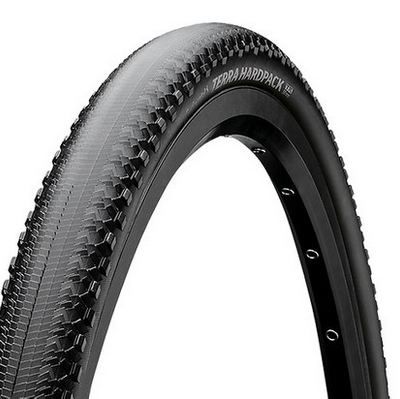
Continental, the German based tire company, have announced a new tire called the Terra Hardpack..It is a 50mm wide tire with a unique, low tread pattern for gravel, smooth dirt, and rougher roads. 

Offered in a 700 X 50mm width, the tire features Continental's Shieldwall puncture protection belt, a tubeless ready bead, and the new PureGrip compound which features excellent grip but long wearing properties, according to Continental. 

According to reports, Continental is also offering this in a 650B X 50mm size, but there are no other sizes available at this time. No pricing was found at this time either. 

Comments: Continental has always been a conservative company when it comes to stepping into new markets, so this late entry into the bike packing/wide gravel realm is not surprising. The Terra Hardpack has an interesting, almost scaly looking tread. My experiences with Continental have been that their tires often do not come out to be as wide as stated, so if that still is the case, this may fit into more bikes than you might think. 

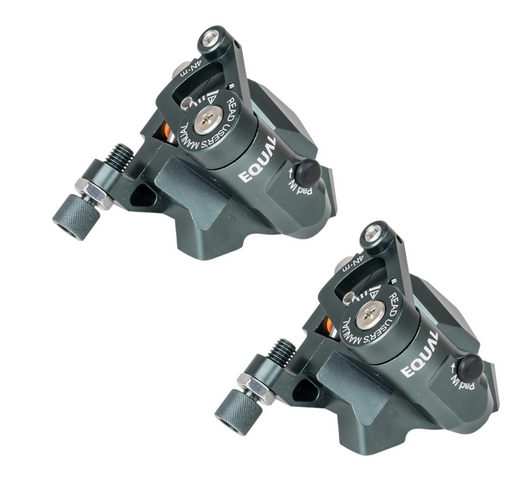
Growtac brand "Equal" flat mount brake calipers. Image courtesy of Velo Orange

 Thems The Brakes:

In a world of parts shortages it is always interesting to find a new option that is actually in stock. Such is the case with a new flat mount disc brake option from Velo Orange called Growtac Equal Flat Mount Disc Brakes

These single-side actuated, mechanical disc brakes calipers come complete with hardware, adapters for the front, cables, housings, ferrules, and come in several anodized colors. The calipers weigh in at a claimed 135 grams each and do not come with rotors. Price is listed at $350.00/both wheels.

Comments: I was looking for flat mount disc brakes the other day and there were not many choices out there. This adds another interesting choice. The price might seem high, but you get everything you need minus rotors. (And good luck finding those!) But still.... You can get hybrid cable/hydraulic Juin Tech brakes for less. Those do come with rotors (six bolt though) and no cables or housings, but even with that you'd be well under $350.00 for both wheels. I mention these Juin Tech's as they are identical to the highly touted Yokozuna hybrid calipers and they work really well. 

TIME Bicycles' ADHX gravel bike. Image courtesy of TIME Bicycles USA.

TIME Bicycles Introduces Complete Bikes In USA:

A news announcement came out this week saying TIME Bicycles were again available in the USA. TIME has a new gravel bike they are excited about that uses a new lay-up of carbon mixed with Dyneema fabric for more strength and vibration reduction. 

Comments: This is a great example of some pretty cool ideas with a couple of fatal misses in design and geometry. First off, TIME specifies that the ADHX is good for tires from 38mm-40mm. What? Have these designers not seen what has been going on around them for the past five to seven years? A 'new' design that can only handle a 40mm tire is pretty much 2012 technology. 

Secondly, they have a great bottom bracket drop, but the head angle at 72.5° for a Large is waaay too steep! Again- it smacks of a geometry chart dredged up for a gravel bike made in the early twenty-teens. I fail to see how this bike would be really great at anything other than rough paved roads and very smooth dirt. But yeah.....racing bikes. I hear ya. 

Again with the wrong bike for the wrong reasons.

Thanks for reading Guitar Ted Productions! I hope that you all can get out for a ride or two this weekend!

Friday News And Views

I'm wearing the Century CC Jacket on the left. (Image by R. Versteegh)
Rain Jacket Review:

 I just posted my Showers Pass Century CC rain jacket review this week on RidingGravel.com. (Standard Disclaimer) It's probably the most comfortable rain jacket I've yet tried, and I've been sent many to check out over the years. 

Showers Pass was the rain jacket to have back in the early days of Trans Iowa. This was in the time before 'gravel' was a thing, and racing in rain jackets was thought to be done only in one of those mimimalist 'rain capes' which were pretty much clear plastic bags with a hole for the neck, two plastic tubes for sleeves, and a Velcro closure instead of a zipper. Gotta be able to read the sponsor's names emblazoned on yer jersey now! 

But touring cyclists were all about the effective, versatile rain gear for cycling. That's kind of where Showers Pass made its hay early on in its history. And subsequently when Trans Iowa riders were looking for that good rain jacket, the Showers Pass jackets were discovered. I remember talking with some of the early T.I. riders about what they were using, and the Showers Pass stuff came up often and got good comments from the folks using them. 

I had aims to buy one of their Century jackets for quite some time, but I had never gotten around to it, mostly because I was getting sent all these other jackets to try out. But recently Showers Pass came out with a budget priced version of the Century Jacket dubbed the Century CC, and I am now finding out what all the fuss was about. Showers Pass says a new version of that stalwart Century is going to be coming out. It might just be another great one for poor weather gravel riding. 

Continental Introduces A New Bike Packing Tire:

Continental, the German based tire company, have announced a new tire called the Terra Hardpack..It is a 50mm wide tire with a unique, low tread pattern for gravel, smooth dirt, and rougher roads. 

Offered in a 700 X 50mm width, the tire features Continental's Shieldwall puncture protection belt, a tubeless ready bead, and the new PureGrip compound which features excellent grip but long wearing properties, according to Continental. 

According to reports, Continental is also offering this in a 650B X 50mm size, but there are no other sizes available at this time. No pricing was found at this time either. 

Comments: Continental has always been a conservative company when it comes to stepping into new markets, so this late entry into the bike packing/wide gravel realm is not surprising. The Terra Hardpack has an interesting, almost scaly looking tread. My experiences with Continental have been that their tires often do not come out to be as wide as stated, so if that still is the case, this may fit into more bikes than you might think. 

Growtac brand "Equal" flat mount brake calipers. Image courtesy of Velo Orange

 Thems The Brakes:

In a world of parts shortages it is always interesting to find a new option that is actually in stock. Such is the case with a new flat mount disc brake option from Velo Orange called Growtac Equal Flat Mount Disc Brakes

These single-side actuated, mechanical disc brakes calipers come complete with hardware, adapters for the front, cables, housings, ferrules, and come in several anodized colors. The calipers weigh in at a claimed 135 grams each and do not come with rotors. Price is listed at $350.00/both wheels.

Comments: I was looking for flat mount disc brakes the other day and there were not many choices out there. This adds another interesting choice. The price might seem high, but you get everything you need minus rotors. (And good luck finding those!) But still.... You can get hybrid cable/hydraulic Juin Tech brakes for less. Those do come with rotors (six bolt though) and no cables or housings, but even with that you'd be well under $350.00 for both wheels. I mention these Juin Tech's as they are identical to the highly touted Yokozuna hybrid calipers and they work really well. 

TIME Bicycles' ADHX gravel bike. Image courtesy of TIME Bicycles USA.

TIME Bicycles Introduces Complete Bikes In USA:

A news announcement came out this week saying TIME Bicycles were again available in the USA. TIME has a new gravel bike they are excited about that uses a new lay-up of carbon mixed with Dyneema fabric for more strength and vibration reduction. 

Comments: This is a great example of some pretty cool ideas with a couple of fatal misses in design and geometry. First off, TIME specifies that the ADHX is good for tires from 38mm-40mm. What? Have these designers not seen what has been going on around them for the past five to seven years? A 'new' design that can only handle a 40mm tire is pretty much 2012 technology. 

Secondly, they have a great bottom bracket drop, but the head angle at 72.5° for a Large is waaay too steep! Again- it smacks of a geometry chart dredged up for a gravel bike made in the early twenty-teens. I fail to see how this bike would be really great at anything other than rough paved roads and very smooth dirt. But yeah.....racing bikes. I hear ya. 

Again with the wrong bike for the wrong reasons.

Thanks for reading Guitar Ted Productions! I hope that you all can get out for a ride or two this weekend!

Friday, February 12, 2021

Friday News And Views

SRAM AXS Force- Could a Rival version be on the way?
 SRAM Pricing Increase And Rumors:

The mechanic's world is all buzzing about a 15% price increase across the board for new SRAM replacement parts and groups which reportedly went into effect February 1st. As I have speculated all along, parts prices would be rising due to materials costs and shipping issues all throughout 2021. 

This should also translate to complete, new bikes for 2021 and 2022. What this means for the consumer is that at the lower, entry levels, price increases will be keenly felt. We are seeing it already. "Bike shop quality" bikes are going to probably start in the $500-$600 range now going forward. I also cannot imagine that box store bikes, or "Mall Wart" bikes, as I call them, won't be a lot more expensive as well. Just from a tariff standpoint, because tariffs went into effect on good from China, now including bicycles, on January 1st.  Not that any of those bikes have SRAM parts, but some do. 

Another tidbit being tossed about online is a SRAM Rival AXS group announcement, which some are claiming will happen this Summer. (UPDATE: Some sources are now confirming it is on the way) For the record, I don't know anything and I am not breaching any embargo, since I never was contacted about this. The fact is, many are chattering online about this, and it makes sense. This bodes well for those wanting an electronic group on a new bike at a lower price, but much of this will get offset by rising costs, so a Rival AXS may not have quite the impact it would have had in, say 2019. Additionally, now I am seeing that the mere existence of a Rival AXS may in fact push mechanical drive train parts by the wayside. So, this is indicating that once you go 12 speed, at least in SRAM's ecosystem, you will have to go wireless and electronic.

Speaking of AXS, SRAM announced earlier in the week that they had a 36T compatible AXS for road now, which was obviously necessary since they are up against Shimano GRX Di2 which has already been out over a year now and has been dominating spec on gravel bikes for 2021 and likely 2022. And speaking of Shimano.....

Not to be missing out, but there is a TON of scuttlebutt running amok online concerning Shimano's newest Dura Ace Di2 being wireless, or partially wireless, which would be considered a direct response to SRAM since SRAM has been wireless on electronic groups from the start. Time will tell, but at least 2021 seems like it will reveal a lot of promise for 2022 bikes. 

The Velo Orange Crazy Bars v2. Image courtesy of Velo Orange

Velo Orange Announces Crazy Bars v2:

If you've been a reader here for a long time you know that I have a certain affinity for weird handle bars. I like to call them "Alt Bars", but they are typically handle bars out of the standard box of risers, flats, and roadie drops. 

Well, Velo Orange announced last week that they are coming out with a redesign of their Crazy Bars. While I wasn't a big fan of the first version, this new version looks very intriguing. They tweaked the angle of the sweep to be at 35° and that compares to a Jones Bar which is 45°. I have thought that the Jones Bar had a bit too much sweep, and so this new Crazy Bar sweep is interesting to me now. The extensions, or 'horns' as Velo Orange calls them, which look like old, old school Moots ends, (the OG of bar ends), is something I don't know I'd need. Maybe if I tried that? Maybe. But the good news here is that Velo Orange is going to offer the same bar without the 'horns' and call it the Seine Bar. 

They are going to offer these in silver and black as well, so you can get your black handle bars, if you must! But don't get your hopes up just yet. Velo Orange isn't expecting these until Summer, and the way things are going, that may get pushed back a bit. 

I'm thinking I'd like to try these though. They are wide enough, have a very interesting sweep, and not a ton of rise, so they could be set up in a way I would like them, I think. I'd likely put these on my One One Inbred or maybe even a set could be had for my Blackbuck, but without the horns on that bike. i think they'd work very well on either bike. Now, if these were ever to be made in carbon, which I highly doubt, since this is Velo Orange we are talking about here, I'd put them on my fat bikes. But I will not entertain the thought of alloy bars for my fat bikes anymore. Carbon just keeps my hands a LOT warmer in Winter, and I am not willing to give that up. 

Froome: Not a fan of the road disc scene.

Meet Chris Froome - Retrogrouch:

I don't usually post anything about Pro Roadie personalities here, but a recent story about Tour de France winner, (amongst other high profile races)  Chris Froome, was interesting since he was commenting about components. 

It's only natural for a Pro road rider to be concerned and intimately familiar with how components work. Froome, having spent his career mainly on caliper brakes, has had to make the switch to road disc since he now rides for a team bike sponsor that does not offer a caliper equipped bike. 

At a recent press meeting where Froome was going over the finer points of his new Factor race machine, he mentioned that he wasn't a big fan of disc brakes on road bikes. He didn't like the disc rub, pistons not retracting right, the fussing with his mechanics, and he's not convinced the current road disc brakes are up to severe use as seen on fast, long mountain descents. Hmm......where have I heard those things before? 

It is ironic because when the whole road disc thing happened several companies and entities were saying the same things yet the industry pushed the idea ahead anyway because 'change equals new sales and old technology gets deleted to support more sales.'  I've said it all along- disc brakes are overkill and unnecessary on gravel bikes, but I will also add that wheels are far more swappable with big tires and in different diameters. Something that is difficult to impossible with cantilever based brakes. 

Otso Cycles finally offers a SS option for the Tuning Chip drop out.

Otso Cycles Offer SS Chip For Metal Bikes:

Back when I reviewed the Otso Warakin stainless steel bike I told Otso Cycles that they should offer a single speed option for their Tuning Chip drop outs. It was so obvious that this would work that I was a bit surprised to find out at the beginning of the review that Otso didn't have that option. Not only that, but they didn't seem too interested in doing one either. It seemed so obvious that it would be a benefit to them to offer the option that I thought they were making a bit of a mistake. Otso however was convinced that there just wasn't enough interest in the idea to make it happen.

Well, be that as it may, I liked the Warakin. It was, and still is, a really great bike. I may have gotten one had the single speed option been there before. That said, Otso Cycles has it now and it makes the Warakin even more of a compelling bike. It's got a nice geometry, big tire capability, and it rides nicely in the stainless steel version. You can even get a titanium version of the frame now, which is expensive, but cool. 

Obviously, Otso Cycles finally made the decision to do the single speed option. They claim that they had gotten a lot of interest in the idea. (It is NOT for their carbon bikes though) Again, I can't believe it took nearly four years to happen, but at least it did. Maybe someday there will be room in the stable for a Warakin, and maybe someday I'll get one.  

Podcast And Reminders:

Just a few end of week reminders for you all. First up- The Riding Gravel Radio Ranch posted up two new episodes this week. One featuring endurance athlete legend John Stamstad, who I mentioned last week. The LINK 

You can also find the podcast on your favorite podcast feeds.  

Also- don't forget that there is still a few jerseys and hats left from the C.O.G.100. You can peruse the selection on my Garage Sale page.  I try to keep that list of inventory current, so what you see there is what is left. Own a piece of gravel grinding history!

Finally, I will remind you that merch reflecting the 15th year of Guitar Ted Productions can be had by clicking THIS LINK.  A portion of every sale goes to support my daughter's artistic efforts. I've seen a few of the offerings there on people and they look great. Have a look and see if you want to fly the G-Ted logo (As seen to the left here) 
 

That's a wrap for this week! Stay warm!

Friday News And Views

SRAM AXS Force- Could a Rival version be on the way?
 SRAM Pricing Increase And Rumors:

The mechanic's world is all buzzing about a 15% price increase across the board for new SRAM replacement parts and groups which reportedly went into effect February 1st. As I have speculated all along, parts prices would be rising due to materials costs and shipping issues all throughout 2021. 

This should also translate to complete, new bikes for 2021 and 2022. What this means for the consumer is that at the lower, entry levels, price increases will be keenly felt. We are seeing it already. "Bike shop quality" bikes are going to probably start in the $500-$600 range now going forward. I also cannot imagine that box store bikes, or "Mall Wart" bikes, as I call them, won't be a lot more expensive as well. Just from a tariff standpoint, because tariffs went into effect on good from China, now including bicycles, on January 1st.  Not that any of those bikes have SRAM parts, but some do. 

Another tidbit being tossed about online is a SRAM Rival AXS group announcement, which some are claiming will happen this Summer. (UPDATE: Some sources are now confirming it is on the way) For the record, I don't know anything and I am not breaching any embargo, since I never was contacted about this. The fact is, many are chattering online about this, and it makes sense. This bodes well for those wanting an electronic group on a new bike at a lower price, but much of this will get offset by rising costs, so a Rival AXS may not have quite the impact it would have had in, say 2019. Additionally, now I am seeing that the mere existence of a Rival AXS may in fact push mechanical drive train parts by the wayside. So, this is indicating that once you go 12 speed, at least in SRAM's ecosystem, you will have to go wireless and electronic.

Speaking of AXS, SRAM announced earlier in the week that they had a 36T compatible AXS for road now, which was obviously necessary since they are up against Shimano GRX Di2 which has already been out over a year now and has been dominating spec on gravel bikes for 2021 and likely 2022. And speaking of Shimano.....

Not to be missing out, but there is a TON of scuttlebutt running amok online concerning Shimano's newest Dura Ace Di2 being wireless, or partially wireless, which would be considered a direct response to SRAM since SRAM has been wireless on electronic groups from the start. Time will tell, but at least 2021 seems like it will reveal a lot of promise for 2022 bikes. 

The Velo Orange Crazy Bars v2. Image courtesy of Velo Orange

Velo Orange Announces Crazy Bars v2:

If you've been a reader here for a long time you know that I have a certain affinity for weird handle bars. I like to call them "Alt Bars", but they are typically handle bars out of the standard box of risers, flats, and roadie drops. 

Well, Velo Orange announced last week that they are coming out with a redesign of their Crazy Bars. While I wasn't a big fan of the first version, this new version looks very intriguing. They tweaked the angle of the sweep to be at 35° and that compares to a Jones Bar which is 45°. I have thought that the Jones Bar had a bit too much sweep, and so this new Crazy Bar sweep is interesting to me now. The extensions, or 'horns' as Velo Orange calls them, which look like old, old school Moots ends, (the OG of bar ends), is something I don't know I'd need. Maybe if I tried that? Maybe. But the good news here is that Velo Orange is going to offer the same bar without the 'horns' and call it the Seine Bar. 

They are going to offer these in silver and black as well, so you can get your black handle bars, if you must! But don't get your hopes up just yet. Velo Orange isn't expecting these until Summer, and the way things are going, that may get pushed back a bit. 

I'm thinking I'd like to try these though. They are wide enough, have a very interesting sweep, and not a ton of rise, so they could be set up in a way I would like them, I think. I'd likely put these on my One One Inbred or maybe even a set could be had for my Blackbuck, but without the horns on that bike. i think they'd work very well on either bike. Now, if these were ever to be made in carbon, which I highly doubt, since this is Velo Orange we are talking about here, I'd put them on my fat bikes. But I will not entertain the thought of alloy bars for my fat bikes anymore. Carbon just keeps my hands a LOT warmer in Winter, and I am not willing to give that up. 

Froome: Not a fan of the road disc scene.

Meet Chris Froome - Retrogrouch:

I don't usually post anything about Pro Roadie personalities here, but a recent story about Tour de France winner, (amongst other high profile races)  Chris Froome, was interesting since he was commenting about components. 

It's only natural for a Pro road rider to be concerned and intimately familiar with how components work. Froome, having spent his career mainly on caliper brakes, has had to make the switch to road disc since he now rides for a team bike sponsor that does not offer a caliper equipped bike. 

At a recent press meeting where Froome was going over the finer points of his new Factor race machine, he mentioned that he wasn't a big fan of disc brakes on road bikes. He didn't like the disc rub, pistons not retracting right, the fussing with his mechanics, and he's not convinced the current road disc brakes are up to severe use as seen on fast, long mountain descents. Hmm......where have I heard those things before? 

It is ironic because when the whole road disc thing happened several companies and entities were saying the same things yet the industry pushed the idea ahead anyway because 'change equals new sales and old technology gets deleted to support more sales.'  I've said it all along- disc brakes are overkill and unnecessary on gravel bikes, but I will also add that wheels are far more swappable with big tires and in different diameters. Something that is difficult to impossible with cantilever based brakes. 

Otso Cycles finally offers a SS option for the Tuning Chip drop out.

Otso Cycles Offer SS Chip For Metal Bikes:

Back when I reviewed the Otso Warakin stainless steel bike I told Otso Cycles that they should offer a single speed option for their Tuning Chip drop outs. It was so obvious that this would work that I was a bit surprised to find out at the beginning of the review that Otso didn't have that option. Not only that, but they didn't seem too interested in doing one either. It seemed so obvious that it would be a benefit to them to offer the option that I thought they were making a bit of a mistake. Otso however was convinced that there just wasn't enough interest in the idea to make it happen.

Well, be that as it may, I liked the Warakin. It was, and still is, a really great bike. I may have gotten one had the single speed option been there before. That said, Otso Cycles has it now and it makes the Warakin even more of a compelling bike. It's got a nice geometry, big tire capability, and it rides nicely in the stainless steel version. You can even get a titanium version of the frame now, which is expensive, but cool. 

Obviously, Otso Cycles finally made the decision to do the single speed option. They claim that they had gotten a lot of interest in the idea. (It is NOT for their carbon bikes though) Again, I can't believe it took nearly four years to happen, but at least it did. Maybe someday there will be room in the stable for a Warakin, and maybe someday I'll get one.  

Podcast And Reminders:

Just a few end of week reminders for you all. First up- The Riding Gravel Radio Ranch posted up two new episodes this week. One featuring endurance athlete legend John Stamstad, who I mentioned last week. The LINK 

You can also find the podcast on your favorite podcast feeds.  

Also- don't forget that there is still a few jerseys and hats left from the C.O.G.100. You can peruse the selection on my Garage Sale page.  I try to keep that list of inventory current, so what you see there is what is left. Own a piece of gravel grinding history!

Finally, I will remind you that merch reflecting the 15th year of Guitar Ted Productions can be had by clicking THIS LINK.  A portion of every sale goes to support my daughter's artistic efforts. I've seen a few of the offerings there on people and they look great. Have a look and see if you want to fly the G-Ted logo (As seen to the left here) 
 

That's a wrap for this week! Stay warm!

Tuesday, February 27, 2018

How Are We Going To Do This?

Those two threaded holes? That's an early attempt at a disc brake mount.
Everyone that nerds out on bicycles seems to have a pretty strong opinion on "standards", (like "there aren't ANY"!), and these opinions often times will be without any regard to history. Usually "it has been done before" and the reason it didn't catch on might be one of several things. Money being one of the biggest reasons, but material technology is usually reason number one. That means that the idea was "there" but the means to make it work right was not. Materials and the way they are applied generally are the reason many innovations ultimately become realities for bicycles. Like disc brakes, for instance.

Shimano had working disc brakes for bicycles back during the bike boom of the 70's. While the calipers were heavy and clunky, and the rotors were solid steel, they did work. There were concerns , of course, and since forks of the day were spindly and not very strong, disc brakes on bicycles then were typically only mounted on rear wheels. Ironically, Shimano chose to thread on the rotor to the hub, much like a freewheel, and if you think about it, Centerlock brakes are just a minor variation on that theme.

The whole disc brake thing then "went away" for a time, but during the late 70's, 80's and 90's, mountain bikers started tinkering around with disc brakes and by the late 90's, it was going to happen. Early adopters were within the ranks of the Marin clunker gang who used the Shimano disc brakes of the time despite their tank-ish weight. Later in the 80's there was a few attempts at using disc brakes on down hill mountain bikes. The 90's saw more activity with disc brakes, maybe most famously by Mountain Cycle who had an "upside down" fork design which required disc brakes to make it work. Gary Fisher also had a bike with disc brakes at the time, but it was........ahhh.... not very good!

Most suspension forks now use the 74mm post mount standard developed by Manitou
Finally, a concerted effort to make disc brakes work cranked up in the 90's. There was the Rock Shox mechanical disc brake with their funky 3 bolt rotors. Hayes Brakes had a 22mm direct mount, Manitou had a 74mm post mount, (yes, Manitou came up with that), and there was a 51mm mount that required adapters floating around as well. Eventually, the 51mm standard got adopted as the "International Standard" while Manitou, (and ironically, Hayes after they bought Manitou), stuck with 74mm mounts which eventually became the standard across most suspension forks and now rigid mtb forks. While the 51mm "IS" standard is still around, it requires different adaptors for front and rear brakes, while the 74mm post mounts do not. 74mm isn't widely adopted by the frame builders though since it requires a bit more effort to make precisely.

Now around about 2014 Shimano unveiled plans to make a new standard called "Flat Mount", which is not unlike what Hayes was trying to do in the late 90's with its 22mm mount. The idea was that the calipers would sit flush to the frame and fork without unsightly adapters or posts sticking off forks and frames. Unfortunately, by the time flat mount came about there were many carbon forks which were using the post mount standard for road applications. To further complicate things, not many custom or high end builders liked the flat mount aesthetic on the rear chain stay, nor were too keen on not using already available IS compatible drop outs which had been refined to look rather good.

Complicating things further is Shimano's lack of interchangeable adapters to fit other types of calipers to flat mount and flat mount calipers to other types of mounts. SRAM has done more in this vein. There are issues with adapters, but one thing flat mount does do is make adapting the caliper to either a 140mm or 160mm rotor an easy affair. You just flip the adapter mount around to use one size or the other. (No 180mm or 203mm rotors can be used with flat mount Shimano calipers.)

Shimano Flat Mount Disc Brakes
Flat mount seems to have been developed to make disc brakes look sleeker and to limit rotor sizes to smaller rotors. While it confuses the market further, it probably isn't going away, since aftermarket brake, fork, and some frame makers are adopting this for road and "gravel" applications.

It also is worth mentioning that along with flat mount disc brakes Shimano also foisted 12mm front through axle for road on us at the same time. This all makes one ask a few hard questions, such as, "What is wrong with 15mm through axles?", (a standard, ironically also foisted on us partially by Shimano), and how about "What is wrong with 74mm post mount, or IS brake mounts we already have?". Don't hold yer breath for any answers to those questions, by the way.

So, in a way, Shimano has brought us full circle back to the flat mount brake, which Hayes proposed in the late 90's. Weird, huh?

The whole disc brake mounting question isn't 100% settled just yet, but it would seem that IS and 74mm post mount will be the realm of off road applications only and this flat mount technology will be the realm of road and gravel. Maybe.......

Then there is the whole through axle thing which is already changing road bike wheels and will, no doubt, upset the apple cart with regard to legacy wheels not working, people wanting certain combinations that won't be possible any longer, and with the brake thing, it will be even worse. Change is often frustrating and painful. This looks to be no different, but we've been through this before with mountain bikes, so welcome to the nightmare......again.

How Are We Going To Do This?

Those two threaded holes? That's an early attempt at a disc brake mount.
Everyone that nerds out on bicycles seems to have a pretty strong opinion on "standards", (like "there aren't ANY"!), and these opinions often times will be without any regard to history. Usually "it has been done before" and the reason it didn't catch on might be one of several things. Money being one of the biggest reasons, but material technology is usually reason number one. That means that the idea was "there" but the means to make it work right was not. Materials and the way they are applied generally are the reason many innovations ultimately become realities for bicycles. Like disc brakes, for instance.

Shimano had working disc brakes for bicycles back during the bike boom of the 70's. While the calipers were heavy and clunky, and the rotors were solid steel, they did work. There were concerns , of course, and since forks of the day were spindly and not very strong, disc brakes on bicycles then were typically only mounted on rear wheels. Ironically, Shimano chose to thread on the rotor to the hub, much like a freewheel, and if you think about it, Centerlock brakes are just a minor variation on that theme.

The whole disc brake thing then "went away" for a time, but during the late 70's, 80's and 90's, mountain bikers started tinkering around with disc brakes and by the late 90's, it was going to happen. Early adopters were within the ranks of the Marin clunker gang who used the Shimano disc brakes of the time despite their tank-ish weight. Later in the 80's there was a few attempts at using disc brakes on down hill mountain bikes. The 90's saw more activity with disc brakes, maybe most famously by Mountain Cycle who had an "upside down" fork design which required disc brakes to make it work. Gary Fisher also had a bike with disc brakes at the time, but it was........ahhh.... not very good!

Most suspension forks now use the 74mm post mount standard developed by Manitou
Finally, a concerted effort to make disc brakes work cranked up in the 90's. There was the Rock Shox mechanical disc brake with their funky 3 bolt rotors. Hayes Brakes had a 22mm direct mount, Manitou had a 74mm post mount, (yes, Manitou came up with that), and there was a 51mm mount that required adapters floating around as well. Eventually, the 51mm standard got adopted as the "International Standard" while Manitou, (and ironically, Hayes after they bought Manitou), stuck with 74mm mounts which eventually became the standard across most suspension forks and now rigid mtb forks. While the 51mm "IS" standard is still around, it requires different adaptors for front and rear brakes, while the 74mm post mounts do not. 74mm isn't widely adopted by the frame builders though since it requires a bit more effort to make precisely.

Now around about 2014 Shimano unveiled plans to make a new standard called "Flat Mount", which is not unlike what Hayes was trying to do in the late 90's with its 22mm mount. The idea was that the calipers would sit flush to the frame and fork without unsightly adapters or posts sticking off forks and frames. Unfortunately, by the time flat mount came about there were many carbon forks which were using the post mount standard for road applications. To further complicate things, not many custom or high end builders liked the flat mount aesthetic on the rear chain stay, nor were too keen on not using already available IS compatible drop outs which had been refined to look rather good.

Complicating things further is Shimano's lack of interchangeable adapters to fit other types of calipers to flat mount and flat mount calipers to other types of mounts. SRAM has done more in this vein. There are issues with adapters, but one thing flat mount does do is make adapting the caliper to either a 140mm or 160mm rotor an easy affair. You just flip the adapter mount around to use one size or the other. (No 180mm or 203mm rotors can be used with flat mount Shimano calipers.)

Shimano Flat Mount Disc Brakes
Flat mount seems to have been developed to make disc brakes look sleeker and to limit rotor sizes to smaller rotors. While it confuses the market further, it probably isn't going away, since aftermarket brake, fork, and some frame makers are adopting this for road and "gravel" applications.

It also is worth mentioning that along with flat mount disc brakes Shimano also foisted 12mm front through axle for road on us at the same time. This all makes one ask a few hard questions, such as, "What is wrong with 15mm through axles?", (a standard, ironically also foisted on us partially by Shimano), and how about "What is wrong with 74mm post mount, or IS brake mounts we already have?". Don't hold yer breath for any answers to those questions, by the way.

So, in a way, Shimano has brought us full circle back to the flat mount brake, which Hayes proposed in the late 90's. Weird, huh?

The whole disc brake mounting question isn't 100% settled just yet, but it would seem that IS and 74mm post mount will be the realm of off road applications only and this flat mount technology will be the realm of road and gravel. Maybe.......

Then there is the whole through axle thing which is already changing road bike wheels and will, no doubt, upset the apple cart with regard to legacy wheels not working, people wanting certain combinations that won't be possible any longer, and with the brake thing, it will be even worse. Change is often frustrating and painful. This looks to be no different, but we've been through this before with mountain bikes, so welcome to the nightmare......again.

Wednesday, February 21, 2018

Welcome To The Dark Side

Yep......carbon.
The latest craze in the gravel travel world is for a company to slip in a bike with 650B wheels and wide rubber. Then they claim that they have this awesome geometry, (generally it is warmed over CX geo), and they start in how all the roads and even single track is now your playground.

As if that weren't the fact with any bike, really. But whatever.

I'm not here to tell you what you should do, I'm just here poking a bit at the marketing machine. This gig they are telling us about isn't "new" and what they put out, (again, in the general sense), isn't really anything but cyclo cross stuff with 650B wheels shoved in. Sometimes it is straight up roadie geometry, (The new Surly Midnight Special), and sometimes they get it mostly right, (The new All City G.M.).

Anyway, I got these new Irwin Cycling wheels to test for RidingGravel.com and they are 650B based. Disc, of course, so that makes them an easy swap into my Raleigh Tamland Two. Now, my Tamland Two is a 2014 model. Yep...... Four years old, and it is steel, and it has reasonable length chain stays, and it can take a big, wide tire in 650B and 29", and it uses a standard road crank. Plus, it doesn't have cyclo cross geometry. So, not new, but in some ways, actually better than what many companies are putting out now.

Weird. Guess some folks aren't paying attention.

Steel- check, 650B wheels-check, big rubber- check.
So, to all you new entries to this niche- welcome to the dark side. 

The old Raleigh may be on the cutting edge with these wheels and its geometry, but there are a few things that will make this bike obsolete in a few years. First and foremost- the quick release wheels. Those quick releases are on their way out. You probably won't even know it when it finally happens to all high performance bikes, but we are in the middle of that "takeover". The other thing that will doom this bike eventually is the 1 1/8th steer tube.That's a good thing to have from the standpoint of front end compliance, but this will be made obsolete by the fact that all forks made in the future will one day have tapered steer tubes. Brands like Soma and Ritchey try to keep it going, but someday...... Then there is the standard road crank and bottom bracket width. Despite decades of bikes being built this way, Road Boost is coming and there will be a time when standard width bottom brackets and standard chain line cranks will become a thing of the past.

Look, I hope I am wrong about all of that, because if I am, I can keep my Tamland going. If I am right, well, one day I'll have to hang it up on the wall for good. Let's hope that dark side doesn't come to pass!

Welcome To The Dark Side

Yep......carbon.
The latest craze in the gravel travel world is for a company to slip in a bike with 650B wheels and wide rubber. Then they claim that they have this awesome geometry, (generally it is warmed over CX geo), and they start in how all the roads and even single track is now your playground.

As if that weren't the fact with any bike, really. But whatever.

I'm not here to tell you what you should do, I'm just here poking a bit at the marketing machine. This gig they are telling us about isn't "new" and what they put out, (again, in the general sense), isn't really anything but cyclo cross stuff with 650B wheels shoved in. Sometimes it is straight up roadie geometry, (The new Surly Midnight Special), and sometimes they get it mostly right, (The new All City G.M.).

Anyway, I got these new Irwin Cycling wheels to test for RidingGravel.com and they are 650B based. Disc, of course, so that makes them an easy swap into my Raleigh Tamland Two. Now, my Tamland Two is a 2014 model. Yep...... Four years old, and it is steel, and it has reasonable length chain stays, and it can take a big, wide tire in 650B and 29", and it uses a standard road crank. Plus, it doesn't have cyclo cross geometry. So, not new, but in some ways, actually better than what many companies are putting out now.

Weird. Guess some folks aren't paying attention.

Steel- check, 650B wheels-check, big rubber- check.
So, to all you new entries to this niche- welcome to the dark side. 

The old Raleigh may be on the cutting edge with these wheels and its geometry, but there are a few things that will make this bike obsolete in a few years. First and foremost- the quick release wheels. Those quick releases are on their way out. You probably won't even know it when it finally happens to all high performance bikes, but we are in the middle of that "takeover". The other thing that will doom this bike eventually is the 1 1/8th steer tube.That's a good thing to have from the standpoint of front end compliance, but this will be made obsolete by the fact that all forks made in the future will one day have tapered steer tubes. Brands like Soma and Ritchey try to keep it going, but someday...... Then there is the standard road crank and bottom bracket width. Despite decades of bikes being built this way, Road Boost is coming and there will be a time when standard width bottom brackets and standard chain line cranks will become a thing of the past.

Look, I hope I am wrong about all of that, because if I am, I can keep my Tamland going. If I am right, well, one day I'll have to hang it up on the wall for good. Let's hope that dark side doesn't come to pass!

Thursday, October 26, 2017

Single Speed Century: Training Ride 1

One gear, gravel, and grit.
Wednesday I got out for a training ride on the single speed. After a month of being on the down low, I have to start building back up to a fitness level that will allow me to complete a century on gravel. That means I needed to put in a couple of hours at least on the Pofahl.

It was chilly, but Sunny and the wind was out of the Northwest. That meant I needed to go North. The routes to the North out of town are all mostly uphill, so that would also be good for training purposes. Now getting out of town, well that is something else altogether these days.

There is so much construction now with so many routes cut off that I ended up just riding along HWY 63 North on the bike path. Then I went East over on East Donald Street to catch a route North and I was on my way. Things felt pretty good, and I was chugging along thinking about several things on that bright, glorious morning. One of those things was a curiosity about why my front brake wasn't working well.

The Pofahl's front brake, well both actually, always worked so well. So, it was a curious thing now that all of a sudden I had a very weak front brake. In fact, I was so curious that I purposed to stop when I reached Bennington No. 4 School house and check it out. When I did, I laughed out loud!

Silly me! I didn't check to see what rotor size I was using on the Pofahl and make sure the alternate wheel set I swapped in was set up appropriately. So, I had a caliper set up for a 180mm rotor with a 160mm rotor bolted to the hub. Yeah.......that doesn't work out. So, realizing this I did the rest of the ride with only a rear brake, which was fine, really. But it was a good thing to figure out now instead of well in to a hundy.

And that saddle...... yeah, that's not gonna work either. 

More soon......

Single Speed Century: Training Ride 1

One gear, gravel, and grit.
Wednesday I got out for a training ride on the single speed. After a month of being on the down low, I have to start building back up to a fitness level that will allow me to complete a century on gravel. That means I needed to put in a couple of hours at least on the Pofahl.

It was chilly, but Sunny and the wind was out of the Northwest. That meant I needed to go North. The routes to the North out of town are all mostly uphill, so that would also be good for training purposes. Now getting out of town, well that is something else altogether these days.

There is so much construction now with so many routes cut off that I ended up just riding along HWY 63 North on the bike path. Then I went East over on East Donald Street to catch a route North and I was on my way. Things felt pretty good, and I was chugging along thinking about several things on that bright, glorious morning. One of those things was a curiosity about why my front brake wasn't working well.

The Pofahl's front brake, well both actually, always worked so well. So, it was a curious thing now that all of a sudden I had a very weak front brake. In fact, I was so curious that I purposed to stop when I reached Bennington No. 4 School house and check it out. When I did, I laughed out loud!

Silly me! I didn't check to see what rotor size I was using on the Pofahl and make sure the alternate wheel set I swapped in was set up appropriately. So, I had a caliper set up for a 180mm rotor with a 160mm rotor bolted to the hub. Yeah.......that doesn't work out. So, realizing this I did the rest of the ride with only a rear brake, which was fine, really. But it was a good thing to figure out now instead of well in to a hundy.

And that saddle...... yeah, that's not gonna work either. 

More soon......

Wednesday, November 25, 2015

The Day That Rim Brakes Died

One disc to rule them all in in the caliper bind them.....
Yesterday it was very quietly reported in the news of cycling that the UCI, (ruling body in all things Pro road racing Worldwide), green-lighted the use of disc brakes in the Pro and amateur road (Note- Amatuer ranks in 2017), racing ranks for 2016. You can read about what some of this may mean by checking out what "Red Kite Prayer" has to say about it.

Anyone with an eye on cycling knew this was coming one of these ol' days. Mountain bikes embraced the disc brake starting in the late 90's and by 2005, you were going to have a hard time finding a brand new, high end rim brake bike anymore. Then the disc brake crept into the world of cyclo-cross, where it was hotly debated for a season or two, then was generally accepted as the better choice amongst Pros, for the most part. Now it would appear that Pro road cycling will be all disc brake by 2017.

Interestingly, much like many changes in cycling, I find that histrionics and grandstanding generally happen during big changes like these. People bemoan the changes, and throw their collective hands in the air, post missives on social media blasting "The Man" for "forcing us to change" and bilking us for money for these "unnecessary changes" purely for profit. I know......I lived through the advent of 29"ers and am still getting an earful from various places about the whole "gravel bike" thing.

Like I have always said- "You don't have to buy into it." So, for instance, say you don't like disc brakes for road bikes, well......don't buy a disc brake road bike then. Think "gravel bikes" are a stupid idea? Then don't buy one. Still think wagon wheelers are daft? You can still buy a smaller wheeled mountain bike. Nobody is taking your money unless you are letting them. All the decrying and hand wringing about something new is pretty much wasted energy. That said.........

Hey! Whattya know! They still make this stuff yet!
Many times there is actually something to these changes. You know.....like when free wheels were invented. Or, how about disc brakes while we're at it. Yes.....rim brakes work, but I've tried these new fangled hydraulic road disc brakes, and you know what? They are pretty dang awesome. At least the Shimano ones are. Modulation, power, ease of use- all there. It doesn't get much better, and I have tried a lot of road caliper brakes. None can hold a candle to the power and ease of using that power that these road disc brakes have.

Now, that said, obviously the title to today's post is sarcastic. Rim brakes are not going away, and you can still buy , and will be able to in the future, a lot of rims and different caliper and cantilever style brakes that are really quite good. Add to that the vintage and used stuff out there that is still serviceable and you will have rim brakes to use for decades to come.

The bottom line is that you might see a bunch of ticked off posts, or rambling rants about how the industry has wreaked havoc again on poor, unsuspecting consumers because your stuff will be "obsolete" in a year and a half. Well, it just isn't true. Maybe it won't be the same again on high-end, new road racing bikes, but rim brakes and frames, wheels, parts, etc, will all be around for a long, long time. In all likelihood, you'll wear out that bike with rim brakes before parts for it are all gone. You don't have to have a disc brake road bike, if you think it is a dumb idea. There will always be alternative choices. Probably good new ones too. They just won't be sold by the "big companies" in the future. Well......probably not, anyway.....