Showing posts with label Nanoraptor. Show all posts

Monday, October 28, 2024

What Is It? 25 Years Of 29"ers

1999 scan of a document sent to dealers about the 29" Nanoraptor
This past March an anniversary occurred which I missed and was reminded of during a ride last week. The thought popped up in my head that the 29"er was 25 years old now! 

Funny how weird, random thoughts come into ones head while riding a bicycle. 

This has prompted me to take a time out on other things I'd be posting about here to mark this occasion. But before I get into anything historical or noteworthy about the start of 29"er bicycles, I need to address something about the current day and age.

You may have noticed that this anniversary has not been marked by anyone in cycling media I have noticed or heard about this year. You yourself may be thinking, "Big deal!", and perhaps no one really cares. But if you, like me, do care, then read on. 

The thing is that now 29"ers are not notable because of their wheel size. They are notable because these bikes are mountain bikes with electric motors, or they have dual suspension designs with high pivots, or for some other reason that has nothing to do with the bike having 29 inch diameter wheels. But this was not always the case. This is why noting the existence of 29"er wheels is important. 

I'm not going to get into the entire story of 29"ers here. I've already written that story, back in 2010. You can read the story of "The Beginnings Of The Modern 29"er: A History"at that link, or from the link under the header whenever you feel like checking that out. 

Gary Fisher's Steve Potts built 29"er with a modded Manitou fork in 1999

Since 2010, when I wrote up that history of 29"ers, things have come a long, long way. We had a dalliance with 27.5"/650B wheels, and while those are sometimes still used, that wheel size has not come to dominate the market as some of its fans had hoped it would in the early twenty-teens. No, it is the 29"er that is "the wheel" now, but this would not have been true had it not been for "The Tire". 

Diameter matters. Even back in the late 1800's diameter mattered. The diameter of the wheel was paramount in determining speed. How far one can travel with one revolution of the wheel of a penny farthing determined speed and effort necessary to propel oneself along on a bicycle. This basis for determining performance still exists today. 

Today diameter matters for other reasons, but as it relates to the 29"er, it matters because that dimension is the line of demarcation. If a wheel and tire do not measure up to 29" in diameter, it is not a 29"er. Some will argue that a Nanoraptor was not a 29" tire, but those who were closest to this, perhaps, would argue differently. Wes Williams, Gary Fisher, Mark Slate, and Don Cook probably would have a word to say about that. 

The first 29"er. A Willits made by Wes Williams. March 1999

Some would argue that the more mountain bike-ish 700c bikes like the Diamond Back Overdrive were the first 29'ers. They were equipped with 700c X 45mm Panaracer Smoke tires. Anyone who rides a gravel bike today with 700c X 45mm tires knows that those are not 29"ers! Of course, they do not measure to 29 inches in diameter on any rim. 

This all matters because of what one can and cannot do on true off-road terrain with tires that have marginal volume and width. The lack of high-volume 700c based tires for handling rougher terrain was the biggest motivating factor in getting the Nanoraptor made. Up to that point only a finite number of odd Continental Goliath 28" tires were even close to being what the mountain riders of 700c based bicycles wanted and those were not all that great. Once the supply of those rare tires ran out, then what

The Nanoraptor was made to fill the gap and to help those who were the biggest enthusiastic supporters of that tire and wheel size  to show others why this idea was superior to the then standard 26" wheel size. That previous statement alone was enough to incite near warfare online in forums across the internet. But eventually all resistance was swept away. 

Next: Three major players that moved the needle for 29" bikes early on.

Saturday, December 11, 2021

The Early Days Of 29"ers- A Gary Fisher Perspective

 During a Fisher Bikes Press camp visit I was on in September of 2009, I was privy to hearing tales told by the famous Gary Fisher himself. This conference of media attendees was entertained and informed on Gary Fisher's take on the history of the wheel size from his perspective. I took notes furiously and after returning home I tossed the note pad in a box which I found again recently. 

So, this is over a decade afterward and some gaps in the notation, which I assume I probably thought at the time would be remembered after I got home, have occurred. This following is, to the best of my ability, a reconstruction of what was told then in the Fall of '09.

There were definitely a few things which Mr. Fisher said that seem to contradict tales told elsewhere, so from that standpoint alone this is an interesting bit of information to add to the history. Who is 'right' and who is 'not so right' really doesn't matter here as much as perhaps being able to see that 'like minds were thinking similarly'. Things said and seen may have been subliminally stored in memories and thought, "not very important', or "obvious" at the time and then brought back to mind later. Then it becomes time to 'fix' timelines and history and you know- things that weren't all that important to mark then have to be marked and well.....it can be messy. 

I'd like to think that some of that happened with regard to 29"ers, because, well, who really thought in 1999 that this wheel size would supplant the mighty 26"er completely? No one did. No one figured this would become what it has, and isn't that the way great things go? With all that in mind......
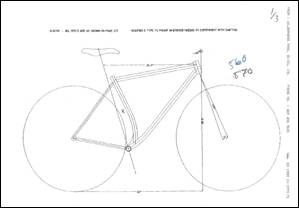
Fisher prototype 29"er drawings
So, this will be given in much the same manner as I received it at the time, which was in a timeline fashion. I will make commentary as this goes along also. 

1999/2000: Starting out with Gary Fisher's first 29"er, which was drawn up and made in Steve Pott's custom bicycle shop. Gary had in mind to do a direct comparison between a 26" and 29" wheeled MTB. His goal was to keep everything he could the same between the two bikes. Geometry, head angles, chain stay lengths, and head tube angles were kept as close as possible to the 26'er. This resulted in a frame with a bent seat tube to keep the chain stays short as possible. Fisher's design goal was to get to an amazingly short 16 1/2" length, which is equivalent to 419.1mm! A modified Manitou Mars fork was crafted as a front fork for the project with travel limited to 50mm. A custom modified XT front derailleur was crafted so it would not interfere with the rear wheel. Much of what was done on this 1st proto were things that would not be seen on 29"ers for a decade or longer. 

Interestingly, Fisher claimed that between he, Mark Slate (head of WTB), and Steve Potts that this was always known as a "29"er" when they referred to this bike. Fisher credits a conversation between he and Mark Slate at Interbike as being when the term was first used. This probably was at the '99 Interbike as "The Tire", the 29"er Nanoraptor, was introduced right at that time. If so, it predates Wes Williams claim of the term by a month, or perhaps a few weeks even. Regardless, as I said, it very well may be that the term was in usage between all the instigators of "The Tire" and no one can really pinpoint when exactly it was first uttered in relation to the wheel size. What matters is that this was a wheel size declared as being the "29"er" out of the gates. 

Update 11/29/23: It has come to light that Slate and Fisher dubbed the tire as a "twenty-nine inch" tire, this according to a Facebook post by Gary himself under his "married name" he uses there, "Gary Zaphiris". I posted the entire written comment by Gary at the bottom of THIS PAGE which is my history of the 29"er. 
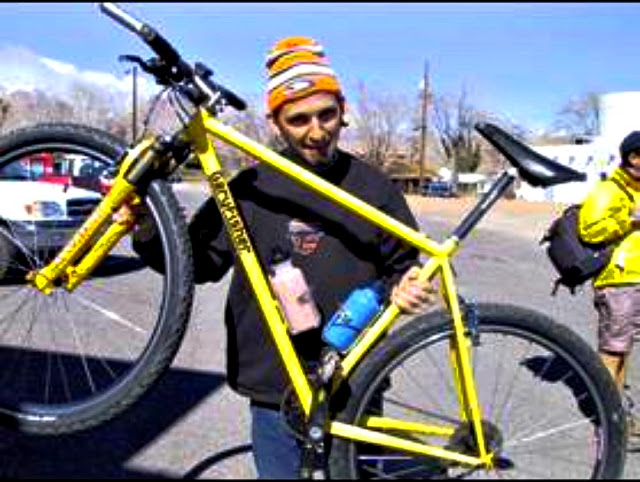
The first Fisher 29"er held by former Mountain Bike Action editor, Zapata Espinoza. (Image courtesy of Gary Fisher.

 As an aside, Gary Fisher claimed that credit for the very first 29 inch wheeled bike belongs to Wes Williams. And what about Fisher's 26'er/29"er comparison? Fisher claimed that in his tests that he was 2-3% faster on the 29"er. That was all he needed to pursue this further. 
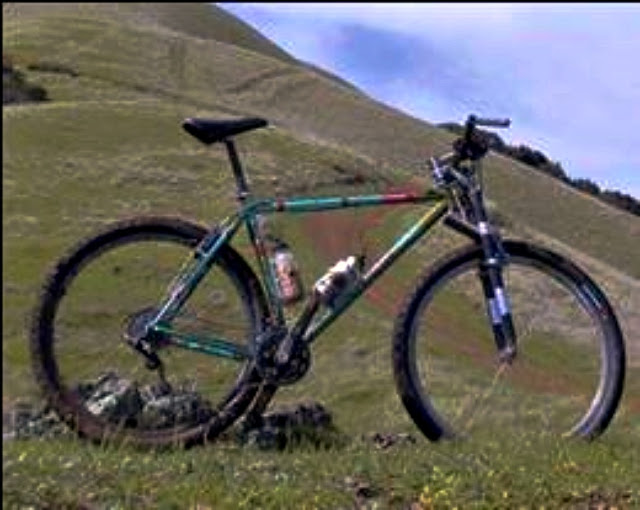
The second Fisher proto 29"er. (Image courtesy of Gary Fisher)
 Two more prototypes were made then in rapid succession. One having a Look Fournales Fork lengthened by none other than Gary Klein to fit a 29"er wheel. The fork was said to have a 450mm axle to crown height. (For reference early 29"er suspension forks with telescoping legs and 80mm of travel were approximately 470-480mm axle to crown. ) This bike had a paint scheme designed by Gary Fisher's daughter. 
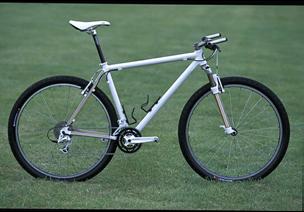
The third Fisher 29'"er prototype was made in titanium. (Image courtesy of Gary Fisher)


 The second was followed quickly by a third bike, but this time the bike was made in titanium with paint designed by well known designer, Paul Smith. This had a prototype Marzocchi suspension fork on it. In 2000 another 29"er with Paul Smith designed paint was made which featured an integrated head set. Interestingly, Fisher claimed that they also were working on a "69er" design, which was a mixed 29 inch front, 26 inch rear wheeled idea. 

Update 11/29/23: Recently Gary Fisher has been posting a lot of historical images and relating stories about his past that were mostly unknown to the public before now. Relating to the white hard tail above, Gary posted on 11/28/23 the following:

"This frame was built at Trek by Doug Cusack. It is a one-off. (Note: there were other similarly painted "Team Frames" but Gary's had proprietary geometry that the others did not have) The chain stays are super short and the Marziocii (sic) fork had a knob that would lower the front end by 60mm. I set up the geometry, so I still had pedal clearance when the bike was let down, and the head angle when lowered would be 69 1/2°. When you let the fork out to its 100mm travel, the head angle was closer to 68. Degrees.. this was a great bike for European marathons.

It is interesting to note that a 68° - 69° head tube angle for 29"ers was generally thought to be unthinkable, crazy, and "would never work" on big MTB wheels like 29"ers back in those days. To see that Gary had tried this and that it worked out was a sign of things to come and introduces the notion that early 29"ers were chasing the wrong ideas. Ideas that were entrenched in the 26"er mindset and not focused on what bigger diameter wheels were actually good at, which finally came into being after about 2012-2014. 

Another interesting tidbit that Gray Fisher brought back to mind was that the UCI had rules on their books making alternative wheel sizes (anything other than 559ISO/26") illegal to use in competition. This arcane rule was starting to be implemented in European races to ban 29"ers from sanctioned events. Gary Fisher went to the UCI personally to lobby against this rule and did see success when the UCI finally recinded the rule and 29"ers were then free to be used in UCI sanctioned events. 

Now, on with the originally posted material.....

Fisher was working hard at trying to get Trek to buy into mass producing the 29" wheeled mountain bike. However, wheels were lacking, the Marzocchi fork was 'floppy', (Gary's term), and they were still trying to figure out the proper geometry and were trying to integrate their new Genesis Geometry into a 29" format. Fisher said that they were working with "less than the best technology" which hampered early acceptance of Fisher 29"ers by athletes and dealers. 
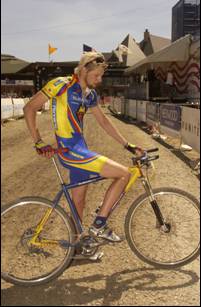
Ryder Hesjedahl on the first Supercaliber in '01 (Image courtesy of Gary Fisher

2001: Fisher Bikes introduces the first Fisher 29"er, the Supercaliber. IRC Tires were developed for the bike. Fisher had a Marzocchi production 29"er fork made for the bikes as well. 

Dealers were baffled by the wheel size and sales people basically ignored the bikes to sell 26"ers. The pressure mounted within Trek to abandon the 29"er experiment. 

2003: Due to poor sales and Fisher being the only company in North America selling 29"ers on a mass scale, Trek seemed poised to cut their losses and kill the 29"er. Internally a suggestion was made to 'hybridize' the 29"er and the Dual Sport models were introduced for the 2003 season. This model, being more closely relatable to hybrid bikes from the 1990's, were a hit with dealers and consumers alike. Gary Fisher said this model line is to be credited with saving the 29"er MTB line from being cut from the Fisher range. In fact, he went as far as to say this was a 'pivotal year' in the history of 29" MTB. 
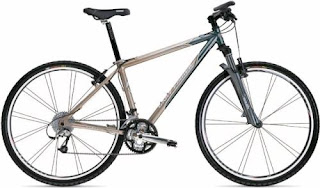
2004 Fisher Dual Sport- the model that saved 29"er MTB.

2004: With the strength of Dual Sport sales, Fisher Bikes was ready to double-down on the 29"er. The company paid out of pocket for all the R&D and tooling to make the Rock Shox Reba 29"er fork, the suspension fork which helped legitimize 29"ers to the mountain biking public. Fisher also designed the new "Rig" model, a single speed MTB which was disc brake specific and came with purpose-built 29"er rims as well. 

2005: The Rig with the Rock Shox Reba is released and it is a Fisher only product. This was a brilliant marketing move in retrospect as Fisher sold out of Rig hard tails and 29"er freaks were left to scramble for Reba take-off forks on the second hand market. This pushed 29"er sales to new heights at Fisher and more good news was coming in as well. Athletes were winning races on 29"ers now. Cam Chambers won on a Fisher 29"er at Single Speed World Championships in '05 as did Jesse La Londe at the Chequamegon Fat Tire 40 that fall. 

2006-2009: Within this three year period 29"ers went from a niche, nearly dead category to the hottest bicycle on the planet. Sales of 29"ers doubled for Fisher in 2006. By 2007, Fisher Team rider Jeremy Horgan-Kobelski was racing 29"ers on the World Cup XC scene. By 2009 he switched to 29"ers exclusively. 

Comments: The early struggles at Fisher Bikes to get 29"ers off the ground nearly sunk the category at Trek. One has to wonder if 29"ers would have remained a niche, small market thing had Trek actually cut the cord in 2004. Remember- Fisher was pretty much the only game in town for non-custom 29" MTB. The rest of the 29"er world was pretty much dominated by custom bike makers. Had Trek pulled out I envision 29"ers being much like what we see today with 36"er wheeled bikes. That being a category of bike on the fringes of the mainstream. 
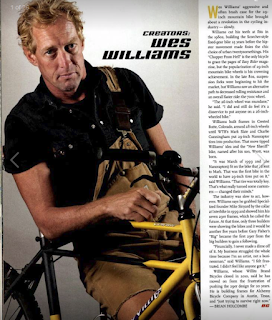
A magazine article featuring Wes Williams and the story of the first 29"er.

You also probably would never have heard about 650B anything. There would have been no reason to move beyond the entrenched 26" wheels. But then again, who knows?

One thing we need to keep reminding ourselves of though is that there are a few key folks who, without their vision, passion, and force of nature in regards to personality, we would not have the bikes we have now. In particular I would single out Gary Fisher, as he not only helped early MTB get off the ground, but it was he that helped push the 29 inch wheel into a place of prominence. Wes Williams has to be credited as the 'force of nature' that would not let big diameter MTB wheels die and no doubt it was Wes that played a pivotal role in getting "The Tire" made in the first place. Then we have to look at Mark Slate and his staff at WTB as the vehicle to get where we are with 29"ers. It was Mark who pretty much had the "kill switch" in his hand which, if pressed, would have pushed the 29 inch wheel off further into the future, or may have killed the idea altogether. 

Obviously there are a host of athletes and industry people to thank here, but if I had to choose a "Mt. Rushmore" of 29"er history it would have Fisher, Slate, Williams, and "The Tire" as its faces. That's my take. You can argue who/what belongs in that pantheon, but in my opinion, those are the main players. 

Thanks: I would be remiss if I did not thank Trek/Gary Fisher Bikes, and specifically Travis Ott, for the invitation all those years ago to go to that Press Camp in Deer Valley Utah. That is where most of the information and images for this post came from.

The Early Days Of 29"ers- A Gary Fisher Perspective

 During a Fisher Bikes Press camp visit I was on in September of 2009, I was privy to hearing tales told by the famous Gary Fisher himself. This conference of media attendees was entertained and informed on Gary Fisher's take on the history of the wheel size from his perspective. I took notes furiously and after returning home I tossed the note pad in a box which I found again recently. 

So, this is over a decade afterward and some gaps in the notation, which I assume I probably thought at the time would be remembered after I got home, have occurred. This following is, to the best of my ability, a reconstruction of what was told then in the Fall of '09.

There were definitely a few things which Mr. Fisher said that seem to contradict tales told elsewhere, so from that standpoint alone this is an interesting bit of information to add to the history. Who is 'right' and who is 'not so right' really doesn't matter here as much as perhaps being able to see that 'like minds were thinking similarly'. Things said and seen may have been subliminally stored in memories and thought, "not very important', or "obvious" at the time and then brought back to mind later. Then it becomes time to 'fix' timelines and history and you know- things that weren't all that important to mark then have to be marked and well.....it can be messy. 

I'd like to think that some of that happened with regard to 29"ers, because, well, who really thought in 1999 that this wheel size would supplant the mighty 26"er completely? No one did. No one figured this would become what it has, and isn't that the way great things go? With all that in mind......

Fisher prototype 29"er drawings
So, this will be given in much the same manner as I received it at the time, which was in a timeline fashion. I will make commentary as this goes along also. 

1999/2000: Starting out with Gary Fisher's first 29"er, which was drawn up and made in Steve Pott's custom bicycle shop. Gary had in mind to do a direct comparison between a 26" and 29" wheeled MTB. His goal was to keep everything he could the same between the two bikes. Geometry, head angles, chain stay lengths, and head tube angles were kept as close as possible to the 26'er. This resulted in a frame with a bent seat tube to keep the chain stays short as possible. Fisher's design goal was to get to an amazingly short 16 1/2" length, which is equivalent to 419.1mm! A modified Manitou Mars fork was crafted as a front fork for the project with travel limited to 50mm. A custom modified XT front derailleur was crafted so it would not interfere with the rear wheel. Much of what was done on this 1st proto were things that would not be seen on 29"ers for a decade or longer. 

Interestingly, Fisher claimed that between he, Mark Slate (head of WTB), and Steve Potts that this was always known as a "29"er" when they referred to this bike. Fisher credits a conversation between he and Mark Slate at Interbike as being when the term was first used. This probably was at the '99 Interbike as "The Tire", the 29"er Nanoraptor, was introduced right at that time. If so, it predates Wes Williams claim of the term by a month, or perhaps a few weeks even. Regardless, as I said, it very well may be that the term was in usage between all the instigators of "The Tire" and no one can really pinpoint when exactly it was first uttered in relation to the wheel size. What matters is that this was a wheel size declared as being the "29"er" out of the gates. 

Update 11/29/23: It has come to light that Slate and Fisher dubbed the tire as a "twenty-nine inch" tire, this according to a Facebook post by Gary himself under his "married name" he uses there, "Gary Zaphiris". I posted the entire written comment by Gary at the bottom of THIS PAGE which is my history of the 29"er. 

The first Fisher 29"er held by former Mountain Bike Action editor, Zapata Espinoza. (Image courtesy of Gary Fisher.

 As an aside, Gary Fisher claimed that credit for the very first 29 inch wheeled bike belongs to Wes Williams. And what about Fisher's 26'er/29"er comparison? Fisher claimed that in his tests that he was 2-3% faster on the 29"er. That was all he needed to pursue this further. 

The second Fisher proto 29"er. (Image courtesy of Gary Fisher)
 Two more prototypes were made then in rapid succession. One having a Look Fournales Fork lengthened by none other than Gary Klein to fit a 29"er wheel. The fork was said to have a 450mm axle to crown height. (For reference early 29"er suspension forks with telescoping legs and 80mm of travel were approximately 470-480mm axle to crown. ) This bike had a paint scheme designed by Gary Fisher's daughter. 

The third Fisher 29'"er prototype was made in titanium. (Image courtesy of Gary Fisher)


 The second was followed quickly by a third bike, but this time the bike was made in titanium with paint designed by well known designer, Paul Smith. This had a prototype Marzocchi suspension fork on it. In 2000 another 29"er with Paul Smith designed paint was made which featured an integrated head set. Interestingly, Fisher claimed that they also were working on a "69er" design, which was a mixed 29 inch front, 26 inch rear wheeled idea. 

Update 11/29/23: Recently Gary Fisher has been posting a lot of historical images and relating stories about his past that were mostly unknown to the public before now. Relating to the white hard tail above, Gary posted on 11/28/23 the following:

"This frame was built at Trek by Doug Cusack. It is a one-off. (Note: there were other similarly painted "Team Frames" but Gary's had proprietary geometry that the others did not have) The chain stays are super short and the Marziocii (sic) fork had a knob that would lower the front end by 60mm. I set up the geometry, so I still had pedal clearance when the bike was let down, and the head angle when lowered would be 69 1/2°. When you let the fork out to its 100mm travel, the head angle was closer to 68. Degrees.. this was a great bike for European marathons.

It is interesting to note that a 68° - 69° head tube angle for 29"ers was generally thought to be unthinkable, crazy, and "would never work" on big MTB wheels like 29"ers back in those days. To see that Gary had tried this and that it worked out was a sign of things to come and introduces the notion that early 29"ers were chasing the wrong ideas. Ideas that were entrenched in the 26"er mindset and not focused on what bigger diameter wheels were actually good at, which finally came into being after about 2012-2014. 

Another interesting tidbit that Gray Fisher brought back to mind was that the UCI had rules on their books making alternative wheel sizes (anything other than 559ISO/26") illegal to use in competition. This arcane rule was starting to be implemented in European races to ban 29"ers from sanctioned events. Gary Fisher went to the UCI personally to lobby against this rule and did see success when the UCI finally recinded the rule and 29"ers were then free to be used in UCI sanctioned events. 

Now, on with the originally posted material.....

Fisher was working hard at trying to get Trek to buy into mass producing the 29" wheeled mountain bike. However, wheels were lacking, the Marzocchi fork was 'floppy', (Gary's term), and they were still trying to figure out the proper geometry and were trying to integrate their new Genesis Geometry into a 29" format. Fisher said that they were working with "less than the best technology" which hampered early acceptance of Fisher 29"ers by athletes and dealers. 

Ryder Hesjedahl on the first Supercaliber in '01 (Image courtesy of Gary Fisher

2001: Fisher Bikes introduces the first Fisher 29"er, the Supercaliber. IRC Tires were developed for the bike. Fisher had a Marzocchi production 29"er fork made for the bikes as well. 

Dealers were baffled by the wheel size and sales people basically ignored the bikes to sell 26"ers. The pressure mounted within Trek to abandon the 29"er experiment. 

2003: Due to poor sales and Fisher being the only company in North America selling 29"ers on a mass scale, Trek seemed poised to cut their losses and kill the 29"er. Internally a suggestion was made to 'hybridize' the 29"er and the Dual Sport models were introduced for the 2003 season. This model, being more closely relatable to hybrid bikes from the 1990's, were a hit with dealers and consumers alike. Gary Fisher said this model line is to be credited with saving the 29"er MTB line from being cut from the Fisher range. In fact, he went as far as to say this was a 'pivotal year' in the history of 29" MTB. 

2004 Fisher Dual Sport- the model that saved 29"er MTB.

2004: With the strength of Dual Sport sales, Fisher Bikes was ready to double-down on the 29"er. The company paid out of pocket for all the R&D and tooling to make the Rock Shox Reba 29"er fork, the suspension fork which helped legitimize 29"ers to the mountain biking public. Fisher also designed the new "Rig" model, a single speed MTB which was disc brake specific and came with purpose-built 29"er rims as well. 

2005: The Rig with the Rock Shox Reba is released and it is a Fisher only product. This was a brilliant marketing move in retrospect as Fisher sold out of Rig hard tails and 29"er freaks were left to scramble for Reba take-off forks on the second hand market. This pushed 29"er sales to new heights at Fisher and more good news was coming in as well. Athletes were winning races on 29"ers now. Cam Chambers won on a Fisher 29"er at Single Speed World Championships in '05 as did Jesse La Londe at the Chequamegon Fat Tire 40 that fall. 

2006-2009: Within this three year period 29"ers went from a niche, nearly dead category to the hottest bicycle on the planet. Sales of 29"ers doubled for Fisher in 2006. By 2007, Fisher Team rider Jeremy Horgan-Kobelski was racing 29"ers on the World Cup XC scene. By 2009 he switched to 29"ers exclusively. 

Comments: The early struggles at Fisher Bikes to get 29"ers off the ground nearly sunk the category at Trek. One has to wonder if 29"ers would have remained a niche, small market thing had Trek actually cut the cord in 2004. Remember- Fisher was pretty much the only game in town for non-custom 29" MTB. The rest of the 29"er world was pretty much dominated by custom bike makers. Had Trek pulled out I envision 29"ers being much like what we see today with 36"er wheeled bikes. That being a category of bike on the fringes of the mainstream. 

A magazine article featuring Wes Williams and the story of the first 29"er.

You also probably would never have heard about 650B anything. There would have been no reason to move beyond the entrenched 26" wheels. But then again, who knows?

One thing we need to keep reminding ourselves of though is that there are a few key folks who, without their vision, passion, and force of nature in regards to personality, we would not have the bikes we have now. In particular I would single out Gary Fisher, as he not only helped early MTB get off the ground, but it was he that helped push the 29 inch wheel into a place of prominence. Wes Williams has to be credited as the 'force of nature' that would not let big diameter MTB wheels die and no doubt it was Wes that played a pivotal role in getting "The Tire" made in the first place. Then we have to look at Mark Slate and his staff at WTB as the vehicle to get where we are with 29"ers. It was Mark who pretty much had the "kill switch" in his hand which, if pressed, would have pushed the 29 inch wheel off further into the future, or may have killed the idea altogether. 

Obviously there are a host of athletes and industry people to thank here, but if I had to choose a "Mt. Rushmore" of 29"er history it would have Fisher, Slate, Williams, and "The Tire" as its faces. That's my take. You can argue who/what belongs in that pantheon, but in my opinion, those are the main players. 

Thanks: I would be remiss if I did not thank Trek/Gary Fisher Bikes, and specifically Travis Ott, for the invitation all those years ago to go to that Press Camp in Deer Valley Utah. That is where most of the information and images for this post came from.

Saturday, January 19, 2019

Minus Ten Review 2009- 3

Early marketing handout from WTB about the "new" 29"er tire, the Nano
Ten years ago on the blog I was talking about how history was made by "The Tire". Since I've been on a bit of a history bent lately, this seems fitting to discuss for today's look back.

If you haven't heard about "The Tire", you could be forgiven. It was the component necessary to kick into motion the entire movement toward how we experience and know mountain biking today. WTB introduced "The Tire" in 1999, and while it didn't catch on right away, eventually it did, and a bunch of other folks followed in "The Tire's" tracks.

Of course, I am referring to the WTB 29" X 2.1" Nanoraptor tire. This is the tire which spurred Wes Williams of Willits to coin the term "29"er", and it was the tire that Gary Fisher did a lot of testing around and motivated him to want to add 29"ers to the Gary Fisher Mountainbike line up in 2001.

Anyway, ten years ago I came across a scan of a document which was handed out by WTB to dealers and OE manufacturers describing this new thing. It is kind of cool to have these sorts of historical touch points to reflect upon. If you'd like to read more about 29"er's beginnings, I wrote a series on that called "The Beginnings of the Modern 29"er: A History" where you can read all about it, as they say.

Back ten years ago the entire 29'er thing was still being argued about and being put down by many mountain bikers. Of course, things have changed and even those who said ten years ago that 26" DH bikes would never die now are probably riding 650B wheeled DH sleds or even 29"er DH bikes.

My how times have changed!

The Green Belt ten years ago this week. There would be a LOT more fat bike tracks now!
Also ten years ago this week there was a LOT of snow and very cold temperatures. Of course, it would be another two years before anyone around here had fat bikes. But let's be honest here......hardly anyone did anything outside back then. 

I mean, just look at the image. XC ski tracks, and..........nothing else! Think about all the folks walking, snow shoeing, and fat biking. This would be an unheard of scene now in the Green Belt if we have snow. But ten years ago I pretty much had the Green Belt to myself for XC skiing. I cannot recall seeing maybe more than a handful of people doing skiing, or anything else, out there in the winter when I XC skied.

Maybe I should call that time "BF"- before fatbikes! Ha!

But there was something about what happened in 2012-2013 when everyone and their brother discovered fat bikes and started getting outside and off trainers and what not. Suddenly the woods were tracked to death by every mode of Winter-specific travel types. Not to mention all the post-holed bumps given to us by walkers. Yes, suddenly everyone was on the trails.

Weird how that works.

Minus Ten Review 2009- 3

Early marketing handout from WTB about the "new" 29"er tire, the Nano
Ten years ago on the blog I was talking about how history was made by "The Tire". Since I've been on a bit of a history bent lately, this seems fitting to discuss for today's look back.

If you haven't heard about "The Tire", you could be forgiven. It was the component necessary to kick into motion the entire movement toward how we experience and know mountain biking today. WTB introduced "The Tire" in 1999, and while it didn't catch on right away, eventually it did, and a bunch of other folks followed in "The Tire's" tracks.

Of course, I am referring to the WTB 29" X 2.1" Nanoraptor tire. This is the tire which spurred Wes Williams of Willits to coin the term "29"er", and it was the tire that Gary Fisher did a lot of testing around and motivated him to want to add 29"ers to the Gary Fisher Mountainbike line up in 2001.

Anyway, ten years ago I came across a scan of a document which was handed out by WTB to dealers and OE manufacturers describing this new thing. It is kind of cool to have these sorts of historical touch points to reflect upon. If you'd like to read more about 29"er's beginnings, I wrote a series on that called "The Beginnings of the Modern 29"er: A History" where you can read all about it, as they say.

Back ten years ago the entire 29'er thing was still being argued about and being put down by many mountain bikers. Of course, things have changed and even those who said ten years ago that 26" DH bikes would never die now are probably riding 650B wheeled DH sleds or even 29"er DH bikes.

My how times have changed!

The Green Belt ten years ago this week. There would be a LOT more fat bike tracks now!
Also ten years ago this week there was a LOT of snow and very cold temperatures. Of course, it would be another two years before anyone around here had fat bikes. But let's be honest here......hardly anyone did anything outside back then. 

I mean, just look at the image. XC ski tracks, and..........nothing else! Think about all the folks walking, snow shoeing, and fat biking. This would be an unheard of scene now in the Green Belt if we have snow. But ten years ago I pretty much had the Green Belt to myself for XC skiing. I cannot recall seeing maybe more than a handful of people doing skiing, or anything else, out there in the winter when I XC skied.

Maybe I should call that time "BF"- before fatbikes! Ha!

But there was something about what happened in 2012-2013 when everyone and their brother discovered fat bikes and started getting outside and off trainers and what not. Suddenly the woods were tracked to death by every mode of Winter-specific travel types. Not to mention all the post-holed bumps given to us by walkers. Yes, suddenly everyone was on the trails.

Weird how that works.

Sunday, December 24, 2017

Tires I Like

Some tires, like these Vittoria Terreno Mix tires, are just plain weird.
Saturday I posted an article on Riding Gravel which was about the top gravel tires I like that are available currently. You can check that out here.

To be completely honest, most tires are pretty decent. It would be a lot easier to talk about tires that are weird, aren't very good, or just downright bad. There are fewer of those than there are tires that are so-so, and definitely fewer of those than good, decent tires.

But I am talking about aftermarket performance tires in that regard, mind you. Not the ubiquitous "replacement tire", or the cheapo tires used on "mart bikes", or tires meant for entry level bike shop bikes. Those are mostly terrible tires. No, I'm talking about tires that purport to be performance enhancing, but for whatever reason, weren't. Tires costing more than $35.00-$40.00 dollars, typically.

Those tires, in my opinion, are tires that fell short of promises and performance was lacking. But enough about those tires. I don't like them, and that isn't what this post is about. This is about tires I like. Some were listed in that post linked above. Others are not there because they are not gravel tires.

Surly Lou's are nice. I like them a lot.
There are a lot of mountain bike tires I like, or used to like since maybe you cannot get them anymore. Tires from Michelin, the "Wildgripper" series of tires, those were great tires. The GEAX tires were all mostly pretty decent, and Bontrager made some killer tires, but many of these are no longer available.

I guess I still like the ol' Nanoraptor, or as WTB calls it now, the "Nano". It does a lot of things well. The Bontrager brand still is rolling out some great stuff. Maxxis, Specialized, and others do some fine treads.

Fat bike tires, now there is some weird stuff going on there! I'll tell ya that for flotation and traction that I look for, the Surly Bud and Lou are hard to beat. Yeah, yeah.......they aren't tubeless. Okay, that isn't a huge deal to me. While having a Bud or Lou tubeless might be better, I just don't have the time to maintain that set up by keeping the sealant up to date. My fat bikes see such limited use that having them set up tubeless would be a liability more than a benefit. My fat bikes can sit around for months at a time unused, so when I do want to use one, I don't want to have to dink around refreshing the sealant.

On the other hand, if a gravel tire model comes out and it is not rated for tubeless, it is not going to be a tire I like. I insist on running tubeless on gravel anymore. It makes a big difference in ride quality, not to mention the elimination of pinch flats.  So, there are some gravel tire models I don't like for that reason. Tires like Challenge's Gravel Grinder, which would be a stellar tread pattern if it could be used tubeless.

So, there are a lot of tires I like, and I've been fortunate to have tried many so I know.

Tires I Like

Some tires, like these Vittoria Terreno Mix tires, are just plain weird.
Saturday I posted an article on Riding Gravel which was about the top gravel tires I like that are available currently. You can check that out here.

To be completely honest, most tires are pretty decent. It would be a lot easier to talk about tires that are weird, aren't very good, or just downright bad. There are fewer of those than there are tires that are so-so, and definitely fewer of those than good, decent tires.

But I am talking about aftermarket performance tires in that regard, mind you. Not the ubiquitous "replacement tire", or the cheapo tires used on "mart bikes", or tires meant for entry level bike shop bikes. Those are mostly terrible tires. No, I'm talking about tires that purport to be performance enhancing, but for whatever reason, weren't. Tires costing more than $35.00-$40.00 dollars, typically.

Those tires, in my opinion, are tires that fell short of promises and performance was lacking. But enough about those tires. I don't like them, and that isn't what this post is about. This is about tires I like. Some were listed in that post linked above. Others are not there because they are not gravel tires.

Surly Lou's are nice. I like them a lot.
There are a lot of mountain bike tires I like, or used to like since maybe you cannot get them anymore. Tires from Michelin, the "Wildgripper" series of tires, those were great tires. The GEAX tires were all mostly pretty decent, and Bontrager made some killer tires, but many of these are no longer available.

I guess I still like the ol' Nanoraptor, or as WTB calls it now, the "Nano". It does a lot of things well. The Bontrager brand still is rolling out some great stuff. Maxxis, Specialized, and others do some fine treads.

Fat bike tires, now there is some weird stuff going on there! I'll tell ya that for flotation and traction that I look for, the Surly Bud and Lou are hard to beat. Yeah, yeah.......they aren't tubeless. Okay, that isn't a huge deal to me. While having a Bud or Lou tubeless might be better, I just don't have the time to maintain that set up by keeping the sealant up to date. My fat bikes see such limited use that having them set up tubeless would be a liability more than a benefit. My fat bikes can sit around for months at a time unused, so when I do want to use one, I don't want to have to dink around refreshing the sealant.

On the other hand, if a gravel tire model comes out and it is not rated for tubeless, it is not going to be a tire I like. I insist on running tubeless on gravel anymore. It makes a big difference in ride quality, not to mention the elimination of pinch flats.  So, there are some gravel tire models I don't like for that reason. Tires like Challenge's Gravel Grinder, which would be a stellar tread pattern if it could be used tubeless.

So, there are a lot of tires I like, and I've been fortunate to have tried many so I know.

Friday, September 29, 2017

Friday News And Views

Recycling cycling.
Big Dummy-

I figured I'd share a few things about the Big Dummy here. It's been a great addition to the fleet. I usually use it for recycling duties, but I have also done the odd errand and hauled things back from the farmers market and whatnot.

I tried using it for commuting but my route is not "Big Dummy friendly". The thing doesn't like curbs and going over them, or even off them, is a jarringly unpleasant experience. I have to cross five or six curbs, (not sure, but at least that many), on my way to work. Loaded, the Big Dummy really sucks on curbs. That front wheel, due to the bike's geometry, is really pinned to the ground and the back end is waaaaaaaay out there, so getting the bike to rotate back on its haunches is nigh unto impossible. So, subsequently I decided to quit using it for commutes unless it was absolutely necessary.

So, I kind of panned the new Blackborow here a few weeks ago when it was announced, and while some of my criticisms were confirmed by a friend and others by Salsa's own "loading instructions" technical page. , I now have a new perspective on the rig. That was a result of speaking with a very good friend of mine, (aforementioned), who happens to be "on the inside" and was able to ride one of these for an extended period of time and has used it for lots of things and with lots of different loads. The main thing I took away was that it is possible to loft the front end of this bike, and that it could perhaps even be easier to do that depending on how it is loaded.

Therefore; I have taken a new interest in the new Blackborow. It would be something I think would fit in with how I use a bike like this, although Salsa is denying it is a "cargo bike", yet they allow for loads to be carried by bags on the rack. I guess it all depends upon your definition of "cargo".

Tubeless......again.......finally!
Pofahl Gets Tubeless......Again!

I was reminiscing about what it took to get a tubeless set up on a 29"er circa 2007. I was curious as to how I could make my 2006 Industry 9 wheel set tubeless with the DT Swiss TK series rims the wheels were spec'ed with. Of course, you had to do it "ghetto-tubeless" because other than the somewhat hard to get your hands on Stan's tape, there wasn't any other options and tires were hard to find that had a tight fit.

It wasn't impossible, but to get these rims to be tubeless with the original set up, with the "not for tubeless use" Vulpines, I had to go to extraordinary lengths. I started with two runs of strapping tape. That was covered by 3M mounting tape which I had to cut to width. Then over that went two runs of black electrical tape. Only then could I get the tires to set up. Of course, it wasn't easy even then. I remember it was quite the struggle. Anyway, things are, thankfully, much different ten years down the road.

After stripping out all the layers I put in ten years ago I added two runs of Velocity "blue" tubeless tape, added two Bontrager road TLR tubeless valve stems, added the "MG's Secret Sauce" (again- don't ask ) tubeless goop, and they aired up with a small compressor I have. Oh......and I used a brand new set of WTB TCS Nano's in the 2.1" size. 

There was one, minor disconcerting fact that I noted while doing this. The tires never made a peep setting up. I did not get that satisfying loud "snap!" of the bead setting in its seat on the rim. That's likely because the TK series of rims that DT Swiss used to make has a pretty aggressive hook bead whereas newer tubeless ready designs do not. The newer, tubeless ready rims generally have a squared off seat which has a slightly larger diameter for the tire bead to "lock" in to. Now, I am not going to be running low pressures or smashing into trail obstacles with this set up, but I have no doubt that if I did the tires would easily burp. So, while I am good to go for gravel, I still want to look into getting "real" tubeless ready rims.

Single Speed Century

So, the next deal I want to get going on is to try out the Pofahl on the planned century ride I have mapped out. I haven't done a century on a single speed in a long time, so I am overdue.

I kind of wanted to do this in September, but, obviously, I am running a bit short on time for this! Well, Saturday is my last chance and I think I am going for it unless I still feel like I am run down.

Yeah......I've been not feeling the best lately. I relapsed in terms of my cold right after the trip I was on last week. Feeling run down, congested, and well........crappy. We'll see how this whole single speed century thing goes.

But, I will give it my best. I have a pretty "single speed friendly" course designed so it isn't anything too radical in terms of elevation gain. I'm hoping that I can get up early on Saturday morning when it is still dark out and get going on that.

Then the next deal will be the second Fat Bike Century. That should happen in October sometime. We actually did that a year ago this weekend, myself and Tony, and Tony wants another go at that as well. So, if I can pull off those two century rides I'll have done five century rides and will need only one more for my own version of a cup o dirt.

Have a great weekend and I hope that you have a good bicycling time!

Friday News And Views

Recycling cycling.
Big Dummy-

I figured I'd share a few things about the Big Dummy here. It's been a great addition to the fleet. I usually use it for recycling duties, but I have also done the odd errand and hauled things back from the farmers market and whatnot.

I tried using it for commuting but my route is not "Big Dummy friendly". The thing doesn't like curbs and going over them, or even off them, is a jarringly unpleasant experience. I have to cross five or six curbs, (not sure, but at least that many), on my way to work. Loaded, the Big Dummy really sucks on curbs. That front wheel, due to the bike's geometry, is really pinned to the ground and the back end is waaaaaaaay out there, so getting the bike to rotate back on its haunches is nigh unto impossible. So, subsequently I decided to quit using it for commutes unless it was absolutely necessary.

So, I kind of panned the new Blackborow here a few weeks ago when it was announced, and while some of my criticisms were confirmed by a friend and others by Salsa's own "loading instructions" technical page. , I now have a new perspective on the rig. That was a result of speaking with a very good friend of mine, (aforementioned), who happens to be "on the inside" and was able to ride one of these for an extended period of time and has used it for lots of things and with lots of different loads. The main thing I took away was that it is possible to loft the front end of this bike, and that it could perhaps even be easier to do that depending on how it is loaded.

Therefore; I have taken a new interest in the new Blackborow. It would be something I think would fit in with how I use a bike like this, although Salsa is denying it is a "cargo bike", yet they allow for loads to be carried by bags on the rack. I guess it all depends upon your definition of "cargo".

Tubeless......again.......finally!
Pofahl Gets Tubeless......Again!

I was reminiscing about what it took to get a tubeless set up on a 29"er circa 2007. I was curious as to how I could make my 2006 Industry 9 wheel set tubeless with the DT Swiss TK series rims the wheels were spec'ed with. Of course, you had to do it "ghetto-tubeless" because other than the somewhat hard to get your hands on Stan's tape, there wasn't any other options and tires were hard to find that had a tight fit.

It wasn't impossible, but to get these rims to be tubeless with the original set up, with the "not for tubeless use" Vulpines, I had to go to extraordinary lengths. I started with two runs of strapping tape. That was covered by 3M mounting tape which I had to cut to width. Then over that went two runs of black electrical tape. Only then could I get the tires to set up. Of course, it wasn't easy even then. I remember it was quite the struggle. Anyway, things are, thankfully, much different ten years down the road.

After stripping out all the layers I put in ten years ago I added two runs of Velocity "blue" tubeless tape, added two Bontrager road TLR tubeless valve stems, added the "MG's Secret Sauce" (again- don't ask ) tubeless goop, and they aired up with a small compressor I have. Oh......and I used a brand new set of WTB TCS Nano's in the 2.1" size. 

There was one, minor disconcerting fact that I noted while doing this. The tires never made a peep setting up. I did not get that satisfying loud "snap!" of the bead setting in its seat on the rim. That's likely because the TK series of rims that DT Swiss used to make has a pretty aggressive hook bead whereas newer tubeless ready designs do not. The newer, tubeless ready rims generally have a squared off seat which has a slightly larger diameter for the tire bead to "lock" in to. Now, I am not going to be running low pressures or smashing into trail obstacles with this set up, but I have no doubt that if I did the tires would easily burp. So, while I am good to go for gravel, I still want to look into getting "real" tubeless ready rims.

Single Speed Century

So, the next deal I want to get going on is to try out the Pofahl on the planned century ride I have mapped out. I haven't done a century on a single speed in a long time, so I am overdue.

I kind of wanted to do this in September, but, obviously, I am running a bit short on time for this! Well, Saturday is my last chance and I think I am going for it unless I still feel like I am run down.

Yeah......I've been not feeling the best lately. I relapsed in terms of my cold right after the trip I was on last week. Feeling run down, congested, and well........crappy. We'll see how this whole single speed century thing goes.

But, I will give it my best. I have a pretty "single speed friendly" course designed so it isn't anything too radical in terms of elevation gain. I'm hoping that I can get up early on Saturday morning when it is still dark out and get going on that.

Then the next deal will be the second Fat Bike Century. That should happen in October sometime. We actually did that a year ago this weekend, myself and Tony, and Tony wants another go at that as well. So, if I can pull off those two century rides I'll have done five century rides and will need only one more for my own version of a cup o dirt.

Have a great weekend and I hope that you have a good bicycling time!

Saturday, August 12, 2017

Minus Ten Review- 32

I did a "Lube-Off" ten years ago. This is from last year's Lube-Off.
Ten years ago on the blog this week there were no pictures again! Apparently I did that quite a bit in 2007, but I didn't think I did. With 2 years under my belt you'd think I'd have figured it out! Ha!

Anyway, one of the things I was doing back then was a test of a few bicycle oriented lubrication products to see which one did the best job. I found that DuMonde Tech did the best job back then. Oddly enough, I haven't found anything better since then.

I was just reapplying some to a chain here in the house the other day when my daughter took notice. I should say that I get away with a lot of things here since everyone is on board with my bicycle nerdiness. Lubing the chain in the kitchen probably wouldn't fly in your house! Anyway, DuMonde Tech off-gasses a very potent smell, so beware of doing lubing in an enclosed area.

That smell is very distinctive. I always thought it was a smell I knew, but I just never could place it until my daughter described it as smelling like bleu cheese. Bingo! She nailed it. DuMonde Tech smells like blue cheese. I like blue cheese. Weird......

So, back to ten years ago.....

An argument arose based upon a story posted in "Dirt Rag" about who built the "first" 29"er with a WTB Nanoraptor. History Alert: WTB built the largest volume, 700c based, mountain bike treaded tire ever made to that date in 1999. While it was just shy of actually making the overall diameter 29 inches, it was so close as to be not worth mentioning. The real point being that you could actually mountain bike like 26"ers did with this tire, not babysit your rig because your 45mm Panaracer Smokes were too low a volume to handle things. (So, this is why all other previous attempts at 700c mtb were not successful and certainly were not 29"ers.) Any of the pioneers of the Nanoraptor 29 X 2.1" tire will attest to this fact and tell you that is why they pushed for "The Tire" to be made. See my page about the history of the modern 29"er here. 

Anyway, there was that deal, and there was also new idea concerning fork offsets for 29"ers which On One and Gary Fisher Bikes brought to the table. It was not a well understood concept back then, so a lot of banter was being written on-line about it all.

Minus Ten Review- 32

I did a "Lube-Off" ten years ago. This is from last year's Lube-Off.
Ten years ago on the blog this week there were no pictures again! Apparently I did that quite a bit in 2007, but I didn't think I did. With 2 years under my belt you'd think I'd have figured it out! Ha!

Anyway, one of the things I was doing back then was a test of a few bicycle oriented lubrication products to see which one did the best job. I found that DuMonde Tech did the best job back then. Oddly enough, I haven't found anything better since then.

I was just reapplying some to a chain here in the house the other day when my daughter took notice. I should say that I get away with a lot of things here since everyone is on board with my bicycle nerdiness. Lubing the chain in the kitchen probably wouldn't fly in your house! Anyway, DuMonde Tech off-gasses a very potent smell, so beware of doing lubing in an enclosed area.

That smell is very distinctive. I always thought it was a smell I knew, but I just never could place it until my daughter described it as smelling like bleu cheese. Bingo! She nailed it. DuMonde Tech smells like blue cheese. I like blue cheese. Weird......

So, back to ten years ago.....

An argument arose based upon a story posted in "Dirt Rag" about who built the "first" 29"er with a WTB Nanoraptor. History Alert: WTB built the largest volume, 700c based, mountain bike treaded tire ever made to that date in 1999. While it was just shy of actually making the overall diameter 29 inches, it was so close as to be not worth mentioning. The real point being that you could actually mountain bike like 26"ers did with this tire, not babysit your rig because your 45mm Panaracer Smokes were too low a volume to handle things. (So, this is why all other previous attempts at 700c mtb were not successful and certainly were not 29"ers.) Any of the pioneers of the Nanoraptor 29 X 2.1" tire will attest to this fact and tell you that is why they pushed for "The Tire" to be made. See my page about the history of the modern 29"er here. 

Anyway, there was that deal, and there was also new idea concerning fork offsets for 29"ers which On One and Gary Fisher Bikes brought to the table. It was not a well understood concept back then, so a lot of banter was being written on-line about it all.

Monday, December 12, 2016

Bikes Of 2016: Karate Monkey

2003 Karate Monkey with the Velo Orange Cigne stem
The old Karate Monkey. My first 29"er, and the bike I likely had my longest ride in one day on. That would have been the first Guitar Ted Death Ride Invitational, which was 152 miles, but I rode to the start and back home again, a likely 14 mile addition, but it is "undocumented", so.......

Anyway, it is finally up and running again with the recent addition of a Velo Orange Cigne stem and the trusty Midge Bar. This bike hasn't seen a ton of riding in 2016, but it is possibly going to be my Winter gravel rig, and it already has seen some commuter duty.

There still are things that are going to get tweaked out. I have a different crank, chain ring, and rear cog that are going on this thing which will make it a bit more gravel road friendly. I have a Brooks saddle that will also be seeing duty on this bike. Eventually I will also be bringing over some Surly hubs in the limited edition "Jim Brown" ano color laced to new rims and I have a fresh set of WTB Nanoraptors to go on it when I get that far.

It is pretty much going to end up becoming a single speed gravel rig and a commuter bike. I always liked the bike in those roles best anyway.

Bikes Of 2016: Karate Monkey

2003 Karate Monkey with the Velo Orange Cigne stem
The old Karate Monkey. My first 29"er, and the bike I likely had my longest ride in one day on. That would have been the first Guitar Ted Death Ride Invitational, which was 152 miles, but I rode to the start and back home again, a likely 14 mile addition, but it is "undocumented", so.......

Anyway, it is finally up and running again with the recent addition of a Velo Orange Cigne stem and the trusty Midge Bar. This bike hasn't seen a ton of riding in 2016, but it is possibly going to be my Winter gravel rig, and it already has seen some commuter duty.

There still are things that are going to get tweaked out. I have a different crank, chain ring, and rear cog that are going on this thing which will make it a bit more gravel road friendly. I have a Brooks saddle that will also be seeing duty on this bike. Eventually I will also be bringing over some Surly hubs in the limited edition "Jim Brown" ano color laced to new rims and I have a fresh set of WTB Nanoraptors to go on it when I get that far.

It is pretty much going to end up becoming a single speed gravel rig and a commuter bike. I always liked the bike in those roles best anyway.

Friday, March 13, 2015

Friday News And Views

Did Fox just announce a fat bike fork, or something else?
Fox Muddies The Fat Waters:

You may have seen the news yesterday that Fox Forks announced what was dubbed by some folks as a "fat bike fork" and by most media as a "27.5+ fork".

I've talked quite a bit about the "mid-fat", 27.5+, B+ thing here. I've said it was going to be a "thing" and now we see this announcement. Here's what it means, like it or not......

Fox Forks doesn't do anything unless they sell, (or can sell), OE (Original Equipment) contracts to big bike brands that can afford to pay Fox's tooling costs. Think back to 2007 when Trek paid Fox to tool up for 29"er forks for their Gary Fisher bikes. Fox stayed out of 29"er forks until that happened. So, based upon that history, it is reasonable to say that Fox has a lot of orders to fulfill to companies planning to unleash 27.5+ bikes on the masses. You can bet on this: 27.5+ will be everywhere post Sea Otter and into next year. Enduro bikes will be unleashed, bike packing bikes will be unleashed, and slack hard tail, AM type bikes will be unleashed. The bike industry is hoping this will be "the next 29"er" thing.

The last thing the industry banked on to be "the next 29"er" didn't really pan out. Sure, 27.5" bikes are everywhere, but in reality, they replaced 26"ers, and anybody looking for the next new thing was on to 29+, fat bikes, and other odds and ends. The fat bike craze has topped out, (yes folks......it's old hat now), and this 29+ thing, well it is too big. So 27.5+ will be the deal. It is seen as something that isn't so "snow/sand specific", so heavy, so weird, and maybe will fit a wider slice of the mtb market while being "different".

The dirty little secret? 27.5+ is just about identical in diameter to 29"ers. So, really what you have here is a 29 inch, 3 inch plus wide wheel that still fits all the industry knows about 29"er geometry. All they have to do is widen out a few things and there ya go! New! Shiny! Gotta have one!

You'll have a traction heavy, (pun intended), 29"er bike. Will it be fun? Yes. All bicycles can be fun. But don't get too rolled up in the marketing folks. Your current 29"er will be more nimble and faster, if that's what floats yer boat. Otherwise, have at it.

Gravel bikes are somehow evil, unnecessary, and sub-road bike?
So, The Road Bike Is Dead? 

A recent article on "Bike Radar" called
"Bend in the Road: The end of the road bike" laments the fact that road bikes, as a category, are marginalized into sub-groups, much like mountain bikes, but then seems to come around at the end by saying " All road bikes are no longer created equal. And that's a beautiful thing." 

Seriously, they could have just have written that two line paragraph they have at the bottom of the article and that would have been enough. The drivel that amounts to the bulk of the rest of the article is purely fodder for the bird cage. 

The notion that "road bikes" are based on "race bikes" is clearly lined out in the piece and that's the trouble with the industry. Of all bicyclists that ride roads, most are not racers. So, why would they need a bike optimized for racing? Or from another perspective, why would anyone want a bike based off a racing bike if they do not race? How is it that road racing is the basis for practical road riding? It just doesn't add up. Guys and gals that spend all day riding to be the fastest they can be is great. However; more people are out there than them, and these people are not interested in training 8 hours a day, nor will they ever race. How about a road bike for them? Maybe the "road bike is dead" should be rephrased to say that the "road racing bike is dead". If that is the case, I would say "hallelujah!" Maybe I won't have to install so many stem extenders, shorter stems, and comfy saddles since the bikes will start coming stock with them. You know, maybe if road bikes were not based on the very specialized task of road racing there wouldn't be so many sub-divisions of road bicycles. 

But probably not.......

Sweet Sixteen:

Mark Slate's design notes on a 29"er circa 1999
While all this hoopla is going on, let's go back to calmer times, shall we? Sixteen years ago, there were road bikes, mountain bikes, and hybrid bikes in most bicycle shops. Mountain bikes were 26" wheeled, road bikes and hybrid bikes were 700c. Shimano had unleashed another milestone XTR group, and disc brakes were the latest thing folks were arguing about. (In the mtb world, that is.) A little known fella by the name of Lance Armstrong would win the TDF, and in September, a new wheel size quietly debuted in the WTB booth at Interbike meant for a thing dubbed "29ers". 

You can read a great post on the WTB blog about this here that was posted yesterday for their Throwback Thursday post. There in the post you will see the actual bike that was in the WTB booth that year. Plus there you can read Mark Slate's actual note that appeared with the bike. 

Sixteen years ago 29"ers took a bow and, as you might realize, it took about six more years for them to finally come into their own. (See the Fox Shox story above as an example.) While WTB played a pivotal part in the 29"er introductions, the industry largely ignored their presence. Unlike today's "manufacture invented trends", 29"ers grew at a grassroots level for 5-6 years before the industry was forced to notice. Trek/Gary Fisher Bikes were selling these things like hotcakes by 2005, and other companies sales of 26"ers were either flat or declining. It was becoming clear that riders were into 29"ers, and that the industry had better get ther act together or miss the boat. And you know what? Some did. 

That's partly to blame for why it is that companies like Giant have abandoned the 29"er, for all intents and purposes, and have thrown in their hat with the 27.5 size. They don't want to miss out on the hoped for rising tide of sales connected with this "new wheel size". Other companies have hedged their bets with complete or partial lines in both 29" and 27.5" sizes. The "missing the boat on 29"ers" is the reason why fat bikes blew up so quickly this past year, year and a half, after many companies saw what QBP was doing in 2011 and 2012. 

Will there ever be another grassroots driven bicycle style/innovation/trend in the coming years? Not likely, since marketers are quick to jump on anything emerging as a trend and try to own it. But......you never know. 

For more on the history of the modern 29"er, see my series page HERE.

Have a great weekend!