Showing posts with label Domane. Show all posts

Friday, August 14, 2026

Friday News And Views

Image courtesy of Trek Bicycles.
Mazda Becomes Official Vehicle Of Trek Off-Road Teams In North America:

On Tuesday a press release went out declaring the Mazda has become the Official Vehicle of Trek North American Off-Road Teams and events. 

Mazda will provide the CX-50 model to Trek in a "multi-year" deal. These vehicles will appear at North American XC MTB events, DH events, and at select gravel events under the "DRFTLSS" moniker. (DRFTLSS example shown) 

Comments: Old timers will recall the Trek VW MTB Team and how they were a staple of the NORBA scene in the mid to late 90's. There were some Trek VW mountain bike models made and sold at dealers, but no such plan has been revealed for this new partnership with Mazda. 

Yeah.....gravel events have come a long, long way. Team cars at gravel events? With big time sponsorship from a worldwide automaker? Crazy.....  I just shake my head in wonder.

Then there is this current trend to avoid vowels. I'm going to say it - I don't like it. I know...... Maybe I'm a fuddy-duddy, but spelling is important to me. At least it seems the terms "groadie" and "groad" have quietly been retired. Those were just plain stupid. I always despised those two terms.

Image courtesy of Trek Bicycles

 You're Almost There!

The "endurance" geometry road bikes have been creeping into "gravel bike" territory for the last couple of years. On Thursday Trek released the fifth generation of the Domane. It is another step closer to where I thought road bikes for the average folks should be at back in 2010. 

Featuring the new frame and fork which has retired the use of IsoSpeed (thankfully!), Trek has otherwise designed in a compliant seat post, (A ROUND seat post? gasp!) and given the bike clearance for tires up to 40mm. The geometry is pretty much "first generation" gravel bike geo, and hilariously, they ditched the down tube storage to lighten the frame. (Take that N.Y. Roll!)  

There are several models to choose from starting at about 8K and going up from there. 

Comments: First of all, Trek's website navigation is a disaster. It seems overly-complex and offensive in its barrage of visual information. Maybe that's just me, but I've seen far easier sites to look at. That much I do know.... 

Okay, the bikes! Well, I find it very interesting that, ten years ago, this would have been a top tier gravel bike without question. Checking into some details, there is even a frame bag mount and a custom fitted bag available for this Domane along with a top tube bag. Fully kitted out, a new Gen 5 Domane would slip right into any current gravel event and no one would bat an eyelash.  

There is a white paper page which goes into all the nerdy details of the ditching of IsoSpeed. I found it fascinating to read that Trek credits tire volumes and disc brakes as things which have negated the need for decoupling their frames. They credit flexing seat posts as a benefit as well as their trotting out the old saw of "vertical compliance and lateral stiffness". (HA!) 

I'm glad Trek figured it out, (finally), but they need to go just a little further with this. Give me clearance for 42/43mm tires, (or 45mm, since the tire folks have kinda landed on a 40-45-50 scheme), and slacken that head angle a half degree or so and we're there. Domane AllRoad, I'd call it. Oh! And maybe not make the entry level bike so dang expensive (carbon), 8K is nuts.  


Accell Group Declared Bankrupt By Dutch Court:

In news from the bicycle industry, it was revealed on Wednesday that a Dutch court had declared Accell Group and its brands bankrupt. This is an escalation from the previous designation by the courts which would have provided a means of restructuring the company. 

Accell Group owns the brands Raleigh, Lapierre, Ghost, Haibike, and others. The status of these subsidiaries is  complex due to the multi-national situation. Lapierre, for instance, is seeking to find its way independently, but the success of this move has yet to be determined. 

You can see more details in the story posted on "Bicycle Retailer and Industry News

Comments: This seemed to me to be the most probable end-game for Accell, who have struggled mightily since the pandemic. It would be easy to blame that time for this news, but I feel Accell's problems started well before this. 

Now.....this is just my opinion, but as I was working at a Raleigh dealer in the USA in the 2010's, I can say that Raleigh was at their pinnacle of potential here in 2014. In that year Raleigh introduced the Tamland range. It was one of the very first, purpose-designed bicycles for gravel. It also sold very well. Raleigh could have made a big dent in the gravel market. 

However; shortly afterward, Raleigh started a consumer direct model of selling bicycles, which Raleigh's US based dealer network was not happy about. 

Subsequently their dealership numbers faded quickly here. This coupled with Raleigh's too soon timing of their D2C move essentially erased Raleigh's presence from the US bicycle market. It could have gone so much differently, but the D2C thing along with a lack of vision for the Tamland and successors in the gravel range pretty much set the tone for what happened after the pandemic.   

unPAved of the Susquehanna River Valley Announces 2026 Events:

A press release sent out on Wednesday announced the details on the 9th unPAved of the Susquehanna River Valley events for 2026. This year the unPAved weekend will be on October 10th - 11th in Lewisburg, Pennsylvania. 

Some details include:

Race for Whoopie Pies: For those who want a place on the podium and part of a $3,000 cash purse we've got the Full-130 course battled out over four timed segments that add up to 59 total miles (45% of the full route) of gravel racing. And if that’s not enough, there's the Big Lick-200 for the ultra endurance folks that prefer to race through the night.

Ride at Pierogies Pace: For those just looking for the vibes and the views we've got four choose-your-own-adventure courses from just over 50 miles to the Full-130 course at a civilized pace and lower price. Plus we have added two new courses (40 and 70 miles) for our Pierogi Pacers in 2026 that will start and finish at the Rusty Rail Brewing Company in Mifflinburg, PA.

Have a SlumberPArty: If you're all about gravelmaxxing the weekend our SlumberPArty gives you two days to ride the course. Roll out on Saturday, camp overnight at R.B. Winter State Park, and finish the course with the other riders Sunday. We'll even ferry your gear to and from camp.

Weekend Full of Activities: unPAved has grown from a single-day event to a full 3-day weekend, with gatherings starting on Friday night, and on Saturday there’s the Lewisburg Fall Festival with FUNpaved Rides, vendors, crafters, and kids’ activities followed up by the unPAved Film Festival at the historic Campus Theatre in downtown Lewisburg, PA.

Comments: Highly recommended event and one of the very best gravel events anywhere. Especially for anyone on the East Coast. Register HERE

No Powerline?

Wildfire damage has altered the course for this weekend's Leadville event taking out an iconic climb and making the overall elevation gain for the event less than it typically has. 

Storylines for this year include Quin Simmons attempt at the Men's win, Last year's Woman's winner, Kate Courtney's attempt two double up, 32"ers making a dent, and the 5DEV company offering 12K plus a little to anyone who can win using their Shredville Mount, a system which allows one to use road controls on a flat bar. 

Lots of weirdness possibilities this year, which I think is fun. We'll see how it all turns out. 

Okay, that is a wrap for this week! Get out and ride those bikes! Summer is fading fast!

Thursday, March 01, 2018

Hands On With The New Trek Checkpoint

Our Trek rep showed up today with this new Trek Checkpoint.
Today was the "official" reveal for Trek's worst kept secret in gravel bikes, the Trek Checkpoint. If you knew where to look, information on this bike was out on the web in January, images in mid-February. So, this date wasn't that big of a deal. Heck, many dealers already had them on their show floors last week.

That said, I posted a story about this important development on RidingGravel.com today early in the morning. I figured that would be that, unless I was to see one in our shop in the near future. Little did I know that "near future" was today! Our Trek rep showed up wheeling in this black beauty in the morning. What a treat to get to see the top of the line Checkpoint SL6 in the flesh.

This is a size 54cm, bone stock Checkpoint SL6 with a set of Shimano pedals bolted on and nothing more. The bike belongs to our rep. It weighed in at just a hair over 20lbs ready to ride. The spec is full Shimano Ultegra 11 speed with the newest Shadow rear road derailleur and toggle front derailleur. Wheels are aluminum and the tires are Schwalbe G-ones with tubes. These tires are 35mm wide, for reference. Brakes are hydraulic flat mount Shimano units.

Following will be a bunch of images and comments.

The frame features internal routing, as you'd expect. Notice that there are TWO sets of bottle bosses on the down tube. There are also bosses on the seat tube and underneath the down tube for a total of four water bottle mounts.

The two silver fasteners hold the battery door and if you run Di2, that's where the battery goes. Note the front, 12mm through axle and flat mount brake.


Notice those two "buttons" on the top tube? Those are plugs covering the bosses that will eventually be compatible with a future Bontrager top tube bag, or they could be used with a custom bag set up to accept this mount. Note also the two bosses on the fork. They won''t work with an Anything Cage- we tried- but Trek does make a carrier for their 720 model which is called a "720 Mount", so you could attach dry bags. We don't know if a Wolf Tooth B-Rad 3 would work, but it might.

The Stranglehold drop out allows for adjutment to the wheel base and for an easy, secure single speed set up. Notice the "button" on the lower seat stay? That's a cover for a lower rack mount. It's hard to see, but just to the left of that is the "hidden fender mount" boss.


A look at the flat mount brake caliper and Shimano's funky Ice Tech rotor. That skewer for  the through axle is where our rep put it, by the way.......

Note how the right chain stay, (here on the left since we're looking at this upside down) snakes through the gap between the chain rings and the tire. That chain stay is dropped lower so it didn't have to be wafer thin. Trek claims room for 45mm tires here. We're thinking that's for dry roads only. The bottom bracket is Trek's press fit style.

Another view of the undercarriage. Note the rubberized lower down tube and chain stay areas. This is a smart move by Trek to not only keep the noise down when rocks hit, (and they will), but to protect the carbon as well. The silver buttons are the two down tube bottle bosses. The bottom bracket area is way beefy and laterally stiff. (We pushed on it HARD) and those big beefy chain stays look stiff as well. Had Trek not used the dropped chain stay on the drive side this view would not look the same.

The fork  has boatloads of clearance. Note the upper fender mount on the fork crown. You probably could mount a light off this for a dyno hub set up. The carbon SL6 and SL5 feature a full carbon fork. The aluminum ALR Checkpoints have alloy steer tubes with carbon fork blades.

Carbon Checkpoints will be tough to land until late Summer. Most of the first production has been spoken for already. Aluminum ALR4 Checkpoints are readily available in the darker colorways. Brighter colored ALR Checkpoints should arrive in April. I am thinking about a Checkpoint SL5 in Cobra Blood colorway but it looks as though the soonest it might happen is in June. Of course, all of this is subject to change.

What I Think: The Checkpoint is a really sharp, well thought out first effort. Trek went with a completely new frame and our rep stated it is actually lighter than a comparable Domane. Trek did squeak out the head angle to be slightly steeper than 72° in my 58cm size, which makes me wince just a little. I would actually prefer it be a degree slacker and have a nice, long offset on the fork, but this is liveable. The big news for me is the bottom bracket drop which is only a few millimeters higher than a Domane in comparable size, but still well into the 70's. I was really hoping Trek would stick with that cue from the Domane and they did.

Trek doggedly sticks with the press fit style bottom bracket, and I'd rather see a threaded bottom bracket, but again, since I work on these all the time I am familiar with how they work. So, not a huge deal. The carbon armor around the bottom bracket is a very smart. I like that Trek thought about that.

I'm not really big on carbon, but hey......it is the fashionable thing these days. So what about the ALR aluminum version then? Well, for starters, Trek chose not to use the ISO Speed decoupler on it. Trek claims that in their testing it wasn't as effective as a big tire on the bike and so they chose to not use it, since it would also drive up the price. The tested ALR prototype with ISO Speed would have been cool to try, but we will have to take Trek's word for it. So, what about front ISO Speed? Yeah......I guess it would have been nice. The Domane Gravel (rebadged Domane Disc) has it, but I can always use a ShockStop stem to get that sort of comfort. And who knows if, or when, I might ever get a Checkpoint? Hmm......

Update- I thought about a couple of other points- Pricing- The Checkpoints are pretty reasonably priced for what you get. Oh, and these are FULL Shimano groups with hydro braking. Nice. Handlebars- Straight drop roadie style. Not going to fly with me, but Trek is trying to appease the roadie riders with that spec. I think they are thinking this may cross over to recreational road riders and the spec speaks to that. Honestly, the rack mounts say "RAGBRAI" and the handling will be a big sell to casual roadies. (Where do you mount the kickstand?) Throw in some 30mm tires and ride all day. I get it, but the front end geo, handle bars, and the stiff looking fork are definitely NOT gravel friendly. Again- I can probably live with the front end given the BB drop, but I won't like those bars and the bike needs a Redshift stem PRONTO for gravel travel. 

Anyway, I hope this sneak peek was helpful. I'm sure we will have some of these at the shop where I work in the future.

Hands On With The New Trek Checkpoint

Our Trek rep showed up today with this new Trek Checkpoint.
Today was the "official" reveal for Trek's worst kept secret in gravel bikes, the Trek Checkpoint. If you knew where to look, information on this bike was out on the web in January, images in mid-February. So, this date wasn't that big of a deal. Heck, many dealers already had them on their show floors last week.

That said, I posted a story about this important development on RidingGravel.com today early in the morning. I figured that would be that, unless I was to see one in our shop in the near future. Little did I know that "near future" was today! Our Trek rep showed up wheeling in this black beauty in the morning. What a treat to get to see the top of the line Checkpoint SL6 in the flesh.

This is a size 54cm, bone stock Checkpoint SL6 with a set of Shimano pedals bolted on and nothing more. The bike belongs to our rep. It weighed in at just a hair over 20lbs ready to ride. The spec is full Shimano Ultegra 11 speed with the newest Shadow rear road derailleur and toggle front derailleur. Wheels are aluminum and the tires are Schwalbe G-ones with tubes. These tires are 35mm wide, for reference. Brakes are hydraulic flat mount Shimano units.

Following will be a bunch of images and comments.

The frame features internal routing, as you'd expect. Notice that there are TWO sets of bottle bosses on the down tube. There are also bosses on the seat tube and underneath the down tube for a total of four water bottle mounts.

The two silver fasteners hold the battery door and if you run Di2, that's where the battery goes. Note the front, 12mm through axle and flat mount brake.


Notice those two "buttons" on the top tube? Those are plugs covering the bosses that will eventually be compatible with a future Bontrager top tube bag, or they could be used with a custom bag set up to accept this mount. Note also the two bosses on the fork. They won''t work with an Anything Cage- we tried- but Trek does make a carrier for their 720 model which is called a "720 Mount", so you could attach dry bags. We don't know if a Wolf Tooth B-Rad 3 would work, but it might.

The Stranglehold drop out allows for adjutment to the wheel base and for an easy, secure single speed set up. Notice the "button" on the lower seat stay? That's a cover for a lower rack mount. It's hard to see, but just to the left of that is the "hidden fender mount" boss.


A look at the flat mount brake caliper and Shimano's funky Ice Tech rotor. That skewer for  the through axle is where our rep put it, by the way.......

Note how the right chain stay, (here on the left since we're looking at this upside down) snakes through the gap between the chain rings and the tire. That chain stay is dropped lower so it didn't have to be wafer thin. Trek claims room for 45mm tires here. We're thinking that's for dry roads only. The bottom bracket is Trek's press fit style.

Another view of the undercarriage. Note the rubberized lower down tube and chain stay areas. This is a smart move by Trek to not only keep the noise down when rocks hit, (and they will), but to protect the carbon as well. The silver buttons are the two down tube bottle bosses. The bottom bracket area is way beefy and laterally stiff. (We pushed on it HARD) and those big beefy chain stays look stiff as well. Had Trek not used the dropped chain stay on the drive side this view would not look the same.

The fork  has boatloads of clearance. Note the upper fender mount on the fork crown. You probably could mount a light off this for a dyno hub set up. The carbon SL6 and SL5 feature a full carbon fork. The aluminum ALR Checkpoints have alloy steer tubes with carbon fork blades.

Carbon Checkpoints will be tough to land until late Summer. Most of the first production has been spoken for already. Aluminum ALR4 Checkpoints are readily available in the darker colorways. Brighter colored ALR Checkpoints should arrive in April. I am thinking about a Checkpoint SL5 in Cobra Blood colorway but it looks as though the soonest it might happen is in June. Of course, all of this is subject to change.

What I Think: The Checkpoint is a really sharp, well thought out first effort. Trek went with a completely new frame and our rep stated it is actually lighter than a comparable Domane. Trek did squeak out the head angle to be slightly steeper than 72° in my 58cm size, which makes me wince just a little. I would actually prefer it be a degree slacker and have a nice, long offset on the fork, but this is liveable. The big news for me is the bottom bracket drop which is only a few millimeters higher than a Domane in comparable size, but still well into the 70's. I was really hoping Trek would stick with that cue from the Domane and they did.

Trek doggedly sticks with the press fit style bottom bracket, and I'd rather see a threaded bottom bracket, but again, since I work on these all the time I am familiar with how they work. So, not a huge deal. The carbon armor around the bottom bracket is a very smart. I like that Trek thought about that.

I'm not really big on carbon, but hey......it is the fashionable thing these days. So what about the ALR aluminum version then? Well, for starters, Trek chose not to use the ISO Speed decoupler on it. Trek claims that in their testing it wasn't as effective as a big tire on the bike and so they chose to not use it, since it would also drive up the price. The tested ALR prototype with ISO Speed would have been cool to try, but we will have to take Trek's word for it. So, what about front ISO Speed? Yeah......I guess it would have been nice. The Domane Gravel (rebadged Domane Disc) has it, but I can always use a ShockStop stem to get that sort of comfort. And who knows if, or when, I might ever get a Checkpoint? Hmm......

Update- I thought about a couple of other points- Pricing- The Checkpoints are pretty reasonably priced for what you get. Oh, and these are FULL Shimano groups with hydro braking. Nice. Handlebars- Straight drop roadie style. Not going to fly with me, but Trek is trying to appease the roadie riders with that spec. I think they are thinking this may cross over to recreational road riders and the spec speaks to that. Honestly, the rack mounts say "RAGBRAI" and the handling will be a big sell to casual roadies. (Where do you mount the kickstand?) Throw in some 30mm tires and ride all day. I get it, but the front end geo, handle bars, and the stiff looking fork are definitely NOT gravel friendly. Again- I can probably live with the front end given the BB drop, but I won't like those bars and the bike needs a Redshift stem PRONTO for gravel travel. 

Anyway, I hope this sneak peek was helpful. I'm sure we will have some of these at the shop where I work in the future.

Thursday, December 14, 2017

The Myth That Stiffer Bicycles Are Faster

Recent race bike design is starting to acknowledge that stiffness everywhere in a bike isn't necessarily a good thing.
Riding Gravel just posted a great new article about how vibration isn't your best friend on gravel rides. I've been saying similar things for years. In fact, the article's author, in an e-mail to me, reminded me of how I have advocated against the use of cyclo cross bikes for gravel riding and have gotten into some "discussions" with others about this. This because I have often said that these bikes are too stiff and don't have the ideal geometry for gravel riding.

Those bikes specifically designed for that niche of riding have peculiar traits which have been honed over decades of design and with material technologies available now, they are typically very stiff bikes. They should be. Cyclo cross is a short event which demands racers have every iota of energy come out as power to the ground. Stiffness to the detriment of comfort is something which is a given in this sport of cyclo cross, which, let's be honest, is about suffering on many levels.

Anyway, the point is that cyclo cross bikes are not tuned to absorb the sort of vibrations that gravel road riding induces. This makes them not the best tool for the job. NOTE- I did not say that you should never use a CX bike for gravel. I merely am saying that these sharply defined bikes for a singular purpose are not really "gravel bikes".  And I haven't even mentioned their geometry, which also isn't ideal.

But that isn't a big deal anymore, like it was five or more years ago. Now you can buy a bicycle tuned for gravel travel from many brands, and some of those actually address the problem of vibration by allowing flex. 

Salsa Cycles Warbird was designed to absorb vibrations over gravel roads.
 The Warbird specifically is allowed to have flex in the seat stays to allow the rider to have a less jarring ride. Bicycles like Trek's Domane, (which has technology which will be applied to a new model specifically for gravel, due in March), and Specialized's Roubaix models have existed for some time now, both which allow for flex that absorbs vibrations which otherwise would impede the rider's performance.

Obviously, stiffness isn't always the over-arching goal of design, but typically we see riders responding to claims of stiffness in a frame as being "good". Not just in terms of bottom bracket stiffness, or lateral stiffness, but in the entire frame. Customers think this is "good" in a frame, and they can feel this stiffness, so it must be "good".

Carbon frames have also  made a name for themselves by being brutishly stiff, yet having the oft misused descriptor of "carbon absorbs vibrations" attached to them by unwitting salespeople and general riders. This may have been the case 25 years ago when carbon fiber frames were not as well made, (read: having more bonding component compared to actual carbon material), but that is not the case anymore. Carbon stiffness is incredible now days, and vibrations are not muted by the material. It just passes through frequencies and energy differently than metal frames, but the energy is still getting through to the rider.

One place where carbon has made ride quality worse than ever is in the area of forks.
Vibrations which are passed through to a rider make that rider fatigued and slower. Especially if the road surface is rough, as it is with gravel road riding. This is one of the reasons why Pro riders are gravitating to wider rims and tires. Those tires on wider rims allow for slightly lower pressures and help absorb these unwanted vibrations. No longer should you listen to that guy you know from RAGBRAI who says you should run 23mm tires at 110psi. He's wrong about that. Dead wrong.

One of my pet peeves is the use of carbon forks with massive, thick legs, tapered steer tubes, and thick "uni-crown" style fork crowns. These forks do not give an inch. (Again- riders can feel stiffness and think it means "I'm faster", but they aren't) These unforgiving forks may make sense to a cyclo cross racer, where high load cornering is almost always a thing. But for the general public, and especially for gravel riders, it is a useless commodity. Forks which flex and give are far more road worthy and comfortable. Straight steer tubes, while seemingly archaic, actually allow some flex which also helps keep the front triangle, and especially the handle bars, "quieter". Less vibration means more comfort and a faster ride. Think about this. Why would Specialized and Trek work so hard to design flex into the front ends of their bikes?

But flex, and the resulting smoother and more efficient ride quality, is a hard sell. Riders feel smoothness as "slowness". This was true back when suspension forks came along for mountain biking in the early 1990's. Riders tried it and hated it, saying the devices made them slower and sluggish. However; when running similar courses back to back with suspended and non-suspended bikes, it became clear that the smoother riding suspension equipped bikes were making for faster times. All that despite these bikes being heavier and "less stiff" than their non-suspended counterparts. Well, we know what happened next......

Why is it so hard for us to understand that flex, be it passive or active, as in suspension applications, make us faster and obviously more comfortable when almost any other human carrying vehicle employs suspension and flex? Vibrations are bad, most often, and as cyclists, we should be very wary of any bicycle company claiming that more stiffness is a good thing.

The Myth That Stiffer Bicycles Are Faster

Recent race bike design is starting to acknowledge that stiffness everywhere in a bike isn't necessarily a good thing.
Riding Gravel just posted a great new article about how vibration isn't your best friend on gravel rides. I've been saying similar things for years. In fact, the article's author, in an e-mail to me, reminded me of how I have advocated against the use of cyclo cross bikes for gravel riding and have gotten into some "discussions" with others about this. This because I have often said that these bikes are too stiff and don't have the ideal geometry for gravel riding.

Those bikes specifically designed for that niche of riding have peculiar traits which have been honed over decades of design and with material technologies available now, they are typically very stiff bikes. They should be. Cyclo cross is a short event which demands racers have every iota of energy come out as power to the ground. Stiffness to the detriment of comfort is something which is a given in this sport of cyclo cross, which, let's be honest, is about suffering on many levels.

Anyway, the point is that cyclo cross bikes are not tuned to absorb the sort of vibrations that gravel road riding induces. This makes them not the best tool for the job. NOTE- I did not say that you should never use a CX bike for gravel. I merely am saying that these sharply defined bikes for a singular purpose are not really "gravel bikes".  And I haven't even mentioned their geometry, which also isn't ideal.

But that isn't a big deal anymore, like it was five or more years ago. Now you can buy a bicycle tuned for gravel travel from many brands, and some of those actually address the problem of vibration by allowing flex. 

Salsa Cycles Warbird was designed to absorb vibrations over gravel roads.
 The Warbird specifically is allowed to have flex in the seat stays to allow the rider to have a less jarring ride. Bicycles like Trek's Domane, (which has technology which will be applied to a new model specifically for gravel, due in March), and Specialized's Roubaix models have existed for some time now, both which allow for flex that absorbs vibrations which otherwise would impede the rider's performance.

Obviously, stiffness isn't always the over-arching goal of design, but typically we see riders responding to claims of stiffness in a frame as being "good". Not just in terms of bottom bracket stiffness, or lateral stiffness, but in the entire frame. Customers think this is "good" in a frame, and they can feel this stiffness, so it must be "good".

Carbon frames have also  made a name for themselves by being brutishly stiff, yet having the oft misused descriptor of "carbon absorbs vibrations" attached to them by unwitting salespeople and general riders. This may have been the case 25 years ago when carbon fiber frames were not as well made, (read: having more bonding component compared to actual carbon material), but that is not the case anymore. Carbon stiffness is incredible now days, and vibrations are not muted by the material. It just passes through frequencies and energy differently than metal frames, but the energy is still getting through to the rider.

One place where carbon has made ride quality worse than ever is in the area of forks.
Vibrations which are passed through to a rider make that rider fatigued and slower. Especially if the road surface is rough, as it is with gravel road riding. This is one of the reasons why Pro riders are gravitating to wider rims and tires. Those tires on wider rims allow for slightly lower pressures and help absorb these unwanted vibrations. No longer should you listen to that guy you know from RAGBRAI who says you should run 23mm tires at 110psi. He's wrong about that. Dead wrong.

One of my pet peeves is the use of carbon forks with massive, thick legs, tapered steer tubes, and thick "uni-crown" style fork crowns. These forks do not give an inch. (Again- riders can feel stiffness and think it means "I'm faster", but they aren't) These unforgiving forks may make sense to a cyclo cross racer, where high load cornering is almost always a thing. But for the general public, and especially for gravel riders, it is a useless commodity. Forks which flex and give are far more road worthy and comfortable. Straight steer tubes, while seemingly archaic, actually allow some flex which also helps keep the front triangle, and especially the handle bars, "quieter". Less vibration means more comfort and a faster ride. Think about this. Why would Specialized and Trek work so hard to design flex into the front ends of their bikes?

But flex, and the resulting smoother and more efficient ride quality, is a hard sell. Riders feel smoothness as "slowness". This was true back when suspension forks came along for mountain biking in the early 1990's. Riders tried it and hated it, saying the devices made them slower and sluggish. However; when running similar courses back to back with suspended and non-suspended bikes, it became clear that the smoother riding suspension equipped bikes were making for faster times. All that despite these bikes being heavier and "less stiff" than their non-suspended counterparts. Well, we know what happened next......

Why is it so hard for us to understand that flex, be it passive or active, as in suspension applications, make us faster and obviously more comfortable when almost any other human carrying vehicle employs suspension and flex? Vibrations are bad, most often, and as cyclists, we should be very wary of any bicycle company claiming that more stiffness is a good thing.

Friday, September 08, 2017

Friday News And Views

T.I.v14 News: 

The announcement of another running of Trans Iowa seemingly went over well. Seeing the response on Facebook and the number of hits on the blog post seems to point to that.

There is one thing I want to get out there about a change to the event right now. I'll be reminding you all of this throughout the coming months because it is a fundamental difference from how things were done in the past. First off, this change is being implemented due to a discovery I made regarding cheating.

What Happened: I was made aware through a random Facebook thread that riders were taking the cues for the first section of the event, normally handed out at the Pre-Race Meat-Up, and transferring the cues to their GPS devices for navigation by an audible cue instead of having to read the cues. This gave those who did that an advantage as they only had to listen for a sound and look down at their GPS for a direction and they did not have to do navigation as it was meant to be done- by the cue sheets and by observing the signs on the road. 

What The Change Is: Since only a few were doing this, it was an unfair advantage over the rest of the field. Also, it is expressly against the rules. So, as a result, cue sheets for the first part of Trans Iowa v14 will be handed out the morning of the event just before you are to take off. I haven't decided yet just how this will look, but I am thinking that you are going to have to line up single file and get your cues based on your race number plate, (to avoid anyone not in the event from getting cues), and riders will just have to deal with it. This will probably happen within minutes of the start. So, be prepared!

How This Affects The Pre-Race Meat-Up: First off- attendance to the Pre-Race Meat-Up is still mandatory! There will be no "morning of" registering or signing on. This would be too much of a burden for me and my volunteers, and there is no need for it. Plan on the Pre-Race Meat-Up to be pretty much as it was with a slight change to the end. (No cues to get and put in your GPS, for one thing!)

What If You Don't Like This Change? That's simple. Please do not consider coming to Trans Iowa. My decision is final and it will be done this way whether three of you show up or 120 do. I simply will not put up with cheating, and this is how it is going to be dealt with.

It's no different than usual, but...........
Trek Quietly Debuts Domane Gravel:

Some of you may know this, but Trek recently debuted a 2018 model dubbed the "Domane SL 5 Gravel" and an aluminum framed counterpart as well which costs less and is down spec'ed from the carbon frame and forked SL 5 Gravel bike pictured here.

I've been a big advocate of Domane geometry for gravel going since the Domane was introduced. I have pestered Trek  employees to bring out a version which could handle wider tires since its debut. Trek came out with the Domane disc version a couple years ago, and that bike was rumored to accept up to 30-something millimeter tires, but no one I ever talked to would put a hard  number on what the limit was.

Well, now we have a "gravel version" of the Domane. Or do we? Actually, I have it on good authority that, in fact, this is just an ordinary Domane Disc frame and fork. Yes, it has 35mm Scwalbe G-One tires, but that is all. It isn't a specific frame for gravel road riding, and thus the 35mm tire width limitation. That said, there is a specific gravel frame and fork coming.......

That's all I know. It is already in the pipeline and probably will get released sometime next year. What it will be called and exactly what sized tire it will take is not yet known, but if it cannot handle 42mm tires, then it would be seen as a fail in my eyes. That and if they change the geometry radically from the current Domane, which would immediately put me off. We'll see.

If it does turn out, as I hope it will, as a Domane with wide tire clearances, I'm on board. I would have to try it out. With ISO decouplers front and rear, wide tire clearances, low bottom bracket height, and the typically relaxed angles the Domane has always had, it would be the best gravel bike geometry/technology going by a long shot.I know Open and others promote a short rear/short wheelbase ideal, but they are appealing to a road racer, not what works best on gravel the Mid-West has. But, we'll see......

Have a great weekend. Thinking of all those folks in harms way in Florida. Stay safe!!

Friday News And Views

T.I.v14 News: 

The announcement of another running of Trans Iowa seemingly went over well. Seeing the response on Facebook and the number of hits on the blog post seems to point to that.

There is one thing I want to get out there about a change to the event right now. I'll be reminding you all of this throughout the coming months because it is a fundamental difference from how things were done in the past. First off, this change is being implemented due to a discovery I made regarding cheating.

What Happened: I was made aware through a random Facebook thread that riders were taking the cues for the first section of the event, normally handed out at the Pre-Race Meat-Up, and transferring the cues to their GPS devices for navigation by an audible cue instead of having to read the cues. This gave those who did that an advantage as they only had to listen for a sound and look down at their GPS for a direction and they did not have to do navigation as it was meant to be done- by the cue sheets and by observing the signs on the road. 

What The Change Is: Since only a few were doing this, it was an unfair advantage over the rest of the field. Also, it is expressly against the rules. So, as a result, cue sheets for the first part of Trans Iowa v14 will be handed out the morning of the event just before you are to take off. I haven't decided yet just how this will look, but I am thinking that you are going to have to line up single file and get your cues based on your race number plate, (to avoid anyone not in the event from getting cues), and riders will just have to deal with it. This will probably happen within minutes of the start. So, be prepared!

How This Affects The Pre-Race Meat-Up: First off- attendance to the Pre-Race Meat-Up is still mandatory! There will be no "morning of" registering or signing on. This would be too much of a burden for me and my volunteers, and there is no need for it. Plan on the Pre-Race Meat-Up to be pretty much as it was with a slight change to the end. (No cues to get and put in your GPS, for one thing!)

What If You Don't Like This Change? That's simple. Please do not consider coming to Trans Iowa. My decision is final and it will be done this way whether three of you show up or 120 do. I simply will not put up with cheating, and this is how it is going to be dealt with.

It's no different than usual, but...........
Trek Quietly Debuts Domane Gravel:

Some of you may know this, but Trek recently debuted a 2018 model dubbed the "Domane SL 5 Gravel" and an aluminum framed counterpart as well which costs less and is down spec'ed from the carbon frame and forked SL 5 Gravel bike pictured here.

I've been a big advocate of Domane geometry for gravel going since the Domane was introduced. I have pestered Trek  employees to bring out a version which could handle wider tires since its debut. Trek came out with the Domane disc version a couple years ago, and that bike was rumored to accept up to 30-something millimeter tires, but no one I ever talked to would put a hard  number on what the limit was.

Well, now we have a "gravel version" of the Domane. Or do we? Actually, I have it on good authority that, in fact, this is just an ordinary Domane Disc frame and fork. Yes, it has 35mm Scwalbe G-One tires, but that is all. It isn't a specific frame for gravel road riding, and thus the 35mm tire width limitation. That said, there is a specific gravel frame and fork coming.......

That's all I know. It is already in the pipeline and probably will get released sometime next year. What it will be called and exactly what sized tire it will take is not yet known, but if it cannot handle 42mm tires, then it would be seen as a fail in my eyes. That and if they change the geometry radically from the current Domane, which would immediately put me off. We'll see.

If it does turn out, as I hope it will, as a Domane with wide tire clearances, I'm on board. I would have to try it out. With ISO decouplers front and rear, wide tire clearances, low bottom bracket height, and the typically relaxed angles the Domane has always had, it would be the best gravel bike geometry/technology going by a long shot.I know Open and others promote a short rear/short wheelbase ideal, but they are appealing to a road racer, not what works best on gravel the Mid-West has. But, we'll see......

Have a great weekend. Thinking of all those folks in harms way in Florida. Stay safe!!

Friday, August 26, 2016

Friday News And Views

It could be great.....
Thoughts On Trek's Almost Gravel Bike And Carbon Fiber Armoring:

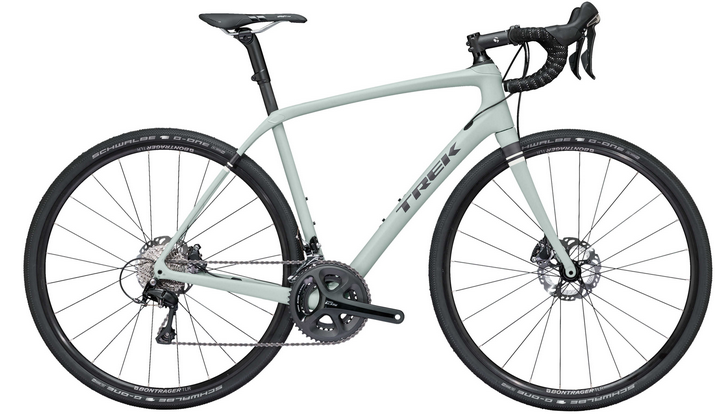
Okay, so we had a customer buy the newest Trek Domane Disc "something number-something or another" (Trek has 31 different Domane models, so maybe you could see why it is I cannot recall the exact numeral/digital moniker for the one I saw in the shop.) Anyway, once again I say it- this is darn near the perfect gravel road bike. In terms of bottom bracket drop, head tube angle, front/center dimensions, and of course, the ISO Speed decouplers front and rear, this bike nearly tics all the boxes and some that you don't even know that you need. However; there are one or two major modifications necessary before I would sign off on a Domane for my personal gravel grinding pleasure.

One would be tire clearances. The new Domane Disc is oh-so-close in that area. The stock bike comes out of the box with 32mm slicks with room to spare. we were looking at this at the shop and figured it might clear 35's on a nominally wide road rim set up tubeless. But barely so, if it does. That's not going to cut it. We need room for at least 40's. I think Trek can do this easily.

Secondly, I find the thought of riding a $5,000 to $10,000 dollar rig in moist, grinding, muddy paste rather.......stupid? Yes. Stupid. That would be rather unwise given that I have seen, and I have heard reports of chain stays getting ground through on carbon bikes in one event. Yeah...... That's an expensive proposition. So, what would I suggest that Trek, (or any manufacturer that makes a carbon gravel rig), do to protect against this? Think what they do on mountain bikes. Armoring is the answer. Here's what I would do......

A somewhat horse shoe shaped piece of steel, or titanium could be fashioned and slightly recessed into the inside facing area of each chain stay, and bridging across at the bottom bracket, to keep mud from grinding holes in the area between the tire and chain stay. You could even do the same thing underneath a fork crown, but that is a less susceptible area, I think. Anyway, this piece could be anchored in with a few small screws and could be removed for cleaning, replacement, or might even serve as a "window" of sorts to ease internal cable routing of hydraulic brake lines and shifting cables, for instance. The weight added would be minimal and the case for ground through chain stays would be closed.

One of the country churches on the Geezer Ride route
Geezer Ride Update:

A week ago I updated y'all on the Geezer Ride route, and gave you the date, which is September 17th. We will likely start at 8:00-ish from Gateway Park in Cedar Falls, Iowa. There is a gravel parking lot there and it is right over the Main Street Bridge from the main highway and downtown Cedar Falls.

The other news is that I have a theme for the ride and a route. It looks as though the route works out to 42 miles, four of which are on easy-peasy bike paths. Four more or so are on easy pavement. So, in total there should be only about 34 miles of actual gravel roads, and according to my best guestimates, we're looking at maybe 1200 feet of elevation gain. Not too bad, but there are a couple steeps that will test your legs. It's mainly pretty flat.

What is more, I came up with a theme! I'm calling this the "Geezer Ride Tour of Country Churches ". By my count we should go right by six rural churches. Almost all of which are still working churches, by the way. We will also go by Bennington #3 School house as well. So, bring your cameras and we should have lots of photo ops.

Finally, there are no convenience store stops that fit the route without adding a ton of mileage. So....... I asked real nice, and I think Mrs.Guitar Ted and my two kids might be out to service the group with cold drinks and snacks. Stay tuned on that front.....

I'm hoping to recon the route Saturday morning early, unless it rains, or something like flooding gets in my way! I'll update the ride page on the Geezer Ride site and be back with more here again soon......

Otso is a new company out of the minds of the Wolf Tooth folk in Minnesota.
Otso Cycles:

Another new bicycle company? Really? Well, I think this one looks like it just might have some cool things to offer that are innovations.

Otso Cycles: They are a bunch of folks that are the brains and marketing behind Wolf Tooth Components. Based up there in Minnesota, you'd expect that they would do a carbon fat bike frame, and they have. This is a bit different though.

I think one of the coolest attributes of their fat bike model is the bottom bracket width. I happen to know more than a few folks cannot ride traditional 100mm bottom bracket width fat bikes because it is ergonomically unfit to do so for them. They have hip pain, knee pain, or both. Ouch! Not good. Well, this Voytek fat bike from Otso is running an 83mm bottom bracket which puts the pedals at a claimed 10mm wider than a traditional mountain bike, yet the frame clears 4.0" tires easily and up to 4.6" fat bike tires on 70mm rims.  That's pretty rad. Now obviously, if you have to have the widest rims and tires for maximum flotation, this model is out.

The Voytek also dances with Plus sized fare in the 27.5 and 29 flavors, if that is your jam. Cool! Obviously, it is going to be spendy, but they are claiming full builds for less than 4G. Not bad.

I liked their stainless steel framed Warakin gravel/all road bike. It has some pretty trick features too, and I already wrote up that on RidingGravel.com here. It's interesting that they hit these two models up first, as I am hearing that the big cycling trade shows are going to be loaded with adventure road this, adventure bikepacking that, and adventure whatever else they can market up a storm about. So, we will see how it goes for Otso, but the homework these models reflect is pretty stout, and I am betting these will shine a bit brighter than much of the "me too" bikes that we will see coming in the next few weeks or so.

Okay, that's a wrap on this post. Have a great weekend, y'all!

Friday News And Views

It could be great.....
Thoughts On Trek's Almost Gravel Bike And Carbon Fiber Armoring:

Okay, so we had a customer buy the newest Trek Domane Disc "something number-something or another" (Trek has 31 different Domane models, so maybe you could see why it is I cannot recall the exact numeral/digital moniker for the one I saw in the shop.) Anyway, once again I say it- this is darn near the perfect gravel road bike. In terms of bottom bracket drop, head tube angle, front/center dimensions, and of course, the ISO Speed decouplers front and rear, this bike nearly tics all the boxes and some that you don't even know that you need. However; there are one or two major modifications necessary before I would sign off on a Domane for my personal gravel grinding pleasure.

One would be tire clearances. The new Domane Disc is oh-so-close in that area. The stock bike comes out of the box with 32mm slicks with room to spare. we were looking at this at the shop and figured it might clear 35's on a nominally wide road rim set up tubeless. But barely so, if it does. That's not going to cut it. We need room for at least 40's. I think Trek can do this easily.

Secondly, I find the thought of riding a $5,000 to $10,000 dollar rig in moist, grinding, muddy paste rather.......stupid? Yes. Stupid. That would be rather unwise given that I have seen, and I have heard reports of chain stays getting ground through on carbon bikes in one event. Yeah...... That's an expensive proposition. So, what would I suggest that Trek, (or any manufacturer that makes a carbon gravel rig), do to protect against this? Think what they do on mountain bikes. Armoring is the answer. Here's what I would do......

A somewhat horse shoe shaped piece of steel, or titanium could be fashioned and slightly recessed into the inside facing area of each chain stay, and bridging across at the bottom bracket, to keep mud from grinding holes in the area between the tire and chain stay. You could even do the same thing underneath a fork crown, but that is a less susceptible area, I think. Anyway, this piece could be anchored in with a few small screws and could be removed for cleaning, replacement, or might even serve as a "window" of sorts to ease internal cable routing of hydraulic brake lines and shifting cables, for instance. The weight added would be minimal and the case for ground through chain stays would be closed.

One of the country churches on the Geezer Ride route
Geezer Ride Update:

A week ago I updated y'all on the Geezer Ride route, and gave you the date, which is September 17th. We will likely start at 8:00-ish from Gateway Park in Cedar Falls, Iowa. There is a gravel parking lot there and it is right over the Main Street Bridge from the main highway and downtown Cedar Falls.

The other news is that I have a theme for the ride and a route. It looks as though the route works out to 42 miles, four of which are on easy-peasy bike paths. Four more or so are on easy pavement. So, in total there should be only about 34 miles of actual gravel roads, and according to my best guestimates, we're looking at maybe 1200 feet of elevation gain. Not too bad, but there are a couple steeps that will test your legs. It's mainly pretty flat.

What is more, I came up with a theme! I'm calling this the "Geezer Ride Tour of Country Churches ". By my count we should go right by six rural churches. Almost all of which are still working churches, by the way. We will also go by Bennington #3 School house as well. So, bring your cameras and we should have lots of photo ops.

Finally, there are no convenience store stops that fit the route without adding a ton of mileage. So....... I asked real nice, and I think Mrs.Guitar Ted and my two kids might be out to service the group with cold drinks and snacks. Stay tuned on that front.....

I'm hoping to recon the route Saturday morning early, unless it rains, or something like flooding gets in my way! I'll update the ride page on the Geezer Ride site and be back with more here again soon......

Otso is a new company out of the minds of the Wolf Tooth folk in Minnesota.
Otso Cycles:

Another new bicycle company? Really? Well, I think this one looks like it just might have some cool things to offer that are innovations.

Otso Cycles: They are a bunch of folks that are the brains and marketing behind Wolf Tooth Components. Based up there in Minnesota, you'd expect that they would do a carbon fat bike frame, and they have. This is a bit different though.

I think one of the coolest attributes of their fat bike model is the bottom bracket width. I happen to know more than a few folks cannot ride traditional 100mm bottom bracket width fat bikes because it is ergonomically unfit to do so for them. They have hip pain, knee pain, or both. Ouch! Not good. Well, this Voytek fat bike from Otso is running an 83mm bottom bracket which puts the pedals at a claimed 10mm wider than a traditional mountain bike, yet the frame clears 4.0" tires easily and up to 4.6" fat bike tires on 70mm rims.  That's pretty rad. Now obviously, if you have to have the widest rims and tires for maximum flotation, this model is out.

The Voytek also dances with Plus sized fare in the 27.5 and 29 flavors, if that is your jam. Cool! Obviously, it is going to be spendy, but they are claiming full builds for less than 4G. Not bad.

I liked their stainless steel framed Warakin gravel/all road bike. It has some pretty trick features too, and I already wrote up that on RidingGravel.com here. It's interesting that they hit these two models up first, as I am hearing that the big cycling trade shows are going to be loaded with adventure road this, adventure bikepacking that, and adventure whatever else they can market up a storm about. So, we will see how it goes for Otso, but the homework these models reflect is pretty stout, and I am betting these will shine a bit brighter than much of the "me too" bikes that we will see coming in the next few weeks or so.

Okay, that's a wrap on this post. Have a great weekend, y'all!

Friday, May 06, 2016

Where They Are Getting It (Almost) Right

So, soooo close!!
Yesterday I mentioned how many so called "gravel road/Adventure road" bikes are really silly, off the shelf parts concoctions or out and out rebadged cyclo cross bikes. Some are truly ground up designs, but use features and design elements not truly suited to gravel road/rough road riding. Today, I wanted to point to a bike that was derived from ideas learned decades ago, pushed into modernized materials and engineering, with a dash of brilliant innovation. It is the "almost" best gravel bike you could ever buy, but for one small, very important detail- Tire clearances.

Yes, it is the Trek Domane, and even before they introduced the newest version, it was top of the heap from a design perspective and spot on in geometry. Why? How could a huge, corporate entity, (well, "huge" in the sense that it is one of the biggest bicycle companies), make a bike that is almost the perfect gravel going weapon? Well, you can thank the cobbles and Fabian Cancellara for all of that.

Trek signed the classics master and went straight to work on ideas Fabian had for the "perfect cobble killer". He brought ideas forged from his past experiences and a European's innate sense of "what works" in terms of geometry on rough, inhospitable terrain that is the antithesis of what most Pro Road racing is done on. The result was a geometry that has more to do with traditional, "Italian" frame design house thought than the typical American Criterium type road bike geometry almost all of us are used to. For a bit of background on the differences and what they impart to a rider and how a bike handles, read this article from "Red Kite Prayer"

The T-6 Standard Rando features geo similar to the Domane, only in steel.
What resulted in the Domane was a bike that had a low bottom bracket, (80-75mm), a slacker head angle, and longer chassis than a traditional American style racing bike. Add in the vibration damping attributes, the special fork designed to absorb vibrations, and the ISO decoupler, and you have the ingredients for what could be the best handling, most comfortable, lightest gravel road racer in existence. Nothing else would touch it. Too bad you cannot put bigger than 32mm tires on the disc model. 

I know many folks think, "Just ride a cyclo cross bike!", and I would say that gravel road riders are not riding on cyclo cross courses. We don't need, and are not best served by, such designs. I would also add that ol' Fabs knows a thing or three about how a road bike on rough tracks should handle, since he has won the Strade Bianchi a couple of times, (a gravel road event in Italy), and that Trek has infused the design with technology that works and would be a huge benefit to any gravel road cyclist.  You know "gravel roads" are.......wait for it......roads, right? Why wouldn't the design of a gravel road machine be best served by borrowing from a design for rough road cycling? One that has seen major success in road racing and with "normal cyclists". 

So, yeah.....it's a Trek and all that, but if the bike would fit 40mm tires with clearance to spare, I would be all over this bike as my main gravel "go-fast" machine.  


Where They Are Getting It (Almost) Right

So, soooo close!!
Yesterday I mentioned how many so called "gravel road/Adventure road" bikes are really silly, off the shelf parts concoctions or out and out rebadged cyclo cross bikes. Some are truly ground up designs, but use features and design elements not truly suited to gravel road/rough road riding. Today, I wanted to point to a bike that was derived from ideas learned decades ago, pushed into modernized materials and engineering, with a dash of brilliant innovation. It is the "almost" best gravel bike you could ever buy, but for one small, very important detail- Tire clearances.

Yes, it is the Trek Domane, and even before they introduced the newest version, it was top of the heap from a design perspective and spot on in geometry. Why? How could a huge, corporate entity, (well, "huge" in the sense that it is one of the biggest bicycle companies), make a bike that is almost the perfect gravel going weapon? Well, you can thank the cobbles and Fabian Cancellara for all of that.

Trek signed the classics master and went straight to work on ideas Fabian had for the "perfect cobble killer". He brought ideas forged from his past experiences and a European's innate sense of "what works" in terms of geometry on rough, inhospitable terrain that is the antithesis of what most Pro Road racing is done on. The result was a geometry that has more to do with traditional, "Italian" frame design house thought than the typical American Criterium type road bike geometry almost all of us are used to. For a bit of background on the differences and what they impart to a rider and how a bike handles, read this article from "Red Kite Prayer"

The T-6 Standard Rando features geo similar to the Domane, only in steel.
What resulted in the Domane was a bike that had a low bottom bracket, (80-75mm), a slacker head angle, and longer chassis than a traditional American style racing bike. Add in the vibration damping attributes, the special fork designed to absorb vibrations, and the ISO decoupler, and you have the ingredients for what could be the best handling, most comfortable, lightest gravel road racer in existence. Nothing else would touch it. Too bad you cannot put bigger than 32mm tires on the disc model. 

I know many folks think, "Just ride a cyclo cross bike!", and I would say that gravel road riders are not riding on cyclo cross courses. We don't need, and are not best served by, such designs. I would also add that ol' Fabs knows a thing or three about how a road bike on rough tracks should handle, since he has won the Strade Bianchi a couple of times, (a gravel road event in Italy), and that Trek has infused the design with technology that works and would be a huge benefit to any gravel road cyclist.  You know "gravel roads" are.......wait for it......roads, right? Why wouldn't the design of a gravel road machine be best served by borrowing from a design for rough road cycling? One that has seen major success in road racing and with "normal cyclists". 

So, yeah.....it's a Trek and all that, but if the bike would fit 40mm tires with clearance to spare, I would be all over this bike as my main gravel "go-fast" machine.