Showing posts with label suspension fork. Show all posts

Wednesday, February 23, 2022

A Guide To Fork Swapping

2000 Fisher Tassajara
 In Monday's "Randomonium" post I asked you readers if you had any questions about fork swapping or technical questions about fork geometry. One of you did ask, so that results in today's subject: "A Guide To Fork Swapping". 

So, before we get started, let's get some definitions and terms down that I'll be using today. It is very important to note that a bicycle is a 'system'. It is not wise to think of a bicycle in terms of one of its parts, or to focus in solely on a particular facet of a bicycle's geometry. So, for instance, when we discuss forks, it is not a good thing to just focus on "offset", and to disregard that "offset" is but one of a few things that ultimately determines how a bicycle will handle. So, don't fall for the simplistic idea that changing a fork from one offset to another will magically cure your handling ills. Many media writers are guilty of perpetuating this myth.

So, following are the things that are important to consider about a fork for your bicycle:

Basic fork geometry terms visualized: From http://yojimg.net/bike/web_tools/trailcalc.php

 
Fork Offset/Fork "Rake": These are interchangeable terms that define how far the wheel axle is placed ahead of the steering axis. More 'offset/rake' means that the axle sits further away in front of the steering axis. 

Steering Axis: This is an imaginary line which is traced through the centerline of the head tube, fork crown, and on down towards the ground. (See the blue hash marked line in the diagram above) Steering Axis angle is equal to the "Head Angle" of a bicycle. Designers adjust this to affect overall Fork Trail.

Fork Trail: This is the distance from a point on the ground where the steering axis intersects the ground plane to the center point of the tire's contact patch behind it. More "Trail" usually means slower/ more stable handling and vice-versa- Less "Trail" means a quicker, less stable bike. This measurement is typically expressed in millimeters.

Wheel Diameter: Wheel diameter is determined by the combination of tire and wheel rim diameter you choose. So, just saying "twenty-niner" isn't good enough. Similarly, the terms "26 inch", "700c", and "27.5"er/650B" are not sufficient for determining overall handling characteristics. Not if we are concerned with detail. Here we need an actual measurement of the wheel/tire combination's diameter, which- as you probably know- is a measurement from the ground, through the axle centerline, to the top of the tire. Essentially, in visual terms for our example above, you would extend that blue hash mark line from the ground plane past where it terminates with the rear wheel axle to the top of the diagram's 'tire'. 

The axle to crown measurement is the distance between the axle to the fork crown along the fork's 'leg'.

Axle to Crown: This determines overall fork 'length'. The distance is determined from the centerline of the wheel axle to the top of the fork crown, or you can think of this as the point where the steer tube exits the fork. 

Suspension Correction: Designers account for the longer length of a suspension fork, necessary to allow for a wheel to 'travel' in a suspension design, and translate that to their rigid fork design, So, if a suspension fork has, let's say, 80mm of travel, to keep the front end of a bicycle equipped with that fork the same in terms of head angle, stack height, and more, that designer makes the rigid fork a similar length to a suspension fork with a rider on board. 

With the weight of a rider, that suspension fork will sink into its travel a bit, and this is called "sag". That is also accounted for in the rigid fork design. So, let's take our 80mm travel fork in a 29'er size and measure that. It's going to come out, nominally, with an axle to crown of around 480mm. That's a bit more than 18"'s for you non-metric folk. Now, 80mm of travel equals about 3"'s. take that off the slightly more than 18" and you are left with around 15+ inches, doubled, equals 30+ inches, or in other words, more than enough to clear a 29" wheel safely with room to spare at full travel of the fork. 

Now let's say we don't want a suspension fork, but we want a rigid one that keeps our 29"er handling similar to what we know. Accounting for some rider induced "sag", while on the bike, our suspension fork really probably is more like 470mm or so in terms of axle to crown. So, our rigid fork needs to be that measurement to preserve the handling characteristics we know, all else remaining the same. This is what we mean when we say that a fork is "suspension corrected for_____ travel". In our example's case, the rigid fork would be suspension corrected for 80mm's of travel. 

Whew!

____________________________________________________________________________
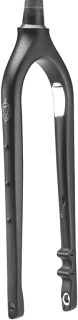
Choosing A Fork:

So, let's say you want a new fork for that old bike you have in the garage. Let's say it is a clapped out old suspension fork on an older MTB that you have had for years, but now you have some ideas. Maybe you want to do some bikepacking, or maybe this will end up being your 'gravel bike', or like me, maybe you want to use that bike as a townie/urban errand rig. 

Well, you know that a suspension fork is too much money, hassle, and it isn't necessary. So what do you get? Well, here is a list of things you'll need to know:

  • What is your steer tube size: One inch? Inch-and-an-eighth? Is that a threaded or threadless steer tube? It is probably a straight steer tube, and if so, a tapered steer tube fork, (like the one to the left here) won't work.
  • Wheel size, (Probably 26 inch, but there are old 650B MTB's and old 29"ers out there nowadays)
  • If you have suspension, what travel length does your fork have? Older bikes had 63mm, bikes from about 1998 on had 80mm, or even 100mm in 26"er flavors. Measure the axle to crown and see if you can compress the shock to assess what travel you might have. 
  • Axle type: Most probably are quick release, but there may be a few instances of thru-axle bikes in this situation. 
  • What is your suspension fork offset/rake? If it was a fork made before 2007 and a 26"er fork, it most assuredly is going to have the then industry-wide standard 38mm offset. But some newer bikes had longer offsets, so check specifications if you can find them. Measuring a fork offset can be done at home, but it gets tricky to be accurate. 

Now, with that information in hand, you can start looking for a suitable replacement fork. Here's an important thing to remember though- If you veer too far from your bicycle's original specifications, you will affect the way the bike handles. And I cannot tell you if you would or would not like that. Just realize that millimeters make a big difference. It may seem trivial to you that your fork has a 440m axle to crown and the replacement you want has 420mm axle to crown, but that matters. You will feel a difference. 

And in some cases you won't be able to replace your fork with an off-the-shelf option. Let's say that you have a 1" steer tube, threaded fork with 63mm of suspension travel, (Original Rock Shox forks, as an example). Well.....you may have to get a fork custom made to suit your desires. Options off the shelf will likely be, what in the industry are called, "replacement forks', and generally are the lowest common denominator in terms of fork options. 

Many 1990's MTB's with 1 1/8th steer tubes and 63mm travel forks can be converted to rigid using a Surly Troll fork, which - while a bit shorter than the stock forks, and have a bit more offset, seem to work a trick for a weight bearing, bikepacking set up. Plus they had canti OR disc brake tabs. Now if you can actually find one......

Sometimes you have to think outside the box. Take for example the Surly Ogre Fork, which is for rigid, non suspension corrected 29"ers. It has an axle to crown of 447mm. Since it is a disc fork, it could work for a 26" wheel. If your 26" suspension fork had 4"/100mm travel, that Ogre fork might work for you. 

Besides those things, you'll need to consider brake standard, brake levers, and if the forks are different lengths, one from the other, you'll need to consider how that affects your stem, bottom bracket height, and seat angle too. 

_______________________________________________________________________________

Hopefully that helps! But if you have anymore questions about forks, switching forks, or what have you, let me know. 

A Guide To Fork Swapping

2000 Fisher Tassajara
 In Monday's "Randomonium" post I asked you readers if you had any questions about fork swapping or technical questions about fork geometry. One of you did ask, so that results in today's subject: "A Guide To Fork Swapping". 

So, before we get started, let's get some definitions and terms down that I'll be using today. It is very important to note that a bicycle is a 'system'. It is not wise to think of a bicycle in terms of one of its parts, or to focus in solely on a particular facet of a bicycle's geometry. So, for instance, when we discuss forks, it is not a good thing to just focus on "offset", and to disregard that "offset" is but one of a few things that ultimately determines how a bicycle will handle. So, don't fall for the simplistic idea that changing a fork from one offset to another will magically cure your handling ills. Many media writers are guilty of perpetuating this myth.

So, following are the things that are important to consider about a fork for your bicycle:

Basic fork geometry terms visualized: From http://yojimg.net/bike/web_tools/trailcalc.php

 
Fork Offset/Fork "Rake": These are interchangeable terms that define how far the wheel axle is placed ahead of the steering axis. More 'offset/rake' means that the axle sits further away in front of the steering axis. 

Steering Axis: This is an imaginary line which is traced through the centerline of the head tube, fork crown, and on down towards the ground. (See the blue hash marked line in the diagram above) Steering Axis angle is equal to the "Head Angle" of a bicycle. Designers adjust this to affect overall Fork Trail.

Fork Trail: This is the distance from a point on the ground where the steering axis intersects the ground plane to the center point of the tire's contact patch behind it. More "Trail" usually means slower/ more stable handling and vice-versa- Less "Trail" means a quicker, less stable bike. This measurement is typically expressed in millimeters.

Wheel Diameter: Wheel diameter is determined by the combination of tire and wheel rim diameter you choose. So, just saying "twenty-niner" isn't good enough. Similarly, the terms "26 inch", "700c", and "27.5"er/650B" are not sufficient for determining overall handling characteristics. Not if we are concerned with detail. Here we need an actual measurement of the wheel/tire combination's diameter, which- as you probably know- is a measurement from the ground, through the axle centerline, to the top of the tire. Essentially, in visual terms for our example above, you would extend that blue hash mark line from the ground plane past where it terminates with the rear wheel axle to the top of the diagram's 'tire'. 

The axle to crown measurement is the distance between the axle to the fork crown along the fork's 'leg'.

Axle to Crown: This determines overall fork 'length'. The distance is determined from the centerline of the wheel axle to the top of the fork crown, or you can think of this as the point where the steer tube exits the fork. 

Suspension Correction: Designers account for the longer length of a suspension fork, necessary to allow for a wheel to 'travel' in a suspension design, and translate that to their rigid fork design, So, if a suspension fork has, let's say, 80mm of travel, to keep the front end of a bicycle equipped with that fork the same in terms of head angle, stack height, and more, that designer makes the rigid fork a similar length to a suspension fork with a rider on board. 

With the weight of a rider, that suspension fork will sink into its travel a bit, and this is called "sag". That is also accounted for in the rigid fork design. So, let's take our 80mm travel fork in a 29'er size and measure that. It's going to come out, nominally, with an axle to crown of around 480mm. That's a bit more than 18"'s for you non-metric folk. Now, 80mm of travel equals about 3"'s. take that off the slightly more than 18" and you are left with around 15+ inches, doubled, equals 30+ inches, or in other words, more than enough to clear a 29" wheel safely with room to spare at full travel of the fork. 

Now let's say we don't want a suspension fork, but we want a rigid one that keeps our 29"er handling similar to what we know. Accounting for some rider induced "sag", while on the bike, our suspension fork really probably is more like 470mm or so in terms of axle to crown. So, our rigid fork needs to be that measurement to preserve the handling characteristics we know, all else remaining the same. This is what we mean when we say that a fork is "suspension corrected for_____ travel". In our example's case, the rigid fork would be suspension corrected for 80mm's of travel. 

Whew!

____________________________________________________________________________

Choosing A Fork:

So, let's say you want a new fork for that old bike you have in the garage. Let's say it is a clapped out old suspension fork on an older MTB that you have had for years, but now you have some ideas. Maybe you want to do some bikepacking, or maybe this will end up being your 'gravel bike', or like me, maybe you want to use that bike as a townie/urban errand rig. 

Well, you know that a suspension fork is too much money, hassle, and it isn't necessary. So what do you get? Well, here is a list of things you'll need to know:

  • What is your steer tube size: One inch? Inch-and-an-eighth? Is that a threaded or threadless steer tube? It is probably a straight steer tube, and if so, a tapered steer tube fork, (like the one to the left here) won't work.
  • Wheel size, (Probably 26 inch, but there are old 650B MTB's and old 29"ers out there nowadays)
  • If you have suspension, what travel length does your fork have? Older bikes had 63mm, bikes from about 1998 on had 80mm, or even 100mm in 26"er flavors. Measure the axle to crown and see if you can compress the shock to assess what travel you might have. 
  • Axle type: Most probably are quick release, but there may be a few instances of thru-axle bikes in this situation. 
  • What is your suspension fork offset/rake? If it was a fork made before 2007 and a 26"er fork, it most assuredly is going to have the then industry-wide standard 38mm offset. But some newer bikes had longer offsets, so check specifications if you can find them. Measuring a fork offset can be done at home, but it gets tricky to be accurate. 

Now, with that information in hand, you can start looking for a suitable replacement fork. Here's an important thing to remember though- If you veer too far from your bicycle's original specifications, you will affect the way the bike handles. And I cannot tell you if you would or would not like that. Just realize that millimeters make a big difference. It may seem trivial to you that your fork has a 440m axle to crown and the replacement you want has 420mm axle to crown, but that matters. You will feel a difference. 

And in some cases you won't be able to replace your fork with an off-the-shelf option. Let's say that you have a 1" steer tube, threaded fork with 63mm of suspension travel, (Original Rock Shox forks, as an example). Well.....you may have to get a fork custom made to suit your desires. Options off the shelf will likely be, what in the industry are called, "replacement forks', and generally are the lowest common denominator in terms of fork options. 

Many 1990's MTB's with 1 1/8th steer tubes and 63mm travel forks can be converted to rigid using a Surly Troll fork, which - while a bit shorter than the stock forks, and have a bit more offset, seem to work a trick for a weight bearing, bikepacking set up. Plus they had canti OR disc brake tabs. Now if you can actually find one......

Sometimes you have to think outside the box. Take for example the Surly Ogre Fork, which is for rigid, non suspension corrected 29"ers. It has an axle to crown of 447mm. Since it is a disc fork, it could work for a 26" wheel. If your 26" suspension fork had 4"/100mm travel, that Ogre fork might work for you. 

Besides those things, you'll need to consider brake standard, brake levers, and if the forks are different lengths, one from the other, you'll need to consider how that affects your stem, bottom bracket height, and seat angle too. 

_______________________________________________________________________________

Hopefully that helps! But if you have anymore questions about forks, switching forks, or what have you, let me know. 

Friday, October 26, 2018

Friday News And Views

Velocity does all these rad ano colors plus a very industrial looking "Mill" finish
A Shout Out To Velocity USA:

I've built bicycle wheels since 1994. Right from the get-go I have laced up Velocity rims. They have always been a great rim to work with, albeit a tad on the "soft" side as alloys go. But that isn't all bad. Just different.

Well, Velocity now does a rim brake model called the Quill which I got to handle recently. A friend of mine wanted a 700c set in silver laced up to go on a Rivendell Atlantis. I have to say that they were some of the best rims to build with I've ever used. In fact, most recent Velocity rims I have built with have been really stellar to build up.

The really cool thing about Velocity USA is that, as their company name suggests, they manufacture their rims right here in the USA. They even do their own anodizing, which allows them to do a rainbow of colors in many of their rims. The newest deal they have on offer now is the Quill rim brake rim in the 650B size. That's a great rim, and as I said above, I just built up a set in 700c which went together almost too easily!

 Anyway, a shout out to Velocity USA for making great product here in the States. I highly recommend their stuff.

The Trust fork, a linkage style affair, is VERY different.
Linkage Style Fork Freaks People Out, Blows Them Away With High Price:

Their have been different ways to absorb trail/road inputs to the front end of a two wheeled vehicle than your typical telescopic design since forever. Motorcycle design really was rife with various oddball forks for years. Just research vintage "Indian Motorcycles" sometime and you'll see all sorts of weirdness involving leaf springs, linkages, and odd hydraulic dampers.

So when bicycle designers went off road and were looking for a way to better manage bumps, these ideas were plumbed to see what might be best to get on a bicycle. There were air bags, elastomers, upside down telescopic forks, linkage forks, and leaf spring forks made for mtb's all during the 1990's. I own, not one, but TWO- AMP linkage forks which I rode in the 90's, so I am familiar with how they work. I also have a bit of experience with Girvin Vector linkage forks and Lawhill Leader forks.

So, why linkage? Well, they have the ability to be designed in such a way that they resist brake dive and remain constant in their trail figure throughout their travel. This is revelatory when you ride a linkage fork. So, why don't we ride linkage forks if they are so superior? 

Actually, that's an easy question to answer. It is because the focus of early linkage fork design was primarily on light weight and anti-brake dive. The attributes of durability and overall suspension performance were secondary to these goals. Therefore, linkage designs suffered from constant bushing and damper issues. Plus, they looked weird. They were hard to market to an audience that was equating off road abilities with motorcycle technologies. And as you probably know, there aren't very many linkage forks in moto cross.

So, basically the linkage fork has been a design without proper treatment, (German Answer aside), since forever. Dave Weagle, the suspension designer behind Split Pivot, DW Link, and others, has now applied his know-how to front suspension. The result is the Trust. A 130mm travel linkage design unlike the predecessors in that ALL aspects of design were addressed. Of course, it comes at a cost with such a high tech-low production model fork. You'd better sit down for this- $2700.00 clams. Ouch! 

Maybe in the future the prices can be brought down, but regardless, this is actually an innovation in tech which I find very interesting. Imagine this in a shorter travel configuration for gravel. You might say, "But we already have Lauf." I hear you, but the Lauf is undamped, has issues with independent leg movement, and is not tunable. This would solve all those issues and be just as light. Time will tell.... And yes- it is butt ugly. 

Start line- 2015 Dirty Kanza 200. Before "The Take Over".
 Debate About How Corporate Ownership Of Events Affects Participants Experiences Rages On:

The Life Time Fitness purchase of the Dirty Kanza events has prompted a lot of debate and speculation both here on the blog and elsewhere. A recent "Outside Magazine" article explores this topic which you can read here.

Author Aaron Gulley asked several event promoters and the staff of the DK200 about this subject. One of those referenced in this post by Mr. Gulley is me. I find this subject intriguing and I have wrestled with it for many years.

While the format of "Friday News And Views" is not sufficient for me to get all my thoughts down about this, I am going to make a few comments today here. Some of what I say sharp eyed readers of this blog will have read before. Some of these thoughts may be new.

First and foremost, while there is a big effort from the DK Promotions team to make this about "the future existence of the Dirty Kanza", make no mistake- They didn't need Lifetime Fitness to make that happen. The DK Promotions team has already led by example here and shown that they can make this work year after year. The idea put forth is that Lifetime guarantees the future in terms of quality of experience, but in reality, a good team, recruited and trained also could have done this within the existing DK Promotions structure.

The Lifetime Fitness deal does another important thing, which I alluded to previously and which is also pointed at in this linked article- that being that there is an equity take away for people retiring from the event production company. Jim Cummins is quoted as he speaks in the third person here as saying, " I just turned 60, and one of these years, Jim Cummins is going to decide that he wants to just go out and ride his bike....." Of course, he follows it up with the "guaranteed future" idea right afterward, but the point being is that his, (and I would assume future employees/directors) exit from the company will be one which is rewarded in some fashion. Otherwise, why bother? They could "insure the future" of the DK 200 without going the corporate route. But then again, maybe they didn't want to do it that way. 

But beyond that, the point about riders feeling like the DK200 has been "killed" by the sale of the event is only really a thing because we seem to feel that if an event experience we have is monetized, it cheapens our previous experiences and "takes away" from the event. Marketing can also be thrown in here. You start marketing the event to sponsors, corporate entities, and city businesses and it seems that this is a signal that filthy lucre is infiltrating the "purity" of  the event experience. 

This seems like a disconnect when riders applaud infrastructure and details like timing and scoring, finish line hoopla, and stuff like that. I mean, as I stated in the "Outside" article, this kind of detail costs a LOT of money. You are not going to get that for free. I think riders "get" that, but they still bitch about events "getting too corporate". Thus my take that it is a disconnect. It is an irrational, emotional issue that is very complex.

But I've gone on too much on this already. I'll have more to say later...

Have a great weekend.

Thursday, December 14, 2017

The Myth That Stiffer Bicycles Are Faster

Recent race bike design is starting to acknowledge that stiffness everywhere in a bike isn't necessarily a good thing.
Riding Gravel just posted a great new article about how vibration isn't your best friend on gravel rides. I've been saying similar things for years. In fact, the article's author, in an e-mail to me, reminded me of how I have advocated against the use of cyclo cross bikes for gravel riding and have gotten into some "discussions" with others about this. This because I have often said that these bikes are too stiff and don't have the ideal geometry for gravel riding.

Those bikes specifically designed for that niche of riding have peculiar traits which have been honed over decades of design and with material technologies available now, they are typically very stiff bikes. They should be. Cyclo cross is a short event which demands racers have every iota of energy come out as power to the ground. Stiffness to the detriment of comfort is something which is a given in this sport of cyclo cross, which, let's be honest, is about suffering on many levels.

Anyway, the point is that cyclo cross bikes are not tuned to absorb the sort of vibrations that gravel road riding induces. This makes them not the best tool for the job. NOTE- I did not say that you should never use a CX bike for gravel. I merely am saying that these sharply defined bikes for a singular purpose are not really "gravel bikes".  And I haven't even mentioned their geometry, which also isn't ideal.

But that isn't a big deal anymore, like it was five or more years ago. Now you can buy a bicycle tuned for gravel travel from many brands, and some of those actually address the problem of vibration by allowing flex. 

Salsa Cycles Warbird was designed to absorb vibrations over gravel roads.
 The Warbird specifically is allowed to have flex in the seat stays to allow the rider to have a less jarring ride. Bicycles like Trek's Domane, (which has technology which will be applied to a new model specifically for gravel, due in March), and Specialized's Roubaix models have existed for some time now, both which allow for flex that absorbs vibrations which otherwise would impede the rider's performance.

Obviously, stiffness isn't always the over-arching goal of design, but typically we see riders responding to claims of stiffness in a frame as being "good". Not just in terms of bottom bracket stiffness, or lateral stiffness, but in the entire frame. Customers think this is "good" in a frame, and they can feel this stiffness, so it must be "good".

Carbon frames have also  made a name for themselves by being brutishly stiff, yet having the oft misused descriptor of "carbon absorbs vibrations" attached to them by unwitting salespeople and general riders. This may have been the case 25 years ago when carbon fiber frames were not as well made, (read: having more bonding component compared to actual carbon material), but that is not the case anymore. Carbon stiffness is incredible now days, and vibrations are not muted by the material. It just passes through frequencies and energy differently than metal frames, but the energy is still getting through to the rider.

One place where carbon has made ride quality worse than ever is in the area of forks.
Vibrations which are passed through to a rider make that rider fatigued and slower. Especially if the road surface is rough, as it is with gravel road riding. This is one of the reasons why Pro riders are gravitating to wider rims and tires. Those tires on wider rims allow for slightly lower pressures and help absorb these unwanted vibrations. No longer should you listen to that guy you know from RAGBRAI who says you should run 23mm tires at 110psi. He's wrong about that. Dead wrong.

One of my pet peeves is the use of carbon forks with massive, thick legs, tapered steer tubes, and thick "uni-crown" style fork crowns. These forks do not give an inch. (Again- riders can feel stiffness and think it means "I'm faster", but they aren't) These unforgiving forks may make sense to a cyclo cross racer, where high load cornering is almost always a thing. But for the general public, and especially for gravel riders, it is a useless commodity. Forks which flex and give are far more road worthy and comfortable. Straight steer tubes, while seemingly archaic, actually allow some flex which also helps keep the front triangle, and especially the handle bars, "quieter". Less vibration means more comfort and a faster ride. Think about this. Why would Specialized and Trek work so hard to design flex into the front ends of their bikes?

But flex, and the resulting smoother and more efficient ride quality, is a hard sell. Riders feel smoothness as "slowness". This was true back when suspension forks came along for mountain biking in the early 1990's. Riders tried it and hated it, saying the devices made them slower and sluggish. However; when running similar courses back to back with suspended and non-suspended bikes, it became clear that the smoother riding suspension equipped bikes were making for faster times. All that despite these bikes being heavier and "less stiff" than their non-suspended counterparts. Well, we know what happened next......

Why is it so hard for us to understand that flex, be it passive or active, as in suspension applications, make us faster and obviously more comfortable when almost any other human carrying vehicle employs suspension and flex? Vibrations are bad, most often, and as cyclists, we should be very wary of any bicycle company claiming that more stiffness is a good thing.

Thursday, September 07, 2017

Small Changes- Big Differences

The Sawyer with a shorter travel Reba G2 fork
Tuesday I had a gritchy throat which ended up becoming a full blown cold on Wednesday. so, any thoughts of long rides in the country on a chilly early Fall day were thrown out the window. I ended up nursing myself along at home and in the meantime I decided to monkey around with the Sawyer which I posted about yesterday.

Fork exchanges are no big deal, especially when the wheel standards and head set standards remain the same between parts. I just took about ten minutes to swap things around. That was the easy part.

The change to the Rock Shox Reba meant the same offset with a shorter axle to crown since the fork is set at 80mm of travel. That's positively unheard of these days, 80mm of travel, but that is what the Sawyer was developed around. By the way, I still have the original fork, but suspension for off roading sure is nice to have. The thought here was that maybe the fact that I'd been running a fork that was technically "too long" was causing my dislike of the bike's ride to some degree. Millimeters of difference, but sometimes small changes result in very different feelings and sensations while riding.

The game of millimeters and degrees of angle change are sometimes scoffed at by some cyclists. However; I would say that if I lowered your saddle by 5mm, or lengthened your stem by one centimeter, you'd notice a "big" difference. So, small changes really do matter. Even novice cyclists can tell these things. We see this all the time in the bike shop.

Te Reba has plenty of clearance with the 27.5+ tires as they are on Blunt 35 rims.
 Plunking around the neighborhood, (I was too ill to go for a full blown ride), I felt that the bike was "better". It didn't feel so up in the air, and the lowered front end made the top tube a touch more roomy. Definitely a move in the right direction. I'll have to actually get it out on a trail, obviously, but I think the slightly longer fork wasn't doing this bike any favors. Not for me, at any rate.

As a side note I also discovered I still have an 80mm travel Manitou Tower fork that would also work on this bike. It is not 51mm offset, but- and I may be wrong- I believe it is 46mm offset. Manitou liked that 46mm offset for 29"ers back then, as I recall. So, popping that one on the Sawyer would result in a different feel as well. More stability, and maybe not as eager to turn in. I may try it out as well. The axle to crown is similar to the Rock Shox, maybe a tick taller, I didn't take an exact measurement.

That all said, I probably will not be using any of the three forks. The thing I want to do here is get a 3.0" tire on an internal 40.mm wide rim and forks made the better part of a decade ago did not take such wheels in to account. I'll likely look for a newer, Boost spaced fork I can lower to 80mm of travel and that has through axles. The current, B plus wheels will likely be moved to gravel grinding duty.

The rear of the bike is a quick release, of course, but with aluminum sliding drop outs, well.......maybe I could get something made in through axle. It isn't imperative that I do so, but being that I am moving in to a modern front end at some point, it might prove to be nice to have the rear end match up.

All because the smallest differences seem to make all the difference in how much I like the bike.

Tuesday, August 15, 2017

The Missing Linkage

I rode this fork in the 90's. Linkage forks could be a good thing, if not a tad ugly.
So, there was a bit of a hullabaloo in the mtb community about this "new" design which features a linkage fork. Actually, it isn't anything new, or revolutionary. Linkage forks have been attempted and used in mountain biking since suspension became a "thing" back in the 90's.

My friend from So Cal, Grannygear, suggested that the "newest" incarnation of  this idea as shown recently could be miniaturized and employed as a gravel going fork. Actually, even that already exists. It is called the Lauf Grit fork, which doesn't use pivots, but it uses "leaf springs" which link together the two separate structures which make up the drop out and fork legs respectively. Lauf manages to eliminate pivots and a separate spring which a more "typical" linkage fork uses by making the links the springs. It is genius, and it seems to work. The negative here is that there is zero damping. Of course, with the short travel and higher frequency of bumps a gravel going bike would see, this is less of an issue than it is for a mountain bike.

An example of the German Answer "Kilo" linkage fork.
 Let's say we want damping though, well, then you get into pivots and a separate damper unit. Okay, but why? Why would you even want to put one of these ghastly contraptions on a bicycle?

Well, I happen to have some experience riding a linkage fork. I rode an AMP fork for a few years there on a couple of different bikes. In fact, I have two of these unicorns in my basement. Anyway, they did have a very good small bump compliance and steered really well even deep into their travel. There are reasons why that was.

While there have been, and are, many different types of these beasts, what is attractive here are two things. First; You can rid yourself of stiction- the term refers to the energy required to break free from/overcome the friction of bushings and seals on a stanchion sliding in uppers/shock can in a typical cylindrical, telescopic damper unit. (Suspension fork/rear shock) Linkage forks rely solely on pivots which are much freer to move, or as in the case of the Lauf, just any input overcoming the spring force will allow the wheel to move upward.

Secondly, linkage forks can be designed to control the axle path and can be designed to have "anti-dive" characteristics when applying the brake. Think "Split Pivot" for the front wheel, if "anti-dive" doesn't make sense.

Obviously, eight pivots and a damping unit are going to be susceptible to dirt and moisture and the damage those things can incur upon bushings and bearings. That's why most linkage forks put "the business end" of things where the fork crown is. That arrangement, well......actually anywhere you put linkage, is typically not a very attractive solution but it is an effective solution for bump absorption. Much more so than a telescopic suspension fork is, and generally speaking, lighter to boot.

A linkage fork wouldn't necessarily have to look ugly. Weird? Well.....yes.
In terms of gravel riding, a long travel of the wheel isn't a desirable trait, nor is it necessary. Many forks being positioned in this category feature 30mm of travel. That isn't much and wouldn't require much of a damper unit.

So, in my estimation, a fork like the recently shown mountain bike fork, with its frame altering design, is not at all necessary. A short linkage could be designed which would not only give the right amount of travel, but be aesthetically appealing as well. It may even be able to be made to be so compact that the fork could look nearly traditional. 

But then it could be argued that we don't need a suspension device at all. In fact, many would argue that a simple, rigid fork with an adequate amount of compliance will work with a voluminous tire to provide just the right amount of wheel movement without any unnecessary complexity. I happen to be one of those folks, and I think that many companies miss the boat on this when they spec these big section, beefy looking, unforgiving carbon fiber forks.

Many folks feel that carbon forks will damp vibrations. Really? If you own one of these beefy looking carbon forks you should check this out: When your front wheel impacts a road irregularity sometime, watch the fork blades. (Being extremely conscious of where and in what situation you do this, of course.) More often than not you will see the fork blades remain in plane, but the wheel moves backward a bit. What you are witnessing, most times, is a flex of the top and down tubes of your bike, not the fork blades themselves. This is because manufacturers are deathly afraid of fork failures, the industry testing standards are too stringent, and because of the manufacturers reliance on the fairy tale that carbon forks absorb road chatter. Now some do, but most don't on gravel bikes. 

That said, a smartly designed, short travel, tunable, good looking linkage fork with damping is possible, it just hasn't been done yet. If it ever is, I'll definitely want to try it out. It may just be the missing link between rigid forks and full on, traditional style suspension forks for gravel bikes. 


Friday, April 14, 2017

Friday News And Views

Wait! 180mm of travel?!! In a 29"er fork?!!
From The "They Said It Couldn't Be Done" File:

29"ers were slagged off ten years ago as being only worth it if you were in to XC, single speeding, or short travel full suspension bikes, and let's face it, who wants anything to do with those things? If you were a dreamer back then, you wanted to see the day when a long travel big wheeler was made for big trail days. But, you know, they all said "No way!".

Well, then you had all that business with "enduro", which by the way, is that even a thing now? Anyway, there was that distraction for a few years. Then 29"ers sort of had a renaissance of sorts when the engineering finally caught up and big wheeled, longer travel rigs began to appear at enduro events and started winning them. Now it would appear that the unthinkable has been achieved- that being a super long travel 29"er fork.

Rock Shox just announced some big trail forks ahead of Sea Otter and one of those is a Lyric fork that has a maximum travel of 180mm in 29"er form. (According to a site I read the news on) That's crazy. If you would have suggested such a fork for 29"ers even five years ago, you'd have been laughed off the face of the earth.

So, if you've been listening and reading what I have said about product intros here, you know that things like a Rock Shox Lyric fork for 29"ers is not being made as just an aftermarket option. No, these are going to show up somewhere on someone's production bike with big hoops. So, apparently saying "it will never happen" means that, "hold on, sooner or later you'll see it" in "bike speak", because there it is. The thing they said couldn't be done.

Shape My Grips bar grips are.........interesting.
Shape My Grip Update:

Well, after a few hundred miles of Shape My Grip usage, I can say that I feel I know these as well as I am going to. I ran them at the Renegade Gent's Race and afterward on gravel and commutes.

Shape My Grips says that these are vibration damping add-ons. Hmm......... I don't know about that. Maybe they are, but I cannot say I can tell any differences. I can say that they do offer more control and that they do make for a unique gripping experience that might be right up some folks alleys.

I could totally see how they might be a great thing on wet, muddy rides and especially for cyclo cross where a bit of control added with a secure grip might  be a good thing. People with larger hands might really like something like this to fill up their big paws more than a puny, round tube might otherwise.

One thing that I noted which seemed counter-intuitive was that the part that fitted into the curved part of the drops, the grip oddly enough dubbed "CURVE", was all forward of the bar. In other words, any part of the grip that might enhance comfort was all concentrated in your finger side of the grip and not on the load bearing, vibration absorbing palm side. That seems like a missed feature opportunity.

So, these might be cool for some of you out there for more control, or maybe for a secure grip enhancement, but I have to question any benefit due to a vibration reduction that these are said to provide. I think you'd be better served by dropping your air pressures a bit in your tires to get a noticeable gain there.

Banjo Brothers bags- Top Tube Bag on Left, XL Saddle Trunk on Right
Bag It:

Banjo Brothers is an outfit based out of the Twin Cities that does value packed, bang for your buck bags that happen to work really well. I know, because I have used Banjo Brothers bags for years. They sponsored a couple of Trans Iowas, back in the day, and most recently, I used one of their seat packs on my Fat Bike Century. That trunk bag is very similar to the XL Saddle Trunk they sent over for test and review recently, and I have beaten that thing to death over the Winter, but you'd hardly know it. Well, that is, if I cleaned it up! It's rather dirty right now.

Anyway, this new XL sized behemoth bag is 800 cubic inches of seat bag packing possibilities, and I aim to find out how much stuff it can handle and how well it handles it. That will require me doing a sub 24hr overnighter or two, I suppose.

Oh darn!

The top tube bag is a much larger, more spacious, and easier to use top tube bag than their previous version which was barely big enough for my old point and shoot Fuji x-7 camera.This one should work out fine. I'll have more details on the bags and a review later. I will say that the bag comes equipped with enough strapping that you should have no issues strapping it to even the widest top tube/down tube junctions. I don't really have bikes like that, so I'll likely shorten mine up. You can always cut off what you don't need, but adding on is something else altogether.

Disclaimer: Shape My Grip sent over the SMG BAR TOP and CURVE grips at no charge for test and review. Banjo Brothers sent over the Top Tube Bag and XL Seat Trunk at no charge for test and review. I am not being paid nor bribed to write these reviews and I strive to give my honest thoughts and opinions throughout. 

Have a great Easter Weekend!