 |
The Gorge Gravel Grinder has three distances
|
Over the past week a few media outlets in the realm of cycling have been promoting a story about a new "managed finish" (my words) element to an event in the Oregon Gravel series called the
Gorge Gravel Grinder.
Essentially how it works in a nutshell is that people who sign up for this will get a lead rider who is to set a predetermined pace and there will be a follow-up rider who will help to keep said paced group together.
This is being done to, "help participants stay on track to reach a specific finish time, help take the nerves out of gravel riding and racing by offering an inviting and inclusive, beginner-friendly supportive riding environment while promoting the camaraderie that makes the gravel community so spectacular", according to an article from Cyclingweekly.com.
They call these "pace groups" and they market them as "freight trains of fun". Other objectives of this initiative are to "... ensure participants complete the course and meet their goals", and to raise the level of female participation to 50% of field limits.
Comments: First off, I was a bit puzzled by the author of the linked article when the so-called "pace groups" were suggested to be analogous to gravel riding/racing because, "The experience of gravel racing is often likened to running a marathon."
I've been around gravel riding and racing for many years and I have never heard this before. If anyone reading this can give me some context for this quote, I am all ears and eyes here. Maybe I am out of touch....
 |
Riders in a group from T.I.v10
|
Secondly, the idea of "pace groups" in gravel racing is not new at all, despite what the article, the event, or anyone else seems to think. It's just that previous to this event's announcement, those "pace groups" were allowed to form organically. There never has been any need to make "pace groups" a managed part of an event because event organizers did not make rules against this, and in fact, many early gravel races and rides actually encouraged such behavior.
Also, having been in these groups inside events before, and having observed how they have worked in Trans Iowa over the course of 14 years, I think I can speak to a few points concerning this effort by Gorge Gravel Grinder.
First of all, let me say that I have no real problem with the idea of "pace groups", but trying to manufacture and manage such things is a bit of a problem, in my opinion. I have done "managed pace groups" while doing several "no-drop" events over the years, and so I think I can speak to this with some authority.
And that's a great point here. That being that, whatever you want to call this which is to occur at Gorge Gravel Grinder, it is essentially a "no-drop" ride within the event. Or, maybe several no-drop rides, depending on how they break things up. No-drop rides are not at all uncommon, and they do exactly what the organizers are after- They help ensure riders meet goals and finish rides. So, really, that's all this is.
The problem is that if their groups get too big, they are going to need more leaders and more sweepers for each "pace", or speed of group. And I would imagine Gorge Gravel Grinder has a time stamp, (they mention "specific finish times") so you need to herd all these cats within a certain time frame. What is "too big" in terms of a group? Well, for best results? I'd say 20 riders, or less, for a leader and a sweeper. Especially if you are rolling within a larger group.
But I have even more questions about this idea. How does a time limit affect riders? (Gotta pick up the pace if there are too many stops?) Can groups stop or is that not allowed? What if one or two have mechanicals? Does the rest of the group stop? Do you lose your sweeper if that happens? What about a rider that is having a bad day? Or a rider becomes too slow for the group because they over-estimated their ability to hold the specified pace? Do you shed riders and leave them to fend for themselves? (Doubtful, given the stated goals here for the Gorge Gravel Grinder)
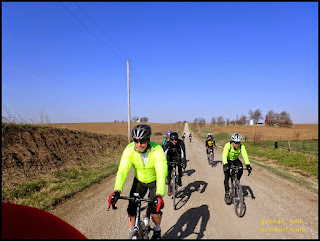 |
A "pace group" ride I used to put on called "The Geezer Ride'.
|
Here's a "for instance" from a "pace group" ride I used to put on called the "Geezer Ride". It was for those who did not want to race, who wanted a "no-drop", no rider left behind experience, and at a casual pace. I ensured people would finish, and at whatever cost that came at, that's what was going to happen.
At one particular Geezer Ride we had a rider that was inexperienced, a "virgin" gravel rider, and was not a finely tuned athlete. In fact, this rider was already telling me to go ahead and leave them behind at the ride's start because they did not expect to be able to keep up. But I was committed to seeing this person finish. And I was successful in managing this for that rider and all the others there that day.
But we were sloooow! We stopped. A lot! So, because a Geezer Ride had no time stamp, no "finish" to make in a certain time, I could leave that part to chance. But when you have event volunteers, infrastructure to tear down after an event, and after-event things like social activities or podium ceremonies, can you allow a managed group to have that sort of luxury?
To my way of thinking, you have to game plan for things like slow riders, over-zealous riders, mechanicals, and making time cuts for end-of-event reasons. You cannot expect volunteers to just hang because a managed pace group is slower than they thought they would be, unless.....
Unless you are willing to allow for failure. In my mind, in an event like Gorge Gravel Grinder, the element of failure should be a part of that event. Failure to finish should never be seen in a negative light, and actually, it can be the best thing that ever could have happened for some riders. At the worst, it should be a lesson for a rider to learn from. But, if the goal is to "make sure everyone finishes", then you lose a valuable asset that gravel grinding, and well, life, has in store for us. That being the chance to learn, to grow, and to have clarity from failures that you otherwise wouldn't have gained.
And that is an essential element of gravel grinding. Without failure, you lose a big part of what makes gravel riding and racing what it was, and has become. That said, I think there is a part to play for no-drop rides as well. It just shouldn't be considered a part of, or analogous to doing, any racing event or challenge. Failure should be an option, and it shouldn't be feared, or held against anybody. That's being "inclusive".