Showing posts with label Fat Fargo. Show all posts

Saturday, August 05, 2023

Fat Tires On Gravel: From Krampus To Gryphon

A Brief Look At The Fat Fargo

 Continuing on with this series concerning my thoughts and experiences with 29+ tires and gravel, today I am going to tell the story behind the Fat Fargo. Well, a little bit of that story, at any rate. 

See, I covered a lot about the Fat Fargo in a post I wrote recently for the "GTDRI Stories" series which runs on Sundays here. You can read that post HERE

In this post I will talk a little bit about how the bike came together and why I ultimately quit using it. So, with that said, let's dive in...

Going back a couple of weeks ago you might remember me talking about the B+ idea and how I was swapping those wheels and tires out into all of my 29"ers. Well, one of those bikes was my Gen 2 Fargo, which I had previously set up as my "mountain biking" Fargo. This set up had an 80mm travel 51mm offset Rock Shox Reba fork on it to keep the axle to crown height in check.

The first test ride of the fat Fargo set up in January of 2015.

My initial test ride was very promising. I was critical of the B+ idea because it was a slightly smaller diameter than 29" wheels and that caused the wheels to have a lack of momentum and as a single speeder, I find that to be a benefit. But, I was pretty encouraged overall. Here is what I wrote about my first impressions back in January of 2015:

"These still seem like a good choice for really rough, looser, back road events like Odin's Revenge to me, but if I cannot live with how they feel on gravel then I think my experimenting will be done. If they make it through that, then they stay on. Time will tell."

Then, as I stated in that linked GTDRI Stories post above, I was injured in 2015. I had a bad shoulder, and this bike ended up being one of the only bikes I had that I could bear to ride for longer than an hour or so.  With a scheduled appearance at the tenth DK200 coming up, I chose to take this and try to just finish the event. But before I got there, I shed some weight by taking off the seat post and fork. 

The Fat Fargo in its final form in the late Summer of 2015.

By the end of 2015 I had pretty much recovered enough that I was able to move back onto my other bikes. Then when 2016 rolled around I was on my Raleigh Tamland Two for gravel along with some Black Mountain Cycles Monstercross action and other test rigs for Riding Gravel. Meanwhile I had the Fargo Gen I, which I was not ever planning on getting rid of, a Singular Cycles Gryphon Mk1, and that made me wonder why I had either the Gryphon, a single speed, or the Fat Fargo just sitting around most of the time. 

Despite a a stellar season of riding in 2015, where I made 152 miles of the muddiest DK200 ever, a big chunk of what turned out to be my last Odin's attempt, and a GTDRI finish, I just found no reason to ride the Fat Fargo at all in 2016. I mean, zero rides at all. 

So, my policy is that if a bike sits around too long with no reason to ride it, and especially if I have no emotional connection to the bike, it has to go. The Fat Fargo was torn apart, the components and wheels used elsewhere, and the frame and fork went to a new owner in the Summer of 2017. 

The fat tires on gravel idea was on hiatus for a bit. Especially so because starting in 2017 I was hitting the pause button on a lot of extracurricular stuff due to an impending job change on the horizon. (Yes....I knew Europa was coming to an end far before it actually happened) So, things like experimenting with 29+ wheels was not feasible at that point. That would all have to wait. 

Next: Another Fat Fargo Idea

Fat Tires On Gravel: From Krampus To Gryphon

A Brief Look At The Fat Fargo

 Continuing on with this series concerning my thoughts and experiences with 29+ tires and gravel, today I am going to tell the story behind the Fat Fargo. Well, a little bit of that story, at any rate. 

See, I covered a lot about the Fat Fargo in a post I wrote recently for the "GTDRI Stories" series which runs on Sundays here. You can read that post HERE

In this post I will talk a little bit about how the bike came together and why I ultimately quit using it. So, with that said, let's dive in...

Going back a couple of weeks ago you might remember me talking about the B+ idea and how I was swapping those wheels and tires out into all of my 29"ers. Well, one of those bikes was my Gen 2 Fargo, which I had previously set up as my "mountain biking" Fargo. This set up had an 80mm travel 51mm offset Rock Shox Reba fork on it to keep the axle to crown height in check.

The first test ride of the fat Fargo set up in January of 2015.

My initial test ride was very promising. I was critical of the B+ idea because it was a slightly smaller diameter than 29" wheels and that caused the wheels to have a lack of momentum and as a single speeder, I find that to be a benefit. But, I was pretty encouraged overall. Here is what I wrote about my first impressions back in January of 2015:

"These still seem like a good choice for really rough, looser, back road events like Odin's Revenge to me, but if I cannot live with how they feel on gravel then I think my experimenting will be done. If they make it through that, then they stay on. Time will tell."

Then, as I stated in that linked GTDRI Stories post above, I was injured in 2015. I had a bad shoulder, and this bike ended up being one of the only bikes I had that I could bear to ride for longer than an hour or so.  With a scheduled appearance at the tenth DK200 coming up, I chose to take this and try to just finish the event. But before I got there, I shed some weight by taking off the seat post and fork. 

The Fat Fargo in its final form in the late Summer of 2015.

By the end of 2015 I had pretty much recovered enough that I was able to move back onto my other bikes. Then when 2016 rolled around I was on my Raleigh Tamland Two for gravel along with some Black Mountain Cycles Monstercross action and other test rigs for Riding Gravel. Meanwhile I had the Fargo Gen I, which I was not ever planning on getting rid of, a Singular Cycles Gryphon Mk1, and that made me wonder why I had either the Gryphon, a single speed, or the Fat Fargo just sitting around most of the time. 

Despite a a stellar season of riding in 2015, where I made 152 miles of the muddiest DK200 ever, a big chunk of what turned out to be my last Odin's attempt, and a GTDRI finish, I just found no reason to ride the Fat Fargo at all in 2016. I mean, zero rides at all. 

So, my policy is that if a bike sits around too long with no reason to ride it, and especially if I have no emotional connection to the bike, it has to go. The Fat Fargo was torn apart, the components and wheels used elsewhere, and the frame and fork went to a new owner in the Summer of 2017. 

The fat tires on gravel idea was on hiatus for a bit. Especially so because starting in 2017 I was hitting the pause button on a lot of extracurricular stuff due to an impending job change on the horizon. (Yes....I knew Europa was coming to an end far before it actually happened) So, things like experimenting with 29+ wheels was not feasible at that point. That would all have to wait. 

Next: Another Fat Fargo Idea

Saturday, July 22, 2023

Fat Tires On Gravel: From Krampus To Gryphon

 The Experimental Phase - Part 1

 Continuing on with this series concerning my thoughts and experiences with 29+ tires and gravel, today I am going to tell the story behind one of two ideas I had to mimic the Mukluk/29+ idea I had seen work so well at Odin's Revenge in 2014. You can go back to read that post here

That year, 2014, was a pivotal year for alternative wheel sizes. But first, we have to understand one thing about bicycle design that, without this innovation, none of what followed would have happened. That means this innovation is very influential, and to my mind has been the biggest influence on bicycle design in the last 30 years. What is it? 

The disc brake.

Without the disc brake, alternative wheel sizes and tire sizes would have been hindered by having to make a frame and fork for each wheel size instead of allowing for anyone to slap any sized disc wheel in a frame to  'just see what would happen'. It is arguable that 650B for MTB, 650B for gravel bikes, all "plus-sized" tires, and fat bike conversion wheels would have never happened without the disc brake. 

So, a shout out to disc brakes for, at the minimum, making all these niche wheel choices possible. Following is one example of a story that would not have happened without the disc brake's existence on bicycles. 

A "spy-shot" of a 650B+ WTB Trailblazer sent to me in 2014.

Not long after the 2012 (I think it was this time period) Interbike show I got a message from 29"er pioneer, Bob Poor which tipped me off to an idea he had for a 650B tire that was wider than most and due to that, it had an overall diameter which approximated a 29" wheel. This was all hush-hush at the time, but the word was that WTB was the company that was going to push this idea forward.

During late 2013 and into 2014 I kept hearing bits and pieces of news that led me to believe that 650B+, as it was being called, was actually going to happen. The idea was that many then current 29"ers could convert to a fatter, more plush ride by simply swapping in a 'B+" wheel set. Initial tires for this size were set to come out as 2.8" wide and on wider rims the ride was claimed to be transformative. 

I made mention of this development, which was to be released at Interbike in 2014, on my blog in August of that year. I got so much blow-back, saying the idea was preposterous and would never happen, that a "spy-shot" was sent to me to prove that the idea did, in fact, exist already. And as we all know, it still is around these days, albeit in a much less popular form.

This all led up to myself getting one of the very first sets of "B+" tires made. A set of WTB 650B X 2.8" Trailblazers. This was a significant development for myself in terms of gravel riding, but that would take some time to evolve into what became, for me, the most successful use of 650B+ wheels. 

Much wheel swapping between bikes in my stable happened. The whole idea was that you could put these B+ wheels into almost any 29" frame and make it go. Well.....not really in reality. No, that did not pan out 100%. In fact, I had three 29"ers in which the rear wheel would not work in my possession alone. This raised a question. What other 29"ers existed that this idea wasn't going to work out on? So, it was obvious to me that the promise of the B+ idea, at least in its conceptual form, was not what it was cracked up to be. Not 100%.

That's not to say it was a bad idea. But it was an idea that, in the end, got its own frames and forks which made the fitment issues with 29"ers go away. Meanwhile, I came to the conclusion that this was a wheel for things beyond singletrack. 

One of the first bikes I tries 'B+" tires on was my OS Bikes Blackbuck
The Fargo Gen I with the B+ wheels.

After a while my experimentation led me to try these new wheels and tires on my Gen I Fargo. One ride on that set up revealed a couple of things. First that the bike didn't really accommodate the width and lowered bottom bracket resulting from the wide tires and slightly smaller diameter of the B+ wheels. Secondly, Holy cow! Was this idea a home run or what

Forget about mountain biking on B+ wheels and tires, this entire set up for bikepacking would be the bomb, and I knew this immediately. A non-suspension corrected frame was 100% the only way it would ever really work, in my mind, at least. So, with that thought in mind, I looked for something that would do what I was thinking. There was nothing commercially viable at that point though. Yes, I could go custom, but that was outside of my means. 

But that attempt was the seed that grew toward a result that has been manifested in my Gryphon Mk3. But we're getting ahead of ourselves here. A lot happened between 2014 and now which factors into this story. 

Next, The second idea I had and its eventual demise, but with an element to it that made a big difference to this story.

Fat Tires On Gravel: From Krampus To Gryphon

 The Experimental Phase - Part 1

 Continuing on with this series concerning my thoughts and experiences with 29+ tires and gravel, today I am going to tell the story behind one of two ideas I had to mimic the Mukluk/29+ idea I had seen work so well at Odin's Revenge in 2014. You can go back to read that post here

That year, 2014, was a pivotal year for alternative wheel sizes. But first, we have to understand one thing about bicycle design that, without this innovation, none of what followed would have happened. That means this innovation is very influential, and to my mind has been the biggest influence on bicycle design in the last 30 years. What is it? 

The disc brake.

Without the disc brake, alternative wheel sizes and tire sizes would have been hindered by having to make a frame and fork for each wheel size instead of allowing for anyone to slap any sized disc wheel in a frame to  'just see what would happen'. It is arguable that 650B for MTB, 650B for gravel bikes, all "plus-sized" tires, and fat bike conversion wheels would have never happened without the disc brake. 

So, a shout out to disc brakes for, at the minimum, making all these niche wheel choices possible. Following is one example of a story that would not have happened without the disc brake's existence on bicycles. 

A "spy-shot" of a 650B+ WTB Trailblazer sent to me in 2014.

Not long after the 2012 (I think it was this time period) Interbike show I got a message from 29"er pioneer, Bob Poor which tipped me off to an idea he had for a 650B tire that was wider than most and due to that, it had an overall diameter which approximated a 29" wheel. This was all hush-hush at the time, but the word was that WTB was the company that was going to push this idea forward.

During late 2013 and into 2014 I kept hearing bits and pieces of news that led me to believe that 650B+, as it was being called, was actually going to happen. The idea was that many then current 29"ers could convert to a fatter, more plush ride by simply swapping in a 'B+" wheel set. Initial tires for this size were set to come out as 2.8" wide and on wider rims the ride was claimed to be transformative. 

I made mention of this development, which was to be released at Interbike in 2014, on my blog in August of that year. I got so much blow-back, saying the idea was preposterous and would never happen, that a "spy-shot" was sent to me to prove that the idea did, in fact, exist already. And as we all know, it still is around these days, albeit in a much less popular form.

This all led up to myself getting one of the very first sets of "B+" tires made. A set of WTB 650B X 2.8" Trailblazers. This was a significant development for myself in terms of gravel riding, but that would take some time to evolve into what became, for me, the most successful use of 650B+ wheels. 

Much wheel swapping between bikes in my stable happened. The whole idea was that you could put these B+ wheels into almost any 29" frame and make it go. Well.....not really in reality. No, that did not pan out 100%. In fact, I had three 29"ers in which the rear wheel would not work in my possession alone. This raised a question. What other 29"ers existed that this idea wasn't going to work out on? So, it was obvious to me that the promise of the B+ idea, at least in its conceptual form, was not what it was cracked up to be. Not 100%.

That's not to say it was a bad idea. But it was an idea that, in the end, got its own frames and forks which made the fitment issues with 29"ers go away. Meanwhile, I came to the conclusion that this was a wheel for things beyond singletrack. 

One of the first bikes I tries 'B+" tires on was my OS Bikes Blackbuck
The Fargo Gen I with the B+ wheels.

After a while my experimentation led me to try these new wheels and tires on my Gen I Fargo. One ride on that set up revealed a couple of things. First that the bike didn't really accommodate the width and lowered bottom bracket resulting from the wide tires and slightly smaller diameter of the B+ wheels. Secondly, Holy cow! Was this idea a home run or what

Forget about mountain biking on B+ wheels and tires, this entire set up for bikepacking would be the bomb, and I knew this immediately. A non-suspension corrected frame was 100% the only way it would ever really work, in my mind, at least. So, with that thought in mind, I looked for something that would do what I was thinking. There was nothing commercially viable at that point though. Yes, I could go custom, but that was outside of my means. 

But that attempt was the seed that grew toward a result that has been manifested in my Gryphon Mk3. But we're getting ahead of ourselves here. A lot happened between 2014 and now which factors into this story. 

Next, The second idea I had and its eventual demise, but with an element to it that made a big difference to this story.

Sunday, July 02, 2023

GTDRI Stories: Fat Fargo

I ran the same header for 2015 as I had for '14.
  "The GTDRI Stories" is a series telling the history, untold tales, and showing the sights from the run of Guitar Ted Death Ride Invitationals. This series will run on Sundays. Thanks for reading!

While I had cemented the idea of running the same course as the previous year for the tenth GTDRI, I waffled on the bike choice for the better part of three months. However, a certain development in the 27.5" wheeled marketplace sort of set off a choice that I did not see coming for the bike that I ended up using more than any other for gravel in 2015. 

Then there was the injury. Not the truck hitting me either! No, this was a multiple hit injury that I sustained over the course of two years, but was really amplified in the Winter of 2014-15. 

The "Fat Fargo" at the DK200 (Image by A Andonopoulous)
First- The injury was caused by multiple crashes while mountain biking on my left shoulder. It seemed that if I lost it on the mountain bike, I went down on my left side. That got a bit annoying, but then I biffed it hard on my Fargo, dumping myself on my left side on concrete. I fell so hard I thought I broke something. Finally, to cap it all off I slipped on some ice in Winter and body slammed myself - you guessed it  - on my left side and that was the straw that broke the camel's back, as it were. 

The following year, 2015, I was relegated to using a handlebar with a lot of sweep/flare like a Midge Bar or the Cowchipper, which came out in the Summer of 2015. The Luxy Bar was another one I could tolerate well. However; it was not without a dull, aching pain that I've had to deal with off and on ever since those days. 

The bike choice was also dictated by WTB's introduction of the "mid-fat" tire, the Trailmaster 27.5 X 2.8" tire. That tire was sent to me to test and I mounted them on some wheels I built with Velocity Blunt 35's and Chris King hubs. Those wheels got passed around to various bikes because the idea WTB had was that you'd slap these into a 29"er and have really fat, voluminous tires to ride. This eventually led to my using the wheels on my Fargo Gen 2 bike which then became known as "Fat Fargo". This pre-dated Salsa Cycles' introduction of their own "plus-sized" wheels in a Fargo by at least a year or more. 

The first outing for the "Fat Fargo" was the 2015 DK200 where it ended up being an ideal choice with which to deal with a wet, muddy 200 mile course. I made it 158 miles that day before I missed the last checkpoint by two minutes. 

Me (in red) bombing a hill at Odin's (Image by W. Kilburg)
The next outing was at Odin's Revenge, where once again, the bike seemed like the obvious choice and it did me really well until I bonked spectacularly later into the event. 

While I had been originally wanting to use the Tamland Two, this Fargo had lower gearing, a better, more comfortable seated position, and those ginormous tires which made mincemeat of mud, grit, and dusty. loose patches of dirt. 

I was also contemplating using the Black Mountain Cycles Monstercross also, but I am glad I didn't as that bike was a troublesome mess on loose, higher speed downhills and all my events were rife with things like that which I attended in 2015. 

So, it was neither the BMC or the Tamland. It was the Fat Fargo. I have to say that 2015 was one of my best riding years ever, despite the injury, and much of that was due to this bike. But I sold it in 2016. Why?

Like many people that sell good things, I needed the money more than I needed that bike sitting around. Also, the wheels ended up on my Fisher/Trek Sawyer single speed, so the Fat Fargo ceased to exist anyway. I could have built new wheels, but like I said, I needed money more than I needed that bike, so it went away. 

But that Fat Fargo had quite a run. DK200, Odin's, the GTDRI. All crazy rides that were almost perfect, but only the GTDRI that year was really a success in terms of getting a complete ride in. And even then, I technically sagged the last 5 or six miles. But whatever.... 

Anyway, this was the year of the "Fat Fargo" and along with the shoulder injury, the wheels I had to test really made 2015 that year. 

Next: The Tenth GTDRI

GTDRI Stories: Fat Fargo

I ran the same header for 2015 as I had for '14.
  "The GTDRI Stories" is a series telling the history, untold tales, and showing the sights from the run of Guitar Ted Death Ride Invitationals. This series will run on Sundays. Thanks for reading!

While I had cemented the idea of running the same course as the previous year for the tenth GTDRI, I waffled on the bike choice for the better part of three months. However, a certain development in the 27.5" wheeled marketplace sort of set off a choice that I did not see coming for the bike that I ended up using more than any other for gravel in 2015. 

Then there was the injury. Not the truck hitting me either! No, this was a multiple hit injury that I sustained over the course of two years, but was really amplified in the Winter of 2014-15. 

The "Fat Fargo" at the DK200 (Image by A Andonopoulous)
First- The injury was caused by multiple crashes while mountain biking on my left shoulder. It seemed that if I lost it on the mountain bike, I went down on my left side. That got a bit annoying, but then I biffed it hard on my Fargo, dumping myself on my left side on concrete. I fell so hard I thought I broke something. Finally, to cap it all off I slipped on some ice in Winter and body slammed myself - you guessed it  - on my left side and that was the straw that broke the camel's back, as it were. 

The following year, 2015, I was relegated to using a handlebar with a lot of sweep/flare like a Midge Bar or the Cowchipper, which came out in the Summer of 2015. The Luxy Bar was another one I could tolerate well. However; it was not without a dull, aching pain that I've had to deal with off and on ever since those days. 

The bike choice was also dictated by WTB's introduction of the "mid-fat" tire, the Trailmaster 27.5 X 2.8" tire. That tire was sent to me to test and I mounted them on some wheels I built with Velocity Blunt 35's and Chris King hubs. Those wheels got passed around to various bikes because the idea WTB had was that you'd slap these into a 29"er and have really fat, voluminous tires to ride. This eventually led to my using the wheels on my Fargo Gen 2 bike which then became known as "Fat Fargo". This pre-dated Salsa Cycles' introduction of their own "plus-sized" wheels in a Fargo by at least a year or more. 

The first outing for the "Fat Fargo" was the 2015 DK200 where it ended up being an ideal choice with which to deal with a wet, muddy 200 mile course. I made it 158 miles that day before I missed the last checkpoint by two minutes. 

Me (in red) bombing a hill at Odin's (Image by W. Kilburg)
The next outing was at Odin's Revenge, where once again, the bike seemed like the obvious choice and it did me really well until I bonked spectacularly later into the event. 

While I had been originally wanting to use the Tamland Two, this Fargo had lower gearing, a better, more comfortable seated position, and those ginormous tires which made mincemeat of mud, grit, and dusty. loose patches of dirt. 

I was also contemplating using the Black Mountain Cycles Monstercross also, but I am glad I didn't as that bike was a troublesome mess on loose, higher speed downhills and all my events were rife with things like that which I attended in 2015. 

So, it was neither the BMC or the Tamland. It was the Fat Fargo. I have to say that 2015 was one of my best riding years ever, despite the injury, and much of that was due to this bike. But I sold it in 2016. Why?

Like many people that sell good things, I needed the money more than I needed that bike sitting around. Also, the wheels ended up on my Fisher/Trek Sawyer single speed, so the Fat Fargo ceased to exist anyway. I could have built new wheels, but like I said, I needed money more than I needed that bike, so it went away. 

But that Fat Fargo had quite a run. DK200, Odin's, the GTDRI. All crazy rides that were almost perfect, but only the GTDRI that year was really a success in terms of getting a complete ride in. And even then, I technically sagged the last 5 or six miles. But whatever.... 

Anyway, this was the year of the "Fat Fargo" and along with the shoulder injury, the wheels I had to test really made 2015 that year. 

Next: The Tenth GTDRI

Wednesday, May 18, 2022

Gryphon Mk 3: Why This Bike?

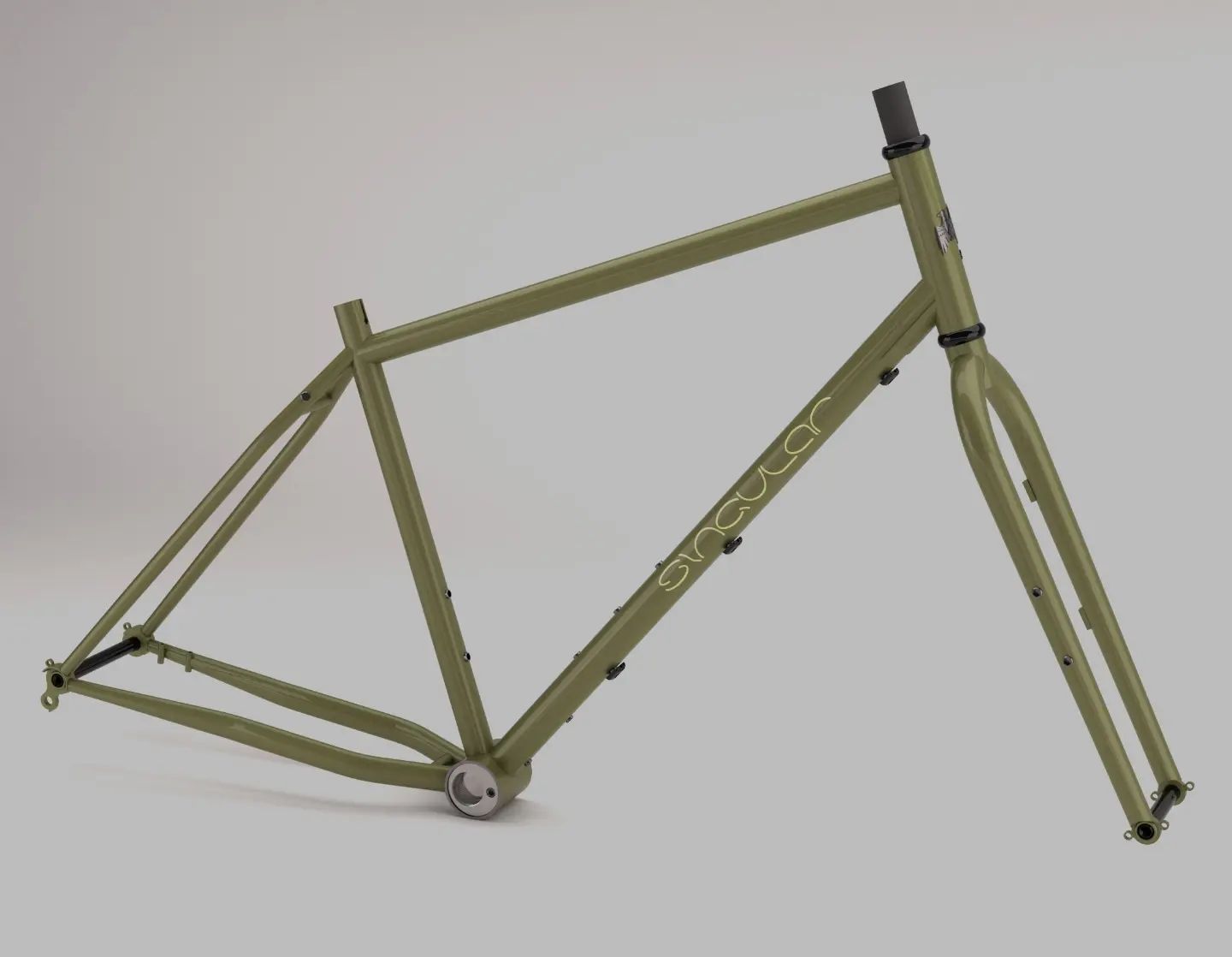
The Gryphon Mk3 mock-up. Image courtesy of Singular Cycles.
 So, in the comments section on the Fargo Gen I post the other day I was asked which modern bike was closest to the original Fargo ideals. I think that distinction falls to the Tumbleweed Stargazer. (Link to my post about the Fargo-Stargazer comparison)

But I also was not interested in getting a Stargazer, and there is one reason I have against the Stargazer, and the Gen I Fargo, for that matter. That is that neither of those two bikes can be single speed. This is important to me not because I like single speed, (I most certainly do like single speed bikes) but because there have been situations that I have been witness to where being able to set up a bike single speed after a rear derailleur gets ripped off would have been a good thing. 

So, while I will agree that the Stargazer is a phenomenal choice, I have decided to pull the trigger on the Singular Cycles Gryphon Mk 3. Yes- the Gryphon Mk3 can be set up single speed. Tumbleweed commented that they decided against a single speed option for two reasons. First of all they did not get good feedback on slider/rocker style rear drop outs because those play havoc with rear racks. They did not like the eccentric bottom bracket option because crankset compatibilities were limited.

A good look at the bare frame/fork of the Gryphon Mk3. Image courtesy of Singular Cycles.

So, obviously I chose this Singular model since it can be set up single speed. But there are other points about this frame and fork which factored into my decision here. I should point out here that these features apply to my decision making. You can and probably do have a completely different take which is 100% valid for what you expect out of a bikepacking/drop bar/gravel/MTB-ish bike. 

One of the big attractions for me is that the Singular Gryphon Mk3 is not a Boost spaced frame/fork. This means for me that I already have compatible wheel sets. Many bikes in this category have Boost spacing, which is fine, but I do not have Boost spaced wheels and I am not interested in kludgy Boost conversions for non-Boost hubs. (My opinion) 

Secondly, this is a non-suspension corrected frame, not at all like a current generation Fargo. I don't like the looks of that overly-long Fargo fork, and I don't like how that raises up the stack height. (671m on a size large Fargo vs  638mm on the Gryphon Mk 3 in a large) 

Finally I think having a straight 1 1/8th steer tube is fine on a bike with a non-suspension corrected fork since finding a carbon option would be nearly impossible that would be compatible anyway. So, you may as well have the more compliant, easier for me to source a head set option. 

Gryphon Mk 3 sideview. Image courtesy of Singular Cycles.

Goals & Objectives: The purpose of this bike, for me, is to fill in the gap where I used to have the "Fat Fargo" option. Now I can have a Fargo Gen I set up for gravel use, (how I really want it to be) and have the 'plus tire' option ready on another Fargo-like bike. The Gryphon Mk3 has clearance for up to 29" X 3" tires. Plenty of girth for my needs. I probably will opt for these Teravail Coronado tires to go on this bike. 29" X 2.8" sounds pretty good to me. 

That will float me over duff, moon-dust, sand, and big, chunky gravel, and possibly some snow and wetter gravel, if need be. Things and conditions where my normal 700 X 40-47mm tires have trouble or cannot manage to be ridden in anyway. 

It will, obviously, be a drop bar bike. That is how I like to ride, predominantly, and I don't see myself doing anything 'single track' here, but it could, if the need arises.  It's steel, and that keeps costs down and riding feel pretty good. It has a fork with an internal dynamo route, which I like the idea of a lot. (Future option)

I may gear this bike, but I might not. That's to be determined. I have the parts to go either way. And as for parts, the crank sets I would use are completely eccentric-friendly, so no big spindled issues at all. Many of the other parts I have. I will need to get those tires and some flat mount brakes though. 

So, that's a short look at why I went the way that I did instead of with another modern, Gen I Fargo replacement option. Questions? Comments? Hit the comments section and I will answer.

Gryphon Mk 3: Why This Bike?

The Gryphon Mk3 mock-up. Image courtesy of Singular Cycles.
 So, in the comments section on the Fargo Gen I post the other day I was asked which modern bike was closest to the original Fargo ideals. I think that distinction falls to the Tumbleweed Stargazer. (Link to my post about the Fargo-Stargazer comparison)

But I also was not interested in getting a Stargazer, and there is one reason I have against the Stargazer, and the Gen I Fargo, for that matter. That is that neither of those two bikes can be single speed. This is important to me not because I like single speed, (I most certainly do like single speed bikes) but because there have been situations that I have been witness to where being able to set up a bike single speed after a rear derailleur gets ripped off would have been a good thing. 

So, while I will agree that the Stargazer is a phenomenal choice, I have decided to pull the trigger on the Singular Cycles Gryphon Mk 3. Yes- the Gryphon Mk3 can be set up single speed. Tumbleweed commented that they decided against a single speed option for two reasons. First of all they did not get good feedback on slider/rocker style rear drop outs because those play havoc with rear racks. They did not like the eccentric bottom bracket option because crankset compatibilities were limited.

A good look at the bare frame/fork of the Gryphon Mk3. Image courtesy of Singular Cycles.

So, obviously I chose this Singular model since it can be set up single speed. But there are other points about this frame and fork which factored into my decision here. I should point out here that these features apply to my decision making. You can and probably do have a completely different take which is 100% valid for what you expect out of a bikepacking/drop bar/gravel/MTB-ish bike. 

One of the big attractions for me is that the Singular Gryphon Mk3 is not a Boost spaced frame/fork. This means for me that I already have compatible wheel sets. Many bikes in this category have Boost spacing, which is fine, but I do not have Boost spaced wheels and I am not interested in kludgy Boost conversions for non-Boost hubs. (My opinion) 

Secondly, this is a non-suspension corrected frame, not at all like a current generation Fargo. I don't like the looks of that overly-long Fargo fork, and I don't like how that raises up the stack height. (671m on a size large Fargo vs  638mm on the Gryphon Mk 3 in a large) 

Finally I think having a straight 1 1/8th steer tube is fine on a bike with a non-suspension corrected fork since finding a carbon option would be nearly impossible that would be compatible anyway. So, you may as well have the more compliant, easier for me to source a head set option. 

Gryphon Mk 3 sideview. Image courtesy of Singular Cycles.

Goals & Objectives: The purpose of this bike, for me, is to fill in the gap where I used to have the "Fat Fargo" option. Now I can have a Fargo Gen I set up for gravel use, (how I really want it to be) and have the 'plus tire' option ready on another Fargo-like bike. The Gryphon Mk3 has clearance for up to 29" X 3" tires. Plenty of girth for my needs. I probably will opt for these Teravail Coronado tires to go on this bike. 29" X 2.8" sounds pretty good to me. 

That will float me over duff, moon-dust, sand, and big, chunky gravel, and possibly some snow and wetter gravel, if need be. Things and conditions where my normal 700 X 40-47mm tires have trouble or cannot manage to be ridden in anyway. 

It will, obviously, be a drop bar bike. That is how I like to ride, predominantly, and I don't see myself doing anything 'single track' here, but it could, if the need arises.  It's steel, and that keeps costs down and riding feel pretty good. It has a fork with an internal dynamo route, which I like the idea of a lot. (Future option)

I may gear this bike, but I might not. That's to be determined. I have the parts to go either way. And as for parts, the crank sets I would use are completely eccentric-friendly, so no big spindled issues at all. Many of the other parts I have. I will need to get those tires and some flat mount brakes though. 

So, that's a short look at why I went the way that I did instead of with another modern, Gen I Fargo replacement option. Questions? Comments? Hit the comments section and I will answer.

Saturday, September 26, 2020

Fat Fargo v2


The original Fat Fargo experiment did not work. 
 
Five years ago I tried 650B X 2.8" wheels in my Fargo Gen I bike. I was really hoping that it would work, but there were issues. First, the clearances were minimal. The tires would spin freely, but there wasn't much room there with the fat 27.5"ers. 

The second thing was that the smaller wheel diameter put the bottom bracket on this bike in the weeds. That wasn't going to fly at all. So, I abandoned that idea, pulled the wheels off, and stuck them in my Fargo Gen 2 bike which I used to own. The wheels stayed there until I sold the bike and then those wheels went on the Sawyer which was sold recently. 

The B+ experiment was a qualified success. I did a couple of things, which in my looking back on it, were very unlike what the industry did with the idea, or what many riders did with the idea. Had I modified one component in that wheel assembly, the experiment likely would have been short lived. So, what was it that made it so compelling? 

I think the main ingredient was the WTB Trailblazer 2.8" tires. Had the tires been anything other than this tread pattern, I likely would have bailed out on the trial sooner. Much sooner. See, the Trailblazer had certain attributes that made it ideal for my applications. First, it wasn't too wide. It was a true 2.8", but it didn't have a super wide casing, so it fit the Fargo, and it made the tire ride well on the rims I chose to use. 

Those rims were Velocity Blunt 35's. They were far narrower internally than what the industry first went with for B+ tires, and far narrower than what most riders thought they needed. However; that narrow profile crowned up what was a really flat profile. The WTB Trailblazer was a very flat tire putting a LOT of its tread width on the ground, especially by the popular pairing of this tire with 50mm wide rims. This made the tire slow, but the Blunt 35's made the tire ride reasonably fast for its size. Especially on that center ridge the Trailblazers have. 

Me riding the Fat Fargo (Gen 2) at Odin's Revenge. Image by Wally Kilburg

I had some excellent rides on the Fat Fargo (The Gen 2 Fargo). I used it to great effect at the "muddy year" of the DK200 and later at Odin's Revenge. The big tires had their day in the Sun in specific conditions where some float was advantageous, but a fast rolling tire was paramount to success. 

The set up was good, but there were some things that weren't so good. Big diameter wheels just were much more to my liking. Once I had ridden a fat bike set up with some very light 29+ wheels, I was smitten by the possibilities of having a large diameter wheel with a wider tire in the 2.8" - 3.0" range. However; manufacturers didn't quite see things that way, offering few choices, and most of what was available was over-built, suspension corrected, or more mountain bike-like. 

So, despite the 'almost but not quite' 2.8" Fat Fargo set up, I ended up going back to 29"er wheels for the Fargo Gen I and rode that bike so much I sold off the Gen 2 version and as stated earlier, moved the wheels over to the Sawyer. Then gravel bikes took off and well...... I left the Fat Fargo idea to simmer, maybe never coming back to it at all. 

However, the other day I was offered some 29" X 2.5" Surly Extraterrestrial tires that Andy, of Andy's Bike Shop, had which he never used, or if he did, very little. They looked nearly perfect. Now Extraterrestrials were a tire I was very familiar with, having run them on the 1X1, ironically now in Andy's possession. They are heavy tires, but they roll fast, are tubeless ready, and are very voluminous for their size. I was quite tempted many a time to run the Surly as a gravel bike, as one of its previous owners, Jeff Kerkove had. But I never got around to it. 

These tires in 29'er size? Intriguing. I took them with plans to mount them on my old Gen I Fargo. That bike is set up with a rather pedestrian, and very heavy wheel set, a Bontrager Duster wheel set laced to Shimano Deore hubs. Nothing too fantastic but a serviceable wheel set. Duster rims are modestly wide, and in fact, are about the same width many 'gravel' rims are now. I was afraid to mount these big, voluminous tires to anything wider or they may not fit into the Gen I Fargo. 

The Fat Fargo v2 with 29" X 2.5" Surly Extraterrestrial tires.

Well, happily, they did fit. The clearances are acceptable, and these tires, while not quite the volume of a 3.0" tire, have the same, or very close to it, volume of the old 2.8 Trailblazers. I know it says 2.5" on the tire, but on these narrow-ish rims, they already have puffed up to exactly 2.5" and I suspect that they will stretch a bit beyond this, as the 26"ers I had did. 

Will they scratch the itch I have for large diameter wheels and big, floaty tires? That's yet to be determined, but if they end up being anything like what the 1X1 was like, hmm.......I think maybe- yes. And if they do pass that test, ah........new lighter wheels will be in order. There is no denying the weight and inertia these monsters have now, and a LOT of the fat is in the hubs here. Those Deore disc hubs weigh a ton. 

There are a few other 'upgrades' to come to the Fargo Gen I, so stay tuned for those and I think you will be surprised by a couple of the things I have in mind to do here.

Fat Fargo v2


The original Fat Fargo experiment did not work. 
 
Five years ago I tried 650B X 2.8" wheels in my Fargo Gen I bike. I was really hoping that it would work, but there were issues. First, the clearances were minimal. The tires would spin freely, but there wasn't much room there with the fat 27.5"ers. 

The second thing was that the smaller wheel diameter put the bottom bracket on this bike in the weeds. That wasn't going to fly at all. So, I abandoned that idea, pulled the wheels off, and stuck them in my Fargo Gen 2 bike which I used to own. The wheels stayed there until I sold the bike and then those wheels went on the Sawyer which was sold recently. 

The B+ experiment was a qualified success. I did a couple of things, which in my looking back on it, were very unlike what the industry did with the idea, or what many riders did with the idea. Had I modified one component in that wheel assembly, the experiment likely would have been short lived. So, what was it that made it so compelling? 

I think the main ingredient was the WTB Trailblazer 2.8" tires. Had the tires been anything other than this tread pattern, I likely would have bailed out on the trial sooner. Much sooner. See, the Trailblazer had certain attributes that made it ideal for my applications. First, it wasn't too wide. It was a true 2.8", but it didn't have a super wide casing, so it fit the Fargo, and it made the tire ride well on the rims I chose to use. 

Those rims were Velocity Blunt 35's. They were far narrower internally than what the industry first went with for B+ tires, and far narrower than what most riders thought they needed. However; that narrow profile crowned up what was a really flat profile. The WTB Trailblazer was a very flat tire putting a LOT of its tread width on the ground, especially by the popular pairing of this tire with 50mm wide rims. This made the tire slow, but the Blunt 35's made the tire ride reasonably fast for its size. Especially on that center ridge the Trailblazers have. 

Me riding the Fat Fargo (Gen 2) at Odin's Revenge. Image by Wally Kilburg

I had some excellent rides on the Fat Fargo (The Gen 2 Fargo). I used it to great effect at the "muddy year" of the DK200 and later at Odin's Revenge. The big tires had their day in the Sun in specific conditions where some float was advantageous, but a fast rolling tire was paramount to success. 

The set up was good, but there were some things that weren't so good. Big diameter wheels just were much more to my liking. Once I had ridden a fat bike set up with some very light 29+ wheels, I was smitten by the possibilities of having a large diameter wheel with a wider tire in the 2.8" - 3.0" range. However; manufacturers didn't quite see things that way, offering few choices, and most of what was available was over-built, suspension corrected, or more mountain bike-like. 

So, despite the 'almost but not quite' 2.8" Fat Fargo set up, I ended up going back to 29"er wheels for the Fargo Gen I and rode that bike so much I sold off the Gen 2 version and as stated earlier, moved the wheels over to the Sawyer. Then gravel bikes took off and well...... I left the Fat Fargo idea to simmer, maybe never coming back to it at all. 

However, the other day I was offered some 29" X 2.5" Surly Extraterrestrial tires that Andy, of Andy's Bike Shop, had which he never used, or if he did, very little. They looked nearly perfect. Now Extraterrestrials were a tire I was very familiar with, having run them on the 1X1, ironically now in Andy's possession. They are heavy tires, but they roll fast, are tubeless ready, and are very voluminous for their size. I was quite tempted many a time to run the Surly as a gravel bike, as one of its previous owners, Jeff Kerkove had. But I never got around to it. 

These tires in 29'er size? Intriguing. I took them with plans to mount them on my old Gen I Fargo. That bike is set up with a rather pedestrian, and very heavy wheel set, a Bontrager Duster wheel set laced to Shimano Deore hubs. Nothing too fantastic but a serviceable wheel set. Duster rims are modestly wide, and in fact, are about the same width many 'gravel' rims are now. I was afraid to mount these big, voluminous tires to anything wider or they may not fit into the Gen I Fargo. 

The Fat Fargo v2 with 29" X 2.5" Surly Extraterrestrial tires.

Well, happily, they did fit. The clearances are acceptable, and these tires, while not quite the volume of a 3.0" tire, have the same, or very close to it, volume of the old 2.8 Trailblazers. I know it says 2.5" on the tire, but on these narrow-ish rims, they already have puffed up to exactly 2.5" and I suspect that they will stretch a bit beyond this, as the 26"ers I had did. 

Will they scratch the itch I have for large diameter wheels and big, floaty tires? That's yet to be determined, but if they end up being anything like what the 1X1 was like, hmm.......I think maybe- yes. And if they do pass that test, ah........new lighter wheels will be in order. There is no denying the weight and inertia these monsters have now, and a LOT of the fat is in the hubs here. Those Deore disc hubs weigh a ton. 

There are a few other 'upgrades' to come to the Fargo Gen I, so stay tuned for those and I think you will be surprised by a couple of the things I have in mind to do here.

Wednesday, June 21, 2017

Thinning The Herd: Part 2

Navigating the Iowan jungle.
Back in the first "Thinning The Herd" post I spoke about the Fargo Gen 2 bike and why it was that I was parting ways with that rig. I sent the frame and fork off to its new owner, and that should be arriving with him this Friday, if not before. So, that chapter in my bicycle fleet is now nearly closed.

Of course, I stripped a bunch of parts off that bike and I alluded to that in the first post linked above. The Gen 2 Fargo was known as the "Fat Fargo" since it was sporting those 27.5+ wheels and tires. This was a key part for another bike, my Fisher. Sure, it was actually a bike sold as a Trek, but c'mon! This is a Fisher bike that came out the year after Trek absorbed Fisher. I'm sure it was meant to be a Fisher.

Now for a bit of history on the Sawyer. The  Sawyer was a 2 X 9 bike with a rigid fork. Trek sold it for two years and then it went away. Obviously, it was a special model made to be an evolution of Gary Fisher's original "Klunker" bike. A model of which made a cameo appearance in the mid-90's as well. In my opinion, the 2011/2012 Sawyer model was the best looking non-custom cruiser styled mountain bike ever. Unfortunately, the absorption of the Fisher brand in to Trek's corporate "borg hive-like" culture killed the marketing of this bike. Essentially was it doomed from the get-go because Trek dealers largely ignored the whimsical, oddball Sawyer and due to the lack of marketing buzz, many riders didn't know what to make of it.

The 27.5+ wheels and this bike were meant for each other.
 Trek sent me a Sawyer to review for Twenty Nine Inches back in the day and when I was done, they, as many companies did, ignored my requests for instructions to send it back. So.......here it is to this day. I liked the Sawyer as it was offered, but it had almost no corporate buzz and getting anything beyond the basics from Trek about it was met with radio silence, for the most part. As I surmised at the time, it was an expensive bike to produce, since it had so many proprietary castings and the frame was difficult to produce. With its triple top tubes having to be precisely bent and welded into place, I can imagine that this frame kept some Trek folks up late at night worrying that they might have a load of misaligned frames on their hands. What is more, it has a split drive side drop out, which is one of the trickest belt compatibility solutions I've ever seen. Had this been a NAHBS one-off custom, it would have been a very popular rig. But it got stuck with a Trek head tube badge and that pretty much killed the "cool factor" right there. Many Sawyers, which were about $1500.00 retail, ended up selling at a grand or even less by 2013 just so dealers could clear them out.


So, like I say, I had this thing setting around so I began to play with it. I had an older Fisher with a 100mm Fox fork, a G2 geometry fork, so I put it on the Sawyer. Then I swapped the geared set up to a Gates Center Track for another review of those parts. Along the way, I had trouble getting comfortable with the gangly, high, and akward Sawyer. It was like a teenager that hadn't matured into its overly large feet and hands. It just never set well with me, and although I was, (and still am) in love with the look, I could never reconcile with how this bike felt despite multiple changes to it. The stock set up seemed to be far better, so I purposed to go back to that to see what I was screwing up with what I had been doing to this bike.

So, the whole 27.5+ thing started blowing up in 2013, and I got sent a set of WTB Trailblazer 2.8"ers to try out. The Sawyer was a perfect candidate for the wheels. I knew people had shoe-horned 29+ wheels into Sawyers, so the clearances were there. The bottom bracket, in a choice made by Trek/Fisher in what I am sure was an influence from Gary himself, was made to have almost zero drop. Putting slightly smaller diameter wheels on the Sawyer would be okay then.

The wheels seemed tailor made for the Sawyer. For the first time the bike seemed "right". I actually had a ton of fun with it set up with the 27.5+ wheels. But I ended up choosing to go with these wheels on the Fargo, which, for a time, proved to be a great choice as well. The Sawyer, in the meantime, languished in the corner of The Lab where it was doomed to sit until I either sold it or got some 27.5+ wheels for it. I never was motivated to build up another 27.5+ set up, so instead, I almost sold the Sawyer a couple of months ago.

Then the realization that I may want a Ti Fargo more than two steel ones came along. I sold the Gen 2 frame and fork, and the wheels were suddenly available again, so.... Now I am planning on keeping this bike around.

Now you know the rest of the story.


Thinning The Herd: Part 2

Navigating the Iowan jungle.
Back in the first "Thinning The Herd" post I spoke about the Fargo Gen 2 bike and why it was that I was parting ways with that rig. I sent the frame and fork off to its new owner, and that should be arriving with him this Friday, if not before. So, that chapter in my bicycle fleet is now nearly closed.

Of course, I stripped a bunch of parts off that bike and I alluded to that in the first post linked above. The Gen 2 Fargo was known as the "Fat Fargo" since it was sporting those 27.5+ wheels and tires. This was a key part for another bike, my Fisher. Sure, it was actually a bike sold as a Trek, but c'mon! This is a Fisher bike that came out the year after Trek absorbed Fisher. I'm sure it was meant to be a Fisher.

Now for a bit of history on the Sawyer. The  Sawyer was a 2 X 9 bike with a rigid fork. Trek sold it for two years and then it went away. Obviously, it was a special model made to be an evolution of Gary Fisher's original "Klunker" bike. A model of which made a cameo appearance in the mid-90's as well. In my opinion, the 2011/2012 Sawyer model was the best looking non-custom cruiser styled mountain bike ever. Unfortunately, the absorption of the Fisher brand in to Trek's corporate "borg hive-like" culture killed the marketing of this bike. Essentially was it doomed from the get-go because Trek dealers largely ignored the whimsical, oddball Sawyer and due to the lack of marketing buzz, many riders didn't know what to make of it.

The 27.5+ wheels and this bike were meant for each other.
 Trek sent me a Sawyer to review for Twenty Nine Inches back in the day and when I was done, they, as many companies did, ignored my requests for instructions to send it back. So.......here it is to this day. I liked the Sawyer as it was offered, but it had almost no corporate buzz and getting anything beyond the basics from Trek about it was met with radio silence, for the most part. As I surmised at the time, it was an expensive bike to produce, since it had so many proprietary castings and the frame was difficult to produce. With its triple top tubes having to be precisely bent and welded into place, I can imagine that this frame kept some Trek folks up late at night worrying that they might have a load of misaligned frames on their hands. What is more, it has a split drive side drop out, which is one of the trickest belt compatibility solutions I've ever seen. Had this been a NAHBS one-off custom, it would have been a very popular rig. But it got stuck with a Trek head tube badge and that pretty much killed the "cool factor" right there. Many Sawyers, which were about $1500.00 retail, ended up selling at a grand or even less by 2013 just so dealers could clear them out.


So, like I say, I had this thing setting around so I began to play with it. I had an older Fisher with a 100mm Fox fork, a G2 geometry fork, so I put it on the Sawyer. Then I swapped the geared set up to a Gates Center Track for another review of those parts. Along the way, I had trouble getting comfortable with the gangly, high, and akward Sawyer. It was like a teenager that hadn't matured into its overly large feet and hands. It just never set well with me, and although I was, (and still am) in love with the look, I could never reconcile with how this bike felt despite multiple changes to it. The stock set up seemed to be far better, so I purposed to go back to that to see what I was screwing up with what I had been doing to this bike.

So, the whole 27.5+ thing started blowing up in 2013, and I got sent a set of WTB Trailblazer 2.8"ers to try out. The Sawyer was a perfect candidate for the wheels. I knew people had shoe-horned 29+ wheels into Sawyers, so the clearances were there. The bottom bracket, in a choice made by Trek/Fisher in what I am sure was an influence from Gary himself, was made to have almost zero drop. Putting slightly smaller diameter wheels on the Sawyer would be okay then.

The wheels seemed tailor made for the Sawyer. For the first time the bike seemed "right". I actually had a ton of fun with it set up with the 27.5+ wheels. But I ended up choosing to go with these wheels on the Fargo, which, for a time, proved to be a great choice as well. The Sawyer, in the meantime, languished in the corner of The Lab where it was doomed to sit until I either sold it or got some 27.5+ wheels for it. I never was motivated to build up another 27.5+ set up, so instead, I almost sold the Sawyer a couple of months ago.

Then the realization that I may want a Ti Fargo more than two steel ones came along. I sold the Gen 2 frame and fork, and the wheels were suddenly available again, so.... Now I am planning on keeping this bike around.

Now you know the rest of the story.


Monday, September 05, 2016

Bar Yak For The Fargo

The BarYak Q: Pro
I just got a piece of new gear for my old Fargo that I am pretty excited about. It is an item from a company called "BarYak". Before I get into the part I purchased, I wanted to give some background on BarYak and its founder, Joe Stiller.

I first came across Joe when he e-mailed me wanting to get into Trans Iowa several years ago. I started checking him out via the "innergoogles" and found out he was big into Winter events like the Arrowhead 135, Tuscobia 150, and more. Eventually, at Trans Iowa v10, I met Joe and then it wasn't long before I started hearing more about Joe's exploits including his Trans South Dakota bikepacking event. Well, to say that Joe is an endurance event junkie is putting things mildly.

The interesting thing about endurance cyclists is that many of them are problem solver/inventor types. Most of what we have come to know as "bikepacking gear" was developed by some genius bikepacker's mind while fighting sub-standard gear during a long event. That's one thing about endurance events- you have a lot of time to think through a solution for a problem while you are out in the field. Necessity is the mother of invention? This never rang more true, I think, then it does with endurance cycling events.

Well, getting back to Joe, one of the things he saw when he came to Trans Iowa was the various cue sheet holder systems that were invented by many of the riders. Joe took the idea of what he thought would be best and made it a reality as the "Q:Pro" cue sheet holding system. I actually got to see and hold the first couple of prototype Q: Pro cue sheet holders at Trans Iowa last Spring when Joe's BarYak company sponsored the event and put up two for the Pre-Race Meat-Up raffle. That is where I got real interested in perhaps owning a component from BarYak. Interest was further piqued at this year's Dirty Kanza 200 where I spoke with Joe at the DK200 expo and got to see and handle his "Complete" BarYak set up and hear about the development and construction of the parts and pieces. One day, I was going to get one of these set ups.

My mileage (computer was off on the low side) from Gravel Worlds. Note cue sheets in lower RH corner
Well, as I related in one of my posts on Gravel Worlds, I had issues switching out cue sheets. That was just one of the many issues I had with the system I used for cue sheets at that event. Gravel Worlds publishes route information just a couple of days ahead of the event. As a rider, you can either download a GPS file for a device, or you can print good ol' cue sheets for yourself. Since I do not own a GPS device, nor would I trust one 100% anyway, I decided to print my own cues.

My printer formatted the things so that they came out fairly large and were bigger than my Cyco-Active Bar Map's pouch. They actually hung out the end far enough that I had to use a rubber band to hold them in so they would not get lost. Switching out cue sheets was a trick while riding. I had to momentarily let go of the bars when I was executing a swap, which wasn't always possible on the sandy, wash-boarded roads of the course. What is more, the border of the Bar Map obscured several lines of cues at the bottom of each sheet, which made for some frustrating navigation. This was the straw that broke the camel's back for me. I contacted Joe shortly after Gravel Worlds.

My BarYak system arrived well packaged and safely.
The nice thing about BarYak is that it is truly a one man operation and you talk to the owner when you call the company number. I first contacted BarYak by the e-mail contact form on their site and received a response asking me to call. Joe and I discussed my needs and he provided a few options. The BarYak system is configurable and can be combined with the Q:Pro cue sheet holder, which is the route I took. Joe suggested to me that if I had a spare handle bar that wasn't being used I could use it as part of the system. I happened to have an old Bontrager 118 titanium bar which Joe suggested would be a perfect substitute for the carbon cross bar he uses as stock. So, I got the BarYak bars, Easton carbon bar ends, and the Q:Pro minus the 3D printed bars that usually go with that.

I received the items double packed in bubble wrapped envelopes and shrink wrapped to a cardboard base. Very secure and safe. I got some blue anodized bar stock, just because it isn't black! BarYak does blue and red as stock colors, I believe, along with black. All attachment hardware is also included, of course. I should mention that the clamping size at the handle bar is 31.8mm, which is the most common size people have, but it isn't the only size out there, so double check your bike before ordering. The cross bar is a clamp size of 25.4mm, so if you plan on using your own handle bar stock, make sure it is a mountain bike handle bar.

My titanium Bontrager bar was a shimmed one, so it was 25.4mm all the way across its length, so I used the center portion of it and cut back the ends myself.  This allowed me to customize the length of the cross bar to my liking, which was nice.
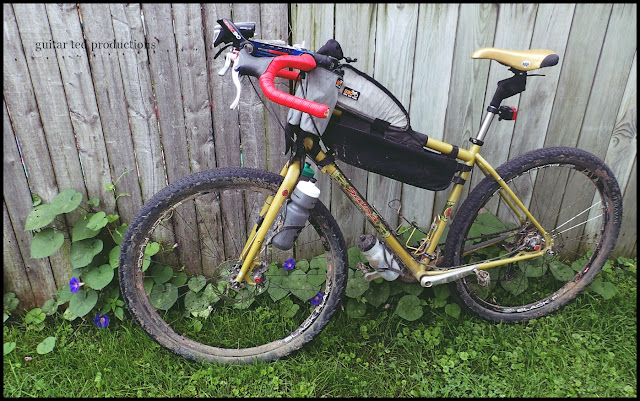
And here is the Fargo Gen I with the BarYak system attached.
A look from the saddle.
Okay, so just above you get the look from the saddle at the BarYak system and how I set it up for now. Note- LOTS could change with this, so don't take any of the above as my "final set up". That said, I have some comments about what I have going on here below.
  • On that cross bar: I noted the old Ti bar had some back sweep, so I used that as "forward sweep" to somewhat better align the bar ends with my arms if I use a more aero grip while riding. By the way, there is the Peregrine Arm Rests which can attach to the BarYak system as well, which was out of stock when I ordered, which I will add in the future. One could go sans arm rests, if that doesn't seem to bother you. 
  • I popped on my wired (!!) Cat Eye computer and my Trelock Control Ion 950 light onto the cross bar. While it doesn't appear so, I can grasp the bar ends comfortably with these components there. Now that doesn't mean that they are staying there! They won't, but for now, it works. 
  • Notice the Q: Pro cue sheet holder is rather spacious. This would have been the trick set up for my Gravel Worlds cues. Also of note- Joe got rider feedback on the Q: Pro saying that the original, shiny clip which holds the cues down was a reflector and was blinding if the Sun was just so. Joe laminated a sheet of carbon fiber on there to alleviate that issue. 
  • The bar ends were purchased from BarYak, but any old mtb bar end you have that you really like can be substituted. 
  • Note my Bike Bag Dude Chaff Bags. I was able to strap one to the slotted bar stock of the BarYak to allow for a different placement. (Left side). My original placement is on the right of the stem in the image above. 
  • The BarYak system is not only configurable, it is adjustable as well. You can rotate the rails up or down to taste and the bar ends can be rotated on the cross bars as well depending on your desired ergonomics. 
Here you can see the slots in the rails which allow for a multitude of strap attachment options.
So that's the set up for the Fargo Gen I, but I probably will move this around to different bikes as the seasons change. I will, for instance, swap this over to the Blackborow DS at some point where the BarYak system will allow me to strap on a front bag and not foul my brake cables. It may end up on the Fat Fargo at some point depending upon the needs I have. Or, it could easily go on one of my gravel grinding rigs for cue sheet duty.

The fit of the parts are precise and the rails are claimed to carry some ridiculous amount of gear, so I expect that I will be able to use this system for years to come. Like I say, it is configurable, and I am certain to add the Peregrine Arm Rests soon and I may utilize this system in different configurations as the need arises. Besides that versatility, I could also see myself adding a Q: Pro cue sheet holder to another rig as a standalone piece. Keep in mind that the rails on the Q: Pro are 3D printed, so they are not up to gear hauling, should you think you want that. In that case, I would advise the regular BarYak as the solution.

Okay, so stay tuned for more as I get used to this set up and make any changes.