Showing posts with label cue sheets. Show all posts

Saturday, April 19, 2025

Where Were We?

 In celebration of the twentieth year of this blog, I have a few tales to tell. This post is one of them. This series will occur off and on throughout this anniversary year, I hope to illuminate some behind-the-scenes stories and highlights from the blog during this time. Enjoy! 

Again with the Trans Iowa stuff. I know, but April was essentially "Trans Iowa Month" here, and I suppose you could add in the first week of May with my reporting on the just completed event for the year. This time I wanted to shine a light on cue sheet navigation. It was something I took great pains to explain in detail here on the blog, so many of you long-time readers will probably recall this being a big deal.

A typical Trans Iowa cue sheet

I was chatting with Cedar Valley Bicycle Collective board member Nick Arendt at our most recent board meeting and he brought up cue sheet navigation while we were discussing Iowa Wind And Rock, (happening today and tomorrow, actually!). 

Nick said something which I've heard before, but is something I do not consider often, and is probably something most folks who have never used a cue sheet in an event would think about. Now, this probably is somewhat unique in terms of how I implemented cue sheet navigation, so others may have a different viewpoint, but if you had ridden in Trans Iowa, or as Nick, in the only C.O.G.100 event, you know first hand what Nick meant when he told me he didn't really ever know exactly where he was during the event.

I suppose it may seem very odd as to why I would have made the cues so precise, yet so vague at the same time so that riders knew exactly where to turn, but had no idea in a macro sense where the points were on a map. No sense of space beyond the immediate was portrayed on the cues. I went as far as not identifying towns and villages on the cues. Unless a rider saw a water tower emblazoned with the village's name, or a Post Office, business, or official government office of some sort, they would never know where they were in relation to ....well, anything!

Finishers of Trans Iowa knew where the start and end points were. But where did they go? Image by A. Andonopoulous
It was not uncommon for Trans Iowa finishers to ask me at the end of the event, "Where did we go this year?" Some of them would understand in a general sense given some knowledge of highways in the state and where they had crossed them, but most had no idea where they had been, especially in the earlier versions before GPS was widely available to cyclists. Of course, later into TI's run cyclists could have used a track of where they had been on their GPS enabled computer afterward to gauge where the route had gone, but many riders did not have this available to them during those days.

So, it was imperative not only for the riders to pay attention to every detail on the cues, but for me and those who reviewed my cue sheets to get every detail critical to navigation right. It was also a difficult task to edit this information down to a clear and concise reading with no confusion induced by the information I did give riders. This was facilitated by those I had volunteer to check my cues out. People like Jeremy Fry, Wally Kilburg, George Keslin, Tony McGrane, and others who would either look over my cues or use them to navigate the route in the field.

Every year these people suggested edits and helped me make Trans Iowa cues the best possible. It was a hard task with a new course every year all 14 years I put this event on. While processes were refined and things were eased by the end of the run, it was by no means an "easy task". Giving explanations every year on the blog was also a bit tedious, however, I felt it could never be pointed out enough how the cues worked.

And I am glad I took the space here to do that. It made for an experience you cannot get anywhere else in cycling. Well......there is Iowa Wind and Rock! And the Ragnarok 105 uses cues yet, I think... So you still can get this experience as long as they keep those events going.

Saturday, August 24, 2024

Analog Navigation

 In celebration of the twentieth year of this blog, I have a few tales to tell. This post is one of them. This series will occur off and on throughout this anniversary year, I hope to illuminate some behind-the-scenes stories and highlights from the blog during this time. Enjoy!


 In speaking with Ari a couple weeks ago (and featured in the podcast I did with him), the subject of cue sheet navigation was brought up. I was reminded how most riders do not understand the impact of cue sheets on events and what a different challenge that can be for the riders. Also, with this blog often serving as the "long-form" explainer for Trans Iowa related issues and topics, the cue sheet idea has bearing on the history of this blog. 

A typical Trans Iowa cue sheet

Now, maybe you are reading this and you don't know what a "cue sheet" is. Maybe you do know what they are, but have never ridden an event using them. Let me tell you, these things can really be a difference maker

We use to use cue sheets because when we started gravel events there were no GPS cycling computers. None. 

Imagine this if you can!

So, to send someone out on a course with no markings, (I know! Another nearly unfathomable thing for some folks), we had to give riders 'directions'. You can think of cue sheets as "riding directions" which you must follow to stay on course. 

Using cues meant that you had to do several things. One: You had to be able to read the cues. This may seem obvious, but think about it: How do you read a cue sheet while riding? You must consider several things. First, you have to have something to hold the cues with. Make sure the wind and the bumping around doesn't knock them off your bike! How do you move from one cue page to another? How can you see a cue sheet - either with poor vision or at night? Almost none of this is necessary for using GPS navigation these days. 

Next, you need to pay more attention to your mileage, sight cues, and the cue sheet! Again, with modern GPS you simply listen for the audible prompt and check the arrow to see which way to turn. You don't read signs, landmarks, or mileage on a computer or cue. Simple. Faster. Easier. 

Cues had their own "language" which varied from event to event. There was no real "standard" unless you were using "tulip" style cues which a lot of events were using back then. To my knowledge Trans Iowa was one of the only events to use strictly alphanumerical cues. You had to read them, as there were no symbols used besides the occasional "arrow". This put a premium on "paying attention" to not only the cues, but your surroundings. 

I could give a long dissertation here on why I think cue sheets are a good idea for events, but I'll just say here that the whole "paying attention" thing was the reason I made a  deliberate and intentional move to include as much "vagueness" in my cues as I could while still providing the clearest directions I could possibly give. 

For instance, I quit giving information as to where you were in a city, town, or village, as that should have been readily apparent to the rider if they were observant. Only in the case of crossing highways and County blacktops did I give any warning ahead of getting there.That was a safety concern. 

Anyway, getting back to the blog, I had to use "Guitar Ted Productions" as a means to give long-form explainers for cue sheets, and this became even more necessary as time went on as more and more I found new riders to be unfamiliar with the cue sheet navigation idea. As an example, you can read THIS POST from 2017 where I went into great detail about how the cues were to be used for Trans Iowa v`13.

I did this to not only inform the riders of Trans Iowa, but to keep the formatting of the Trans Iowa site in its mostly unmolested form which Jeff Kerkove set up in late 2004. I think, and have always thought this, that the OG Trans Iowa blog page is a treasure to be archived and curated so that anyone curious about how things got started could maybe get a feel for the event through that page. Especially the rules which were copied outright or borrowed heavily from by a LOT of following gravel events. 

So, in a way, I leveraged this blog to be what maybe should always have been on an event site, but now you know why I never considered that as an option.

Tuesday, August 17, 2021

Final Gravel Worlds Prep

Cue sheet production for GW 2021 Trans Iowa style.
 The final run up to my Gravel Worlds 2021 attempt is coming along well. Sunday morning I got the cues formatted into a Trans Iowa style cue sheet standard which I find easier to use. I suppose after 10 plus years of using this style of formatting it would make sense that I would like this better. 

As I mentioned previously, Gravel Worlds often had about 8-9 sheets to cover their course. I managed to get it squeezed down to six. So, I was pretty pleased with that. I also condensed in a couple areas that seemed superfluous to my way of understanding directions where the GW sheet was overly complex. 

The plan is to build up each sheet on card stock and 'self-laminate' each with packing tape, which I've done a lot in the past. It works, but it may not be the prettiest. I also will bring the original print out as sent by Gravel Worlds as a back-up, should the odd-ball loss of my sheets happen for some reason.  So, I should be good there. 

I'm charging the Lezyne Super GPS up here and so that should be good to go. I'll do a quick test of that later today. I need to top up the charges on the Ravemen lights I'll be using. I also will stick a fresh battery in the Olympus TG Tough camera so I won't have to worry about that running out. I'll have chargers for the iPhone and Apple watch in the travel bag. That should take care of the electronics. 

Hopefully the rest of the nutrition lands today or tomorrow. One of my items arrived Sunday, so that was nice to see. I have to bring a couple of things from home, some ibuprofen tablets and some turmeric capsules that I use. Chamois creme! Can't forget that. I've been using this Honeybutt Chamois Creme with Manuka honey in it that seems to be really agreeable with me. Gotta track down the family supply of suntan lotion. I'll ask Mrs. Guitar Ted, she'll know where to find that! 

I've got the clothing thing dialed. I'm going with the no-gloves and Sun sleeves approach. One of my frequent commenters, "Wilson", will be glad to know that he influenced me to stick with the base layer. I'll be taking one of my brand new Twin Six base layers and wearing that underneath my Summer-weight Merino wool jersey from Bike Rags

Okay, gotta get to work on a few last minute details. Buttoning this deal up now........

Final Gravel Worlds Prep

Cue sheet production for GW 2021 Trans Iowa style.
 The final run up to my Gravel Worlds 2021 attempt is coming along well. Sunday morning I got the cues formatted into a Trans Iowa style cue sheet standard which I find easier to use. I suppose after 10 plus years of using this style of formatting it would make sense that I would like this better. 

As I mentioned previously, Gravel Worlds often had about 8-9 sheets to cover their course. I managed to get it squeezed down to six. So, I was pretty pleased with that. I also condensed in a couple areas that seemed superfluous to my way of understanding directions where the GW sheet was overly complex. 

The plan is to build up each sheet on card stock and 'self-laminate' each with packing tape, which I've done a lot in the past. It works, but it may not be the prettiest. I also will bring the original print out as sent by Gravel Worlds as a back-up, should the odd-ball loss of my sheets happen for some reason.  So, I should be good there. 

I'm charging the Lezyne Super GPS up here and so that should be good to go. I'll do a quick test of that later today. I need to top up the charges on the Ravemen lights I'll be using. I also will stick a fresh battery in the Olympus TG Tough camera so I won't have to worry about that running out. I'll have chargers for the iPhone and Apple watch in the travel bag. That should take care of the electronics. 

Hopefully the rest of the nutrition lands today or tomorrow. One of my items arrived Sunday, so that was nice to see. I have to bring a couple of things from home, some ibuprofen tablets and some turmeric capsules that I use. Chamois creme! Can't forget that. I've been using this Honeybutt Chamois Creme with Manuka honey in it that seems to be really agreeable with me. Gotta track down the family supply of suntan lotion. I'll ask Mrs. Guitar Ted, she'll know where to find that! 

I've got the clothing thing dialed. I'm going with the no-gloves and Sun sleeves approach. One of my frequent commenters, "Wilson", will be glad to know that he influenced me to stick with the base layer. I'll be taking one of my brand new Twin Six base layers and wearing that underneath my Summer-weight Merino wool jersey from Bike Rags

Okay, gotta get to work on a few last minute details. Buttoning this deal up now........

Thursday, August 12, 2021

More Gravel Worlds Prep On The MCD

Cue sheet test and calibration check- Done!
   As I stated last time I posted an update on my Gravel Worlds prep, I have most of the major stuff taken care of now. The final details are getting checked and tweaked out if necessary now. Wednesday I got out in this brutal heat and humidity for a short spell to check out several small, but important, details. 

  • Cue Sheet Holder: I found my bigger clip and in conjunction with the smaller clip, I think I have a rock solid set up for cues now. Wednesday was pretty breezy, so that made for great testing conditions. I used some old Gravel Worlds cues that I have collected over the years as dummy cues to make sure that they would be readable and not flapping in the breeze as I rode. That checked out all good, so one more item off the list!
  • Calibration Check: I needed to know if I would want to calibrate the computer again, or if it was good on mileage measuring. I usually check this against signs that the State put up along US Highway 218/27 by using a side road which parallels the highway. I can look over and see where the State has marked of the tenths of a mile and see if my computer is racking up similarly to what the State has. I checked out within .01 of a mile, so that'll do. Wandering on the road, stopping at convenience stores, or hiking over to a corn field to relieve oneself could easily amount to being off more than that. I have no doubt I'll be good on mileage tracking. I may chuck my GPS head in the bag as a back-up, but I have zero room to mount that head on the bike unless I do that where I cannot read it from the saddle. That seems pointless. I also need to see if I can turn off the scrolling function on this particular Sigma computer. That constantly changing screen is annoying! 
  • Heat Acclimation: Of course, I've been doing short rides in the intense heat whenever I can to get used to it. Tuesday was likely the worst I'll see as it was 81° at 90% humidity for a "real-feel' heat index of 99°F, I think it was. Anyway- sweat-city! My grips were slimy and bare-handing it was sketchy. Which led to....
  • The Gloves: I figured that the easiest thing to do was to just wear gloves, and I tried that Wednesday, but I don't really want to wear any gloves at all. While the gloves solved the immediate problems with sweat and grip, I found them to be hot and uncomfortable. I just really want to avoid gloves if at all possible. Next up I will try my sleeves which I have used to good effect before. I am reticent to try anything on my wrists as I am really sensitive to any pressure on my skin. It causes numbness really quickly. In fact, I have to loosen my watch band so it bounces around on my wrist or I cannot wear it while riding. More tweaking needs to be done here.
  • No Base Layer: I have been thinking about eschewing wearing a base layer at Gravel Worlds. I know- they say base layers keep you cooler. I say it is still like wearing two shirts. When it is hot and humid, do I really need to be wearing two shirts? It doesn't add up to my mind. So, Wednesday I tried just a jersey while on Tuesday I wore a base layer under a loose fitting 'jersey shirt' thing. I have. I could see wearing the slightly flappy jersey-shirt thing with a base layer and the jersey only deal was great. More testing needed... 

Gotta line up the nutrition stuff next. Then, if Gravel Worlds gets the cues published soon enough, I may transfer them to Trans Iowa style cues. I can read those more easily and I can get more lines on a sheet than they do for Gravel Worlds. I figure that instead of the usual 8-9 sheets Gravel Worlds ends up putting out I might get that down to 7, maybe 8. 

Anyway.... More soon on all this as I wrap things up for next week's trip. Stay tuned......

More Gravel Worlds Prep On The MCD

Cue sheet test and calibration check- Done!
   As I stated last time I posted an update on my Gravel Worlds prep, I have most of the major stuff taken care of now. The final details are getting checked and tweaked out if necessary now. Wednesday I got out in this brutal heat and humidity for a short spell to check out several small, but important, details. 

  • Cue Sheet Holder: I found my bigger clip and in conjunction with the smaller clip, I think I have a rock solid set up for cues now. Wednesday was pretty breezy, so that made for great testing conditions. I used some old Gravel Worlds cues that I have collected over the years as dummy cues to make sure that they would be readable and not flapping in the breeze as I rode. That checked out all good, so one more item off the list!
  • Calibration Check: I needed to know if I would want to calibrate the computer again, or if it was good on mileage measuring. I usually check this against signs that the State put up along US Highway 218/27 by using a side road which parallels the highway. I can look over and see where the State has marked of the tenths of a mile and see if my computer is racking up similarly to what the State has. I checked out within .01 of a mile, so that'll do. Wandering on the road, stopping at convenience stores, or hiking over to a corn field to relieve oneself could easily amount to being off more than that. I have no doubt I'll be good on mileage tracking. I may chuck my GPS head in the bag as a back-up, but I have zero room to mount that head on the bike unless I do that where I cannot read it from the saddle. That seems pointless. I also need to see if I can turn off the scrolling function on this particular Sigma computer. That constantly changing screen is annoying! 
  • Heat Acclimation: Of course, I've been doing short rides in the intense heat whenever I can to get used to it. Tuesday was likely the worst I'll see as it was 81° at 90% humidity for a "real-feel' heat index of 99°F, I think it was. Anyway- sweat-city! My grips were slimy and bare-handing it was sketchy. Which led to....
  • The Gloves: I figured that the easiest thing to do was to just wear gloves, and I tried that Wednesday, but I don't really want to wear any gloves at all. While the gloves solved the immediate problems with sweat and grip, I found them to be hot and uncomfortable. I just really want to avoid gloves if at all possible. Next up I will try my sleeves which I have used to good effect before. I am reticent to try anything on my wrists as I am really sensitive to any pressure on my skin. It causes numbness really quickly. In fact, I have to loosen my watch band so it bounces around on my wrist or I cannot wear it while riding. More tweaking needs to be done here.
  • No Base Layer: I have been thinking about eschewing wearing a base layer at Gravel Worlds. I know- they say base layers keep you cooler. I say it is still like wearing two shirts. When it is hot and humid, do I really need to be wearing two shirts? It doesn't add up to my mind. So, Wednesday I tried just a jersey while on Tuesday I wore a base layer under a loose fitting 'jersey shirt' thing. I have. I could see wearing the slightly flappy jersey-shirt thing with a base layer and the jersey only deal was great. More testing needed... 

Gotta line up the nutrition stuff next. Then, if Gravel Worlds gets the cues published soon enough, I may transfer them to Trans Iowa style cues. I can read those more easily and I can get more lines on a sheet than they do for Gravel Worlds. I figure that instead of the usual 8-9 sheets Gravel Worlds ends up putting out I might get that down to 7, maybe 8. 

Anyway.... More soon on all this as I wrap things up for next week's trip. Stay tuned......

Wednesday, July 21, 2021

A Couple Of Hacks For The Pink MCD

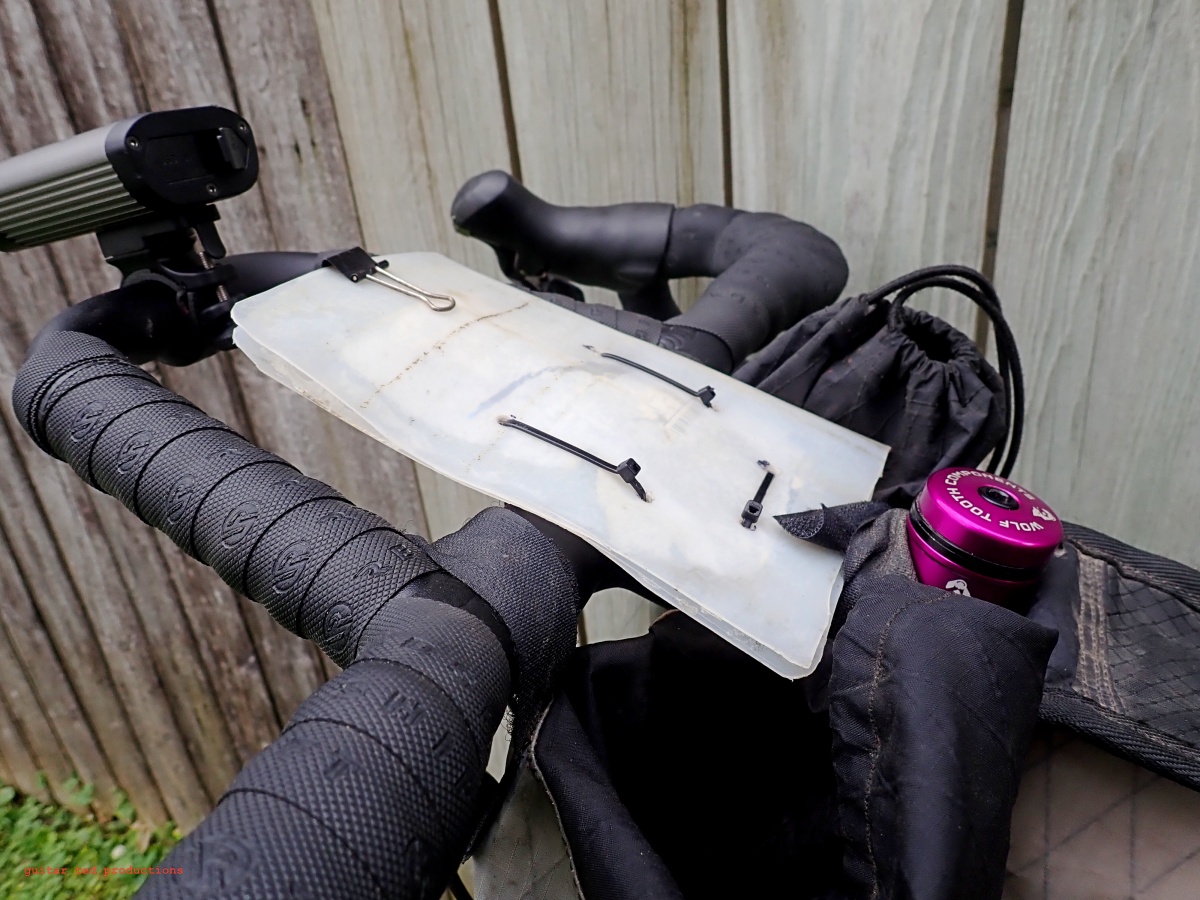
An 'upcycled' plastic bit, a clip, and some cable ties.
 I had a commenter ask about my hack for a cue sheet holder and light mount which I mentioned that I had done on the pink BMC MCD bike. Well, here are the images and descriptions for replicating these bits for yourself. If you care to....(*See disclaimer in the last paragraph!)

These are not what I would call 'elegant' solutions to problems, but they are basic, they work, and almost anyone could probably make something along these lines and likely make it look better than what I have done here. I really don't care how it looks, just that it works.

Okay, so first up is the cue sheet holder, which in itself may seem like an archaic idea given the existence of GPS data for many events. That said, I like cues. They don't have batteries which can fail, screens that freeze, or glare that makes them unreadable. That's my take, anyway......

So, this is super-easy to do. I got this idea from Mike Johnson, actually, who did something similar for his Trans Iowa cue sheet holder back in the day.  I believe Mike used old water bottles, but in this instance, I used an empty container of washer solvent for car windshields to make this. First- Cut off the top tapered section and the very bottom of the container and recycle them. I used a sharp, new blade in a utility knife to do this. then, with what remains, which should be a cylinder, simply cut that lengthwise and fold it in half. I rounded the edges with a scissors to eliminate any sharp edges. I laid a heavy object, (I cannot remember what it was now) on the folded over plastic and let it sit for weeks before I picked it back up again. By that time the plastic had taken on the flattened form you see here. You can accelerate this process, as Mike Johnson did, by putting the part in an oven, or toaster oven, and set it at a very low temperature so as not to melt the plastic, and heat it. (Note- I didn't do the heat activated part, so I am not 100% sure how Mike did his. You are on your own there)

At any rate, then all I did was to punch some holes into this with an awl, and lace it using cable ties to my handle bars. A simple office paper clip, as shown in the image, holds the cues. (Note- I will get a larger pair for the event to aid against wind issues) That's it! A simple cue sheet holder made from something you otherwise might throw away. Obviously you can make this any size you need to. That's another plus to it. And yes- it doesn't look pretty. But it works. 

A carbon fiber steer tube made into a light mount.

The next bit I have done before and learned from some posters online years ago. This is a fairly common hack, but if you haven't seen it done, here's how you do it.

You'll need a chunk of steer tube. The 1 1/8th diameter type is fairly common and not too hard to get from local bike shops that do a lot of fork installations. I have always saved these bits of tubing for several reasons, including making light mounts. 

You will need a star nut, a star nut setter, and a fairly long water bottle bolt, washer, and a boss to mount the thing from. It is important that the bit of steer tube you use is at least long enough to clear your light head unit from the fork blade. I used a piece of a carbon steer tube approximately 3.5" long. Mine could have been a tic shorter, but you'll want to pay attention to that as you get your set up figured out and try to make a mount like this. 

Next, using the star nut setter, drive a star nut into one end of the steer tube bit enough that it is fully into the tube, and that's it. You don't want it down any further. Then, using the bolt and washer, thread the bolt through from the opposite end from the star nut and pass it through the center hole of the star nut. You'll likely want a long hex key to turn the bolt at this point. Thread the bolt into the boss and tighten. Make sure you greased the threads on the bolt! Then you are done! 

You can use steel, aluminum, or a carbon steer tube bit. I'd not try carbon unless you are fairly certain you know what you are doing as it can beak and splinter if you are not careful. (You are NOT supposed to do this, by the way, with carbon steer tubes!) Aluminum would probably be your best bet here. Steel works as well, but it is heavier, if that matters, and it could rust.

Happy Hacking! 

*Remember! You are doing any of this on your own and any damages, failures, or other negative issues are your responsibility. I am only showing you how I did these things and you should consider these strategies carefully and think things through for yourself. I am NOT responsible for YOUR actions. 

A Couple Of Hacks For The Pink MCD

An 'upcycled' plastic bit, a clip, and some cable ties.
 I had a commenter ask about my hack for a cue sheet holder and light mount which I mentioned that I had done on the pink BMC MCD bike. Well, here are the images and descriptions for replicating these bits for yourself. If you care to....(*See disclaimer in the last paragraph!)

These are not what I would call 'elegant' solutions to problems, but they are basic, they work, and almost anyone could probably make something along these lines and likely make it look better than what I have done here. I really don't care how it looks, just that it works.

Okay, so first up is the cue sheet holder, which in itself may seem like an archaic idea given the existence of GPS data for many events. That said, I like cues. They don't have batteries which can fail, screens that freeze, or glare that makes them unreadable. That's my take, anyway......

So, this is super-easy to do. I got this idea from Mike Johnson, actually, who did something similar for his Trans Iowa cue sheet holder back in the day.  I believe Mike used old water bottles, but in this instance, I used an empty container of washer solvent for car windshields to make this. First- Cut off the top tapered section and the very bottom of the container and recycle them. I used a sharp, new blade in a utility knife to do this. then, with what remains, which should be a cylinder, simply cut that lengthwise and fold it in half. I rounded the edges with a scissors to eliminate any sharp edges. I laid a heavy object, (I cannot remember what it was now) on the folded over plastic and let it sit for weeks before I picked it back up again. By that time the plastic had taken on the flattened form you see here. You can accelerate this process, as Mike Johnson did, by putting the part in an oven, or toaster oven, and set it at a very low temperature so as not to melt the plastic, and heat it. (Note- I didn't do the heat activated part, so I am not 100% sure how Mike did his. You are on your own there)

At any rate, then all I did was to punch some holes into this with an awl, and lace it using cable ties to my handle bars. A simple office paper clip, as shown in the image, holds the cues. (Note- I will get a larger pair for the event to aid against wind issues) That's it! A simple cue sheet holder made from something you otherwise might throw away. Obviously you can make this any size you need to. That's another plus to it. And yes- it doesn't look pretty. But it works. 

A carbon fiber steer tube made into a light mount.

The next bit I have done before and learned from some posters online years ago. This is a fairly common hack, but if you haven't seen it done, here's how you do it.

You'll need a chunk of steer tube. The 1 1/8th diameter type is fairly common and not too hard to get from local bike shops that do a lot of fork installations. I have always saved these bits of tubing for several reasons, including making light mounts. 

You will need a star nut, a star nut setter, and a fairly long water bottle bolt, washer, and a boss to mount the thing from. It is important that the bit of steer tube you use is at least long enough to clear your light head unit from the fork blade. I used a piece of a carbon steer tube approximately 3.5" long. Mine could have been a tic shorter, but you'll want to pay attention to that as you get your set up figured out and try to make a mount like this. 

Next, using the star nut setter, drive a star nut into one end of the steer tube bit enough that it is fully into the tube, and that's it. You don't want it down any further. Then, using the bolt and washer, thread the bolt through from the opposite end from the star nut and pass it through the center hole of the star nut. You'll likely want a long hex key to turn the bolt at this point. Thread the bolt into the boss and tighten. Make sure you greased the threads on the bolt! Then you are done! 

You can use steel, aluminum, or a carbon steer tube bit. I'd not try carbon unless you are fairly certain you know what you are doing as it can beak and splinter if you are not careful. (You are NOT supposed to do this, by the way, with carbon steer tubes!) Aluminum would probably be your best bet here. Steel works as well, but it is heavier, if that matters, and it could rust.

Happy Hacking! 

*Remember! You are doing any of this on your own and any damages, failures, or other negative issues are your responsibility. I am only showing you how I did these things and you should consider these strategies carefully and think things through for yourself. I am NOT responsible for YOUR actions. 

Sunday, May 17, 2020

Trans Iowa Stories: A Brief History Of Numbers And Cues

Joe Frost, a v2 rider, showing his v2 number plate. Image by Jeff Kerkove
"Trans Iowa Stories" is an every Sunday post which helps tell the stories behind the event. You can check out other posts about this subject by going back to earlier Sunday posts on this blog. Thanks and enjoy!

Look around any bicycle racers "bike room", wherever in their abode that may be, and you are likely to find the most common "souvenir" from events hanging somewhere. Race/Event number plates are often saved and displayed by many racers. I've got number plates going back to my mountain bike racing days in the 1990's hanging from the ceiling of my Lab. I know other friends of mine who display theirs as well. It's a common thing to do.

So, when I mentioned something about race numbers and Trans Iowa on social media recently, it got some interest. I figured that since this was an important part of the ephemera surrounding cycling events in general, and also adding in cue sheets in particular to Trans Iowa, that a full on post about it all might be of interest.

Since Jeff Kerkove was pretty much in charge of things concerning Trans Iowas v1 and v2, he being a semi-Pro racer and all, our number plates reflected this. They were the "legit" type with the name "Trans Iowa" on them and they had a yellow background on a white plate with black numerals. Apparently they were the same for both v1 and v2 according to the images I have been able to find showing them. I have no "extras" in my stash to prove this though. But at any rate, this was , once again, a small but important part of the puzzle for the new event which made it seem legitimate.

Once Jeff had been courted by Ergon, that beginning at the middle of 2006, he left more and more of the details for Trans Iowa in my hands. Besides much of the main route finding, I then had smaller details including what to do about number plates on my "to do" list. Owing to the fact that we were then not taking entry fees, the cost to put on Trans Iowa became something I had become keenly aware of. Previous to this, I had little cash outlay, seeing how Jeff had handled most of the financial end of the event. But buying number plates seemed "extravagant" to me when, perhaps, a simpler solution costing less might be had.

This led to me finding stickers which triathletes used for their events and cost far less. I ended up getting a metric-ton of these and they were used for v3, v4, and partially, at least, for v6.


A Trans Iowa v3 rig with the number "70" on the top tube.
The number "178" on Steve Fuller's T.I.v6 rig.
The stickers weren't disliked, and I never really heard any complaints about them from the riders. Not that there weren't any, I just never heard any. Many stuck the sticker on their helmet. Many on their bikes. I recall seeing bikes in later Trans Iowa events that still were sporting their sticker numbers, so I guess that was one way that riders saved those.

The sticker numbers ended up being kind of a pain since there was almost no way to see a number unless you are almost on top of them in the event. For instance, identifying a rider for race commentary purposes, or just for keeping track of folks in groups, was impossible. It kind of was put into focus when in T.I.v5's run up we got a sponsorship for race number plates. Having those and seeing how it made keeping track of folks easier, made me rethink the sticker thing. Plus, I was running out of them by T.I.v6 and I needed to do something about that.

You can clearly see an example of the T.I.v5 plates here on Joe Meiser's bike from CP#1 of that year.

Trans Iowa v5 was singular in many ways, as I have said, but we are talking number plates. It was the only time we had "sponsored" number plates and it was the last time we did that. These were sent to us and I wish I could remember which sponsor did this, but right now I cannot recall who it was. And maybe David arranged for these and that is why I have little to no memory of this. Could very well be....

Anyway, they featured  "Trans Iowa" over the number in red, a black numeral, and a red font saying "Version 5" underneath. Again, I have no extra examples to draw any info from. But they were nice and this plate greatly influenced my getting back into Tyvek number plates again starting full-on for Trans Iowa v8.

Which leads me to a mystery about T.I.v6. We know we used some stickers for numbers but there is some indication that we also may have used some Tyvek plates as well. I have no visual evidence for that, but records on the blog here seem to point to that.


Thanks to Matt Jennings for this showing v7-v14 plates.  This is what sparked this post, actually.
Trans Iowa v7 was unique in that we didn't use numbers at all! In fact, the idea for v7 came from two different places. First of all, if you grew up in Iowa it was common to see seed bags for corn or beans flopping in the wind from barbed wire fences. Farmers seemed to fill their planters and then just fold the empty bags over a wire and leave them to be destroyed by the wind. Later, when plastic bags became common, these were also seen flopping off fences. Now days seeds come in plastic containers, so this practice has disappeared from the Iowa landscape.

I also was aware of how these flopping bags from fence lines were similar to Buddhist prayer flags. Jeff Kerkove had taken a trip to ride in Nepal once and had a few images of this which he shared. I combined the two ideas and suggested we do "prayer flags" for the riders. David Pals loved the idea and made it happen.

Originally, our idea was to have riders tie off their prayer flag to a fence where they DNF'ed, if they did, and we'd have these flags fluttering across Iowa, but that was unrealistic of us to expect that from anyone, of course. It is noteworthy to make the point that there were three, maybe four colors for these, the most prominent being yellow. If you have one that is another color, it is rare.

Then after v7 I dipped into a stash of Tyvek number plates that were sitting in a box where I used to work. No one was ever going to use these which likely dated from the late 80's/early 90's. So, I availed myself of them and started the practice of personalizing them for each rider. These plates were huge, by the way, and very easy to spot from a distance, which made tracking riders really much easier. Also, I had a ton of them to use, which kept costs down for a few versions of Trans Iowa.

But starting with v11, I found I was running a bit shy in numbers, and instead of using duplicates, which I had, I ended up supplementing the old plates with newer Tyvek plates which were smaller in size, but otherwise similar in every other way. You can see in the image above where a v11 plate is smaller and a v12 plate is back to the old size. I kept mixing sizes as needed until v13 and v14 where I had to go to using the newer size for everyone, or almost everyone.

As far as style, well, I mixed styles within years even, so for instance- I might have done single speed class rider's plates one way, the Women's plates another, and everyone else may have had a third different way. There was no rhyme or reason to it. I just did whatever I felt like doing. And of course, since they were all done by hand, no two are alike.


Trans Iowa v2 cues
Cue Sheets: 

Now cue sheets were also something that varied wildly over the first half of Trans Iowa's run. Originally we fashioned these to be similar to what Mike Curiak and his helpers were using for the Great Divide Race out West. We didn't need to use a lot of detail since Iowa roads are typically marked by "street signs", and so we made our cues a lot less detailed than the Great Divide race used as a result.

This changed over time though, and as cues were changed, the formatting changed as well. I have been digging through old records here and I have noted a few odd things about old cue sheets which, frankly, I was a bit surprised by. I also had thought that the latter years type of cues had been used earlier than they were.

The first thing that struck me was how big those early cue sheets were. They were ginormous compared to the last cues sheets I used! This persisted until T.I.v8, but not quite as huge as the first couple of years cues were. There were several formats used also, which I found strange. Part of this is due to splitting up the cue sheet duties between David Pals and I for versions 4-7.

The paper was also pretty much just your garden variety of typing paper, or printer paper which could be had free or nearly free. In fact, the first Trans Iowa cues were printed off on the old shop printer at Europa using paper meant for the recycling bin! Jeff and I hand cut those cues using an ancient paper cutter at the shop, which was also done for v2 as well.

Due to the snafu with v3's cues, I redid them, printed them on a ratty old printer hooked up to my PC, and cut them with scissors, if I recall correctly, all in my home. Starting with v4-v6 I had not a lot of hands on work with cues since that was David's domain. So, my memories of those cues is cloudy, as far as production of them. I do know, from looking at the examples I have, that every year they looked different from versions 4-7.


Josh Lederman's cue set from a past TI. (Route obscured by GT )
Starting with v8, the Trans Iowa cues fell into the format I used through to v14. I found this template when I searched for that on the internet from a now defunct randonnuer cycling site which had a few formats free to download at the time. I looked at the ones available and settled in on this as the way that made the most sense to my mind. Ironically I had seen the "tulip" style sheets and I wasn't impressed by them enough to choose that format over what I ended up with. So, my style came off as unique in the gravel world, since to my knowledge no one else ever used this format for gravel racing. The tulip style ended up being the most widely used type. Probably due to a romanticized view of cycling, and mostly that this style is the most easily found format today.

At any rate, I used that old, rare style and never veered away from it. In fact, I still use it for the C.O.G. 100. My feedback over the various Trans Iowa events and from a wide variety of riders has told me it works well. So, don't fix what ain't broke, right? That's my take on these cues.

 The first couple of years of the last format were printed here at G-Ted HQ with me cutting cues sheets up from card stock on the previously mentioned paper cutter from my old job. I also handled all the stuffing of those cues into their bags. Then, oh about T.I.v11 or so, former finisher and veteran of Trans Iowa, Mike Johnson offered to pay for the cue sheet printing, paper, and he and his wife Amy, along with N.Y. Roll or Jeremy Fry at times, would help with the stuffing of cues into their bags. We had that system down pat for the last few years, for sure. Thanks to Mike, Amy, N.Y, Roll, and Jeremy for all the help with that in the years they helped. What a huge relief that was to have those folks as resources!

I always took a lot of heat in the latter years for using cues and I heard the "I'll never do a Guitar Ted event because he uses those stupid cue sheets" plenty of times. Well, there are various event types for a reason. Go do something where you don't have to figure out where you are going then. I never cared what they said, and still don't.

In fact, besides the distance, I'm pretty sure my number plates and cue sheets kept a lot of people from entering Trans Iowa. I'm actually pretty happy about that. Why? Because if silly reasons like using cue sheets and cheesy numbers kept you from coming to Trans Iowa, well you probably didn't belong in an event like that in the first place.

Next: I'll get back into the run-up for Trans Iowa v8.

Trans Iowa Stories: A Brief History Of Numbers And Cues

Joe Frost, a v2 rider, showing his v2 number plate. Image by Jeff Kerkove
"Trans Iowa Stories" is an every Sunday post which helps tell the stories behind the event. You can check out other posts about this subject by going back to earlier Sunday posts on this blog. Thanks and enjoy!

Look around any bicycle racers "bike room", wherever in their abode that may be, and you are likely to find the most common "souvenir" from events hanging somewhere. Race/Event number plates are often saved and displayed by many racers. I've got number plates going back to my mountain bike racing days in the 1990's hanging from the ceiling of my Lab. I know other friends of mine who display theirs as well. It's a common thing to do.

So, when I mentioned something about race numbers and Trans Iowa on social media recently, it got some interest. I figured that since this was an important part of the ephemera surrounding cycling events in general, and also adding in cue sheets in particular to Trans Iowa, that a full on post about it all might be of interest.

Since Jeff Kerkove was pretty much in charge of things concerning Trans Iowas v1 and v2, he being a semi-Pro racer and all, our number plates reflected this. They were the "legit" type with the name "Trans Iowa" on them and they had a yellow background on a white plate with black numerals. Apparently they were the same for both v1 and v2 according to the images I have been able to find showing them. I have no "extras" in my stash to prove this though. But at any rate, this was , once again, a small but important part of the puzzle for the new event which made it seem legitimate.

Once Jeff had been courted by Ergon, that beginning at the middle of 2006, he left more and more of the details for Trans Iowa in my hands. Besides much of the main route finding, I then had smaller details including what to do about number plates on my "to do" list. Owing to the fact that we were then not taking entry fees, the cost to put on Trans Iowa became something I had become keenly aware of. Previous to this, I had little cash outlay, seeing how Jeff had handled most of the financial end of the event. But buying number plates seemed "extravagant" to me when, perhaps, a simpler solution costing less might be had.

This led to me finding stickers which triathletes used for their events and cost far less. I ended up getting a metric-ton of these and they were used for v3, v4, and partially, at least, for v6.


A Trans Iowa v3 rig with the number "70" on the top tube.
The number "178" on Steve Fuller's T.I.v6 rig.
The stickers weren't disliked, and I never really heard any complaints about them from the riders. Not that there weren't any, I just never heard any. Many stuck the sticker on their helmet. Many on their bikes. I recall seeing bikes in later Trans Iowa events that still were sporting their sticker numbers, so I guess that was one way that riders saved those.

The sticker numbers ended up being kind of a pain since there was almost no way to see a number unless you are almost on top of them in the event. For instance, identifying a rider for race commentary purposes, or just for keeping track of folks in groups, was impossible. It kind of was put into focus when in T.I.v5's run up we got a sponsorship for race number plates. Having those and seeing how it made keeping track of folks easier, made me rethink the sticker thing. Plus, I was running out of them by T.I.v6 and I needed to do something about that.

You can clearly see an example of the T.I.v5 plates here on Joe Meiser's bike from CP#1 of that year.

Trans Iowa v5 was singular in many ways, as I have said, but we are talking number plates. It was the only time we had "sponsored" number plates and it was the last time we did that. These were sent to us and I wish I could remember which sponsor did this, but right now I cannot recall who it was. And maybe David arranged for these and that is why I have little to no memory of this. Could very well be....

Anyway, they featured  "Trans Iowa" over the number in red, a black numeral, and a red font saying "Version 5" underneath. Again, I have no extra examples to draw any info from. But they were nice and this plate greatly influenced my getting back into Tyvek number plates again starting full-on for Trans Iowa v8.

Which leads me to a mystery about T.I.v6. We know we used some stickers for numbers but there is some indication that we also may have used some Tyvek plates as well. I have no visual evidence for that, but records on the blog here seem to point to that.


Thanks to Matt Jennings for this showing v7-v14 plates.  This is what sparked this post, actually.
Trans Iowa v7 was unique in that we didn't use numbers at all! In fact, the idea for v7 came from two different places. First of all, if you grew up in Iowa it was common to see seed bags for corn or beans flopping in the wind from barbed wire fences. Farmers seemed to fill their planters and then just fold the empty bags over a wire and leave them to be destroyed by the wind. Later, when plastic bags became common, these were also seen flopping off fences. Now days seeds come in plastic containers, so this practice has disappeared from the Iowa landscape.

I also was aware of how these flopping bags from fence lines were similar to Buddhist prayer flags. Jeff Kerkove had taken a trip to ride in Nepal once and had a few images of this which he shared. I combined the two ideas and suggested we do "prayer flags" for the riders. David Pals loved the idea and made it happen.

Originally, our idea was to have riders tie off their prayer flag to a fence where they DNF'ed, if they did, and we'd have these flags fluttering across Iowa, but that was unrealistic of us to expect that from anyone, of course. It is noteworthy to make the point that there were three, maybe four colors for these, the most prominent being yellow. If you have one that is another color, it is rare.

Then after v7 I dipped into a stash of Tyvek number plates that were sitting in a box where I used to work. No one was ever going to use these which likely dated from the late 80's/early 90's. So, I availed myself of them and started the practice of personalizing them for each rider. These plates were huge, by the way, and very easy to spot from a distance, which made tracking riders really much easier. Also, I had a ton of them to use, which kept costs down for a few versions of Trans Iowa.

But starting with v11, I found I was running a bit shy in numbers, and instead of using duplicates, which I had, I ended up supplementing the old plates with newer Tyvek plates which were smaller in size, but otherwise similar in every other way. You can see in the image above where a v11 plate is smaller and a v12 plate is back to the old size. I kept mixing sizes as needed until v13 and v14 where I had to go to using the newer size for everyone, or almost everyone.

As far as style, well, I mixed styles within years even, so for instance- I might have done single speed class rider's plates one way, the Women's plates another, and everyone else may have had a third different way. There was no rhyme or reason to it. I just did whatever I felt like doing. And of course, since they were all done by hand, no two are alike.


Trans Iowa v2 cues
Cue Sheets: 

Now cue sheets were also something that varied wildly over the first half of Trans Iowa's run. Originally we fashioned these to be similar to what Mike Curiak and his helpers were using for the Great Divide Race out West. We didn't need to use a lot of detail since Iowa roads are typically marked by "street signs", and so we made our cues a lot less detailed than the Great Divide race used as a result.

This changed over time though, and as cues were changed, the formatting changed as well. I have been digging through old records here and I have noted a few odd things about old cue sheets which, frankly, I was a bit surprised by. I also had thought that the latter years type of cues had been used earlier than they were.

The first thing that struck me was how big those early cue sheets were. They were ginormous compared to the last cues sheets I used! This persisted until T.I.v8, but not quite as huge as the first couple of years cues were. There were several formats used also, which I found strange. Part of this is due to splitting up the cue sheet duties between David Pals and I for versions 4-7.

The paper was also pretty much just your garden variety of typing paper, or printer paper which could be had free or nearly free. In fact, the first Trans Iowa cues were printed off on the old shop printer at Europa using paper meant for the recycling bin! Jeff and I hand cut those cues using an ancient paper cutter at the shop, which was also done for v2 as well.

Due to the snafu with v3's cues, I redid them, printed them on a ratty old printer hooked up to my PC, and cut them with scissors, if I recall correctly, all in my home. Starting with v4-v6 I had not a lot of hands on work with cues since that was David's domain. So, my memories of those cues is cloudy, as far as production of them. I do know, from looking at the examples I have, that every year they looked different from versions 4-7.


Josh Lederman's cue set from a past TI. (Route obscured by GT )
Starting with v8, the Trans Iowa cues fell into the format I used through to v14. I found this template when I searched for that on the internet from a now defunct randonnuer cycling site which had a few formats free to download at the time. I looked at the ones available and settled in on this as the way that made the most sense to my mind. Ironically I had seen the "tulip" style sheets and I wasn't impressed by them enough to choose that format over what I ended up with. So, my style came off as unique in the gravel world, since to my knowledge no one else ever used this format for gravel racing. The tulip style ended up being the most widely used type. Probably due to a romanticized view of cycling, and mostly that this style is the most easily found format today.

At any rate, I used that old, rare style and never veered away from it. In fact, I still use it for the C.O.G. 100. My feedback over the various Trans Iowa events and from a wide variety of riders has told me it works well. So, don't fix what ain't broke, right? That's my take on these cues.

 The first couple of years of the last format were printed here at G-Ted HQ with me cutting cues sheets up from card stock on the previously mentioned paper cutter from my old job. I also handled all the stuffing of those cues into their bags. Then, oh about T.I.v11 or so, former finisher and veteran of Trans Iowa, Mike Johnson offered to pay for the cue sheet printing, paper, and he and his wife Amy, along with N.Y. Roll or Jeremy Fry at times, would help with the stuffing of cues into their bags. We had that system down pat for the last few years, for sure. Thanks to Mike, Amy, N.Y, Roll, and Jeremy for all the help with that in the years they helped. What a huge relief that was to have those folks as resources!

I always took a lot of heat in the latter years for using cues and I heard the "I'll never do a Guitar Ted event because he uses those stupid cue sheets" plenty of times. Well, there are various event types for a reason. Go do something where you don't have to figure out where you are going then. I never cared what they said, and still don't.

In fact, besides the distance, I'm pretty sure my number plates and cue sheets kept a lot of people from entering Trans Iowa. I'm actually pretty happy about that. Why? Because if silly reasons like using cue sheets and cheesy numbers kept you from coming to Trans Iowa, well you probably didn't belong in an event like that in the first place.

Next: I'll get back into the run-up for Trans Iowa v8.

Tuesday, November 12, 2019

Iowa Wind And Rock Registration Opens

Hey there! Yes you, dear reader. Maybe you come here for the "Trans Iowa Stories". Maybe you wonder if that crazy old coot named Guitar Ted will ever do another Trans Iowa. (Answer: No. Not ever.) Maybe you got a hankerin' to see if'n ya kin do such a cray-zee dealio. Well, ya still kin, if'n ya wants ta.

Just pony on up and put yer name in that hat called "Iowa Wind And Rock Registration". Y'all have till the 18th ta git'er dun!

Seriously- this is the most "Trans Iowa-like" event out there. There isn't anything else you can do in the gravel grinding niche that will come close. The folks that put it on are all Trans Iowa veterans and loved that event so much they didn't want it to go away, so they did the next best thing. They started their own deal.

Just to be perfectly clear, I have nothing at all to do with Iowa Wind & Rock. I have "retired" from that sort of nonsense and I have no desire to get back in. Been there, done that. That said, I have a LOT of respect for these folks, and I am really HAPPY that they are pushing this sort of an event onward. There truly is not anything else out there like it.

Of course, they are free to do it the way they see fit, and going onward, things could change and maybe I won't be down with those changes. But that's me. They have to figure out things for themselves now, and I've moved on. Sure, I hope they keep things close to the heart of what Trans Iowa was, but there are never any guarantees. I saw some guy grousing about how he hated cue sheet navigation. See, that's a cry to make it easier. Cue sheets are a pain in the butt. They are harder to use. To my mind, that's part of the point of it all. But these things are always relative. Ask any pioneer from the 1800's if they would have liked to have had cue sheets/maps instead of relying on memory or tales pointing to landmarks for navigation. See what I mean? Challenges are not about using the latest technology, as far as I am concerned. Technology? That actually is a crutch to lean on. And it causes all sorts of complications.

Anywho...... Get on the registration if you want such a challenge.

Iowa Wind And Rock Registration Opens

Hey there! Yes you, dear reader. Maybe you come here for the "Trans Iowa Stories". Maybe you wonder if that crazy old coot named Guitar Ted will ever do another Trans Iowa. (Answer: No. Not ever.) Maybe you got a hankerin' to see if'n ya kin do such a cray-zee dealio. Well, ya still kin, if'n ya wants ta.

Just pony on up and put yer name in that hat called "Iowa Wind And Rock Registration". Y'all have till the 18th ta git'er dun!

Seriously- this is the most "Trans Iowa-like" event out there. There isn't anything else you can do in the gravel grinding niche that will come close. The folks that put it on are all Trans Iowa veterans and loved that event so much they didn't want it to go away, so they did the next best thing. They started their own deal.

Just to be perfectly clear, I have nothing at all to do with Iowa Wind & Rock. I have "retired" from that sort of nonsense and I have no desire to get back in. Been there, done that. That said, I have a LOT of respect for these folks, and I am really HAPPY that they are pushing this sort of an event onward. There truly is not anything else out there like it.

Of course, they are free to do it the way they see fit, and going onward, things could change and maybe I won't be down with those changes. But that's me. They have to figure out things for themselves now, and I've moved on. Sure, I hope they keep things close to the heart of what Trans Iowa was, but there are never any guarantees. I saw some guy grousing about how he hated cue sheet navigation. See, that's a cry to make it easier. Cue sheets are a pain in the butt. They are harder to use. To my mind, that's part of the point of it all. But these things are always relative. Ask any pioneer from the 1800's if they would have liked to have had cue sheets/maps instead of relying on memory or tales pointing to landmarks for navigation. See what I mean? Challenges are not about using the latest technology, as far as I am concerned. Technology? That actually is a crutch to lean on. And it causes all sorts of complications.

Anywho...... Get on the registration if you want such a challenge.

Sunday, September 22, 2019

Trans Iowa Stories: It Was The Third - But It Was The First

An old iron bridge over the Volga River which I reconned for the Trans Iowa v3 route
"Trans Iowa Stories" is an every Sunday post which helps tell the stories behind the event. You can check out other posts about this subject by going back to earlier Sunday posts on this blog. Thanks and enjoy!

 The Trans Iowa v3 story, from my viewpoint, transitioned Trans Iowa as the event it would be until the end. In that sense, T.I.v3 was the first, or maybe a prototype, of what was to come for the next eleven years for the event, and for me.

Since Jeff was obviously leaving- eventually- I was going to be doing everything on my own by 2007. Well, not quite everything. There was one thing I thought I was going to be getting help with, and that was the cue sheet checking and printing. Now, originally, my understanding was that Jeff and I would run the course to double check the cues before the event. I kept hoping that would happen, but as the event drew nearer, it was increasingly clear that Jeff wasn't going to be able to do that. Then I thought he might actually double check the cues against a map, but he didn't, and he simply printed them, left them to me at the shop, and that was his last direct effort in putting on a Trans Iowa. I did ask him in subsequent years to do the graphics for the header on the site. So, in that way Jeff was a part of Trans Iowa up through T.I.v9, after which I took over the designing of the headers.

Anyway, the cues. Well, I had a "last chance" to check the cues the weekend before Trans Iowa. I didn't get very far. Several miles outside of Decorah, in the rambling hills of Northeast Iowa, I became panicked. I pretty much lost it, because the cues were completely off and unusable. Due to an early mistake which compounded itself further into the cues, the mileages were unreliable and several turns were incorrect. I was going to have to scrap this cue set and start completely from scratch with six days to go before Trans Iowa v3.

I had last minute details to attend to besides this. Prizing, number plates, volunteers, organizing the finish line, detailing events for the pre-race event, post race events, and communicating with racers. Top it all off with Zach Dundas' requests, my family's demands on my time, and working at the bike shop, and well...... How I ever got through that week I haven't a clue.

T.I.v3 complete cue set. (Image courtesy of Cale Wenthur)
First, I rushed home with the correct information in hand and a plan. I rewrote the cues immediately after getting home, and then every evening I stayed up late printing the cues for three straight days. I used a home printer that could do maybe 30 sheets at a crack, and ink cartridges were dying at an alarming rate. I had to go out and buy them two times. Paper was another thing I had to purchase. Then they all had to be cut and bagged by hand with scissors and using sandwich baggies.

I would be up until 1-2am doing this, then getting the cues organized took a bunch of time. Finally, on Thursday, I had that all redone and my family, including my six year old daughter and three year old son, stuffed race bags, and placed everything in boxes and tubs for transport the following day.

It was a big relief to have those cues finished, obviously, but I was also worried to death something later into the course might still be off since I had no chances to recon that against the cue sheets. The other thing was that this cue sheet crisis caused me to worry less about the "other stuff". I just didn't have the time to worry about anything else. But the energy expended to get the extra work done on top of being the only mechanic at the shop during a busy Spring made my wife unhappy. She could see what this event was doing to me, and she didn't particularly like it. Keep in mind that the previous two Trans Iowas were half as much worry and work for me. Now it was all on my shoulders.

Also, interestingly enough, we never made any "big announcements" that Jeff wouldn't be there, or that he was no longer helping to put on the event. We never even thought about doing that. It just evolved and next thing ya know, it's a "Guitar Ted" deal. Jeff? Well, it was as if he had slipped out the back door. Even Zach Dundas, in his excellent write up on Trans Iowa in the book, "The Renegade Sportsman", never brought Jeff's involvement in the event into the story. It was portrayed as if I was the only guy behind it. And at the time of the eve of T.I.v3, that was true.

And I didn't even have time to think about that. I just dove straight in, because what else could I have done? I felt like I had just dodged a huge bullet in getting the cue sheet debacle taken care of, and with no time to catch my breath, I was headed to Decorah to do things I had never done before on my own.

Next: The surreal set up and anger at being stiffed.

Trans Iowa Stories: It Was The Third - But It Was The First

An old iron bridge over the Volga River which I reconned for the Trans Iowa v3 route
"Trans Iowa Stories" is an every Sunday post which helps tell the stories behind the event. You can check out other posts about this subject by going back to earlier Sunday posts on this blog. Thanks and enjoy!

 The Trans Iowa v3 story, from my viewpoint, transitioned Trans Iowa as the event it would be until the end. In that sense, T.I.v3 was the first, or maybe a prototype, of what was to come for the next eleven years for the event, and for me.

Since Jeff was obviously leaving- eventually- I was going to be doing everything on my own by 2007. Well, not quite everything. There was one thing I thought I was going to be getting help with, and that was the cue sheet checking and printing. Now, originally, my understanding was that Jeff and I would run the course to double check the cues before the event. I kept hoping that would happen, but as the event drew nearer, it was increasingly clear that Jeff wasn't going to be able to do that. Then I thought he might actually double check the cues against a map, but he didn't, and he simply printed them, left them to me at the shop, and that was his last direct effort in putting on a Trans Iowa. I did ask him in subsequent years to do the graphics for the header on the site. So, in that way Jeff was a part of Trans Iowa up through T.I.v9, after which I took over the designing of the headers.

Anyway, the cues. Well, I had a "last chance" to check the cues the weekend before Trans Iowa. I didn't get very far. Several miles outside of Decorah, in the rambling hills of Northeast Iowa, I became panicked. I pretty much lost it, because the cues were completely off and unusable. Due to an early mistake which compounded itself further into the cues, the mileages were unreliable and several turns were incorrect. I was going to have to scrap this cue set and start completely from scratch with six days to go before Trans Iowa v3.

I had last minute details to attend to besides this. Prizing, number plates, volunteers, organizing the finish line, detailing events for the pre-race event, post race events, and communicating with racers. Top it all off with Zach Dundas' requests, my family's demands on my time, and working at the bike shop, and well...... How I ever got through that week I haven't a clue.

T.I.v3 complete cue set. (Image courtesy of Cale Wenthur)
First, I rushed home with the correct information in hand and a plan. I rewrote the cues immediately after getting home, and then every evening I stayed up late printing the cues for three straight days. I used a home printer that could do maybe 30 sheets at a crack, and ink cartridges were dying at an alarming rate. I had to go out and buy them two times. Paper was another thing I had to purchase. Then they all had to be cut and bagged by hand with scissors and using sandwich baggies.

I would be up until 1-2am doing this, then getting the cues organized took a bunch of time. Finally, on Thursday, I had that all redone and my family, including my six year old daughter and three year old son, stuffed race bags, and placed everything in boxes and tubs for transport the following day.

It was a big relief to have those cues finished, obviously, but I was also worried to death something later into the course might still be off since I had no chances to recon that against the cue sheets. The other thing was that this cue sheet crisis caused me to worry less about the "other stuff". I just didn't have the time to worry about anything else. But the energy expended to get the extra work done on top of being the only mechanic at the shop during a busy Spring made my wife unhappy. She could see what this event was doing to me, and she didn't particularly like it. Keep in mind that the previous two Trans Iowas were half as much worry and work for me. Now it was all on my shoulders.

Also, interestingly enough, we never made any "big announcements" that Jeff wouldn't be there, or that he was no longer helping to put on the event. We never even thought about doing that. It just evolved and next thing ya know, it's a "Guitar Ted" deal. Jeff? Well, it was as if he had slipped out the back door. Even Zach Dundas, in his excellent write up on Trans Iowa in the book, "The Renegade Sportsman", never brought Jeff's involvement in the event into the story. It was portrayed as if I was the only guy behind it. And at the time of the eve of T.I.v3, that was true.

And I didn't even have time to think about that. I just dove straight in, because what else could I have done? I felt like I had just dodged a huge bullet in getting the cue sheet debacle taken care of, and with no time to catch my breath, I was headed to Decorah to do things I had never done before on my own.

Next: The surreal set up and anger at being stiffed.