Showing posts with label Lezyne. Show all posts

Friday, September 18, 2026

Friday News And Views

Image courtesy of Vittoria Tire
 Vittoria Offers New 42mm Size In Road Tire Range:

News came out on Tuesday of a new addition to the Ride Armor tire range from Vittoria. This is a road tire range with copious amounts of puncture protection and sidewall protection, yet is supposedly lightweight and rides nicely.  

The range now includes a 42mm wide tire. The tire is tubeless ready.  Claimed weight for the 700 x 42mm tire is 480 gm. The Ride Armor tires cost $89.99 each. 

See the range on Vittoria's site HERE.  

Comments: I'm actually interested in this tire for my Twin Six fixed gear Standard Rando. I think it is a very interesting product from an application standpoint as well. There are a lot of places where a 42mm road tire is all you would ever need. Gravel, as long as it isn't super loose and chunky, would be fioe with a tire like this. Smooth dirt roads, double track, pathways, and on and on. This tire has a weight and protection qualities which would recommend it for  much of what we call "gravel" these days. 

Of course, I haven't ridden it, and perhaps this all goes out the window because it is a tire which has a terrible ride quality. I don't know. But it is intriguing. Coupled with the current trends for "endurance road bikes" and I could easily see those bikes taking over much of the "gravel market" since "gravel" is becoming more "drop bar mountain bike" than it has been.  

Confused yet? The marketing departments apologize and will promise to work harder at blurring lines and confusing you in the future. And then there is this......

Image courtesy of Pirelli Tires
Pirelli Introduces New Cinturato Evo Tire Sizes:

Not to be outdone by Vittoria, Pirelli also added new, wider Evo road tires to their Cinturato range. Pirelli now has 700 x 40mm, 45mm, 50mm, and 55mm (!!!) widths out in this range. 

These tires also feature new rubber compounds and Pirelli's Techwall protection layers. You can check out the range on Pirelli's site HERE.  

Comments: Fifty-five millimeter road tires? Well, maybe these are really touring tires with a new category name. Back in the day, there were some pretty beefy touring tires out there like the Avocet and Continental examples from the 1990's. 

But again, with road endurance bikes getting wider clearances, and maybe some gravel bike purchasers having slick-tire regrets, these tires maybe have a place out there. I just find this entire segment of tires fascinating and I look forward to seeing how the bicycle brands and consumers use these in the future.  

Image courtesy of Ergon
Ergon Updates Grip Model Ranges:

Ergon announced on Tuesday that it has retired the GA2 and GA3 grips and have replaced them with the new GMA and GMS grip models. 

The GMA is the grip which is rounder, but has varying shaping to it to better fit the hand. This and the new GMS have what Ergon is calling "Smart Texture Rhythm Surface". It is a "deliberately engineered pattern that varies the density of the surface breaks across the grip to deliver zone specific damping." Ergon claims this lends the rider better vibration absorption and comfort for long rides and technical terrain.  

The CMS carries on with the mini-wing platform and a tweaked grip shape with a new "thumb saddle" and outer grip stop. All CMA and CMS grips come in multiple color options so you can best address your bike's color scheme. 

Hit the links for each model above to see more details. 

Salsa Cycles Beargrease Eagle 70 (Image courtesy of Salsa Cycles)

Salsa Cycles New Beargrease Fat Bikes & 45NRTH Carbon Fat Bike Rims Announced:

Salsa Cycles revamped their Beargrease fat bike to have a different, slacker, trail oriented geometry including a steeper seat tube. The range starts with the aluminum framed Eagle 70 (shown) and goes carbon frame after this up to the 6K range topping Beargrease C GX AXS. Besides the five model range there is also a frame set offered for 2K. 

More details and images can be seen at Salsa Cycles website HERE.  

Image courtesy of 45NRTH
The new 45NRTH Levitas carbon fat bike rims, which comes on the new range topping Beargrease model only, is offered in 27.5" and 26" versions. Thirty-two spoke holes only here. The 27.5"er is 76mm internal/83mm external width while the 26 inch version is 84mm internal/91mm external width. 

  • 32-hole drill pattern for strong wheel builds
  • Optimized relationship between tire volume and rim width for consistent contact patch and tire profile
  • 35mm rim depth
  • Recommended single layer of 30mm rim tape
  • Recommended valve length 65mm (or longer)
  • Fits 4-5" wide tires
  • Max inflation 30 psi
  • Tested to ASTM Category 3, suggested weight limit of 300 lbs
  • MSRP: $599.00 (USD)
Image courtesy of Lezyne

Lezyne E Drive Electric Pump Debuts:

Those mini-electric compressors you may have seen are becoming more ubiquitous within our cycling community. Heck, even N.Y. Roll bailed me out with his little electric pump a week or so ago now. 

Lezyne, whose accessories I have used and have recommended for years, now offer their version of one of these pumps. It has some interesting features like a cooling fan, a removable/replaceable battery, and it is compatible with Presta, Schrader, and Clik valves. 

Lezyne claims the battery will last long enough to fully inflate six tires or last long enough to do 15-20 pre-ride top-offs.  The battery is USB C standard rechargeable. The pump will achieve a pressure of 120psi, likely high enough for most any bicycle tire most of us have. 

The price is #149.99. More images and details can be found at Lezyne's page for the E Drive HERE.  

Image courtesy of Dahon
Dahon Introduces Mariner XL Folding Bike For Bigger, Taller Riders:

Dahon, known for their innovative folding bicycles, has introduced the new Mariner XL model which has been designed with bigger, taller riders in mind. 

The Mariner has been tested at levels 30% - 50% above folding bike testing standards and is rated to carry up to 330lbs and should fit riders from 5'1" to 6'7" according to the press release.  

Equipped with a Shimano 8 speed drive train and Tektro hydraulic disc brakes the Mariner XL is slated to retail at $1,299.00.

Comments: I do not typically cover urban/micro-mobility bicycles and accessories. However; the fact that Dahon saw fit to address riders who typically are either too heavy, too tall, or both to safely ride folding bikes is commendable.  

The level of detail Dahon went to in designing the bike is impressive as well. With increased stiffness by 15% over their standard folding bike, it shows Dahon is serious here. They also tested the steer post and seat post to levels commensurate with their rider recommendations and addressed this underserved portion of the market with a fairly priced alternative. Good job Dahon!

To learn more click HERE. 

Seen on "X" from Trek's social media account
Trek 32"er Prototype To Be Raced In Utah:

Seen on social media, Trek revealed that their factory racing team will be onboard the new 32" wheeled XC bike prototype in the WHOOP UCI Mountain Bike World Cup bike race in Utah this weekend.  

 Comments: I saw another social media post from a female athlete on the team showing her test riding a 32"er prototype as well. So, Trek is making a big statement with this bike. At the very least, the investment into the wheel size is substantial. 

No doubt all eyes will be on the team to see what sort of results they can squeeze out from these big wheelers, but it also is notable that the athletes agreed to ride them. That permission is not forced or a slam dunk in most situations. I'm sure Trek wants this to happen, but I also am sure, based upon what I knew about past Trek MTB teams, that this is not a required participation situation. 

If good results come from using 32 inch wheels you are going to see a major shift in mountain bike XC racing in 2027. This should prove to be an interesting race this weekend.  

 That's all for this week! Thanks for reading Guitar Ted Productions! Now get out there and ride those bicycles!

Friday, April 18, 2025

Friday News And Views

Image courtesy of KOM

 A "Thinking Outside Of The Box" FN&V

 KOM Xeno Hubs Redefine Rear Hub Technology:

A U.K. based company called KOM is attempting to redefine how rear hubs will look and work in the future with its Xeno hubset. 

Boasting a revolutionary design which places the ratcheting pawls, which allow for coasting, on the non-drive side of the hub, the Xeno hubs are a very different take on bicycle hubs. The hub uses a kind of torque tube, which transfers the power of pedaling to the other side of the hub from the cassette carrier. It is nothing like a traditional hub design.

The one-piece, tubular axle is supported by bearings which can be placed more outboard than can be with a traditional design, making for a claimed stiffer axle. This all results in a design which can take advantage of lighter materials and larger diameters for the axles and ratchet ring.

What is really wild about these Xeno hubs are the pawls, which are made from aluminum. KOM claims this is okay because the larger diameter of the system lends more leverage and thus a lighter material can be utilized without sacrificing strength necessary for transmitting pedaling forces. KOM claims the aluminum pawls have less inertia allowing for faster engagement of the 120 points of contact.

Of course, there is a compromise. This design necessitates a different disc rotor due to the non-standard diameter of the hub axle.  KOM sells a rotor with each hub which compensates for this. These are claimed to be lighter than usual rotors, again due to the diameter of the hub, and stiffer because the rotor mounting point is closer to the brake calipers. A unique four bolt mounting pattern is used as well.

Cost for a standard color (silver or black) hub set (front and rear Xeno design)  is approximately $1.100.00USD. Custom colored sets are available as well for an upcharge. 

 Comments: The Xeno hubs are MTB specific for now, but if something like this idea shows merit, it could be applied to other types of bicycles as well. Yes, the disc mount is odd, but this idea makes sense on the surface. If this idea proves to be worthwhile in the long haul there are several benefits to riders which standard hubs cannot provide. Obviously the prices would have to come down a lot for anything like this to become mainstream. Something to watch and see if it takes root here, I think. 

Image courtesy of KAV Helmets

KAV Helmets Redefines Helmet Fit, Tech With 3D Printing:

The helmet technology we ride with today is based upon materials and construction techniques developed decades ago. KAV Helmets looks to break this mold with their range of 3D printed helmets which boast several advantages, the most impressive being a customized fit for each purchaser of their helmets.

KAV Helmets offer a rider the chance to get a helmet which is claimed to be as aerodynamic as anything available, better at cooling your head, and made to fit your head. They do this by leveraging 3D printing.

Utilizing "crumple zone" design, KAV claims their helmets are nearly 3 times better at absorbing impacts. Using a hexagonal design, their helmets shear as well as crumple, which does basically the same thing as MIPS tries to achieve.

Their custom fit allows each helmet to be tailor made for its rider. KAV achieves this by sending you a link to an app after purchase which the customer uses to take an image of their head. The app maps the head and allows KAV to create a custom "Fit Cap" which is sent out to the customer for trial fitting. Once any changes are suggested and the cap is approved then KAV 3D prints your helmet and sends it to you. 

All this sounds incredibly expensive, but looking at the prices, the KAV range falls in line with most helmet company's top-range offerings with KAV helmets starting at $225.00USD and going up to $300.00USD. All manufacturing is based in the USA as well.

Comments: I've got an odd-shaped, BIG noggin, and this technology and manufacturing technique sounds pretty interesting. I'm considering it for myself.  

Image courtesy of Morelle 

Fast Charging In 15 Minutes?

Another outside of the box cycling product which soon might revolutionize things is from Morelle. An ebike that claims a fast charge of 15 minutes.

Using a silicon based battery instead of a graphite one, along with some other electronic wizardry, Morelle promises a bike you will be able to ride and recharge the battery in without much down time, which will allow riders to push the limits of range more than perhaps they do now with slower recharging rates.

Morelle hopes to move into more micro-mobility areas and energy storage systems but this product is a kind of proof-of-concept exercise to show their ideas work. You may have seen Gary Fisher touting the benefits of Morelle recently and he is a part of the company. The first concept bike was shown recently at Sea Otter.

The Morelle bike will go for 3K but if you are interested in having one you have to reserve one now for 2026 delivery. You can check the bike out HERE. 

Image courtesy of Lezyne.

Lezyne To Release Clik Valve Compatible Inflation Range:

Readers of the blog might be familiar with my ongoing review of Clik Valves and inflation accessories.  One of the negatives for switching over to these valves and valve cores is the dearth of choices in inflation tools which will interface with Clik Valves.

This will be relieved a bit now that Lezyne has committed to partnering with Clik Valve to introduce a range of inflation tools which will interface with the Clik Valve standard. These devices will include mini-pumps, floor pumps, and CO2 adapters for quick repairs in the field.

Details on the partnership can be read on Lezyne's site HERE.

Comments: You love to see it and this should give Clik Valve a big boost in acceptance. Personally, I feel Clik Valve is head and shoulders better than any other valve type and should replace what we are using now. Especially for newer cyclists who may find Presta valves off-putting, and many do in my experience. Clik Valve solves all the negativity around Presta and is easier to use than it and Schrader valves. 

I am looking for a tubeless valve stem offerings from other companies to be developed at this point and if this happens I think I'll start switching over to Clik Valve. I'll have more on my review coming later in the season. 

Iowa Wind And Rock Event This Weekend:

The successor to Trans Iowa, Iowa Wind And Rock, happens starting tomorrow at 4:00am in the morning and will continue on through Saturday, Saturday evening, and into Sunday ending at 2:00pm in the afternoon. 

An event navigated by cue sheet, this oddball of a gravel race is definitely "outside the box" in terms of the gravel racing/riding scene. There are imitators, (Long Voyage, Unbound XL, Mega Mid-South) but none of those can match the original formula which IWAR utilizes to this day.

Sending much love and hoping for tailwinds to all who toe that line tomorrow in the dark. 

Look for my Trans Iowa 20th anniversary post coming up on the 23rd, next week. 

That's a wrap for this week. Get out there and ride those bikes!

Thursday, November 02, 2023

Bookman Volume Light Review: Part 2

 Note: Bookman sent over the Volume light, (as well as some previously reviewed products) for test and review to Guitar Ted Productions at no charge. I am not being paid, nor bribed for this review, and I always strive to give my honest thoughts and opinions throughout. 

Well, now that I've used this light several times I have some impressions to share. All the technical data and specs are found in Part 1 of this review HERE. Click that before you fire off any questions about run times, batteries, etc. This post will mainly deal with how this light is to use and any high or low points I have found in its design and function. 

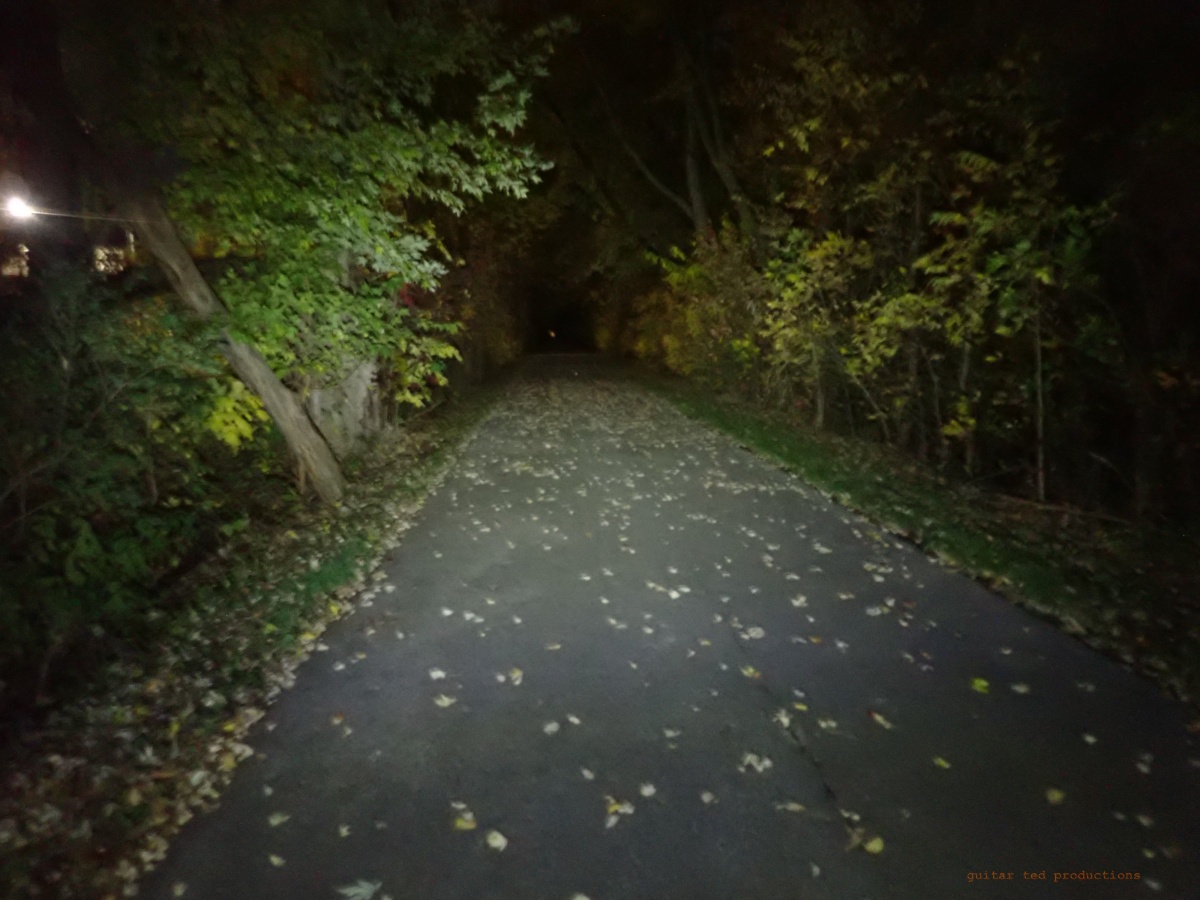
Many of you will be looking for some light beam shots, and I actually have some okay ones to share here. It is difficult to find places in the vicinty of Waterloo that are not really light-polluted at night, but a "tree-tunnel" over one of our cycling paths did prove to be pretty good for what I needed to show here. Especially so since the foilage is still mostly on the branches. So, from "low" to "high", here are four of the five levels of light that the Bookman Volume light has on tap.(The lowest setting is basically a flashlight level) I'm going to show these from dimmest to brightest and the level will be numerically indicated from low to high (2,3,4, and 5)

Setting "2"

Setting "3"

Setting "4"

Setting "5"

In these images I see why my preference was to run only the two brightest settings. I also noted that there is barely any difference between "3" and "4", but to my eyes "4" was significantly easier to ride with. While it is nearly impossible for you, the reader, to see, I did place an object at 25 paces away which I cannot see at level "3" but I can discern it at "4", so there is that. But be that as it may, level "5", the 800 Lumen level, is what I would want for faster riding. The next level "4" is 400 Lumens, so that is a significant drop in "punch" level, but this is something I found to be a curiosity with the Volume light.

Bookman Volume at level "4" on a gravel pathway.

The Volume doesn't have that "throw" that some lights do, and that's going to adversely affect my comfort levels on fast downhill gravel sections. Think something at 25+ miles per hour here. There just is not enough bright light far enough ahead of you to make corrections, or brake, to avoid bad lines, potholes, etc. The front "fill" light is tremendous here. The width of the beam pattern is excellent as well. The color is okay with my eyes. it's just that this light doesn't punch a beam way down the road as I would need it to for faster descending or just plain very fast riding on technical roads. 

2016-ish era Lezyne 1100i on high.

The good news? I can find a helmet mounted torch that will have a long-throw spot beam for that higher speed stuff and that would be a great compliment to this more washed out beam pattern of the Bookman light. 

Run times are something to consider as well. The Volume is rated at 3 hours on the highest setting. That's actually pretty impressive. Consider that my late twenty-teens era Lezyne 1100i runs for 1.5 hours on the "high" setting. You might be thinking, "Hey Ted! isn't that Lezyne supposed to be 1100 Lumens on "high"?" You would be correct. But there are "lumens" and then there are Lumens. How these companies measure their light output is not regulated and varies from one tester to another. See my comparison of "high" on the Lezyne to the half power setting on the Volume. Not much difference, eh? 

Of course, it could come down to the old battery, or different optics. But it is clear that the Volume is a better light. Better than the Lezyne anyway. Plus, when you factor in that brilliant knob design that the Volume has, which eliminates guesswork and tabbing through a "menu" to get where you want to be in terms of light level, this light begins to look like a much better design. 

That button is hard to find in the dark with a gloved hand.

There were a couple of things that bugged me about the Volume light though. One was the On-Off power button. It is oh-so "Apple-like" sleek and it works, but try to find that little depression in the dark with gloves on. Yeah..... Frustrating. Maybe there should be a little ring of LED light there or a raised button. I vote for the raised button myself. 

Then there is the mount's band attachment. It is clever, but that one bolt attachment is fiddly and hard to get to. Fahgeddaboudit if you are in the dark and need to tighten it up. I know.....tighten it up enough before you leave. I get it, but a tool-less attachment might be nicer. 

I had one curious hiccup with the Volume where I had turned it off and was running the Lezyne light as a comparison. When I went to turn on the Volume light, after I found that durned button, it would not turn on. It would show me the battery status, but that was it. I tried it a few blocks down the trail later and hey! On it came. What? 

I couldn't replicate the issue, yet..... But I'm watching for this and I will report back if that becomes an issue again. 

So Far... Okay, so this thing will run three hours on high, and the light pattern is pretty okay. The knob thing is really nice. I love that and the Garmin mount. I had a middling experience with the Lezyne 1100i this past Summer on gravel. We will have to get this Volume light out on the gravel next to see how it stacks up. But first, I need it to not be "dead of Winter cold" before I will consider that. Fortunately temperatures are supposed to moderate a bit going into November. 

Stay tuned...

Wednesday, September 13, 2023

Light Season Starts Now

My lights are two years old and already old technology!
Maybe you are old enough to remember when computers, home computers, or "PC's", went out of date at a rate of about every six months. You'd buy a cutting edge system only to have it be , essentially, an antique in a year. 

Well, I feel that way about LED lights for bicycles. The technology changes so quickly that I end up having lights that have good batteries yet but don't have nearly the lens technology or battery performance that the newer stuff coming out now has. It's hard to "make do" with two year old lights when you see how well new lights work and especially when you see how inexpensive that technology is. 

This is getting important right now because we are just coming into "Light Season". I know, many of you think it is "Fall", whatever that means, but for us cyclists who like to ride all year, it is "Light Season". The time of year we have to break out the lights, charging cables (uggh!) and to make sure we have the mounts (double uggh!), for the lights we want to use. 

So, this press release from Lezyne came out the other day featuring their newly redesigned (of course they are!) lights. I checked out the "big dog" of the range with the most Lumen power. I do this out of habit because in the past, those were the lights I'd use for longer outings. Never at the maximum power rating, but at a mid-level, because battery run times on "high" level were generally around an hour, maybe an hour and a half. And you know, that isn't very long for my rides out in the country.

The Lezyne Macro Drive 1400+ (Image courtesy of Lezyne)

I was looking for something at a lumen rating of 300 with at least two hours of run time. That would be great! And lately, those lights have started to appear that have that capability. But now?

Oh my!

Check out these stats for the latest Lezyne model, the Macro Drive 1400+. On the highest setting, the blinding 1400 Lumen setting, this light is rated to run for three hours! What?!!

And 450L is a lot of light on white rock, gravel roads, and I can see really well at that level, given the lens tech is reasonably good. What is the run time there?

Twelve hours plus. 

Okay, but what do you have to pay for that? Usually great specs equaled big dollars, at least it used to in the past. How does a hundred bucks seem to you? Actually, it lists for a penny less than 100 at $99.99, but who's quibbling over that penny here when you get all of that packed into a self-contained unit? It's insane what you can buy for that kind of money in 2023. 

Look, you don't have to just look at Lezyne. Many lights will be hitting the market this Fall, (Light Season) for similar prices with similar specs. These sorts of advancements in bicycle lighting are generated by LED emitter tech and battery tech that is available to many companies. So, I'm not saying Lezyne is all that, although I will admit to liking heir past products. Good stuff which I still use. But obviously, Lezyne isn't the only deal on the block here. 

But if you haven't been thinking about some late-season night riding, you should. These lights out now are bargains for what performance you can get and they are compact and easy to get along with. The lens technologies have never been better and riding in the dark is fun. It's Light Season - Go ride in the dark!

Monday, December 19, 2022

A Comparison & Contrast: Sigma GPS Update

Does the Sigma ROX 4.0 hold up under scrutiny?
 It has been a while since I last wrote about the Sigma ROX 4.0 GPS computer. If you've been reading the blog this Fall and early Winter you'll understand why that is. But I knew I needed to get this looked at so I have done what I needed to do to wrap this up recently. Only, it isn't wrapped up. You'll see why soon....

You can see my previous look at this, which is a comparison between this ROX 4.0 with a couple of other GPS units, here. This post on the ROX 4.0 will be a take on how this unit does with its GPS and Bluetooth features. 

I was a bit let down, first off, to learn that the ROX 4.0 is just like my old Lezyne Super GPS which needed to be tethered to a smart phone to give you turn by turn navigation. Secondly, the difference between the Lezyne Super and this Sigma ROX 4.0's data programs is night and day. Lezyne has what they call "GPS Root" and you create an account which then allows you to upload your ride data. This data is then shown in really finely detailed charts. The Sigma Ride App does similar data breakdowns, but it isn't as fine grained as GPS Root is. Sigma Ride isn't bad, it's just that GPS Root looks more impressive and, in my opinion, is a bit more engaging to use. 

Apologies for the out-of-focus shot! 

On the connectivity side, I had many experiences which led me to believe that the Bluetooth function of this GPS computer is suspect. While I was able to pair up sensors for cadence and speed easily, and my smart phone would pair seamlessly with the head unit, I found that the head unit would drop the connection consistently and randomly whenever I used the ROX 4.0.  Also, in one bizarre incident, I actually was getting a cadence read out briefly with no sensor on the bike! How that happened I don't have a clue. 

This Bluetooth dropping problem also extended to the turn by turn navigation. Essentially, that rendered the turn by turn feature useless, as you may not even realize you have dropped the signal from your smart phone and ride past a corner you were to turn at. That said, the head unit does warn you with a message that stays up for several seconds that connectivity has been lost. 

So,  I reached out to my contact for this review to let him know that there were issues, and unless there was some sort of explanation, or unless I was to try another head unit, this wasn't going to turn out as a favorable review. The answer I received was that this seemed to be a case of a suspect head unit. The contact I have told me that in his experience, Sigma GPS was pretty stout. 

So, I am going to be receiving a new ROX 4.0 to see if that doesn't solve the problems I am experiencing.  The one I have now is a great unit if you don't need nav or sensors, but it is supposed to handle that, so we'll see. 

I liked quite a few things about this computer up until the sensor and Bluetooth issues arose. The user interface is pretty simple, and I liked the compass up in the corner, along with altitude tracking. I will also add that this Sigma will mount to Garmin mounts, so if you are invested in those, this will work with a Garmin mount quite nicely.

So, stay tuned..... This ain't over with just yet!

Note: The Sigma ROX 4.0 was provided to me at no charge for test and review. I was not bribed, nor paid, for this review and I always strive to give my honest thoughts and opinions throughout.

Saturday, October 15, 2022

A Comparison & Contrast: GPS Computer Experiences

The SIGMA ROX 4.0
 As mentioned yesterday in my weekly "FN&V" post, I received a SIGMA ROX 4.0 GPS cycling computer to test for RidingGravel.com. (Intro review here) In this post I wanted to compare and contrast my experiences with three GPS devices focusing on user interface and how that affected my experiences. 

You'll get marketing from all directions telling you that a device is "intuitive" and "easy to use" all the time. And maybe for some folks, that's the case. But, as I have found, we are all vastly different and a lot the same all wrapped up in one human family. In other words- we are complicated.

So using blanket statements like those mentioned, and others, isn't anywhere near the truth for big chunks of the population. That applies to what I am writing here today.

Keep that in mind as you read on....

My very first GPS unit was a Garmin 600 back around 2006 or so. It was waaaay complicated to get anywhere with that thing. I could see the promise of GPS navigation, it's just that it was so hard to make it work that - to my mind - the hassle was far too great. I gave the unit away to a friend at the time, who understood it far better than I did. 

The next unit was my Lezyne Super GPS. That was a pretty easy to use unit, and I had features at my disposal that were kind of fun, (altitude) and data to look at after a ride, (somewhat enlightening), so I was satisfied with how it worked at first. However; it did not support turn-by-turn navigation native to its unit only. You had to tether a smart phone while you were riding to access the route navigation. That was a big problem since for many of the events I was doing, the phone battery wasn't going to last, and that brought in another hassle with external power, and ....no. I could write cues and just use the Super GPS for a basic computer and the data for later use. 

But as far as user interface and set up? That Lezyne was awesome that way. It had its quirks, but at the time it was a far cheaper solution for my needs and since I don't do anything with a power meter, I did not need a "Garmin" or a Wahoo. That perception started to change over time though, so the next GPS came around....

The Karo 2 was awesome- the few times that it worked, that is.

I started reading up on Hammerhead Karoo 2 GPS computers and I liked what I read. So, Mrs. Guitar Ted bought me one as a holiday/birthday gift last December. 

Initially it was a bit of a frustrating thing to figure out. The user interface was not all it was cracked up to be, in my opinion. But, once I got it working I found a few things I really liked about it. It was fun, until it wasn't. 

Long story short- Two units later and I was so frustrated with how the unit did not work, that I am at the point that I was really angry. Anything that causes me THAT much frustration has to be eliminated, so no more Karoo 2 for me, ever again! 

The thing was that for that kind of money, it should work flawlessly. It didn't even come close to being "intuitive" and digging for help was a fruitless endeavor. In fact, I got better tips from some of you readers here than I ever did from Hammerhead. 

So, I seriously was considering a return to Lezyne. I had experienced really good things in terms of user interface with their product. I was hopeful that some of the nits I had (slow start up, tethered turn-by-turn nav) had been solved, but I held off because I am still waiting for Lezyne to have true turn-by-turn features, which at this point, I haven't seen that from them. 

Meanwhile I get this SIGMA ROX 4.0. It is very similar to what Lezyne offers in that you aren't going to see a lot of features outside the box of typical cycling computers with the exception of navigation. So, no power data, no connectivity to lights, radar, or that sort of stuff. Frankly, those are features I'd probably never use anyway. Give me a computer with speed data, time data, and turn-by-turn navigation. Add in altitude data for fun. I'm good.

That's pretty much what the ROX 4.0 is about. Lezyne has some interesting computers as well. This Sigma is probably closest to this Lezyne GPS unit. I know the Lezyne interface is a good one, what about this SIGMA unit's interface? 

Well, it's really good. I was able to set things up and ride very quickly. The unit actually works, which seems weird to have to say, but I know that some do not work well. 

So, the interface and the SIGMA Ride App seem pretty good so far. On par with Lezyne's, and that's a good thing - for me anyway. Your mileage may vary.

Now to see if turn-by-turn works without a tethered phone. SIGMA claims this thing wil do that once you've downloaded a route to the app, and then you must sync that with the ROX, which then - they claim - allows you to run turn-by-turn. I'm not 100% sure of that, because the thing always prompts me to turn on the app. So, there is that.... 

But at any rate, even if it doesn't do navigation independently of a phone being on, I think this GPS experience has been a good one. Far better than the last experience, that's for sure! Thinking about that...

The SIGMA ROX 4.0 costs $100.00 or even less if you just get the head unit. ($200.00 with every sensor and the fancier mount)  A Hammerhead Karoo 2 runs $400.00. Sure, the Karoo has far better graphics, but it doesn't actually work. (Two units failed to operate for me. You can take your chances if you want..) I cannot figure out how a company can continue to exist when it puts out products that are very expensive and have poor user experiences when you can buy something for far less money and have a far better experience. (Lezyne, SIGMA). But once again, this has been my personal GPS story. Yours may vary quite a bit. I get that.

I'm not telling you what to buy or not to buy. You be the judge. Maybe I'm GPS-ignorant, maybe I'm just not good with devices, (entirely possible), and maybe I am an example to learn from. Again- you be the judge. 

This is my story, and I'm sticking to it. 

Stay tuned for more.....

Friday, September 09, 2022

Friday News And Views

Is The Bicycling Retail/Wholesale Segment Looking At A Whiplash Effect?

Over the past two years supply of bicycles, parts, and accessories has been very spotty, if not dried up altogether. There still are segments of the marketplace still showing holes in inventory. I just tried ordering inner tubes for the Cedar Valley Bicycle Collective and came up with nothing, so there is one area that maybe is still in short supply. 

But several signs point to a complete reversal of this supply shortage and many are predicting that within the next six months that the bicycling industry will be sitting on piles of inventory with demand ebbing every day already. 

In fact, many companies are already positioning themselves in a posture of inventory reduction and belt-tightening. Last week, it was widely reported on social media, that Quality Bicycle Products, the largest distributor of bicycle products in North America, was laying off employees. A sign of cost-cutting due to an over-stock situation they may be facing? Possibly. 

Other companies are already running sales on certain items. Trek, for one, is clearing out hybrid bikes and ebikes with a sale that is already in progress. Look for a lot more of this in the coming months and into next season. It sure looks like we're going in whiplash mode- from under stocked to over-stocked- in a big hurry.

Velo Orange Utility Bras & Rack: Image courtesy of Velo Orange.

Velo Orange Shows Off New Bar/Rack Idea:

Last week Velo Orange teased a new handle bar and rack idea that is going into production. It's called the Utility Bar and Utility Rack. The handle bar sports a unique through-bolt set up that can accept water bottle cages, or this cool front mini-rack. There will be a flat bar version along with the riser bar version with bars in black or silver. 

Both the handle bar and the rack are made in ChroMoly and you can match up the rack with either the flat or the riser, or use other accessories like Anything Cages, or other racks. There is no set ETA on when these will be available. 

The flat bar version Image courtesy of Velo Orange.

Comments: I'm not a big fan of weight "up high" out ahead of the steering axis because it causes "flop" and handling is more of a chore. However; some weight can be tolerated and I think this idea would be okay with me. Obviously, a ChroMoly bar and arck are going to add their own amount of weight up front, but on something like a cargo bike, or on my townie, this makes a lot of sense for errands and the like.

I guess the price will be the determining factor for many, but this is a cool idea, and adds versatility to any bike you use for general purpose riding. Bikepacking? Well, yeah, maybe. I guess I'd be more apt to look at cutting weight where I could on a long-distance tour, and adding a steel based alloy bar and rack might not make as much sense as a standard "rackless" type harness for the handle bar. But again- I still think this is a great idea.  

Lezyne Matrix Air Cage Image courtesy of Lezyne

Anti-Theft Air Tag Accessories From Lezyne:

Every week I see posts on social media from distraught bicycle owners saying that their beloved bike has been nicked. Locks and devices made for bicycle security have been available to help prevent theft in the past, but what if a criminal defeats your security device?

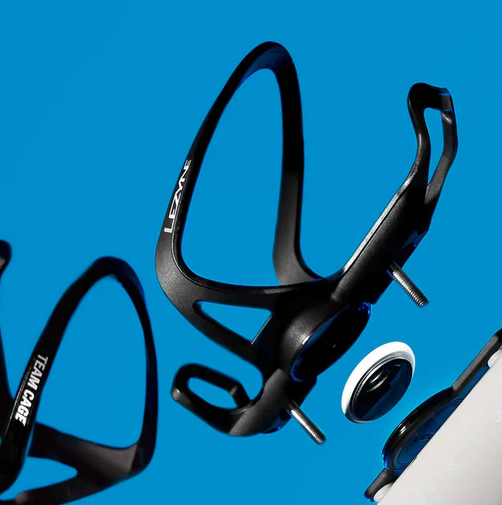
That's where the Apple Air Tag laden Lezyne Matrix accessories might help. A small tracking "Air Tag" is embedded into three accessory items from Lezyne- The Matrix Air Cage, the Matrix Bike Tagger, and the Matrix Saddle Tagger. 

Of course, you have to supply ypur own Air Tag, and you have to buy into Apple's ecosystem to make use of it, but this is something that could help in the event of a theft with recovering a stolen bicycle.

Comments: Cool idea with some limitations, but I see this as a step in the right direction. I can see HPC/motorized micro-mobility devices having this sort of thing built in from the get-go for owners of vehicles like that. But "normally" powered bicycles are probably going to have to be equipped with such devices in the very near future, with bicycle prices being as high as they are. Commuters by bicycle also should be able to add aftermarket devices, like the Lezyne accessories here, which will work with any smartphone. 

If we expect more people to use bicycles in utilitarian ways, this sort of thing needs to be more widely available.

Saturday, September 11, 2021

In The Market

My GPS computer met an untimely end at Gravel Worlds this year.
 Okay, so I am looking for a GPS computer. As you can see here from today's image, my former GPS computer met an untimely end when it was crushed under the wheels of a Ford F-150. 

Truck - 1 GPS Computer - 0

And I guess I should have one of these things. Mrs. Guitar Ted likes to keep track of me and many GPS units will allow for that. Also, many routes and events are on GPS, so it might behoove me to make that resource available to me now days. But with that said, I am going to float a few ideas I have and outline what I expect to use from a GPS computer. I'm not looking for a lot, mind you, but if something comes with extras, well I am not going to dismiss a choice out of hand for features I'll never use. But there will be a LOT of features I'll never use, and I know that going in. 

  • I need to have a GPS that does turn-by-turn navigation so I can use event routes and routes without availability of cue cards for riders, (although that is something I'll always use).
  • All the basic computer functions, but any unit that allows me to customize a screen so all I see is speed, mileage and time is a bonus. 
  • Rider tracking (For Mrs. Guitar Ted- not that I want that.) 
  • Ability to upload routes to my computer.
  • Long battery life.

That's all I need. I do not care about anything else. Workouts, ride data, charts, coaching, connectivity to devices, connectivity to other riders, running your lights, or whatever. I don't care about that stuff, and I know I will never use that stuff, because I never did with my old GPS computer. I never look at data. I never look at old rides/routes that I have saved. (Although I may use that as a reference some day) I don't care about that stuff. But like I said, if the unit advised to me has that.....excuse me....'garbage'- I won't discount it as a choice. 

Now- Andy's Bike Shop just became a Garmin dealer. Do I go with a Garmin or stick with Lezyne, or do I go rogue with something like a Wahoo or other brand? I'm inclined to stick with Lezyne since I am invested in their mounts for bikes and I have an account for their GPS support. Whatever I end up doing, I am in no big rush to get one, so I have time to consider choices. 

Got any advice? I'm all ears.......