Showing posts with label Gravel Travel. Show all posts

Friday, January 13, 2023

Friday News And Views

Trek Travel social media post showing new gravel vacation options
Trek Travel Goes Gravel:

Trek Travel did a social media campaign and email blast to subscribers concerning its new options for gravel vacations. Trek Travel has mostly been all about road biking getaways and they have done a few MTB based vacations as well.

The gravel options are mostly split between Europe and the U.S.A. The new destinations include Girona, Spain, Bentonville, Arkansas, The Shenandoah Valley of Virginia, The Swiss Alps, The Tuscany district of Italy, and Vermont, U.S.A. 

Prices vary from $1799.00 - $3600.00 USD. You can find out more by visiting the Trek Travel site.

Comments: Well, you knew it would happen someday- Curated gravel trips for those folks who want to try it out and see what the fuss is. Honestly, I don't have an issue here, and to be clear, I think this is a great option for the person who wants to experiment and see what gravel cycling is all about without having to spend 5K+ on a bike, gear, and accessories to check out the scene. I see this as an especially attractive option for those who live in very urban areas that have little access to gravel/back road cycling. 

Also, having had worked at a Trek dealer for many years, I have heard a lot of good things about Trek Travel. So, if Trek Travel has managed to uphold its standards, I would expect that this would be a great option for certain folks.

Guitar Ted Productions Podcast News:

A new change in the back ground of the podcast has occurred with the creative control, business, and distribution aspects of the podcast now fully under my control. My assistant and co-host of the podcast is N.Y. Roll. Besides this, a slight tweak in the name will be noticed, but otherwise nothing else should be different from what you've heard before. (Assuming that you have listened at all, of course.) If you are new here or if you have never listened to the podcast, here is a LINK to the Spotify GTPP site. The podcast is also available on Apple, Google, and Podchaser. 

The Guitar Ted Productions Podcast should be releasing episodes about twice monthly throughout the year. The plan is to cover the gravel scene and interview interesting race directors, athletes, and industry folks. By the way, we should have a sponsor (working on that) but we are always interested in episode sponsors, news, and interview requests. Just contact me @ g.ted.productions@gmail.com for comments, questions, or suggestions. 

The latest episode of the Guitar Ted Productions Podcast published just this past Tuesday and is an interview with Iowa Gravel Series director, Chris McQueen. 

You can check it out HERE if you'd like to listen to the episode which runs a bit over an hour in length.

Thank You!

Former Outside Media Journos To Start New Media Company:

I noted a call for applicants to look into employment for a new cycling oriented media company were pushed via social media over the past week. The end of 2022 saw a lot of cycling media get laid off and terminated by a few notable companies. This left a lot of mainstream cycling media journos out in the cold. 

The announcement was followed up by this post on Substack which details what the vision for this new cycling media outlet is. Apparently, this will be a "membership based" entity. The aim is to provide, "...the best damn cycling media and community you’ve ever seen.", according to the Substack post. 

Comments: So, a modern-day equivalent to magazines? Without a way to attract new readers via a "digital news stand exposure"? Seems to be similar by the sounds of it. The author of that Substack seems to think that, "They underestimate the audience." Detractors and pessimists, I think is what that refers to, but there is a reality to the situation here that must be considered. 

That being that our media choices are now spread across so many format choices that it is bewildering. We have hundreds of choices across social media, both written, audio, and visual. That was not the case even ten years ago. That's only going to make another choice harder to push on a national scale. Also, it isn't as though there won't be "free" to access media focused on cycling anytime soon. So, given the choice of perusing a thought piece on a particular facet of cycling at a cost, and digesting a three minute read with easy to understand cliche's and slick images for free, I'm going with the latter as being more popular and more importantly, easier to find. 

The author warns against "fluff" and AI generated content. I'm not so sure that we haven't been getting spoon-fed, AI generated content for years already, to be honest. It doesn't seem to faze many folks and I'm betting that continues into the future. The danger with a smaller, community driven, paid for media is that it becomes insular and self-satisfying. You'll have to keep that money coming in so you'll have to give those subscribers what they want, not necessarily what they need. Or, probably even more importantly, any way of reaching beyond those pay-walled borders to build that audience into something more than a cycle-clubhouse. 

Salsa Cycles Timberjack XT Z2 (Image courtesy of Salsa Cycles)
Salsa Cycles Announces New Spec/Colors On Timberjack Models:

The Timberjack from Salsa Cycles continues on into 2023 with three model levels and a frame set. The range-topping bike is the Timberjack XT Z2 featuring an unusual choice in a fork, the Marzocchi Z2 Rail at 130mm of travel. 

There is also a choice of wheel size with both 27.5" and 29" wheeled models on offer. Prices range from $2199.00 - $2899.00 USD. For more details see Salsa Cycles

Comments: The Timberjack, which appeared in 2016 as a 2017 model, used to retail below 2K. Let that sink in for a minute.... 

Of course, you have the Rangefinder, which will be your entry-level hard tail and probably still available at sub-2K in some form, but seeing a rather unremarkable hard tail bike with an aluminum frame retailing at well over 2k is a bit jarring to these old eyes. It is another reminder that cycling, at least in terms of using new equipment, is pretty exclusive and getting worse every year. 

I am sure the Timberjack is a fine bicycle, and I am in no way disparaging it, but I only am dismayed by the incredible leap prices have taken in ten years. Salsa Cycles is not the only example here. That said, I'm sure income levels haven't kept pace, and so how do we justify this? I don't have the answers... 

Sorry about that rabbit trail.... Anyway, there you go. New Timberjack bikes. 

That's a wrap for this week! Have a safe weekend and get out to ride if you can!

Friday News And Views

Trek Travel social media post showing new gravel vacation options
Trek Travel Goes Gravel:

Trek Travel did a social media campaign and email blast to subscribers concerning its new options for gravel vacations. Trek Travel has mostly been all about road biking getaways and they have done a few MTB based vacations as well.

The gravel options are mostly split between Europe and the U.S.A. The new destinations include Girona, Spain, Bentonville, Arkansas, The Shenandoah Valley of Virginia, The Swiss Alps, The Tuscany district of Italy, and Vermont, U.S.A. 

Prices vary from $1799.00 - $3600.00 USD. You can find out more by visiting the Trek Travel site.

Comments: Well, you knew it would happen someday- Curated gravel trips for those folks who want to try it out and see what the fuss is. Honestly, I don't have an issue here, and to be clear, I think this is a great option for the person who wants to experiment and see what gravel cycling is all about without having to spend 5K+ on a bike, gear, and accessories to check out the scene. I see this as an especially attractive option for those who live in very urban areas that have little access to gravel/back road cycling. 

Also, having had worked at a Trek dealer for many years, I have heard a lot of good things about Trek Travel. So, if Trek Travel has managed to uphold its standards, I would expect that this would be a great option for certain folks.

Guitar Ted Productions Podcast News:

A new change in the back ground of the podcast has occurred with the creative control, business, and distribution aspects of the podcast now fully under my control. My assistant and co-host of the podcast is N.Y. Roll. Besides this, a slight tweak in the name will be noticed, but otherwise nothing else should be different from what you've heard before. (Assuming that you have listened at all, of course.) If you are new here or if you have never listened to the podcast, here is a LINK to the Spotify GTPP site. The podcast is also available on Apple, Google, and Podchaser. 

The Guitar Ted Productions Podcast should be releasing episodes about twice monthly throughout the year. The plan is to cover the gravel scene and interview interesting race directors, athletes, and industry folks. By the way, we should have a sponsor (working on that) but we are always interested in episode sponsors, news, and interview requests. Just contact me @ g.ted.productions@gmail.com for comments, questions, or suggestions. 

The latest episode of the Guitar Ted Productions Podcast published just this past Tuesday and is an interview with Iowa Gravel Series director, Chris McQueen. 

You can check it out HERE if you'd like to listen to the episode which runs a bit over an hour in length.

Thank You!

Former Outside Media Journos To Start New Media Company:

I noted a call for applicants to look into employment for a new cycling oriented media company were pushed via social media over the past week. The end of 2022 saw a lot of cycling media get laid off and terminated by a few notable companies. This left a lot of mainstream cycling media journos out in the cold. 

The announcement was followed up by this post on Substack which details what the vision for this new cycling media outlet is. Apparently, this will be a "membership based" entity. The aim is to provide, "...the best damn cycling media and community you’ve ever seen.", according to the Substack post. 

Comments: So, a modern-day equivalent to magazines? Without a way to attract new readers via a "digital news stand exposure"? Seems to be similar by the sounds of it. The author of that Substack seems to think that, "They underestimate the audience." Detractors and pessimists, I think is what that refers to, but there is a reality to the situation here that must be considered. 

That being that our media choices are now spread across so many format choices that it is bewildering. We have hundreds of choices across social media, both written, audio, and visual. That was not the case even ten years ago. That's only going to make another choice harder to push on a national scale. Also, it isn't as though there won't be "free" to access media focused on cycling anytime soon. So, given the choice of perusing a thought piece on a particular facet of cycling at a cost, and digesting a three minute read with easy to understand cliche's and slick images for free, I'm going with the latter as being more popular and more importantly, easier to find. 

The author warns against "fluff" and AI generated content. I'm not so sure that we haven't been getting spoon-fed, AI generated content for years already, to be honest. It doesn't seem to faze many folks and I'm betting that continues into the future. The danger with a smaller, community driven, paid for media is that it becomes insular and self-satisfying. You'll have to keep that money coming in so you'll have to give those subscribers what they want, not necessarily what they need. Or, probably even more importantly, any way of reaching beyond those pay-walled borders to build that audience into something more than a cycle-clubhouse. 

Salsa Cycles Timberjack XT Z2 (Image courtesy of Salsa Cycles)
Salsa Cycles Announces New Spec/Colors On Timberjack Models:

The Timberjack from Salsa Cycles continues on into 2023 with three model levels and a frame set. The range-topping bike is the Timberjack XT Z2 featuring an unusual choice in a fork, the Marzocchi Z2 Rail at 130mm of travel. 

There is also a choice of wheel size with both 27.5" and 29" wheeled models on offer. Prices range from $2199.00 - $2899.00 USD. For more details see Salsa Cycles

Comments: The Timberjack, which appeared in 2016 as a 2017 model, used to retail below 2K. Let that sink in for a minute.... 

Of course, you have the Rangefinder, which will be your entry-level hard tail and probably still available at sub-2K in some form, but seeing a rather unremarkable hard tail bike with an aluminum frame retailing at well over 2k is a bit jarring to these old eyes. It is another reminder that cycling, at least in terms of using new equipment, is pretty exclusive and getting worse every year. 

I am sure the Timberjack is a fine bicycle, and I am in no way disparaging it, but I only am dismayed by the incredible leap prices have taken in ten years. Salsa Cycles is not the only example here. That said, I'm sure income levels haven't kept pace, and so how do we justify this? I don't have the answers... 

Sorry about that rabbit trail.... Anyway, there you go. New Timberjack bikes. 

That's a wrap for this week! Have a safe weekend and get out to ride if you can!

Monday, April 18, 2022

Before There Was "Gravel"

My Black Mountain Cycles "Monstercross" pre-dates the "gravel bike"
 Last week I received a call from veteran bicycle journalist, Josh Patterson, and he was doing research for the Gravel Cycling Hall of Fame. Apparently he was tasked by the GCHoF's LeLan Dains to find out what sorts of things should be included for people to see and learn about at a physical display regarding the hall. 

Yes- there will be a place you can go to eventually to visit the Gravel Cycling Hall of fame, but beyond that I probably should not say anything yet. There are a lot of things going on behind the scenes right now, and I'll let those who are working hard to bring this to reality reveal their plans when they are ready to.

I just wanted to touch upon some things I was reminded of during my conversation with Josh. Specifically, that there was a "time before Gravel™". A time when the bicycle industry had no clue about dirt and crushed rock road riding. A time when the internet forums, where people were aware of this "fad", were telling us who were into it to "Just ride cyclo cross bikes and go away already!"

For myself, and many others into the scene early on, that wasn't good enough. We wanted more capable equipment. My conversation with Josh last week reminded me of the struggles many of us went through searching for better tools for this job of conquering crushed rock roads and minimum maintenance roads which events were putting us on. This in turn eventually inspired companies like Salsa Cycles, Clement (now Donnelly), and Challenge Tires to do something to help us out. Others like Raleigh and WTB soon followed, and the early successes of these companies drove the rest of the industry into the "Gravel™" niche and this helped propel the genre into its current status. 

But what about pre-2012? We'd been putting on gravel events for many years by this point. I was leading a weekly gravel ride here, and others were catching on to the trend. What stuff did we use?

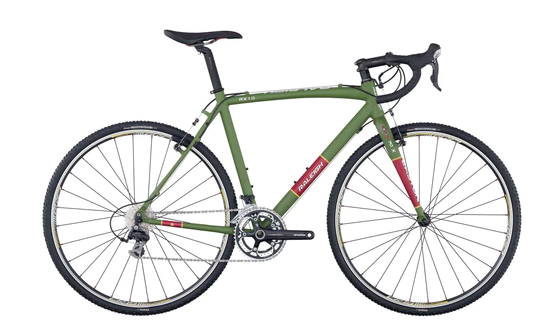
2011 Raleigh RX 1.0- People used CX bikes for years like this.
Early on in the gravel scene the bikes were all over the place as riders brought what they had to bear on the gravel roads. Mountain bikes were very popular, especially the then 'new' 29"ers. But eventually it became increasingly apparent that cyclo cross bikes seemed to have an advantage, up to a point. That point had to do with tires, and really, it was all about the tires at this point during the history of gravel riding. Tires were the demarcation line between using a cyclo cross bike and a mountain bike. 

I can remember pouring over wholesale suppliers catalogs in the mid to late oughts trying to find options for 29"ers and anything  in a tire from 34mm - 52mm that was not a heavy, stiff hybrid tire or an over-armored touring tire. There weren't many options in that 34mm-52mm range at all back then. Due to this fact, there was a tough decision to be made regarding what style of bicycle to use. 

Cyclo-cross was never a really popular niche of cycling- not on the scale of mountain and road biking, and maybe on par with recumbents in terms of finding them on shop floors. Sure- there were shops that catered to CX. But try finding a cyclo cross bike on a shop floor in the Mid-West. Not easy..... Plus, many of these CX bikes were stiff, not suited to really long rides, (very few braze-ons for bottles, etc) and many had no room for really big rubber. If you chose to use a cyclo cross bike, you had many hurdles to get over, not the least of which was dealing with injuries caused by riding this style of bike. I remember hearing tales of Trans Iowa riders having numb hands or fingers for months after an event. 

But using a mountain bike was fraught with its own issues. Tires were big enough, sure, but generally too heavy, too treaded, and they slowed you down. Typical choices generally were WTB's Nanoraptors or Vulpines, IRC Mythos XC's, or the excellent Bontrager Team Issue XR1's of that time period. And also, generally speaking everyone used tubes, but if you went the MTB route, you could go tubeless, and many did. 

You can see the varied different styles of bikes used for gravel here in this scene from the 2007 Guitar Ted Death Ride Invitational.

I pulled this image above from 2007 as an illustration of a typical gravel scene from that time period. I think we can see that there were several approaches to "doing it" which we can observe. First in the foreground here we have, to my mind, what became "The Gravel Bike" of the time, the venerable Surly Cross Check. It's versatility, capability, value, and widespread availability made it an easy choice for early gravel grinders. By 2010, you were likely to see more Cross Checks at gravel events than any other type of bike. 

Next in line is a rare Fisher Ferrous, a semi-custom style steel framed 29"er. This represents the 29"er element of the early gravel scene. If you had one bike to do most everything on back then, it was a hard tail 29"er. Lots of people used them back then, (and I think I was using one on this particular ride as well, unless it was my old Salsa Dos Niner soft tail)

The next bike up the ditch edge there is obscured partially by a hydration pack, but it looks like another drop bar bike. It could have been a Surly Long Haul Trucker, which I know was on this ride. Then we see some fat tired oddity at the head of the line, and that is a Surly 1X1 fitted with big 26 inch DH Gazzolodi tires on Large Marge rims set up single speed. So, a kind of "fat bike" set up, which pre-dates the fat bikes on gravel thing by at least 4 years!

While the variety of choices here was fun to observe, each had its own pitfalls and things one had to get around to do gravel travel well, or at all. Perhaps I'll get into more about this if you readers find this interesting at all. I can think of a lot of things we had to deal with which eventually have become "no big deal" now. Things like hydration, lighting, and the aforementioned tire thing, which is pretty interesting if you want to know. 

So, I hope you enjoyed this little glimpse back and how we were experimenting and trying to find new ways to solve these 'new-to-us' issues out on the gravel roads. If you've got any questions or suggestions, let me have them in the comments!

Before There Was "Gravel"

My Black Mountain Cycles "Monstercross" pre-dates the "gravel bike"
 Last week I received a call from veteran bicycle journalist, Josh Patterson, and he was doing research for the Gravel Cycling Hall of Fame. Apparently he was tasked by the GCHoF's LeLan Dains to find out what sorts of things should be included for people to see and learn about at a physical display regarding the hall. 

Yes- there will be a place you can go to eventually to visit the Gravel Cycling Hall of fame, but beyond that I probably should not say anything yet. There are a lot of things going on behind the scenes right now, and I'll let those who are working hard to bring this to reality reveal their plans when they are ready to.

I just wanted to touch upon some things I was reminded of during my conversation with Josh. Specifically, that there was a "time before Gravel™". A time when the bicycle industry had no clue about dirt and crushed rock road riding. A time when the internet forums, where people were aware of this "fad", were telling us who were into it to "Just ride cyclo cross bikes and go away already!"

For myself, and many others into the scene early on, that wasn't good enough. We wanted more capable equipment. My conversation with Josh last week reminded me of the struggles many of us went through searching for better tools for this job of conquering crushed rock roads and minimum maintenance roads which events were putting us on. This in turn eventually inspired companies like Salsa Cycles, Clement (now Donnelly), and Challenge Tires to do something to help us out. Others like Raleigh and WTB soon followed, and the early successes of these companies drove the rest of the industry into the "Gravel™" niche and this helped propel the genre into its current status. 

But what about pre-2012? We'd been putting on gravel events for many years by this point. I was leading a weekly gravel ride here, and others were catching on to the trend. What stuff did we use?

2011 Raleigh RX 1.0- People used CX bikes for years like this.
Early on in the gravel scene the bikes were all over the place as riders brought what they had to bear on the gravel roads. Mountain bikes were very popular, especially the then 'new' 29"ers. But eventually it became increasingly apparent that cyclo cross bikes seemed to have an advantage, up to a point. That point had to do with tires, and really, it was all about the tires at this point during the history of gravel riding. Tires were the demarcation line between using a cyclo cross bike and a mountain bike. 

I can remember pouring over wholesale suppliers catalogs in the mid to late oughts trying to find options for 29"ers and anything  in a tire from 34mm - 52mm that was not a heavy, stiff hybrid tire or an over-armored touring tire. There weren't many options in that 34mm-52mm range at all back then. Due to this fact, there was a tough decision to be made regarding what style of bicycle to use. 

Cyclo-cross was never a really popular niche of cycling- not on the scale of mountain and road biking, and maybe on par with recumbents in terms of finding them on shop floors. Sure- there were shops that catered to CX. But try finding a cyclo cross bike on a shop floor in the Mid-West. Not easy..... Plus, many of these CX bikes were stiff, not suited to really long rides, (very few braze-ons for bottles, etc) and many had no room for really big rubber. If you chose to use a cyclo cross bike, you had many hurdles to get over, not the least of which was dealing with injuries caused by riding this style of bike. I remember hearing tales of Trans Iowa riders having numb hands or fingers for months after an event. 

But using a mountain bike was fraught with its own issues. Tires were big enough, sure, but generally too heavy, too treaded, and they slowed you down. Typical choices generally were WTB's Nanoraptors or Vulpines, IRC Mythos XC's, or the excellent Bontrager Team Issue XR1's of that time period. And also, generally speaking everyone used tubes, but if you went the MTB route, you could go tubeless, and many did. 

You can see the varied different styles of bikes used for gravel here in this scene from the 2007 Guitar Ted Death Ride Invitational.

I pulled this image above from 2007 as an illustration of a typical gravel scene from that time period. I think we can see that there were several approaches to "doing it" which we can observe. First in the foreground here we have, to my mind, what became "The Gravel Bike" of the time, the venerable Surly Cross Check. It's versatility, capability, value, and widespread availability made it an easy choice for early gravel grinders. By 2010, you were likely to see more Cross Checks at gravel events than any other type of bike. 

Next in line is a rare Fisher Ferrous, a semi-custom style steel framed 29"er. This represents the 29"er element of the early gravel scene. If you had one bike to do most everything on back then, it was a hard tail 29"er. Lots of people used them back then, (and I think I was using one on this particular ride as well, unless it was my old Salsa Dos Niner soft tail)

The next bike up the ditch edge there is obscured partially by a hydration pack, but it looks like another drop bar bike. It could have been a Surly Long Haul Trucker, which I know was on this ride. Then we see some fat tired oddity at the head of the line, and that is a Surly 1X1 fitted with big 26 inch DH Gazzolodi tires on Large Marge rims set up single speed. So, a kind of "fat bike" set up, which pre-dates the fat bikes on gravel thing by at least 4 years!

While the variety of choices here was fun to observe, each had its own pitfalls and things one had to get around to do gravel travel well, or at all. Perhaps I'll get into more about this if you readers find this interesting at all. I can think of a lot of things we had to deal with which eventually have become "no big deal" now. Things like hydration, lighting, and the aforementioned tire thing, which is pretty interesting if you want to know. 

So, I hope you enjoyed this little glimpse back and how we were experimenting and trying to find new ways to solve these 'new-to-us' issues out on the gravel roads. If you've got any questions or suggestions, let me have them in the comments!

Thursday, July 09, 2020

Tips On Dealing With The Mighty Red Winged Blackbird

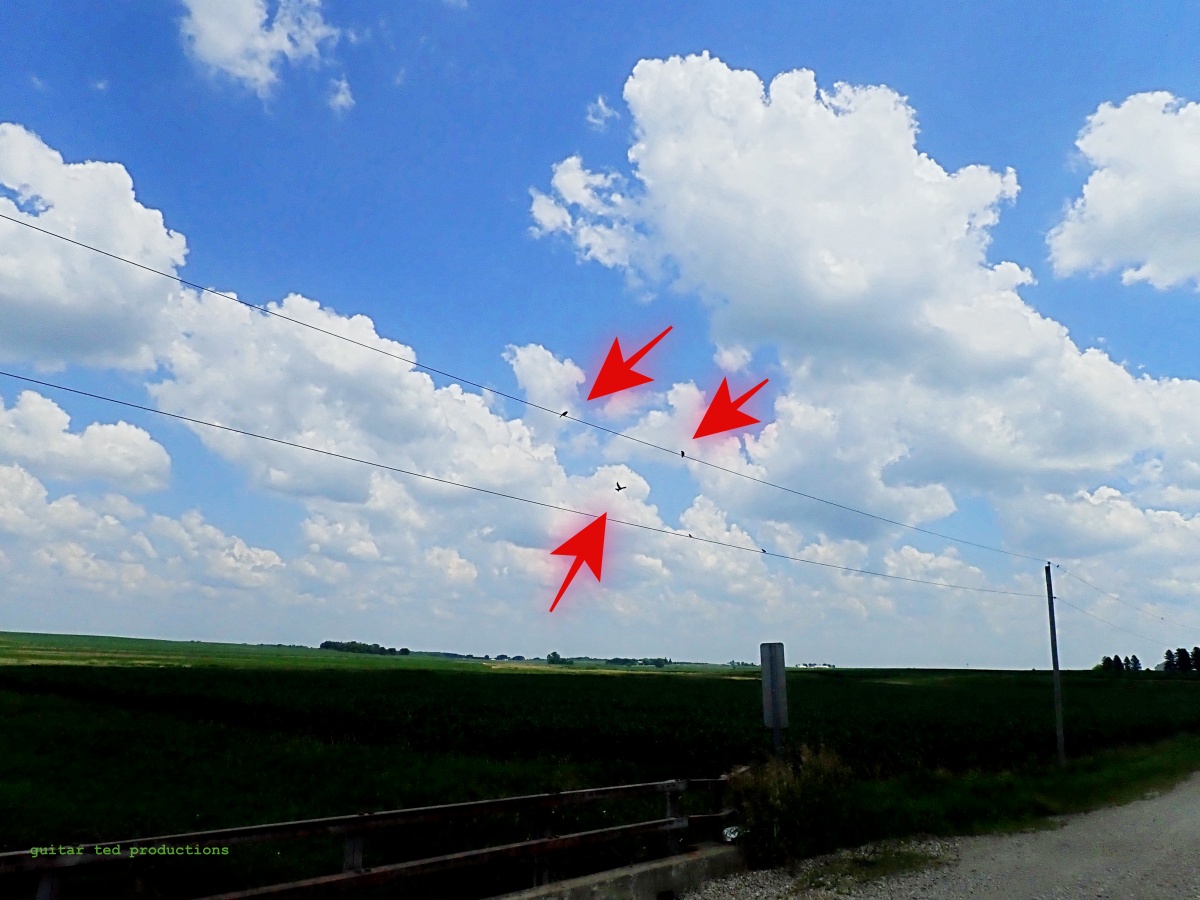
Red arrows pointing to the feathered bastards of Doom
If you've ever ridden the gravel roads in the Upper Mid West, well you know all about the little Red Winged Blackbird. They have an aggressive streak a country mile long, and are stubborn as an old mule. Often while the females are sitting on the nest or tending to little ones, the males are up on fence posts or high wires waiting to harass any would-be predators.

"Would-be predators" includes folks riding bicycles, by the way. I can not say that Red Winged Blackbirds have very good powers of discernment, they just seem ticked off 24-7. So, whether or not you mean their nestlings any harm, they are comin' after ya, and they won't quit until they feel you've 'moved on' enough that the next Red Winged Blackbird takes over, and the chain can go on for miles, actually.

Now, I will say that many times you won't even notice them, but don't be fooled! They are watching you, and you are a target. Much of the time it is about wind speed and direction, since conditions have to be just right for their attacks to be successful. However; during the dog-days of mid to late Summer, these conditions are common, and depending upon where you live, you are going to get harassed by these devils in feathered suits. Make no mistake. I believe these so-called birds are really cowardly demons of the dusty paths. Well.........not really, but ask me when I'm hot and bothered while being attacked by one of these birds and I might just have that opinion at the time!

So, after dealing with a particularly aggressive population of these rascals last Saturday, I thought about what I do to thwart them and strategies I might be able to pass along to you if these birds seem to be a bother.

Red Winged Blackbird. (Image courtesy of Wikipedia)
First off, it is best to get to know your enemy, or harasser, as the case may be. The Red Winged Blackbird has possibly the largest population and most widely spread population of any bird in North America. They typically gravitate toward marshy wetlands, but have adapted to breeding along ditches and in areas of high grasses and prairies. So, these things are pretty much everywhere. 

Next, you can learn about the Red Winged Blackbird's breeding habits and how the males are VERY protective and territorial. They have been observed harassing hawks and eagles, fearlessly dive-bombing any would-be predator for long distances until the threat has been chased away. So, you are dealing with one ornery, stubborn bird of great perseverance.

The length of the breeding season, May to August, pretty much guarantees you'll have some encounters with this bird at some point. So, what do you do? I've listed, in no particular order, some things I do when I encounter these threats to my peace of mind.

But first- There is one key thing I have learned about these birds. I always thought they were fearless, aggressive, and a bird that would take on any challenger. That's not at all true. These birds are cowards of the highest order. In fact, they only attack you from behind and will cower and fly away if you make eye contact with them. So, with that in mind.....

  • If at all possible, make eye contact with the bird. This is difficult, yes. They like to hover above and behind your head. I have found that even just turning your head around as far as you can, without crashing, of course, will send the blighters packing. But if you can look your attacker in the eye, they will not dive bomb you. They will immediately pull up and often will turn tail and fly away. 
  • Use their shadows to assess when they are close. I have used this technique to ascertain when to do some of the following things..... 
  • - First: To wave my hand about my head. When I feel one of these birds is close, a waving motion of the hand about my head will send them off. 
  • - Second: A water bottle squirt. Assuming I have copious amounts of water, or access to more, I will use the shadow on the road to assess when to assault the flying devils with a blast of water. This seems pretty effective. 
  • -Third: The Dogfight Move: This is my favorite if I am alone. I simply swerve when they dive. It's fun when you get the timing down right. 
  • Now on to a couple more strategies. First is speed. I have found that Red Winged Blackbirds usually won't bother with you at speeds over 16-17mph and at 20mph you'll never notice them. It takes far too much effort and time for them to draw a bead on a fast moving target. 
  • Finally- You may have to stop and stand your ground. Red Winged Blackbirds can sometimes mob a would-be predator. This means several males attacking at once. I had this happen Saturday. When this occurs, the best thing you can do is stop, get off your bike, get loud and wave your arms around. This scares the birds and typically they will fly off after a few moments and you'll be able to continue. 
To close, remember that these birds can be beneficial to farmers at times since they eat a lot of pests that harm crops. (Although sometimes they eat the crops too, so....) They are pretty harmless little birds, just bothersome at times. And remember- If the winds are contrary they cannot get at you anyway. Only during a tailwind section, or on days with little to no wind will they be a big time bother.

Thinking about how these birds don't like seeing your eyes, I wonder what would happen if I painted some big ol' eyeballs on the backside of my helmet? Hmm....... Anyway- I hope this helps. What do you do when these pesky birds get frisky with you?

Tips On Dealing With The Mighty Red Winged Blackbird

Red arrows pointing to the feathered bastards of Doom
If you've ever ridden the gravel roads in the Upper Mid West, well you know all about the little Red Winged Blackbird. They have an aggressive streak a country mile long, and are stubborn as an old mule. Often while the females are sitting on the nest or tending to little ones, the males are up on fence posts or high wires waiting to harass any would-be predators.

"Would-be predators" includes folks riding bicycles, by the way. I can not say that Red Winged Blackbirds have very good powers of discernment, they just seem ticked off 24-7. So, whether or not you mean their nestlings any harm, they are comin' after ya, and they won't quit until they feel you've 'moved on' enough that the next Red Winged Blackbird takes over, and the chain can go on for miles, actually.

Now, I will say that many times you won't even notice them, but don't be fooled! They are watching you, and you are a target. Much of the time it is about wind speed and direction, since conditions have to be just right for their attacks to be successful. However; during the dog-days of mid to late Summer, these conditions are common, and depending upon where you live, you are going to get harassed by these devils in feathered suits. Make no mistake. I believe these so-called birds are really cowardly demons of the dusty paths. Well.........not really, but ask me when I'm hot and bothered while being attacked by one of these birds and I might just have that opinion at the time!

So, after dealing with a particularly aggressive population of these rascals last Saturday, I thought about what I do to thwart them and strategies I might be able to pass along to you if these birds seem to be a bother.

Red Winged Blackbird. (Image courtesy of Wikipedia)
First off, it is best to get to know your enemy, or harasser, as the case may be. The Red Winged Blackbird has possibly the largest population and most widely spread population of any bird in North America. They typically gravitate toward marshy wetlands, but have adapted to breeding along ditches and in areas of high grasses and prairies. So, these things are pretty much everywhere. 

Next, you can learn about the Red Winged Blackbird's breeding habits and how the males are VERY protective and territorial. They have been observed harassing hawks and eagles, fearlessly dive-bombing any would-be predator for long distances until the threat has been chased away. So, you are dealing with one ornery, stubborn bird of great perseverance.

The length of the breeding season, May to August, pretty much guarantees you'll have some encounters with this bird at some point. So, what do you do? I've listed, in no particular order, some things I do when I encounter these threats to my peace of mind.

But first- There is one key thing I have learned about these birds. I always thought they were fearless, aggressive, and a bird that would take on any challenger. That's not at all true. These birds are cowards of the highest order. In fact, they only attack you from behind and will cower and fly away if you make eye contact with them. So, with that in mind.....

  • If at all possible, make eye contact with the bird. This is difficult, yes. They like to hover above and behind your head. I have found that even just turning your head around as far as you can, without crashing, of course, will send the blighters packing. But if you can look your attacker in the eye, they will not dive bomb you. They will immediately pull up and often will turn tail and fly away. 
  • Use their shadows to assess when they are close. I have used this technique to ascertain when to do some of the following things..... 
  • - First: To wave my hand about my head. When I feel one of these birds is close, a waving motion of the hand about my head will send them off. 
  • - Second: A water bottle squirt. Assuming I have copious amounts of water, or access to more, I will use the shadow on the road to assess when to assault the flying devils with a blast of water. This seems pretty effective. 
  • -Third: The Dogfight Move: This is my favorite if I am alone. I simply swerve when they dive. It's fun when you get the timing down right. 
  • Now on to a couple more strategies. First is speed. I have found that Red Winged Blackbirds usually won't bother with you at speeds over 16-17mph and at 20mph you'll never notice them. It takes far too much effort and time for them to draw a bead on a fast moving target. 
  • Finally- You may have to stop and stand your ground. Red Winged Blackbirds can sometimes mob a would-be predator. This means several males attacking at once. I had this happen Saturday. When this occurs, the best thing you can do is stop, get off your bike, get loud and wave your arms around. This scares the birds and typically they will fly off after a few moments and you'll be able to continue. 
To close, remember that these birds can be beneficial to farmers at times since they eat a lot of pests that harm crops. (Although sometimes they eat the crops too, so....) They are pretty harmless little birds, just bothersome at times. And remember- If the winds are contrary they cannot get at you anyway. Only during a tailwind section, or on days with little to no wind will they be a big time bother.

Thinking about how these birds don't like seeing your eyes, I wonder what would happen if I painted some big ol' eyeballs on the backside of my helmet? Hmm....... Anyway- I hope this helps. What do you do when these pesky birds get frisky with you?

Friday, May 17, 2019

Friday News And Views

A map of the Butterfield Stage gravel route
Butterfield Stage Experience Route Announced:

People that ride bicycles LOVE point to point routes and having them drawn up for them ahead of time. I don't typically roll that way, liking to do my own research, but from time to time, I see something that piques my interest that is a pre-planned route. This new route announcement coming out of Missouri is just such a thing.

Here is the lowdown from the Butterfield Stage Experience site:

In 1858, John Butterfield personally carried the first bag of mail, boarding the Pacific Railroad in St. Louis. Butterfield's journey took him through Jefferson City, California, Tipton, Syracuse, Florence, Cole Camp, Warsaw, Bolivar, and Springfield--a journey you can live again by bicycling the Butterfield Stage Experience route in Missouri.

 Your ride on the Butterfield Stage Experience will bring you to all of these historic routes and places--and more.

In the 1920s the Dry Wood Threshers Association of Sheldon, Missouri, erected stone monuments at the location of every known Butterfield Stage Station in Missouri.

In the 1950s, to commemorate the centennial of the Butterfield Stage, the Missouri State Historical Society erected metal signs at towns along the Butterfield route in Missouri. Most signs direct you to the actual Butterfield Stage Station location (and corresponding stone monument) a few miles outside of town.

Tracking down those markers and monuments--as well as dozens more historically significant buildings and places across Missouri--is a big part of what makes the Butterfield Stage Experience a real adventure--and a real experience.


So, this ticks all the boxes for me. Self-supported touring, history, and gravel, all combined in a route you can do all of, or parts of. I think I need to make time on my calendar to experience this. 

 Controversy Over Almanzo Changes:

The chain of events started with the original founder of the Almanzo 100, Chris Skogen, announcing in August of 2018, that he was taking over the reins as the organizer of the Almanzo events. This after three years of being "retired" from organizing the events which traditionally have been held the weekend after Mother's Day in Spring Valley. Then, in a bombshell announcement in November of 2018, Skogen announced that the event was leaving Spring Valley due to some communications and requirements from officials in Spring Valley that seemed to be untenable to Mr. Skogen. The Almanzo events (100, 165, and 380 mile events) were moved from Spring Valley, Minnesota to Northfield, Minnesota, requiring all new courses for the three traditional event distances plus the addition of a 50 mile event which was added as well. 

Then, on Tuesday of this week, a mere four days before the inaugural Northfield events, Skogen announced that all the Almanzo events were not going to be timed and scored, and that there would be no number plates issued to riders. This announcement produced a flurry of both supportive and negative reactions. Skogen then, according to my contacts that saw it, posted a Facebook video claiming that the negative comments were inflicting too much stress and that this year would be the last Alamnzo. That video was pulled down within an hour of its posting. Then the following day, (Wednesday), Skogen posted on Facebook saying that he stood by his decision to eliminate timing and scoring and to not issue bib numbers since it was "a barrier to participation". Skogen then went on to cite failing bicycle businesses and falling participation in events as a reason for this decision to stand. The question of whether or not this will actually be the last Almanzo has been left unanswered by the latest post I've seen.

Almanzo's "Alexander" distance, 380-ish miles, was to have started by the time you've probably read this. The remainder of the Almanzo events, the traditional 100, the Royal 165-ish, and the new Malanzo 50, are to be held tomorrow. 

Okay, so I've recounted the facts here. Make of that what you may. My personal take is that I find this very odd. Whether or not Almanzo should or should not be a timed, scored, and otherwise "traditionally marked" race is up for debate. To me, that is all secondary to the timing of the announcements. This strikes me as being unnecessary. Why not run this year's events as they have in the past, and make your changes next week for 2020? (Unless this truly is the last Almanzo) What happens to the number plates and work done to time and score the event, which, one would think,  surely must have been in place a week before the event?  Odd. Seems a waste and ill-timed to me, unless....well. I don't know the particulars. So, my questions stem from having run events. Again- you are welcome to have your opinions, these are my thoughts as a race/event director. 

Good luck to those riding from Northfield tomorrow.  

The Bubblegum Princess with IRC Boken Plus tires.

 Records Were Made To Be Broken:

The record I have in my tire roll down test I conduct with tires I am reviewing was set several years ago when I ran a set of Gravel King SK 40mm tires. There were tires that came close, but none that exceeded the lower rolling resistance of that set of tires.

I used to use the Tamland for all those tests, as much as I could. The Tamland has disc wheels and QR attachment for those. Most every wheel I had was in that standard, so it made sense to make the Tamland the "control" bike and keep things as similar as possible. 

But as standards changed, (and I use that term loosely), I decided to switch from using the Tamland to using the Black Mountain Cycles MCD. It has through axles, disc brakes, and otherwise is very "Tamland-ish" in that it is steel, with a steel fork. Anyway, it is what it is. A change was necessary since almost every wheel I'll test now, or own, will be 12mm through axle until such time that some knuckle headed enginerd decides we need to change that.  

So, anyway- the record. Well, I use a big, steep downhill that is paved in town, (surface remains consistent), that spills out into a double tracked gravel/dirt thing. The Gravel King was one of the only set of tires that rolled without pedaling into this double track. Now I have a set of IRC Boken Plus 650B X 47mm tires set up tubeless on the BMC MCD and I took it over to the "test track". 

Result? Record blown away! I not only made it into this double track, but I went about an eighth of a mile up it. So, I broke the record not by a little- by a LOT.  By more than the changes in bike would seem to affect things. If anything, I would have pegged the BMC as slower since the body position is a bit more upright. Anyway..... 

It is clear to me that the IRC Boken Plus is the fastest tire I have yet tested on that course. Scary fast! I suspect that record will stand for some time, but..... Records were made to be broken.  

Have a great weekend! 

Friday News And Views

A map of the Butterfield Stage gravel route
Butterfield Stage Experience Route Announced:

People that ride bicycles LOVE point to point routes and having them drawn up for them ahead of time. I don't typically roll that way, liking to do my own research, but from time to time, I see something that piques my interest that is a pre-planned route. This new route announcement coming out of Missouri is just such a thing.

Here is the lowdown from the Butterfield Stage Experience site:

In 1858, John Butterfield personally carried the first bag of mail, boarding the Pacific Railroad in St. Louis. Butterfield's journey took him through Jefferson City, California, Tipton, Syracuse, Florence, Cole Camp, Warsaw, Bolivar, and Springfield--a journey you can live again by bicycling the Butterfield Stage Experience route in Missouri.

 Your ride on the Butterfield Stage Experience will bring you to all of these historic routes and places--and more.

In the 1920s the Dry Wood Threshers Association of Sheldon, Missouri, erected stone monuments at the location of every known Butterfield Stage Station in Missouri.

In the 1950s, to commemorate the centennial of the Butterfield Stage, the Missouri State Historical Society erected metal signs at towns along the Butterfield route in Missouri. Most signs direct you to the actual Butterfield Stage Station location (and corresponding stone monument) a few miles outside of town.

Tracking down those markers and monuments--as well as dozens more historically significant buildings and places across Missouri--is a big part of what makes the Butterfield Stage Experience a real adventure--and a real experience.


So, this ticks all the boxes for me. Self-supported touring, history, and gravel, all combined in a route you can do all of, or parts of. I think I need to make time on my calendar to experience this. 

 Controversy Over Almanzo Changes:

The chain of events started with the original founder of the Almanzo 100, Chris Skogen, announcing in August of 2018, that he was taking over the reins as the organizer of the Almanzo events. This after three years of being "retired" from organizing the events which traditionally have been held the weekend after Mother's Day in Spring Valley. Then, in a bombshell announcement in November of 2018, Skogen announced that the event was leaving Spring Valley due to some communications and requirements from officials in Spring Valley that seemed to be untenable to Mr. Skogen. The Almanzo events (100, 165, and 380 mile events) were moved from Spring Valley, Minnesota to Northfield, Minnesota, requiring all new courses for the three traditional event distances plus the addition of a 50 mile event which was added as well. 

Then, on Tuesday of this week, a mere four days before the inaugural Northfield events, Skogen announced that all the Almanzo events were not going to be timed and scored, and that there would be no number plates issued to riders. This announcement produced a flurry of both supportive and negative reactions. Skogen then, according to my contacts that saw it, posted a Facebook video claiming that the negative comments were inflicting too much stress and that this year would be the last Alamnzo. That video was pulled down within an hour of its posting. Then the following day, (Wednesday), Skogen posted on Facebook saying that he stood by his decision to eliminate timing and scoring and to not issue bib numbers since it was "a barrier to participation". Skogen then went on to cite failing bicycle businesses and falling participation in events as a reason for this decision to stand. The question of whether or not this will actually be the last Almanzo has been left unanswered by the latest post I've seen.

Almanzo's "Alexander" distance, 380-ish miles, was to have started by the time you've probably read this. The remainder of the Almanzo events, the traditional 100, the Royal 165-ish, and the new Malanzo 50, are to be held tomorrow. 

Okay, so I've recounted the facts here. Make of that what you may. My personal take is that I find this very odd. Whether or not Almanzo should or should not be a timed, scored, and otherwise "traditionally marked" race is up for debate. To me, that is all secondary to the timing of the announcements. This strikes me as being unnecessary. Why not run this year's events as they have in the past, and make your changes next week for 2020? (Unless this truly is the last Almanzo) What happens to the number plates and work done to time and score the event, which, one would think,  surely must have been in place a week before the event?  Odd. Seems a waste and ill-timed to me, unless....well. I don't know the particulars. So, my questions stem from having run events. Again- you are welcome to have your opinions, these are my thoughts as a race/event director. 

Good luck to those riding from Northfield tomorrow.  

The Bubblegum Princess with IRC Boken Plus tires.

 Records Were Made To Be Broken:

The record I have in my tire roll down test I conduct with tires I am reviewing was set several years ago when I ran a set of Gravel King SK 40mm tires. There were tires that came close, but none that exceeded the lower rolling resistance of that set of tires.

I used to use the Tamland for all those tests, as much as I could. The Tamland has disc wheels and QR attachment for those. Most every wheel I had was in that standard, so it made sense to make the Tamland the "control" bike and keep things as similar as possible. 

But as standards changed, (and I use that term loosely), I decided to switch from using the Tamland to using the Black Mountain Cycles MCD. It has through axles, disc brakes, and otherwise is very "Tamland-ish" in that it is steel, with a steel fork. Anyway, it is what it is. A change was necessary since almost every wheel I'll test now, or own, will be 12mm through axle until such time that some knuckle headed enginerd decides we need to change that.  

So, anyway- the record. Well, I use a big, steep downhill that is paved in town, (surface remains consistent), that spills out into a double tracked gravel/dirt thing. The Gravel King was one of the only set of tires that rolled without pedaling into this double track. Now I have a set of IRC Boken Plus 650B X 47mm tires set up tubeless on the BMC MCD and I took it over to the "test track". 

Result? Record blown away! I not only made it into this double track, but I went about an eighth of a mile up it. So, I broke the record not by a little- by a LOT.  By more than the changes in bike would seem to affect things. If anything, I would have pegged the BMC as slower since the body position is a bit more upright. Anyway..... 

It is clear to me that the IRC Boken Plus is the fastest tire I have yet tested on that course. Scary fast! I suspect that record will stand for some time, but..... Records were made to be broken.  

Have a great weekend! 

Thursday, January 31, 2019

This Post Is Cranky!

The best crank set format ever made.
There once was a time when bicycle crank set choice was not predicated upon whether you were a "roadie", a mountain biker, adventure cyclist, or a gravel rider. There was one crank set that could cover all those bases, and more, with a simple swapping of chain rings and adjustment of chain line.

Now days, things are not at all like that. This was the genesis of the discussion I was having yesterday with Grannygear, via messenger. First, I have to say that in all my years of knowing Grannygear, it has been a joy to be able to have differing viewpoints AND have a civil discussion about it. Trust me, Grannygear and I don't always agree on things. But when we discuss our ideas, we are both respectful to one another, we listen, we consider, and then, as in many cases, one or the other of us, (and sometimes both of us!) change our tune a little bit.

Anyway, I had to share that because, not to brag on us, but it is something sorely missing in today's communications. We could do with a LOT more of that sort of "getting along". But anyway.....

The crank thing! Right then.... Okay, so we were discussing gearing, specifically for gravel travel, and we both had different ideas of what that should look like for both of us. Which, after a bit of thought on the matter, turned into a revelatory thought. That being that the bicycle manufacturers, specifically parts manufacturers, have us pigeonholed into niche groups. They are trying to come up with multiple gearing solutions for smaller pieces of the pie that are demanding different things from their bicycles. The other thing is that, while doing the solution in the form of parts, the manufacturers have developed niche standards, not cross-compatible with others. This has led to much consternation on the part of riders who often are left with a compromised set up because they cannot customize their gearing to their individual needs and for where they live and how they ride.

Not that square taper cranks are better, but the 110/74BCD format was better.
Now, if you want to get a certain gearing set up, you have to accept current "standards". Like the limited chain ring availability on 1X, or the big jumps in between gears on those 1X specific cassettes, or the proprietary bolt circle diameters, (BCD's) of many cranks on the market. These standards, so-called, are limiting, not customizable, and not cross-compatible. This leaves many riders wanting for certain gearing set ups, that for them, would be better than what is out there now. If not better, than at least something a rider could experiment with, and then return to a previous incarnation without major component expense. This, in my view, is a barrier to making cycling more accessible to many of us.

I picked on the old 110/74BCD crank as being reflective of a time when gearing wasn't proprietary to a certain style of cycling or specific manufacturer of parts. That bolt circle diameter, and arguably the 94/58 as well, were the epitome of cross-compatibility and customization of gearing. You could get a double or triple chain ring set up and then combine that with almost any combination of chain rings. Go nuts. Do weird jumps, half-step gearing, wide, bail-out grannys, or even just one gear. A few stock crank sets could cover almost anything the cycling world put out.

Arguably, we could have that today as well. 4 bolt, five bolt arms, cartridge bottom bracket, adjustable chain line, pipe spindle bottom brackets, I don't care, just pick one type, make it 110/74 BCD, and then 11/12 speed compatible and let's get on with this. No one would complain a bit because you could set your bicycle up in about a 100 different ways to accommodate anyone's gearing needs. But what we don't need is arguing over what chain ring sizes are "gravel" and what ones are not. That is stupid and ignores the real issue at hand, which is the proprietary nature of what the component manufacturers have to offer us. It didn't used to be so much that way, and it shouldn't be now either. 

This Post Is Cranky!

The best crank set format ever made.
There once was a time when bicycle crank set choice was not predicated upon whether you were a "roadie", a mountain biker, adventure cyclist, or a gravel rider. There was one crank set that could cover all those bases, and more, with a simple swapping of chain rings and adjustment of chain line.

Now days, things are not at all like that. This was the genesis of the discussion I was having yesterday with Grannygear, via messenger. First, I have to say that in all my years of knowing Grannygear, it has been a joy to be able to have differing viewpoints AND have a civil discussion about it. Trust me, Grannygear and I don't always agree on things. But when we discuss our ideas, we are both respectful to one another, we listen, we consider, and then, as in many cases, one or the other of us, (and sometimes both of us!) change our tune a little bit.

Anyway, I had to share that because, not to brag on us, but it is something sorely missing in today's communications. We could do with a LOT more of that sort of "getting along". But anyway.....

The crank thing! Right then.... Okay, so we were discussing gearing, specifically for gravel travel, and we both had different ideas of what that should look like for both of us. Which, after a bit of thought on the matter, turned into a revelatory thought. That being that the bicycle manufacturers, specifically parts manufacturers, have us pigeonholed into niche groups. They are trying to come up with multiple gearing solutions for smaller pieces of the pie that are demanding different things from their bicycles. The other thing is that, while doing the solution in the form of parts, the manufacturers have developed niche standards, not cross-compatible with others. This has led to much consternation on the part of riders who often are left with a compromised set up because they cannot customize their gearing to their individual needs and for where they live and how they ride.

Not that square taper cranks are better, but the 110/74BCD format was better.
Now, if you want to get a certain gearing set up, you have to accept current "standards". Like the limited chain ring availability on 1X, or the big jumps in between gears on those 1X specific cassettes, or the proprietary bolt circle diameters, (BCD's) of many cranks on the market. These standards, so-called, are limiting, not customizable, and not cross-compatible. This leaves many riders wanting for certain gearing set ups, that for them, would be better than what is out there now. If not better, than at least something a rider could experiment with, and then return to a previous incarnation without major component expense. This, in my view, is a barrier to making cycling more accessible to many of us.

I picked on the old 110/74BCD crank as being reflective of a time when gearing wasn't proprietary to a certain style of cycling or specific manufacturer of parts. That bolt circle diameter, and arguably the 94/58 as well, were the epitome of cross-compatibility and customization of gearing. You could get a double or triple chain ring set up and then combine that with almost any combination of chain rings. Go nuts. Do weird jumps, half-step gearing, wide, bail-out grannys, or even just one gear. A few stock crank sets could cover almost anything the cycling world put out.

Arguably, we could have that today as well. 4 bolt, five bolt arms, cartridge bottom bracket, adjustable chain line, pipe spindle bottom brackets, I don't care, just pick one type, make it 110/74 BCD, and then 11/12 speed compatible and let's get on with this. No one would complain a bit because you could set your bicycle up in about a 100 different ways to accommodate anyone's gearing needs. But what we don't need is arguing over what chain ring sizes are "gravel" and what ones are not. That is stupid and ignores the real issue at hand, which is the proprietary nature of what the component manufacturers have to offer us. It didn't used to be so much that way, and it shouldn't be now either. 

Wednesday, January 23, 2019

How I Keep My Drivetrain Clean

My old Gen II Fargo after the "Mud Year" at the DK200.
Yesterday's post generated a question concerning the cleaning of drive trains and how to keep them clean. I view this as an entirely different subject from the cleaning of a bicycle. While you may need to do both things- clean your bicycle and your drive train- you probably should clean your drive train more often than you clean your bicycle. The techniques involved are completely different as well, so this is why it is a different subject for me.

Again, I have been at this a long, long time, so I have a few things that I do that may seem weird, or unconventional to the casual observer. This is how I do it. Not necessarily how anyone else does it, or perhaps, not even how one should do it. Think for yourself and see if there is anything of benefit to you, and take what you need, or nothing at all. That said, I am not interested in hearing about "how I am doing things all wrong and such-and-such is how you should do things." I've proven that my techniques work for me. I'm not going to change the way I do this.

'Nuff said there........

Just as with cleaning, I have one cardinal rule for keeping the drive train clean. "Use A Quality Lube And Apply It Correctly"

So, take a look at the chain/cassette image above/left. That's what my Fargo looked like after the "Mud Year" of 2015. That's 165+ miles of mud, grit, and water applied over the course of, I cannot remember.....16 hours or something stupid like that. No, I didn't finish that year. I missed the last checkpoint cutoff by two lousy minutes. But that's another story......

The point is, I had used a quality lube, (DuMonde Tech), and I applied it correctly. I did have to stop and lube the chain after about 120 miles, but as you can see, the chain looks pretty dang good for that much abuse. Keep in mind most people were blowing off derailleurs and breaking chains that year. Drive trains were being replaced afterward by most riders. I didn't have to. I merely cleaned mine up and it was fine. Had I used some marginal lube, or had I not applied a good lube correctly, I would have had far different results.

(L-R) Pedros Chainj, Pro Link, DuMonde Tech
I belabor the lubrication point because it is key to keeping a drive train clean. If you are lazy about preparation and application, you will get poor results. If you use "whatever" for lube, you will get what you deserve for results.

In the case of DuMonde Tech, it is imperative that you make your first application on a chain that is perfectly clean. So clean you could put it in your mouth without reservation. Then you apply the lube per label instructions, let it dry, and then, and only then, can you ride your bicycle. You do not reapply it until you hear your chain making noise. if you do this, it will keep your drive train really clean. Then you don't have to clean it, or rarely ever will you need to. 

Get the point?

Now, moving on.... Yes, as with my Fargo after the DK200 "Mud Year", you will need to clean your drive train once in awhile. I use a degreaser called WD-40. You may have heard of it. (snicker!) But really, that is what  use. I get the spray can, and blast the chain out with that. Then I back pedal the chain through a rag. Then I examine the chain and see if it needs replacing or not. Good to go? Then I fully clean it, re-apply DuMonde Tech, and that's it. Or, I replace the chain if that is what is needed. Cassettes and chain rings are cleaned with a rag soaked in WD-40 and then wiped dry. I like to take the edge of a terry cloth rag and run it across the cassette like dental floss, with the cloth going between gears. That's soaked in WD-40 as well. Things come out shiny-clean and then I'm good to go there.

I know a lot of folks say that gravel travel is hard on drive trains. I guess it isn't any worse than mountain biking, or road riding, really. Fat biking? Worse case scenario there, if you actually use that bike for what it is designed for.

A season's worth of gravel travel here.
I know you may not believe this, but again- use a quality lube and apply it correctly. The image to the left here is my Tamland Two after a complete Summer season of gravel travel. Never cleaned the chain. Not once. Hundreds of miles represented here. This was a very dusty summer too. Again, I think this is from 2015, for reference.

So, I don't think I reapplied lube the entire Summer....... maybe once? I'd have to go back and review the "Lube-Off" tests I conducted, but I know it was only once, if that. The point here being that dusty gravel roads don't necessarily mean a gunky chain. In my experience using lubes, DuMonde Tech was best, but again- feel free to use whatever you want. I don't need to know because I already have my lube choice and I am not changing.

I will mention one other thing here in regard to keeping your drive train clean- Use high quality cassettes, chains, and chain rings. Cheaper, lower quality chains, chain rings, and cassettes will not clean up well. You will have a harder time keeping them from oxidizing, getting gunky, and they will wear out faster. I generally use 105 or higher quality Shimano chains and SRAM cassettes with chromed steel cogs in the 11-36T spread. Cannot recall the model number here, but they are commonly available. Chain rings are generally Shimano, SRAM, or FSA of high quality. No cheaping out here, because it isn't worth it from a performance or cleanliness angle.

So, that about covers it with one more piece of advice here- Never, ever, EVER put water on your drive train to clean it! This also includes cleaning the bike, and is another reason I never let water touch my bike with the exception of riding conditions.