Saturday, February 09, 2013

Trans Iowa V9: This And That #3

How's It Goin'?

Here's an update on where I stand with Trans Iowa preparations thus far:

  • The entire course has been driven once. What I saw seems pretty straightforward. I'll have some specific details later. 
  • Cue sheets have been drafted, post recon, and they have been proofread and corrected once already. In March, there will be a full course recon by an independent source using my cues as directions. (We did something similar last year) If my course checkers see anything confusing, wrong, or if they find roads closed, I can then make any corrections necessary to insure the highest possible level of accuracy on cues for T.I.V9. Hopefully they will be on par compared to last years or better. (Last year they were lauded as being "spot on".) 
  • Thanks to a T.I. Vet, Keith C, I have been gifted baggies for all the cues once they are printed. Thanks! 
  • Number Plates: I'll likely use similar ones to last year. I have a source for those and it will take a few hours to personalize them, but I think that's the direction I am headed in with those. 
  • My next big hurdle is to get the Pre-Race Meat-Up all settled. Look for details to surface on this soon....
  • Volunteers: I have Checkpoints covered. Thanks to all who stepped forward for this. I'll contact you all before the event to get you all specifics on your assignments. I still need a couple of folks for starting duties. 
That's about it right now. Things are going pretty smoothly otherwise. We will have a couple individuals out on course doing photography. Because of this, all riders will be required to sign Media Releases at the Pre-Race Meat-Up, as we have had you do for the past two Trans Iowas. I am not sure how the images may or may not be made available afterward just yet, but I do know some things are being discussed with and amongst the photographers, so stay tuned for details on that.

Last week in the T.I.V9 discussion I ran some Tire Tips. Go see that post here if you missed it. Apparently, by the numbers of hits that generated, it's pretty popular.

Finally: if you can not show up, and have to drop out of Trans Iowa- for any reason- please let me know. I will be bummed that you will not be there, but it will help me out and prevent wasting time, money, and resources.

Thanks! 

Friday, February 08, 2013

Friday News And Views

1993 Rock & Road
The Original Gravel Grinder:

The bike in the image here is representative of a model of bike from Bruce Gordon Cycles called the Rock & Road. This is a seminal bike from the standpoint of 29"ers, (which you can read more about their history here), but it also was a bike meant to go on off road rides and- as the name implies, on rocky roads. You know.........like gravel. 

Well, this wasn't lost on Mr. Gordon, who saw all the gravel grinder stuff popping up, and in order to acknowledge this, and point back to his own contributions to the genre', he is offering a 25th Anniversary Edition of the Rock & Road dubbed the "O.G.G. 25". (that stands for "Original Gravel Grinder 25", the 25 signifying the 25th anniversary of that model. ) Mr. Gordon is only going to make 10 of these rigs and you can get one by calling him up to get the ball rolling. Bikes made in this series will all be signed and numbered. Sounds pretty special! See the details here.

Pick yer axle options
 Axle Options:
I was thinking the other day- why do we even bother with 9mm QR's and 20mm through axles anymore? For anyone that isn't racing, self supported, and that doesn't need to get a wheel out in a nano-second, (read- almost everyone.), the 9mm QR for mountain biking is.......silly. 

Then there is the 20mm through axle- a fine and dandy idea in its day, but for whatever reasoning, Fox and Shimano conspired to effectively kill it for anything outside of down hill sleds. The resulting 15mm through axle standard is okay. But, since it has basically pushed out 20mm through axles, lets just go with that...

Then there are rear through axles. Okay, but why 12mm?  Make everything 15mm, and make that the through axle standard, front and rear. Simple. There, that's my rant on axle standards.....

Maiden Voyage?

Looks like a wet, windy, sloppy weekend is in store for us here. I have been wanting to get out the new-to-me Vaya but my body isn't cooperating very well right now. I have had a wicked head cold and mild flu, so riding has been not happening of late.

Let's say I feel a lot better by Saturday. If so....and that's a big if, I will get that Vaya out for a short cruise. I sure hope that works out.

There are other bikes I need to be getting out and riding, but it all depends upon the weather. If it turns, all the better, but I do realize that it is only early February. So, you know- I am being a bit premature on this Spring-like weather, perhaps! Be that as it may, this "tweener" weather is for the birds. Not really winter, not good enough to be out on the trails, and we are left with crapola. (That's a technical term- by the way!)

Okay, I hope all of you have a great weekend and get some good outdoors time in.

Thursday, February 07, 2013

Thoughts On Weight From A Fever Addled Brain

Weight- It's a big deal, a hotly contested subject, and gets folks all in a dither. I've read many opinions on weight, from a total dismissal of the subject to folks who are so into getting the lightest bike they will sweat the finest details to achieve their goals. I've seen folks spend exorbitant amounts of money to prove a point, then sell the bike almost immediately afterward.

My take is that the truth is somewhere in the midst of all that debate. Having the lightest bike is not good, and neither is having a really heavy bike that is hindering your enjoyment of the ride. Like anything requiring balance in life, it is not easy to find the place where weight, (or lack thereof), is at a place which neither hinders you nor causes concern for parts breaking, loss of handling performance, or a credit card drained to the limit.

One of the best examples of this was back in 2008 when I was doing a lot of riding on my OS Bikes Blackbuck. Now the Blackbuck isn't the lightest steel frame on the planet, but it isn't a porker either. Pretty good, I'd say. Right in the ball park for a eccentric bottom bracket equipped 29"er.

I used that basic platform for testing all sorts of rigid and suspension forks on one bike. So- the wheels, components, and set up had to remain the same, (or as nearly the same as possible), for the duration of the test. The wheels I used were the stock set off a Raleigh XXIX+G and were not light. Nope. They were in excess of 2000 grams for the set, as I recall, but those Joy Tech hubs just rolled super smoothly. Plus, the WTB rims were stout and stayed stable all throughout that year.

The following year I was finished with the fork testing, so I removed those "old, heavy wheels", and put on some different, high dollar, lighter wheels. You know what? I didn't go any faster, nor did I like them better than those cheesy Raleigh wheels. But I do remember liking the feel of that bike very much back then. No matter that it weighed more than many other "blingy" single speeds out there.

So what was the deal? I think it had a lot to do with every component I set the bike up with for that year after the fork test. They all worked in concert and put me in a position to really get the most out of the Blackbuck. You know, I should build it back as close I can the way it was then! But the point is, I didn't need lighter weight. At least I don't think so.

But then again, I've had a low grade fever and wicked head cold the past few days, so I might be crazier than usual!

Wednesday, February 06, 2013

What Is Your "Wheel Type?"

Carbon Bling?
I work at a bicycle shop that also deals in cross country ski sales and service. We also do a modicum of service on downhill stuff. When you do that, the tech/ski guy has to be "certified" and he needs to know your "ski type". In other words, it is like setting the tension of your clipless pedals according to your skill level as a cyclist, only....cyclists don't do that sort of thing normally.

Maybe we should....

I was ruminating on all of this as I built up a wheel the other day.While I am not what you would call a "wheel building expert", or some "Zen-wheel building guru", I have built some really nice wheels for customers that have lasted a long time.  Nuff said....

But the point here is that I see a lot of commentary about how "such-and-such" wheel really is "bad" and the rims ding easily, the hubs explode, or whatever. You always hear complaints about the wheels, but you almost never hear about the "rider type". You know what I mean? How does this person actually use the wheel? A bad wheel to rider type match is going to end up like a celebrity wedding. Broken. It may look pretty at the beginning- all shiny, light, and high engagement, but eventually the dings come, and the spokes break, and everything goes to hell in a hand basket leaving you with an expensive pile of twisted metal.

It didn't used to be this way. At one time there were no "pre-built" wheel sets that you could un-box and within minutes be riding. No- it was a longer process in which you went to the local bike shop, asked about a wheel build, and were then introduced to some grizzled old veteran who asked you several odd questions. Then you were told to "...come back next Thursday." Then you got a set of wheels that looked like anyone elses, but in reality were wheels with hand selected components for the job, your weight, and your riding style. If this all sounds mystic and weird to you, just think of the scene in "Harry Potter and the Sorcerer's Stone" where Harry gets his wand. Yeah.......something like that anyway.

One size fits all, or maybe two sizes...
Well, you usually are in too big of a hurry for any of that sort of crap these days, right? So you buy wheel sets that are......well, if you stop to think, one size fits all. Maybe there is a "Clydesdale" option, but typically in most cases there are weight restrictions......that most folks ignore. (That is, if there are any openly publicized restrictions at all.)

There is no matching rider type and skill level to the component. Is it really any wonder then that I read and hear about so many issues regarding wheel damage? I don't think so.

However; if we were to suddenly go about doing the "rider type" thing with bicycle wheels, there would be a lot of "disgruntled" cyclists and a lot of unhappy marketing departments. See, many riders should be on tougher, heavier equipment for their style and type of riding, not the latest lightweight tubeless ready rim from wherever. A lot of companies would not sell as many wheel sets either. Not unless they changed the way they marketed their wares. (Or not unless a lot of riders refined their riding styles.)

My wife came home the other day and told me about some guy driving a Cadillac Escalade with those big 22" wheels and low profile, wide tires in the latest 5" snow we just had. Apparently they slid into some curbing and knocked the bead off the wheel's rim. They kept on driving though.....

Don't laugh: lots of cyclists are doing similar dumb things with their wheels too.....

Tuesday, February 05, 2013

A Carbon Fiber Fat Bike Dream

On One carbon fatty one-off
Recently I posted about a one off carbon fiber fat bike being done for On One's Brant Richards. This has been a pretty popular post here of late. It got me thinking, "So.....if we're going to do fat bikes in carbon, let's dream a little, shall we?"

Here's my list and some reasons why I think the ideas are worthy....

  • Carbon fiber is, or more correctly "can be", a great material to make a frame from if you maximize the material's unique properties. So, if On One, or any other company, wants to really make carbon worthwhile, it is good to know that some of us feel it has more than being "light weight" going for it. One of the best things about carbon fiber is that it can be shaped in ways metal can not be. Sometimes this is used as a stylistic cue by designers, but I think it could benefit fat bikes greatly. Another thing is that the material can be compliant where you want it to be, stiff where you want it to be, and strong as it needs to be without weight penalty. 
  • Let's take on the shaping. There are a lot of things that could be done here to make carbon fat bikes a good thing. I think one of those things is in the area of tire clearances. Crimping stays is really the main way metal frames gain clearances, but that technique is limited in its effectiveness.  Carbon fiber is mostly free of those limitations. I could see a thin, tall right chain stay snaking around crank rings and tire with an asymmetrical left chain stay with a beefier profile, yet allowing for a good amount of clearance. The stays could "wrap" more around the wider part of a tire, and pinch in for heel clearances which metal would be hard pressed to accomplish. A built in direct mount for a front derailleur could be shaped so that it wouldn't be a "mud shelf", as an example.
  • Frame compliance could be built in for the rider with a stiffer frame laterally which is always a nice thing. The biggest negative thing I feel on a fat bike is when it twists nose to tail on fast corners and on really rough terrain. Those big contact patches like to grip and exert forces on a frame which make steering a little weird at times. I wonder how a carbon frame might be tuned to help alleviate that situation. 
  • If I were doing a carbon fat bike, there are a few "musts" I would insist on. One would be clearances for the big Surly tires on 130mm rims. Yes- I know that you can not get 130mm rims.......yet. So, that's why it needs clearances for that big a rim/tire combo. The second thing is that I would insist on a 170mm spaced front fork. I'm not sure I would ever swap wheels, but- ya know- these wheels and tires are so expensive, having versatility makes sense. Single speed capable wheel up front, cassette in back. Plus, I think a wider front hub would make a rigid wheel that would track even better. You would ease the big tire clearance issues as well. 
  • That brings up the issue of single speed. I don't know how you get that accomplished unless you fit an EBB or someone's proprietary slider/swinger drop outs. I think a full on adventure vehicle needs to be able to do this though. (Go single speed, that is.)
Otherwise what is going on with fat bikes now is good. I'm not "all for a carbon fat bike frame", but if you're going to bother doing one, do something that pushes the boundaries and that makes sense. It's going to cost a truckload of money anyway, so why not?

Got some thoughts on this? Hit the comment section.....

Monday, February 04, 2013

Snowy Reprise

My Son sliding down a dike
After nearly being 95% snow free, we got another dumping of the white stuff last Wednesday. Then it got brutally cold, and I was under the weather to boot, so this past weekend was the first time in several days I was able and fit enough to get outdoors and enjoy doing some things.

One of those things was to go sledding with my Son. We went to a place we both know we will have the hill all to ourselves and while that was fine, the snow was thinner here, so it wasn't as fast as it could have been. Still- we had a good time. I got the distance record this time, as my Son couldn't quite get there. Oh well, it's my first time winning that contest all Winter!

The sledding outing was really the first time in awhile, besides snow shoveling, that I've had any outdoor activities since it snowed and iced up before that. I was thinking on riding the bike on Sunday, but after coming home from sledding, I was feeling overly worked and was thinking I may still not be ready for a big bike outing just yet.

Sunday came and it was my turn to play the guitar at church, so that was the morning right there. Played the '88 Strat Plus this time, by the way. Then I had some free time in the afternoon, and I didn't feel too bad, so....

I knew that a few guys were supposedly going through the Green Belt on Saturday, so I figured I would go check that out to see how they fared. I went over on top of the dike and that went well, since the snow wasn't too deep up there. Then I dove down into the opening trail of the Green Belt and found a trail all worked over by snow shoes and feet.

Normally this would be good, but again- this snow- like the last, was all powdery and sand-like. There was no packing down of this stuff, and the going was slide this way, then that way, and I decided to bail on that after a bit. I made an exit at the point where the dike goes East to the bike trail and picked up a snowmobile track, which was pretty good and fast. Then I hit the bike path, and I was feeling a bit too fatigued for only having been out as long as I had. Just then, I got a phone call from California which took several minutes. By the time I wrapped that up, I was a bit chilled, and decided to head for the shed.

It wasn't all roses going back either. It was really soft, shifty snow, and the fact that the temperature had risen above 20°F made the packed sections of snowmobile track really sketchy as well. In the end, I found out I was out for two hours anyway. Good enough for a start, or "re-start" of the year's riding, I should say.

Sunday, February 03, 2013

Vaya: The Full Reveal

Salsa Cycles Vaya in G-Ted Team colors. (HA!)
The Vaya is completed. Yep. And here it is, in all it's "mutt-build" glory. I'll get to all the details here in a minute, but I have a couple of "thank yous" to get on with here first off.

The first "thank you" goes out to Mike, who sold me the frame and fork. He has been gracious in dealing with the sale of his frame/fork and I appreciate this very much. I also appreciate the fact that he has become a friend as well over the last years.

The second "thanks" goes out to Dean from Illinois, who contacted me and let me know about a fork he had laying around that he wanted me to use for this project. He sent it to me at no charge, and that means a lot. Thanks Dean!

Okay, so here's the details on the bike. I can not say for certain, but this probably is a 2011 Vaya. (Mike would know for sure), and I do have the original fork, which I will talk about here in a bit. Dean's fork is a Winwood Muddy Cross which has carbon blades bonded to an aluminum steer tube. These were made at a time when "disc only" wasn't an option, so this fork does have the provisions for canti brake mounts.

The wheels are the old Edge Composites hoops laced to American Classic Disc hubs with DT Swiss Aerolite spokes. These wheels have been through the mill, but are still kicking along just fine. We'll see how long they last! I do know that the hubs are so free and smooth that they rotate for a long, long time in the stand when you spin them. Of course, they are quite light for disc brake wheels at sub 1500 grams for the pair.

Mounted to those with standard tubes are a set of Vee Rubber X-C-X 1.75" wide tires. These have a folding bead, dual compound tread, and are pretty beefy feeling. I'll have a lot more to say about those tires later on GGN. The disc rotors are from a set of Quad hydraulic disc brakes, 180mm front, 160mm rear. Brake calipers are Avid Mtn BB-7's. Levers are Tektro RL520's. Those levers are mounted to an On One Midge Bar. Wrapped in Bontrager gel tape. Stem is a Salsa CroMoto stem. Headset is Cane Creek. A 40 series, I think.

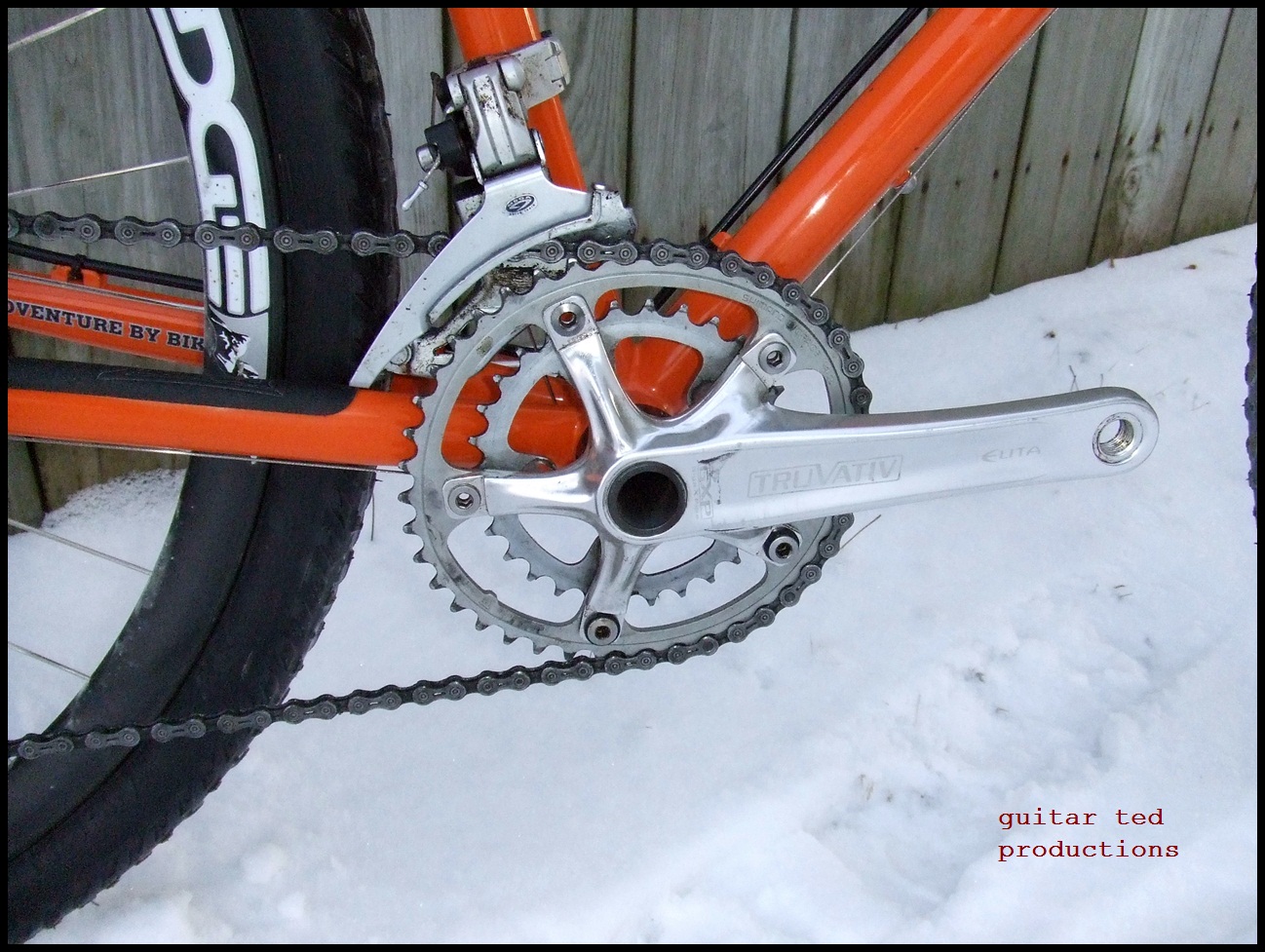
Moving back and down we find one of the more interesting, (or maybe stupid),  things I did here. I am running a TruVativ Elita crank, (heavy), with a GXP bottom bracket. The Elita is a triple, but I mounted an old Shimano BioPace 42T ring to the middle position in such a way as to mimic the popular and outrageously expensive alternative from a certain Spanish outfit. I've heard a lot about this being an advantage, so I figured what the heck. I'll experiment. If I do not like it, I have a FSA 42T ring waiting in the wings to swap out to. The inner ring is the Elita's standard 30T granny. Yes- I am running a 10 speed chain which seems to be just fine with this set up. That's a Shimano 105 10 speed chain, by the way.The front derailleur is a SRAM X-Gen unit. Dual pull, high mount.

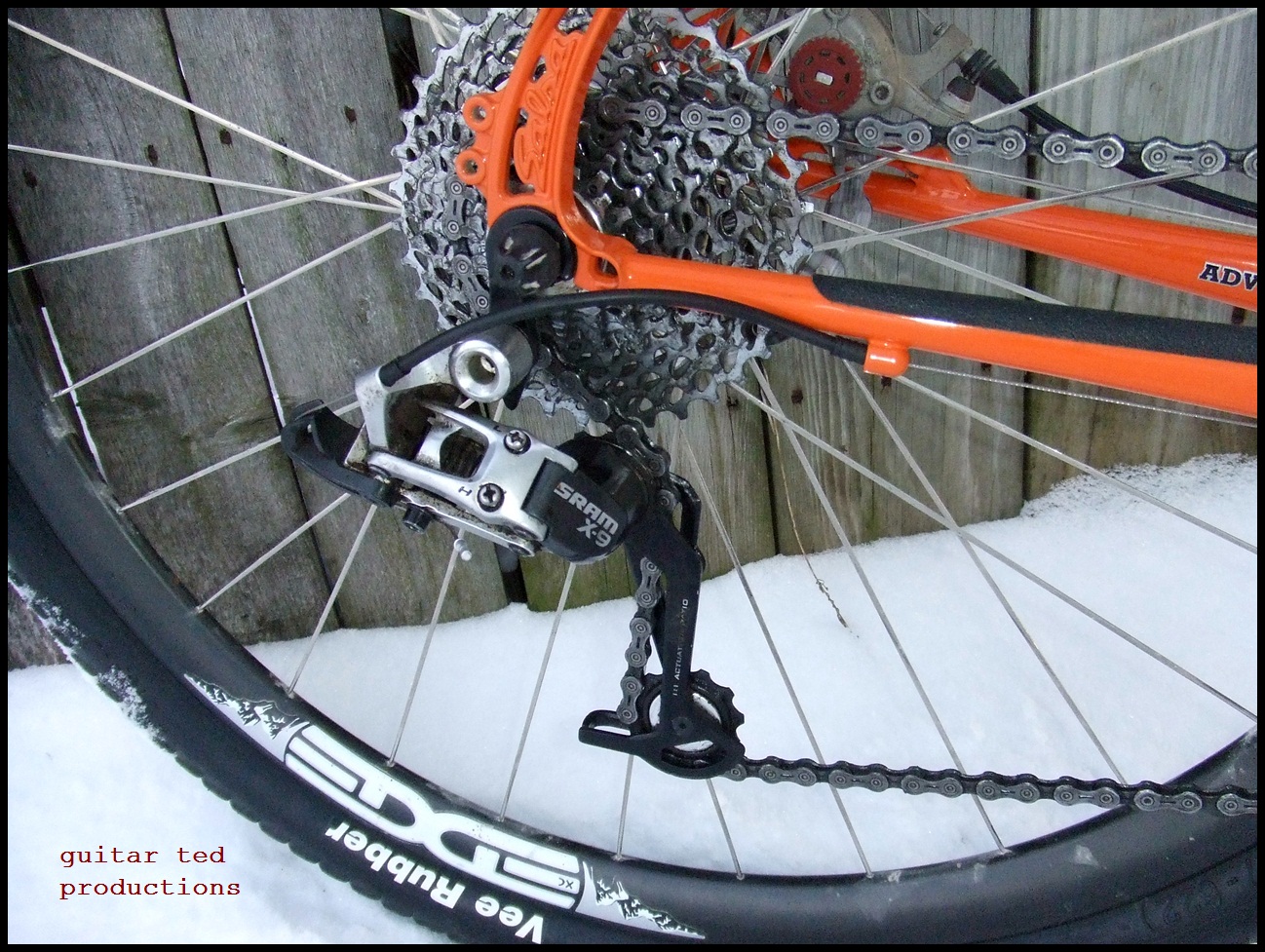
That spins a 10 speed SRAM cassette, which is an 11-36T range. This is shifted by a 9speed X-9 rear derailleur. (Seems to be okay so far, but I do have a X-9 10speed sitting around if I need to swap to it.)

A closer look at that old BioPace ring
This is all shifted by a SRAM 10 speed bar end shifter for the rear and a Shimano bar end shifter for the front. (I like the Shimano ratcheting feel on the front shifter better.) Cables are standard stainless steel, and housings are Jagwire's standard black issue stuff, nothing fancy.

The seat post, well, that's a vintage oldy. It is a Tamer carbon post with no offset. The saddle is something that closely mimics the WTB Pure V which I love and use on the Black Mountain Cycles rig. It is a Velo model of some sort that came stock on a SE Racing mountain bike. It's comfy, that's all that matters right now. The seat collar is a standard Salsa Cycles LipLoc.

Okay, I think that is it. Did I leave anything out? I don't think so. Pedals will come soon in the form of my standard choice of Shimano SPD's of some sort. I haven't gotten those yet. (Okay- so technically it isn't done yet. Bother....)

The bike had a goal- be lightweight. I think there is room to improve on weight. Certainly the saddle, seat post, (just because it is carbon doesn't mean "light"), and certainly the stem and crank set. Plenty of grams to be shaved safely and wisely here. So the weight, as you look at it here, is 23lbs on the nose. I'm not impressed, but I am not disappointed either. 

You could also take a hard look at the tires here. Yes, they are tubed, so going tubeless might save me something, but the tires are 620 grams each. That's a bit porky for 47mm tires here. Clement MSO's, (about 7-8mm narrower) weigh 100 grams less each, and WTB Nanoraptors weigh about 40 grams less each, as a comparison. However; you also have to weigh in cut resistance and durability into the discussion, and I think the Vee Rubber tires will shine there. We'll see. For example, the WTB Nanos feel like they are made paper thin compared to the Vee Rubber X-C-X's.

The fork, which is lighter than stock, isn't lighter by a lot, like you might think. I saved about 60 grams over the stock steel Vaya fork. I will be looking at getting a different crank set in the long run, and that is a place where I can save some significant grammage. I also will be looking at getting an Ergon saddle, swapping out disc rotors, and at some point, a different seat post as well. If I deem the cassette range to be too wide, I may also be able to swap out to a tighter, lighter range there, and get a shorter caged derailleur.

In the end, I figure that with pedals installed and two water bottle cages I should end up at 22lbs or so. That isn't bad for a steel gravel rig. It's pretty good, I think. But I needed to spend very little post frame/fork purchase on getting this up and running, so the choices here reflect that. (Almost all stuff I had already.) Down the road, if the bike warrants it, the suggested changes may be pursued.

Stay tuned, I will be back with my thoughts on the Vaya's ride later.....

Saturday, February 02, 2013

Trans Iowa V9: This And That #2

This image from V1 became part of the V2 header for the T.I. site
Volunteer Update: 

First off, thanks to everyone that has contacted me to volunteer for Trans Iowa V9. I have filled the Checkpoint #2 needs and half of Checkpoint #1 needs.

I would feel a little better about things if I could get a few more folks to say they would help out at Checkpoint #1. The core group I have now is experienced and has done volunteering at Trans Iowa before, so you do not need to have any special knowledge, just a desire to help out the racers in getting their name and hand them up cue sheets. Update: Looks like I'm going to be good to go on Checkpoint #1 now. I still need a few intrepid souls for the start/roll out to give a hand. You should have access to a vehicle for this. Give me a shout if you can help out.

Dropping From Trans Iowa: 

Yes- I have gotten a few drops already, and it happens. I appreciate finding out if you can not come, because it helps me plan and saves me time and money by not doing the extra legwork for someone that won't be showing up. So, if you can not show up- for any reason- please let me know. I will be bummed that you will not be there, but it will help me out and prevent wasting time, money, and resources. 

Tires:

Probably one of the biggest question marks for new-to-gravel grinding folks is what tires to use. In Trans Iowa, it will be a different answer than it will be for the Almanzo 100, and different than what you might choose for the Dirty Kanza 200 too. Here are some thoughts on tires for you to consider, based upon my observations, experience, and knowledge of the course.

  • Volume: You won't want to run tires under 32mm. If you do, you will waste energy, suffer "cutting in" to soft surfaces, and have a high risk for pinch flatting. The most popular size range for tires at Trans Iowa is anything from 35mm to 42mm wide. (Based upon a survey I once took and years of observations.) Even going this big, pinch flatting still occurs, so running even bigger rubber is okay, as long as you can get by the idea of the wheels being slightly heavier. 
  • Tread: You really do not need to run any tires with a deep tread pattern. File tread would work fine at Trans Iowa, but a minimalistic tread pattern tire may also have a thin casing, so be careful. Micro-knobs are probably a good bet, as is most anything I've seen on a touring tire. That should get you pointed in the right direction.
  • Tubeless: I happen to like tubeless tires on Iowa gravel. It works great, essentially eliminates the possibility of a pinch flat, and has better shock absorption qualities. Downsides are the initial set up and dealing with a cold, gooey mess if you do have to stick a tube in due to a flat tire issue.
  • Mud clearances: You definitely will need mud clearance at Trans Iowa. Well......there is a 95% chance you'll run into a situation where mud clearance is necessary. (I suppose there is a 5% chance it could be bone dry this Spring.) At any rate, if you show up with tires that max out your frame clearances, you may end up dealing with cleaning out a lot of muck and mire from the frame, or dealing with jammed brakes, torn up rear derailleurs, or other mud related maladies.
  • Tire Pressures: You won't want to run high pressure in your tires, whatever you run. All that will do is make your bike more skittish, which you will have to spend more energy on to control. I don't know about you, but in a 325+ mile gravel road event, I would think saving any bits of energy you could would be wise. So- run a pressure that keeps the bike stable and comfortable, yet prevents pinch flats. Trust me, you will go faster with less energy expended. For example- I go about 230lbs, and run Clement MSO 40mm tires a lot. I never go over 40psi, and have run these as low as 20psi- with tubes! I probably am just as fast at 30psi as I am at 40psi, but I run a heck of a lot more smoothly. Think about that.....
Image by W. Kilburg from T.I.V8
So, there are some of my observations on tires. Could you come to T.I., run 32's at 65psi and finish? Sure you could. But you probably would be just as fast with 38's at 45psi, and have the feeling in your hands and arms when you are done, and feel like you can ride a bike again a couple of days past Trans Iowa. You choose your damage level. You also could end up actually going faster with the skinnies when you were moving and end up slower over all because you spent more time fixing flats alongside the road too. Choose how often you want to fix your sled during the event.

That's all for this week. 


Friday, February 01, 2013

Friday News And Views

Okay, maybe I should re-name this post "Fat Bike Friday". You'll see why...

SRAM Fat bike crank?
The image here is supposedly from SRAM and supposedly depicts a 2014 component for a fat bike. This appeared on mtbr.com's fat bike forum back in December of last year. You can click to enlarge the image, look and decide for yourself what it is....

My opinion: If this is a SRAM X-9 fat bike crank, and if it is destined for production for 2014, I would say that it isn't going to be produced solely for the aftermarket. SRAM doesn't work that way, that much I do know from being around this stuff for awhile.

So, what does that mean? I would suggest that some bigger company is either fronting the tooling costs, or has ordered enough of these to make it worth SRAM's while to manufacture a fat bike crank, if it is a reality. That could  mean just one company, ( a bigger company), or several smaller companies are involved here. Either way- I do not think Surly and Salsa have enough numbers to support this on their own. Not from numbers I've seen bandied about. (But those numbers could have been all just speculation as well.)

So, I am not saying that a "big company is coming in to make a fat bike". I have heard that though......a lot lately. In fact, a certain company's rep came into a shop I am very familiar with and told the buyer that "Trek and Specialized" are both going to make fat bikes for 2014, and that Specialized is going to introduce theirs this Spring. I have heard rumors mostly about Specialized from other sources. I do know a fat bike was spotted in Specialized's compound during a media tour last Spring, and that a certain well known Trek mountain bike tester has been riding fat bikes quite a bit of late from that tester's Twitter feed. Read into that what you may.......

Of course, all of this could be complete rubbish. It may never happen, but if it does, here is more of my opinion. Trek and Specialized are looking to get dealers to push the competition for floor space on local bike shop floors out the door. Meaning- they want more of the local bike shop owners dollars, and are being very aggressive about it. With fat bikes selling like hot cakes in Winter, this maybe has raised some eyebrows with the big companies. But maybe the only way they can leverage dealers carrying fat bikes is to make their own fat bike models, and get the sales the other smaller companies are getting now. Maybe. Maybe not......

This irks some folks out there...
No Love Here: 

Obviously, not everyone is going to like fat bikes, nor should they. However; I found a pretty brazen rant on-line yesterday from a certain small brand's owner that, well......you can go read it here and make up your own mind.  Apparently, the posting of the carbon fat bike from On One was part of the pebbles that set off that avalanche of screed. (Judging by a reaction to said post on Twitter yesterday.)

It's interesting to read from the standpoint of a dissenting opinion, but obvious holes in the logic do jump out at me. For instance, you could insert "29 inch wheeled bikes", (something that company sells), and insert it in the place of "fat bikes", or as he erroneously calls them, "snow bikes", and the story fits as well.

Oh well, as I say, just an interesting viewpoint, if nothing else, and as always, it is good to consider from the standpoint of someone that may not get it, or agree with it, or like the idea at all. That's okay with me.

New shoes for the Vaya
Vaya Update:

Well, first off, the bike is built and ready to be ridden. No images yet, as it is too flippin' cold out to take images just yet. Soon! I will have a full post on the build.

I did get these Vee Rubber tires on suggestion from a reader that thought I should try them and review them for Gravel Grinder News. That I will do, but for this post, I just wanted to point out the hot patch which says "29 X 1.75".

I find that amusing, as anything sub-2 inch is almost always not 29" in diameter mounted to a 700c rim. It's stuff like this that the bicycle industry does that confuses the heck out of consumers. However; it isn't as easy to market a 28"er tire, and you know- "twenty nine inches" is much better from that standpoint. Who cares that it isn't even close to reality.

Then there is a certain German based tire company that marks their 700c X 28mm-30mm tires as "28 inches". Again- not even close. Plus, it mixes two measuring standards up. It gets customers of the shop where I work tripped up all the time. They ask for a "28 inch tube" and we hand them a 700 X 28mm tube and they tell us that we're crazy. We need to carry 28" tubes.

Okay, well, I digress.... The Vaya- yeah. It is done and these new tires, set up tubed for now, will be the shoes it wears for awhile at least. I'm pretty pleased with the way it came out. Not floored, but pleased. It does barely cut the mustard for the goal I set which was to be a lighter rig. I'll get into detail on that, but for now I will say it weighs 23lbs less pedals. I could shave some more off it, but again- this had to be a "mutt build" for now.  More soon....

Have a great weekend, and remember, fat bikes are stupid, so ride something else, right? (<====HA!)