Sunday, February 23, 2020

Trans Iowa Stories: New Things - Part 2

This view is completely familiar now, but in '09 it was new and exciting.
"Trans Iowa Stories" is an every Sunday post which helps tell the stories behind the event. You can check out other posts about this subject by going back to earlier Sunday posts on this blog. Thanks and enjoy!"

After a Summer of planning a new route in a new area, it was Fall and time to do recon. I had been pushing for an earlier date to get this done since we had been burned a few times by waiting too long and having Winter hit. So, this recon happened in late October, but even the best laid plans can go awry. That will be explained in a bit here.

I still remember being pumped about this route. I cannot speak for David, but I found a renewed energy after we had settled in on Grinnell and this energy was amped up even further by what we saw during the recon. Maybe I got a little too excited, because all the "highs" I was experiencing over this edition of Trans Iowa ended up being translated into many ideas which I ran with. I did these things without really consulting anyone, and in fact, looking back it is a bit embarrassing. This was not at all the direction I wanted Trans Iowa to go into, and I'm pretty certain it was not what David had envisaged either.

Things like the "acronym" crazy ideas I had were pointing more towards bigger production and slicker marketing. All the while we were still limiting the field to 75 riders, so it was a bit incongruous. The basic formula was retained- a short lead out to the first checkpoint, then a second and third checkpoints would fall at intervals across the course of about 80-ish miles. Convenience stores would be near each checkpoint, but we were careful not to choose sites where the checkpoint would interfere with normal business. New was a "no-tell" policy on the whereabouts of Checkpoints 2 and 3. We even kept the volunteers in the dark so as to short-circuit any bribing or "arm-twisting" for information. This became an issue with this event, as we will see.


From the late October recon of T.I.v6
We had a TON of sponsorship for this version of Trans Iowa as well. Coming off a year where sponsorship was basic and nearly non-existent, this was a stunning turn of events. This excited me even more and I was posting sponsorship news like crazy. Oakley, Revelate bags, Banjo Brothers, and more were onboard for this deal. Gravel cycling had caught the imagination of forward looking companies and marketing departments. Salsa Cycles, of course, was also a sponsor of T.I.v6. They were in the throes of putting together the first "gravel specific race bike", and they used events like Trans Iowa to do their "in the field" testing. Revelate Bags actually sent us prizing based upon the T.I.v5 web banner which depicted the calf I saw during T.I.v4 and which Jeff Kerkove used in his design. That featured "blood splattering" on the calf. Eric, the proprietor of Revelate, was so impressed that a gravel event would use such imagery that he told us that he just had to sponsor us!

With myself heading up all the goofy marketing, hoopla, receiving prizing, and doing all the communications, it left David out of the loop. This ended up causing a bit of a ruffle leading up to the start of T.I.v6. It was another one of those things that almost derailed Trans Iowa, but was a thing narrowly averted.


David did much of "his part" of recon by bicycle. Image by David Pals
With recon cut short by another severe Winter which lasted right into March, getting the route verified got pushed back. I was rather anxious about it and was putting pressure on to get everything lined up and completed for this edition of Trans Iowa. We had so many things lined up- a pre-race meeting at the Grinnell Steakhouse, discounted meals and motel rooms, a ride for non-competitors, and the big finale planned for the barn West of Grinnell. I had a lot of well known (in gravel riding circles at the time) competitors showing up. Even Jay Petervary and his wife, Traci, were showing up on a tandem, a first for Trans Iowa. To say that I felt pressure to get this thing sewn up and ready to put on was a great understatement.

I got a LOT of crazy gifts for v6 registration. David got nothing. It was unfair.
To boot, all the craziness of registration, the gifts and all the attention was on me. I, of course, enjoyed it and figured it was small recompense for my risk taking and efforts. But in the process, David, who lived an hour and a half away, got none of the benefits and a lot of the hassles. He was tasked with cue sheet production, and as I know, that is no fun at all and a very tedious task. Added to your daily job stress and family life, well, it can be quite a load to bear.

This all came to a head about two weeks out from the event. I was pressuring David about cues, and he responded in an angry e-mail saying he was quitting Trans Iowa and that he wasn't going to do the cue sheets. It was crisis management time for me, and I had to put away my emotions for the time being to help preserve Trans Iowa.

Sure, David could have communicated his displeasure long before it came to a head. Sure, I could have been a lot more sensitive to the situation he was in regarding Trans Iowa. We both had parts to play in the troubles, but that could all be navigated later. Maybe... At the moment, in 2010 only two weeks out from Trans Iowa, all I cared about was salvaging the event, no matter what. I smoothed things over as best I could, and David calmed himself down and put away his issues for the time being, and cues got done.

But you have no idea how close it came to all unraveling right there.

Next: Thunder And Lightning: Part 1

Trans Iowa Stories: New Things - Part 2

This view is completely familiar now, but in '09 it was new and exciting.
"Trans Iowa Stories" is an every Sunday post which helps tell the stories behind the event. You can check out other posts about this subject by going back to earlier Sunday posts on this blog. Thanks and enjoy!"

After a Summer of planning a new route in a new area, it was Fall and time to do recon. I had been pushing for an earlier date to get this done since we had been burned a few times by waiting too long and having Winter hit. So, this recon happened in late October, but even the best laid plans can go awry. That will be explained in a bit here.

I still remember being pumped about this route. I cannot speak for David, but I found a renewed energy after we had settled in on Grinnell and this energy was amped up even further by what we saw during the recon. Maybe I got a little too excited, because all the "highs" I was experiencing over this edition of Trans Iowa ended up being translated into many ideas which I ran with. I did these things without really consulting anyone, and in fact, looking back it is a bit embarrassing. This was not at all the direction I wanted Trans Iowa to go into, and I'm pretty certain it was not what David had envisaged either.

Things like the "acronym" crazy ideas I had were pointing more towards bigger production and slicker marketing. All the while we were still limiting the field to 75 riders, so it was a bit incongruous. The basic formula was retained- a short lead out to the first checkpoint, then a second and third checkpoints would fall at intervals across the course of about 80-ish miles. Convenience stores would be near each checkpoint, but we were careful not to choose sites where the checkpoint would interfere with normal business. New was a "no-tell" policy on the whereabouts of Checkpoints 2 and 3. We even kept the volunteers in the dark so as to short-circuit any bribing or "arm-twisting" for information. This became an issue with this event, as we will see.


From the late October recon of T.I.v6
We had a TON of sponsorship for this version of Trans Iowa as well. Coming off a year where sponsorship was basic and nearly non-existent, this was a stunning turn of events. This excited me even more and I was posting sponsorship news like crazy. Oakley, Revelate bags, Banjo Brothers, and more were onboard for this deal. Gravel cycling had caught the imagination of forward looking companies and marketing departments. Salsa Cycles, of course, was also a sponsor of T.I.v6. They were in the throes of putting together the first "gravel specific race bike", and they used events like Trans Iowa to do their "in the field" testing. Revelate Bags actually sent us prizing based upon the T.I.v5 web banner which depicted the calf I saw during T.I.v4 and which Jeff Kerkove used in his design. That featured "blood splattering" on the calf. Eric, the proprietor of Revelate, was so impressed that a gravel event would use such imagery that he told us that he just had to sponsor us!

With myself heading up all the goofy marketing, hoopla, receiving prizing, and doing all the communications, it left David out of the loop. This ended up causing a bit of a ruffle leading up to the start of T.I.v6. It was another one of those things that almost derailed Trans Iowa, but was a thing narrowly averted.


David did much of "his part" of recon by bicycle. Image by David Pals
With recon cut short by another severe Winter which lasted right into March, getting the route verified got pushed back. I was rather anxious about it and was putting pressure on to get everything lined up and completed for this edition of Trans Iowa. We had so many things lined up- a pre-race meeting at the Grinnell Steakhouse, discounted meals and motel rooms, a ride for non-competitors, and the big finale planned for the barn West of Grinnell. I had a lot of well known (in gravel riding circles at the time) competitors showing up. Even Jay Petervary and his wife, Traci, were showing up on a tandem, a first for Trans Iowa. To say that I felt pressure to get this thing sewn up and ready to put on was a great understatement.

I got a LOT of crazy gifts for v6 registration. David got nothing. It was unfair.
To boot, all the craziness of registration, the gifts and all the attention was on me. I, of course, enjoyed it and figured it was small recompense for my risk taking and efforts. But in the process, David, who lived an hour and a half away, got none of the benefits and a lot of the hassles. He was tasked with cue sheet production, and as I know, that is no fun at all and a very tedious task. Added to your daily job stress and family life, well, it can be quite a load to bear.

This all came to a head about two weeks out from the event. I was pressuring David about cues, and he responded in an angry e-mail saying he was quitting Trans Iowa and that he wasn't going to do the cue sheets. It was crisis management time for me, and I had to put away my emotions for the time being to help preserve Trans Iowa.

Sure, David could have communicated his displeasure long before it came to a head. Sure, I could have been a lot more sensitive to the situation he was in regarding Trans Iowa. We both had parts to play in the troubles, but that could all be navigated later. Maybe... At the moment, in 2010 only two weeks out from Trans Iowa, all I cared about was salvaging the event, no matter what. I smoothed things over as best I could, and David calmed himself down and put away his issues for the time being, and cues got done.

But you have no idea how close it came to all unraveling right there.

Next: Thunder And Lightning: Part 1

Saturday, February 22, 2020

Iowa Gravel Expo Pop-Up Series Reviewed

Session #1 Jen Reed presents the event, "Turds of Misery"
With last Wednesday's final pop-up for the Gravel Expo, it is time to assess how it went, and to look toward the future. When N.Y. Roll and I started this deal we were amazed by the interest and demand for knowledge and for the community to gather during the 'down time" of Winter. We went from a single event on a single evening to a two session event on a single day to this pop-up series. All within three years.  The changes made the dynamic different, and I think we learned a lot along the way. But before I get to the lessons learned and what the future of the event may look like, it is time to review the just completed series.

With the change in venue and format, we did not really have a clear idea on what to expect. So, N.Y. Roll and I were pleasantly surprised to see a nice gathering of folks for the first session. We had people from the Des Moines area and our presenter, Jen Reed, from the Bettendorf, Iowa area talking about the "Turds of Misery" event. (Yes- that is the event's name) My presentation afterward then finished up our first evening. N.Y. Roll and I were pleased with how things went and we noted several folks from the local area, (and a local bike shop employee or two), that were in attendance. A good start then.

Session #2 was marked by a Winter Weather Advisory and it was snowing pretty good right at the time of the second session. This damped the attendance a bit, but we still had a nice gathering to see Dangerous Dan's presentation for the Sterile Iowan event. N.Y. Roll then presented the "How To Choose an Event and to Train For It" talk. This was all well received by those that could make it.

Dangerous Dan at session #2
By this time we were getting feedback that we should have put these pop-up series on during the weekends when people weren't having work obligations and whatnot. Yes. We get that, but here is "our reality" when it comes to venues, business support, and being able to do this.

First thing to understand is that we have zero for a budget. We also charge no attendance fees. We are not paying anyone for appearances. N.Y. Roll and I put in all the behind the scenes work for nothing. Do you understand now that we have no money? That's the first part of the puzzle to get here.

Next is that since we cannot pay for a room, we have to provide the venue owner/manager a benefit. In the previous case of the IGE, (Iowa Gravel Expo), we were bringing in a fairly decent number of people, (80+) to a restaurant which would not have gotten those patrons otherwise. Beer and food was "seeded" by N.Y. Roll's bankrolling the event with beverage and food purchases which then were offered for free to the crowd. (Yes- we lost money the first time)

For the Pop-Up Series we went to Second State Brewing, who wanted to bolster mid-week business. We brought more people than they normally would have had on Wednesday evening for four weeks during their slowest time of the year. The IGE was a benefit monetarily to Second State Brewing. Weekends are different for them. They did not need our help for the weekends. So, with that all said, do you understand why we did Wednesdays now?

Session #3 saw Dan Roberts of the Snaggy Ridge 105 presenting.
I apologize for the economic banter and bluntness, but I feel that many folks don't understand what you have to do to get a space and to make something seemingly so simple actually happen. You come to a Pop-Up Series event and just walk right in, sit down, and consume our content and maybe have a beer or two. Big deal? Yes, a very big deal. In fact, I just described above the "deal" we brokered to get the space. Would you be able to pull that off? Get it done so you could have folks on a weekend? Right......

Let N.Y. Roll or I know your plan for that when/if you care to share it. We're all ears here, but the bottom line is that this isn't easy. By the way, thanks to N.Y. Roll, Nick of Second State Brewing, and his staff there for making this happen for us. I think we pulled our end of the deal off well, and judging by the smiles at Second State I noted, I think it is safe to say they thought it worked for them as well. So, yeah......"have it on a weekend!", we hear ya. But that wasn't a possibility, and I hope people that read this understand now why.

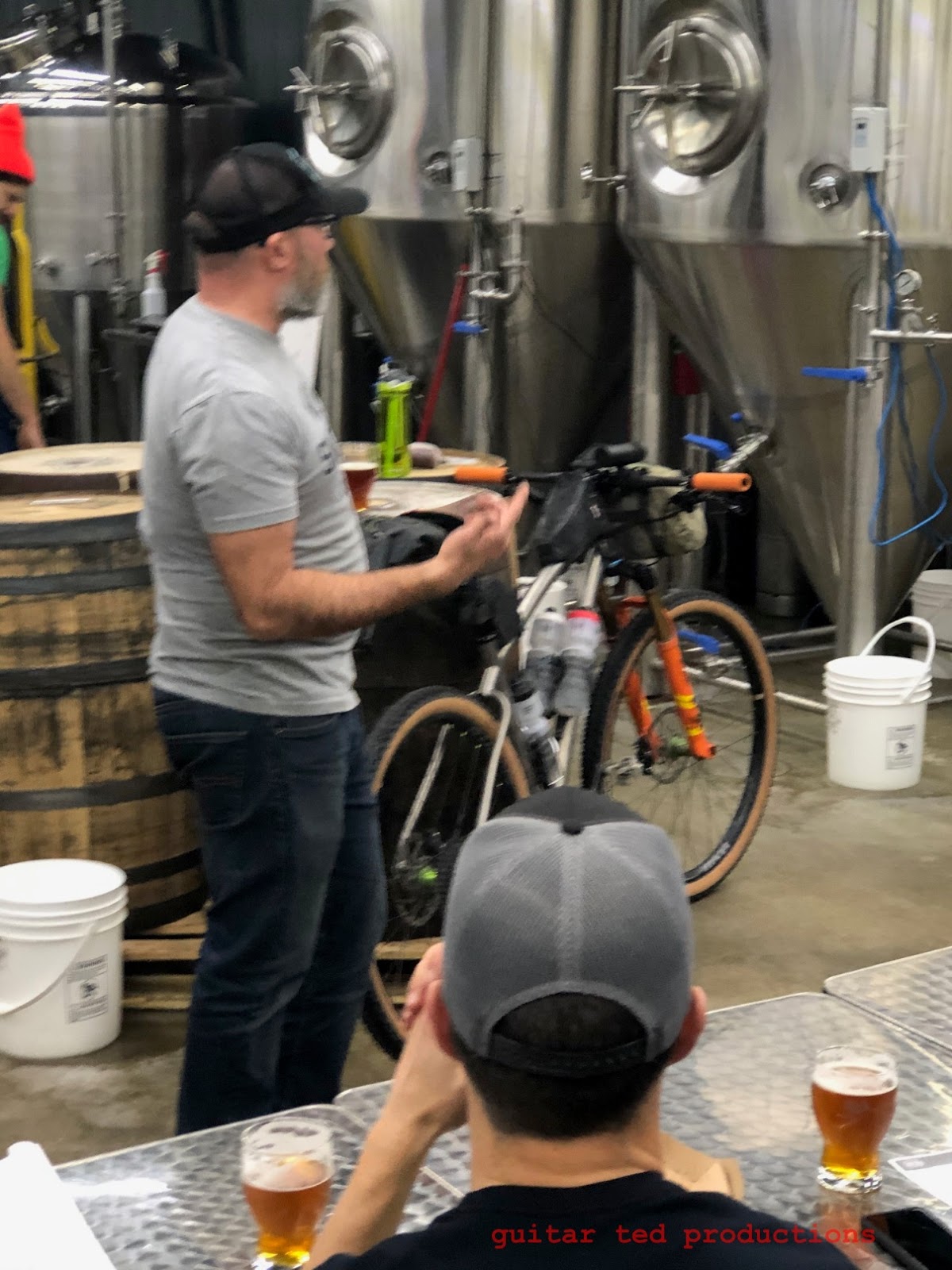
Now with that out of the way, the third session had better weather and maybe was our best attended session of the four. This one saw a presentation from a local fat bike race and from Dan Roberts, of the Snaggy Ridge 105, a gravel race out of Tipton, Iowa. After that we had a presentation from N.Y. Roll on his ultra-distance experience in the BC Epic event last Summer in Canada. He brought in one of his bikes all set up as he might have had it for that long bike-packing event, and talked about his reasons for his choices.

Todd Young presents his event, ICGravel, which happens near Iowa city, Iowa
The 4th session was where we saw a gathering nearly as big as session #3's, which, honestly, I was super surprised by. The reason is that locally the CVAST soft trails group decided to have their event the same evening, (despite our picking that date first and publicizing it), so I expected a worse turn out than the weather affected session #2. However; that wasn't that case, and we also had out of town representation again. This time from Iowa Falls and Alden, Iowa.

The event featured this time was ICGravel and Todd Young came up to present on behalf of that event. After Todd's excellent presentation, I got to talk about what it takes to put on a gravel event, and judging by the responses, it went over quite well. With that our four session pop-up series was a wrap. So, now it is time to take stock, assess our efforts, and look toward the future a bit.

N.Y. Roll and I have already been batting around a lot of ideas. Here's the thing- again, sorry- but we do not have a pool of money to work with. We will, if we do this again, be pulling ourselves up by our own bootstraps unless we get backing from an unforeseen source. So, bearing that in mind, our ideas have to be based in that reality.

I think the dynamic of the pop-up series model is a good one, and one we'd likely stick to again. A bigger, one-off event takes a LOT more logistical and financial horsepower. Plus, each presenter gets lost in the haze of the "everything going on", which is not what we intend. We want to spotlight Iowa gravel events. The pop-up idea did just that. Plus, people can pick and choose what they want to come and hear about.

N.Y. Roll and his bikepacking rig at session #3.
So, the pop-up idea works best for that, and we will likely stick to that format. With that in mind, does it make sense to move the pop-up series to different locations? Obviously, getting venues becomes much more complicated, but this is an intriguing idea and one we will be looking at.

The IGE has been, since its inception, all about Iowa gravel events. But, every time N.Y. Roll and I talk about this, the idea of bikes and associated gear comes up. Could the Iowa Gravel Expo be like the Iowa Bicycle Expo, or even be a part of that? I think so, but N.Y. Roll and I also both believe that the event presentations and the gathering of the riders is more important, and that by mixing that in with what the Iowa Bicycle Expo is about, we feel it would dilute the product. It would become just another booth on the showroom floor. So, we never get beyond the talking stages on that idea. But that doesn't mean we couldn't show some bikes and gear at a pop-up, let's say. In the end, it isn't really that high on our "to-do list".

Speaking of venues again- We have also thought about moving the IGE to a warmer time of year and doing it outdoors. If that idea were to be pursued, it may open up a lot of venue choices and other possibilities. So, we're toying around with that too.

In the end, we feel we were successful this year. The changes made were positive and still have potential. So, if we stuck to the basic formula from 2020 and went for that again in 2021, (Second State Brewing willing), I have no problem with that. But we have a long time to work on next year, if we do it again.

Thanks To The Iowa Gravel Expo Series Sponsors: Andy's Bike Shop, Riding Gravel, Second State Brewing, N.Y. Roll, and Guitar Ted Productions.

Iowa Gravel Expo Pop-Up Series Reviewed

Session #1 Jen Reed presents the event, "Turds of Misery"
With last Wednesday's final pop-up for the Gravel Expo, it is time to assess how it went, and to look toward the future. When N.Y. Roll and I started this deal we were amazed by the interest and demand for knowledge and for the community to gather during the 'down time" of Winter. We went from a single event on a single evening to a two session event on a single day to this pop-up series. All within three years.  The changes made the dynamic different, and I think we learned a lot along the way. But before I get to the lessons learned and what the future of the event may look like, it is time to review the just completed series.

With the change in venue and format, we did not really have a clear idea on what to expect. So, N.Y. Roll and I were pleasantly surprised to see a nice gathering of folks for the first session. We had people from the Des Moines area and our presenter, Jen Reed, from the Bettendorf, Iowa area talking about the "Turds of Misery" event. (Yes- that is the event's name) My presentation afterward then finished up our first evening. N.Y. Roll and I were pleased with how things went and we noted several folks from the local area, (and a local bike shop employee or two), that were in attendance. A good start then.

Session #2 was marked by a Winter Weather Advisory and it was snowing pretty good right at the time of the second session. This damped the attendance a bit, but we still had a nice gathering to see Dangerous Dan's presentation for the Sterile Iowan event. N.Y. Roll then presented the "How To Choose an Event and to Train For It" talk. This was all well received by those that could make it.

Dangerous Dan at session #2
By this time we were getting feedback that we should have put these pop-up series on during the weekends when people weren't having work obligations and whatnot. Yes. We get that, but here is "our reality" when it comes to venues, business support, and being able to do this.

First thing to understand is that we have zero for a budget. We also charge no attendance fees. We are not paying anyone for appearances. N.Y. Roll and I put in all the behind the scenes work for nothing. Do you understand now that we have no money? That's the first part of the puzzle to get here.

Next is that since we cannot pay for a room, we have to provide the venue owner/manager a benefit. In the previous case of the IGE, (Iowa Gravel Expo), we were bringing in a fairly decent number of people, (80+) to a restaurant which would not have gotten those patrons otherwise. Beer and food was "seeded" by N.Y. Roll's bankrolling the event with beverage and food purchases which then were offered for free to the crowd. (Yes- we lost money the first time)

For the Pop-Up Series we went to Second State Brewing, who wanted to bolster mid-week business. We brought more people than they normally would have had on Wednesday evening for four weeks during their slowest time of the year. The IGE was a benefit monetarily to Second State Brewing. Weekends are different for them. They did not need our help for the weekends. So, with that all said, do you understand why we did Wednesdays now?

Session #3 saw Dan Roberts of the Snaggy Ridge 105 presenting.
I apologize for the economic banter and bluntness, but I feel that many folks don't understand what you have to do to get a space and to make something seemingly so simple actually happen. You come to a Pop-Up Series event and just walk right in, sit down, and consume our content and maybe have a beer or two. Big deal? Yes, a very big deal. In fact, I just described above the "deal" we brokered to get the space. Would you be able to pull that off? Get it done so you could have folks on a weekend? Right......

Let N.Y. Roll or I know your plan for that when/if you care to share it. We're all ears here, but the bottom line is that this isn't easy. By the way, thanks to N.Y. Roll, Nick of Second State Brewing, and his staff there for making this happen for us. I think we pulled our end of the deal off well, and judging by the smiles at Second State I noted, I think it is safe to say they thought it worked for them as well. So, yeah......"have it on a weekend!", we hear ya. But that wasn't a possibility, and I hope people that read this understand now why.

Now with that out of the way, the third session had better weather and maybe was our best attended session of the four. This one saw a presentation from a local fat bike race and from Dan Roberts, of the Snaggy Ridge 105, a gravel race out of Tipton, Iowa. After that we had a presentation from N.Y. Roll on his ultra-distance experience in the BC Epic event last Summer in Canada. He brought in one of his bikes all set up as he might have had it for that long bike-packing event, and talked about his reasons for his choices.

Todd Young presents his event, ICGravel, which happens near Iowa city, Iowa
The 4th session was where we saw a gathering nearly as big as session #3's, which, honestly, I was super surprised by. The reason is that locally the CVAST soft trails group decided to have their event the same evening, (despite our picking that date first and publicizing it), so I expected a worse turn out than the weather affected session #2. However; that wasn't that case, and we also had out of town representation again. This time from Iowa Falls and Alden, Iowa.

The event featured this time was ICGravel and Todd Young came up to present on behalf of that event. After Todd's excellent presentation, I got to talk about what it takes to put on a gravel event, and judging by the responses, it went over quite well. With that our four session pop-up series was a wrap. So, now it is time to take stock, assess our efforts, and look toward the future a bit.

N.Y. Roll and I have already been batting around a lot of ideas. Here's the thing- again, sorry- but we do not have a pool of money to work with. We will, if we do this again, be pulling ourselves up by our own bootstraps unless we get backing from an unforeseen source. So, bearing that in mind, our ideas have to be based in that reality.

I think the dynamic of the pop-up series model is a good one, and one we'd likely stick to again. A bigger, one-off event takes a LOT more logistical and financial horsepower. Plus, each presenter gets lost in the haze of the "everything going on", which is not what we intend. We want to spotlight Iowa gravel events. The pop-up idea did just that. Plus, people can pick and choose what they want to come and hear about.

N.Y. Roll and his bikepacking rig at session #3.
So, the pop-up idea works best for that, and we will likely stick to that format. With that in mind, does it make sense to move the pop-up series to different locations? Obviously, getting venues becomes much more complicated, but this is an intriguing idea and one we will be looking at.

The IGE has been, since its inception, all about Iowa gravel events. But, every time N.Y. Roll and I talk about this, the idea of bikes and associated gear comes up. Could the Iowa Gravel Expo be like the Iowa Bicycle Expo, or even be a part of that? I think so, but N.Y. Roll and I also both believe that the event presentations and the gathering of the riders is more important, and that by mixing that in with what the Iowa Bicycle Expo is about, we feel it would dilute the product. It would become just another booth on the showroom floor. So, we never get beyond the talking stages on that idea. But that doesn't mean we couldn't show some bikes and gear at a pop-up, let's say. In the end, it isn't really that high on our "to-do list".

Speaking of venues again- We have also thought about moving the IGE to a warmer time of year and doing it outdoors. If that idea were to be pursued, it may open up a lot of venue choices and other possibilities. So, we're toying around with that too.

In the end, we feel we were successful this year. The changes made were positive and still have potential. So, if we stuck to the basic formula from 2020 and went for that again in 2021, (Second State Brewing willing), I have no problem with that. But we have a long time to work on next year, if we do it again.

Thanks To The Iowa Gravel Expo Series Sponsors: Andy's Bike Shop, Riding Gravel, Second State Brewing, N.Y. Roll, and Guitar Ted Productions.

Friday, February 21, 2020

Friday News And Views

Early "Slop Season" road from 2018
Entering The Slop Season:

Well, we're just about to the end of February and that means that "Slop Season" is just around the corner. "What is that?", you might ask. Well, it is when the roads are in the process of thawing out and the frost draws up out of the ground. This makes the roads soft, wet, muddy, and therefore, sloppy. Slop Season. Get it?

This is a hard time in the cycling season for many folks. Traditionally, roadie season cycling was about the only game in town, but with deaths, injuries, and too many close calls to name, most of us aren't going out for road rides these days. Not with distracted drivers and just plain bad, lazy drivers out on the roads. I know we like to blame electronic devices for much of the mayhem that affects us cyclists, but I'm here to tell you that just plain old bad driving skills and poor decisions are killing more than we care to admit.

Anyway....

The point is, the trails for off road are not suitable to ride on, road cycling is too dangerous, and gravel roads are there , but you'd better be prepared for some gooey-going.  When Winter fades and Spring edges in, the gravel roads can be pretty bad. This is when I bust out the wider tires and fenders. Remember those? British folk call 'em mudguards. That's actually exactly what they are during "Slop Season" here.

I also will ride single speeds. In fact, the old "Orange Crush" BMC is set up specifically to tackle "Slop Season" this year with a single speed set up and mudguards. Derailleur drive trains can get destroyed in the slop or the rear derailleur can be completely ripped off your bike! Single speeds get around all that, plus they are easier to maintain. But yeah....I'll also still run a fully geared bike. The BMC MCD with full mudguards will be fitted with the fatter 650B tires which allow for a bit less of a "pizza cutter" effect on the softer roads.

I'm sure Winter will make a final appearance or maybe two, but Slop Season is nigh, and there is no stopping it.

A nod to the grassroots gravel events. Where gravel gets its "realness" from.
 A Good Word;

You know I've banged on about how the entire gravel scene is basically a grassroots scene, built by the populace, not by the marketing machine. But we're becoming victims of our own, homegrown success. Now the slick, fancy messages from the traditional cycling media and the former roadie Pros turned gravel grinders have been making a raucous noise about how this is "the new thing", when in fact, it most certainly is not "the new thing", and especially not because they say it is so. There's this thing called "history". They might want to look into that.

Anyway, I welcome them regardless. I welcome them to what we've been doing for about a decade and a half now. Hope they have fun. But enough about what I think. I'm not the only one seeing this. A gravel rider and friend of mine from South Dakota, Craig Groseth, has similar thoughts, only maybe his are more concisely and clearly laid out than my ramblings are. If you care to check out what he has written, click HERE.

I met Craig while grinding away in central Nebraska at Odin's Revenge. Woo! That was some kinda tough right there, and I do miss that event, and seeing Craig also. I guess they have a new event out that way which is set to take in some of that Odin's area. I just cannot get out there this year due to the new job, but it looks tasty.

Anyway, Craig is a great guy and I just wanted to point out another take on the scene. Thank you, Craig!

Specialized CG-R seat post
 Seat Post Shoot-Out:

Several years ago MG and I ran a seat post shoot-out on the old "Gravel Grinder News" site. We had that Ergon/Canyon leaf spring deal, a Niner RDO post, and I think something titanium was thrown in the mix as well. Anyway.....

Now we have the Kinekt suspension post, the new Redshift Sports ShockStop post, and the old Cane Creek Thudbuster suspension post. I'm going to pit my experiences with these posts against some fully rigid offerings like the new PRO Discover Carbon post with Dyneema, and this guy here......a Specialized CG-R. 

I've wanted to get my hands on one of these posts for years. It has been around since at least 2012, as near as I can tell, and I remember trying to get one for our old shoot-out. Unfortunately it never materialized. But here is a used one I got my hands on, and I am going to check it out. It gets great reviews, from what I can see, but there are a few things that are nits on this post as well. One being the 25mm of setback. Not everyone is going to get along with that! Some also allude to the post's shaft being where all the comfort comes from and not so much from the funky head design, but I will try to see if I can figure out what is going on with this particular post, along with the others as well.


That's all for this week! Have a great weekend!

Friday News And Views

Early "Slop Season" road from 2018
Entering The Slop Season:

Well, we're just about to the end of February and that means that "Slop Season" is just around the corner. "What is that?", you might ask. Well, it is when the roads are in the process of thawing out and the frost draws up out of the ground. This makes the roads soft, wet, muddy, and therefore, sloppy. Slop Season. Get it?

This is a hard time in the cycling season for many folks. Traditionally, roadie season cycling was about the only game in town, but with deaths, injuries, and too many close calls to name, most of us aren't going out for road rides these days. Not with distracted drivers and just plain bad, lazy drivers out on the roads. I know we like to blame electronic devices for much of the mayhem that affects us cyclists, but I'm here to tell you that just plain old bad driving skills and poor decisions are killing more than we care to admit.

Anyway....

The point is, the trails for off road are not suitable to ride on, road cycling is too dangerous, and gravel roads are there , but you'd better be prepared for some gooey-going.  When Winter fades and Spring edges in, the gravel roads can be pretty bad. This is when I bust out the wider tires and fenders. Remember those? British folk call 'em mudguards. That's actually exactly what they are during "Slop Season" here.

I also will ride single speeds. In fact, the old "Orange Crush" BMC is set up specifically to tackle "Slop Season" this year with a single speed set up and mudguards. Derailleur drive trains can get destroyed in the slop or the rear derailleur can be completely ripped off your bike! Single speeds get around all that, plus they are easier to maintain. But yeah....I'll also still run a fully geared bike. The BMC MCD with full mudguards will be fitted with the fatter 650B tires which allow for a bit less of a "pizza cutter" effect on the softer roads.

I'm sure Winter will make a final appearance or maybe two, but Slop Season is nigh, and there is no stopping it.

A nod to the grassroots gravel events. Where gravel gets its "realness" from.
 A Good Word;

You know I've banged on about how the entire gravel scene is basically a grassroots scene, built by the populace, not by the marketing machine. But we're becoming victims of our own, homegrown success. Now the slick, fancy messages from the traditional cycling media and the former roadie Pros turned gravel grinders have been making a raucous noise about how this is "the new thing", when in fact, it most certainly is not "the new thing", and especially not because they say it is so. There's this thing called "history". They might want to look into that.

Anyway, I welcome them regardless. I welcome them to what we've been doing for about a decade and a half now. Hope they have fun. But enough about what I think. I'm not the only one seeing this. A gravel rider and friend of mine from South Dakota, Craig Groseth, has similar thoughts, only maybe his are more concisely and clearly laid out than my ramblings are. If you care to check out what he has written, click HERE.

I met Craig while grinding away in central Nebraska at Odin's Revenge. Woo! That was some kinda tough right there, and I do miss that event, and seeing Craig also. I guess they have a new event out that way which is set to take in some of that Odin's area. I just cannot get out there this year due to the new job, but it looks tasty.

Anyway, Craig is a great guy and I just wanted to point out another take on the scene. Thank you, Craig!

Specialized CG-R seat post
 Seat Post Shoot-Out:

Several years ago MG and I ran a seat post shoot-out on the old "Gravel Grinder News" site. We had that Ergon/Canyon leaf spring deal, a Niner RDO post, and I think something titanium was thrown in the mix as well. Anyway.....

Now we have the Kinekt suspension post, the new Redshift Sports ShockStop post, and the old Cane Creek Thudbuster suspension post. I'm going to pit my experiences with these posts against some fully rigid offerings like the new PRO Discover Carbon post with Dyneema, and this guy here......a Specialized CG-R. 

I've wanted to get my hands on one of these posts for years. It has been around since at least 2012, as near as I can tell, and I remember trying to get one for our old shoot-out. Unfortunately it never materialized. But here is a used one I got my hands on, and I am going to check it out. It gets great reviews, from what I can see, but there are a few things that are nits on this post as well. One being the 25mm of setback. Not everyone is going to get along with that! Some also allude to the post's shaft being where all the comfort comes from and not so much from the funky head design, but I will try to see if I can figure out what is going on with this particular post, along with the others as well.


That's all for this week! Have a great weekend!

Thursday, February 20, 2020

Deep Dive; Down The Rabbit Hole Of Tire Nomenclature

In the late 19th Century, it was all about diameter.
Okay! Today you had better be prepared to get your "nerd' on, because we're taking a deep dive into why tires have the designations that they do. Some of what I am going to share is knowledge I picked up along my journey as a bicycle mechanic. But I am going to credit a few folks right up front here. Thank you to Wes Williams, Clayton Wangbichler of WTB, and the inimitable Sheldon Brown (RIP) and his website.

I'm going to breeze through a LOT of technicalities here and focus only on a few salient points, so please bear this in mind. 

Wheels. That was what it all was about back in the late 19th Century. Wheels determined how fast or slow you could go, and this was figured out based upon a formula which required the measurement of the overall diameter of said wheel. Keep in mind that "tires' were nothing more than a steel strip over wood, or maybe a wired on rubber tube later on.  Pneumatic tires came around right around the turn of the century, but this wouldn't get sorted out until the 20th Century as tires you and I might recognize today. The point is, tires added little, if anything, to overall diameter.

Along with this tire/wheel thing, we had other factors which eventually lead to the "Safety Bike". Now wheels were not driven "directly", but by means of a crankset, chain, rear cog, and the rear wheel. This complicated things for the early wheelman, as it made figuring out your wheel development, or how far your wheel traveled with one revolution, much more of a chore. However; rear wheel diameter was still important to know so one could figure this out. Pnuematic tires also complicated things because they added to the overall wheel diameter. Now throw in bigger, or smaller volume of tires. Generally speaking, wider tires are going to add more diameter to a fixed diameter of wheel/rim. This radically changed gear development, so something had to be done to tame this cacophony of innovation and confusing tire/wheel sizes. This didn't happen for several years, thanks to two World Wars, innovations in automobiles and airplanes, and the ups and downs of economies. But eventually, it happened.

We pretty much have the French to thank for our predicament today. They helped develop a system of codification for wheels. Because the bicycle wheel was a worldwide phenomenon, we ended up with a mixed bag of Imperial and Metric measures for wheels. This really makes things hard, but we will stick to the metric side of things here.

The French made some wheels standardized around the 650mm diameter, but keep in mind, that's overall diameter. They way it was supposed to work was that if you had a skinny, low volume tire, you'd need a larger diameter rim to make the tire/rim combination equal 650mm. This was designated as 650A. Medium sized tires, with larger volume, required a smaller diameter rim, and thus the 650B designation. The largest volume tires went on even smaller rims, and these were designated 650C.

650B really doesn't tell us what size tires we are looking at anymore like it used to.
Copy and paste for 700 sized wheels. They were supposed to be 700mm overall diameter and rims varied in diameter depending upon tire volume. You now know that the "c" in 700c meant- originally- that a pretty good sized tire was supposed to be on there. But none of this applies in 2020. Obviously. That "c" in 700c is pretty much meaningless. You know this because a 29"er tire and a 700 X 44mm tire can both go on the same rim, but both result in vastly different diameters.

And of course, figuring out wheel/gear development is an arcane practice which few engage in anymore anyway. We keep saying "700c" because we need to call it something and traditions die hard. But now you know a little bit of that story. Now I want to address another letter "c".

That being the "c" people sometimes drop behind the millimeter measurement of a tire's width. Example: 700 X 44c. What is that? If we are measuring in millimeters, is the "c" for centimeters? Obviously that cannot be the case, although a 44cm wide tire would be rad on snow! No, here's what the deal is, as I have come to find out. Thanks to WTB's Clayton Wangbichler for the following.

Rims weren't always how we know them today. There were hookless rims, (Schwinn was famous for these), and there were a type of hooked bead rim called "crochet style". The "c" behind the tire designation for width would often have an upper case "C" to designate that the tire was designed for the crochet style rim bead. So, "44C" would be an example of how many companies would have designated such a thing. Eventually this important designation became meaningless as all rims became more or less standardized, and the "C" became "c", because.........tradition and marketing. It doesn't tell us anything.

In fact, Clayton from WTB told me that WTB has dropped the "c" on 700 and the "c" or "mm" from the width too. (Note the image above) So, there ya go. I've always wondered what the heck the 'c" was for on the width measurement, and now I know it doesn't really mean anything. It's just a mannerism, a vestige of days gone by. Not that you or anyone else should follow suit with WTB and stop using that, but, as Clayton told me, "We've all offended", and I think what he means is that we all were just doing what we had been seeing and not really asking "why?'. I think, given the history, it maybe will bring about a clearer way for talking about tires in the future. Not that we've gotten away from some other confusing bits. Like mixing metric and Imperial measurements!

For a bit of a visual presentation on the "A", "B", "C" French thing, here is a link to a GCN video which does a great job of explaining it.  https://youtu.be/xlyuWSrbGyk?t=786

Once again, a big thanks to all of you folks for reading.

Deep Dive; Down The Rabbit Hole Of Tire Nomenclature

In the late 19th Century, it was all about diameter.
Okay! Today you had better be prepared to get your "nerd' on, because we're taking a deep dive into why tires have the designations that they do. Some of what I am going to share is knowledge I picked up along my journey as a bicycle mechanic. But I am going to credit a few folks right up front here. Thank you to Wes Williams, Clayton Wangbichler of WTB, and the inimitable Sheldon Brown (RIP) and his website.

I'm going to breeze through a LOT of technicalities here and focus only on a few salient points, so please bear this in mind. 

Wheels. That was what it all was about back in the late 19th Century. Wheels determined how fast or slow you could go, and this was figured out based upon a formula which required the measurement of the overall diameter of said wheel. Keep in mind that "tires' were nothing more than a steel strip over wood, or maybe a wired on rubber tube later on.  Pneumatic tires came around right around the turn of the century, but this wouldn't get sorted out until the 20th Century as tires you and I might recognize today. The point is, tires added little, if anything, to overall diameter.

Along with this tire/wheel thing, we had other factors which eventually lead to the "Safety Bike". Now wheels were not driven "directly", but by means of a crankset, chain, rear cog, and the rear wheel. This complicated things for the early wheelman, as it made figuring out your wheel development, or how far your wheel traveled with one revolution, much more of a chore. However; rear wheel diameter was still important to know so one could figure this out. Pnuematic tires also complicated things because they added to the overall wheel diameter. Now throw in bigger, or smaller volume of tires. Generally speaking, wider tires are going to add more diameter to a fixed diameter of wheel/rim. This radically changed gear development, so something had to be done to tame this cacophony of innovation and confusing tire/wheel sizes. This didn't happen for several years, thanks to two World Wars, innovations in automobiles and airplanes, and the ups and downs of economies. But eventually, it happened.

We pretty much have the French to thank for our predicament today. They helped develop a system of codification for wheels. Because the bicycle wheel was a worldwide phenomenon, we ended up with a mixed bag of Imperial and Metric measures for wheels. This really makes things hard, but we will stick to the metric side of things here.

The French made some wheels standardized around the 650mm diameter, but keep in mind, that's overall diameter. They way it was supposed to work was that if you had a skinny, low volume tire, you'd need a larger diameter rim to make the tire/rim combination equal 650mm. This was designated as 650A. Medium sized tires, with larger volume, required a smaller diameter rim, and thus the 650B designation. The largest volume tires went on even smaller rims, and these were designated 650C.

650B really doesn't tell us what size tires we are looking at anymore like it used to.
Copy and paste for 700 sized wheels. They were supposed to be 700mm overall diameter and rims varied in diameter depending upon tire volume. You now know that the "c" in 700c meant- originally- that a pretty good sized tire was supposed to be on there. But none of this applies in 2020. Obviously. That "c" in 700c is pretty much meaningless. You know this because a 29"er tire and a 700 X 44mm tire can both go on the same rim, but both result in vastly different diameters.

And of course, figuring out wheel/gear development is an arcane practice which few engage in anymore anyway. We keep saying "700c" because we need to call it something and traditions die hard. But now you know a little bit of that story. Now I want to address another letter "c".

That being the "c" people sometimes drop behind the millimeter measurement of a tire's width. Example: 700 X 44c. What is that? If we are measuring in millimeters, is the "c" for centimeters? Obviously that cannot be the case, although a 44cm wide tire would be rad on snow! No, here's what the deal is, as I have come to find out. Thanks to WTB's Clayton Wangbichler for the following.

Rims weren't always how we know them today. There were hookless rims, (Schwinn was famous for these), and there were a type of hooked bead rim called "crochet style". The "c" behind the tire designation for width would often have an upper case "C" to designate that the tire was designed for the crochet style rim bead. So, "44C" would be an example of how many companies would have designated such a thing. Eventually this important designation became meaningless as all rims became more or less standardized, and the "C" became "c", because.........tradition and marketing. It doesn't tell us anything.

In fact, Clayton from WTB told me that WTB has dropped the "c" on 700 and the "c" or "mm" from the width too. (Note the image above) So, there ya go. I've always wondered what the heck the 'c" was for on the width measurement, and now I know it doesn't really mean anything. It's just a mannerism, a vestige of days gone by. Not that you or anyone else should follow suit with WTB and stop using that, but, as Clayton told me, "We've all offended", and I think what he means is that we all were just doing what we had been seeing and not really asking "why?'. I think, given the history, it maybe will bring about a clearer way for talking about tires in the future. Not that we've gotten away from some other confusing bits. Like mixing metric and Imperial measurements!

For a bit of a visual presentation on the "A", "B", "C" French thing, here is a link to a GCN video which does a great job of explaining it.  https://youtu.be/xlyuWSrbGyk?t=786

Once again, a big thanks to all of you folks for reading.

Wednesday, February 19, 2020

The Last Pop-Up Is Tonight!

This is N.Y. Roll. He's gonna let me talk this time!
Iowa Gravel Expo Pop-Up Series #4 Tonight!

Tonight will mark the end of the 2020 Iowa Gravel Expo series we've been putting on since mid-January every other week. This is being held at Second State Brewing in Cedar Falls, Iowa at 6:30pm - 7:30pm-ish. The topic of this session will be "How To Start And Organize A Gravel Event". 

The series has been successful so far and we hope that we get a few folks tonight despite a competing event which scheduled on the same evening after we did. It's one of those things though- there's always something else going on. 

Anyway, I thought maybe it might be a good idea to do a bit of a mini-series on this blog about how I approached putting on the gravel events I have done in the past. So, that's something I'll probably tackle coming up in March. It'll be brief, nothing huge.

To my way of thinking, in general, there are really not many bullet points to putting on an event. Details can get you into the weeds, so as a person that puts on events, you always have to keep your eyes up and on the big picture. Generally this always should go back to your core ideals and goals. So, if you are all about a loose, fun, simple, and a more organic feel for an event, then chip timing and blow-up finish line arches are probably something you want to steer clear of. If, however; you are all about ultra-competitive, high-performance, traditional racing, then you have to have those amenities I mentioned. But everything you consider has to be consistent with your vision for the event. That's just one example of this sort of decision making I give you there.

And timing and finish line hoopla is not necessarily exclusive to a loose, organic feel, so don't go reading into my examples here. I'm just trying to illustrate a point. In the end, "you do you" when it comes to an event. The worst thing one can do is try to appeal to people they do not understand. (That is- unless you are willing to bring on people that do understand the groups you want to see attending, and have THEM run the event, which isn't always possible.) Do an event that appeals to you. What would you like to see? Do that.

Of course there is a LOT more to it, but I think people forget about how their visions of things probably will appeal to a lot of folks out there. You don't have to try to appeal to things you don't understand. It's your event. Of course there will be people that don't like it, that will criticize it, and even make fun of it. That's okay. They shouldn't be coming to your event and now you know who they are. That's all. That's all you should take away from that sort of thing. The ones that do come already pretty much agree with what you have going down. Worry about their experiences. 

Anyway, more to come on this, and if you are around, head over to Second State Brewing in Cedar Falls. I'd be happy to see you!  

The Last Pop-Up Is Tonight!

This is N.Y. Roll. He's gonna let me talk this time!
Iowa Gravel Expo Pop-Up Series #4 Tonight!

Tonight will mark the end of the 2020 Iowa Gravel Expo series we've been putting on since mid-January every other week. This is being held at Second State Brewing in Cedar Falls, Iowa at 6:30pm - 7:30pm-ish. The topic of this session will be "How To Start And Organize A Gravel Event". 

The series has been successful so far and we hope that we get a few folks tonight despite a competing event which scheduled on the same evening after we did. It's one of those things though- there's always something else going on. 

Anyway, I thought maybe it might be a good idea to do a bit of a mini-series on this blog about how I approached putting on the gravel events I have done in the past. So, that's something I'll probably tackle coming up in March. It'll be brief, nothing huge.

To my way of thinking, in general, there are really not many bullet points to putting on an event. Details can get you into the weeds, so as a person that puts on events, you always have to keep your eyes up and on the big picture. Generally this always should go back to your core ideals and goals. So, if you are all about a loose, fun, simple, and a more organic feel for an event, then chip timing and blow-up finish line arches are probably something you want to steer clear of. If, however; you are all about ultra-competitive, high-performance, traditional racing, then you have to have those amenities I mentioned. But everything you consider has to be consistent with your vision for the event. That's just one example of this sort of decision making I give you there.

And timing and finish line hoopla is not necessarily exclusive to a loose, organic feel, so don't go reading into my examples here. I'm just trying to illustrate a point. In the end, "you do you" when it comes to an event. The worst thing one can do is try to appeal to people they do not understand. (That is- unless you are willing to bring on people that do understand the groups you want to see attending, and have THEM run the event, which isn't always possible.) Do an event that appeals to you. What would you like to see? Do that.

Of course there is a LOT more to it, but I think people forget about how their visions of things probably will appeal to a lot of folks out there. You don't have to try to appeal to things you don't understand. It's your event. Of course there will be people that don't like it, that will criticize it, and even make fun of it. That's okay. They shouldn't be coming to your event and now you know who they are. That's all. That's all you should take away from that sort of thing. The ones that do come already pretty much agree with what you have going down. Worry about their experiences. 

Anyway, more to come on this, and if you are around, head over to Second State Brewing in Cedar Falls. I'd be happy to see you!  

Tuesday, February 18, 2020

WW4M: Topeak Joe Blow Sport Floor Pump

For a purchase that was meant to just "get me by" on a vacation.....
This is another "WW4M" post. That means "What Works For Me" and it may not work for you. So, take that with the following words into consideration.....

Probably about 2007, I think it was, I was on a vacation with my family to see my in-laws in El Paso Texas. That trip included my first with mountain bikes to that area. I was doing reviews for "Twenty Nine Inches", and I could ride "real" mountains down there, only 17 miles away from my relative's home. It was a perfect combination of "work and play" from my perspective.

So, besides trying to coordinate getting everyone packed up and ready for the two day drive down, I also had to get my gear together to support myself down there. I would be riding alone, so I was concerned about water, food, and even first aid should I have a mishap out there in the desert. To say I had a lot going on would be an understatement.

The trip went well, and when I had time to unpack down there, I realized I had forgotten my floor pump, an old, barely functional Blackburn one. Well, I had to have a floor pump. So, my brother in law suggested I go see Crazy cat Cyclery in El Paso. I found the shop, and told my wife I'd only be inthere a minute. I ran in, asked the clerk for a "decent floor pump", and he handed me this mustard colored Topeak job which went for about $25.00. "Perfect! I can make that work for the short time I'm here", I thought to myself. 

The rest of that trip was uneventful, I got my test riding in the mountains done, and when it came time to leave, I offered to leave the pump with my brother in law, as he was talking about maybe getting back into cycling. I thought, ya know, it was a cheap pump and I need one better than this anyway. However, my brother in law insisted I take it home, so I did.

Battered and beaten, but still pumping after all these years.
And that pump has been used, abused, and it still is kicking. I just cannot kill this thing. What is equally as amazing as this pump's long term performance is the fact that I have never had to install a single replacement part yet. No gaskets, no seals, no hoses. Nothing.

I've taken this pump on more El Paso trips, vacations, trips for races, and trips for testing gear. It's been down in the Lab pumping up tubeless tire set ups, fat bike tires, and I've used it to pump up my car and truck tires on numerous occasions.

One day I heard a weird hissing noise coming from the pump and I thought, well......this is it. This pump is finally done. However; after a short time of inspection I found the cause. A loose fitting, and once I tightened it, I was all good to go again. That's the only issue I've ever had with this pump.

Now you gotta figure that after having this pump for 13 years that the thought that this was just a purchase to get me by for a week was selling this pump short. I mean, it was 25 bucks! I've probably pumped up well over a thousand tires with this thing in that time. Maybe a couple thousand. I don't know, but I do know that for all the times I've knocked this thing around, and for a total lack of maintenance, I am pretty sure I got my money's worth. This thing has done all my tire testing work, since I use the gauge as a relative measure for my reviews, and I have done a boatload of tire reviews. So, if you ask me if this pump was worth it?.......

Yep. Pretty sure about that!

Anyway, I see no reason that this pump won't go a handful more years at the least. I do mix it up, as far as usage, with that new fangled Silca  pump I got about a year ago or so. That will help extend the life of this pump. But even so, I would expect this pump to be around a long time here. By the way, they do make replacement parts for the high wear parts on this pump, and I have the rebuild kit, because I figured I'd need it sooner or later. But that may be a long time from now!

Also a testament to the design- Topeak still makes this model floor pump. It's about $50.00 now, but ya gotta figure that if Topeak is using similar design, that $50.00 investment will last you well over ten years. That's a LOT of tire pumping. I should know.

Note: I bought the Topeak Joe Blow sport pump with my own money. I was not paid nor bribed for this review and I strive to give my honest thoughts and views throughout.

WW4M: Topeak Joe Blow Sport Floor Pump

For a purchase that was meant to just "get me by" on a vacation.....
This is another "WW4M" post. That means "What Works For Me" and it may not work for you. So, take that with the following words into consideration.....

Probably about 2007, I think it was, I was on a vacation with my family to see my in-laws in El Paso Texas. That trip included my first with mountain bikes to that area. I was doing reviews for "Twenty Nine Inches", and I could ride "real" mountains down there, only 17 miles away from my relative's home. It was a perfect combination of "work and play" from my perspective.

So, besides trying to coordinate getting everyone packed up and ready for the two day drive down, I also had to get my gear together to support myself down there. I would be riding alone, so I was concerned about water, food, and even first aid should I have a mishap out there in the desert. To say I had a lot going on would be an understatement.

The trip went well, and when I had time to unpack down there, I realized I had forgotten my floor pump, an old, barely functional Blackburn one. Well, I had to have a floor pump. So, my brother in law suggested I go see Crazy cat Cyclery in El Paso. I found the shop, and told my wife I'd only be inthere a minute. I ran in, asked the clerk for a "decent floor pump", and he handed me this mustard colored Topeak job which went for about $25.00. "Perfect! I can make that work for the short time I'm here", I thought to myself. 

The rest of that trip was uneventful, I got my test riding in the mountains done, and when it came time to leave, I offered to leave the pump with my brother in law, as he was talking about maybe getting back into cycling. I thought, ya know, it was a cheap pump and I need one better than this anyway. However, my brother in law insisted I take it home, so I did.

Battered and beaten, but still pumping after all these years.
And that pump has been used, abused, and it still is kicking. I just cannot kill this thing. What is equally as amazing as this pump's long term performance is the fact that I have never had to install a single replacement part yet. No gaskets, no seals, no hoses. Nothing.

I've taken this pump on more El Paso trips, vacations, trips for races, and trips for testing gear. It's been down in the Lab pumping up tubeless tire set ups, fat bike tires, and I've used it to pump up my car and truck tires on numerous occasions.

One day I heard a weird hissing noise coming from the pump and I thought, well......this is it. This pump is finally done. However; after a short time of inspection I found the cause. A loose fitting, and once I tightened it, I was all good to go again. That's the only issue I've ever had with this pump.

Now you gotta figure that after having this pump for 13 years that the thought that this was just a purchase to get me by for a week was selling this pump short. I mean, it was 25 bucks! I've probably pumped up well over a thousand tires with this thing in that time. Maybe a couple thousand. I don't know, but I do know that for all the times I've knocked this thing around, and for a total lack of maintenance, I am pretty sure I got my money's worth. This thing has done all my tire testing work, since I use the gauge as a relative measure for my reviews, and I have done a boatload of tire reviews. So, if you ask me if this pump was worth it?.......

Yep. Pretty sure about that!

Anyway, I see no reason that this pump won't go a handful more years at the least. I do mix it up, as far as usage, with that new fangled Silca  pump I got about a year ago or so. That will help extend the life of this pump. But even so, I would expect this pump to be around a long time here. By the way, they do make replacement parts for the high wear parts on this pump, and I have the rebuild kit, because I figured I'd need it sooner or later. But that may be a long time from now!

Also a testament to the design- Topeak still makes this model floor pump. It's about $50.00 now, but ya gotta figure that if Topeak is using similar design, that $50.00 investment will last you well over ten years. That's a LOT of tire pumping. I should know.

Note: I bought the Topeak Joe Blow sport pump with my own money. I was not paid nor bribed for this review and I strive to give my honest thoughts and views throughout.