
 |
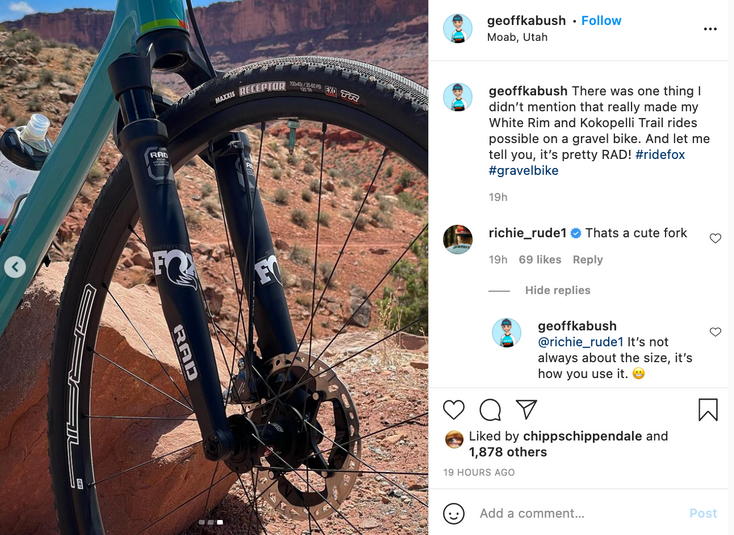
| Apparently leaked on social media, this Fox AX sus fork is rumored to be out this Fall. |
Many people weren't aware of that, but many Pro XC racers were effectively locking their suspension forks out and riding them rigid. Now, there could be a lot of reasons as to why that happened, but after riding the Fox AX Adventure fork a few years ago, I think I could tell you at least a couple of reasons why that was.
First of all, one should consider a few parameters which were non-negotiable for suspension on bicycles. One: Weight HAD to be minimized at all costs. This is probably the number one limitation upon suspension fork design to this very day. Since we were, and still are for the most part, speaking of 100% human powered design, weight is a critical factor to deal with and you want that weight to be as low in mass as possible. This means that certain things that may have stiffened up the chassis on forks, made them operate more efficiently, and which may have accounted for pedal induced movement had to be discarded in favor of light weight.
Secondly: Geometry for the bike had to be compromised to accept suspension. At first, this wasn't that big of a deal. 63mm of overall travel isn't a lot to account for, but there are no forks for MTB with that little of travel anymore, and most have a minimum of 100mm of travel. The 'sweet spot' for average mountain biking is 120mm-130mm. This length of suspension adds to the overall length of a bicycle fork, which has to be accounted for in design. The sloping top tube design was the answer to the question of how to do this, and front end height increased as a result.
 |
| The Fox AX suspension fork I tested for Riding Gravel in 2018. |
Why did we need more travel? Because it was quickly realized that 63mm, and really, even 80mm of travel, wasn't enough to account for everything a MTB was seeing in terms of trail obstacles, speeds, and being capable of dispersing energy in a way that riders would find acceptable.
So, that's a brief description of where we came from and why we went where we did with MTB suspension. What does that have to do with a 'gravel bike'? Well, certain things are happening here that are causing us to see that what is happening now with these short travel gravel forks and the initial wave of MTB forks is related. We also are seeing another effect happening. That being that MTB design has swung so far in one direction that a void exists which some folks are trying to fill with a 'gravel bike'.
Comments: In my opinion, we are reliving the past if we think for a moment that 40mm of damped travel will work in a way that is intended. These short travel forks, (Fox, White Brothers) address small inputs just fine, but are quickly overwhelmed when faced with anything resembling an MTB experience, and no wonder. While it is true that you could set it up differently, you are playing with such a restricted amount of travel that getting the kind of energy dissipated that one might see from riding rough single track is nearly impossible to do without compromising every other aspect of riding gravel. And then there is weight. You are adding a LOT of weight for not much benefit here. I have not even touched the complexity and maintenance issues either.
So, just use a Lauf type design then? Well, obviously the Lauf fork wins the weight and simplicity of design over the telescopic options, but it is not damped travel and you have to buy into the odd-ball looks. But yes- that fork is far superior for everything a gravel bike should be doing. I do not think 'gravel bikes' need to have MTB traits to handle MTB trails. Want to take that single track, that connector which has that rocky down hill, or what have you? Great, either live with 'underbiking' or get out your MTB hard tail which has all the versatility, utility, and capability you need to cover everything from fire roads to pretty tough back country stuff. Oh........those modern hard tails don't go very fast? They handle climbs a bit clumsily? You don't need 120-130mm of suspension business up front? I get that, and this is where the bicycle industry has gone wrong.
Once upon a time when NORBA Pro MTB'ers competed, they had to do a hill climb, a down hill competition, a trials competition, and an XC race, all on the same bike. I know...it sounds far-fetched, but it is true. At one time a mountain bike was made to cover all the mountain biking needs. Of course, specialization came in and changed all of that, but somehow the multi-purpose all-terrain rig held on. Then about ten years ago, that all changed.
 |
| The Gen I Fargo, as seen at the 2008 Interbike Outdoor demo, is 'that' bike that is missing. |
Drive trains became more limited in range on the high end to accommodate short chain stays and huge tires. Front ends got really jacked up to accommodate longer suspension forks, and more, of course, happened along the way and the next thing ya know, that versatile off-road vehicle was gone. Fat bikes could be said to be 'that bike', but those huge, heavy tires and still, you also lack the high speed drive train along with that low end grunt. It just is not the same thing.
So, we get these bikes with curly bars, barely big enough tires (50mm) and now they want to put some anemic front suspension fork on this? I'm saying this is a whack idea based upon the idea that 'anything gravel sells', not on real-life, sensible design and practicality for use. Keep gravel bikes 'road based' and if you go off-road, well then design this bike that is missing in action these days. But don't try to use a 'Gravel®' as a marketing ploy to make 'that' bike happen again. It's going about it all the wrong way.
The bike that they are all mimicking, the one bike that solves the problem of 'curly barred, big tired, "mountain bike-versa-tool" is the Gen I Fargo which came out in 2008. Make that bike, a flat bar version, (El Mariachi?) and done. Make it accept 650B X 2.1's or 29"er X 2.4"ers and keep the geometry less slack. Add a big ringed crankset with at least two chain rings. (I'd still spec a triple), and make it 11 speed with at least 3 gears below 1 to 1 ratio and a big ring in the 46-48T range for speeding down fire roads and flats.
It would definitely NOT be a sexy bike, a racer's bike, or a bike that would figure into a marketing plan showing riders catching air, roosting, or bombing edits on social media. No, it would be that bike that most off-roaders should have. Just like most road bikers should not have racing oriented bikes, but they should have that 'all-road' bike misnamed the 'Gravel Bike'.
And that's my take..............


