Showing posts with label touring. Show all posts

Wednesday, June 25, 2025

Two Ways To Tour

Frame bags or....
 How Do You Carry Your Cargo For Overnights?

With Tour Divide in full swing, and a press release I received prompting my thoughts, I wanted to dive into the two ways to tour.  I have extensive experience with racks and bags, but while I do have all the stuff here to do a rackless type set up, I have not actually spent much time using this way of touring. My thoughts on the matter may be skewed, but I thought this exercise would be a fun one to consider.

Racks and bags have been the default way to tour for decades. When I participated in two fully-self-contained tours in the 90's, racks and bags were the only option. However; when the Great Divide Race/Tour Divide got rolling in the 2000's, rackless type set ups quickly became a thing based upon certain advantages this style of touring has. Okay- I can hear some of you already saying "bikepacking". But let's be honest: Bikepacking is touring. You can do this off-pavement or on pavement. Being a temporary homeless person via bicycle is essentially no different either way you decide to carry your stuff. So, let's get on with deciding which way is best.

....fully racked and bagged?
Full disclosure: I wrote a bit on this back in 2023. So, why dig into this again? Well, for a few reasons. First of all being that N.Y. Roll and I have a believe more and more people are tiring of |racing and want to have experiences via bicycle in a more non-competitive, relaxed manner. Focusing more on camaraderie and shared experiences instead, and what better way to do this than by touring?

Secondly, more rack options are becoming available which are easier to install and take off, making it easy to configure your bicycle for specific rides and not having to dedicate a bike to being "the bag-bike". Furthermore; frame bags are fine, but they have to be custom-made to fit, and again - dedicated to a specific bicycle. The "convertible" and versatile set ups, which often do not even require a bicycle to be rack compatible, are making touring and sub-24's easier than ever.

Frame bags have to be custom-fitted to a specific bicycle for best results. However; they are easily removed, unlike many racks. 
As I stated, I have a lot of frame bags, seat packs, top tube bags, and other bags as well. It was not until recently when I started reviewing some Old Man Mountain gear that I was reintroduced to racked touring options.One of the many features of their gear is one which I found fascinating, and that was the ability of thir racks to fit almost any type of bicycle.

It used to be racks only went on bicycles with rack mounts. Those eyeletted frames and forks were most often found on hard tails, touring bikes, and hybrid bicycles made from metal. Carbon fiber bikes? Yeah......rrrright! (Said in a Patrick Warburton voice) But no more! Even carbon bikes, full-suspension bikes, and non-eyeletted bikes can all have racks nowadays.

Who said you had to use racks or frame bags? Why not both!

And now quick-mount/dismount racks are making things even easier for those who want to just pop on a rack, attach a couple of panniers, and go have a picnic, or an over-night trip. So, choosing a rack system over a frame bag system is becoming less of a defined line. Heck, you can even use both types of systems on one bike.

There are finer points to discuss and you can get way into the weeds when it comes to bikepacking/touring stuff, but I think all those details only dampen the itch to go out and try something. I'd caution against too much thinking about details which really don't matter a lot. I will say a few things here which I have learned over the years which may help you out though, and are important to consider. I did mention three things to think about in the previous post mentioned above, and those are Weight, Wheels/Tires, and Comfort. I'll add a few things here and the first has to do with weight. 

Brakes: More weight means more to stop when the time comes. Your brakes need to be in tip-top shape. Not only that, but if your brakes are rim brakes, this means your rims need to be in good shape as well. Rims wear out at the braking track, so if those wheels are old, and your brake track feels concave when you check it out, it may be time for new wheels. (And your spokes and hubs will be better as well.) Disc brake pads wear out, as do rotors, and these points of possible failure are imperceptibly fine lines which, if crossed, can be catastrophic to you and your adventure. Cables, housings, and brake lines/fluid, (if using hydraulic brakes) should be in good order as well.

Air Pressure: Heavier loads will require you to adjust your air pressure upward. Using what usually works for your normal riding isn't going to be correct for loaded riding. Make sure to check tire recommendations and rim spec so you do not go overboard, but raising your air pressure somewhat from normal will be a best practice for loaded touring. 

Attention To Details: I know I intimated earlier to not sweat the small stuff too much, but if you plan on spending hours in the saddle to get somewhere, then those niggling bits you've been meaning to address should be taken care of before you embark on your voyage.  That dangling bit of bar tape, the stem that is slightly off center, or the squeaky seat you've been putting up with should be cleared up so you have one or two less things to stress you out mentally while you are traveling by bicycle. This isn't a point about "do this or that" as much as it is about getting mentally comfortable for long hours in the saddle. Little things you could get cleaned up before hand will bug the crap out of you on longer rides if you don't address them.

Racks or frame bags? Just get out there!
So, back to the way to go - Racks and bags or frame bags? You can go back and forth on either one, but whichever way you go, there are a lot more important things to think about hen going touring for a day or a month. The main thing should be "the main thing" and that would be just to get out there and do it.

Plus, who said you had to use racks and bags or frame bags? Use whatever you can get your hands on, and works for you, and get out there.

Also, I am writing this to myself more than any of you dear readers. I need to just get out there and do an overnight trip. I've had one planned for several years which I've wanted to do, and time keeps slipping away. It is a problem I need to address myself, so I am not trying to be preachy or whatever.

Hopefully I make the trip happen this Summer. Stay tuned.... 

Thursday, November 09, 2023

What Will The "Post-Gravel" Era Look Like?

A week or so ago N.Y. Roll asked a question during the recording of the "Guitar Ted Podcast" concerning the post-gravel era when he said, "Are we seeing the end of the Age of Gravel?" 

I found that question to be particularly intriguing. I am a strong believer that there are the beginnings and endings of things. Sometimes you see a cyclical, rise and fall, thing happening with trends and styles, but mainly, it is more of a beginning, middle period, and an ending. 

N.Y. Roll also mentioned in our latest recording (which you can listen to HERE) that we may not know when we are off the "peak of gavel" until after about three years, in his estimation. Hmm..... Okay. Let's assume that's about right for argument's sake. 

In the beginnings of this "Modern Day Gravel" era, we didn't have anything "gravel specific" at all. N.Y. Roll likes to say that we were in a "discovery phase" back then, and I cannot say he's wrong about that. So, it is easy to say we were at "the beginning" then, right? 

Then we had a period of growth, events came on line, more people were showing up to these events and then the cycling industry kicked into gear with gravel specific things about ten years ago now. People became less and less reliant on "self-discovery" and more and more it became an experience you "bought into". Things that were once a conundrum, (how to set up non-tubeless touring tires as tubeless, route discovery, bike choice) were now on a checklist to be procured at your local bike shop or online retailer. 

There were "bucket-list" events, Pros started showing up, prize money went up, and big corporations came in like Life Time Fitness, and even the highest form of competitive bicycle racing has a "world championships". Social media is flooded with gravel-this, gravel that to the point that it becomes white noise. 

"Peak Gravel" anyone?

There isn't anywhere else for "gravel" to go once it permeates everything.

I would submit that , yes, we have reached "Peak Gravel". When the genre has nowhere else to go in terms of reach, well....you are there, my friend!

So, I think it is safe to say that now we're on the backside of gravel cycling's growth curve. How will that look? Well, I think that in terms of cycling, we are in a depressed state, economically, right now. So, it is hard to say with any clarity what will happen right now without another form of cycling to come in and fill the void which will be left as gravel cycling declines in popularity. 

And make no mistake, gravel cycling cannot continue to grow forever, and it won't reach a plateau and stay there either. Evidence is all around us right now that supports this theory. People are selling gravel bikes and stating that they don't ride them, or that the niche of gravel is not for them. Sure....you are going to have that with any type of cycling. I understand that, but you gotta figure that the amount of folks that bought a gravel bike that are selling them off now have a certain element within that subgroup that came out a bit disillusioned with gravel cycling.  

Image courtesy of the Flint Hills Ultra Gravel Tour

There are splinters off the gravel scene proper which also may give us some clues as to what people will gravitate toward in the future. One of those activities is "touring/bikepacking". (Same thing?) Routes are popping up that cater to the gravel cyclist that can be done in a weekend or over several weeks and everything in between. Sites like Gravel Kansas are being populated with curated routes that have a story and historically significant landmarks to discover. I suspect that other states and counties may follow suit with this idea.

We even talked about this on the latest "Guitar Ted Podcast" with Bryan Hansel, a landscape photographer that lives in Northern Minnesota. He discovered an off-road vehicle route being proposed by the Minnesota DNR and went ahead and rode it recently. "Adventure by Bike", a concept initiated by Jason Boucher at Salsa Cycles, may actually make headway as an "alternative gravel style" via bikepacking routes across various states. 

Of course, traditional forms of cycling could certainly make comebacks. I feel that mountain biking is due for a bit of a renaissance. Same for road cycling, but on a much less popular stage due to the inherent risks involving motor vehicle/distracted driver issues. 

Those are my thoughts, but what about you? Have we reached "Peak Gravel"? What will be the "post-gravel" cycling form of choice? Let me know in the comments. 

Thanks for reading Guitar Ted Productions.

Wednesday, May 17, 2023

Rack vs Rackless: How to Carry Your Stuff

The Old Man Mountain Elkhorn rack
 Another "Guitar Ted Podcast" dropped yesterday (Link Here) and we were yakking about bikepacking. In that discussion the subject of "rack vs rackless" came up. If you don't understand, this describes the means by which you carry your essentials on a self-contained bicycle trip where overnight sleeping somewhere is part of the plan. 

You need clothes, you need food, you need water, you need toiletries, you need to bring a shelter, (optional) and/or a sleep system (again- optional), and how you plan on transporting that "stuff" on your bike (self-contained) is what this is about. 

Actually a lot of what you want to carry is maybe more of an option vs a "need", depending on who you plan on relying on. Credit card touring is one thing, a fully self-supported, self-contained tour is quite another. And there are all shades of those in between. 

Back to carrying the "stuff". Okay, there are various "strap-on" or maybe even bolt-on, bag solutions these days. But there are also bags that rely on metal, (or carbon sometimes) racks that bags either hang from or sit on. I've used all manner of bag systems and racks over my time in cycling and doing things in a more self-sufficient manner. I've got a lot of experience with front/rear rack/pannier type riding and with fully bagged out set ups too. 

Which is "best"? 

Well, to my way of thinking, neither way on their own is "best". The extremes are fine, but I think the savvy bike packer these days takes advantage of both ways. 

This is me with a rear pannier set up touring self-contained in 1995 somewhere in Nebraska.

 
I tested this bagged set up several years ago with 2.8" tires on my Gen I Fargo.

In my experience, there are a few things to think about here when it comes to using bags, racks, and being self-contained. in no particular order....

  • Weight: The big concern, for several reasons, is weight. Weight of your racks, bags, cargo, and how that all affects wheels, racks, bags, and even how your bike will handle stopping, turning, and climbing.
  • Wheels & Tires: You aren't going anywhere if your wheels and tires are not up for the challenge. Dealing with recurring issues like flat tires, broken spokes, or ill-handling wheels is a ride-killing thing.
  • Comfort: You also are not going anywhere if you are not comfortable with the obvious things, (saddles, handle bars, overall positioning on the bike), but you also won't go far if you are not comfortable mentally with your set up. Dry runs, trying different things well before the trip, and just general tweaking is good to arrive at a place where you are going to be settled mentally with how you are approaching carrying the "stuff". 

My set up I tested for my proposed two day tour on gravel that I planned last year.

As I said earlier, I think the best way to go, in my opinion, is somewhere in between fully racked out and fully rackless. I used a combo of racks and bags in last years testing for a two-day gravel tour which didn't pan out. Hopefully I'll get that done this year, but for this article the point is that I mixed racks and rackless bag ideas to arrive at a really good place for carrying the "stuff" I wanted to take on this trip. 

If the two-day gravel tour happens, this Gryphon Mk3 will likely be the bike I use.

The pink BMC was a bit of a handful in terms of handling loose crushed rock under that load, so now that I have the Singular Gryphon Mk3, that bike with its more stable 700 X 2.8" tires will likely get the call for that trip. 

So, it all matters: The bike, the way you want to carry the stuff, and if you are okay with all of that and can just concentrate on riding. How that all works when actually loaded up and going is a test that needs to be done long before you leave on that trip. So, now that I plan on using the Gryphon, I have to get it set up with the actual load I plan on using and then I have to ride that set up. I'll make adjustments, if necessary, from that point. 

The "rack vs rackless" thing is the least of your concerns. Actually trying things out is better, and I am betting that if you do try things out that you may arrive at a completely unique set up that is custom-made for you, be that with some racks or just bags, or more likely, something in between.

Rack vs Rackless: How to Carry Your Stuff

The Old Man Mountain Elkhorn rack
 Another "Guitar Ted Podcast" dropped yesterday (Link Here) and we were yakking about bikepacking. In that discussion the subject of "rack vs rackless" came up. If you don't understand, this describes the means by which you carry your essentials on a self-contained bicycle trip where overnight sleeping somewhere is part of the plan. 

You need clothes, you need food, you need water, you need toiletries, you need to bring a shelter, (optional) and/or a sleep system (again- optional), and how you plan on transporting that "stuff" on your bike (self-contained) is what this is about. 

Actually a lot of what you want to carry is maybe more of an option vs a "need", depending on who you plan on relying on. Credit card touring is one thing, a fully self-supported, self-contained tour is quite another. And there are all shades of those in between. 

Back to carrying the "stuff". Okay, there are various "strap-on" or maybe even bolt-on, bag solutions these days. But there are also bags that rely on metal, (or carbon sometimes) racks that bags either hang from or sit on. I've used all manner of bag systems and racks over my time in cycling and doing things in a more self-sufficient manner. I've got a lot of experience with front/rear rack/pannier type riding and with fully bagged out set ups too. 

Which is "best"? 

Well, to my way of thinking, neither way on their own is "best". The extremes are fine, but I think the savvy bike packer these days takes advantage of both ways. 

This is me with a rear pannier set up touring self-contained in 1995 somewhere in Nebraska.

 
I tested this bagged set up several years ago with 2.8" tires on my Gen I Fargo.

In my experience, there are a few things to think about here when it comes to using bags, racks, and being self-contained. in no particular order....

  • Weight: The big concern, for several reasons, is weight. Weight of your racks, bags, cargo, and how that all affects wheels, racks, bags, and even how your bike will handle stopping, turning, and climbing.
  • Wheels & Tires: You aren't going anywhere if your wheels and tires are not up for the challenge. Dealing with recurring issues like flat tires, broken spokes, or ill-handling wheels is a ride-killing thing.
  • Comfort: You also are not going anywhere if you are not comfortable with the obvious things, (saddles, handle bars, overall positioning on the bike), but you also won't go far if you are not comfortable mentally with your set up. Dry runs, trying different things well before the trip, and just general tweaking is good to arrive at a place where you are going to be settled mentally with how you are approaching carrying the "stuff". 

My set up I tested for my proposed two day tour on gravel that I planned last year.

As I said earlier, I think the best way to go, in my opinion, is somewhere in between fully racked out and fully rackless. I used a combo of racks and bags in last years testing for a two-day gravel tour which didn't pan out. Hopefully I'll get that done this year, but for this article the point is that I mixed racks and rackless bag ideas to arrive at a really good place for carrying the "stuff" I wanted to take on this trip. 

If the two-day gravel tour happens, this Gryphon Mk3 will likely be the bike I use.

The pink BMC was a bit of a handful in terms of handling loose crushed rock under that load, so now that I have the Singular Gryphon Mk3, that bike with its more stable 700 X 2.8" tires will likely get the call for that trip. 

So, it all matters: The bike, the way you want to carry the stuff, and if you are okay with all of that and can just concentrate on riding. How that all works when actually loaded up and going is a test that needs to be done long before you leave on that trip. So, now that I plan on using the Gryphon, I have to get it set up with the actual load I plan on using and then I have to ride that set up. I'll make adjustments, if necessary, from that point. 

The "rack vs rackless" thing is the least of your concerns. Actually trying things out is better, and I am betting that if you do try things out that you may arrive at a completely unique set up that is custom-made for you, be that with some racks or just bags, or more likely, something in between.

Friday, December 16, 2022

Friday News And Views

Image courtesy of KMC Chains
 KMC Chains Offers "Aurora" Finish:

Last week, KMC sent out a press release which announced that their "Aurora" finish was now available on 12 speed X-Series chains which are compatible, they claim, with SRAM, Shimano, and Campagnolo drive trains. Reading the release, I found it hard to ascertain whether or not the 10 and 11 speed X-Series chains had already been available in Aurora finish, or were also "new" to the range. 

At any rate, there you go! Now you can "oil slick" all the things on your drive train. 

Comments:  The finish is......meh! I thought it was kind of psychedelic and would match an old Gary Fisher Grateful Dead bike well. (ha!) But yeah, this "oil slick" trend is not me. I guess having seen the "real thing" almost all my life in the streets and in garages, the "celebration" of the rainbow effect that polluting oil slicks give off seems rather incongruent to bicycling's "green manifesto". But maybe that's just me.....

Ergon "OrthoCell" Pad Kit On Test:

Last Summer I was offered the opportunity to try out the new Ergon handlebar tape for gravel use. I ended up having a pretty favorable view of the tape (see here) and I have continued to use that tape up until the present on the pink BMC. 

The marketing firm that handles all the Ergon product now recently reached out to me again with the offer to try out Ergon's "OrthoCell" Pad Set for drop handlebars. I agreed to check it out and so now I have that here to put on one of my bicycles. 

Standard Disclaimer applies.

Okay, so my perception before I got this stuff was that it was a take on the other types of under-the-tape vibration relief/comfort products like those various gel/rubbery pads that fizik, Specialized, and others made for drop bar handlebars. And in principle, this Ergon product is like those, but in important ways, it is very much unlike those previous products. 

First and foremost, the OrthoCell pads are closed cell foam type pads, not elastomeric or gel based. They are also a bit thinner than the other products at 2.5mm in thickness. I like that because the previous attempts at making under-the-tape pads all had far too much give. They were squishy, or too soft, and my hands would end up cramping because subconsciously, that "give" sent the message to my brain that I wasn't gripping the bars well enough, so I gripped harder than I needed to and.... well that sucked! 

I gave up on those under-the-tape products years ago because of that. We'll see how this OrthoCell stuff behaves, but I have a feeling it will be better than what I have tried before. 

Fitwave becomes Big River Gravel Series.
Big River Gravel Series Announces Dates For 2023:

Last year another Mid-West/kinda Iowa based gravel series kicked off under the name "Fitwave". That has now become the Big River Gravel Series. The news was released via Fitwave/Big River Gravel series social media a week ago now.

Comments: As far as the name change goes, I like it. "Fitwave" was not very representative of what was going on here. In fact, it sounded more indoor cycling related to me than the new name, which pretty much nails what is actually happening. 

I think I mentioned this when Fitwave kicked off its series, but I cannot believe that it took this long to get gravel series going in Iowa. We've got the Relentless Events gravel races, but technically, those are not a series. Then you've got the Iowa Gravel Series, which sprang up a couple of years ago now, and that's it. 

70,000 miles of gravel and dirt roads and it took until the 2020's for anything to be organized as far as series for gravel events in Iowa, and really, for a full calendar of gravel events in Iowa at all. That's always been a mystery to me, but it is what it is.

This new Club Spinistry event is for club members only.

Adventure Gravel Tours/Races/Events Taking Off:

Lately I've seen a trend toward route development that caters to touring/racing/adventuring on gravel or remote back roads across the country. Things like the Great Plains Gravel Route, The Pony Express Bikepacking Route, and this newest addition, the Red To Rio Grande Rivers Route. It's something we cover on the Riding Gravel Radio Ranch Podcast from time to time. (By the way, the latest episode on cold weather riding tips is HERE)

I'm not sure if this is a reaction to Big Time Gravel™ becoming a thing so pervasive that a reaction to it is forming, but my gut tells me that it is just that. I could be way off here, but this is a trend that seems to have popped up over the last three years or less. 

One common theme here is that these routes have gained some notoriety due to their point-to-point layouts, multi-day completion times, and their "ultra-remote" nature. My feeling is that 'if' these routes show interest from riders that shorter, more attainable routes/loops/tours will start to become a "thing" in terms of events. 

And they plan on even bigger things!

It could grow from the "other end", and by that I mean the rise in gravel group rides that I have noted as well. I could easily see sub-24 rides, weekend outings, and "gravel vacations" becoming a thing that grows out of the group ride scene. I could see clubs and certain adventure oriented bike shops dipping their toes into doing supported gravel tours. (There used to be a shop out of Sioux Falls that did just that years ago) I don't think this is limited to the West or Appalachian areas either. There is no reason at all this couldn't be a scene right here in Iowa. 

The common thread will be just as it was in the early gravel scene: Cheap (maybe even free) to enter, low key, focus on experience vs. competition, and community building. Stay tuned.... This bears watching.

The 2023 Spearfish Deore: Image courtesy of Salsa Cycles.

Salsa Cycles Announces Color/Spec For 2023 Spearfish Models:

Salsa Cycles released new colors and spec details for their 2023 line up of Spearfish mountain bikes featuring the dual suspension, Split Pivot design. This platform has been around for Salsa Cycles for several years now. 

Spearfish models will be available in both carbon fiber and aluminum with an addition of a frame-only option in carbon fiber. Prices range from $3,449.00 for either the carbon frame-only or a complete Spearfish Deore bike to $6,999.00 for the range topping Spearfish XT bike. 

My "dream-bike", if I had the $$$'s. Spearfish XT (Image courtesy of Salsa Cycles)

Comments: Well, I find the Spearfish to be a very interesting bike. For me, at any rate, the Spearfish is that link between "29"ers 1.0" and modern-day 29 inch wheeled trail bikes. 

Back when I was heavily involved in the 29"er scene, a bike with a slacker than 70° head angle was weird. They just did not exist. To think about a bike with a 68°-ish head tube angle? Wild! Outlandish! Would steer like a wheelbarrow! 

Now? Ha! "Low, Slack, and Long" is the order of the day. Heck, even some gravel bikes have slacker than 70° head angles now! But back to this Spearfish. It is a bike that allows many to have a sharper handling, single track style bike that isn't focused on gravity fed mountain trail riding. This is the Mid-West's MTB, and for a lot of other places, this sort of bike makes way more sense than an enduro based bike with gobs of travel and a chopper inspired geometry. 

I also appreciate that you can look at a Spearfish and not feel like you are being priced out of the market, to a degree. I mean, the Spearfish XT is 7K, so that's not "cheap", but you can get a decent example of this bike for a lot less than that and still have a very capable bike that features a well known, respected dual suspension design. I like that about this Spearfish.

That's a wrap for this week! Have a great weekend! Thank you for reading Guitar Ted Productions!

Friday News And Views

Image courtesy of KMC Chains
 KMC Chains Offers "Aurora" Finish:

Last week, KMC sent out a press release which announced that their "Aurora" finish was now available on 12 speed X-Series chains which are compatible, they claim, with SRAM, Shimano, and Campagnolo drive trains. Reading the release, I found it hard to ascertain whether or not the 10 and 11 speed X-Series chains had already been available in Aurora finish, or were also "new" to the range. 

At any rate, there you go! Now you can "oil slick" all the things on your drive train. 

Comments:  The finish is......meh! I thought it was kind of psychedelic and would match an old Gary Fisher Grateful Dead bike well. (ha!) But yeah, this "oil slick" trend is not me. I guess having seen the "real thing" almost all my life in the streets and in garages, the "celebration" of the rainbow effect that polluting oil slicks give off seems rather incongruent to bicycling's "green manifesto". But maybe that's just me.....

Ergon "OrthoCell" Pad Kit On Test:

Last Summer I was offered the opportunity to try out the new Ergon handlebar tape for gravel use. I ended up having a pretty favorable view of the tape (see here) and I have continued to use that tape up until the present on the pink BMC. 

The marketing firm that handles all the Ergon product now recently reached out to me again with the offer to try out Ergon's "OrthoCell" Pad Set for drop handlebars. I agreed to check it out and so now I have that here to put on one of my bicycles. 

Standard Disclaimer applies.

Okay, so my perception before I got this stuff was that it was a take on the other types of under-the-tape vibration relief/comfort products like those various gel/rubbery pads that fizik, Specialized, and others made for drop bar handlebars. And in principle, this Ergon product is like those, but in important ways, it is very much unlike those previous products. 

First and foremost, the OrthoCell pads are closed cell foam type pads, not elastomeric or gel based. They are also a bit thinner than the other products at 2.5mm in thickness. I like that because the previous attempts at making under-the-tape pads all had far too much give. They were squishy, or too soft, and my hands would end up cramping because subconsciously, that "give" sent the message to my brain that I wasn't gripping the bars well enough, so I gripped harder than I needed to and.... well that sucked! 

I gave up on those under-the-tape products years ago because of that. We'll see how this OrthoCell stuff behaves, but I have a feeling it will be better than what I have tried before. 

Fitwave becomes Big River Gravel Series.
Big River Gravel Series Announces Dates For 2023:

Last year another Mid-West/kinda Iowa based gravel series kicked off under the name "Fitwave". That has now become the Big River Gravel Series. The news was released via Fitwave/Big River Gravel series social media a week ago now.

Comments: As far as the name change goes, I like it. "Fitwave" was not very representative of what was going on here. In fact, it sounded more indoor cycling related to me than the new name, which pretty much nails what is actually happening. 

I think I mentioned this when Fitwave kicked off its series, but I cannot believe that it took this long to get gravel series going in Iowa. We've got the Relentless Events gravel races, but technically, those are not a series. Then you've got the Iowa Gravel Series, which sprang up a couple of years ago now, and that's it. 

70,000 miles of gravel and dirt roads and it took until the 2020's for anything to be organized as far as series for gravel events in Iowa, and really, for a full calendar of gravel events in Iowa at all. That's always been a mystery to me, but it is what it is.

This new Club Spinistry event is for club members only.

Adventure Gravel Tours/Races/Events Taking Off:

Lately I've seen a trend toward route development that caters to touring/racing/adventuring on gravel or remote back roads across the country. Things like the Great Plains Gravel Route, The Pony Express Bikepacking Route, and this newest addition, the Red To Rio Grande Rivers Route. It's something we cover on the Riding Gravel Radio Ranch Podcast from time to time. (By the way, the latest episode on cold weather riding tips is HERE)

I'm not sure if this is a reaction to Big Time Gravel™ becoming a thing so pervasive that a reaction to it is forming, but my gut tells me that it is just that. I could be way off here, but this is a trend that seems to have popped up over the last three years or less. 

One common theme here is that these routes have gained some notoriety due to their point-to-point layouts, multi-day completion times, and their "ultra-remote" nature. My feeling is that 'if' these routes show interest from riders that shorter, more attainable routes/loops/tours will start to become a "thing" in terms of events. 

And they plan on even bigger things!

It could grow from the "other end", and by that I mean the rise in gravel group rides that I have noted as well. I could easily see sub-24 rides, weekend outings, and "gravel vacations" becoming a thing that grows out of the group ride scene. I could see clubs and certain adventure oriented bike shops dipping their toes into doing supported gravel tours. (There used to be a shop out of Sioux Falls that did just that years ago) I don't think this is limited to the West or Appalachian areas either. There is no reason at all this couldn't be a scene right here in Iowa. 

The common thread will be just as it was in the early gravel scene: Cheap (maybe even free) to enter, low key, focus on experience vs. competition, and community building. Stay tuned.... This bears watching.

The 2023 Spearfish Deore: Image courtesy of Salsa Cycles.

Salsa Cycles Announces Color/Spec For 2023 Spearfish Models:

Salsa Cycles released new colors and spec details for their 2023 line up of Spearfish mountain bikes featuring the dual suspension, Split Pivot design. This platform has been around for Salsa Cycles for several years now. 

Spearfish models will be available in both carbon fiber and aluminum with an addition of a frame-only option in carbon fiber. Prices range from $3,449.00 for either the carbon frame-only or a complete Spearfish Deore bike to $6,999.00 for the range topping Spearfish XT bike. 

My "dream-bike", if I had the $$$'s. Spearfish XT (Image courtesy of Salsa Cycles)

Comments: Well, I find the Spearfish to be a very interesting bike. For me, at any rate, the Spearfish is that link between "29"ers 1.0" and modern-day 29 inch wheeled trail bikes. 

Back when I was heavily involved in the 29"er scene, a bike with a slacker than 70° head angle was weird. They just did not exist. To think about a bike with a 68°-ish head tube angle? Wild! Outlandish! Would steer like a wheelbarrow! 

Now? Ha! "Low, Slack, and Long" is the order of the day. Heck, even some gravel bikes have slacker than 70° head angles now! But back to this Spearfish. It is a bike that allows many to have a sharper handling, single track style bike that isn't focused on gravity fed mountain trail riding. This is the Mid-West's MTB, and for a lot of other places, this sort of bike makes way more sense than an enduro based bike with gobs of travel and a chopper inspired geometry. 

I also appreciate that you can look at a Spearfish and not feel like you are being priced out of the market, to a degree. I mean, the Spearfish XT is 7K, so that's not "cheap", but you can get a decent example of this bike for a lot less than that and still have a very capable bike that features a well known, respected dual suspension design. I like that about this Spearfish.

That's a wrap for this week! Have a great weekend! Thank you for reading Guitar Ted Productions!

Thursday, November 10, 2022

Are These The "Real" Mountain Bikes?

These are billed as "adventure bikes", but isn't that what an MTB is supposed to be?
 Today Wilde Bikes of Minnesota is announcing a new bike called the "Supertramp", a bike which they bill as being ".....our bike packing, trekking, and all terrain bicycle platform."

Wait.......did they mention "all terrain"? Yes! And as we who have been around a while know, that's just code for "mountain bike".  A brief history, if I may....

The term "mountain bike" was once actually a brand name for a bicycle company that made "all-terrain" bicycles. Bicycles meant for mountains, fire roads, and yes......gravel roads too. Anything that was not paved was game for an all-terrain bicycle. Of course, what we know as mountain bikes now are completely different than this idea, and the term, "all-terrain" is pretty much meaningless these days. 

In today's parlance, a mountain bike is a pretty niche device for tackling extreme, mountainous terrain only. Yes- you can ride one on lame-o, flattish single track, or in the Mid-West, or on gravel roads, but they are really focused on a lot rougher and gravity oriented terrain than that. That wasn't the case early on into the all-terrain phase of off-roading in the early 1980's. 

 Troy on a Schwinn Voyager (L), me on a 1984 Mongoose All-Terrain Pro

In 1994, things had already changed for mountain bikes. Anything you bought in those days had a heavy influence from XC racing and it showed. Gone were all the accoutrements of touring, or as we call them today, "adventure warts". Gone was the stable geometry, the all-day riding comfort, the wide, capable rims, and the fat, poofy tires. 

In 1994 I went on a tour. A self-supported tour with panniers and bags. Today it would have been fashionable to call what I did "bikepacking", but that wasn't a term to choose from to describe what it was I did back then. I also did not use a modern MTB for the tour. Instead, I purchased a ten year old Mongoose All-Mountain Pro, a bike from the "all-terrain" era of 26" wheeled off road bicycling. 

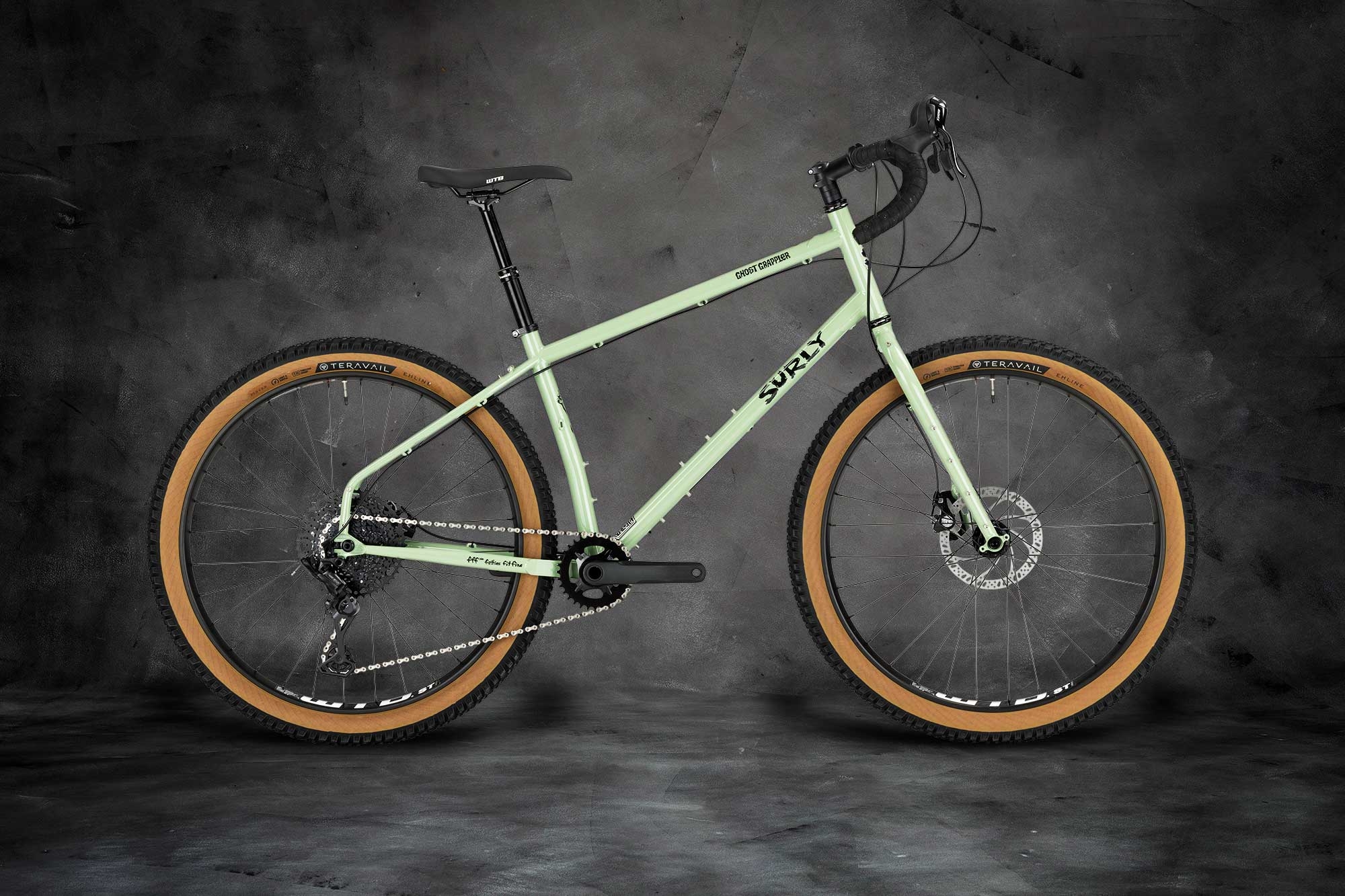
A similar sutuation exists today. If you were to go on a bikepacking tour now, would you choose a bicycle with a long, slack, and low geometry fitted with a 130-160mm travel suspension fork? Well......you could, or you could use a Ghost Grappler, as shown up top, or this new Wilde Bikes Supertramp bike. 

Wilde Bikes Supertramp. An "all-terrain", off-road touring bike.

Not that there are not a lot of other bikes that could be categorized in this "all-terrain", adventure bike niche, but the idea here is that, as Wilde Bikes states about their Supertramp: "It's designed to take
you anywhere in the world you care to go in comfort and style. From month-long backcountry tours
to trips to the corner store and everything in between, it is an incredibly versatile platform for living
your life via bicycle.
"

Sounds a lot like what the intentions were for "all terrain" bikes from the likes of MounatinBike, Ritchey, and others back when the modern day all-terrain movement got started. Where did we get off the rails?

Marketing based upon an unhealthy focus on racing got that started. Then it was niche-creating, to sell more product. Before we knew what happened, the "incredibly versatile platform for living your life by bicycle" became a down hill bike, a free-ride bike, a dual-suspension bike, a back-country bike, a down-country bike, an enduro bike......... You get the picture. 

But there was a void. A place for a "real mountain bike" to emerge and capture that wanderlust, that sense of adventure that was lacking in the bikes which catered to a certain look and lifestyle. Bikes that could be personalized and molded into that bike you'd ride anywhere for anything. For some of us that became the "gravel bike", (an unfortunate name if there ever was one). But in terms of fat-tired fun times, these bikepacking/adventure rigs? In my opinion, these are the "real mountain bikes". 

Are These The "Real" Mountain Bikes?

These are billed as "adventure bikes", but isn't that what an MTB is supposed to be?
 Today Wilde Bikes of Minnesota is announcing a new bike called the "Supertramp", a bike which they bill as being ".....our bike packing, trekking, and all terrain bicycle platform."

Wait.......did they mention "all terrain"? Yes! And as we who have been around a while know, that's just code for "mountain bike".  A brief history, if I may....

The term "mountain bike" was once actually a brand name for a bicycle company that made "all-terrain" bicycles. Bicycles meant for mountains, fire roads, and yes......gravel roads too. Anything that was not paved was game for an all-terrain bicycle. Of course, what we know as mountain bikes now are completely different than this idea, and the term, "all-terrain" is pretty much meaningless these days. 

In today's parlance, a mountain bike is a pretty niche device for tackling extreme, mountainous terrain only. Yes- you can ride one on lame-o, flattish single track, or in the Mid-West, or on gravel roads, but they are really focused on a lot rougher and gravity oriented terrain than that. That wasn't the case early on into the all-terrain phase of off-roading in the early 1980's. 

 Troy on a Schwinn Voyager (L), me on a 1984 Mongoose All-Terrain Pro

In 1994, things had already changed for mountain bikes. Anything you bought in those days had a heavy influence from XC racing and it showed. Gone were all the accoutrements of touring, or as we call them today, "adventure warts". Gone was the stable geometry, the all-day riding comfort, the wide, capable rims, and the fat, poofy tires. 

In 1994 I went on a tour. A self-supported tour with panniers and bags. Today it would have been fashionable to call what I did "bikepacking", but that wasn't a term to choose from to describe what it was I did back then. I also did not use a modern MTB for the tour. Instead, I purchased a ten year old Mongoose All-Mountain Pro, a bike from the "all-terrain" era of 26" wheeled off road bicycling. 

A similar sutuation exists today. If you were to go on a bikepacking tour now, would you choose a bicycle with a long, slack, and low geometry fitted with a 130-160mm travel suspension fork? Well......you could, or you could use a Ghost Grappler, as shown up top, or this new Wilde Bikes Supertramp bike. 

Wilde Bikes Supertramp. An "all-terrain", off-road touring bike.

Not that there are not a lot of other bikes that could be categorized in this "all-terrain", adventure bike niche, but the idea here is that, as Wilde Bikes states about their Supertramp: "It's designed to take
you anywhere in the world you care to go in comfort and style. From month-long backcountry tours
to trips to the corner store and everything in between, it is an incredibly versatile platform for living
your life via bicycle.
"

Sounds a lot like what the intentions were for "all terrain" bikes from the likes of MounatinBike, Ritchey, and others back when the modern day all-terrain movement got started. Where did we get off the rails?

Marketing based upon an unhealthy focus on racing got that started. Then it was niche-creating, to sell more product. Before we knew what happened, the "incredibly versatile platform for living your life by bicycle" became a down hill bike, a free-ride bike, a dual-suspension bike, a back-country bike, a down-country bike, an enduro bike......... You get the picture. 

But there was a void. A place for a "real mountain bike" to emerge and capture that wanderlust, that sense of adventure that was lacking in the bikes which catered to a certain look and lifestyle. Bikes that could be personalized and molded into that bike you'd ride anywhere for anything. For some of us that became the "gravel bike", (an unfortunate name if there ever was one). But in terms of fat-tired fun times, these bikepacking/adventure rigs? In my opinion, these are the "real mountain bikes". 

Saturday, July 23, 2022

The Closure Tour: Experimental Phase 2

With my bicycle set up mostly figured out I moved my focus to the important overnight accommodations and just how that would work. Logistically, I needed to identify a place where I could overnight. My initial thought was to do a 'bandit camp' in the woods adjacent to a cemetery along the route, but then I decided to check out camping opportunities in the area where I was riding through.

I found a good alternative in Charles City called "R Campground". I'm riding through Charles City, so I only had to tweak the route a small amount to make this work. 

It's a bit longer of a stretch to get there on my loop at about 84 miles in, but I think it shouldn't be a big concern if I get shoved off before Sunrise on the first day. Plus, that leaves a shorter distance on Day 2 for me to finish off the trip, and Charles City is a good point to resupply at, or source a meal from, so I think that's set in stone as my overnight spot. 

 Next on the agenda: How the heck do I set up my tent? This may seem like a silly question, but keep in mind, I haven't used this tent in many years. I'd forgotten what it even looked like. So, off to the back yard to do a dry run of set up and tear down.

Oh yeah....it's coming back to me now....

The Sierra Designs tent I have is a two-man, backpacking affair with a built in rain fly and shock-corded poles. It's free-standing, but I can stake down the fly and corners to keep it from becoming a man-made tumbleweed. 

Once I had it out of its cocoon that it had been in for years, I began to remember what it was about. I was timing myself on set up as well, so when I was able to have it completely ready to move into within fifteen minutes, I was pretty happy. 

And there it is! Ready to be slept in.

Once I had it set up I was also pleased to find that the interior was not musty or stinky at all. I let it air out for about an hour anyway. Then I decided to see how long it might take to pack it up. Ten minutes! I think it will all go smoother next time I try this out. 

So, that was a major hurdle which I cleared with no issues. Plus I have identified a good place to stop overnight on my route. Next up I need to refine what I am taking along with me. Staying in Charles City will modify my plans somewhat, as food and drink will be readily available to me there. That will put less of a burden on me as far as packing up stuff. I'll really only need to worry about snacks and food for the trip up,as I won't be going through any towns with a convenience store and there is only a gas station at Mile 62 which might have some refreshments. 

Water shouldn't be a problem there, so I can find a source to refill bottles at that point and make the final 20+ mile run into Charles City where I'll plan on chowing down. I only will then have to concern myself with water and nutrition to go about another 50+ to get home. 

Stay tuned......

The Closure Tour: Experimental Phase 2

With my bicycle set up mostly figured out I moved my focus to the important overnight accommodations and just how that would work. Logistically, I needed to identify a place where I could overnight. My initial thought was to do a 'bandit camp' in the woods adjacent to a cemetery along the route, but then I decided to check out camping opportunities in the area where I was riding through.

I found a good alternative in Charles City called "R Campground". I'm riding through Charles City, so I only had to tweak the route a small amount to make this work. 

It's a bit longer of a stretch to get there on my loop at about 84 miles in, but I think it shouldn't be a big concern if I get shoved off before Sunrise on the first day. Plus, that leaves a shorter distance on Day 2 for me to finish off the trip, and Charles City is a good point to resupply at, or source a meal from, so I think that's set in stone as my overnight spot. 

 Next on the agenda: How the heck do I set up my tent? This may seem like a silly question, but keep in mind, I haven't used this tent in many years. I'd forgotten what it even looked like. So, off to the back yard to do a dry run of set up and tear down.

Oh yeah....it's coming back to me now....

The Sierra Designs tent I have is a two-man, backpacking affair with a built in rain fly and shock-corded poles. It's free-standing, but I can stake down the fly and corners to keep it from becoming a man-made tumbleweed. 

Once I had it out of its cocoon that it had been in for years, I began to remember what it was about. I was timing myself on set up as well, so when I was able to have it completely ready to move into within fifteen minutes, I was pretty happy. 

And there it is! Ready to be slept in.

Once I had it set up I was also pleased to find that the interior was not musty or stinky at all. I let it air out for about an hour anyway. Then I decided to see how long it might take to pack it up. Ten minutes! I think it will all go smoother next time I try this out. 

So, that was a major hurdle which I cleared with no issues. Plus I have identified a good place to stop overnight on my route. Next up I need to refine what I am taking along with me. Staying in Charles City will modify my plans somewhat, as food and drink will be readily available to me there. That will put less of a burden on me as far as packing up stuff. I'll really only need to worry about snacks and food for the trip up,as I won't be going through any towns with a convenience store and there is only a gas station at Mile 62 which might have some refreshments. 

Water shouldn't be a problem there, so I can find a source to refill bottles at that point and make the final 20+ mile run into Charles City where I'll plan on chowing down. I only will then have to concern myself with water and nutrition to go about another 50+ to get home. 

Stay tuned......

Monday, July 18, 2022

Rack Me! Update

The Old Man Mountain Elkhorn Rack as it came to me.
 Last week I ran a post entitled "Rack Me!" where I showed a few choices in minimalist racks for bicycles. I mentioned that I was getting in an Old Man Mountain Elkhorn Rack for test/review for RidingGravel.com. Note: Standard Disclaimer applies.

I'm not going to focus too much on the details of the rack here, because I want you to read my Riding Gravel review for that. (It won't be out for a bit yet) 

This post will be more about what I am going to do with this rack

So, as of now I have fitted this rack to my Black Mountain Cycles MCD. I gave some thought as to which end of the bike I wanted to mount the thing to, as it works on either end. I chose to mount it as a rear rack, because I wanted to distribute the weight I will be carrying so that the front end of my bike doesn't get too slowed down by inertia induced from a heavier front load. Here's what the set up ended up looking like....

The OMM Elkhorn Rack set up with Salsa Cycles Anything Cage HD cages.

Okay, so as to 'why' I used the Anything Cage HD cages and why the rack is on the rear, I have a certain 'mission' in mind for this set up. I plan on doing a sub-24 over-nighter type trip. Actually, it probably would be better to call it a two day, one night trip. I don't think I'll be done in less than one day's time.

I plan on possibly 'bandit-camping' or doing it 'official' at a campground, but either way- This requires a sleep system and shelter. Over the years, I have accumulated enough gear to make this all work. I have a Sierra Designs tent, some lightweight sleep-sack or another. I cannot recall the brand but it compresses down nicely for travel. I have an ancient Thermarest pad from my 1990's tours, (still works), and I have a few various dry bags to put stuff in. 

This Ti pot, stand, and folding spork along with my homemade stove are ready!

So, now I am mocking up loads and thinking through what I really need to take on this little trip. I have already strapped a few items to the Elkhorn using an old school device called a "toe strap". Some of you old cycling folks may know what those are. Yeah, there are those fancy new rubbery straps everyone is talking about, but this lil' trip is going to go off using as much 'stuff' as I have at hand. Keeping the purchases minimal and doing things "dirt-bag" if necessary. 

It's going to be a mish-mash of old and newer gear and things employed in different ways than intended will feature into my set up. Like the toe straps, which I have collected a bunch of through the years. They are so useful.... Anyway.... 

 The next post on this will focus on the trip and my experiments in loading. I will be test-riding with the full load once I have it all together. The route is pretty much figured out already. It isn't anything spectacular from an outside observer's viewpoint, but this trip will have deep meaning for me. You'll see why later as long as I actually get this done.... Nothing guaranteed. 

Okay- Any questions? Let me have 'em in the comments. Otherwise stay tuned for more soon....