Showing posts with label Ghost Grappler. Show all posts

Thursday, November 10, 2022

Are These The "Real" Mountain Bikes?

These are billed as "adventure bikes", but isn't that what an MTB is supposed to be?
 Today Wilde Bikes of Minnesota is announcing a new bike called the "Supertramp", a bike which they bill as being ".....our bike packing, trekking, and all terrain bicycle platform."

Wait.......did they mention "all terrain"? Yes! And as we who have been around a while know, that's just code for "mountain bike".  A brief history, if I may....

The term "mountain bike" was once actually a brand name for a bicycle company that made "all-terrain" bicycles. Bicycles meant for mountains, fire roads, and yes......gravel roads too. Anything that was not paved was game for an all-terrain bicycle. Of course, what we know as mountain bikes now are completely different than this idea, and the term, "all-terrain" is pretty much meaningless these days. 

In today's parlance, a mountain bike is a pretty niche device for tackling extreme, mountainous terrain only. Yes- you can ride one on lame-o, flattish single track, or in the Mid-West, or on gravel roads, but they are really focused on a lot rougher and gravity oriented terrain than that. That wasn't the case early on into the all-terrain phase of off-roading in the early 1980's. 

 Troy on a Schwinn Voyager (L), me on a 1984 Mongoose All-Terrain Pro

In 1994, things had already changed for mountain bikes. Anything you bought in those days had a heavy influence from XC racing and it showed. Gone were all the accoutrements of touring, or as we call them today, "adventure warts". Gone was the stable geometry, the all-day riding comfort, the wide, capable rims, and the fat, poofy tires. 

In 1994 I went on a tour. A self-supported tour with panniers and bags. Today it would have been fashionable to call what I did "bikepacking", but that wasn't a term to choose from to describe what it was I did back then. I also did not use a modern MTB for the tour. Instead, I purchased a ten year old Mongoose All-Mountain Pro, a bike from the "all-terrain" era of 26" wheeled off road bicycling. 

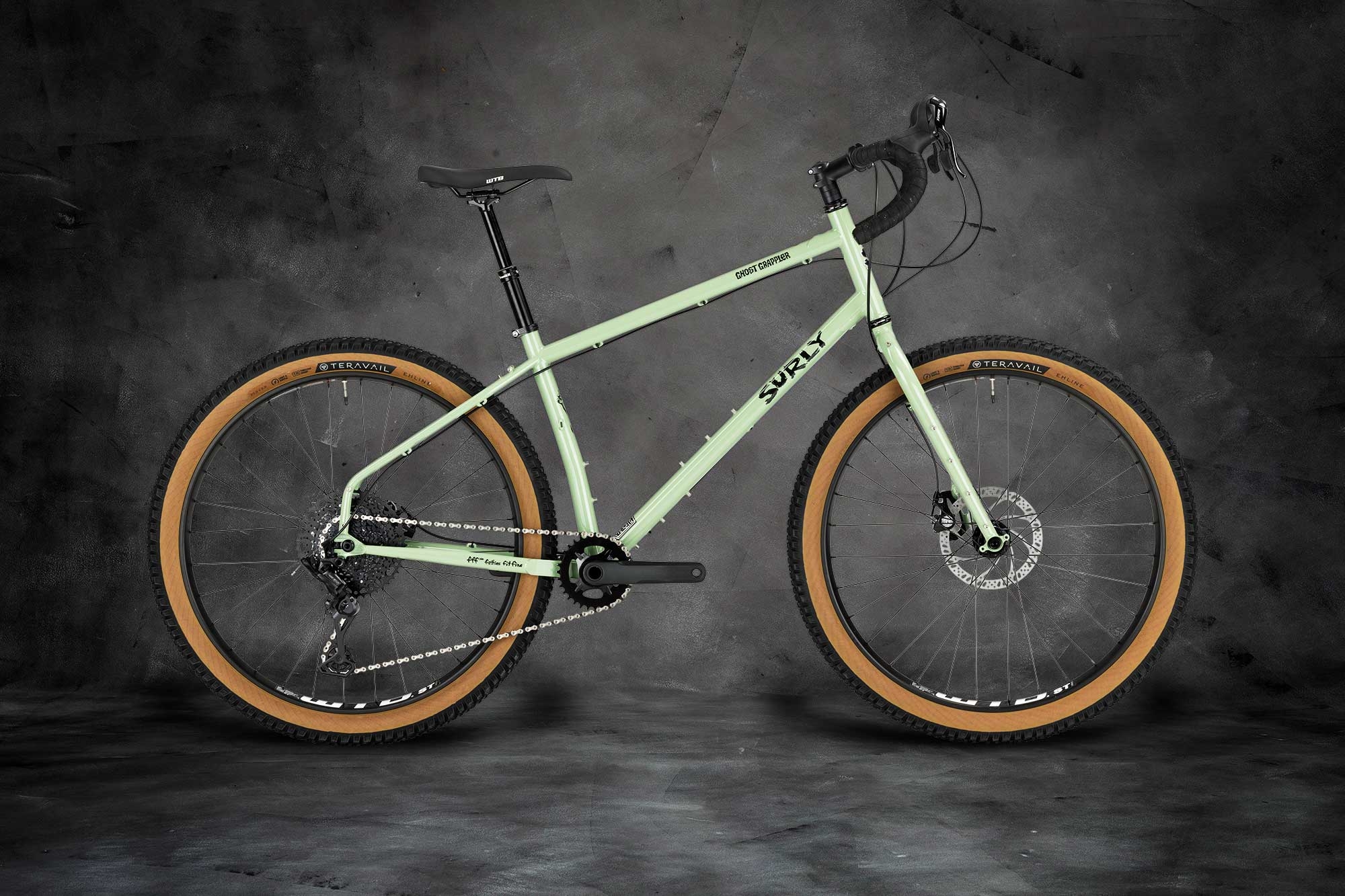
A similar sutuation exists today. If you were to go on a bikepacking tour now, would you choose a bicycle with a long, slack, and low geometry fitted with a 130-160mm travel suspension fork? Well......you could, or you could use a Ghost Grappler, as shown up top, or this new Wilde Bikes Supertramp bike. 

Wilde Bikes Supertramp. An "all-terrain", off-road touring bike.

Not that there are not a lot of other bikes that could be categorized in this "all-terrain", adventure bike niche, but the idea here is that, as Wilde Bikes states about their Supertramp: "It's designed to take
you anywhere in the world you care to go in comfort and style. From month-long backcountry tours
to trips to the corner store and everything in between, it is an incredibly versatile platform for living
your life via bicycle.
"

Sounds a lot like what the intentions were for "all terrain" bikes from the likes of MounatinBike, Ritchey, and others back when the modern day all-terrain movement got started. Where did we get off the rails?

Marketing based upon an unhealthy focus on racing got that started. Then it was niche-creating, to sell more product. Before we knew what happened, the "incredibly versatile platform for living your life by bicycle" became a down hill bike, a free-ride bike, a dual-suspension bike, a back-country bike, a down-country bike, an enduro bike......... You get the picture. 

But there was a void. A place for a "real mountain bike" to emerge and capture that wanderlust, that sense of adventure that was lacking in the bikes which catered to a certain look and lifestyle. Bikes that could be personalized and molded into that bike you'd ride anywhere for anything. For some of us that became the "gravel bike", (an unfortunate name if there ever was one). But in terms of fat-tired fun times, these bikepacking/adventure rigs? In my opinion, these are the "real mountain bikes". 

Are These The "Real" Mountain Bikes?

These are billed as "adventure bikes", but isn't that what an MTB is supposed to be?
 Today Wilde Bikes of Minnesota is announcing a new bike called the "Supertramp", a bike which they bill as being ".....our bike packing, trekking, and all terrain bicycle platform."

Wait.......did they mention "all terrain"? Yes! And as we who have been around a while know, that's just code for "mountain bike".  A brief history, if I may....

The term "mountain bike" was once actually a brand name for a bicycle company that made "all-terrain" bicycles. Bicycles meant for mountains, fire roads, and yes......gravel roads too. Anything that was not paved was game for an all-terrain bicycle. Of course, what we know as mountain bikes now are completely different than this idea, and the term, "all-terrain" is pretty much meaningless these days. 

In today's parlance, a mountain bike is a pretty niche device for tackling extreme, mountainous terrain only. Yes- you can ride one on lame-o, flattish single track, or in the Mid-West, or on gravel roads, but they are really focused on a lot rougher and gravity oriented terrain than that. That wasn't the case early on into the all-terrain phase of off-roading in the early 1980's. 

 Troy on a Schwinn Voyager (L), me on a 1984 Mongoose All-Terrain Pro

In 1994, things had already changed for mountain bikes. Anything you bought in those days had a heavy influence from XC racing and it showed. Gone were all the accoutrements of touring, or as we call them today, "adventure warts". Gone was the stable geometry, the all-day riding comfort, the wide, capable rims, and the fat, poofy tires. 

In 1994 I went on a tour. A self-supported tour with panniers and bags. Today it would have been fashionable to call what I did "bikepacking", but that wasn't a term to choose from to describe what it was I did back then. I also did not use a modern MTB for the tour. Instead, I purchased a ten year old Mongoose All-Mountain Pro, a bike from the "all-terrain" era of 26" wheeled off road bicycling. 

A similar sutuation exists today. If you were to go on a bikepacking tour now, would you choose a bicycle with a long, slack, and low geometry fitted with a 130-160mm travel suspension fork? Well......you could, or you could use a Ghost Grappler, as shown up top, or this new Wilde Bikes Supertramp bike. 

Wilde Bikes Supertramp. An "all-terrain", off-road touring bike.

Not that there are not a lot of other bikes that could be categorized in this "all-terrain", adventure bike niche, but the idea here is that, as Wilde Bikes states about their Supertramp: "It's designed to take
you anywhere in the world you care to go in comfort and style. From month-long backcountry tours
to trips to the corner store and everything in between, it is an incredibly versatile platform for living
your life via bicycle.
"

Sounds a lot like what the intentions were for "all terrain" bikes from the likes of MounatinBike, Ritchey, and others back when the modern day all-terrain movement got started. Where did we get off the rails?

Marketing based upon an unhealthy focus on racing got that started. Then it was niche-creating, to sell more product. Before we knew what happened, the "incredibly versatile platform for living your life by bicycle" became a down hill bike, a free-ride bike, a dual-suspension bike, a back-country bike, a down-country bike, an enduro bike......... You get the picture. 

But there was a void. A place for a "real mountain bike" to emerge and capture that wanderlust, that sense of adventure that was lacking in the bikes which catered to a certain look and lifestyle. Bikes that could be personalized and molded into that bike you'd ride anywhere for anything. For some of us that became the "gravel bike", (an unfortunate name if there ever was one). But in terms of fat-tired fun times, these bikepacking/adventure rigs? In my opinion, these are the "real mountain bikes". 

Monday, February 21, 2022

Randomonium

  NOTE: Okay folks, if you haven't been around long enough here to know what a "Randomonium" post is, then here is the deal. I ramble, rant, and randomly moan about all things cycling in one, incohesive, bizarre post. "Randomonium", okay?

The refreshed Standard Rando v2
Standard Rando v2/Single Speed Wheel Update:

The refreshing of, and rebuilding of wheels for, the Standard Rando v2 is now complete. The final piece of the puzzle came in last week and I was able to get in a decent test ride before the cold came back again. 

To recap: I wanted a single speed specific wheel for the Standard Rando v2 since my Turkey Burn ride last November. That metric century ride proved to me beyond a doubt that I wanted to stick with single speed for this bike. 

Originally, back in 2020, when I got this bike, I was intending for it to be a geared bike, but what with the pandemic and all, I was fortunate to just get it up and running as a single speed. I left things as is and well, that is how it is going to be. 

So, instead of tying up a geared rear wheel on a single speed that would never see gears, I decided I needed a new wheel set. That prompted the purchase of a Paul rear single speed WORD hub with the through axle for the Standard Rando's 12mm through axle rear end. I inadvertently ordered a 32 spoke hole hub instead of a 28 hole drilling, as I had intended, because I had a set of 28 hole Velocity Blunt SS rims sitting in the Lab waiting to be laced to something. 

So, I ordered up a 32 hole Blunt SS rim. I had the spokes on hand and in the right colors to do my "Guitar Ted Signature" build which is black spokes on one side and silver on the other, reversed for the other wheel. So- Drive side rear = black, drive side front = silver, reversed for non-drive side. I dunno why.....I just think it looks cool! 

I am pretty sure every spoke is double butted and all have brass nipples. The front is something of an oddball. I have the original wheel set - well.....I had it, now one part is modified! Anyway, the front wheel rim, one side of the spokes, and the hub was a part of the Noble GX-5's original build. I took out the black spokes on one side and replaced them with silver, and boom! Done!

The rim is a Stan's Grail and the hub is a Stan's 'vanilla', average front hub. No big deal that they do not match because from five feet away, you cannot tell the difference. Maybe some day I'll get another Blunt SS and relace that, but I doubt I will. At any rate, I still have a good pair of Blunt SS rims waiting for hubs and spokes instead of one lone rim with no mate. 

Finally, I had to get a single speed freewheel. I really wanted to get a White Industries one, but I don't have White Industries money to spend at the moment, so I got an Origin 8 'Black Ops' 20T free wheel, (It's just s Far East free wheel, but a pretty good one) and put that on. We will see how long it hold up to Iowa gravel!  More soon.....

Testing the Redshift Sports ShockStop Pro post here.

Redshift ShockStop Pro Post Thoughts So Far...

I'm reviewing this for Riding Gravel (Standard Disclaimer applies) and while it looks like the post I reviewed previously here, it is almost nothing like that post. It is a very different experience. In that linked review I state that this post 'isolates the rider from vibrations'. This version does not seem to be the same in that manner. I'm still not sure what level of damping, if any, is going on here. 

It also does not feel 'floaty' at all. The previous ShockStop post I tried does kind of, well.....suspend you. It is a suspension seat post, after all. The coil spring sags under your weight until the spring rate supports you and you are kind of disconnected from the rest of the bike at that point. Full suspension mountain bike riders will be quite familiar with this feeling. It may be quite disconcerting for road riders or new-to-the-sport people. It does feel odd at first. 

But this post, which has one stock spring rate which is not user adjustable, does not do that. Nothing of the sort, so it feels more like a standard post. Now at that point, my mind is thinking 'why not just use a flexible standard post, like the Whiskey Carbon, or PRO Carbon Dyneema posts that I like so well?'

And there is the conundrum I am faced with sorting out at the moment. Is the Redshift Sports ShockStop Pro 'not worth it', or is it a 'bad design'? NO! It is a really well executed design and does work, but my question I have to answer is for which riders, and to what degree does this post complete its mission? I don't know the answers to those questions yet.

More ride time. That's what I need here.......

A 420mm axle to crown fork on my Blackbuck circa 2008.

More On Forks & Their Effects On Bikes:

 Last week's Ghost Grappler introduction cracked open the can-o-worms again concerning how fork length and offset can dramatically affect handling. This was because the Ghost Grappler, ("GG" from here on out), has a short (420mm) rigid fork with 50mm offset and that fork, the "Dinner Fork", is available aftermarket. 

I was asked in the comments about how such a fork would work on a 29'er. I said "Not very well", and that I had tried this. Well, today I bring you my examples.

In January of 2008 I got my OS Bikes Blackbuck and later that year I tried 8 different forks on it, all of which had different offsets and axle to crown lengths. In my testing I used the same wheels, tires, and I strove to keep the cockpit the same across all the set ups. (Which was a whole nuther story) This was to eliminate as many variables as I could. 

The Blackbuck with its stock rigid fork.

I'll spare you all the techno-mumbo-jumbo and cut to the chase. The shortest forks I tried were both 420mm axle to crown. The Black Ops was a cabon/aluminum composite fork with (if I recall correctly) 38mm offset. The Blackbuck fork, (came with the frame), had a 51mm offset. Both forks resulted in a waaaaaay steep 74° head angle. It was the offsets that were the diference maker. 

And boy! What a difference! That Black Ops fork was dead feeling and handled very weirdly. I did not like it at all. The Blackbuck fork was razor-sharp quick. You had to be on your "P's and Q's" to ride it. One moment of broken concentration and you were on your butt off the side of the trail. 

Neither was what I would call 'ideal' to ride. So, how does that relate to this GG fork- the Dinner Fork? Well, it has the same axle to crown as the two forks I tested 14 years ago. But it leans more towards the Blackbuck fork I have, with its 50mm offset than it does in regard to that old Black Ops fork. So, on most 29"er hard tails with shorter stock forks, you'd end up with 'crit bike' handling and a nervousness on technical terrain that would require maximum concentration to control. On a longer forked, 'modern-day' trail bike? No. Just no.... Those bikes are made to have LONG forks on them. Like 500mm and longer axle to crown forks, so a 420mm fork would be, almost, unrideable. 

So, unless your 29"er was made to have a 470mm or shorter fork stock, I'd forget about the GG fork as an option. That's my take.

Want more about forks? Let me know in the comments. 

That's it for today, thank you for reading!

Randomonium

  NOTE: Okay folks, if you haven't been around long enough here to know what a "Randomonium" post is, then here is the deal. I ramble, rant, and randomly moan about all things cycling in one, incohesive, bizarre post. "Randomonium", okay?

The refreshed Standard Rando v2
Standard Rando v2/Single Speed Wheel Update:

The refreshing of, and rebuilding of wheels for, the Standard Rando v2 is now complete. The final piece of the puzzle came in last week and I was able to get in a decent test ride before the cold came back again. 

To recap: I wanted a single speed specific wheel for the Standard Rando v2 since my Turkey Burn ride last November. That metric century ride proved to me beyond a doubt that I wanted to stick with single speed for this bike. 

Originally, back in 2020, when I got this bike, I was intending for it to be a geared bike, but what with the pandemic and all, I was fortunate to just get it up and running as a single speed. I left things as is and well, that is how it is going to be. 

So, instead of tying up a geared rear wheel on a single speed that would never see gears, I decided I needed a new wheel set. That prompted the purchase of a Paul rear single speed WORD hub with the through axle for the Standard Rando's 12mm through axle rear end. I inadvertently ordered a 32 spoke hole hub instead of a 28 hole drilling, as I had intended, because I had a set of 28 hole Velocity Blunt SS rims sitting in the Lab waiting to be laced to something. 

So, I ordered up a 32 hole Blunt SS rim. I had the spokes on hand and in the right colors to do my "Guitar Ted Signature" build which is black spokes on one side and silver on the other, reversed for the other wheel. So- Drive side rear = black, drive side front = silver, reversed for non-drive side. I dunno why.....I just think it looks cool! 

I am pretty sure every spoke is double butted and all have brass nipples. The front is something of an oddball. I have the original wheel set - well.....I had it, now one part is modified! Anyway, the front wheel rim, one side of the spokes, and the hub was a part of the Noble GX-5's original build. I took out the black spokes on one side and replaced them with silver, and boom! Done!

The rim is a Stan's Grail and the hub is a Stan's 'vanilla', average front hub. No big deal that they do not match because from five feet away, you cannot tell the difference. Maybe some day I'll get another Blunt SS and relace that, but I doubt I will. At any rate, I still have a good pair of Blunt SS rims waiting for hubs and spokes instead of one lone rim with no mate. 

Finally, I had to get a single speed freewheel. I really wanted to get a White Industries one, but I don't have White Industries money to spend at the moment, so I got an Origin 8 'Black Ops' 20T free wheel, (It's just s Far East free wheel, but a pretty good one) and put that on. We will see how long it hold up to Iowa gravel!  More soon.....

Testing the Redshift Sports ShockStop Pro post here.

Redshift ShockStop Pro Post Thoughts So Far...

I'm reviewing this for Riding Gravel (Standard Disclaimer applies) and while it looks like the post I reviewed previously here, it is almost nothing like that post. It is a very different experience. In that linked review I state that this post 'isolates the rider from vibrations'. This version does not seem to be the same in that manner. I'm still not sure what level of damping, if any, is going on here. 

It also does not feel 'floaty' at all. The previous ShockStop post I tried does kind of, well.....suspend you. It is a suspension seat post, after all. The coil spring sags under your weight until the spring rate supports you and you are kind of disconnected from the rest of the bike at that point. Full suspension mountain bike riders will be quite familiar with this feeling. It may be quite disconcerting for road riders or new-to-the-sport people. It does feel odd at first. 

But this post, which has one stock spring rate which is not user adjustable, does not do that. Nothing of the sort, so it feels more like a standard post. Now at that point, my mind is thinking 'why not just use a flexible standard post, like the Whiskey Carbon, or PRO Carbon Dyneema posts that I like so well?'

And there is the conundrum I am faced with sorting out at the moment. Is the Redshift Sports ShockStop Pro 'not worth it', or is it a 'bad design'? NO! It is a really well executed design and does work, but my question I have to answer is for which riders, and to what degree does this post complete its mission? I don't know the answers to those questions yet.

More ride time. That's what I need here.......

A 420mm axle to crown fork on my Blackbuck circa 2008.

More On Forks & Their Effects On Bikes:

 Last week's Ghost Grappler introduction cracked open the can-o-worms again concerning how fork length and offset can dramatically affect handling. This was because the Ghost Grappler, ("GG" from here on out), has a short (420mm) rigid fork with 50mm offset and that fork, the "Dinner Fork", is available aftermarket. 

I was asked in the comments about how such a fork would work on a 29'er. I said "Not very well", and that I had tried this. Well, today I bring you my examples.

In January of 2008 I got my OS Bikes Blackbuck and later that year I tried 8 different forks on it, all of which had different offsets and axle to crown lengths. In my testing I used the same wheels, tires, and I strove to keep the cockpit the same across all the set ups. (Which was a whole nuther story) This was to eliminate as many variables as I could. 

The Blackbuck with its stock rigid fork.

I'll spare you all the techno-mumbo-jumbo and cut to the chase. The shortest forks I tried were both 420mm axle to crown. The Black Ops was a cabon/aluminum composite fork with (if I recall correctly) 38mm offset. The Blackbuck fork, (came with the frame), had a 51mm offset. Both forks resulted in a waaaaaay steep 74° head angle. It was the offsets that were the diference maker. 

And boy! What a difference! That Black Ops fork was dead feeling and handled very weirdly. I did not like it at all. The Blackbuck fork was razor-sharp quick. You had to be on your "P's and Q's" to ride it. One moment of broken concentration and you were on your butt off the side of the trail. 

Neither was what I would call 'ideal' to ride. So, how does that relate to this GG fork- the Dinner Fork? Well, it has the same axle to crown as the two forks I tested 14 years ago. But it leans more towards the Blackbuck fork I have, with its 50mm offset than it does in regard to that old Black Ops fork. So, on most 29"er hard tails with shorter stock forks, you'd end up with 'crit bike' handling and a nervousness on technical terrain that would require maximum concentration to control. On a longer forked, 'modern-day' trail bike? No. Just no.... Those bikes are made to have LONG forks on them. Like 500mm and longer axle to crown forks, so a 420mm fork would be, almost, unrideable. 

So, unless your 29"er was made to have a 470mm or shorter fork stock, I'd forget about the GG fork as an option. That's my take.

Want more about forks? Let me know in the comments. 

That's it for today, thank you for reading!

Friday, February 18, 2022

Friday News And Views

From Peter Stetina's Twitter feed: A bull knocks down a rider at the Rock Cobbler event.
 That Was Bull!:

Last weekend on social media you may have noted a few images of people getting knocked down by a young bull during the Rock Cobbler event in California. Apparently there were no severe injuries and I did not see anything related to what the event director(s) may have stated afterward.

Comments: While every event is an expression of what the organizer(s) think is appropriate for a challenge, one has to wonder how this event will deal with the fall-out from the incidents of the past weekend during their event. My opinion is my own, but if I had to make a call here I would have possibly diverted the course around such a danger. 

I have, a few different times, been exposed to "open range" conditions at the event formerly known as The Dirty Kanza 200. I am not aware that any bulls were around, but I have seen cows right on the course we were directed to ride on. That's dangerous enough, as a cow can easily cause serious injury to a cyclist that is unaware of the dangers of cattle. 

And as a former director of events which were similar to the Rock Cobbler, I can tell you that some form of education prior to the event is necessary and must be repeated multiple times. Even then, you are not guaranteed the people in your audience are taking you seriously. That's why, (again- risk assessment comes into play), you as a Race Director are tasked with judging your course and the risks it may present with an ultra-critical eye. Getting outside advice is often wise as well, because no matter how 'cool' you may think a certain experience may be for your riders, you may be blinded to possibilities for things to get ugly. 

In the case of open range riding and bulls, I would submit that it is not a prudent idea to submit your riders to such possibilities for injury and harm. But that's just me......

Fork Update:

Thank you for all of the excellent comments about my recently discovered Colnago Super Fork from Monday's post this week. I really appreciated every one of the responses and considered each one. 

A few good points were made. Like how often this bike would see roads? And that is really a good way to look at this. Also, some suggested just trying to polish it out to get a better read on where I am at with it. Perhaps do that and seal it with a clear coat? 

And to be honest, those were the comments that resonated the most with me. Getting it painted, or re-chromed makes sense if I am creating a garage queen, or restoration of some sort, well then yeah. However; I am not at a point where I have the free cash or inclination to do a full-on early 80's restoration so I think that just getting it going with the least fuss possible is what makes sense here. 

Next I will do the clean up, polish, and inspect it from there. I think clear coating the lower fork legs is a good idea to arrest the rust pitting that will be there. I probably will touch up the yellow painted bits as well. Of course, I'll need that threaded Athena head set, but I almost forgot that I'll also need a quill stem now. Hmm..... I may have to do some more digging around in the shop!

Guitar Ted 'Lube-Off' Update:

Thanks to all those readers who commented on the post from Wednesday concerning lubes to test for the next Lube-Off. I got some solid votes on one brand and some advice on using the wax I mentioned I have.

So, it was crystal-clear that SILCA's "Super-Secret" lube should be in the next Lube-Off. So, I will get a bottle of that coming and I will likely install that with a new Shimano 11 speed chain I just received for my Raleigh Tamland Two. (Most likely anyway.) 

The wax is NOT going to make the cut in this round. One commenter saying, "Super secret is supposed to have most of the wax benefit without the hassle of actual waxing". Another commenter chimed in saying, "I also think sticking with a drip lube for your round up is the best option as most people have no desire to go through the tedious processes of maintaining a hot dip waxed chain every 200 or so miles."

That's enough reason there to convince me that using the Molten Speed Chain Wax is not really all that interesting to you- the readers- and it definitely is okay with me if I do not have to hassle with that stuff. That said, someday I'll try it. 

I will work on the compiling of all the "Lube-Off" results and post that soon. Stay tuned for that and the next round of the Lube-Off soon. 

New Polar water bottles from their Breakaway series.
Polar Bottle Debuts New Big Bottle:

On Tuesday of this past week, Polar Bottle introduced the new Breakaway series of bottles which includes a new 30 ounce size

Last year I did a bit of a series on water bottles and using larger sized ones. I found that by doing some careful tweaking utilizing some bottle mount expanders like the Wolf Tooth B-Rad, I could carry as much water on the bike as I could have with a hydration pack on my body. 

While not everyone can use bigger capacity bottles, perhaps due to shorter frames or specific frame limitations, those who can may want to look into that. It works out well in practice on longer rides and I have seen the benefits of not having a heavy hydration pack on my body. 

I get that hydration packs have their fans and reasons for being a great choice. One, and maybe the biggest reason of all to use a hydration vest or pack, is that you can drink 'on-the-fly' easily and that this promotes better hydration. That's an excellent case for using a hydration bladder somewhere on your body or bicycle. However; those systems have some pretty significant drawbacks as well. 

Keeping the hoses clean, the bladders clean, having weight on your back, (if it is traditional system) and having more of a hassle in filling a bladder in the field are but a few of the concerns.  "End-of-service" life of hydration packs is also a bit more difficult than with bottles, and is a subject not many consider when thinking about bladders and packs. 

At any rate, it is nice to see options in bottles now.

The new Surly Bikes Ghost Grappler
Surly Bikes Debuts The Ghost Grappler Drop Bar Trail Bike:

A bit of a surprise here from Surly. A drop bar trail bike that has a very familiar look to it if you are a Fargo aficionado. It is a bike designed around a drop bar for bike packing, trail riding, and gravel with a focus on versatility and 27.5" wheels. Steel, of course, and it has several interesting features.

Besides looking like a Gen I Fargo, the Ghost Grappler has through axle capabilities with Surly's "GnotBoost" rear spacing, a Boost spaced fork which is not suspension corrected, and new bottle mounts on the seat stays near the drop outs. Stealth dropper post routing is also offered along with rack, fender, and Three-Pack mounting options on the top and bottom of the down tube. 

Tire clearance is 27.5 X 3.0" or 29" X 2.5". The frame has a straight, 1 1/8th head tube and the fork, called the Surly "Dinner Fork", is available separately

Comments: Yeah, if Salsa Cycles had ever done a Fargo Gen I reissue, this Ghost Grappler would be pretty much what I would have expected from them. It's very close, in my opinion, to what a Fargo should be now days. 

But hold on- That name! Yes, this is Surly Bikes, after all, but still. Weird. I guess that's the whole point? Anyway...... GnotBoost rear spacing? Rear facing, track fork style drop outs? Uggh! In some ways Surly's bent to be the most versatile bike choice is also its undoing. If you've ever dealt with their various versions of multiple-standard rear drop out designs, you'll understand. A Salsa version would have been elegantly executed with their Alternator Drop Out. But this is Surly's way.... 

After checking out the geometry, this really isn't all that far off from the Gen I Fargo. Tweaked for the modern day trail rider, yes. And I like what Surly has done with the geometry. Tire sizes that can be used here are also very appropriate, in my view. 

Some will grouse and say that the Gen I Fargo had a better drive train compatibility, but with Boost spacing? You are not going to get old, triple crank drive trains, or even a double with a big drive ring, on a bike like that. Boost pretty much kicked all that to the curb and so 1X is pretty much going to be the jam here, unfortunately. 

Finally- A straight steer tube MTB in 2022? I did not see that coming. I think that's a big mistake, but whatever. It should ride better, and maybe that's one reason Surly did that. It also pretty much takes the whole, "Can I put a suspension fork on this?" question off the table. Regarding the fork: It is soooo short, axle to crown, that anyone thinking it might work for their Gen I Fargo, or an older 29"er should reconsider that. Axle to crown is a short 420mm, which was the old sus corrected length for 26" wheeled rigid forks. It'll clear a 29"er wheel/tire, but juuust barely. Plus, because it is a short fork it would really steepen most 29"er bike's head angles to the point that you would negatively affect handling. (I know- I've tried it before.)
  

That's a wrap for this week! Thank you for reading Guitar Ted Productions and I hope that you get out for some riding this weekend!

Friday News And Views

From Peter Stetina's Twitter feed: A bull knocks down a rider at the Rock Cobbler event.
 That Was Bull!:

Last weekend on social media you may have noted a few images of people getting knocked down by a young bull during the Rock Cobbler event in California. Apparently there were no severe injuries and I did not see anything related to what the event director(s) may have stated afterward.

Comments: While every event is an expression of what the organizer(s) think is appropriate for a challenge, one has to wonder how this event will deal with the fall-out from the incidents of the past weekend during their event. My opinion is my own, but if I had to make a call here I would have possibly diverted the course around such a danger. 

I have, a few different times, been exposed to "open range" conditions at the event formerly known as The Dirty Kanza 200. I am not aware that any bulls were around, but I have seen cows right on the course we were directed to ride on. That's dangerous enough, as a cow can easily cause serious injury to a cyclist that is unaware of the dangers of cattle. 

And as a former director of events which were similar to the Rock Cobbler, I can tell you that some form of education prior to the event is necessary and must be repeated multiple times. Even then, you are not guaranteed the people in your audience are taking you seriously. That's why, (again- risk assessment comes into play), you as a Race Director are tasked with judging your course and the risks it may present with an ultra-critical eye. Getting outside advice is often wise as well, because no matter how 'cool' you may think a certain experience may be for your riders, you may be blinded to possibilities for things to get ugly. 

In the case of open range riding and bulls, I would submit that it is not a prudent idea to submit your riders to such possibilities for injury and harm. But that's just me......

Fork Update:

Thank you for all of the excellent comments about my recently discovered Colnago Super Fork from Monday's post this week. I really appreciated every one of the responses and considered each one. 

A few good points were made. Like how often this bike would see roads? And that is really a good way to look at this. Also, some suggested just trying to polish it out to get a better read on where I am at with it. Perhaps do that and seal it with a clear coat? 

And to be honest, those were the comments that resonated the most with me. Getting it painted, or re-chromed makes sense if I am creating a garage queen, or restoration of some sort, well then yeah. However; I am not at a point where I have the free cash or inclination to do a full-on early 80's restoration so I think that just getting it going with the least fuss possible is what makes sense here. 

Next I will do the clean up, polish, and inspect it from there. I think clear coating the lower fork legs is a good idea to arrest the rust pitting that will be there. I probably will touch up the yellow painted bits as well. Of course, I'll need that threaded Athena head set, but I almost forgot that I'll also need a quill stem now. Hmm..... I may have to do some more digging around in the shop!

Guitar Ted 'Lube-Off' Update:

Thanks to all those readers who commented on the post from Wednesday concerning lubes to test for the next Lube-Off. I got some solid votes on one brand and some advice on using the wax I mentioned I have.

So, it was crystal-clear that SILCA's "Super-Secret" lube should be in the next Lube-Off. So, I will get a bottle of that coming and I will likely install that with a new Shimano 11 speed chain I just received for my Raleigh Tamland Two. (Most likely anyway.) 

The wax is NOT going to make the cut in this round. One commenter saying, "Super secret is supposed to have most of the wax benefit without the hassle of actual waxing". Another commenter chimed in saying, "I also think sticking with a drip lube for your round up is the best option as most people have no desire to go through the tedious processes of maintaining a hot dip waxed chain every 200 or so miles."

That's enough reason there to convince me that using the Molten Speed Chain Wax is not really all that interesting to you- the readers- and it definitely is okay with me if I do not have to hassle with that stuff. That said, someday I'll try it. 

I will work on the compiling of all the "Lube-Off" results and post that soon. Stay tuned for that and the next round of the Lube-Off soon. 

New Polar water bottles from their Breakaway series.
Polar Bottle Debuts New Big Bottle:

On Tuesday of this past week, Polar Bottle introduced the new Breakaway series of bottles which includes a new 30 ounce size

Last year I did a bit of a series on water bottles and using larger sized ones. I found that by doing some careful tweaking utilizing some bottle mount expanders like the Wolf Tooth B-Rad, I could carry as much water on the bike as I could have with a hydration pack on my body. 

While not everyone can use bigger capacity bottles, perhaps due to shorter frames or specific frame limitations, those who can may want to look into that. It works out well in practice on longer rides and I have seen the benefits of not having a heavy hydration pack on my body. 

I get that hydration packs have their fans and reasons for being a great choice. One, and maybe the biggest reason of all to use a hydration vest or pack, is that you can drink 'on-the-fly' easily and that this promotes better hydration. That's an excellent case for using a hydration bladder somewhere on your body or bicycle. However; those systems have some pretty significant drawbacks as well. 

Keeping the hoses clean, the bladders clean, having weight on your back, (if it is traditional system) and having more of a hassle in filling a bladder in the field are but a few of the concerns.  "End-of-service" life of hydration packs is also a bit more difficult than with bottles, and is a subject not many consider when thinking about bladders and packs. 

At any rate, it is nice to see options in bottles now.

The new Surly Bikes Ghost Grappler
Surly Bikes Debuts The Ghost Grappler Drop Bar Trail Bike:

A bit of a surprise here from Surly. A drop bar trail bike that has a very familiar look to it if you are a Fargo aficionado. It is a bike designed around a drop bar for bike packing, trail riding, and gravel with a focus on versatility and 27.5" wheels. Steel, of course, and it has several interesting features.

Besides looking like a Gen I Fargo, the Ghost Grappler has through axle capabilities with Surly's "GnotBoost" rear spacing, a Boost spaced fork which is not suspension corrected, and new bottle mounts on the seat stays near the drop outs. Stealth dropper post routing is also offered along with rack, fender, and Three-Pack mounting options on the top and bottom of the down tube. 

Tire clearance is 27.5 X 3.0" or 29" X 2.5". The frame has a straight, 1 1/8th head tube and the fork, called the Surly "Dinner Fork", is available separately

Comments: Yeah, if Salsa Cycles had ever done a Fargo Gen I reissue, this Ghost Grappler would be pretty much what I would have expected from them. It's very close, in my opinion, to what a Fargo should be now days. 

But hold on- That name! Yes, this is Surly Bikes, after all, but still. Weird. I guess that's the whole point? Anyway...... GnotBoost rear spacing? Rear facing, track fork style drop outs? Uggh! In some ways Surly's bent to be the most versatile bike choice is also its undoing. If you've ever dealt with their various versions of multiple-standard rear drop out designs, you'll understand. A Salsa version would have been elegantly executed with their Alternator Drop Out. But this is Surly's way.... 

After checking out the geometry, this really isn't all that far off from the Gen I Fargo. Tweaked for the modern day trail rider, yes. And I like what Surly has done with the geometry. Tire sizes that can be used here are also very appropriate, in my view. 

Some will grouse and say that the Gen I Fargo had a better drive train compatibility, but with Boost spacing? You are not going to get old, triple crank drive trains, or even a double with a big drive ring, on a bike like that. Boost pretty much kicked all that to the curb and so 1X is pretty much going to be the jam here, unfortunately. 

Finally- A straight steer tube MTB in 2022? I did not see that coming. I think that's a big mistake, but whatever. It should ride better, and maybe that's one reason Surly did that. It also pretty much takes the whole, "Can I put a suspension fork on this?" question off the table. Regarding the fork: It is soooo short, axle to crown, that anyone thinking it might work for their Gen I Fargo, or an older 29"er should reconsider that. Axle to crown is a short 420mm, which was the old sus corrected length for 26" wheeled rigid forks. It'll clear a 29"er wheel/tire, but juuust barely. Plus, because it is a short fork it would really steepen most 29"er bike's head angles to the point that you would negatively affect handling. (I know- I've tried it before.)
  

That's a wrap for this week! Thank you for reading Guitar Ted Productions and I hope that you get out for some riding this weekend!