Showing posts sorted by date for query Tumbleweed. Sort by relevance Show all posts

Monday, August 24, 2026

Two Things

700c based Tumbeleweed Sunliner (Image courtesy of Tumbleweed Bicycles)
32" Done Right:

When the idea started looking real concerning 32" wheeled bicycles, I stated here what I thought should happen with this platform. Specifically with regard to wheel axle standards. 

I stated that SuperBoost rear and 150mm OLD front axles should be considered. Some agreed with the rear axle ideas, but most laughed at, or dismissed my thoughts on the front being 150mm wide. 

Well, I feel a little bit validated now due to what I saw and heard listening to the Bikepacking.com video from the MADE Show. (See the written page with the Sunliner 32"er HERE. Scroll WAY down the page!) NOTE - that link won't tell you about the axle spacing. It's only found in the video. 

Anyway, like Daniel from Tumbleweed says, this wider axle in front lends a ton of stability and precision in terms of handling, especially with a load. I experienced this when I transitioned from fat 26"er wheels to 29"er wheels in a fat bike. Those wheels were so much better than most 29"er wheels it was not even a discussion. 

Tumbleweeds are not cheap. But if I were to get a 32"er, the 32" Sunliner would top my list because of this design choice. That and it would make a killer flat bar gravel touring rig. I know someone who might just know about this. Maybe we need to talk....

2012 Salsa Cycles Titanium Warbird

The Evolution Of The Species:

This past weekend marked the anniversary of my trying out the first purposely designed bicycle for gravel racing, the Salsa Cycles Warbird. 

It was August 22nd 2012. I was at a Salsa Cycles demo in the Twin Cities. My test ride was on single track, so..... Not really representative of what I wanted to see in terms of what the bike was capable of, but it was a portent of how many would eventually see "gravel bikes". 

My test rides were on both the titanium and aluminum versions of the bike. Looking back, the original Warbird was analogous to what an "endurance road bike" is in 2026 terms. Maximum tire clearance was 38mm. (!!!) A far cry from the bikes labled "gravel" today which can swallow 29"er rubber with ease. 

It is notable to remember the context of those times though. First of all, it was 2012. The bike was developed over a period of two to three years, so the idea was hatched somewhere around 2008 -2009. Think about this: Gravel racing was a very niche sport. Obviously Salsa Cycles saw the potential for gravel racing to become something more significant, so this bicycle came into existence, but from a lens of nearly twenty years ago, it was a big gamble. 

What was, perhaps, a bit of a saving grace to making this decision was that a Warbird could just as easily have been a cyclo- cross bike, making the "excuse" to buy one a little easier to swallow, perhaps. But this is just my feeling from my recollections of those days. 

Another point: There were no tires for gravel in 2008. Getting Clement ( which became Donnelly after a few years) to jump in with the MSO tire was key to getting the Warbird off the ground, (no pun intended). Remember folks: Tires drive market trends. You can make a "gravel bike", but if Salsa had been stuck putting touring tires in this bike it would have been a big fail. 

Now we have gravel aero bikes, 2.2" wide tires, and carbon everything. But wait! Now there are 32" wheels! (Monster Gravel, right "Bike Rumor? You saw that here first.) So the breed evolves yet again. 

One could say much of this is being perpetuated to keep Gravel™ afloat as a driver in the market. Perhaps this theory has some merit. But I'll say it again: The bicycle industry cannot help itself. Everything it does gravitates toward racing, top level competition, and technical innovations for the sake of technical innovations. It is painfully obvious that the vast majority of cyclists are expected to hang on to where the industry goes or risk getting spat out the back, (shamed), so.....get on board with the latest

Or just 'eff it all' and ride for fun. 

Where will it evolve from here? 

The consumer will decide. 

NOTE: Tomorrows post  won't publish until 7:00am CST due to an embargo. 

Friday, September 05, 2025

Friday News And Views

Image courtesy of Pashley Bicycles
 Pashley Wildfinder: Another "Fargo-Like" Adventure Bike Introduced:

This past Tuesday word came out about Pashley, a UK bicycle brand, and their new Wildfinder adventure bicycle. Sporting a Reynolds 853 DZB frame, this bike is aimed at what Pashley says are "off-grid adventures".  

Featuring suspension corrected geometry for the addition of a suspension fork, this bike also has all the accessory mounts you may need for touring, bike packing, or adventures way off the main path. 

The Wildfinder has clearance for a 29" x 2.4" tire maximum. It is compatible and available with a few different geared drive trains but the Wildfinder has no single speed option native to the design. 

Prices start at $2,595.00 USD for a frame and fork. 

Comments: I find this bike to be a great idea which is probably better executed by others for less money. For instance, the original Adventure Bike, the Fargo, can be had as a frame and fork, (a carbon fork, by the way) at 1K.  Plus the Fargo, as well as others in this category, can handle much larger tires if so desired. The Fargo also is single speed capable in case of emergency, or if an IGH type hub is utilized. Another awesome bike in this category, the Tumbleweed Stargazer, is $1,300.00 for the frame and steel fork. 

I get most others are not using Reynolds tubing, but this is of such a minute relevance it seems silly to bring this up as a nit against other adventure bikes in the category of the Wildfinder. Great idea, a nice bike, but a bit pricey, in my opinion, for what you get.  

Logo courtesy of Life Time Fitness
"The 40"

In the early days of mountain biking one of the toughest parts concerning this, then new, activity for cyclists was finding proper venues to enjoy off-road cycling here in the Mid-West. Obviously, most of the land is put to use for agriculture, so forests and woodlands are few.

One of the earliest opportunities to engage in competitive, off-road riding in this part of the country was started in 1983 in Northwestern Wisconsin and was called the "Chequamegon Fat Tire 40". A local rider named Gary Crandall started the event by promoting it via local ski and bicycle shops and on various cork bulletin boards in grocery stores in his area. 

During the 1980's and early 90's, I used to go on a fishing trip to Northwestern Wisconsin with friends every year starting on Memorial Day Weekend. I recall being in a grocery store in Hayward, Wisconsin, waiting for my friends to check out with our supplies for the week. As I was waiting I scanned the bulletin board on the wall. Grocery stores in those days used to have these cork boards for people to post yard sales on, local services, business via business cards, and posters for upcoming events. Amongst all this chaos was a lined sheet torn from a spiral bound notebook with information on "The Chequamegon Fat Tire 40" with a pen dangling from a pinned string next to it. On this sheet you could write your name and phone number so Gary Crandall could call you and get you on the roster for the event. 

Can you believe that? Well, believe it, because this is how "grassroots" this event used to be. Maybe I saw the first sign up sheet for this event. It had to be one of the first years the event took place, at any rate. They had 27 riders at that first Fat Tire 40, and today Life Time expects a field of over 1,700 riders in "The 40" with another approximately 800 in the "Short and Fat" event, which is a shorter distance. 

My belief is "The 40" kind of represents what happened to gravel events. Say what you will about the event itself, or the course, (many would say the Fat Tire 40 is essentially a "gravel race" anyway), but it is easy to draw parallels to another Life Time event called "Unbound". The 40 has been around over 40 years now and shows no signs of disappearing. Maybe gravel events have a similar trajectory? 

Maybe...

Image courtesy of Fulcrum Wheels

Fulcrum Wheels Announce New, More Affordable Aero Wheel Set:

On Wednesday news came down concerning a new aero wheel set from Fulcrum. Their new Soniq 42 wheels employ the radical "shark tooth" profile which is said to lend more stability in cross-winds. This variable rim height also acts like a deeper section wheel would in calmer air, or in tailwinds/headwinds.  

The section is called "mid-profile" by Fulcrum and amounts to a 42mm height varying to 45mm height along the rim profile. Other features include 24 rounded spokes in each wheel, a 25mm inner rim width, and a claimed tire width compatibility from 29mm to 76mm (!!!) 

Offered in several free hub combinations in 100mm/142mm through axle configuration only at  approximately $1,855.00 USD. 

Comments: The tire width compatibility is laughable. 76 mm is approximately 3 inches, in case you were wondering. Yeah..... That's insane. But otherwise I can see these being on a serious gravel racing set up, or for anyone who rides in windier conditions on the regular. By the way, the sub-1600 gram weight for the pair is not bad, considering the price and size of the rims here.  Probably not a climber's wheel set, but on the plains of the Mid-West, I can see these doing well. 

Maybe more competition will bring the prices down, and perhaps we will see even more aero wheel offerings for gravel in the near future. I still think this is a severely overlooked asset for gravel riding by many gravel riders.  

New Episode Of The Guitar Ted Podcast:

If you have not heard the latest episode of the podcast, the link to Spotify is HERE. You can also find us on Apple Podcasts, and most other podcasting platforms. We appreciate it when you listen!

This latest episode was a fun one for me. N.Y. Roll and I ramble on about several subjects. One in particular I wanted to touch upon here. 

The subject of muddy dirt roads seems to crop up every year lately. Some big gravel event will have a rain event, then the following day, or on following days, an event with muddy roads. Then the typical complaining and grousing about why muddy roads have to be a part of any gravel event. Complaints about "ruined races" or damaged equipment are often seen and heard.

Most gravel racers at the "pointy end" of things are what? Thirty years of age or younger? Let's say the average age is 30. Well, there are 2/3rds of their years with gravel racing history knowledge at their disposal. All VERY public, and VERY accessible. Finding out about "muddy dirt roads" is easy to do. So......who is at fault for a lack of knowledge

My mind is boggled by the lack of historical knowledge displayed by most top-flite gravel Pros and semi-Pros. They often seem to be oblivious to any sort of practical decision making skills when presented with difficulties like a muddy dirt road. They definitely often do not know these sorts of roads have featured in gravel events since the beginning of the Modern Gravel era.

Two decades worth of historical information on your specific sport is a treasure trove of information with which one could use to their advantage, but we'd rather obsess over tire widths and aero frames. None of this matters when you come across a muddy dirt road. 

I hope promoters don't cow-tow to the desires of pampered gravel Pros and take these roads out of events in the future. If this does happen, and those types of roads cease to exist in gravel racing, then it will be just one more step toward the road-ification of gravel racing. 

Have a great weekend! Get out there and ride those bicycles!

Saturday, August 30, 2025

Salsa Cycles Gen I Fargo vs Singular Gryphon Mk3

Singular Gryphon Mk3
 After riding the Fargo Gen I I thought it would be a fun experiment to do a comparison between it and the Mk3 Gryphon, which I rode for the Tree In The Road Ride. 

The Fargo Gen I is a unique bicycle in that it was likely the first 29"er which was developed strictly as a drop bar adventure bicycle. The Gryphon Mk1, was developed concurrently with the Fargo Gen I, but totally independently, and with a slightly different mission in mind than the Fargo Gen I had.  The Mk3 is actually more akin, in terms of what the design is for, to the Gen I Fargo, so I feel as thought the comparison is an apt one.

I will also say there are more bicycles like the Gen I Fargo now than there ever have been which are available. The Tumbleweed Stargazer comes to mind here. Moots just announced a bike like this. Ridley Bikes has a model like this. Mason Cycles has something like this as well. But I haven't ridden those bikes, nor have I even seen them, so I am sticking to the Singular and the Fargo. 

So, let's start with what is similar and what is very different between these two bicycles. When I have gotten through those things I will give my opinion on what it is about each bike I like overall and what I do not like.

Similarities:

Obviously both of these bicycles are designed for drop bars and 29"er wheels. So, without further commentary on those things, I'll move on to other, less obvious similarities. 

Both bikes are meant for adventure, not racing. While it is possible to race on these bikes, and I've raced the Gen I Fargo plenty of times, this is not the design intent for either bike. This manifests itself in more comfortable riding positioning, many accessory mounts, longer wheel bases (primarily in the chain stays), and in the stouter tubing choices. They are both "mountain bikes" in that they were tested and designed with passing the certifications for mountain bikes at the time either was made. In other words, neither bike is a fragile object needing particularly delicate handling. No, either of these bikes is up to a bit of bushwhacking, rougher trail, and inclement weather with difficult conditions. 

Both bicycles were available as frame sets, with the Singular being available as a frame set only unless you set something up with Singular's newer USA partner. The Gen I Fargo was available as a complete as well. Both bikes are not designed for front suspension forks. While one could stick one on, you'd be doing a great disservice to yourself and the bike. I wouldn't recommend this at all. 

Differences:

The obvious things here relate to the advancements made in standards, drive train fads, and details. First, the Fargo was always triple chain set compatible in the beginning. The Singular is not. (But wait! You've got one on there!) Yes..... Moving on.... The Singular has through axles and the Fargo Gen I has quick release wheels. The Fargo also, being made in steel and from a traditionalists standpoint, has no removable derailleur hangar. The Singular has a removable derailleur hangar. Finally, the Singular is single speed compatible with the eccentric bottom bracket. Gen I Fargo's were not single speed capable. 

What I Like About The Fargo Gen I:

First and foremost, it is all about the way I fit this bicycle. From the first moment I threw a leg over this bike I felt like I was "home". I've set up other newer bicycles I have obtained since then based off this bike. So fit is number one on this list of likes. Then there is the ride quality and handling. I like the way this bike handles rough roads. One thing about this bike: You have to drive it through the front wheel to make it steer in single track, or on gravel. I was told once that the Fargo Gen I likes being steered like a motorcycle. Since I haven't ridden a motorcycle in 40 plus years, I'll have to take their word on this point.  But once you understand this about a Gen I Fargo, things go a lot more smoothly. Finally, I like the triple compatible drive train capability and the drop outs. Yes- quick release drop outs! The front ones are stainless steel and both are impeccably made. This and their detail make the Gen I Fargo seem almost like custom bikes. 

What I Do Not Like About A Gen I Fargo:

 Probably wheel clearance. While I now have 29" X 2.5" Surly Extraterrestrial's on there now, usually most anything bigger than 2.4" won't fit, and especially on wider rims. Then the non-single speed thing bugs me too. I've been on a ride where a Fargo derailleur mount got mangled and we had to push the rider back to the car, about five plus miles, maybe more. (Remember that Ben?) So, had the Fargo been equipped with a single speed capability in its first generations, this would have been a non-issue. Other than this? Not much bugs me about this bike.


 What I Like About The Singular Cycles Gryphon Mk3:

This version of the Gryphon is a beefed up version over their previous Mk 1 (which I had at one time,) and Mk2 versions. It can handle big loads, and this is good if you bike pack. (I'd like to, but haven't found the right time and venue yet) The bike has a longer front center than a Fargo Gen I, so it drives through corners more like a modern MTB, and no weight-shifting is really required here. I LOVE the 29" X 2.8"/3.0" tire clearances. The geometry is really good as well. very stable but yet not like a wheel barrow. I LOVE the single speed capability, and yes - I even like the eccentric bottom bracket. So there! 

What I Do Not Like About The Singular Cycles Gryphon Mk3:

The 1X drive train restriction isn't my cup of tea, so I found a way around it. (HA!) I wish this bike could be set up natively with this option, though, it doesn't matter to me anymore.  Hmm.... I think this about covers it for anything major. 

 Final Words: 

No question, I really like both of these bikes. I like that they have no suspension compatibility, which keeps the height of the front end in check. I know this isn't a thing for many riders who seem to want their handle bars really high, but I do not need nor do I want this from my bicycles. Some people like modern Fargos for this very reason. 

I don't really care about the axle differences. Salsa designed the drop outs so well on the Fargo Gen I that they are a joy to work with. Drop out design and execution matters. A LOT. Most bicycles have really crappy drop outs, if we're being honest, and this is partially to blame for why through axles are seen as being "better". No ding on through axles. I like them, but not having through axles can be okay too.  

A fair question would be: "If the Gen I Fargo could have handled 29" X 3.0" tires, would you still have gotten a Singular Gryphon Mk3?" Assuming the 29" X 3.0" tire was around in 2008, yes, I would have stuck with my Fargo. However; the Fargo Gen I predated the 3.0" 29"er tire by about five years, so it was never going to be a thing then. When the Fargo changed in 2011, and became suspension corrected, I got one, and it could handle 27.5" X 2.8" tires easily, but it was too close to being what I had in a Fargo Gen I, and I did not like the 27.5" diameter enough to hang on to my Gen 2 bike. By the time Fargos could handle 29" X 3.0" tires, the geometry was so different I was not interested anymore. This made the Singular much more amenable to me when it came out two years ago. 

So, I like both bikes and both serve me in different ways. I hope this was interesting for you if you made it this far. Thanks for reading Guitar Ted Productions.  

Wednesday, December 04, 2024

Rear View 2024: The First Quarter

 Hello! it's time again to review the year on Guitar Ted Productions. The "Rear View" has been a staple of the blog since almost the very beginning. This year there will be four Rear View posts looking back on the year in quarters. I'll also have a post looking ahead at 2024. Enjoy the look back and thanks for reading Guitar Ted Productions!

The first three months on the blog for 2024 were kicked off in the usual way with my look at the State of the Gravel Scene posts. Then it was on to review items, which was a new thing folded into the blog at the end of 2023 as I left the Riding Gravel site. 

Things were cooking along with plans in the background which would end up dominating the blog for the first three months. This had to do with the making of the Honeman Flyer gravel bike by King Fabrications and plans leading up to and including attending the Mid-South gravel event in mid-March. That wasn't all that was happening though. Here are some other early 2024 highlights on the blog. 

The reviews were coming in which included the Big Dipper Handlebar from Tumbleweed Bikes, the Axle Pack from Old Man Mountain, WTB's new TPU tubes, and a review of a Boss IR-2 Amp & Cabinet pedal for guitar. 

The day I brought the Tamland Two home in 2014

Anniversarys for bikes I own included a review of a decade of riding the Raleigh Tamland Two and the one year look-back for the Singular Cycles Gryphon Mk3.

I had a couple of series on the blog early on in 2024. One was a short series on wheels. The other was the ending of the Guitar Ted Death Ride tales which started at the end of the Trans Iowa Stories series a couple of years prior. I also started another Guitar Ted Lube-Off test pitting a couple lubes against last year's winner. Finally, I was proud to present an article by John Ingham entitled "Not Time To Die". 

But the biggest deal for the early portion of 2024 was the unexpected but awesome addition of the Honeman Flyer to the bike stable along with the trip down and back to Mid-South. I tested a theory I had (also held by N.Y.Roll) that there was really nothing stopping people from doing events like Mid-South without entering the event "officially". Doing the event "bandit style" was therefore undertaken as an experiment. I was a bit surprised to have randomly met a few others who, when they heard I had done Mid-South as a bandit, admitted to me that they had also done this as well. I'll have more to say about that in my upcoming "State of the Gravel Scene " post at the beginning of 2025. 

 What I also did not expect was that Mid-South had a very deep impact on me. As I entered the trip my expectation was that this was "just another gravel event", but I was very wrong about that! So, I am very thankful that the first quarter of 2024 ended on that note. 

Look for the next Rear View covering the second quarter of 2024 next week!

Tuesday, August 20, 2024

Review: Velo Orange Mojave Cage

Image courtesy of Velo Orange
 Note: The Velo Orange Mojave Cage was purchased by Guitar Ted for test and review on this site. Guitar Ted was not paid nor bribed for this review and all opinions are Guitar Ted's.

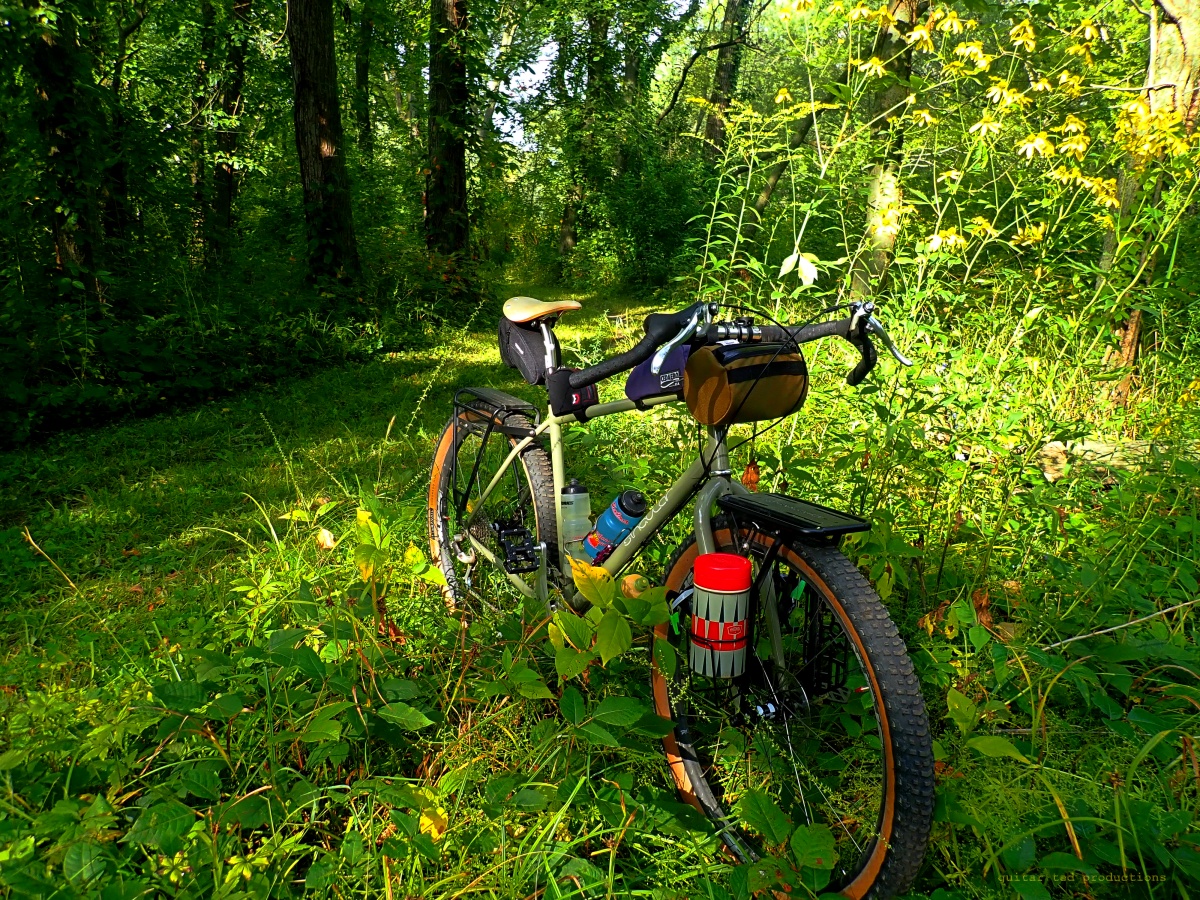
The Velo Orange Mojave Cage is a cage for oversized bottles, such as a Nalgene bottle, or any cylindrical canister/bag that comes close to the diameter described by the Mojave Cage's two sprung arms. 

I have used this cage on my Singular Gryphon Mk3 bike as a fork mounted accessory. The cage does have multiple mounting points on its back plate and could be positioned in many ways. Typical uses besides a fork mounted cage might include a down tube, either above or below, or off a rack of the type that Tumbleweed Bicycles makes, or the Old Man Mountain Elkhorn or Axle Pack racks. 

Initially I used a plastic food canister with the Mojave Cage, (seen HERE) and that worked quite well. Because the canister was pliable, the cage could actually make an impression into the plastic and eventually this almost molded the canister into the Mojave Cage! 

This made getting the plastic canister out a chore, but it was doable. I likely would go with a harder plastic canister for a longer tour to store dry food items in if I were planning a bike packing/tour. I don't have a Nalgene, or equivalent canister to try this with, but I do have an ancient Thermos bottle/canister which I tried as a carrier for some coffee on a recent outing. 

The Thermos would not fit all the way in, but the cage held it anyway!

The grip of the Mojave Cage is pretty stout if you have a larger diameter canister or bottle. The Thermos seemed to be on the larger side for the Mojave Cage, but that was not the limitation I thought it was at first. Actually one of my mounting bolts was protruding out enough that the steel edge of the Thermos was catching on it, which acted like a stop. However; the Mojave Cage's grip was so strong I figured I would give it a go and see how the cage would handle a Thermos filled with coffee on rougher trail with only half a grip on the bottle. 

Of course, I was risking destroying an antique Thermos jug, but hey! Someone has to test these things, and this looked like a good way to test the Mojave Cage's grip level. I am happy to report that coffee was enjoyed alongside a local lake and it was a very good morning. The Mojave Cage was not fazed by this test at all. 

The Mojave Cage delivered my coffee to this spot with no issues.

Final Word:

I think if I were to go on an extended trip by bicycle and needed a bigger cage for water, food, or other storage that the Mojave Cage would provide me with a safe, reliable way to do just that. As long as the canister you choose is large enough to spread the arms a bit on the cage I would think that the grip this cage exerts on things would be perfect for such a trip. 

One thing about this design which might be a concern is that if your canister is larger in diameter, those arms get really tough to spread apart far enough to release the canister. The hand strength required to push the arms apart (a pinching motion, by the way) is pretty high in such cases. Perhaps smaller hands or weaker hands would be prevented from moving the cage's arms enough to release a larger canister. It is something to think about, say if you are cold, wet, or really tired after a long day in the saddle. 

Other than that, I like and recommend this cage to anyone looking for something along these lines to carry oversized bottles on their bicycle. You can find a more detailed description of the Mojave Cage here

Thursday, August 15, 2024

A Couple Of Changes

I promise this is THE seatpost now!
 There has been a couple of tweaks done recently on two of my bicycles that I thought bore mentioning. They aren't a big deal, necessarily, but I have my reasons that some might find interesting, or at least amusing. 

I will admit I may have a bit of the "Princess and the Pea" syndrome going on here, so please bear that in mind as I detail these changes. 

So I had a bunch of issues with the original seatposts I was trying to use with the Honeman Flyer and found out later that one, especially, was undersized. That slipping seat post thing drove me mad for a bit until I settled upon using a PRO Discover post I had when I realized that set-back seat posts weren't unusable with this new single speed bike. 

Then the Redshift ShockStop Endurance Pro post came along and next thing ya know I am swapping out seat posts with a "boing factor" left and right for a bit. I really thought I might have settled on the Redshift post, the PRO Race model, actually, but I just never really warm up to sus posts. I guess its the changing saddle height thing. It eventually gets on my nerves and I finally couldn't take it anymore with the Honemann Flyer. Especially because I do seated climbing on it more often than not, and you are mashing teh gear then, of course, which activates the post. Not good for me. (Remember - Princess and the Pea!)

So, I was scrounging around for something and came across my "extra" Salsa titanium Regulator post. Yes! It was an extra one because I have four of them! Anyway, I was appalled that it wasn't being used and as I had a search on for a post for the Honemann Flyer I was only too happy to swap the Redshift post out for this titanium one. Now seated climbing is great! 

It's titanium grey, and a bit out of place, maybe, but I don't care at this point. This is THE post now going forward. 

You cannot really see the stem, but it is different. Oh! And there is another Regulator post!

Then I had the case of the Singular Gryphon Mk3. Originally I had this bike set up with the Ragley Luxy Bar which determined the full-length housing runs for the brakes and derailleurs. Then I got that Tumbleweed handlebar, which was nice, really wide, and stressed the cable lengths badly. 

Eventually even a shorter stem wasn't going to help, and then I got the Redshift Short ShockStop Stem and while I was installing that I decided the Tumbleweed bar had to come off. I was not about to re-cable the entire bike for a wider bar. 

So, now I am back to that Luxy Bar and the cables and housings are all happy again. Plus I have the boinger stem on there which makes things extra-comfy. So, there is the Gryphon Mk3 as it stands now. 

Time to ride.

Friday, August 09, 2024

Friday News And Views

Image courtesy of Colnago
 A Relatively Quiet Week Edition of the FN&V

Colnago Announces Rim Brake C 68 Frameset:

Rim brakes for road bikes have not been an option from many brands now for a few years. Especially on upper end bikes. This has raised some ire amongst road bike fans as the simplicity and - more importantly - lightweight of rim brake design, is still something many riders desire from a new road bike.

Now top-end brand Colnago has announced a US $7,750.00 carbon fiber rim brake frameset. The C-68 Rim Brake model is definitely a throwback to ten years ago when quick release wheels and non-hydraulic brake levers were still being offered in top-range drive train choices from Campagnolo, SRAM and Shimano. 

Comments: Should bikes like this still be considered range-topping bikes, or even bikes that average roadies could buy? The industry seems bent upon making every top-end bike, (and even mid-range bikes) 'feats of electronic technology and proprietary parts' instead of beautifully crafted, simple machines that draw the best out of humans. Bikes that show sustainability versus bikes that use batteries which will take energy and effort to recycle safely. 

Bicycles already have issues with being 'green' without the electronics and hydraulic fluids. Tires need to be recycled on a much larger scale than they are now, including tubes. This is happening, that is not the problem. The problem is that what is happening is a drop in the bucket. Then you have carbon fiber....

Ah! Do we need this Colnago to exist? Probably not. But at least it is an example that can be pointed to for the viability of mechanically operated brakes, at the minimum. 

Image courtesy of Iowa DNR

New Adventure Riding Opportunity In North Central Iowa:

A Facebook friend alerted me to a new opportunity for cycling in a reclaimed wetland wildlife preserve located just off I-35 near Swaledale and South of Thornton, Iowa. It is the Union Hills Wildlife and Waterfowl Production Area

Here is what was sent to me about the area and its cycling opportunities:

 " Just wanted to share an incredible ride that is now open at the Union Hills Wildlife Area south of Mason City and just west of I35. The DNR just mowed trails throughout the area that is one of the few places you get an idea of how North Central Iowa Looked like before settlement with pothole lakes and moraines with Bur Oak groves throughout."

 Area conservation groups and the State DNR have been working for several years to reclaim the area for wildlife and birding. The area boasts a section of native prairie that has never been plowed and many areas where one can "get lost" and feel as though they left civilization behind.

Apparently the trails are most easily ridden on fatter tires. So, a "plus bike" or fat bike might be best so as to not leave ruts and tear up the trails. This is a new opportunity, so don't "eff it up" folks. Keep your pizza-cutter tires on the gravel! Also, this area is heavily hunted during duck season, so please be aware of hunting seasons and maybe avoid this area then. Please be respectful of all the work that has gone into this and be kind to anyone you run across there if you go. If anyone has more information on this area and would like to share, let me know.

Image courtesy of Ritchey Design

Tom Ritchey To Show Off Brazing Skills At MADE Show:

In the beginnings of the modern mountain biking era, Tom Ritchey was single-handedly supplying frames, forks, and his "Bull Moose" handle bars for his customers. Tom hand-brazed each component and frame. Then the demand for his products took off and he was unable to keep pace with all the orders. Subsequently "a few hundred frames" were sold without their proper forks. 

Apparently, according to a recent Ritchey press release, Tom saw folks with his frames trying to source forks. I've been witnessing this for years — where people don't have the fork or bar that was designed to go with their Ritchey frame, and they're scrounging around for them. I started seeing replacement parts for my frames that were missing details. They were made by others, and they weren’t doing them right. Now, after all these years I’m helping these fans do it right.” — Tom Ritchey

To help rectify this, owners of  original " Mountain Bikes by Ritchey " frames will be able to purchase Bi-Plane forks and Bull Moose bars brazed up by the man himself. Furthermore, Tom will be doing a seminar and lecture at the MADE show. He also can be seen brazing in the Ritchey booth, #358, on Saturday, August 24 at noon.

Ritchey will be doing this work under the moniker "Mountain Bikes by Tom" and a further announcement will be made at the show. For details on the MADE Show go HERE.

PCL Shirt Lands:

Ahoy! The newest PCL t-shirt has just arrived on the scene from Lincoln, Nebraska. This time I have one of the original logos for the Pirate Cycling League featuring a mustachioed skeleton astride a drop bar single speed. 

In case you are newer here the Pirate Cycling League is a loose-knit band of cyclists who identify as gravel riders, (mostly) that typify the original free-spirit and independent nature of gravel cycling. The group grew out of training rides for mountain biking which were typically held on gravel roads around Lincoln. 

These cyclists, who were really thinking about getting in miles for racing on dirt originally, ended up becoming a prototype gravel group who then found themselves putting on semi-formal "events" throughout the year. The group eventually was responsible for Gravel Worlds existence, although the PCL has officially now parted ways with Garmin Gravel Worlds. 

Since the split, the group has been putting out the occasional t-shirt and riding kit as well. If you want to support the PCL and become a "member" of the group, you only have to be cool and buy a shirt or jersey when they put one out. I've been purchasing PCL jerseys and tees for over a decade. You can find the group on Facebook. 

Image courtesy of Tumbleweed Bicycles
Tumbleweed Sunliner:

Tumbleweed Bicycles announced their third model yesterday, a flat bar bikepacking bike with no suspension correction. The bike is called the Sunliner

With tire clearance for 29" X 3.0" tires, the Sunliner should appeal to anyone wanting a simple machine with big tire capabilities. That non-sus corrected fork also allowed Tumbleweed to maximize the space in the front triangle for the largest frame bag size. 

There are tons of rack mounts, bottle cage mounts, and fender mounts on the Sunliner. It should work great for carrying about anything you'd want on an off-road tour and with the design intent for a swept back handlebar, it should prove to be a comfortable, all-day riding bike. 

Frame and fork goes for US $1,400.00 with completes starting at $3,775.00.
 

Okay, that's a wrap on this week's news and my views. Keep ridin' those bikes!

Saturday, July 20, 2024

A Man, A Bike, And A Piece Of Black Electrical Tape

The only known shot of Jason Boucher riding "BET". Matt Gersib is on the right.
Sixteen years ago on July 16th, 2008, Jason Boucher rode from Waterloo, Iowa down to Hickory Hills park and the gathered riders there saw a bike that few had laid eyes on. A bike that would be the catalyst for a revival of a style of riding now known as "bike packing", which was formerly known as mountain touring, or off-road touring. This bike, and the man who pushed the idea through to get it made were responsible for the catch-phrase "Adventure by Bike" which became a movement and spawned an entire category of bicycles which are still being produced to this day. 

I've written reams of digital pages about this particular moment and the bike itself. It arguably is one of the most popular subjects on this blog with a page dedicated to this particular bike which gets views every week that top any other pages on this blog consistently. I am speaking, of course, about the Salsa Cycles Fargo. The man behind the ideas for this bike and the man who pushed it through to see the light of day is named Jason Boucher.

Jason Boucher in 2024.

I am not going to write a bunch of words today which already have been written here. I'll put some links down at the end of the post to direct you to where I have already opined about the importance of the Fargo. What I want to do here is to pull a quote from a recent Instagram post Jason made which will tell the story from his vantage point. I think that would be a good viewpoint to add to this story here. 

" It was 14 or 15 years ago today that I was riding a prototype bike to @g.ted.productions Death Ride. A bike I drove and helped create. That weekend it got labelled the “black electrical tape” bike. A coworker at the time called it the ugliest bike he had to own. Many said they didn’t need a drop bar mountain touring bike. Others said it’s a cool concept but touring doesn’t sell. "

And the Fargo was very hard for a lot of people to wrap their minds around. Of course, we need to keep in mind a couple of things to gain the correct context here. First off, 29"ers were not a "done deal" at that point in time. Sure, they had gained a toe-hold, but that wheel size was still roundly being criticized and put down as a fad that would fade away by riders and industry folks alike. Some brands were stating publicly that they would never, ever make a 29"er. (Looking at you Specialized, Yeti, and Giant)

Drop bars and fat tires were very odd  in 2008. Only weirdos and alt-bar freaks would put drop bars  on a MTB, much less one with wagon wheels. Drop bars were for road bikes and cyclo cross bikes! (And maybe touring bikes, but no one was doing that anymore!). Then there was the whole touring aspect, as mentioned, which everyone thought was a dead category.

The Fargo I was given by Jason in late 2008 as seen today.

The bike almost did not happen. It was resisted by higher-ups at Jason's place of employment at the time. It was seen as a bit of a losing prospect, as you can read from Jason's quote above. More from Jason:

"We did it anyways. Inspired by many drop bar bikes, touring bikes, and mountain bikes that came before it. It was the product that drove me to rebrand Salsa to Adventure by Bike. In many ways I still believe its the purest execution of the ethos of that tagline (IMHO) and I admit I am a bit biased."

 Of course, the entire bikepacking scene may have happened anyway at some point. Even without the venerable Fargo and its "Adventure by Bike" ethos. But I don't think the reach of that style of riding would have been as deep and far had the Fargo been nixed and never seen the light of day. I know it was a very popular choice for gravel riders, tourists that were looking for a bit more upright position, and it was popular with 29"er fans. 

In my opinion, the Fargo took a while to catch on, but when it did, the model pretty much had its way with the market until the late 2010's when other companies started jumping into the space the Fargo occupied. Now we have several "Fargo-like" choices, and probably the best of those is the Esker Lorax and the Tumbleweed Stargazer models. Ironically, Jason does some work with Tumbleweed these days. 

So, in closing I just wanted to post this to give Jason his flowers and shine a light on the man and the vision that brought the Fargo to life, and arguably was the catalyst for much of what came afterward in the bikepacking category as far as bicycles are concerned. 

Links to previous stories about the "Black Electrical Tape" bike and origin story. 

"The GTDRI Stories: Black Electrical Tape"

"Minus Ten Review - 29"

"The GTDRI Stories: The Fargo Comes Home"

"Fargo Riders Reunion Ride"

Update: Jason Boucher left a comment on this post which maybe won't be seen by many, so I thought I would add it to the post as it pertains to the Fargo and its genesis story. Here it is:

"I need to add a little more detail here. As memories fade it's important to write them down to both remember and document history. I certainly feel directly responsible for both the Fargo and Adventure by Bike. Yet, it isn't those two things that I remember as the most important. It's the people. The Fargo would not have happened without really good & talented people and partners, both inside the organization as well as outside.

Bikepacking.com just posted something on drop bar mountain bike just yesterday and one of the other really important people to this Fargo story is Joe Meiser. I recall one day chatting with Joe about a bike that I would want if I ever did my Alaska to Utah bike trip again (something I did after attending college). Joe was just then setting his sights not the Tour Divide. He wanted something special too. We schemed. One day Joe showed up to work and said "I drew the bike last night". We were both giddy. We looked. I suggested some changes from my personal experience and desire for this product.

Joe and I made changes. Buttoned it up. Ordered frames for us to build & ride. It was a product that was not on any product map or wasn't ever talked about as a product. We just did it. I'm forever grateful that that moment happened. I'm forever grateful of the team of people on our small Salsa team. I'm forever grateful for the people this idea and concept of adventure brought into my life. It changed me forever.

Also a fun fact, Fargo was not the original name. There was a different name that was changed to align with Adventure by Bike. I think only 3-4 people know what that name is........
"

Friday, February 23, 2024

Friday News And Views

 Welcome to an "electrifying" version of the FN&V!

Congress debating New E-Bike Battery Regs:

A news story this week concerning the dangers of lithium-ion battery fires and laws for regulation of those batteries was noted in several social media posts this week. A link to an excellent story on this comes from thecity.nyc which you can read HERE.

Apparently there has been an over 1000% increase in battery related fires in New York City since 2019. That and the rate of deaths due to these fires has prompted New York City and the State of New York to take some rather dramatic actions in the form of laws limiting e-bikes and battery refurbishing, a main source of concern in New York City.

But this is gaining nationwide notice as fires related to e-bike batteries becomes more prevalent across the nation. The fact that Congress is getting involved shows that this has become a serious issue for people outside of NYC as well.

Comments: With a flood of cheap e-bikes and electrified scooters available at cheap prices from China, many of which have known quality and safety issues, it seems that it is about time for some regulation. Combined with lawsuits regarding the safety of e-bikes and their construction and design which are ongoing, I would expect that the reins will be tightened on these more budget, entry-level items in the future. 

What the ultimately looks like is anyone's guess now. But if the Feds get the low-end electrified market regulated that will probably drive up prices and make these bicycles even more expensive, maybe even in line with mainstream brand offerings. And that will pretty much make electrified bikes the province of fewer and fewer people due to the high prices.   

Image courtesy of Cannondale

Cannondale Debuts New Moterra SL Electric MTB:

Boasting the most power, longer battery life, and all wrapped up in the lightest weight package than any other current electrified MTB, Cannondale showed off its latest effort on Tuesday of this week. 

Dubbed "Moterra SL", the bike comes in three versions with a range-topping LAB71 series Moterra SL checking in at $14,00.00. The Moterra SL 2, shown here in read, is half the price and the entry into the Moterra range. There is also a Moterra SL 1 at $8700.00. 

Comments: So.....what exactly is "lightweight" for a bike like this? Apparently 43lbs is "light". Okay then.... Let's hope that battery lasts for the entire ride because pedaling 43lbs of MTB without assist would be no fun. Again with the super-expensive pricing. I really have a hard time with electric MTB's at this price when one could buy a brand new Honda 125 MX'er for $3500.00. Anyway....

Image courtesy of Wolf Tooth

Wolf Tooth Offers Aero GRX Rings

Tuesday also saw the announcement from Wolf Tooth that they now have "aero" GRX chain rings. These rings come in 46T-52T sizes in oval or round styles to fit 4-bolt GRX crank sets in the 1X configuration only. 

Prices range from $81.95 for the oval rings to $84.95 for the round rings. You can see these and learn more at Wolf Tooth's page for the rings HERE

Comments: Aero chain rings for gravel? Going all-out roadie on us here! Anyway, I would think that these would be - at best - only very slightly "aero", if at all. I do think they look kinda cool. But other than that? Well, you can get big rings, for gravel time trialing, I suppose, but yeah.... Not my bag, but maybe it would work for you? There ya go..... 

From Jason Boucher's social media.

Tumbleweed Announces Hire Of Jason Boucher:

Tumbleweed Bicycle Company announced on Tuesday that they have hired Jason Boucher, former brand manage of Salsa Cycles, as an employee who will be tasked with internal affairs, product development, and coordinating Tumbleweed's dealer network. 

Comments: I have to divulge here that Jason is a good friend of mine, although we don't see each other often, and so I am a bit biased when it comes to this news.

I feel that Jason is custom-made for this role and my feeling is that he will thrive in this role. Tumbleweed and Jason are both about the "adventure by bike" ethos that Jason forged into his previous role at Salsa. I'm excited for Jason and where this might take him going forward. 

I also want to say that I had no idea whatsoever that this was in the cards while I was doing my Big Dipper handle bar review, so there was no influence on what I had to say in that review from this decision, since I was out of that loop.

Image courtesy of GT Bicycles

GT Bicycles Announces Changes In Brand Direction:

GT Bicycles, the brand once part of the Dorel Group, is now owned by The Pon Group and recently has announced that they have made a change in brand direction.

Now headed up by Jason Schiers, who was one of the  founders of Enve Composites, (Then know as Edge), GT Bicycles has been removed from Disck's Sporting Goods stores and will focus exclusively on the independent bicycle dealer network going forward. 

First up on their agenda for products is to get into the full suspension MTB market with a range of bicycles at the upper end of the market. Schiers mentioned in a recent "Bicycle Retailer and Industry News" article on this story that he feels all FS MTB's will be electric in the near future. 

Comments: I think repositioning GT as a brand with a more upscale appeal is probably a good thing, but I don't look for this to be a huge mover in the bicycle landscape at this point. I'm sure GT's team has a good plan, but I would imagine it is modest and has smaller goals in mind in the short term. Dealers are reticent to buy any inventory at this point so getting GT bikes in front of consumers may be a difficult task until this glut of inventory clears itself out of the pipeline. 

That's a wrap for this week! Thanks for reading Guitar Ted Productions.

Tuesday, February 20, 2024

Tumbleweed Bicycle Co. Big Dipper Handle Bar: Conclusions

 Note: Tumbleweed Bicycle Co. sent a Big Dipper handle bar to Guitar Ted Productions at no charge for review. I was not paid, nor bribed for this review, and I always strive to give my honest thoughts and opinions throughout. The first part of this review can be seen HERE.

In the last update I mentioned that I had a very specific course in mind before I wrote up my final verdict on these handlebars and now that I have ridden that course, I am ready to end the review. I also wanted to compare and contrast the wider drop bar choices against the current fad of the use of a narrow drop bar with flared drops in road.  I'm sure it will show up in gravel events this year as well.

The Tumbleweed Big Dipper Handlebar mounted to a Dingular Gryphon Mk3

So, first let's look at my findings with all the riding I have been doing with this handlebar. I've done single track, urban, bike path, deteriorated gravel, gravel, and grassy tracks using the Big Dipper both in loaded and unloaded configurations. I have also done a small amount of snow riding as well. 

Short rides and rides lasting up to four hours have also been done on this handlebar. So, by this time I feel as though I have  a pretty good handle (no pun intended) on what the Big Dipper is like and what it has to offer. 

On the positive side of the ledger the Big Dipper bar will give a bit over rougher terrain due to its width and tubing profile. Whether this was designed purposefully or whether it is just a "happy accident", the bar does a good job of taking the edge off some sharper hits.  By no means is it as good as a suspension stem like the Redshift ShockStop stem, or like any suspension fork, but it does lend a smoother ride to the rider. 

The Big Dipper Drop Bar looks handsome and is reasonably priced at $115.00USD. So, that width won't break the bank and you get a well designed bar in return. I appreciate that about the bar also. (But again, I'll remind you that Tumbleweed sent this one out at no charge) 

About That Width: I was very skeptical that I would be able to get along with a handlebar that was 8cm wider than what I normally ride. However; I was pleasantly surprised that it felt kind of "normal" and when I got back on my other gravel drop bar rigs, those handlebars suddenly felt narrower and twitchy. 

So, yes, stability is enhanced a bit by the wider bar as well. Additionally, this stability and slowed-up handling was a boon in sketchy, loose terrain or on snow and ice. 

The width also played into having more leverage while loaded to keep side-to-side bike stability high and of course, cranking the bike up a climb was also enhanced by that width. 

So, was there anything negative to say about that wide of a handlebar? I think one has to be careful that you don't get carried away with width. I happen to have pretty wide shoulders and longer arms. This allowed me to adapt quickly to this width bar. But if your build is smaller of stature, narrow at the shoulders, or both, you could get too wide easily. I felt a bit different muscle soreness after longer rides on the Big Dipper bar and I attributed that to the wider stance of my hands. 

As far as hands go, I think one thing has to be mentioned here that not many folks who review handlebars think about, or at least, they do not mention this. People ride on the hoods while using drop bars a lot these days. In fact, many barely ever use any other hand position. So, what exactly about any handlebar makes brake hood levers feel like a good place to ride? Nothing about a handlebar affects that position. (Unless the bars are really flared, that is) That's all in the design of the lever itself. So, I won't tell you about that position on the Big Dipper bar. 

One of my nits about the Big Dipper Bar is that the extensions are too short.

Riding in the drops is where I like to be into a wind, running down a steep bit of trail, or for longer, grindy climbs. The Big Dipper is serviceable in these situations but a half an inch more length in the extensions would go a long ways toward making things happier down there. 

The best thing about the Big Dipper, as far as hand positions go, is that wide section of the tops between the levers where you can sit up a bit, relax your back, and cruise without having your hands too close together. Those bars with narrower tops sections can be hard to ride when grasping the center section due to the shorter lever you have over the steer tube. 

Now would you be better served with a more aero, narrower bar for gravel? Maybe one of those crazy, super-narrow flared drop bars? I think of it this way- If you need "aero" get aero bars and use them on gravel. Don't sacrifice the stability, comfort, and control of a wider bar for the "aero" of these weird, niche, racing-only handle bars. Well, unless you are a racer and aero bars are banned. But you do you. 

Conclusions: I really like the Tumbleweed Big Dipper Handlebar, and maybe, if I could sway them into this, I would persuade Tumbleweed to add a bit of length in the extensions. If they were to do that, the Big Dipper would be nearly a perfect drop bar for unpaved and gravel use. 

I think the design, which is much more closely related to traditional road drop bar designs, would work for many people in long-distance, ultra-gravel events, bikepacking, or just for your general purpose gravel rides. There is a ton of space up front for a handlebar bag or a longer roll for sleeping gear or some tents. The stability lent to the rider via the width is a good thing on long days where you may get fatigued by a narrower bar and have trouble with handling. 

Personally, I think the bar this Big Dipper replaced on my Singular is still one of my favorites. The Luxy Bar has a narrower distance between the brake levers, but it has a wider drop extension section which is "swept" outwards and aligns my arms and shoulders much like a Jones Bar might, for reference. Trouble is that bar has been long out of production and no one makes anything quite like it in 2024. 

The Big Dipper comes in a close second to that old handlebar I have. It's really good. Give the Big Dipper bar a try if your are looking for a handsome wide drop bar that will serve you well. It does the wide drop bar thing very nicely and would be my choice now for such a handlebar for my bikepacking rig. 

See the BigDipper Bar at Tumbleweed Bikes HERE.

Thursday, February 01, 2024

Review Updates: OMM, Tumbleweed, WTB

The OMM Axle Pack
 I have a few review projects in the works here at Guitar Ted Productions. Two were put on hold by the weather and one just arrived Tuesday afternoon. This post will serve as an update on the ongoing reviews and a teaser for the new one that is coming up soon. 

Please keep in mind that all these items being mentioned in today;s post were provided to me at no charge for test and review.  I am not being bribed, nor paid for this review and I always strive to give my honest thoughts and opinions throughout.

First we have the Old Man Mountain Axle Pack (last updated HERE) This is a rack strip that you can mount to any fork that does not have bottle bosses or "Three-Pack" mounts and then attach cages or racks to that to carry more stuff. 

I have the one sent to me all ready to go on the Noble Bikes GX5 carbon gravel rig and I should be able to get some country rides in on that set-up soon with these crazy warm temperatures which are forecast. So, hopefully I can get finished up on that one real soon. 

Next up I have that Tumbleweed Big Dipper handlebar that I am reviewing. (Last update HERE) I have a very specific test and route in mind for this review and I need the weather to clear up and warm up before I can get that review put to bed. However; in the meantime I probably will be doing a mid-mid-term update. (Ha!) I have been riding the bike off and on that the handlebar is on. Plus, in light of the aero/narrow drop bar trend, I thought it might be a good idea to compare and contrast what super-narrow bars give you versus the mega-wide drops like the Big Dipper. 

The Big Dipper bars on my Singular Gryphon Mk3.

Finally I have news of a new review that will start on these pages in March. This one I cannot 100% say much about other than the products I received to review are from WTB. 

I will say that one of the products is pretty surprising, but it does make sense in a way. Yeah.....I better stop there. Look for this stuff to be revealed sometime in March when I will have already had several weeks of riding done on the stuff and will give a final review on the products. 

Oh! And the Honeman Flyer single speed should be finished up sometime soon and sent out to me to complete the build on. There's a LOT more to this whole project than just a bike, so stay tuned for more on that as well. 

And as always; Thank you for reading Guitar Ted Productions!

Monday, January 08, 2024

Tinkering

The current state of the Gryphon Mk3
 Over the Holidays I tackled the issues I had resulting from the addition of that Tumbleweed Big Dipper Bar I installed in November. (Review so far is HERE) The stem and the rear brake are both now perfect.

The Big Dipper bar added width which was just enough to cause the rear brake cable and housing to be a tiny bit too short. I could ride the bike, but turning the bars to the right just a bit too far would activate the rear brake. Not at all what you want, to say nothing of the cable housing rub on the head tube. 

So, my first thought was to get a hold of a shorter stem. That original 80mm stem was stretching me out a bit too much anyway, so I ordered up a 60mm Whiskey stem in a polished finish to keep my silver theme for the Gryphon intact. While the stem did fix the fit issue, it didn't take the brake issues all the way out of the equation. 

So, I thought about what I had to do there. The obvious answer would be to add new longer housing and and cable. However; that would mean tearing into the bar tape I had just put on, and that may or may not go well. Plus, it would be a lot of work and expense. I came up with a better, less intrusive and less expensive idea. Lengthen the housing, buy a new cable, insert it, and boom! The problem was just how  I would lengthen the housing without replacing it. Then I had some inspiration....

The new Whiskey stem shows more of the Tumbleweed branding here.

This bit was originally for a time trial bike's rear brake.

I have a "pack-rat" mentality when it comes to cast-off or extra parts that are unusual. So, when I have an unusual situation to tackle, I often sift through my stuff and see if anything strikes up an idea. This time I saw a piece that originally came off a replacement tri-bike rear brake. The original piece was retained and the new "noodle", if you will, went unused, so I kept that bit. This time the piece was perfectly suited for the task of lengthening my full-run housing a bit. 

Since the flexible steel and aluminum bit was about three inches long, I just scooched the full-run housing forward carefully through the cable-tied mounting points along the frame and added it at the end before the caliper. A new, extra-long rear brake cable was purchased at the local bike shop and when installed I had solved the problem. Now the overall length of the system allowed for full-on right hand turns and the housing was off the head tube! 

So, the final tweaking bit I did was an experiment more than anything. A reader of the blog here sent me some images of a "cut-off" light mod that he hacked from a flat piece of plastic or something similar, then he attached it to his Bookman Volume light so that it looked kind of like a visor over the lighting element. This would prevent the beam from shining up higher than the lighting unit. His images he sent of the beam pattern were encouraging enough that I thought I'd give it a try. 

I used some bit of old Iowa license plat aluminum and some tape to temporarily mount the "visor" to my Bookman light. I must say though that my test didn't really show any improvement over not having the visor thingie on and if I wanted to accomplish what I'd seen it would take a much longer piece to do that. 

So, two wins and a fail. I'll report back if I try the light hack again.