Showing posts with label wheel building. Show all posts

Saturday, August 22, 2026

Deconstruction: Part 2

Progress has been made on the wheel project. I managed to get both Surly Extraterrestrials off the Duster rims, remove both TLR rim strips, and then deconstruct the wheels. 

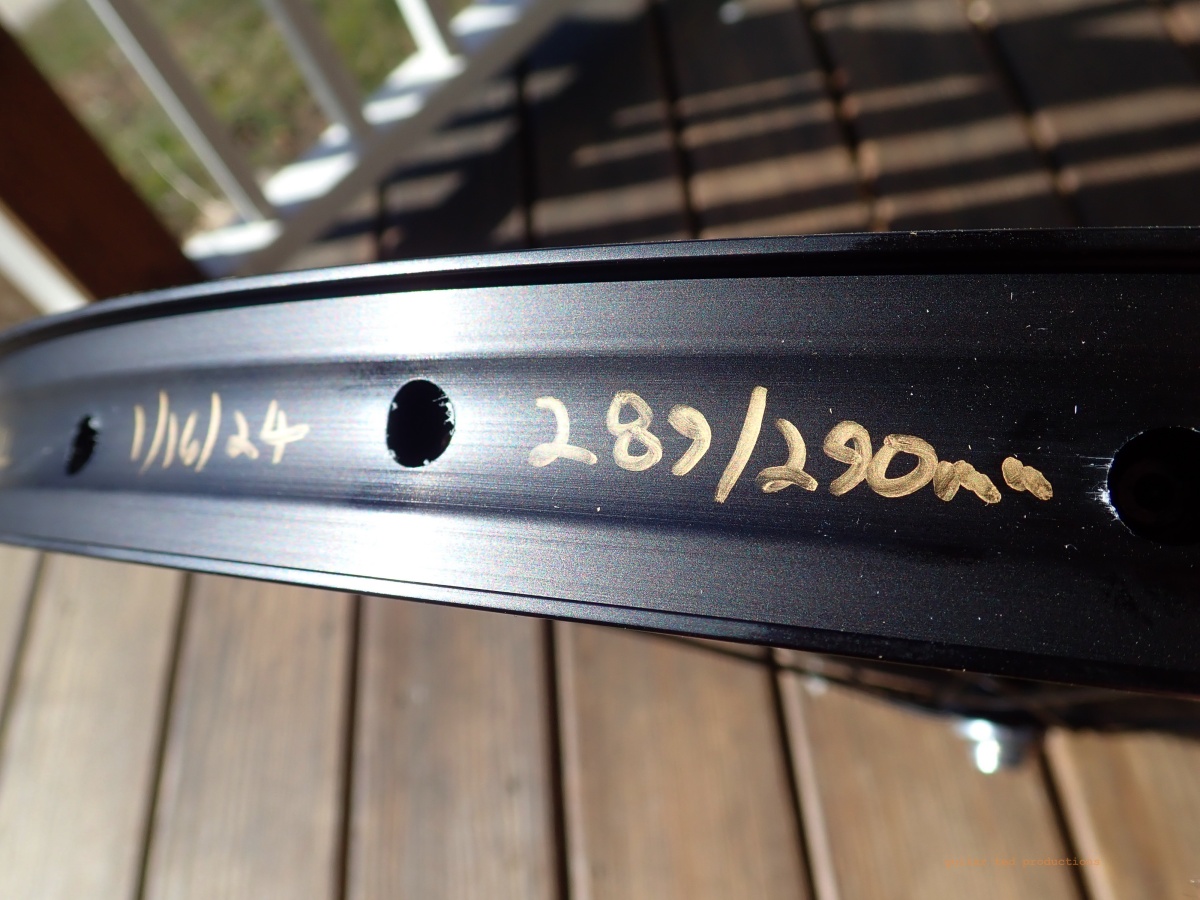
Now that the rims are freed up, I can measure them, measure the hubs, and calculate the spoke lengths. The spokes which came out of the old wheels are actually not bad. I may employ some of them if the measurements agree. 

The rims are in great shape. No dings or big scratches. I do still plan on de-stickering them. I will be ultra-careful with those two TLR rim strips. They are a little delicate along their edges. Fortunately both look reasonably good and reusable. 

That was the big hurdle to get over. Especially removing those tires. That was quite the chore! Once I got past the removing of the tires things went a lot more quickly. 

I'm not sure when I will get to the construction phase at this time. I have to measure everything and figure out spoke lengths. Then I'll have to see what I have in reserve for spokes and decide if I am ordering spokes or not. If an order is necessary, (and I am betting it will be necessary), this will take a bit longer and I may not get the wheels built until later in September. 

But whatever. The deconstruction phase is over. Time to move on. 
 

Sunday, August 16, 2026

Deconstruction: Part 1

Well, since I've been getting rained out here I figured I may as well get cracking on with the new wheel build for the Fargo Gen I. "New" as in a new assemblage of older parts I have. The spokes and nipples may be the only new thing I use. 

The rims will be the venerable Bontrager Duster rims. These were off the Trek Sawyer I once had. The hubs will be the old Chris King hubs, the very same hub set I used over a decade ago during the "Mud Year" of 2015 at the DK200. 

The plan will be to do the "Guitar Ted Special" build, which is black spokes on one side, silver on the other, with one wheel having a reverse arrangement from the other. Black spokes will get silver nipples and silver spokes will get black nipples. I know, it sounds weird, but it looks rad - to my eyes - and I have a few wheel sets already built up using this scheme. 

Other details will include removal of the stickers on the rims, getting the hubs checked out inside, and re-using the Bontrager TLR rim strips. Bontrager TLR Rim strips? Yes..... I'll show you. 

But first, I had to begin things by blowing apart the old wheels. Let the deconstruction commence!

Dismounting the Extraterrestrials was no small task. This was due mostly to the TLR rim strip. Dislodging the bead of the tire from the bead channel molded into the TLR rim strip is a chore. Good thing if you flat while riding because it is unlikely the TLR rim strip will let your tire go. Bad if you want to actually remove a tire

So, to dislodge the bead from the TLR bead channel, I devised a tool from a Pedros tire lever. The purpose of this was to push the bead over the inner part of the bead channel and into the rim well. It worked! Good thing because I could not roll it off with my hands at all. 

After this, you'd think things would get easier. Nope! Next you have to remove the TLR rim strip to reveal the spoke holes and nipples. You want to do this very carefully. The reason being is that the edges of the rim strip are delicate and it is easy to damage the molded strip. I was able to get it out okay. 

Then all I needed to do was start cleaning things up and move on to the next wheel. But I won't get into all of that here. The next update will show you the rims cleaned up and what my spokes will be for the build. After this, I need to verify the condition of the rear King hub, in particular, and build up the wheels, of course. 

The TLR rim strip in situ.

 
Here the TLR rim strip is removed.
One more thing about the system. This was the first, good tubeless rim system ever made. Everything fit together like puzzle pices, but you were locked into Bontrager stuff. Maybe not necessarily in regard to tires, but the rim, rim strip, and valve were all proprietary technology. Brilliant in design though, and it worked perfect most every time. 

No tape to fail, tires were held securely, and things were serviceable. It's too bad it wasn't an industry wide standard, really. Anyway.... 

Stay tuned. 

Wednesday, August 12, 2026

Rim Wars: Sometimes The Solution Is Right In Front Of You.

Just the other day 'shiggy person' asked me to see if I had a Surly Extraterrestrial to measure. Well, in fact, I do. 

The wheel set I rode last year for the Ride For Jacob is the original wheel set from a Trek Sawyer I used to have, Because the wheel was spec'ed with a heavy Shimano hub set, I was not too stoked about riding them and ended up throwing various different wheels at that bike until I sold it. 

The ironic bit is that the Sawyer had the Chris King hubs on it when I sold it. But those were offered back to me earlier this year and I bought them to use for a nice wheel set for the Fargo Gen I,

Which....again in a bit of irony..was the bike I used the Bontrager Duster/Shimano hub set on when I did the Ride For Jacob last year. Again, this wheel set hasn't been a favorite of mine but the Duster rims best suited the Extraterrestrials, so I rolled them. 

So, while I was measuring the Extraterrestrial for 'shiggy', (62.63mm @ 19psi, by the way), I realized that I would like this wheel a lot better if the Chris King hubs were laced in their. 

Boom.....

So I think this is the direction I'm going to go in. I'll set up the Dusters with the King hub set. Then The Surly tires will go back on. Problem solved. 

Saturday, August 08, 2026

Rim Wars

Image courtesy of Hates Bicycle
So for my Chris King hub set I still have not decided upon rims to build up wheels from them. I was considering carbon, but the prices for those are a bit intimidating from the standpoint of my use case scenario. I mean, this is a bike that is almost twenty years old now! (Fargo Gen I) So, putting on bling-wheels seems a bit too much for me when I think about this bicycle. Making wheels which would be worth more than the rest of the bike seems....not wise

So, I have resigned myself to doing a wheel set in aluminum, just to use these Chris King hubs. Earlier in the week I was referred by a commenter to look at Sun/Ringle' Durocd rims. I also am a big fan of Velocity USA's Blunt SS rims. So, I did a compare and contrast with these two choices. They are remarkably similar in some significant ways. 

The Blunt SS

Image courtesy of Velocity USA

I have experience with this rim and it all has been positive. It's a fairly light rim for the inner width at a claimed 425 grams each. These build up nicely and look really good. 

For my uses it would be absolutely fine doing what I'd ask of it. Now, if I were actually mountain biking I would have some reservations. 

The Blunt SS isn't what I would call a rim for really fast, rough riding styles on tough trails. It can be flexy, easily dented, and some say it is problematic doing tubeless tires. (I have never had any issues running Blunt SS's tubeless, so....)

The price for a single Blunt SS 700c rim is $152.00 and these are made in the USA. 

The Sun Duroc 30:

As you can see from the cutaway diagram here, the Sun Duroc 30 is very close in specifications to a Blunt SS. The inner rim width is nearly identical, and in just about every way, the Duroc 30 seems to be analogous to a Blunt SS in the important areas. 

There are two things about the Duroc 30 which distinguish it from the Blunt SS and they are related to each other. 

Firstly, the Duroc 30 is a welded seam rim while the Blunt SS is not. This is a tiny thing in and of itself, but the nod goes to the Duroc here because welded seams can be more durable. Welding can also distort the rim walls, if done poorly, so having not seen any examples of this rim, I cannot say if Sun's production quality is good or no. Based upon other Sun rims I have seen I would guess this is a non-issue. 

The other related thing is weight. A welded seam weighs more than a pin and sleeve one does. So, this bears out as the Duroc 30 is a claimed 465 grams versus the Blunt SS at a claimed 425 grams each. Of course, the Duroc can be heavier just because of its extrusion design also, so we have to account somewhat for this possibility as well. 

The Duroc 30 costs about a hundred bucks each, so a savings of over $100.00 for a pair versus the Velocity product. I do not know where the Duroc is made, but I would hazard a guess that it is not made in the USA. 

Decisions:

I haven't done anything yet, but the Duroc gets some cred from a local rider here I respect, so I would not be afraid to use those rims. The made in USA thing is nice, but at this point spending around $200.00 versus $300.00 or more is a significant difference. One I cannot ignore. 

Soon I will make a decision. What would you do? 

Wednesday, August 05, 2026

Two Things

Getting Back To That Wheel Project:

Last Spring I received back my old Chris King hub set. I mentioned then I wanted to build these up into wheels for the Fargo Gen I. Then.....

Crickets.

Why? Well, first off I was a bit paralyzed by prices for carbon rims. I can afford them, that isn't the problem. The problem is if I believe they are what I truly need to be spending money on for that bike

I still believe Velocity Blunt SS rims would be just fine and do the job well. I probably will end up getting a set. But I did not back then because BRAN then came along and well, I spent a bunch of money getting ready for that

Then Summer came along and I got distracted, as one does, by other things. Now we're going into Fall and my mind is settling into what I need to get done before Winter comes along, besides getting the house ready. 

This wheel set build is on the radar. There is a slight chance I go in a different direction than indicated here, but the Blunt SS is the leader in the clubhouse as of now. Unless I can be persuaded otherwise....

What It Is All About:

Let's see..... Gravel Worlds is coming up. I haven't seen a lot about CORE4 this year (?), and then you have a few, smaller events which are fairly local which I've seen some buzz about. Does anyone know who is winning the UCI Gravel series events or the Gravel Earth events? 

I don't see people yakking about those things much at all, not on social media anyway. barely any coverage on the ol' innergoogles either. So.....does anyone really care about these races

I have seen a LOT more stuff about rides, small gravel competitions, and bike packing adventures, all non-sanctioned, by the way, than I have any of the "big-time" events. 

When is the cycling industry going to catch on to this? Will they ever? And maybe it doesn't matter. I will say that our local shops, all two of them, are still not engaging with the scene and haven't for years. This is Iowa. Gravel is literally everywhere, yet these shops seemingly are blind to it. I worked at one of them for many years and all that shop cared about was a twice yearly road time trial series that drew a small smattering of locals. 

But gravel cycling? Nah..... Whatever. 

The thing is, gravel cycling is the meat of cycling activities, not some weirdo thing going on out in the country. Well.....some of us are weirdos, yes. But you know what I am getting at here. Gravel is the meat of what is going on and you cannot, as a business, treat it like cole slaw. If you do, it is at your own risk. 

Monday, April 20, 2026

Wheels For Gen I: Hubs Here!

Saturday was the day I received the Chris King hubs back I used to own. Kind of an odd feeling while turning those axles and thinking about all the rides I have done on these hubs. 

They feel great, by the way, and they look fine as well. A nick here or there, but what should one expect from a set of hubs that has been kicking around since 2008 or so?

With this set of hubs now in hand, I can start thinking about some rims. There is one big fork in the road to consider. Which way I go will determine price and wheel overall weight in the end. 

I could go carbon or aluminum. If I go aluminum I'll likely roll with some Velocity Blunt SS rims. I like them. They are sturdy, look good,are a nice width, and there are options for colors, polished, or custom anodized rims. But honestly, I'll probably get black anodized ones if I go aluminum. 

Carbon rims are a different story. Most well known name brands are waaaaaaaay expensive. Then you have the carbon rims from China like Nextie or ICAN which have good reputations and perhaps are better known for the rims they make with other brand names on them. 

Like I said, I have to decide which fork in the road to take. Then I will have to buy two rims, probably some spokes, and get busy. 

Stay tuned....

Thursday, August 01, 2024

Wheel Decisions

About three months ago now I was riding the Tamland Two with the Irwin carbon wheel set and I experienced some free hub issues. You can check that post out HERE. Since then that Irwin wheel set has been sitting around and every once in a while while I see it in my shop I start to think about what I can do with the wheels. 

I go back and forth with ideas. I was pretty set on tearing them down to rims, spokes, and hubs on Tuesday but when I went down to take care of that I took one more look at the free hub. See, all along I haven't been able to see why the free hub was not engaging properly at random times. It made no sense. I could see no damage at all, no excessive wear, nothing.

And the end cap I removed to get the free hub body off to inspect things three months ago had been misplaced. gah! So, I dug through my stash of end caps and found some more Irwin compatible ones which got me sorted. I reassembled the free hub, put it back together, and it sounds and feels awesome. gah! x2...

I just hate to have to tear something apart if it isn't really necessary, and swapping these rims to new hubs probably will mean buying spokes and nipples and obviously more time and energy. gah! x3!

The Irwin wheels still have tires mounted tubeless to them, so what I think I am going to do is to relegate these wheels to my very local to me test loop. That way, if they fail I can walk back home with no real issues. If they prove to be reliable, well then the problem is solved. Anyway....

Never been used!

Then there is this other wheel set. I have a Velocity disc hub wheel set with Bontrager RXL rim brake rims laced to them. The hubs are disc. I know......weird! Let me explain....

Probably over ten years ago Velocity USA sent me a set of Major Tom disc wheels as payment for advertising on "Gravel Grinder News", the gravel site that morphed out of this blog starting in 2008. There was scuttlebutt going around that a bigger tubular tire for gravel was coming out, but...... I was ready with the wheels, and the tires were vaporware. Oh well....

Now I had this wheel set with no inclinations of running tubular tires ever. I ended up swapping the rims out with the current Bontrager RXL Scandium aluminum rims which I picked up on close-out from Trek. Then I figured I'd use them on my Black Mountain Cycles "Orange Crush", but right about that time I decided that the Orange Crush was going back to a single speed soon. So the wheels hung from the ceiling in the shop, and I have never used them. 

I had thought about using the hubs with the Irwin carbon rims, and maybe that is what will end up happening, but I don't know..... Decisions between choices. Never fear! I'll likely come up with more ideas of what to do which will freeze my situation for the foreseeable future. 

I'm good a6t doing that!

Sunday, February 25, 2024

Two Things

Image from SRAM promo video
SRAM's New Maven Brakes:

Checked the calendar and yes - it is not April 1st! SRAM really did just make a new brake with mineral oil as the fluid instead of DOT brake fluid. (To be fair, they had an obscure brake ahead of this that was also mineral oil based)

Maven, the new design from SRAM for their DH, Enduro, and Trail categories, is a four piston brake with a huge, chunky looking caliper and a claim of a 50% increase in power over their previous Code R brakes. 

Obviously the main talking point will undoubtedly be that SRAM has used a Maxima made mineral oil for this brake and have forsaken DOT fluid. (Older models are still offered in DOT fluid, by the way) This fluid is very Jello green in color and is claimed to be the only mineral oil that will work with these brakes due to a special proprietary piston seal material SRAM is using on the Maven brakes. 

SRAM's promotions for this brake seems to poke a finger at Shimano with verbiage to the effect that "heat isn't a bad thing" for brakes. (Shimano has for years used "Ice Tech" and other cold-type nomenclature for their brake systems) Maybe I'm wrong, but I don't know that Shimano ever said "heat was bad for brakes". They wanted to reduce heat and control it, but they were never trying to get rid of all heat. That is silly. Maybe SRAM was poking fun at another brand's messaging. I don't know. 

SRAM is saying that they have an optimal temperature range for this brake. They kind of dance around how cold weather affects these brakes, and they infer that you'll need to get these brakes hot, or they won't be what they are supposed to be. How that translates to rides that have longer intervals off the brakes is a question unanswered as of now. 

The Maven comes in an Ultimate, Silver, and Bronze level. The Ultimate and Silver brakes are fully-featured, the difference is that the Ultimate has titanium hardware in the caliper body.  The Bronze level drops the bite adjustment feature, but otherwise is similar. Prices are Ultimate - $300.00/brake, Silver - $265.00/brake, and Bronze - $185.00/brake. 

Comments: Ever since SRAM has made hydraulic brakes, mechanics have groused about their bleeding procedures and laughed at their various brake fails in terms of designs. But above all, mechanics hated working with DOT fluid. The move to mineral oil will be welcomed in that sense. However; as anyone with any kind of bike shop experience would tell you, it is no surprise that the mineral oil is proprietary and that the equipment to service these brakes will all have to be purchased by shops for their mechanics. That's been the same since SRAM has made brakes, pretty much. Always with something else you HAD to buy to work on their latest brake. 

But one thing that has not changed, apparently, is how difficult it is to bleed these and set them up initially. That's been a SRAM hallmark for their hydraulic brakes since forever. 

But consumers will likely dig these brakes and they will be spec'ed on TONS of new mountain bikes, (as long as SRAM doesn't get a recall ding with this new brake). Oh! And E-MTB's will definitely see this brake spec often as well. Hope SRAM has a hit on their hands here because I would love to see them ditch DOT fluid for their entire hydraulic brake line up. 

Honeman Flyer Update:

My front wheel to match my rear wheel has landed at G-Ted Headquarters for the new single speed gravel bike build. This might just be the oddest wheel set I have as it was built by two different people nearly two years apart from each other.

See, back in 2020, parts were hard to come by as the pandemic made cycling ultra-popular. I had one Velocity USA Blunt SS, and that was all we could get. I wanted to score a new Paul Components WORD Disc hub with a 12mm through axle though, but they weren't available. So I put one on back order. Then, finally, in January of 2022, I got an email asking if I still wanted the hub, and I did, so by March of 2022, two years ago,  I built a rear wheel for my Twin Six Standard Rando v2. 

I kludged a front wheel out of the original front wheel that came with my Nobel GX5 bike. It looked similar enough that it was hard to notice the difference, and I probably would have kept things that way for a long, long time, but then....

I got that GRX Limited Edition group set and used it on the Standard Rando v2. That sent the single speed, mismatched wheel set off in the corner of the G-Ted Lab. When the chance to get the Honeman Flyer bike became a reality, that old rear was pegged for the project, but now I felt I may as well finally get the front wheel to match.

Signed by the builder.

I contacted my friend and wheel-building professional, Ben Witt of Heath Creek Cycles, to consult him on a possible front wheel build to match the older Paul rear. Ben mentioned that he could order me the parts and I could build it, but he also offered me the option of having him build it up. 

The thought of having my friend build up my front wheel was appealing to me. It will allow me to have a bit of Ben along with me on every ride of that bike. But it is odd to think that the complete, matched wheel set has taken this long to accomplish and was done by two different wheel builders. 

And we even managed to get the "Guitar Ted Special" spoke pattern down tight. Alternating sides with black and silver spokes with each color spoke featuring an opposite colored nipple in brass. I was stoked that Ben would accommodate me in that way. 


 So, another piece of the puzzle has landed. I think I have a crankset I can use, at least two options would look okay here. I have a head set. I have brakes. I have the levers. I have seat posts and stems. I probably will go with a Luxy Bar. I have one in silver. So, yeah.... I have a bunch of what I need to build the bike up once the frame and fork arrive. 

The waiting game begins......

Friday, September 02, 2022

Friday News And Views

The new SOMA Gullwing Bar. Image courtesy of SOMA.
 New "Alt-Bar" From SOMA:

Ever since I have been writing this blog, (17 years, but who's counting!), I've been into the 'alt-bar' thing. So when I see a new one, I always check it out. The latest weirdo bar is from SOMA and is called the "Gullwing Bar". 

This one isn't weird because of its shape, which has been done pretty similarly by others. No, this one is different because of the shape AND that it is drop-bar control standard only. 

That means- don't try this with flat bar controls. So, as with many alt-bars, the question is always, "Why?!" Read the link above for SOMA's take on it. Basically it is an answer for those who don't like drops, have a bike with drops, and want to convert to a flat bar without having to buy new levers, shifters, and probably a derailluer or two. 

Comments: I see the reason why, and I get it, but my initial reaction is "mustache bar". I mean, essentially this is a mustache bar variant. That's fine, but functionally this bar only really varies the extension angle and otherwise it doesn't really do much for me. 

It does offer some unique hand positions and it probably would be great for some folks. So, a good alt bar here, just not one I see as being something I'd want for any bikes I have. I'd strongly recommend that if you think this looks interesting that a Whiskey Winston Bar might be even better from the standpoint of being able to use MTB or road controls and you can put MTB grips on that bar. Otherwise, the Gullwing Bar is another interesting choice. 

Wheelbased showed this image by VitalMTB on their Instagram.

SRAM To Debut New "Hangarless" Rear Derailleur:

This appeared in my Instagram feed last week from @wheelbased. (A link to the Wheelbased site is on the sidebar when that blog posts new material) 

The image, showing a new design by SRAM for a rear derailleur, features a new way to attach the rear derailleur to a frame by using a hollow bolt, a yoked upper derailleur body, and the wheel's through axle pierces the derailleur mount and frame. 

The design essentially makes a yoked hangar part of the rear derailleur itself which vastly increases rear derailleur stability leading to crisper shifting and less "ghost shifts". However; you might ask yourself, "Doesn't this put the frame and derailleur at risk of being destroyed in a crash or by trail obstacles? You would be correct if you think, "yes". 

But shifting stability and performance is critical now more than ever with the finicky nature and narrow performance window of 11, 12, and 13 speed drive trains. Consider also that rear derailleur hangars rarely break, they bend, and rear derailleurs which get the least amount out of shape are now for the bin.  

So, maybe you would trash a frame using this system, but more than likely you are going to destroy the derailleur. That's a sacrifice many are willing to make for better and more stable shifts on 11,12, and 13 speed drive trains. Plus, hangars are expensive anyway, weak, and don't really do what they were meant to do anymore. 

But the question no one is asking is "How did we get here?". Well, using really big cogs, wide range cassettes, and more gears on there- that's how. Really..... But go further. How did we get here? By accepting that front derailleurs weren't a good thing and that 1X is  "better". That's how this happened, really. 

Make of that what you will.

Controversy In Women's Elite Level Racing At Gravel Worlds:

Earlier this week I found a thread in the Riding Gravel site's forum dealing with an issue with the racing at the front of the Women's field at Gravel Worlds. To be honest, this is an issue, and will continue to be an issue, until we make elite level Men's and Women's events separate from all other gravel racing

I referred to this again in my post earlier in the week this week as well. No need to tread all that ground again, But, it is apparent that what Pro and Elite racers need and what the "95%" of the rest of us do not want is what is being described in this blog post from the second place Women's Pro finisher at Gravel Worlds. We don't want to see team cars, team support, team leaders deriding other riders, or heckling them, or causing doubt to gain advantage over racers. We don't need a "sanctioning body" to know that all that is wrong. 

We don't need a sanctioning body, but we do need strong leadership at the time of the events. We need immediate officiating, and yeah.....that's really a big ask when you have thousands of racers. But again- rules are nothing unless they are enforced, and if you cannot do that, then don't have that big of an event- or change your event to not have that sort of competitor, or find a way to make what you are doing work. My viewpoint is that there can be a way to figure this out. First off, much of the bickering is coming from mixing fast men with women's fields who are using those "wheels" to gain an advantage. So, separating them (different courses, different days for the events) is what needs to happen and would mitigate that issue. Secondly, supporting yourself means you carry it in- you carry it out. No hand-ups, and no team cars, (which- by the way- was explicitly mentioned in the run up to Gravel Worlds.) Officiating that with a separated Pro/Elite event would be a LOT easier than running several event distances concurrently with thousands of participants.

Tragedy At Vermont Overland Results In Kenyan Cyclist's Death:

 Saturday a high-speed crash resulted in the death of  Suleiman "Sule" Kangangi. He was a member of Team AMANI who were here in the USA on a swing of gravel events which the Vermont Overland was to be the last of before returning home to Kenya. Suleiman Kangangi was 33 years of age. 

He had participated in the SBT GRVL and Gravel Worlds before the Vermont Overland event. No further details were offered on the incident which caused Mr. Kangangi to succumb to his injuries. 

Comments: I am deeply saddened and I feel for all parties involved in this incident. Of course, my heartfelt condolences go out to Mr. Kangangi's family and friends. This is not a thing any of use want to think about happening to anyone in the gravel scene.

I've spoken of the fear I lived with that I would be presiding over an event where this sort of thing might happen, and my thoughts go out to those who run the Vermont Overland event. My hope is that everyone- the event organizers, the family and friends of Mr. Kangangi, and those close to this will find peace and comfort. 

An example of Velocity USA's "Oil Slick". Image courtesy of Velocity USA.

Velocity USA Announces Oil Slick Color Options:

Oil Slick color options were being offered quite a bit on some MTB components pre-pandemic. That sort of went away for a bit, but apparently Velocity USA is thinking that Oil Slick color is a thing again.

Only offered on complete wheel set builds, Oil Slick can be had on hubs, spokes, and brass or alloy nipples too. 

Of course, all that faux-petroleum light bending comes at a cost. You'll spend an extra 100 bucks for hubs, 28-38 bucks extra for spokes, and an extra 13-14 bucks for nipples. You can get nips, or spokes, or hubs only in Oil Slick, but again- only on custom wheel builds from Velocity. 

That's it for this week! Have a great weekend! Thanks for reading Guitar Ted Productions!

Friday News And Views

The new SOMA Gullwing Bar. Image courtesy of SOMA.
 New "Alt-Bar" From SOMA:

Ever since I have been writing this blog, (17 years, but who's counting!), I've been into the 'alt-bar' thing. So when I see a new one, I always check it out. The latest weirdo bar is from SOMA and is called the "Gullwing Bar". 

This one isn't weird because of its shape, which has been done pretty similarly by others. No, this one is different because of the shape AND that it is drop-bar control standard only. 

That means- don't try this with flat bar controls. So, as with many alt-bars, the question is always, "Why?!" Read the link above for SOMA's take on it. Basically it is an answer for those who don't like drops, have a bike with drops, and want to convert to a flat bar without having to buy new levers, shifters, and probably a derailluer or two. 

Comments: I see the reason why, and I get it, but my initial reaction is "mustache bar". I mean, essentially this is a mustache bar variant. That's fine, but functionally this bar only really varies the extension angle and otherwise it doesn't really do much for me. 

It does offer some unique hand positions and it probably would be great for some folks. So, a good alt bar here, just not one I see as being something I'd want for any bikes I have. I'd strongly recommend that if you think this looks interesting that a Whiskey Winston Bar might be even better from the standpoint of being able to use MTB or road controls and you can put MTB grips on that bar. Otherwise, the Gullwing Bar is another interesting choice. 

Wheelbased showed this image by VitalMTB on their Instagram.

SRAM To Debut New "Hangarless" Rear Derailleur:

This appeared in my Instagram feed last week from @wheelbased. (A link to the Wheelbased site is on the sidebar when that blog posts new material) 

The image, showing a new design by SRAM for a rear derailleur, features a new way to attach the rear derailleur to a frame by using a hollow bolt, a yoked upper derailleur body, and the wheel's through axle pierces the derailleur mount and frame. 

The design essentially makes a yoked hangar part of the rear derailleur itself which vastly increases rear derailleur stability leading to crisper shifting and less "ghost shifts". However; you might ask yourself, "Doesn't this put the frame and derailleur at risk of being destroyed in a crash or by trail obstacles? You would be correct if you think, "yes". 

But shifting stability and performance is critical now more than ever with the finicky nature and narrow performance window of 11, 12, and 13 speed drive trains. Consider also that rear derailleur hangars rarely break, they bend, and rear derailleurs which get the least amount out of shape are now for the bin.  

So, maybe you would trash a frame using this system, but more than likely you are going to destroy the derailleur. That's a sacrifice many are willing to make for better and more stable shifts on 11,12, and 13 speed drive trains. Plus, hangars are expensive anyway, weak, and don't really do what they were meant to do anymore. 

But the question no one is asking is "How did we get here?". Well, using really big cogs, wide range cassettes, and more gears on there- that's how. Really..... But go further. How did we get here? By accepting that front derailleurs weren't a good thing and that 1X is  "better". That's how this happened, really. 

Make of that what you will.

Controversy In Women's Elite Level Racing At Gravel Worlds:

Earlier this week I found a thread in the Riding Gravel site's forum dealing with an issue with the racing at the front of the Women's field at Gravel Worlds. To be honest, this is an issue, and will continue to be an issue, until we make elite level Men's and Women's events separate from all other gravel racing

I referred to this again in my post earlier in the week this week as well. No need to tread all that ground again, But, it is apparent that what Pro and Elite racers need and what the "95%" of the rest of us do not want is what is being described in this blog post from the second place Women's Pro finisher at Gravel Worlds. We don't want to see team cars, team support, team leaders deriding other riders, or heckling them, or causing doubt to gain advantage over racers. We don't need a "sanctioning body" to know that all that is wrong. 

We don't need a sanctioning body, but we do need strong leadership at the time of the events. We need immediate officiating, and yeah.....that's really a big ask when you have thousands of racers. But again- rules are nothing unless they are enforced, and if you cannot do that, then don't have that big of an event- or change your event to not have that sort of competitor, or find a way to make what you are doing work. My viewpoint is that there can be a way to figure this out. First off, much of the bickering is coming from mixing fast men with women's fields who are using those "wheels" to gain an advantage. So, separating them (different courses, different days for the events) is what needs to happen and would mitigate that issue. Secondly, supporting yourself means you carry it in- you carry it out. No hand-ups, and no team cars, (which- by the way- was explicitly mentioned in the run up to Gravel Worlds.) Officiating that with a separated Pro/Elite event would be a LOT easier than running several event distances concurrently with thousands of participants.

Tragedy At Vermont Overland Results In Kenyan Cyclist's Death:

 Saturday a high-speed crash resulted in the death of  Suleiman "Sule" Kangangi. He was a member of Team AMANI who were here in the USA on a swing of gravel events which the Vermont Overland was to be the last of before returning home to Kenya. Suleiman Kangangi was 33 years of age. 

He had participated in the SBT GRVL and Gravel Worlds before the Vermont Overland event. No further details were offered on the incident which caused Mr. Kangangi to succumb to his injuries. 

Comments: I am deeply saddened and I feel for all parties involved in this incident. Of course, my heartfelt condolences go out to Mr. Kangangi's family and friends. This is not a thing any of use want to think about happening to anyone in the gravel scene.

I've spoken of the fear I lived with that I would be presiding over an event where this sort of thing might happen, and my thoughts go out to those who run the Vermont Overland event. My hope is that everyone- the event organizers, the family and friends of Mr. Kangangi, and those close to this will find peace and comfort. 

An example of Velocity USA's "Oil Slick". Image courtesy of Velocity USA.

Velocity USA Announces Oil Slick Color Options:

Oil Slick color options were being offered quite a bit on some MTB components pre-pandemic. That sort of went away for a bit, but apparently Velocity USA is thinking that Oil Slick color is a thing again.

Only offered on complete wheel set builds, Oil Slick can be had on hubs, spokes, and brass or alloy nipples too. 

Of course, all that faux-petroleum light bending comes at a cost. You'll spend an extra 100 bucks for hubs, 28-38 bucks extra for spokes, and an extra 13-14 bucks for nipples. You can get nips, or spokes, or hubs only in Oil Slick, but again- only on custom wheel builds from Velocity. 

That's it for this week! Have a great weekend! Thanks for reading Guitar Ted Productions!

Saturday, April 16, 2022

Thoughts On Wheel Vibration Damping

Berd spokes: Do they actually make the wheel more comfortable?
 Over this past week I got a question in the comments section regarding wheel vibration damping and if that was really a thing, or just a bunch of speculative, traditional, accepted bicycle lore that, in reality, doesn't exist. 

I do not claim to be a scientist, but I have read a lot of reports, listened to a lot of wise wheel people, and I have built hundreds of bicycle wheels. I have tested some of the most exotic combinations of materials for spokes and I have ridden some really bad designs. 

So, with my experience, learned over 30 years of being a mechanic, and with my lifetime of riding bicycles over 50 years now, I offer these thoughts and opinions on the subject. I'm not trying to sell you anything, and I am not trying to sell anyone else's stuff here. The following text is just my opinions on this subject, plain and simple. 

First of all, the dynamics of how a wheel system works might surprise you. I know when I learned what was actually going on with a rider on a bicycle when it comes to how a wheel works, I was a bit surprised. I'm not going to delve into all of that here, but I strongly recommend that you check out the subject. You could do worse than start here and in that short video you will see that there is a LOT of nerding out one can do on the subject of wheels. 

I'm sticking to wheel vibration damping characteristics and whether or not those are real or imagined. First off, what is 'damping' in terms of vibrations? (Hint- click the link) Essentially, in terms of what I am thinking about practically, I need to erase those pesky vibrations from crushed rock roads from buzzing my hands, feet, and rear end so I don't get fatigued as quickly, or go numb because my body is absorbing- or damping- that energy. 

The first line of defense: Your tires make the biggest difference of all in ride quality.
Obviously, we cannot discuss how a wheel damps vibrations, or even if it can, without discussing tires, because, well, no one should be riding on bare rims. We all are using tires. So that has to be included here. This is your first, and most effective part of the wheel system when it comes to damping vibrations. Tire air pressure is also critical. 

And again- I can write about that all day. But you must understand that how tires can work for you is WAY more important here than how the rest of the wheel will affect the ride. What a wheel might be able to add to the ride feel, vibration damping, and overall joy of your experience is minimized by how you choose a tire and how you choose to run it. (air pressure, tubed, tubeless) 

What is left over in terms of wheel ride feel is what vibrations are coming through the wheel system and then getting transferred into the fork/frame. Different materials will attenuate those frequencies, but they will not eliminate them. For instance, lower amplitude vibrations often are going to affect you as a rider no matter what you do, save running suspension components. But the good news is that those types of vibrations are not really the ones that knock you out so much as the high frequency ones do, which in my experience can be mostly attenuated out of the ride feel on a bicycle.(And not necessarily by using a wheel solution, by the way.)

The FLO Cycling wheels appeared too stiff- but were exactly the opposite of stiff.

So, to get rid of that energy we call vibration you need to dissipate it or absorb it. Dissipation of energy typically is a situation where something turns that energy into heat. Something typically has to move. Spokes don't typically 'move' per se', not in the traditional sense. They tension and lose tension, and they vibrate, at least steel spokes do. They are great at transferring vibration, and not so great at dissipating energy. Rims are not usually an ideal place to have vertical deflection, because - in a traditional rim design, that loads and unloads spokes even more which can lead to premature failures. Ideally, we don't want any rim deflection in a traditional wheel build, although- obviously- there is some. (See video linked in 4th paragraph)  

So, your carbon rim with typical steel spokes is not going to have a lot of vibration damping effect because it is designed to be stiff as all get-out. Especially so if it has low spoke count design. So where can we see a rim/spoke/hub set up that does have this vibration-eating quality? Box section rims? Interestingly, a study done on those wheels traditionally thought to be cobblestone dominating wheels, found them to be stiffer than modern wheels over cobbles! So, maybe that old saw that box section rims had some magical 'give' to them is just an old racers tale. 

Okay, so what could work? Well, a rim that actually deformed and damped vibrations without affecting the spokes. Or, spokes that actually stretched and compressed. Are there such things? Yes, there are. 

I tested a set of wheels from FLO Cycling with an aero profile, and while that is a whole 'nuther subject as well, the main benefit, in my opinion, was how the cross section of the rim worked. These were deep section wheels with the spokes attached at the innermost diameter of the rim, (think- at the pointy end towards the hub), and the deep section was kind of a bulged out, triangular shape in profile up to the wide rim bed. This "bulged out" section made a hollow interior. This allowed FLO Cycling to thin out those wall sections to where they actually flexed outward a bit when riding, and rougher surfaces activated this hysteresis (think like a tire deformation over a road surface) and that actually does something for you. Now keep in mind, the spokes are not a part of that section of the wheel, so this is why it can work. 

Berd spokes are woven fibers, and stretch like a rope.

I also tested, (at the same time period in 2020, ironically) a set of wheels which featured the amazing Berd fiber spokes. These woven spokes stretch and deform like a rope might do, and so they can also act in a similar way by hysteresis to damp vibrations and again- I could feel this. It was an attenuation of different frequencies than the FLO wheel set, but it was actually doing something a rider could benefit from. In a bit less dramatic way, the Spinergy GX and GXX wheels also do this. Not surprisingly those have fiber based spokes also.

So, in these instances, at least, where radically different design and material approaches were applied to wheel design, I think that you can expect a vibration damping benefit. However; when it comes to designs where the end result is more traditional, I have to raise an eyebrow here. 

While there may be some degree of vibration damping going on with more traditional wheel design models, it is minimal, at best, and your tire choice and the way that you set that tire up is going to have far, far more impact than the wheel will on vibration damping. I just don't see a wheel, in the traditional bicycle design sense, as being much of a benefit in this case. I think you have to look to these exotic solutions for any significant vibration damping effects. 

And then again, you have vibration damping handle bars, grips, saddles, stems, and gloves, bib shorts, and on and on. Bicycle fit is a huge thing here as well. There is just so much you can look at and do for yourself to find your "happy place". So, don't get lost in the weeds in wheel design, that is, unless that's your thing to nerd-out on. 

So, those are my thoughts, in general, on whether or not you can get a wheel to be a vibration damping device. Certainly, every wheel does this to a degree. But does that matter when the tire can be such a better way to get there? The only times I see that question being answered differently than "No" is where you have solutions like FLO Cycling and Berd. (And to a lesser extent- Spinergy PBO spokes) Then, yes, you are getting what you are looking for in a significant way. Those aren't the only solutions, I am sure, but those are the ones I am most familiar with that "do something" and are not just marketing-speak. 

Thanks for reading Guitar Ted Productions!

Thoughts On Wheel Vibration Damping

Berd spokes: Do they actually make the wheel more comfortable?
 Over this past week I got a question in the comments section regarding wheel vibration damping and if that was really a thing, or just a bunch of speculative, traditional, accepted bicycle lore that, in reality, doesn't exist. 

I do not claim to be a scientist, but I have read a lot of reports, listened to a lot of wise wheel people, and I have built hundreds of bicycle wheels. I have tested some of the most exotic combinations of materials for spokes and I have ridden some really bad designs. 

So, with my experience, learned over 30 years of being a mechanic, and with my lifetime of riding bicycles over 50 years now, I offer these thoughts and opinions on the subject. I'm not trying to sell you anything, and I am not trying to sell anyone else's stuff here. The following text is just my opinions on this subject, plain and simple. 

First of all, the dynamics of how a wheel system works might surprise you. I know when I learned what was actually going on with a rider on a bicycle when it comes to how a wheel works, I was a bit surprised. I'm not going to delve into all of that here, but I strongly recommend that you check out the subject. You could do worse than start here and in that short video you will see that there is a LOT of nerding out one can do on the subject of wheels. 

I'm sticking to wheel vibration damping characteristics and whether or not those are real or imagined. First off, what is 'damping' in terms of vibrations? (Hint- click the link) Essentially, in terms of what I am thinking about practically, I need to erase those pesky vibrations from crushed rock roads from buzzing my hands, feet, and rear end so I don't get fatigued as quickly, or go numb because my body is absorbing- or damping- that energy. 

The first line of defense: Your tires make the biggest difference of all in ride quality.
Obviously, we cannot discuss how a wheel damps vibrations, or even if it can, without discussing tires, because, well, no one should be riding on bare rims. We all are using tires. So that has to be included here. This is your first, and most effective part of the wheel system when it comes to damping vibrations. Tire air pressure is also critical. 

And again- I can write about that all day. But you must understand that how tires can work for you is WAY more important here than how the rest of the wheel will affect the ride. What a wheel might be able to add to the ride feel, vibration damping, and overall joy of your experience is minimized by how you choose a tire and how you choose to run it. (air pressure, tubed, tubeless) 

What is left over in terms of wheel ride feel is what vibrations are coming through the wheel system and then getting transferred into the fork/frame. Different materials will attenuate those frequencies, but they will not eliminate them. For instance, lower amplitude vibrations often are going to affect you as a rider no matter what you do, save running suspension components. But the good news is that those types of vibrations are not really the ones that knock you out so much as the high frequency ones do, which in my experience can be mostly attenuated out of the ride feel on a bicycle.(And not necessarily by using a wheel solution, by the way.)

The FLO Cycling wheels appeared too stiff- but were exactly the opposite of stiff.

So, to get rid of that energy we call vibration you need to dissipate it or absorb it. Dissipation of energy typically is a situation where something turns that energy into heat. Something typically has to move. Spokes don't typically 'move' per se', not in the traditional sense. They tension and lose tension, and they vibrate, at least steel spokes do. They are great at transferring vibration, and not so great at dissipating energy. Rims are not usually an ideal place to have vertical deflection, because - in a traditional rim design, that loads and unloads spokes even more which can lead to premature failures. Ideally, we don't want any rim deflection in a traditional wheel build, although- obviously- there is some. (See video linked in 4th paragraph)  

So, your carbon rim with typical steel spokes is not going to have a lot of vibration damping effect because it is designed to be stiff as all get-out. Especially so if it has low spoke count design. So where can we see a rim/spoke/hub set up that does have this vibration-eating quality? Box section rims? Interestingly, a study done on those wheels traditionally thought to be cobblestone dominating wheels, found them to be stiffer than modern wheels over cobbles! So, maybe that old saw that box section rims had some magical 'give' to them is just an old racers tale. 

Okay, so what could work? Well, a rim that actually deformed and damped vibrations without affecting the spokes. Or, spokes that actually stretched and compressed. Are there such things? Yes, there are. 

I tested a set of wheels from FLO Cycling with an aero profile, and while that is a whole 'nuther subject as well, the main benefit, in my opinion, was how the cross section of the rim worked. These were deep section wheels with the spokes attached at the innermost diameter of the rim, (think- at the pointy end towards the hub), and the deep section was kind of a bulged out, triangular shape in profile up to the wide rim bed. This "bulged out" section made a hollow interior. This allowed FLO Cycling to thin out those wall sections to where they actually flexed outward a bit when riding, and rougher surfaces activated this hysteresis (think like a tire deformation over a road surface) and that actually does something for you. Now keep in mind, the spokes are not a part of that section of the wheel, so this is why it can work. 

Berd spokes are woven fibers, and stretch like a rope.

I also tested, (at the same time period in 2020, ironically) a set of wheels which featured the amazing Berd fiber spokes. These woven spokes stretch and deform like a rope might do, and so they can also act in a similar way by hysteresis to damp vibrations and again- I could feel this. It was an attenuation of different frequencies than the FLO wheel set, but it was actually doing something a rider could benefit from. In a bit less dramatic way, the Spinergy GX and GXX wheels also do this. Not surprisingly those have fiber based spokes also.

So, in these instances, at least, where radically different design and material approaches were applied to wheel design, I think that you can expect a vibration damping benefit. However; when it comes to designs where the end result is more traditional, I have to raise an eyebrow here. 

While there may be some degree of vibration damping going on with more traditional wheel design models, it is minimal, at best, and your tire choice and the way that you set that tire up is going to have far, far more impact than the wheel will on vibration damping. I just don't see a wheel, in the traditional bicycle design sense, as being much of a benefit in this case. I think you have to look to these exotic solutions for any significant vibration damping effects. 

And then again, you have vibration damping handle bars, grips, saddles, stems, and gloves, bib shorts, and on and on. Bicycle fit is a huge thing here as well. There is just so much you can look at and do for yourself to find your "happy place". So, don't get lost in the weeds in wheel design, that is, unless that's your thing to nerd-out on. 

So, those are my thoughts, in general, on whether or not you can get a wheel to be a vibration damping device. Certainly, every wheel does this to a degree. But does that matter when the tire can be such a better way to get there? The only times I see that question being answered differently than "No" is where you have solutions like FLO Cycling and Berd. (And to a lesser extent- Spinergy PBO spokes) Then, yes, you are getting what you are looking for in a significant way. Those aren't the only solutions, I am sure, but those are the ones I am most familiar with that "do something" and are not just marketing-speak. 

Thanks for reading Guitar Ted Productions!

Thursday, April 14, 2022

Twin Six Standard Rando v2: Review Update

Current state of the Standard Rando v2
 Back in 2021 I posted a "One Year Review" on my Twin Six Standard Rando v2 which has proven to be one of the most consistently accessed pages on the blog here since that time. The last time I posted anything significant on this bike was in my "Bikes of 2021" review where I mentioned that I'd like to get a single speed specific hub for the bike. Then in January I got that wheel built up and a quick test ride on it was reported back in February.

All else on the bike has remained the same, so I thought that now that I have had a few short rides on the bike, that I'd update the review on this bike so far. It seems to be a popular searched item here, so why not

There are a couple of things about this build on this frame and fork that I wanted to point out that, I feel, make this bike work a lot better for me than it should. Then I will get into what differences the wheels make to that overall ride quality. 

The frame and fork are not what I would term a very good definition of a 'steel frame/fork ride', whatever that may mean to you. All I know is that this frame is stiff, and as a single speed platform it is perfect. The last thing I want in my single speed frame is a frame that twists up under extreme torque loading. You'll know what I mean if you are a single speed person. That leads to popping chains, breaking chains, or derailing chains, all of which are bad things. 

I maybe have gotten this frame to pop the chain a couple of times. maybe- cannot remember for sure- so you know it is solid and pretty much twist-free in that regard. But that means it is a stiff frame in terms of ride quality as well. So this is where the big tires, Redshift ShockStop stem, and PRO Dyneema Carbon Post work a trick to make the Standard Rando v2 a nicer ride. 

Having a stiff frame is key when single speeding up the rollers. (Image from the 2021 Turkey Burn Ride0

Someone reached out to me recently regarding a choice on the Standard Rando v2 of steel or carbon for the fork. Honestly, it doesn't matter in terms of ride feel. Both are stiff little buggers, just in different ways. I went carbon to see what I thought. My Standard Rando v1 had the steel fork. So, I've ridden both enough to know that the carbon is the way to go, if only for the lighter weight. It won't 'smooth out' anything, regardless of what your internet forum groupies may say. 

That's the job of the Redshift ShockStop stem. If you have not tried one, it does way more than any steel, carbon, or whatever material fork you choose could do for 'smoothing out' things. Way more. If you ride gravel roads- real gravel roads, with crushed rock- then get one and try to tell me I am wrong. I know it won't be good for 'this-or-that' terrain, I get it. But for where I ride this is indispensable. 

Add a nice, vibration damping seat post and/or saddle, big, aired down tires, and the Standard Rando v2 rides great. Really great. This is due to the geometry and how it affects handling. Twin Six did a pretty nice job here. But back to that fork question- Just get the carbon one and be done with it. 

The Paul WORD through axle hub and that Origin 8 free wheel.
So, now a WORD (ha!) or two about that Paul Components WORD hub and wheel build. Well, I went from carbon hoops to these mixed Velocity/Stan's hoops with that Paul hub. Can I tell a difference? 

If anything, yes- The back of the bike feels more stiff than it used to. Again- great for single speed. Not so great for ride quality! I think the bracing angle of the spokes is why. The compromise one has to accept with bracing angles of spokes on geared, rear hubs makes things a bit flexy. I could discern that in the back of the bike as a sharper feeling over bumps and cracks. 

Did I also lose something going with aluminum rims over carbon? No....just different, and heavier, of course, by a little bit. But that said, I can see me getting the matching Paul front hub, a pair of carbon fiber rims, and re-lacing the rear hub up again. Lighter is 'more-gooderer', or something like that, when it comes to wheels- to a degree. 

So, besides that, I am testing a Redshift Sports ShockStop Pro post in another bike that may find its way over here to this bike after a bit, and then who knows? I'll just be fine tuning beyond that point. But this bike is a real keeper and I have plans to have a lot of fun rides, challenges, and miles onboard this thing in the future. It's a great gravel bike.
 

I paid for this bike, and I was not paid, nor bribed to give this review.

Twin Six Standard Rando v2: Review Update

Current state of the Standard Rando v2
 Back in 2021 I posted a "One Year Review" on my Twin Six Standard Rando v2 which has proven to be one of the most consistently accessed pages on the blog here since that time. The last time I posted anything significant on this bike was in my "Bikes of 2021" review where I mentioned that I'd like to get a single speed specific hub for the bike. Then in January I got that wheel built up and a quick test ride on it was reported back in February.

All else on the bike has remained the same, so I thought that now that I have had a few short rides on the bike, that I'd update the review on this bike so far. It seems to be a popular searched item here, so why not

There are a couple of things about this build on this frame and fork that I wanted to point out that, I feel, make this bike work a lot better for me than it should. Then I will get into what differences the wheels make to that overall ride quality. 

The frame and fork are not what I would term a very good definition of a 'steel frame/fork ride', whatever that may mean to you. All I know is that this frame is stiff, and as a single speed platform it is perfect. The last thing I want in my single speed frame is a frame that twists up under extreme torque loading. You'll know what I mean if you are a single speed person. That leads to popping chains, breaking chains, or derailing chains, all of which are bad things. 

I maybe have gotten this frame to pop the chain a couple of times. maybe- cannot remember for sure- so you know it is solid and pretty much twist-free in that regard. But that means it is a stiff frame in terms of ride quality as well. So this is where the big tires, Redshift ShockStop stem, and PRO Dyneema Carbon Post work a trick to make the Standard Rando v2 a nicer ride. 

Having a stiff frame is key when single speeding up the rollers. (Image from the 2021 Turkey Burn Ride0

Someone reached out to me recently regarding a choice on the Standard Rando v2 of steel or carbon for the fork. Honestly, it doesn't matter in terms of ride feel. Both are stiff little buggers, just in different ways. I went carbon to see what I thought. My Standard Rando v1 had the steel fork. So, I've ridden both enough to know that the carbon is the way to go, if only for the lighter weight. It won't 'smooth out' anything, regardless of what your internet forum groupies may say. 

That's the job of the Redshift ShockStop stem. If you have not tried one, it does way more than any steel, carbon, or whatever material fork you choose could do for 'smoothing out' things. Way more. If you ride gravel roads- real gravel roads, with crushed rock- then get one and try to tell me I am wrong. I know it won't be good for 'this-or-that' terrain, I get it. But for where I ride this is indispensable. 

Add a nice, vibration damping seat post and/or saddle, big, aired down tires, and the Standard Rando v2 rides great. Really great. This is due to the geometry and how it affects handling. Twin Six did a pretty nice job here. But back to that fork question- Just get the carbon one and be done with it. 

The Paul WORD through axle hub and that Origin 8 free wheel.
So, now a WORD (ha!) or two about that Paul Components WORD hub and wheel build. Well, I went from carbon hoops to these mixed Velocity/Stan's hoops with that Paul hub. Can I tell a difference? 

If anything, yes- The back of the bike feels more stiff than it used to. Again- great for single speed. Not so great for ride quality! I think the bracing angle of the spokes is why. The compromise one has to accept with bracing angles of spokes on geared, rear hubs makes things a bit flexy. I could discern that in the back of the bike as a sharper feeling over bumps and cracks. 

Did I also lose something going with aluminum rims over carbon? No....just different, and heavier, of course, by a little bit. But that said, I can see me getting the matching Paul front hub, a pair of carbon fiber rims, and re-lacing the rear hub up again. Lighter is 'more-gooderer', or something like that, when it comes to wheels- to a degree. 

So, besides that, I am testing a Redshift Sports ShockStop Pro post in another bike that may find its way over here to this bike after a bit, and then who knows? I'll just be fine tuning beyond that point. But this bike is a real keeper and I have plans to have a lot of fun rides, challenges, and miles onboard this thing in the future. It's a great gravel bike.
 

I paid for this bike, and I was not paid, nor bribed to give this review.