Showing posts with label wide rims. Show all posts

Wednesday, September 30, 2026

When Wide Is Too Wide

Rim widths have sure changed a lot in the past ten years. I've noted this in several earlier articles on this site. A good historical reference point can be seen HERE for instance. 

That article was written exactly six years ago now. So, even since 2020 things have radically changed in terms of what people are thinking about for inner rim widths. I'm speaking to what gravel riders use here. So, while references to mountain biking will be made, I am primarily thinking about gravel/all-roads riding. 

Why Is This Important?

The most influential facet of a bicycle ride - besides the all-important rider - is the wheel. Wheels have obvious influences over your riding experience, but I want to focus in on how inner rim width works in concert with tire volume and width. 

What happens with this relationship can greatly affect your comfort, efficiency, and overall experience on a bicycle. Take a look above at the image above. I was trying to visually show what happens to a tire when the beads of the tire are set further apart by the inner rim width when it is arguably too wide for the tire being mounted on that rim. In this example I have a 700 x 42mm WTB Resolute mounted on a Spank rim with an inner width of 30.5mm. 

The 30.5mm inner width with 2.8" tires

The profile of the Resolute gets flattened out. This might seem to be a good thing on the surface of it. However; what happens in reality is that the more tire you get to hit the surface laterally makes rolling resistance increase. Furthermore; if the casing gets too squared off you will start to notice a self-steering effect which is not desirable. This increases the rider's efforts to steer the bicycle through corners and in difficult terrain. 

I allude to some of this in my 2021 article on the Spank rims and those Resolute tires HERE. What I did not show there, or talk about much, is how having the beads of the tire set too widely apart from each other affects ride quality. 

There is an optimal shape tire manufacturers design to which allows what they have designed for to be fully expressed during a ride. These qualities are many. What we feel most is influenced by how the tire casing works against the surface you are riding on and the results of the steering/riding inputs the rider exerts on those tires. 

What happens when the beads of a tire are too far apart usually affects how well the tire casing can conform to the riding surface. Generally speaking, a tire sidewall should bow outward, not being a straightened out line from surface to rim bead seat. The straighter the tire sidewall gets the worse that tire works at doing its job of conforming to the surface. It affects negatively how the tire responds to rider input. Combine this with a flattened out tread area and the problems get more magnified. 

Of course, I am describing a worst case scenario, but this happens incrementally when we go from 25mm wide internal widths to anything around 30mm with gravel tires in the 45mm - 50mm range, which is arguably the sweet spot for tire width in gravel now.  Most gravel racing rims are not 30mm wide internally either, so why the worry?

Image courtesy of Continental Tire
 Aero vs Comfort & Handling:

The problem is aero related and how an aero focus in racing influences what you and I get to ride.  Most road cyclists who follow Pro racing know that aero is everything these days. Teams spend gobs of cash trying to find every advantage in aero to make their riders more efficient and faster. Of course, this has spilled over to gravel racing as well. 

Pro gravel riders are pushing the limits on tire widths. We are seeing wider than 2" tires being used in some cases. Aerodynamics dictate that a smoother airflow is achieved when a tire side wall seamlessly transitions off of the rim side wall on a deep section rim. Just like you see on skinnier road racing aero set ups. This affects choices in rim width.

The accompanying image here is from Continental showing the 700 x 50mm Dubnital on a wide, deep section rim. You can see the smoother transition from tire to rim clearly. This is all driven by aero concerns. 

Of course, this causes the tire to have some undesirable effects, as outlined above. In every gain in one area you often get compromise in another area. Racing isn't about comfort, at least not in a top-of-mind design sense. It matters, but these days, aero is king. 

I feel the wider tire thing is going to pull back a little bit from the excesses we see now. I also feel that rider comfort and handling will start to become more important in gravel racing as courses world-wide start to reflect a more MTB-XC feel than a true gravel road type experience. This is because, well, what I see most being called "gravel" isn't gravel at all. 

But this is a subject for another article. 

For now I think it is fair to say that the outlandishly wide inner rim widths and hyper-focus on aero for gravel will relax in favor of better handling and rider comfort leading to faster racing in the long run. I could be wrong, but this is my opinion. Got any thoughts? Hit me up in the comments section.

Friday, April 05, 2019

Friday News And Views

SRAM Force AXS crankset.
A Hit And A Miss:

SRAM's wireless road group has been a pretty big hit with the road going crowd. The new AXS has a lot of folks excited. The recently announced Red version was pretty stylish looking. But people were hanging on for SRAM to trickle down the tech into a more reasonably priced range. Well, their wishes on the pricing have come true. Too bad it looks like a department store group.

I mean, look at this. Could it look anymore bland and....plasticky? It's as if they were out to "out-Tourney" Shimano in the "Mart Bike" category. If this had a bolt on chain guard it would be a dead ringer for an entry level crank set.

But, it is "wireless", and there are no cables, and it shifts whenever, blah, blah, blah. I get it. But why does good design and high tech have to be mutually exclusive? It's as if they tried to make it ugly. Wait....... I hadn't thought of that. Okay, never mind.

But beyond its looks, there are really some limited gearing options if you want to have sub-1 to 1 gears, and that battery on the front derailleur is said to only clear a 40mm tire. Plus, it's hanging out there right where all the dirt, muck, and mire is going to bathe it, collect on it, and gum up the works. That said, I actually got a close up look at the Red AXS group (the GOOD looking one), on a bike with a 40mm tire. (Thanks SRAM Rep Dan!) The issues with clearances are there with big tires, so that still concerns me. However, SRAM has modified the mount for the battery somewhat which should make it so that heavy debris from off the rear tire will not dislodge the battery from its mount. I was also told that this system is imminently weather-proof. Well......we'll see. I still say the Force AXS group needs a re-do, and while you are at it, please put away your ugly stick. Thank you.

23mm inner rim width was once mtb territory. Now it is barely a gravel rim!
The Inner Width Story:

Several years ago mountain bikers saw a move from the old, narrow rim widths and road bikes followed to a degree in that move also. When "gravel" rims were hitting the shelves a few years ago, they started out being marketed as something wider, suitable for the bigger tires gravel riders wanted to use. Typically these were in the 21mm-23mm range. Funny......that was the old mtb inner widths. Anyway, it didn't take long for gravel riders to start seeing bigger tires, and wider inner rim widths. I built a set of wheels a few years ago with WTB i25 KOM rims, and I thought I was pushing the envelope. Now, that is considered about par for the course.

So, I have to shake my head when one of these smaller wheel companies hits me up about checking out their wheels for RidingGravel.com and the inner rim width is under 20mm. Really? That's road racing width from the 00's. That is basically antique, and the marketing is saying it is a "wider rim" suitable for gravel?

I don't know, but information is easy to find these days and I've seen a lot of it for rims. I'm not anybody special in regard to this knowledge- it's there for anyone to see, so I have to chalk that up to just plain not doing the research. Based on that marketing faux pas alone you have to question the company and the product. The story has changed and companies need to keep up on them, or get left behind.

Renegade Gents run amok.
Renegade Gent's Race 9.0:

Well, it is that time of the year again. The Renegade Gent's Race is Saturday. This has been something that is near and dear to my heart, as many long time readers here know. I really look forward to this event and I plan on having a lot of fun.

This will be my 9th time. Yep! I'll have been to every single running of this event. I guess I'll count my lucky stars too, because I easily could have missed any one of them. 9 times to an event without a break is an unusual thing, and I am happy to have seen this through. The event sure has changed, and now the scrum of folks it draws is a mighty throng. The Renegade Gent's Race is one of those things you can enjoy in many ways. I think that is what makes it work for so many folks. That and it kind of kicks off the "normal" season of gravel riding here.

The weather should be darn near perfect too. 70's? Are you kidding me? I better bring some Sun tan lotion. I'm likely to get burnt! This might be the best weather since the first Gent's Race back in 2011. I think there will be some wind out of the South, but whatever. This should be a great day on the bike.

Stay tuned for a race report Monday. Till then, have an awesome weekend! 

Friday News And Views

SRAM Force AXS crankset.
A Hit And A Miss:

SRAM's wireless road group has been a pretty big hit with the road going crowd. The new AXS has a lot of folks excited. The recently announced Red version was pretty stylish looking. But people were hanging on for SRAM to trickle down the tech into a more reasonably priced range. Well, their wishes on the pricing have come true. Too bad it looks like a department store group.

I mean, look at this. Could it look anymore bland and....plasticky? It's as if they were out to "out-Tourney" Shimano in the "Mart Bike" category. If this had a bolt on chain guard it would be a dead ringer for an entry level crank set.

But, it is "wireless", and there are no cables, and it shifts whenever, blah, blah, blah. I get it. But why does good design and high tech have to be mutually exclusive? It's as if they tried to make it ugly. Wait....... I hadn't thought of that. Okay, never mind.

But beyond its looks, there are really some limited gearing options if you want to have sub-1 to 1 gears, and that battery on the front derailleur is said to only clear a 40mm tire. Plus, it's hanging out there right where all the dirt, muck, and mire is going to bathe it, collect on it, and gum up the works. That said, I actually got a close up look at the Red AXS group (the GOOD looking one), on a bike with a 40mm tire. (Thanks SRAM Rep Dan!) The issues with clearances are there with big tires, so that still concerns me. However, SRAM has modified the mount for the battery somewhat which should make it so that heavy debris from off the rear tire will not dislodge the battery from its mount. I was also told that this system is imminently weather-proof. Well......we'll see. I still say the Force AXS group needs a re-do, and while you are at it, please put away your ugly stick. Thank you.

23mm inner rim width was once mtb territory. Now it is barely a gravel rim!
The Inner Width Story:

Several years ago mountain bikers saw a move from the old, narrow rim widths and road bikes followed to a degree in that move also. When "gravel" rims were hitting the shelves a few years ago, they started out being marketed as something wider, suitable for the bigger tires gravel riders wanted to use. Typically these were in the 21mm-23mm range. Funny......that was the old mtb inner widths. Anyway, it didn't take long for gravel riders to start seeing bigger tires, and wider inner rim widths. I built a set of wheels a few years ago with WTB i25 KOM rims, and I thought I was pushing the envelope. Now, that is considered about par for the course.

So, I have to shake my head when one of these smaller wheel companies hits me up about checking out their wheels for RidingGravel.com and the inner rim width is under 20mm. Really? That's road racing width from the 00's. That is basically antique, and the marketing is saying it is a "wider rim" suitable for gravel?

I don't know, but information is easy to find these days and I've seen a lot of it for rims. I'm not anybody special in regard to this knowledge- it's there for anyone to see, so I have to chalk that up to just plain not doing the research. Based on that marketing faux pas alone you have to question the company and the product. The story has changed and companies need to keep up on them, or get left behind.

Renegade Gents run amok.
Renegade Gent's Race 9.0:

Well, it is that time of the year again. The Renegade Gent's Race is Saturday. This has been something that is near and dear to my heart, as many long time readers here know. I really look forward to this event and I plan on having a lot of fun.

This will be my 9th time. Yep! I'll have been to every single running of this event. I guess I'll count my lucky stars too, because I easily could have missed any one of them. 9 times to an event without a break is an unusual thing, and I am happy to have seen this through. The event sure has changed, and now the scrum of folks it draws is a mighty throng. The Renegade Gent's Race is one of those things you can enjoy in many ways. I think that is what makes it work for so many folks. That and it kind of kicks off the "normal" season of gravel riding here.

The weather should be darn near perfect too. 70's? Are you kidding me? I better bring some Sun tan lotion. I'm likely to get burnt! This might be the best weather since the first Gent's Race back in 2011. I think there will be some wind out of the South, but whatever. This should be a great day on the bike.

Stay tuned for a race report Monday. Till then, have an awesome weekend! 

Monday, February 04, 2019

Rim Width And Gravel Tires

Internal rim width- How wide is too wide?
It is no secret that rims have been getting wider. It also is no secret that we have pretty much quit focusing on external rim width and now pretty much speak in terms of internal rim widths. Why? Also, you may wonder why any of this matters. Wide rims are......well, wider, and that's that, right?

Well, not so much. Actually, wider rims do some beneficial things for riders of any bicycle, but I am going to keep the focus on gravel travel here. That said, much of what I am writing about today can be transferred to other types of bicycles and other genres of riding.

First, let's get into why rims were, for the most part, narrow. One must remember it wasn't always the case that rims were narrow. Way back they were wider because tires were bigger and more material was necessary to keep rims strong. Old tolerances were not as tight either, so width helped support the tires that didn't necessarily fit the greatest.

Note the difference in outer rim width versus inner rim width. Image courtesy of Velocity USA.
Then tolerances got tighter and materials technology advanced enough that things swung the other way. To cut weight, both the rim and the tires went on a diet. Rim widths got ever narrower until the 80's/90's when internal rim widths on some XC MTB rims was sub 20mm! That's for 2" plus wide tires!

Road rim widths, internally, were 17mm-19mm wide and stayed that way for a few decades. But then something happened which, in my opinion, opened the door wide for experimentation on rim width. During the late 90's, early "oughties", the down hill mtb scene started to push rim widths out to better support tires in corners and hard landings. Other MTB disciplines started looking at this and with a helping hand from materials technologies, once again, rims started getting wider for mountain bikes.

29"ers were something that also started companies walking down that wider rim lane. I recall when Salsa Cycles announced their Semi (30mm outer) and Gordo (35mm outer) rims, Velocity USA announced the Blunt  (28mm outer) and then the Blunt 35, (Obvious, innit?), and we all started thinking harder about wider rims. Keep in mind that about 12 years ago internal rim widths for most 29"ers was still around 20mm, give or take a millimeter. These new rims were mind blowingly wide.

Tubeless stuff also made wider rims more popular. The whole idea with tubeless was that one could lower air pressures, get more traction, and have similar or lower rolling resistance as with tubes. But, without a wide, stiff foundation for the tire to work from without a tube in it, the problems of burping tires and rolling tires off rims was commonplace. This moved companies to start taking a look at wider rims. Weights went up, for sure, but with new technologies, that weight wasn't as great as it would have been in the decades previous. The ubiquitous usage of disc brakes and the problem solving that came with wider rims brought a new focus on what mattered- inner rim width. 

With tubeless tires, inner rim width is important to note.
 With no regard for cantilever brake's limitations on rim widths, designers of mountain bikes were free to widen the inner rim widths to better support tubeless tires. No longer were riders considering rims only for the lightest weight, like back in the 90's. Now try and find a MTB rim with an inner width below 20mm. Not gonna happen!

In fact, try and find a current, tubeless compatible gravel/all road wheel with an inner rim width of less than 20mm. Yep! Pretty much a unicorn at this point nowadays. So, with the bonus of a good foundation for tires to work off of, and weight penalties being minimized, is there a point where tires and rims don't work as well when inner rim widths get really wide? In fact- yes. There is a point where rims can be too wide.

Now, as I've stated, I'm not going to go all in on mountain bike, fat bike, or road rim widths and tire matching to those. That's a HUGE subject which could fill a book. I'll just keep the focus on my experiences with gravel tires and rims meant for that pursuit.

I've used very narrow, 20-ish millimeter wide rims all the way up to 25mm internal rim width rims with tires ranging from 32mm through 50mm. Basically the gamut of tire widths used for gravel travel. In my opinion, some matching of tire to inner rim widths makes sense here. So, to put a 32mm CX tire on a rim with a 25mm inner width isn't a great idea. the tire casing flattens out, the overall height/volume of the tire suffers, and some elements of "self-steer" will rear their ugly heads on set ups like that. Self-steer is where your wheel kind of has a mind of its own and goes not where you want to point it. I know......that's a pretty technical explanation. Sorry! I would take the time to break that down, but this post is getting long as it is!

Of course, you can put a 50mm tire on a very skinny rim, and I've done that too. You end up having to use a higher pressure to mitigate tire squirm and possibility for roll-offs, and your ride quality will suck. Again- technical speak. But I think you get the picture here. Extreme match-ups are to be avoided. Try to use a wider tire with a wider internal rim width and vice-versa.

A good, all around internal rim width for almost any gravel tire, in my opinion, is 24-25mm. It would seem that most manufacturers agree with that. A few years ago I built up a set of wheels I dubbed the "Project Wide Gravel Wheels". I used a WTB KOM i25 rim set. Yes......that's 25mm inner rim width. I figured I was pushing the limits of "good" and maybe went over the line. Let's keep in mind that even three years ago 22-23mm was considered "really wide" for gravel. But I found that i25 rims were actually ideal for the 40mm-45mm tires I was using. That size even works well for up to 50mm tires, as I have found by using a set of 24mm inner width rims with 650B X 47mm tires.

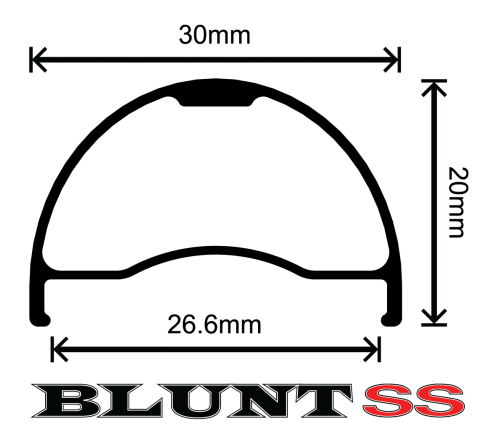
So, would something even wider work? Maybe for the wider gravel tires, yes, it might. I am thinking about pushing a wheel set out and using internal 30mm width rims, like the Blunt SS shown above. It might prove to be interesting to try that out. You may say, "Well, that's a mountain bike rim!", and it is, technically. But take a look at what mountain bikers are using now and much of what you will find makes an internal 30mm wide rim look "skinny".

There is more to this rim width subject, but this post is already at "novel" length, and either your coffee is gone already, or it's cold. Sorry about that...... I'll update this subject down the road if there seems to be enough interest. I could even upgrade my "Project Wide Gravel Wheels" to "Project Even Wider Gravel Wheels" and maybe that is what I should be doing here. Real world test that idea!

Rim Width And Gravel Tires

Internal rim width- How wide is too wide?
It is no secret that rims have been getting wider. It also is no secret that we have pretty much quit focusing on external rim width and now pretty much speak in terms of internal rim widths. Why? Also, you may wonder why any of this matters. Wide rims are......well, wider, and that's that, right?

Well, not so much. Actually, wider rims do some beneficial things for riders of any bicycle, but I am going to keep the focus on gravel travel here. That said, much of what I am writing about today can be transferred to other types of bicycles and other genres of riding.

First, let's get into why rims were, for the most part, narrow. One must remember it wasn't always the case that rims were narrow. Way back they were wider because tires were bigger and more material was necessary to keep rims strong. Old tolerances were not as tight either, so width helped support the tires that didn't necessarily fit the greatest.

Note the difference in outer rim width versus inner rim width. Image courtesy of Velocity USA.
Then tolerances got tighter and materials technology advanced enough that things swung the other way. To cut weight, both the rim and the tires went on a diet. Rim widths got ever narrower until the 80's/90's when internal rim widths on some XC MTB rims was sub 20mm! That's for 2" plus wide tires!

Road rim widths, internally, were 17mm-19mm wide and stayed that way for a few decades. But then something happened which, in my opinion, opened the door wide for experimentation on rim width. During the late 90's, early "oughties", the down hill mtb scene started to push rim widths out to better support tires in corners and hard landings. Other MTB disciplines started looking at this and with a helping hand from materials technologies, once again, rims started getting wider for mountain bikes.

29"ers were something that also started companies walking down that wider rim lane. I recall when Salsa Cycles announced their Semi (30mm outer) and Gordo (35mm outer) rims, Velocity USA announced the Blunt  (28mm outer) and then the Blunt 35, (Obvious, innit?), and we all started thinking harder about wider rims. Keep in mind that about 12 years ago internal rim widths for most 29"ers was still around 20mm, give or take a millimeter. These new rims were mind blowingly wide.

Tubeless stuff also made wider rims more popular. The whole idea with tubeless was that one could lower air pressures, get more traction, and have similar or lower rolling resistance as with tubes. But, without a wide, stiff foundation for the tire to work from without a tube in it, the problems of burping tires and rolling tires off rims was commonplace. This moved companies to start taking a look at wider rims. Weights went up, for sure, but with new technologies, that weight wasn't as great as it would have been in the decades previous. The ubiquitous usage of disc brakes and the problem solving that came with wider rims brought a new focus on what mattered- inner rim width. 

With tubeless tires, inner rim width is important to note.
 With no regard for cantilever brake's limitations on rim widths, designers of mountain bikes were free to widen the inner rim widths to better support tubeless tires. No longer were riders considering rims only for the lightest weight, like back in the 90's. Now try and find a MTB rim with an inner width below 20mm. Not gonna happen!

In fact, try and find a current, tubeless compatible gravel/all road wheel with an inner rim width of less than 20mm. Yep! Pretty much a unicorn at this point nowadays. So, with the bonus of a good foundation for tires to work off of, and weight penalties being minimized, is there a point where tires and rims don't work as well when inner rim widths get really wide? In fact- yes. There is a point where rims can be too wide.

Now, as I've stated, I'm not going to go all in on mountain bike, fat bike, or road rim widths and tire matching to those. That's a HUGE subject which could fill a book. I'll just keep the focus on my experiences with gravel tires and rims meant for that pursuit.

I've used very narrow, 20-ish millimeter wide rims all the way up to 25mm internal rim width rims with tires ranging from 32mm through 50mm. Basically the gamut of tire widths used for gravel travel. In my opinion, some matching of tire to inner rim widths makes sense here. So, to put a 32mm CX tire on a rim with a 25mm inner width isn't a great idea. the tire casing flattens out, the overall height/volume of the tire suffers, and some elements of "self-steer" will rear their ugly heads on set ups like that. Self-steer is where your wheel kind of has a mind of its own and goes not where you want to point it. I know......that's a pretty technical explanation. Sorry! I would take the time to break that down, but this post is getting long as it is!

Of course, you can put a 50mm tire on a very skinny rim, and I've done that too. You end up having to use a higher pressure to mitigate tire squirm and possibility for roll-offs, and your ride quality will suck. Again- technical speak. But I think you get the picture here. Extreme match-ups are to be avoided. Try to use a wider tire with a wider internal rim width and vice-versa.

A good, all around internal rim width for almost any gravel tire, in my opinion, is 24-25mm. It would seem that most manufacturers agree with that. A few years ago I built up a set of wheels I dubbed the "Project Wide Gravel Wheels". I used a WTB KOM i25 rim set. Yes......that's 25mm inner rim width. I figured I was pushing the limits of "good" and maybe went over the line. Let's keep in mind that even three years ago 22-23mm was considered "really wide" for gravel. But I found that i25 rims were actually ideal for the 40mm-45mm tires I was using. That size even works well for up to 50mm tires, as I have found by using a set of 24mm inner width rims with 650B X 47mm tires.

So, would something even wider work? Maybe for the wider gravel tires, yes, it might. I am thinking about pushing a wheel set out and using internal 30mm width rims, like the Blunt SS shown above. It might prove to be interesting to try that out. You may say, "Well, that's a mountain bike rim!", and it is, technically. But take a look at what mountain bikers are using now and much of what you will find makes an internal 30mm wide rim look "skinny".

There is more to this rim width subject, but this post is already at "novel" length, and either your coffee is gone already, or it's cold. Sorry about that...... I'll update this subject down the road if there seems to be enough interest. I could even upgrade my "Project Wide Gravel Wheels" to "Project Even Wider Gravel Wheels" and maybe that is what I should be doing here. Real world test that idea!

Monday, July 25, 2016

Wheel Madness

Go "plus" or 29"er, but will you really ever change one to the other?
I have been having fun lately looking around at the landscape when it comes to mountain biking. I stayed away from it all for a while after I left Twenty Nine Inches.com, because I needed a vacation, a "clean break", and I was focused on my new RidingGravel.com gig 100%. However; enough time has gone by now that I feel better about taking a peek, and, well......I still get "Dirt Rag" every month, so that teases me to stay abreast of the latest stuff. Anyway, things have evolved a bit since I was last really paying attention.

You know, it seems to me that a good way to look at things concerning mountain biking is to put whatever you are looking at in a historical context, because when you do that, you begin to see a clearer picture of why things have come to the point that they have. Case in point- all these damn wheel sizes. It's enough to make you go batty, and really- is it all even necessary?

The other thing is that  I don't think I've seen more vapid, nonsensical comments about bicycles than I have lately. Things like, "all bikes are adventure bikes", which folks like to use against bike packing rigs, gravel/all road bikes, or whatever they deem "unnecessary" in cycling. You know, we get it. Of course "all bikes are adventure bikes". Duh! It's the reason we all started riding in the first place, most likely.

So, anyway, here's the thing folks, for years we had no choices. Historically you can go check this out. Just look at the past- 26 inch wheels only. 2.25" tires were the widest thing you could find easily. Everybody ran a NORBA geometry bike. If you don't know what that means, don't fret. It just means that all bikes handled pretty much identically one to another.

Blame it all on those pesky 29"ers.
Even full suspension bikes didn't deviate much, if at all, from the template for a mountain bike. Heck, folks would lose their religion back then arguing that riser bars would ruin the handling of a hard tail bike. We won't even get into the bar ends or not debate!

All that to say that it seemed to me that the lid was taken off Pandora's Mountain Biking Box when 29"ers came around. Oh oh! Now wheel size was in question. That had never happened on a large scale before in the modern mtb era. Then Gary Fisher unleashed this idea that fork offset was something to toy with. Look folks, if you don't know, please understand that fork offset was something no one thought about before 2007. Now? Heck, it is mentioned in nearly every mtb bike review you pick up these days.

That was all due to 29"ers. Wheels and geometry suddenly were all opened up for experimentation in a way that riders hadn't seen since the early 80's. Then fat bikes came along, and when those finally became viable, affordable bikes in 2011, things got pushed out fatter and wider on all fronts. Suddenly even road bikers were talking about fatter tires and wider rims. That brings us back to my original question, "why all these wheel sizes?" Well, it is because folks were digging all the new ways to enjoy cycling. More ways than ever before. Variety brought more interest, and that brought more sales and dollars. Manufacturers, eager to cash in, jumped on any trend they saw after letting the 29"er thing get away from them, in many cases. That won't happen ever again, by the way- a trend that grew organically and wasn't marketed down our throats. Heck, most brands had marketing guys back then that hated the idea of 29"ers and weren't afraid to say so. Now? Ha! Make a "plus" bike with Boost spacing? Get the factory on it, pronto! 

But is that a bad thing? Well, look at the flip side, we could all be riding 71° head tube angle, 73° seat tube angle 26"ers with 130mm stems and "broomstick" handle bars yet. Those bikes could all be running narrow rims with 2.1"er skinwall tires. I mean, they all are adventure bikes, right? Yeah........right. The reality is that almost all these plus sized, slack angled, different wheel size bikes are not only better at the jobs they are intended for, they are more fun. Maybe some choices will fall by the wayside, but c'mon! We aren't going back to "one geometry/one wheel size" ever again.

And that's a good thing. 

Wheel Madness

Go "plus" or 29"er, but will you really ever change one to the other?
I have been having fun lately looking around at the landscape when it comes to mountain biking. I stayed away from it all for a while after I left Twenty Nine Inches.com, because I needed a vacation, a "clean break", and I was focused on my new RidingGravel.com gig 100%. However; enough time has gone by now that I feel better about taking a peek, and, well......I still get "Dirt Rag" every month, so that teases me to stay abreast of the latest stuff. Anyway, things have evolved a bit since I was last really paying attention.

You know, it seems to me that a good way to look at things concerning mountain biking is to put whatever you are looking at in a historical context, because when you do that, you begin to see a clearer picture of why things have come to the point that they have. Case in point- all these damn wheel sizes. It's enough to make you go batty, and really- is it all even necessary?

The other thing is that  I don't think I've seen more vapid, nonsensical comments about bicycles than I have lately. Things like, "all bikes are adventure bikes", which folks like to use against bike packing rigs, gravel/all road bikes, or whatever they deem "unnecessary" in cycling. You know, we get it. Of course "all bikes are adventure bikes". Duh! It's the reason we all started riding in the first place, most likely.

So, anyway, here's the thing folks, for years we had no choices. Historically you can go check this out. Just look at the past- 26 inch wheels only. 2.25" tires were the widest thing you could find easily. Everybody ran a NORBA geometry bike. If you don't know what that means, don't fret. It just means that all bikes handled pretty much identically one to another.

Blame it all on those pesky 29"ers.
Even full suspension bikes didn't deviate much, if at all, from the template for a mountain bike. Heck, folks would lose their religion back then arguing that riser bars would ruin the handling of a hard tail bike. We won't even get into the bar ends or not debate!

All that to say that it seemed to me that the lid was taken off Pandora's Mountain Biking Box when 29"ers came around. Oh oh! Now wheel size was in question. That had never happened on a large scale before in the modern mtb era. Then Gary Fisher unleashed this idea that fork offset was something to toy with. Look folks, if you don't know, please understand that fork offset was something no one thought about before 2007. Now? Heck, it is mentioned in nearly every mtb bike review you pick up these days.

That was all due to 29"ers. Wheels and geometry suddenly were all opened up for experimentation in a way that riders hadn't seen since the early 80's. Then fat bikes came along, and when those finally became viable, affordable bikes in 2011, things got pushed out fatter and wider on all fronts. Suddenly even road bikers were talking about fatter tires and wider rims. That brings us back to my original question, "why all these wheel sizes?" Well, it is because folks were digging all the new ways to enjoy cycling. More ways than ever before. Variety brought more interest, and that brought more sales and dollars. Manufacturers, eager to cash in, jumped on any trend they saw after letting the 29"er thing get away from them, in many cases. That won't happen ever again, by the way- a trend that grew organically and wasn't marketed down our throats. Heck, most brands had marketing guys back then that hated the idea of 29"ers and weren't afraid to say so. Now? Ha! Make a "plus" bike with Boost spacing? Get the factory on it, pronto! 

But is that a bad thing? Well, look at the flip side, we could all be riding 71° head tube angle, 73° seat tube angle 26"ers with 130mm stems and "broomstick" handle bars yet. Those bikes could all be running narrow rims with 2.1"er skinwall tires. I mean, they all are adventure bikes, right? Yeah........right. The reality is that almost all these plus sized, slack angled, different wheel size bikes are not only better at the jobs they are intended for, they are more fun. Maybe some choices will fall by the wayside, but c'mon! We aren't going back to "one geometry/one wheel size" ever again.

And that's a good thing. 

Thursday, October 30, 2014

The Future Is "Wide Track"

Wider IS better!
Unless you've been hiding under a rock somewhere, you've probably heard about all this wider rim that and wider tire this chatter on the bike forums, in ads, and in reviews. The bicycle industry is rediscovering its roots in stuff with width and volume for your wheels.

It used to be that rims for mountain bikes were pretty wide. Heavy, but wide. Tires were.....well, big tires weren't easy to get. They were out there, but if the early mtb guys had the really big meats, we would maybe have had the voluminous rubber sooner than we did. Then something odd happened.

Rims back in the early 80's weren't all that great, and like I said, they were heavy. The best stuff was going to roadies. Keith Bontrager saw that and started rolling down some old Mavic rims to get 26"er size with the strength and weight that he felt 26"er mtb bikes should have. Of course, these were skinnier rims, but what could he do? Without thinking about it, the industry just jumped down that trail and started pushing skinny rims for mtb and we never really recovered fully until recently.

Velocity's Dually- Meet the new width for rims.
Think about this: Stan's Flow rims were considered All Mountain/Trail rims when they were introduced. They have an outer width of 28mm. That's considered an XC width today! Want proof? Velocity USA recently introduced a new Blunt SS rim, 30mm wide, XC light weight. Okay? So what......

Well, the new set up for the XC/Trail rider is to slap on a 2.1"-2.2" on these wider rims because the tires are better supported and can be run at lower pressures to absorb more of the trail surface and go faster. And what if you are not an XC/Trail speedster? Well, you go even wider. Trail rated rims and tires are going to go fatter and wider. The diameter of the wheels are going to be......unusual. Next year, by all accounts, you'll be seeing these wheels, and they will be called "B+". Oh.....and you'll be seeing them all over.

Muy Grande' Gravelo!

 If you run gravel, or even on the road, you also will be seeing wider stuff, and really, you already have. Road cyclists are now considering 28mm tires because 25mm tires have become "normal". It wasn't all that long ago that riders were pining for 20mm tires and "big" tires were 23mm.

The missing piece of the puzzle here is tubeless technology. Companies are working on it, and before long, it will happen. Pushing to go with wider tires will help. However; the hurdles to jump over with this are proving to be high. Riders need to be able to service these tires out on the road if necessary. That hasn't been the case so much as of yet.

Then there are fat bikes. Yes- you will see more and more of these out there too. They will slowly shed the "snow bike" nomenclature and become more of an "ATV" on two wheels in most folks minds. Weights will stabilize at under 30lbs for most average fat bikes, and at the high end we'll see a 20-ish pound fat bike someday for sale anywhere. It won't be an odd thing. The "other" fat bikes- the "mid-fat", 29+ bikes and aforementioned "B+" stuff, that will become more and more accepted and widespread. It is my opinion that out of all of these, B+ will become the most popular choice due to its better fit for most riders and its balance of weight and fat bike flotation characteristics.

The bottom line is that the 29"er and traditional road bikes will fundamentally change and become less prevalent on bike shop floors and on trails and road ways. Wider will become the new normal, and "skinny" will be weird. 26 inch bicycles will go the way of 27"ers and become the "old" bikes with about three tire choices. Tubes will be weird, and everyone will know and understand how tubeless bicycle tires work on the wider formats.

That's the future.
 

The Future Is "Wide Track"

Wider IS better!
Unless you've been hiding under a rock somewhere, you've probably heard about all this wider rim that and wider tire this chatter on the bike forums, in ads, and in reviews. The bicycle industry is rediscovering its roots in stuff with width and volume for your wheels.

It used to be that rims for mountain bikes were pretty wide. Heavy, but wide. Tires were.....well, big tires weren't easy to get. They were out there, but if the early mtb guys had the really big meats, we would maybe have had the voluminous rubber sooner than we did. Then something odd happened.

Rims back in the early 80's weren't all that great, and like I said, they were heavy. The best stuff was going to roadies. Keith Bontrager saw that and started rolling down some old Mavic rims to get 26"er size with the strength and weight that he felt 26"er mtb bikes should have. Of course, these were skinnier rims, but what could he do? Without thinking about it, the industry just jumped down that trail and started pushing skinny rims for mtb and we never really recovered fully until recently.

Velocity's Dually- Meet the new width for rims.
Think about this: Stan's Flow rims were considered All Mountain/Trail rims when they were introduced. They have an outer width of 28mm. That's considered an XC width today! Want proof? Velocity USA recently introduced a new Blunt SS rim, 30mm wide, XC light weight. Okay? So what......

Well, the new set up for the XC/Trail rider is to slap on a 2.1"-2.2" on these wider rims because the tires are better supported and can be run at lower pressures to absorb more of the trail surface and go faster. And what if you are not an XC/Trail speedster? Well, you go even wider. Trail rated rims and tires are going to go fatter and wider. The diameter of the wheels are going to be......unusual. Next year, by all accounts, you'll be seeing these wheels, and they will be called "B+". Oh.....and you'll be seeing them all over.

Muy Grande' Gravelo!

 If you run gravel, or even on the road, you also will be seeing wider stuff, and really, you already have. Road cyclists are now considering 28mm tires because 25mm tires have become "normal". It wasn't all that long ago that riders were pining for 20mm tires and "big" tires were 23mm.

The missing piece of the puzzle here is tubeless technology. Companies are working on it, and before long, it will happen. Pushing to go with wider tires will help. However; the hurdles to jump over with this are proving to be high. Riders need to be able to service these tires out on the road if necessary. That hasn't been the case so much as of yet.

Then there are fat bikes. Yes- you will see more and more of these out there too. They will slowly shed the "snow bike" nomenclature and become more of an "ATV" on two wheels in most folks minds. Weights will stabilize at under 30lbs for most average fat bikes, and at the high end we'll see a 20-ish pound fat bike someday for sale anywhere. It won't be an odd thing. The "other" fat bikes- the "mid-fat", 29+ bikes and aforementioned "B+" stuff, that will become more and more accepted and widespread. It is my opinion that out of all of these, B+ will become the most popular choice due to its better fit for most riders and its balance of weight and fat bike flotation characteristics.

The bottom line is that the 29"er and traditional road bikes will fundamentally change and become less prevalent on bike shop floors and on trails and road ways. Wider will become the new normal, and "skinny" will be weird. 26 inch bicycles will go the way of 27"ers and become the "old" bikes with about three tire choices. Tubes will be weird, and everyone will know and understand how tubeless bicycle tires work on the wider formats.

That's the future.