Sunday, May 23, 2021

Trans Iowa Stories: Life And Happenings

These 'prairie sunflowers' always remind me of my Grandpa Stevenson.
 "Trans Iowa Stories" is an every Sunday post which helps tell the stories behind the event. You can check out other posts about this subject  by clicking on the "Trans Iowa Stories" link under the blog header. Thanks and enjoy!

I think I should warn you: This post gets pretty personal. So proceed with caution....

As the latter years of Trans Iowa unfolded I had a lot going on behind the scenes with regard to life outside of cycling, and outside of Trans Iowa, but still related to cycling also. Because, well, one thing affects the other, right? Much of this I never shared with anyone openly, and certainly never here on this blog. But regardless, what happens in life often does affect us in our passions and endeavors. So it was for me as well. 

The thing is, after awhile you get comfortable with Life. You wake up and each day is largely predictable, overall. Things take on a feel that 'this won't change', but when you stop to think about it, that is not reality. We get too comfortable and when things finally do change, it may come as a shock in many ways. 

Probably the first 'wake-up call', I guess you could call it, was when my Grandfather died in the early Fall of 2013. I was asked to be a pall bearer, so I went up to the old family lands, which are around Lime Springs/Chester, Iowa, and saw relatives long forgotten. Many of them distantly related to my Grandpa, because when you are 102 and then die, you've likely outlasted most of your peers. Such was the case with my Grandpa. 

Something about that shocked me, and since Grandpa was one of my 'heroes' as a child, it hit me in that way also. Here we were, standing around with people who hardly knew the man with few exceptions, and me being one of the youngest there. At any rate, this situation struck a chord with me that resonates yet today. Then a few years passed and it was late Winter, 2016. I was deep into thoughts concerning the next Trans Iowa, v12, and I received word that my Father had died in Texas. 

Now, I had a very broken relationship with my father for, well......ever since I can remember. He and I did not have what you would call 'normal' anything in regard to relations. He was verbally abusive and not very caring. But that all was dealt with on my end while I was in my 20's. That's a whole 'nuther story, as they say. The point is, we did not have anything resembling a 'close' relationship. This was not a big deal for me at the time of his death, but - you know - it's your Dad. So, that kind of struck another chord with me. 

Big empty skies and a long ribbon of gravel - An antidote for a worried mind.
Then, in March of 2016, I was made aware that my Mother was in decline. It was at Easter dinner that year, which was in late March, just about a month out from T.I.v12. My step father took me aside, and in no uncertain terms told me that this was the last time that he would allow my Mom to do an Easter, Thanksgiving, Christmas, or anything again. That was it. No more! 

He stated it with such finality that it was as if my Mom had already died. And perhaps she was already gone. Dementia is like that. Anyway, you can imagine how that might have been a very negative thing to have come my way. Especially as I was already stressing out about Trans Iowa. 

So, then merely one week after Trans Iowa v12, my maternal Grandmother died. And while it was after Trans Iowa v12, this was another heavy blow to me personally. In combination with all that had been happening to my family anyway, this was just another blow to my desires to do selfish things like dealing with a bicycling event. Especially when it was taking time away from those I should have been seeing. Taking time away from my wife and kids. I was seeing how 'life is short' and that we are not guaranteed another day. I was weighing a lot of things in the balance. 

So, the seeds were being sown for a decision. I wrestled with that from T.I.v10 onward pretty mightily, and these 'back stories' to the event.... Which is really looking at this in the wrong way- Trans Iowa should be the 'back story'. But I wrestled with being a provider of chances for people's growth and for providing a life-enriching experience, and that other side which was pulling me back into my family. It was rough, I'll tell ya that much. 

Maybe you'd have had to have put on an event to understand, but these were the days in which my soul was tormented between going on and putting a stop to Trans Iowa. And of course, there were other specters and demons awaiting me in the quietest hours of my days and nights which tormented me as well. I'll get around to those at another time. But this tale here was what was going on around the time of Trans Iowa v12, and it was something I never want to have to go through again.

Next: The Table Is Set

Saturday, May 22, 2021

Guitar Ted Lube-Off Update: SCC Tech Lube

Current state of the chain with SCC Tech Lube
 The latest round of the Guitar Ted 'Lube-Off' is underway and this time I am pitting the NixFrixShun Blue Devil Lube against SCC Tech Lube. The latest update on the Blue Devil Lube is here in a "FN&V" post (scroll down a bit) . The intro to the SCC Tech Lube is here. 

Okay, so I am impressed with how the chain looks so far with SCC Tech lube. It seems cleaner than the Blue Devil lube and the cassette and derailleur jockey wheels are not showing any signs of gunk build up yet. The cassette maybe is slightly discolored in the gears I've used. Barely, but a little bit. Nothing I'll knock the lube for anyway. 

The shifting performance with this lubricant has been really decent. I've got no beef here either. The Wippermann chain on the Noble GX5 is turning a 1X GRX drivetrain and shifts have been quieter than at first, but still louder by far than with a good Shimano chain like an Ultegra or 105 level chain. 

Okay, so what about the 'Touch-Test'? Well, this chain is still putting out a wetter black residue, but not nearly on the order of the chain with the Blue Devil lubricant. That NFS lube had a drier, gritty component to the residue, not wet and slippery like the SCC Tech Lube. But I did ride the Blue Devil lube in some pretty severe dry conditions. I did not get the SCC Tech as many miles of that yet. 

The 'Touch-Test' reveals some black residue, but it is wet and not as much as the NFS lube.

So, I have quite a ways to go yet on these two lubricants. But just to recap on the two best lubes these are up against, the DuMonde Tech and Muc-Off C3 Ceramic Dry, I'll give some reference for comparison's sake. 

Both of those lubricants did not exhibit any build up on the cassette and derailleur jockey wheels. Touch-Test results for both showed none to very little residue. Shift quality with both was acceptably good, but the comparison to the Wippermann chain makes it a bit difficult to talk about that in comparison. 

Length between re-applications of DuMonde Tech and the Muc-Off c3 was quite long. I don't have anything to say on that front yet, of course, with regard to the two new contenders, but the bar is set pretty high. Let's just say that for now. 

So far I'm more inclined to say that the SCC Tech lube is trending toward the good side and that the Blue Devil Lube has a long way to go before I would be impressed with it. But as I have said, there are many miles yet to ride before I will definitively say what my verdict is on either of the two new contenders.


Friday, May 21, 2021

Friday News And Views

 Beginners On Gravel Series Page:

This past Wednesday I completed the B.O.G. Series of posts which had started out in late February and ran every Wednesday after until this week when it ended. As promised, I posted all the articles on their own page. You can always access the link under the header of the blog where all my page links are located. In fact, if you have not checked out those pages, please do. 

I was taking a bit of a risk with publishing such a series on a blog visited by plenty of seasoned cyclists, experienced in all manner of situations, and who hold varying opinions on 'what is the right way to do that'. Because the B.O.G. was aimed at novice cyclists and at those with little experience at riding rural roads I felt that I may get a little push-back on how I was handling certain topics. That expectation was met, by the way, but overall, I feel that the series was well accepted. 

I have heard a bit of feedback on the series and what I have heard is encouraging. If it truly helps out a cyclist, breaks down a barrier for someone, and seems to enhance a cyclist's experience, then I have done my job. 

MRP introduces the gravel/bikepacking oriented Baxter Fork.

MRP Debuts Another "Gravel Suspension Fork":

This past week saw the introduction of another gravel suspension fork, the MRP Baxter, which I alluded to earlier this week in my "We've Been Here Before" post about such devices. 

Again we have 40mm of travel, like the Fox AX, but the Baxter does have a unique feature in that there are built in mounts for fork mounted water bottle cages. 12mm or 15mm through axles are offered and the fork comes in black or white, when it hits availability, that is, and that is said to be later in the Summer. 

One report I saw also mentioned that a Baxter with longer travel and a Boost front spaced option was also going to be coming soon, but as that fork will have a long axle to crown measurement, it will be unsuitable for almost every gravel bike out there currently. The gravel version of the Baxter is already sitting at 424 mm, which is almost an inch longer than most forks on gravel bikes currently. About 3/4's of an inch to an inch doesn't sound like much, but that is HUGE in terms of how a bike handles. (And yes- I've tested different length forks on one bike before) 

The Baxter goes for about $800.00, so it also is not cheap by any means. Again, I don't see the point in putting sub-standard suspension travel with its extra weight, complexity, initial cost, long-term maintenance cost, and inevitable short shelf life on a gravel bike. But maybe I am an old, hackneyed Luddite and I should not be listened to. You make the call. 

In the meantime, this sort of product does not make a lot of sense to my mind. I would opt for an 80mm-100mm suspension fork on a hardtail style MTB with my preferred drive train any day over what I would  term as a 'band-aid suspension fork for a bike that wasn't designed for that'. Unless, you know, gravel bikes effectively become drop bar MTB's and start looking like, you know, a Fargo?

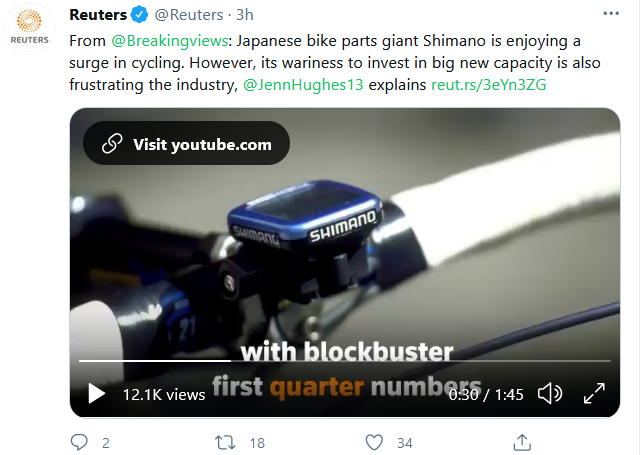
A screen shot from Reuters News' story on Shimano.

Parts Shortages Make "The News":

It isn't often that mainstream news outlets like Reuters makes mention of the cycling industry, but that happened on Wednesday on Reuters' social media feed.

It isn't news that part of the bottleneck in getting new bicycles and repair parts is that Shimano is not ramping up to build more manufacturing capacity to meet the spike in demand caused during the pandemic. Shimano, who have cleared more capital in the last 12 months than they did over the last ten years combined, (according to the Reuters report), feels that making investments into new factories, or expanding current factories to allow for greater production may not be a wise move. According to the report, Shimano stated that any new expansion in manufacturing capacity would take at least two years to realize, and by that time the 'boom' may have busted. 

So, if the report is to be believed, your wait for parts may be quite a long one. What is more, we're hearing in the industry channels that 'lead times'- the time it takes from when an order is placed to its fulfillment- is now extending into 2023 in some cases. Keeping in mind that we are nearing 2022 at a rapid pace, that sounds more and more credible as we slip into Summer. 

I suspect that we will see a mixed bag of availability, varying parts quality on bikes, varying levels of fit and finish, and more common complaints on bicycles in 2022 and 2023 until all this water gets under the bridge. I also suspect that whatever gains were made by cycling companies in 2020 and 2021 will get tempered by not-so-great sales in '22 and '23 as consumers get frustrated and find other things to do. Finally, any economic upheavals in the next three years will also have a detrimental effect upon cycling as a whole. I gotta say- I side with Shimano on their thoughts on the future, but ironically, their reluctance and inability to keep pace with demand currently is probably a big reason why things will not continue 'booming'. That's what happens when you control an estimated 2/3rds of the business in components for cycling.

That's a wrap on this week. Have a great weekend!

Thursday, May 20, 2021

Promoting Events In The Post-Pandemic Era

An 'old fashioned' race flyer from 2016.
 I was at Andy's Bike Shop the other day and noticed a flyer/hand-out on the counter for a Fall gravel grinder in Iowa. This started me to thinking about how promoting an event in 2021 has become so different than it used to be. I started thinking about what the hurdles were, or might be, to getting the word out now versus how we did things in the 90's. So, I thought it might be fun and interesting to take stock of what constitutes 'good race promotions' in 2021 and how we landed where we are at with that. 

I have been involved with putting on cycling events since the mid-90's. I have seen how events were promoted back then and it was a far cry from how it is done now. Of course, you all can guess why that is for the most part. The internet and subsequent social media platforms have really overtaken any other forms of engaging in information spreading for events. 

We usually used flyers back in the day and you can still see the digital form of that type of race information being pushed out there today. It used to be that flyers were posted in bicycle shops and grocery stores. Anywhere that had a bulletin board was fair play to display these flyers on. I recall seeing an early Chequamegon Fat Tire 40 flyer on a cork bulletin board in a Hayward, Wisconsin grocery store, probably in the early 80's. It was replete with a spiral bound notebook page and a ball point pen. If you were interested in riding you simply signed your name to the sheet and showed up the day of with your entry fee! 

Then things moved to more sophisticated means of information spreading, like magazines, regional publications, and ads in newspapers. The most famous of these being "Velo News" and the now defunct "Dirt Rag" which had lists of road and mountain bike races, respectively, listed in their pages. (Even Trans Iowa made the "Dirt Rag" race calendar for a couple of years!) 

But, like I mentioned, everything went topsy-turvy when the internet got a foothold in people's homes and businesses. Now you could find information on anything and it was instantly, (well, almost instantly! Remember dial-up internet?) available at your convenience. This radical change was adopted by some savvy event promoters in the early 00's to great success. 

Blogs, like this one, helped push out event info in the mid-00's. (Header designed by Jeff Kerkove)

 Blogs were probably the first venue/social platform that caught on with those seeking information on niche sporting activities. Cycling blogs were prolific back in 2003-2007. Many cyclists maintained a blog and regional news of events spread in this way amongst those blog creators and those who read such blogs. After about 2007 though, for whatever reasons, blogs started to disappear and the rise of social media as a platform to use for disseminating race/event info started to rise. In between the slow fade of blogs and the slow rise to popularity of social media, events took to making their own websites. 

Gravel Worlds, who have had a web presence since 2010, were one of the first events to maintain a website.

Many events hopped on the "dot-com" wagon and started their own websites back in the late 00's and early teens. Social media wasn't quite as prevalent, and information was typically spread by the main website. However, it did not take long for social media to take a foothold, especially Facebook, which became the de facto web presence for hundreds of gravel events. This seemed to work out fine until Facebook changed their algorithms and now you are not guaranteed the sort of reach as a promoter that you used to be able to get on Facebook's platform.

Other social media outlets like Twitter and Instagram are often used by events to get the word out, but again- unless you subscribe to these social platforms, you do not get the message. The social platforms often feed you what you are interested in, as well, so even if you do subscribe to using these outlets, you may not get all the new information on new events.  So the result has become more and more that it is an echo chamber. These same types of events get broadcast to the same people over and over again. Newer audiences don't see what is happening. Not unless those within the echo chamber spread the news by "good ol' word of mouth". 

Even 'big time' events get shunted by the sheer volume of info out there these days.

Recently there has been more curation of events by singular entities and by event registration companies. BikeReg, eventbrite, and others have search categories and suggested events which may prompt eyes to see event info which otherwise would not get seen. However; with an estimated 500-600 gravel events alone out there in 2021, it is nigh unto impossible to get your message heard these days. Just the sheer numbers of events means that many events will not get a lot of attention. 

So, some events have banded together, and some promoters have started ground-up series of events. Many of these series have created an 'eco-system' where event participants can expect the same set ups at certain events under a promoters umbrella throughout a season. Life Time Events being probably the premier company in that area. Smaller series use the power of numbers and joined resources to place their offerings in front of more eyeballs. Meanwhile, those singular event promoters who are adept at social media and marketing get the 'worm' while other event promoters may get lost in the noise of information. 

And then I still see traditional 'flyers', albeit digital ones, and I still see hand-outs at stores on counters and whatnot. It's a crazy scene and I think that with all the avenues for promotion at our disposal now, it gets to be a bit much. I mean, ten years ago you had one gravel event saying they were the "World's Premier Gravel Event" and now we have what? A half dozen or so saying that they are at that same level? It gets a bit ridiculous and all that noise is going to fatigue a lot of people. Especially now with this pandemic (supposedly) winding down. We're tired, exhausted, and maybe many of us won't be 'tuning in' because it is time to tune-out. 

All in all, this gravel event scene has been a fantastic ride. I've been on the promotions side and I've been in the saddle at other's events. I still think the gravel event is a worthy thing to be doing, but promoting one now? Sheesh! You guys and gals have my sympathies. It's gotta be harder than ever and going forward, different again than it used to be. I find it all pretty fascinating stuff yet. But my promoting days are behind me now. I gotta say, I feel like I had it easy compared to what I see out there today. 

Got any comments on what you think of all this? I'd be glad to read them and respond. Thanks for reading!

Wednesday, May 19, 2021

B.O.G. Series: Sending You Off!

Are you ready for adventure? Yes....yes you are!
 Welcome to the FINAL entry for the Basics of Gravel Series (B.O.G.)! In this series I attempted to bring a very foundational knowledge of gravel and back road riding to anyone reading that may be curious or a beginner in riding off-pavement, but not wanting to be mountain biking. There was a new entry every Wednesday until now that the series is complete.  The old entries will be populated to a page which will be linked under the header soon. Thanks! 

First of all, Thank you for reading! This series- hopefully- has brought new knowledge and understanding for the beginners and 'new-to-gravel' folks that were reading along, and hopefully will be a resource for the future. It was my sincere hope that this was, and will continue to be, a help to my fellow cyclists. 

Secondly, this was by no means all you can know or hope to gain from riding rural byways and paths. Even I would never say I have it all figured out! There will always be more to learn, understand, and see out there, and I think this is what keeps riding gravel and dirt a fresh thing for myself. Hopefully it will be similar for you. Never stop learning! Always keep an open mind. 

But now it is time for you to take the dive. Leap off the comfortable and the known for uncharted territory (for you) and see what adventures await you. With that willingness to explore, experience new things, and not be afraid of getting a little lost or coming up against a new challenge, you will have a ton of fun and grow as a person as a result. 

Not to mention all the other side benefits of cycling, which are well documented. That said, I find that rural cycling has a unique way of rearranging your perspective. It can be a revelation in terms of mental health. It can even touch your soul if you let it. (I strongly suggest that you let it do just that!)

Young or old- Rural cycling can open up a whole new vista in your cycling experience.

So, take your chance while you have the opportunity and get out there. Things may not go perfectly at first, and that's okay. It's all part of the experience. Don't beat yourself up over mistakes or if you feel that you are not 'good enough'. Just turn your back on those thoughts and go for it. 

One thing I've been extremely encouraged by over the past 16 years of spending time riding gravel roads, and hanging out with others that do likewise, is that the community of folks that participate in this form of cycling tend to be very accepting and accommodating. Helpful? Totally. Non-judgemental? For the most part, that's been my experience, and listen- I am no great cyclist by any metric that the normal cycling/racing community would measure by. So, I think I can speak from a place that many of you may find yourselves in now, just getting into this rural/gravel cycling thing. Don't be afraid of being put down, left behind, or what have you. 

And for you folks that may be reading this that are seasoned gravel cycling folks- YOU HAVE A RESPONSIBILITY. We need you to be good ambassadors. What does that mean? 

Just be a good human being and be kind to other human beings, no matter what. 

Simple. 

Now get off this device and go ride already! 

Tuesday, May 18, 2021

Trying To Smooth Things Over

Made a change to hopefully make this smoother.
 I rode the Standard Rando v2 a little while ago out on a gravel grinder and during that ride, and a few subsequent commutes to work and back, I made a decision. It was time to do something to make this front end a bit smoother. It is not the fault of the bike, or any singular thing. It's just this particular combination - a 650B wheel, a stiffer than all get out tire, and a beefy carbon fork which are all working together to make my hands sore when I ride this bike. Yes.......I could swap out the tires, but these are being reviewed, so they stay on until I'm done with that. Honestly, the whole wheel and tire set up is coming off as soon as the review is done. Going' back to 700c, but that's another story..... 

Anyway, I happened to have one item in the parts bin that I could employ to make things a bit nicer on my paws, and that is a Redshift ShockStop Stem. Disclaimer: Redshift Sports sent this stem for test and review at no charge to RidingGravel.com and let me keep it afterward. Okay, so with that bit out of the way, I went ahead and decided to swap out my Easton stem for this ShockStop stem. 

Now there is a bit of a conundrum here regarding what Redshift says about a handle bar like the Winston Bar and use of their stem. They do not recommend using a flat bar with a lot of back-sweep with their stem. They don't really tell you why, but I think many of you out there can figure it out if you stop to think about how this stem works. The stem pivots just ahead of the steer tube and your stem clamp and anything at that extension from the steer tube and further out acts like a lever on that pivot and the elastomers inside. Applying a lever behind that pivot point renders the stem inactive. That is an observance I made once I got the Winston Bar matched up with the ShockStop Stem. 

A close-up of the ShockStop Stem. Note the pivot placement.

The Winston Bar is a bit of an odd-ball in terms of handlebars in several ways, but one of the main features of the bar is that it has a lot of forward-of-the-stem real estate and just as much that extends behind the face plate of the stem. So, it kind of is a 'both worlds' bar. As I ride with the Winston Bar, I am on the extensions near to the brake perch, or my hands are somewhere on the brake levers most of the time. Of course, I use other hand positions as well, but my main ones are ahead of where that pivot would be, and thus the stem should be active. 

When I grip back on the extensions, the further back I grip the less active the stem is until at one point it quits working. All the way back on the ends of the Winston bar all I am getting is the natural flex from the carbon fiber. Conversely, the further up those extensions towards the brakes, the less flex in the bar. So, in a way, the stem and the carbon fiber handle bar compliment each other. I detest the over-used saying 'best of both worlds', but if there ever were a proper example of that, this may be it. Maybe.....

Now the proof will  be in the riding, and that will happen soon enough. While I have this on a single speed bike, I am not fearing that this stem will have any hint of twisting flex or weird 'play' in the mechanism. This design has convinced me that the stem should be able to withstand my efforts in 'mashing' a single speed gear. I know I can cancel out the stem's movement, and that's a good thing on a single speed at times. Plus the obvious suspension/vibration absorbing bit is present now with the ShockStop stem on there. 

I'm very hopeful that this takes the zing out of these wheels and tires. I'm running lower 20's for psi in these Gravel King SK+ tires but there seems to be no real good way to get them to be smooth feeling. I'm sure I could stick with the 650B format if I had a better riding tire, but I'm not buying new tires just for those wheels. 650B has other traits I'm not particularly fond of anyway, so I will be going back to a 700c carbon wheel set and smoother 40mm tires at some point here. I'm pretty sure I know exactly what I am going to do as well. 

So, that's the latest on my search for a smoother ride for the time being.

Monday, May 17, 2021

We've Been Here Before

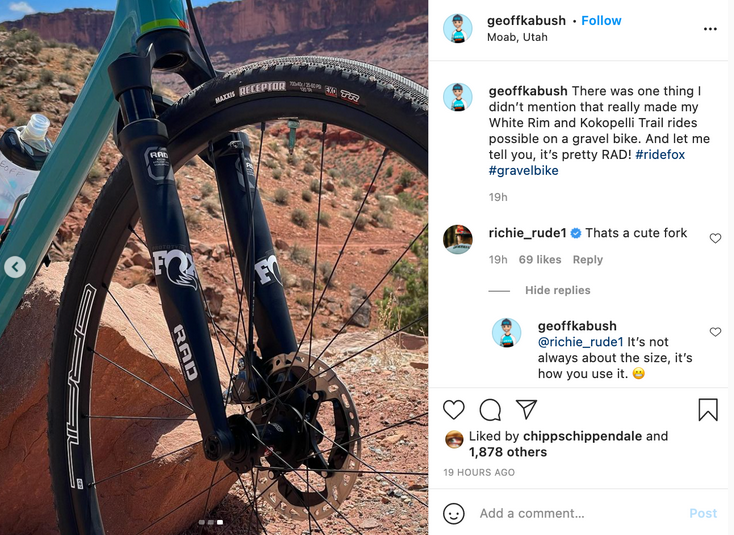
Apparently leaked on social media, this Fox AX sus fork is rumored to be out this Fall.
 Back in the early days of MTB suspension there was a huge debate over whether or not it was necessary, and what, if any design was a good one. Because there were a LOT of weird designs floating about. Obviously telescopic fork design won out, but there also was a 'dirty little secret' about suspension in the early to mid-90's. That was that the Pro racers weren't taking advantage of it.

Many people weren't aware of that, but many Pro XC racers were effectively locking their suspension forks out and riding them rigid. Now, there could be a lot of reasons as to why that happened, but after riding the Fox AX Adventure fork a few years ago, I think I could tell you at least a couple of reasons why that was. 

First of all, one should consider a few parameters which were non-negotiable for suspension on bicycles. One: Weight HAD to be minimized at all costs. This is probably the number one limitation upon suspension fork design to this very day. Since we were, and still are for the most part, speaking of 100% human powered design, weight is a critical factor to deal with and you want that weight to be as low in mass as possible. This means that certain things that may have stiffened up the chassis on forks, made them operate more efficiently, and which may have accounted for pedal induced movement had to be discarded in favor of light weight. 

Secondly: Geometry for the bike had to be compromised to accept suspension. At first, this wasn't that big of a deal. 63mm of overall travel isn't a lot to account for, but there are no forks for MTB with that little of travel anymore, and most have a minimum of 100mm of travel. The 'sweet spot' for average mountain biking is 120mm-130mm. This length of suspension adds to the overall length of a bicycle fork, which has to be accounted for in design. The sloping top tube design was the answer to the question of how to do this, and front end height increased as a result. 

The Fox AX suspension fork I tested for Riding Gravel in 2018.

Why did we need more travel? Because it was quickly realized that 63mm, and really, even 80mm of travel, wasn't enough to account for everything a MTB was seeing in terms of trail obstacles, speeds, and being capable of dispersing energy in a way that riders would find acceptable. 

So, that's a brief description of where we came from and why we went where we did with MTB suspension. What does that have to do with a 'gravel bike'? Well, certain things are happening here that are causing us to see that what is happening now with these short travel gravel forks and the initial wave of MTB forks is related. We also are seeing another effect happening. That being that MTB design has swung so far in one direction that a void exists which some folks are trying to fill with a 'gravel bike'. 

Comments: In my opinion, we are reliving the past if we think for a moment that 40mm of damped travel will work in a way that is intended. These short travel forks, (Fox, White Brothers) address small inputs just fine, but are quickly overwhelmed when faced with anything resembling an MTB experience, and no wonder. While it is true that you could set it up differently, you are playing with such a restricted amount of travel that getting the kind of energy dissipated that one might see from riding rough single track is nearly impossible to do without compromising every other aspect of riding gravel. And then there is weight. You are adding a LOT of weight for not much benefit here. I have not even touched the complexity and maintenance issues either. 

So, just use a Lauf type design then? Well, obviously the Lauf fork wins the weight and simplicity of design over the telescopic options, but it is not damped travel and you have to buy into the odd-ball looks. But yes- that fork is far superior for everything a gravel bike should be doing. I do not think 'gravel bikes' need to have MTB traits to handle MTB trails. Want to take that single track, that connector which has that rocky down hill, or what have you? Great, either live with 'underbiking' or get out your MTB hard tail which has all the versatility, utility, and capability you need to cover everything from fire roads to pretty tough back country stuff. Oh........those modern hard tails don't go very fast? They handle climbs a bit clumsily? You don't need 120-130mm of suspension business up front? I get that, and this is where the bicycle industry has gone wrong. 

Once upon a time when NORBA Pro MTB'ers competed, they had to do a hill climb, a down hill competition, a trials competition, and an XC race, all on the same bike. I know...it sounds far-fetched, but it is true. At one time a mountain bike was made to cover all the mountain biking needs. Of course, specialization came in and changed all of that, but somehow the multi-purpose all-terrain rig held on. Then about ten years ago, that all changed. 

The Gen I Fargo, as seen at the 2008 Interbike Outdoor demo, is 'that' bike that is missing.

 Drive trains became more limited in range on the high end to accommodate short chain stays and huge tires. Front ends got really jacked up to accommodate longer suspension forks, and more, of course, happened along the way and the next thing ya know, that versatile off-road vehicle was gone. Fat bikes could be said to be 'that bike', but those huge, heavy tires and still, you also lack the high speed drive train along with that low end grunt. It just is not the same thing.

So, we get these bikes with curly bars, barely big enough tires (50mm) and now they want to put some anemic front suspension fork on this? I'm saying this is a whack idea based upon the idea that 'anything gravel sells', not on real-life, sensible design and practicality for use. Keep gravel bikes 'road based' and if you go off-road, well then design this bike that is missing in action these days. But don't try to use a 'Gravel®' as a marketing ploy to make 'that' bike happen again. It's going about it all the wrong way. 

The bike that they are all mimicking, the one bike that solves the problem of 'curly barred, big tired, "mountain bike-versa-tool" is the Gen I Fargo which came out in 2008. Make that bike, a flat bar version, (El Mariachi?) and done. Make it accept 650B X 2.1's or 29"er X 2.4"ers and keep the geometry less slack. Add a big ringed crankset with at least two chain rings. (I'd still spec a triple), and make it 11 speed with at least 3 gears below 1 to 1 ratio and a big ring in the 46-48T range for speeding down fire roads and flats. 

It would definitely NOT be a sexy bike, a racer's bike, or a bike that would figure into a marketing plan showing riders catching air, roosting, or bombing edits on social media. No, it would be that bike that most off-roaders should have. Just like most road bikers should not have racing oriented bikes, but they should have that 'all-road' bike misnamed the 'Gravel Bike'. 

And that's my take..............